FREQUENCY MODULATION
The Chapter includes:
• Wave Forms
• Theory
• Modulation Index
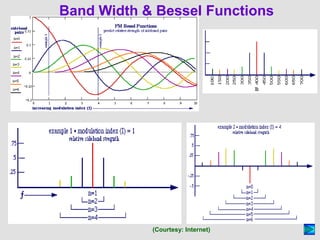
• Bandwidth & Bessel
functions
• Merits & Demerits
“The process of changing the frequency of a carrier
wave in accordance with the AF signal.”
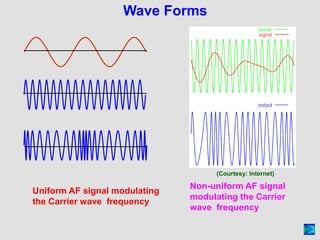
Wave Forms
Uniform AF signal modulating
the Carrier wave frequency
Non-uniform AF signal
modulating the Carrier
wave frequency
(Courtesy: Internet)
Theory:
The instantaneous frequency ‘’of modulated wave is:
 = c + kEm cos mt
(where k is proportionality constant which depends on the modulating system)
If cos mt = ± 1, then  = c ± kEm
or  = c ± 
(where  = kEm is maximum or peak deviation in carrier frequency)
Note that  depends on the magnitude of Em and not upon c.
Instantaneous value of FM voltage is: e = Ec cos 
 is given by the following steps:
d  =  dt  d  = 2  dt  d  = 2 (c + kEm cos mt ) dt
On integration, we get
 = ct + (/ m) sin mt
 e = Ec cos [ct + (/ m) sin mt] = Ec cos (ct + mf sin mt)
where mf = / m is modulation index for FM
e m= Em cos mt & ec = Ec cos (ct + )
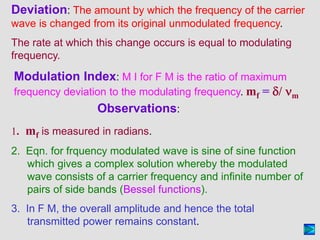
Deviation: The amount by which the frequency of the carrier
wave is changed from its original unmodulated frequency.
The rate at which this change occurs is equal to modulating
frequency.
Modulation Index: M I for F M is the ratio of maximum
frequency deviation to the modulating frequency. mf = / m
Observations:
1. mf is measured in radians.
2. Eqn. for frquency modulated wave is sine of sine function
which gives a complex solution whereby the modulated
wave consists of a carrier frequency and infinite number of
pairs of side bands (Bessel functions).
3. In F M, the overall amplitude and hence the total
transmitted power remains constant.
Band Width & Bessel Functions
(Courtesy: Internet)
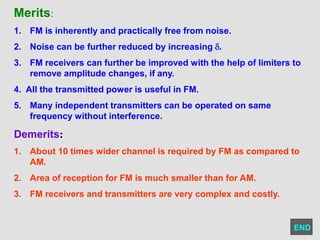
Merits:
1. FM is inherently and practically free from noise.
2. Noise can be further reduced by increasing .
3. FM receivers can further be improved with the help of limiters to
remove amplitude changes, if any.
4. All the transmitted power is useful in FM.
5. Many independent transmitters can be operated on same
frequency without interference.
Demerits:
1. About 10 times wider channel is required by FM as compared to
AM.
2. Area of reception for FM is much smaller than for AM.
3. FM receivers and transmitters are very complex and costly.
END

concept of (FM) Frequency modulation class 12th full ppt

  • 1.
    FREQUENCY MODULATION The Chapterincludes: • Wave Forms • Theory • Modulation Index • Bandwidth & Bessel functions • Merits & Demerits “The process of changing the frequency of a carrier wave in accordance with the AF signal.”
  • 2.
    Wave Forms Uniform AFsignal modulating the Carrier wave frequency Non-uniform AF signal modulating the Carrier wave frequency (Courtesy: Internet)
  • 3.
    Theory: The instantaneous frequency‘’of modulated wave is:  = c + kEm cos mt (where k is proportionality constant which depends on the modulating system) If cos mt = ± 1, then  = c ± kEm or  = c ±  (where  = kEm is maximum or peak deviation in carrier frequency) Note that  depends on the magnitude of Em and not upon c. Instantaneous value of FM voltage is: e = Ec cos   is given by the following steps: d  =  dt  d  = 2  dt  d  = 2 (c + kEm cos mt ) dt On integration, we get  = ct + (/ m) sin mt  e = Ec cos [ct + (/ m) sin mt] = Ec cos (ct + mf sin mt) where mf = / m is modulation index for FM e m= Em cos mt & ec = Ec cos (ct + )
  • 4.
    Deviation: The amountby which the frequency of the carrier wave is changed from its original unmodulated frequency. The rate at which this change occurs is equal to modulating frequency. Modulation Index: M I for F M is the ratio of maximum frequency deviation to the modulating frequency. mf = / m Observations: 1. mf is measured in radians. 2. Eqn. for frquency modulated wave is sine of sine function which gives a complex solution whereby the modulated wave consists of a carrier frequency and infinite number of pairs of side bands (Bessel functions). 3. In F M, the overall amplitude and hence the total transmitted power remains constant.
  • 5.
    Band Width &Bessel Functions (Courtesy: Internet)
  • 6.
    Merits: 1. FM isinherently and practically free from noise. 2. Noise can be further reduced by increasing . 3. FM receivers can further be improved with the help of limiters to remove amplitude changes, if any. 4. All the transmitted power is useful in FM. 5. Many independent transmitters can be operated on same frequency without interference. Demerits: 1. About 10 times wider channel is required by FM as compared to AM. 2. Area of reception for FM is much smaller than for AM. 3. FM receivers and transmitters are very complex and costly. END