Pune Vidyarthi Griha’s
COLLEGE OF ENGINEERING, NASHIK – 3.
“ASM”
By
Prof. Anand N. Gharu
(Assistant Professor)
PVGCOE Computer Dept.
30th June 2017
.
CONTENTS :-
1. Introduction to ASM
2. The Chart Notation
3. The State Box
4. Decision Box
5. Condition Box
6. Examples
7. MUX Controller Method
8. Examples
INTRODUCTION OF ASM
•Used to graphically describe the operations of an FSM more concisely
•Resembles conventional flowcharts – differs in
interpretation.
•Conventional flowchart – sequential way of
representing procedural steps and decision paths
for algorithm
-No time relations incorporated
•ASM chart – representation of sequence of
events together with timing relations between
states of sequential controller and events
occurring while moving between steps
•Three basic elements: state box, decision
box and conditional box
-State and decision boxes used in conventional
flowcharts
-Conditional box characteristic to ASM
•State box
-Used to indicate states in control sequence
•Register operations and output signals used to
control generation of next state written
State box
•Represents one state in the ASM.
•May have an optional state output list.
•Single entry.
•Single exit to state or decision boxes.
ACOE161 - Digital Logic for
Computers - Frederick University
State Box
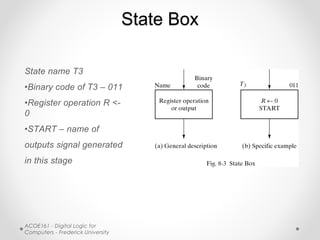
State name T3
•Binary code of T3 – 011
•Register operation R <-
0
•START – name of
outputs signal generated
in this stage
ACOE161 - Digital Logic for
Computers - Frederick University
Decision box
• Provides for next alternatives and
conditional outputs.
• Conditional output based on logic
value of Boolean expression involving
external input variables and status
information.
• Single entry.
• Dual exit, denoting if Boolean
expression is true or false.
• Exits to decision, state or conditional
boxes.
ACOE161 - Digital Logic for
Computers - Frederick University
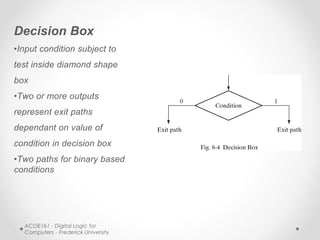
Decision Box
•Input condition subject to
test inside diamond shape
box
•Two or more outputs
represent exit paths
dependant on value of
condition in decision box
•Two paths for binary based
conditions
ACOE161 - Digital Logic for
Computers - Frederick University
Conditional output box
• Provides a listing of output variables
that are to have a value logic-1, i.e.,
those output variables being
asserted.
• Single entry from decision box.
• Single exit to decision or state box.
ACOE161 - Digital Logic for
Computers - Frederick University
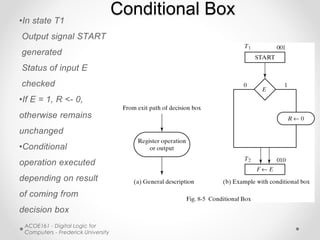
•In state T1
Output signal START
generated
Status of input E
checked
•If E = 1, R <- 0,
otherwise remains
unchanged
•Conditional
operation executed
depending on result
of coming from
decision box
Conditional Box
ACOE161 - Digital Logic for
Computers - Frederick University
ASM Block
• Consists of the interconnection of a single state
box along with one or more decision and/or
conditional boxes.
• It has one entry path which leads directly to its
state box, and one or more exit paths.
• Each exit path must lead directly to a state,
including the state box in itself.
• A path through an ASM block from its state box to
an exit path is called a link path.
ACOE161 - Digital Logic for
Computers - Frederick University
Timing Considerations
All sequential elements in datapath and control
path controlled by master-clock generator.
Does not necessarily imply single clock in design.
•Multiple clocks can be obtained through division of clock
signals from master-clock generator.
•Not only internal signals, but also inputs
synchronized with clock.
•Normally, inputs supplied by other devices working
with the same master clock.
•Some inputs can arrive asynchronously
Difficult to handle by synchronous designs, require
asynchronous glue-logic.
ACOE161 - Digital Logic for
Computers - Frederick University
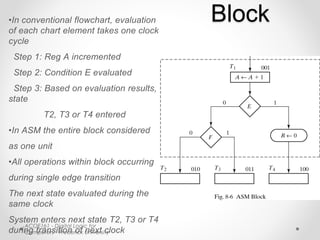
•In conventional flowchart, evaluation
of each chart element takes one clock
cycle
Step 1: Reg A incremented
Step 2: Condition E evaluated
Step 3: Based on evaluation results,
state
T2, T3 or T4 entered
•In ASM the entire block considered
as one unit
•All operations within block occurring
during single edge transition
The next state evaluated during the
same clock
System enters next state T2, T3 or T4
during transition of next clock
Block
ASM Block
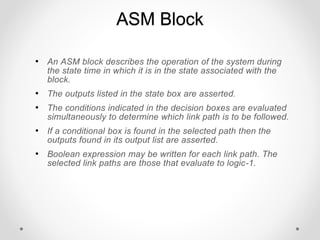
• An ASM block describes the operation of the system during
the state time in which it is in the state associated with the
block.
• The outputs listed in the state box are asserted.
• The conditions indicated in the decision boxes are evaluated
simultaneously to determine which link path is to be followed.
• If a conditional box is found in the selected path then the
outputs found in its output list are asserted.
• Boolean expression may be written for each link path. The
selected link paths are those that evaluate to logic-1.
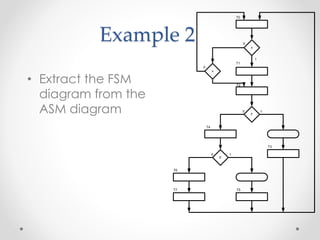
Example 2
• Extract the FSM
diagram from the
ASM diagram
T0
x
F
T1
T2
x
E
T4
T6
T3
T7
0
0
0
T5
1
0
1
1
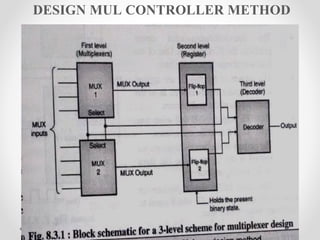
DESIGN MUL CONTROLLER METHOD
Thank You
8/26/2017 33

ALGORITHMIC STATE MACHINE

  • 1.
    Pune Vidyarthi Griha’s COLLEGEOF ENGINEERING, NASHIK – 3. “ASM” By Prof. Anand N. Gharu (Assistant Professor) PVGCOE Computer Dept. 30th June 2017 .
  • 2.
    CONTENTS :- 1. Introductionto ASM 2. The Chart Notation 3. The State Box 4. Decision Box 5. Condition Box 6. Examples 7. MUX Controller Method 8. Examples
  • 3.
    INTRODUCTION OF ASM •Usedto graphically describe the operations of an FSM more concisely •Resembles conventional flowcharts – differs in interpretation. •Conventional flowchart – sequential way of representing procedural steps and decision paths for algorithm -No time relations incorporated •ASM chart – representation of sequence of events together with timing relations between states of sequential controller and events occurring while moving between steps
  • 4.
    •Three basic elements:state box, decision box and conditional box -State and decision boxes used in conventional flowcharts -Conditional box characteristic to ASM •State box -Used to indicate states in control sequence •Register operations and output signals used to control generation of next state written
  • 5.
    State box •Represents onestate in the ASM. •May have an optional state output list. •Single entry. •Single exit to state or decision boxes.
  • 6.
    ACOE161 - DigitalLogic for Computers - Frederick University State Box State name T3 •Binary code of T3 – 011 •Register operation R <- 0 •START – name of outputs signal generated in this stage
  • 7.
    ACOE161 - DigitalLogic for Computers - Frederick University Decision box • Provides for next alternatives and conditional outputs. • Conditional output based on logic value of Boolean expression involving external input variables and status information. • Single entry. • Dual exit, denoting if Boolean expression is true or false. • Exits to decision, state or conditional boxes.
  • 8.
    ACOE161 - DigitalLogic for Computers - Frederick University Decision Box •Input condition subject to test inside diamond shape box •Two or more outputs represent exit paths dependant on value of condition in decision box •Two paths for binary based conditions
  • 9.
    ACOE161 - DigitalLogic for Computers - Frederick University Conditional output box • Provides a listing of output variables that are to have a value logic-1, i.e., those output variables being asserted. • Single entry from decision box. • Single exit to decision or state box.
  • 10.
    ACOE161 - DigitalLogic for Computers - Frederick University •In state T1 Output signal START generated Status of input E checked •If E = 1, R <- 0, otherwise remains unchanged •Conditional operation executed depending on result of coming from decision box Conditional Box
  • 11.
    ACOE161 - DigitalLogic for Computers - Frederick University ASM Block • Consists of the interconnection of a single state box along with one or more decision and/or conditional boxes. • It has one entry path which leads directly to its state box, and one or more exit paths. • Each exit path must lead directly to a state, including the state box in itself. • A path through an ASM block from its state box to an exit path is called a link path.
  • 12.
    ACOE161 - DigitalLogic for Computers - Frederick University Timing Considerations All sequential elements in datapath and control path controlled by master-clock generator. Does not necessarily imply single clock in design. •Multiple clocks can be obtained through division of clock signals from master-clock generator. •Not only internal signals, but also inputs synchronized with clock. •Normally, inputs supplied by other devices working with the same master clock. •Some inputs can arrive asynchronously Difficult to handle by synchronous designs, require asynchronous glue-logic.
  • 13.
    ACOE161 - DigitalLogic for Computers - Frederick University •In conventional flowchart, evaluation of each chart element takes one clock cycle Step 1: Reg A incremented Step 2: Condition E evaluated Step 3: Based on evaluation results, state T2, T3 or T4 entered •In ASM the entire block considered as one unit •All operations within block occurring during single edge transition The next state evaluated during the same clock System enters next state T2, T3 or T4 during transition of next clock Block
  • 14.
    ASM Block • AnASM block describes the operation of the system during the state time in which it is in the state associated with the block. • The outputs listed in the state box are asserted. • The conditions indicated in the decision boxes are evaluated simultaneously to determine which link path is to be followed. • If a conditional box is found in the selected path then the outputs found in its output list are asserted. • Boolean expression may be written for each link path. The selected link paths are those that evaluate to logic-1.
  • 15.
    Example 2 • Extractthe FSM diagram from the ASM diagram T0 x F T1 T2 x E T4 T6 T3 T7 0 0 0 T5 1 0 1 1
  • 19.
  • 33.