Chapter 1
Introduction
Universal shift register is capable of converting input
data to parallel or serial which also does shifting of
data bidirectional, unidirectional (SISO , SIPO , PISO ,
PIPO) and also parallel load this is called as Universal
shift register .
Shift register are used as: Data storage device , Delay
element , communication lines , digital electronic
devices (Temporary data storage , data transfer , data
manipulation , counters), etc .
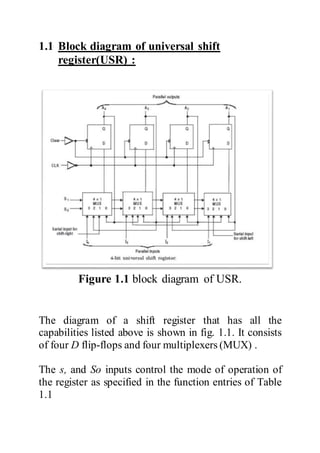
1.1 Block diagram of universal shift
register(USR) :
Figure 1.1 block diagram of USR.
The diagram of a shift register that has all the
capabilities listed above is shown in fig. 1.1. It consists
of four D flip-flops and four multiplexers (MUX) .
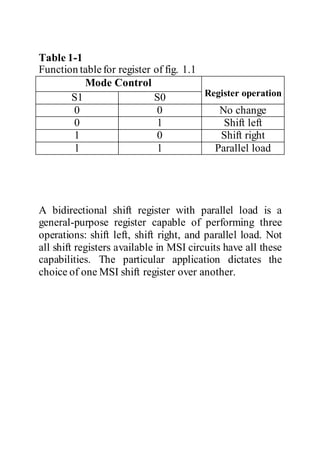
The s, and So inputs control the mode of operation of
the register as specified in the function entries of Table
1.1
Table 1-1
Function tablefor register of fig. 1.1
Mode Control
Register operationS1 S0
0 0 No change
0 1 Shift left
1 0 Shift right
1 1 Parallel load
A bidirectional shift register with parallel load is a
general-purpose register capable of performing three
operations: shift left, shift right, and parallel load. Not
all shift registers available in MSI circuits have all these
capabilities. The particular application dictates the
choice of one MSI shift register over another.
CHAPTER 2
Implementation of USR in Verilog
2.1 Verilog Code :
`timescale 1ns / 1ps
//modual declaraion of input and output and register
module USR(O,I,clk,reset,s,SINR,SINL);
wire [3:0] w;
input [3:0]I;
input [1:0]s ;
input clk ;
input reset,SINR,SINL;
output [3:0]O;
reg [27:0] count = 0;
//MUX modual calling
mux_4_1 m1(w[0],s[1],s[0],I[0],SINL,O[1],O[0]);
mux_4_1 m2(w[1],s[1],s[0],I[1],O[0],O[2],O[1]);
mux_4_1 m3(w[2],s[1],s[0],I[2],O[1],O[3],O[2]);
mux_4_1 m4(w[3],s[1],s[0],I[3],O[2],SINR,O[3]);
//D flip flop modual calling
D_FF d1(O[0],w[0],clk,reset);
D_FF d2(O[1],w[1],clk,reset);
D_FF d3(O[2],w[2],clk,reset);
D_FF d4(O[3],w[3],clk,reset);
//increment count on every clock
endmodule
//sub module for D flip flop
module D_FF(q,d,clk,reset);
output reg q;
input d,clk,reset;
always@(posedge clk)
if (reset == 1'b1)
q<=1'b0;
else
q<=d;
endmodule
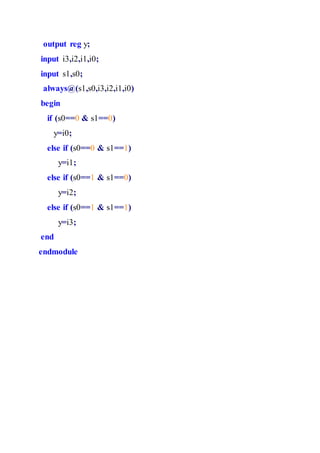
//sub module for 4x1 MUX
module mux_4_1(y,s1,s0,i3,i2,i1,i0);
output reg y;
input i3,i2,i1,i0;
input s1,s0;
always@(s1,s0,i3,i2,i1,i0)
begin
if (s0==0 & s1==0)
y=i0;
else if (s0==0 & s1==1)
y=i1;
else if (s0==1 & s1==0)
y=i2;
else if (s0==1 & s1==1)
y=i3;
end
endmodule
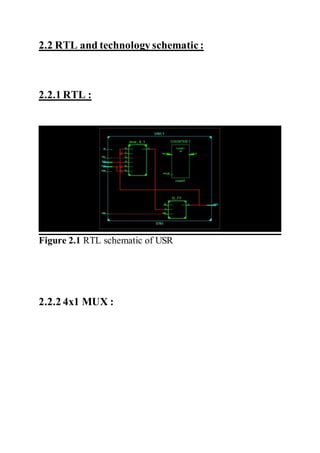
2.2 RTL and technology schematic:
2.2.1 RTL :
Figure 2.1 RTL schematic of USR
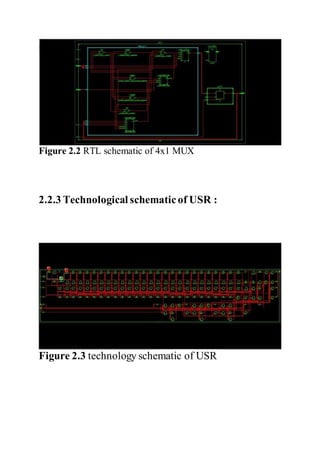
2.2.2 4x1 MUX :
Figure 2.2 RTL schematic of 4x1 MUX
2.2.3 Technological schematicof USR :
Figure 2.3 technology schematic of USR
2.3 Simulationand test bench:
2.3.1 Test bench:
`timescale 1ns / 1ps
module uni_testbench;
// Inputs
reg [3:0] I;
reg clk;
reg reset;
reg [1:0] s;
reg SINR;
reg SINL;
// Outputs
wire [3:0] O;
// Instantiate the Unit Under Test (UUT)
USR uut (
.O(O),
.I(I),
.clk(clk),
.reset(reset),
.s(s),
.SINR(SINR),
.SINL(SINL)
);
initial begin
// Initialize Inputs
//I = 4'b0000;
clk = 1'b1;
reset = 1'b1;
SINR = 1'b1;
SINL = 1'b0;
s = 2'b00;
#100;
reset = 1'b1;
// s = 2'b00;
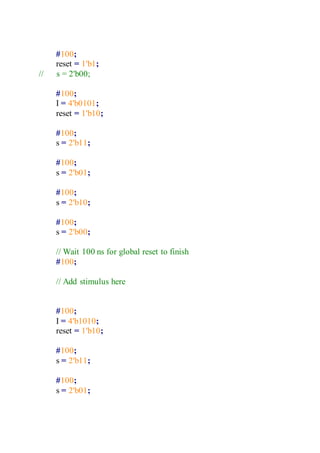
#100;
I = 4'b0101;
reset = 1'b10;
#100;
s = 2'b11;
#100;
s = 2'b01;
#100;
s = 2'b10;
#100;
s = 2'b00;
// Wait 100 ns for global reset to finish
#100;
// Add stimulus here
#100;
I = 4'b1010;
reset = 1'b10;
#100;
s = 2'b11;
#100;
s = 2'b01;
#100;
s = 2'b10;
#100;
s = 2'b00;
end
always #50 clk=~clk;
endmodule
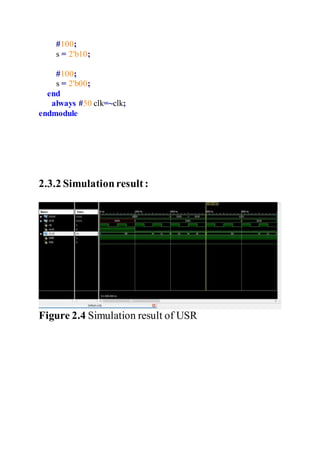
2.3.2 Simulationresult:
Figure 2.4 Simulation result of USR
Chapter 3
Implementation of CLA on FPGA
Board
3.1 UCF file:
NET "I[0]" LOC = "L13" ;
NET "I[1]" LOC = "L14" ;
NET "I[2]" LOC = "H18" ;
NET "I[3]" LOC = "N17" ;
NET "s[0]" LOC = "H13" | IOSTANDARD = LVTTL | PULLDOWN
| CLOCK_DEDICATED_ROUTE = FALSE;
NET "s[1]" LOC = "K17" | IOSTANDARD = LVTTL | PULLDOWN
| CLOCK_DEDICATED_ROUTE = FALSE;
NET "reset" LOC = "V16"| IOSTANDARD = LVTTL |
PULLDOWN ;
NET "SINL" LOC = "D18"| IOSTANDARD = LVTTL |
PULLDOWN ;
NET "SINR" LOC = "V4"| IOSTANDARD = LVTTL | PULLDOWN
;
NET "clk" LOC = "C9";
NET "O[0]" LOC = "F12" ;
NET "O[1]" LOC = "E12" ;
NET "O[2]" LOC = "E11" ;
NET "O[3]" LOC = "F11" ;
Chapter 4
4.1 Schematic of USR :
Figure 4.1 symbol representation of USR
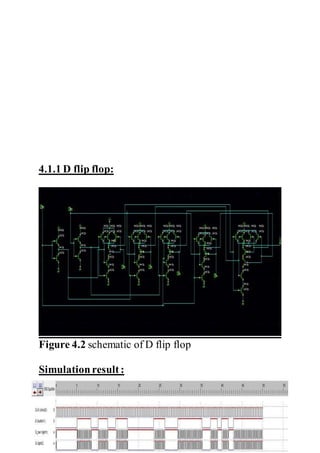
4.1.1 D flip flop:
Figure 4.2 schematic of D flip flop
Simulationresult:
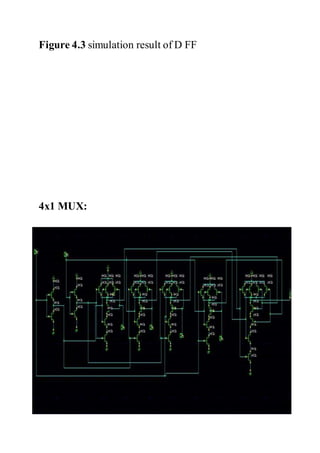
Figure 4.3 simulation result of D FF
4x1 MUX:
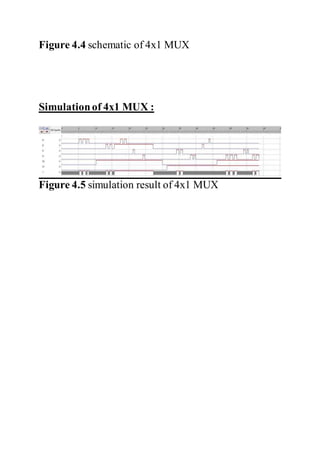
Figure 4.4 schematic of 4x1 MUX
Simulationof 4x1 MUX :
Figure 4.5 simulation result of 4x1 MUX
Chapter 5
Layout of USR
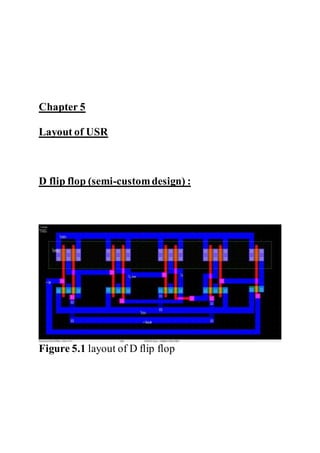
D flip flop (semi-customdesign) :
Figure 5.1 layout of D flip flop
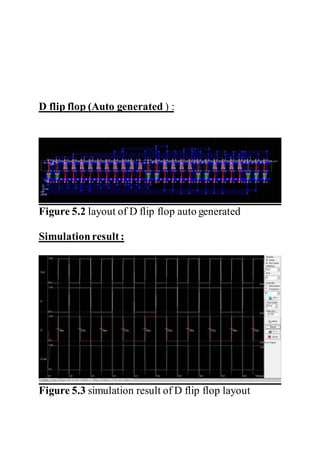
D flip flop (Auto generated ) :
Figure 5.2 layout of D flip flop auto generated
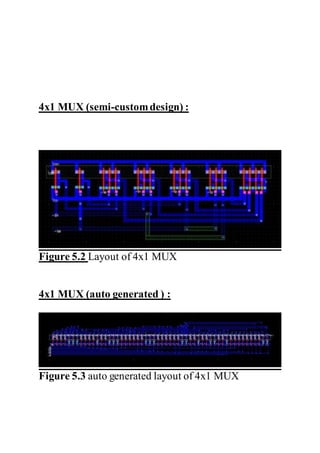
Simulationresult:
Figure 5.3 simulation result of D flip flop layout
4x1 MUX (semi-customdesign) :
Figure 5.2 Layout of 4x1 MUX
4x1 MUX (auto generated ) :
Figure 5.3 auto generated layout of 4x1 MUX
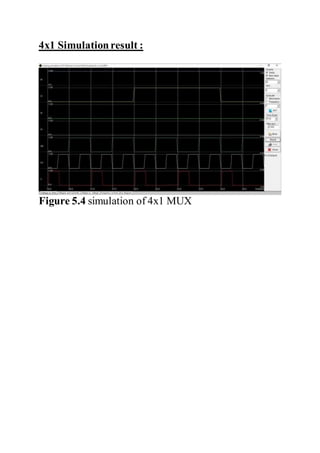
4x1 Simulationresult :
Figure 5.4 simulation of 4x1 MUX

4 bit uni shift reg

  • 1.
    Chapter 1 Introduction Universal shiftregister is capable of converting input data to parallel or serial which also does shifting of data bidirectional, unidirectional (SISO , SIPO , PISO , PIPO) and also parallel load this is called as Universal shift register . Shift register are used as: Data storage device , Delay element , communication lines , digital electronic devices (Temporary data storage , data transfer , data manipulation , counters), etc .
  • 2.
    1.1 Block diagramof universal shift register(USR) : Figure 1.1 block diagram of USR. The diagram of a shift register that has all the capabilities listed above is shown in fig. 1.1. It consists of four D flip-flops and four multiplexers (MUX) . The s, and So inputs control the mode of operation of the register as specified in the function entries of Table 1.1
  • 3.
    Table 1-1 Function tableforregister of fig. 1.1 Mode Control Register operationS1 S0 0 0 No change 0 1 Shift left 1 0 Shift right 1 1 Parallel load A bidirectional shift register with parallel load is a general-purpose register capable of performing three operations: shift left, shift right, and parallel load. Not all shift registers available in MSI circuits have all these capabilities. The particular application dictates the choice of one MSI shift register over another.
  • 4.
    CHAPTER 2 Implementation ofUSR in Verilog 2.1 Verilog Code : `timescale 1ns / 1ps //modual declaraion of input and output and register module USR(O,I,clk,reset,s,SINR,SINL); wire [3:0] w; input [3:0]I; input [1:0]s ; input clk ; input reset,SINR,SINL; output [3:0]O; reg [27:0] count = 0; //MUX modual calling mux_4_1 m1(w[0],s[1],s[0],I[0],SINL,O[1],O[0]); mux_4_1 m2(w[1],s[1],s[0],I[1],O[0],O[2],O[1]); mux_4_1 m3(w[2],s[1],s[0],I[2],O[1],O[3],O[2]);
  • 5.
    mux_4_1 m4(w[3],s[1],s[0],I[3],O[2],SINR,O[3]); //D flipflop modual calling D_FF d1(O[0],w[0],clk,reset); D_FF d2(O[1],w[1],clk,reset); D_FF d3(O[2],w[2],clk,reset); D_FF d4(O[3],w[3],clk,reset); //increment count on every clock endmodule //sub module for D flip flop module D_FF(q,d,clk,reset); output reg q; input d,clk,reset; always@(posedge clk) if (reset == 1'b1) q<=1'b0; else q<=d; endmodule //sub module for 4x1 MUX module mux_4_1(y,s1,s0,i3,i2,i1,i0);
  • 6.
    output reg y; inputi3,i2,i1,i0; input s1,s0; always@(s1,s0,i3,i2,i1,i0) begin if (s0==0 & s1==0) y=i0; else if (s0==0 & s1==1) y=i1; else if (s0==1 & s1==0) y=i2; else if (s0==1 & s1==1) y=i3; end endmodule
  • 7.
    2.2 RTL andtechnology schematic: 2.2.1 RTL : Figure 2.1 RTL schematic of USR 2.2.2 4x1 MUX :
  • 8.
    Figure 2.2 RTLschematic of 4x1 MUX 2.2.3 Technological schematicof USR : Figure 2.3 technology schematic of USR
  • 9.
    2.3 Simulationand testbench: 2.3.1 Test bench: `timescale 1ns / 1ps module uni_testbench; // Inputs reg [3:0] I; reg clk; reg reset; reg [1:0] s; reg SINR; reg SINL; // Outputs wire [3:0] O; // Instantiate the Unit Under Test (UUT) USR uut ( .O(O), .I(I), .clk(clk), .reset(reset), .s(s), .SINR(SINR), .SINL(SINL) ); initial begin // Initialize Inputs //I = 4'b0000; clk = 1'b1; reset = 1'b1; SINR = 1'b1; SINL = 1'b0; s = 2'b00;
  • 10.
    #100; reset = 1'b1; //s = 2'b00; #100; I = 4'b0101; reset = 1'b10; #100; s = 2'b11; #100; s = 2'b01; #100; s = 2'b10; #100; s = 2'b00; // Wait 100 ns for global reset to finish #100; // Add stimulus here #100; I = 4'b1010; reset = 1'b10; #100; s = 2'b11; #100; s = 2'b01;
  • 11.
    #100; s = 2'b10; #100; s= 2'b00; end always #50 clk=~clk; endmodule 2.3.2 Simulationresult: Figure 2.4 Simulation result of USR
  • 12.
    Chapter 3 Implementation ofCLA on FPGA Board 3.1 UCF file: NET "I[0]" LOC = "L13" ; NET "I[1]" LOC = "L14" ; NET "I[2]" LOC = "H18" ; NET "I[3]" LOC = "N17" ; NET "s[0]" LOC = "H13" | IOSTANDARD = LVTTL | PULLDOWN | CLOCK_DEDICATED_ROUTE = FALSE; NET "s[1]" LOC = "K17" | IOSTANDARD = LVTTL | PULLDOWN | CLOCK_DEDICATED_ROUTE = FALSE; NET "reset" LOC = "V16"| IOSTANDARD = LVTTL | PULLDOWN ; NET "SINL" LOC = "D18"| IOSTANDARD = LVTTL | PULLDOWN ;
  • 13.
    NET "SINR" LOC= "V4"| IOSTANDARD = LVTTL | PULLDOWN ; NET "clk" LOC = "C9"; NET "O[0]" LOC = "F12" ; NET "O[1]" LOC = "E12" ; NET "O[2]" LOC = "E11" ; NET "O[3]" LOC = "F11" ; Chapter 4 4.1 Schematic of USR : Figure 4.1 symbol representation of USR
  • 14.
    4.1.1 D flipflop: Figure 4.2 schematic of D flip flop Simulationresult:
  • 15.
    Figure 4.3 simulationresult of D FF 4x1 MUX:
  • 16.
    Figure 4.4 schematicof 4x1 MUX Simulationof 4x1 MUX : Figure 4.5 simulation result of 4x1 MUX
  • 17.
    Chapter 5 Layout ofUSR D flip flop (semi-customdesign) : Figure 5.1 layout of D flip flop
  • 18.
    D flip flop(Auto generated ) : Figure 5.2 layout of D flip flop auto generated Simulationresult: Figure 5.3 simulation result of D flip flop layout
  • 19.
    4x1 MUX (semi-customdesign): Figure 5.2 Layout of 4x1 MUX 4x1 MUX (auto generated ) : Figure 5.3 auto generated layout of 4x1 MUX
  • 20.
    4x1 Simulationresult : Figure5.4 simulation of 4x1 MUX