Pune Vidyarthi Griha’s
COLLEGE OF ENGINEERING, NASHIK – 3.
“QUEUE”
By
Prof. Anand N. Gharu
(Assistant Professor)
PVGCOE Computer Dept.
01 August 2019
.
Introduction of Queue
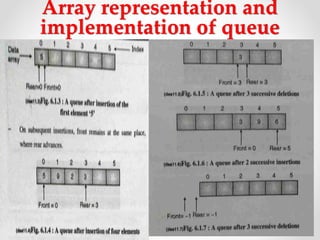
➢ “A queue is an ordered list in which all insertions are
done at one end, called rear and deletions at another end
called front“
➢ Queue when implemented using arrays has some
drawbacks which can be avoided by circular queue
➢ Queue is used in many applications such as as simulation,
priority queue, job queueetc
Introduction of Queue
➢ One of the most common dataprocessing structures
➢ Frequently used in most of the system software's like
operating systems, Network and Database
implementations and in many more other areas
➢ Very useful in time-sharing and distributed computer
systems where many widely distributed users share the
system simultaneously
Array representation and
implementation of queue
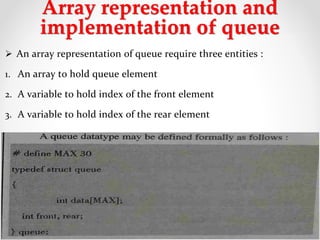
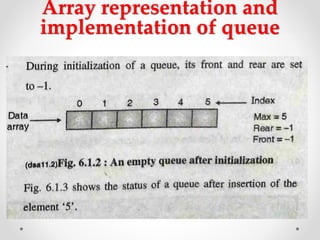
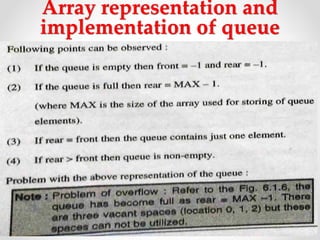
➢ An array representation of queue require three entities :
1. An array to hold queue element
2. A variable to hold index of the front element
3. A variable to hold index of the rear element
Array representation and
implementation of queue
Array representation and
implementation of queue
Array representation and
implementation of queue
Operation on queue
implemented using array
Operation on queue
implemented using array
Operation on queue
implemented using array
Operation on queue
implemented using array
Operation on queue
implemented using array
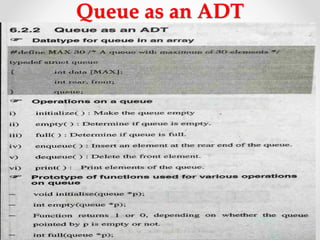
Queue as an ADT
➢ Create : Create creates an empty queue, Q
➢ Add (i,Q) : Add adds the element i to the rear end of queue,
Q and returns the newqueue
➢ Delete (Q) : Delete takes out an element i from the
➢ front end of queue and returns the resulting queue
➢ Front(Q) : Front returns the element i which is at the front
position of queue
➢ Is_Empty_Q(Q) : Is_Empty_Q returns true if queue is
➢ empty otherwise returns false
Queue as an ADT
Queue as an ADT
Queue as an ADT
STACK VS QUEUE
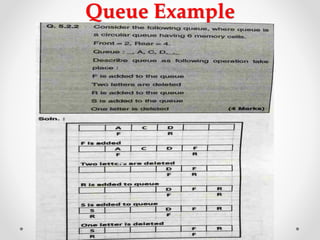
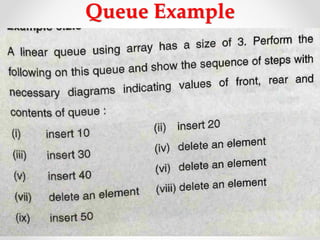
Queue Example
Queue Example
Queue Example
Queue Example
Operation on queue implemented using
Linked list
Operation on queue implemented using
Linked list
Operation on queue implemented using
Linked list
Operation on queue implemented using
Linked list
Operation on queue implemented using
Linked list
Operation on queue implemented using
Linked list
Circular Queue
6-29
Second Approach: Queue as a
Circular Array
• If we don't fix one end of the queue at
index 0, we won't have to shift elements
• Circular array is an array that conceptually
loops around on itself
o The last index is thought to “precede” index 0
o In an array whose last index is n, the location “before” index 0 is index n;
the location “after” index n is index 0
• Need to keep track of where the front as
well as the rear of the queue are at any
given time
6-30
Conceptual Example of a Circular Queue
1
0
12
11
10
1
0
12
11
10
1
0
12
11
10
After 7 enqueues
front
rear
After 5
dequeues
front
rear
After 8 more enqueues
front
rear
6-31
Implementation of a
Queue
rear
front
5
queue
count
8
3
0
1
2 3 4
5
6
7
8
9
10
n-1
n-2
n-3
. ..
cq
6-32
A Queue Straddling the
End of a Circular Array
rear
front
4
queue
count
2
98
0
1
2 3 4
5
6
7
8
9
10
99
98
97
. ..
cq
6-33
Circular Queue Drawn
Linearly
rear
front
4
queue
count
2
98
0 4321 96 97 98 99
…
Queue from previous slide
cq
6-34
Circular Array
Implementation
• When an element is enqueued, the value of rear is
incremented
• But it must take into account the need to loop back
to index 0:
rear = (rear+1) % queue.length;
• Can this array implementation also reach capacity?
6-35
Example: array of length 4
What happens?
rear
front
3
queue
count
1
2
0 321
rear
front
4
queue
count
2
2
0 321
Suppose we try to add one
more item to a queue
implemented by an array of
length 4
cq
cq
The queue is now full. How
can you tell?
6-36
Need to expand
capacity…
rear
front
4
queue
count
2
2
0 321
rear
front
4
queue
count
2
2
0 321 4 765
We can’t just double the
size of the array and
copy values to the same
positions as before:
circular properties of the
queue will be lost
These locations
should be in use
cq
cq
6-37
rear
front
4
queue
count
6
2
0 321 4 765
We could build the new array, and copy the queue elements into
contiguous locations beginning at location front:
cq
6-38
rear
front
4
queue
count
4
0
0 321 4 765
Better: copy the queue elements in order to the beginning of the
new array
cq
6-39
rear
front
5
queue
count
5
0
0 321 4 765
New element is added at rear = (rear+1) % queue.length
See expandCapacity() in CircularArrayQueue.java
cq
Circular Queue
Circular Queue
Circular Queue
Circular Queue
Circular Queue
DeQueue
DeQueue
DeQueue as an ADT
Implementation of DeQueue using linked list
C function for deque using circular array
Priority Queue
Priority Queue as an ADT
Multiple Queue using array
Application of Queue

Unit 5 dsa QUEUE