+ 
Strategic 
Intervention 
Material 
Mathematics IX 
Solving Quadratic Equation by Factoring 
Prepared by: Brian M. Mary T-I
LEAST MASTERED SKILLS 
Solving Quadratic Equation by Factoring 
Sub Tasks 
+ 
 Identifying quadratic equations 
 Rewriting quadratic equations to its standard form 
 Factor trinomials in the form x2 + bx + c 
 Determine roots of quadratic equation 
ax2 + bx + c = 0, by factoring
+ 
Overview 
A quadratic equation in one variable is a 
mathematical sentence of degree 2 that 
can be written in the following form 
ax2 + bx + c = 0, 
where a, b, and c are real numbers and 
a ≠ 0. 
How are quadratic equations used in 
solving real – life problems and in 
making decisions? 
Many formulas used in the 
physical world are quadratic in 
nature since they become 
second-degree equations when 
solving for one of the variables. 
Likewise, many word problems 
require the use of the quadratic 
equation. 
At the enrichment card, we 
will consider some of the 
common uses of the quadratic 
equations.
+ Activity # 1 
Quadratic or Not Quadratic? 
Direction. Identify which of the following equations are 
quadratic and which are not. Write QE if the equations 
are quadratic and NQE if not quadratic equation. 
__________ 1. 3m + 8 = 15 
__________ 2. x2 – 5x – 10 = 0 
__________ 3. 2t2 – 7t = 12 
__________ 4. 12 – 4x = 0 
__________ 5. 25 – r2 = 4r
Activity # 2 
+ 
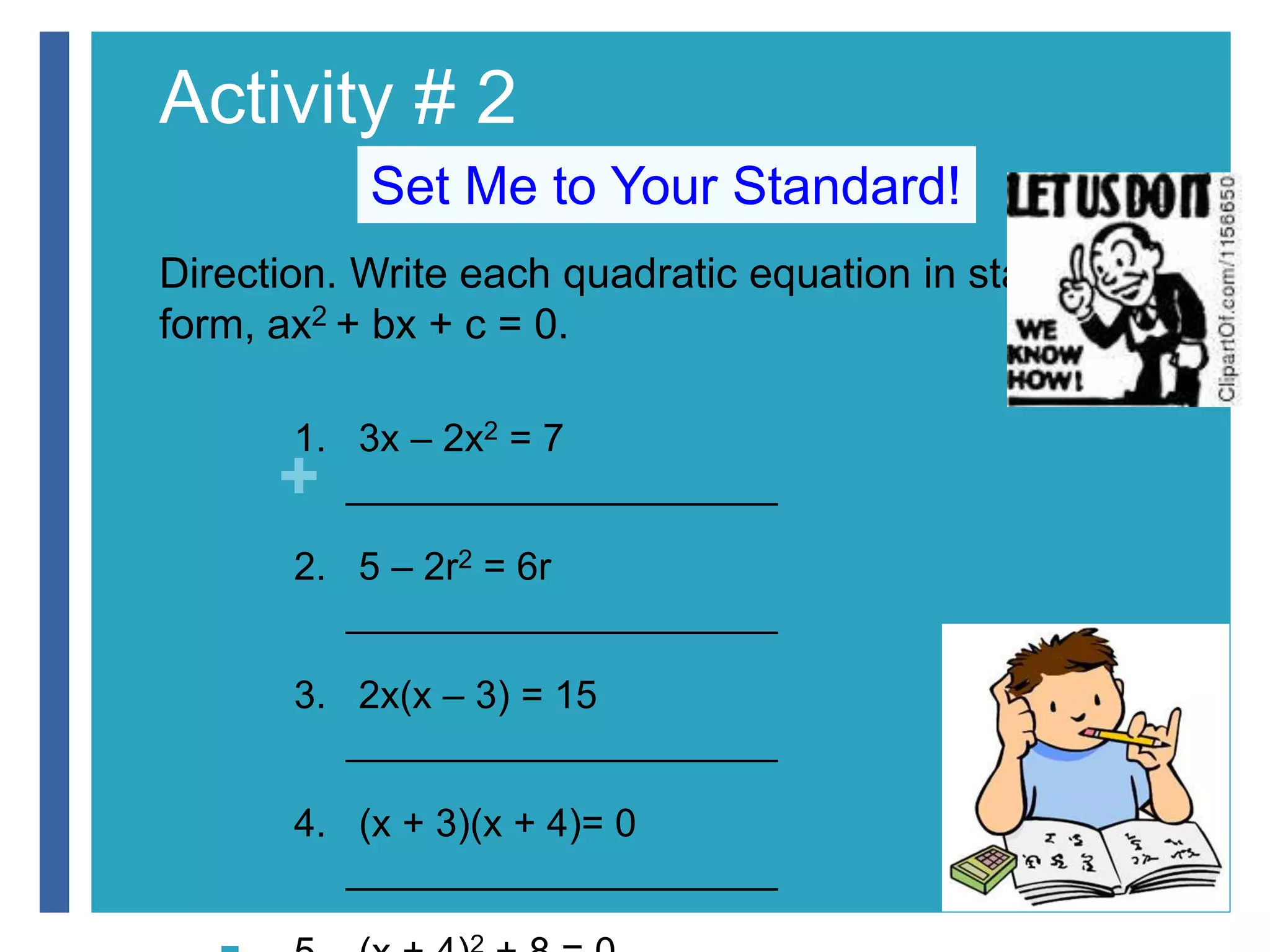
Set Me to Your Standard! 
Direction. Write each quadratic equation in standard 
form, ax2 + bx + c = 0. 
 1. 3x – 2x2 = 7 
____________________ 
 2. 5 – 2r2 = 6r 
____________________ 
 3. 2x(x – 3) = 15 
____________________ 
 4. (x + 3)(x + 4)= 0 
____________________ 
 5. (x + 4)2 + 8 = 0
+ Activity # 3 
What Made Me? 
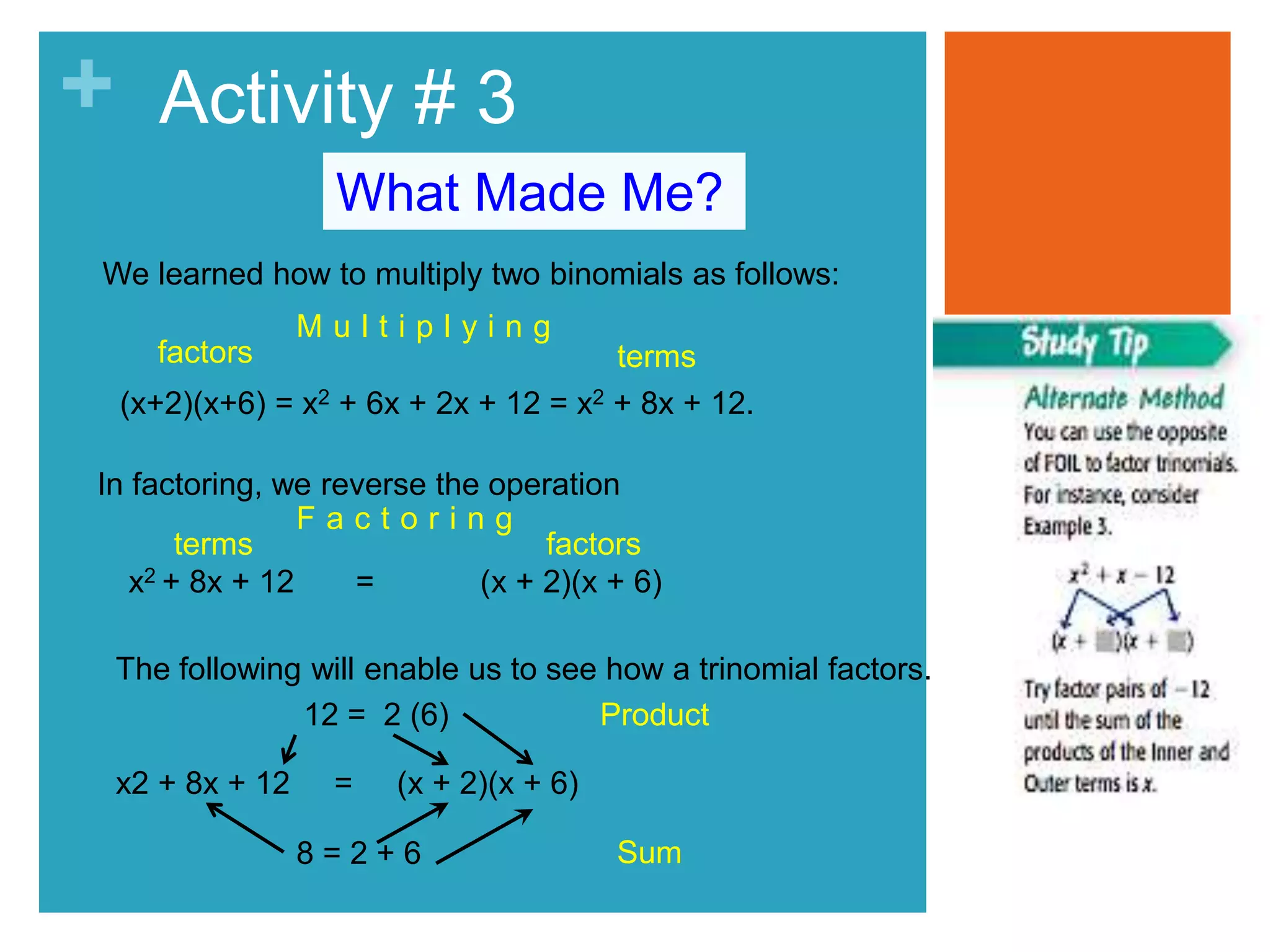
We learned how to multiply two binomials as follows: 
factors 
terms 
M u l t i p l y i n g 
(x+2)(x+6) = x2 + 6x + 2x + 12 = x2 + 8x + 12. 
In factoring, we reverse the operation 
F a c t o r i n g 
terms factors 
x2 + 8x + 12 = (x + 2)(x + 6) 
The following will enable us to see how a trinomial factors. 
12 = 2 (6) 
x2 + 8x + 12 = (x + 2)(x + 6) 
8 = 2 + 6 
Product 
Sum
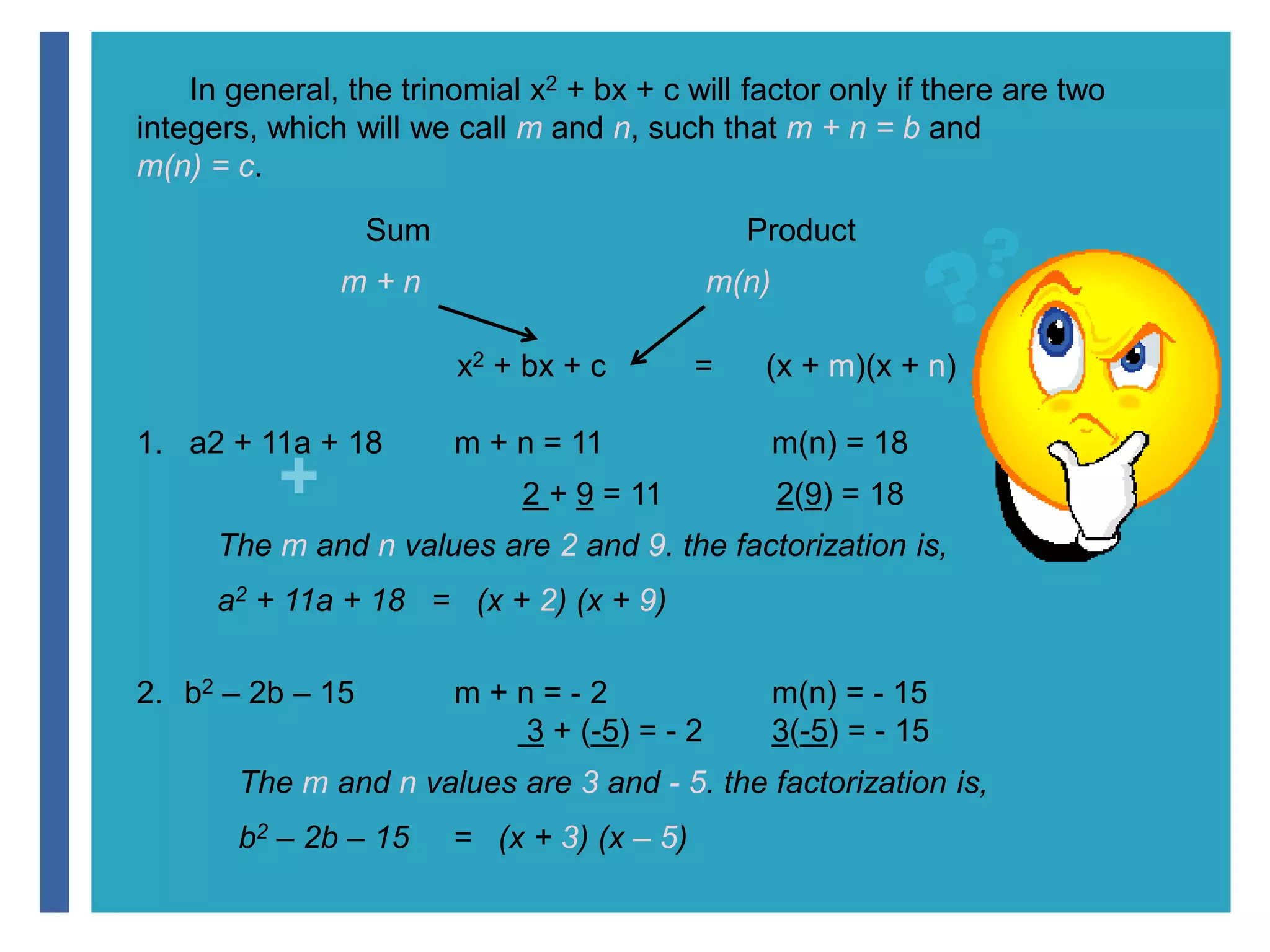
In general, the trinomial x2 + bx + c will factor only if there are two 
integers, which will we call m and n, such that m + n = b and 
m(n) = c. 
+ 
Sum Product 
m + n m(n) 
x2 + bx + c = (x + m)(x + n) 
1. a2 + 11a + 18 m + n = 11 m(n) = 18 
2 + 9 = 11 2(9) = 18 
The m and n values are 2 and 9. the factorization is, 
a2 + 11a + 18 = (x + 2) (x + 9) 
2. b2 – 2b – 15 m + n = - 2 m(n) = - 15 
3 + (-5) = - 2 3(-5) = - 15 
The m and n values are 3 and - 5. the factorization is, 
b2 – 2b – 15 = (x + 3) (x – 5)
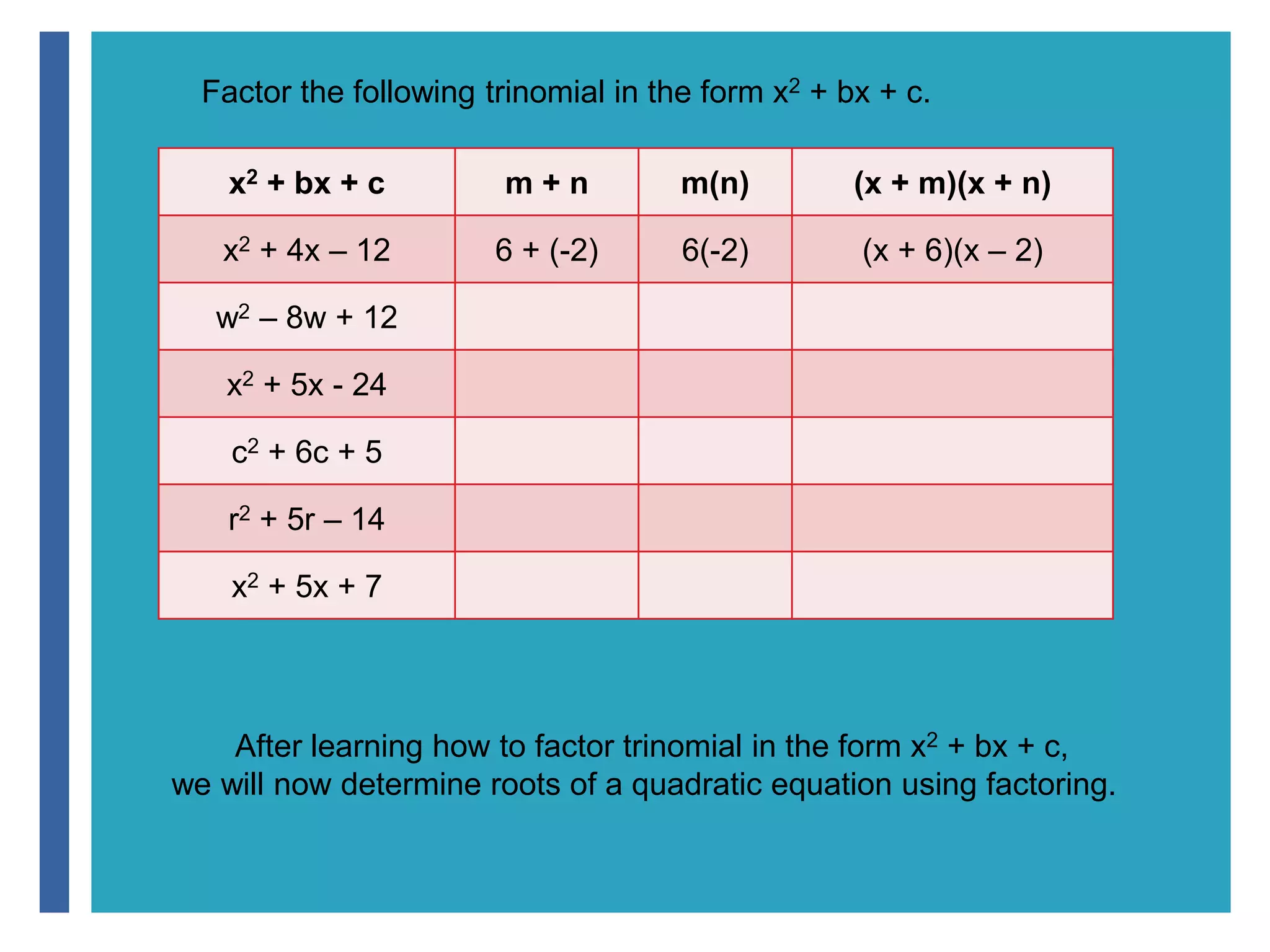
Factor the following trinomial in the form x2 + bx + c. 
x2 + bx + c m + n m(n) (x + m)(x + n) 
x2 + 4x – 12 6 + (-2) 6(-2) (x + 6)(x – 2) 
w2 – 8w + 12 
x2 + 5x - 24 
c2 + 6c + 5 
+ 
r2 + 5r – 14 
x2 + 5x + 7 
After learning how to factor trinomial in the form x2 + bx + c, 
we will now determine roots of a quadratic equation using factoring.
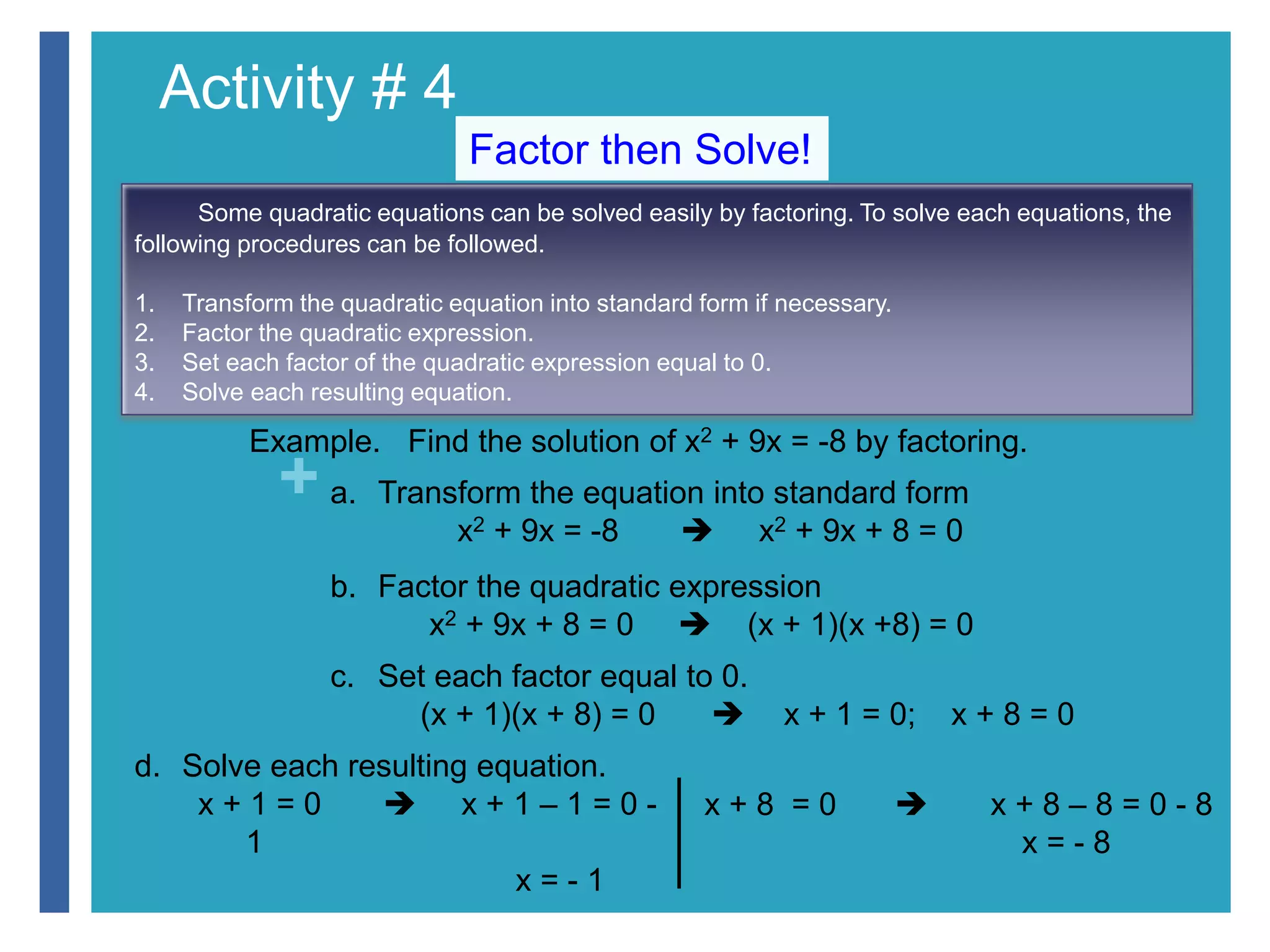
Activity # 4 
+ 
Factor then Solve! 
Some quadratic equations can be solved easily by factoring. To solve each equations, the 
following procedures can be followed. 
1. Transform the quadratic equation into standard form if necessary. 
2. Factor the quadratic expression. 
3. Set each factor of the quadratic expression equal to 0. 
4. Solve each resulting equation. 
Example. Find the solution of x2 + 9x = -8 by factoring. 
a. Transform the equation into standard form 
x2 + 9x = -8  x2 + 9x + 8 = 0 
b. Factor the quadratic expression 
x2 + 9x + 8 = 0  (x + 1)(x +8) = 0 
c. Set each factor equal to 0. 
(x + 1)(x + 8) = 0  x + 1 = 0; x + 8 = 0 
d. Solve each resulting equation. 
x + 1 = 0  x + 1 – 1 = 0 - 
1 
x = - 1 
x + 8 = 0  x + 8 – 8 = 0 - 8 
x = - 8
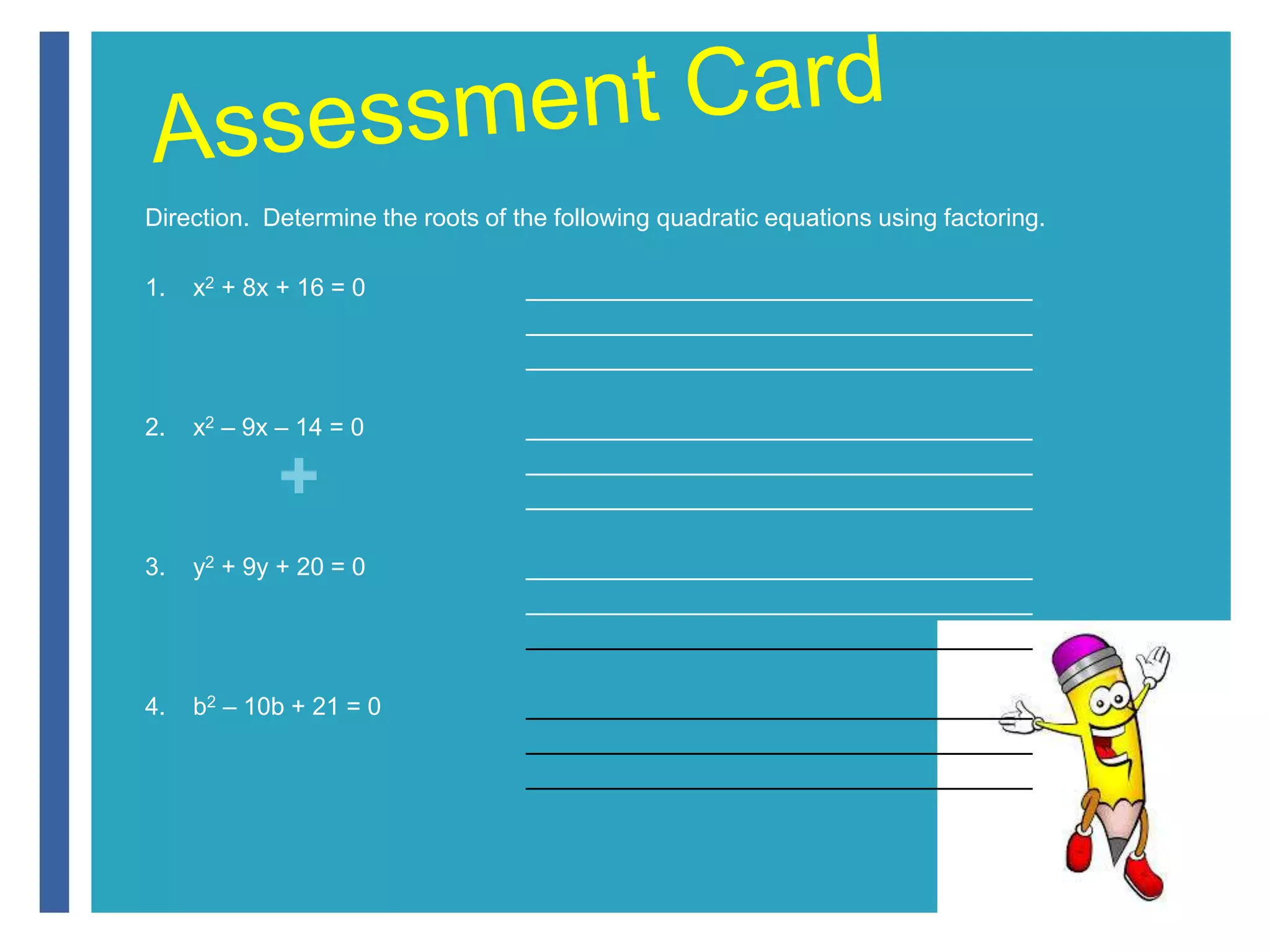
Direction. Determine the roots of the following quadratic equations using factoring. 
1. x2 + 8x + 16 = 0 _____________________________________ 
+ 
_____________________________________ 
_____________________________________ 
2. x2 – 9x – 14 = 0 _____________________________________ 
_____________________________________ 
_____________________________________ 
3. y2 + 9y + 20 = 0 _____________________________________ 
_____________________________________ 
_____________________________________ 
4. b2 – 10b + 21 = 0 _____________________________________ 
_____________________________________ 
_____________________________________
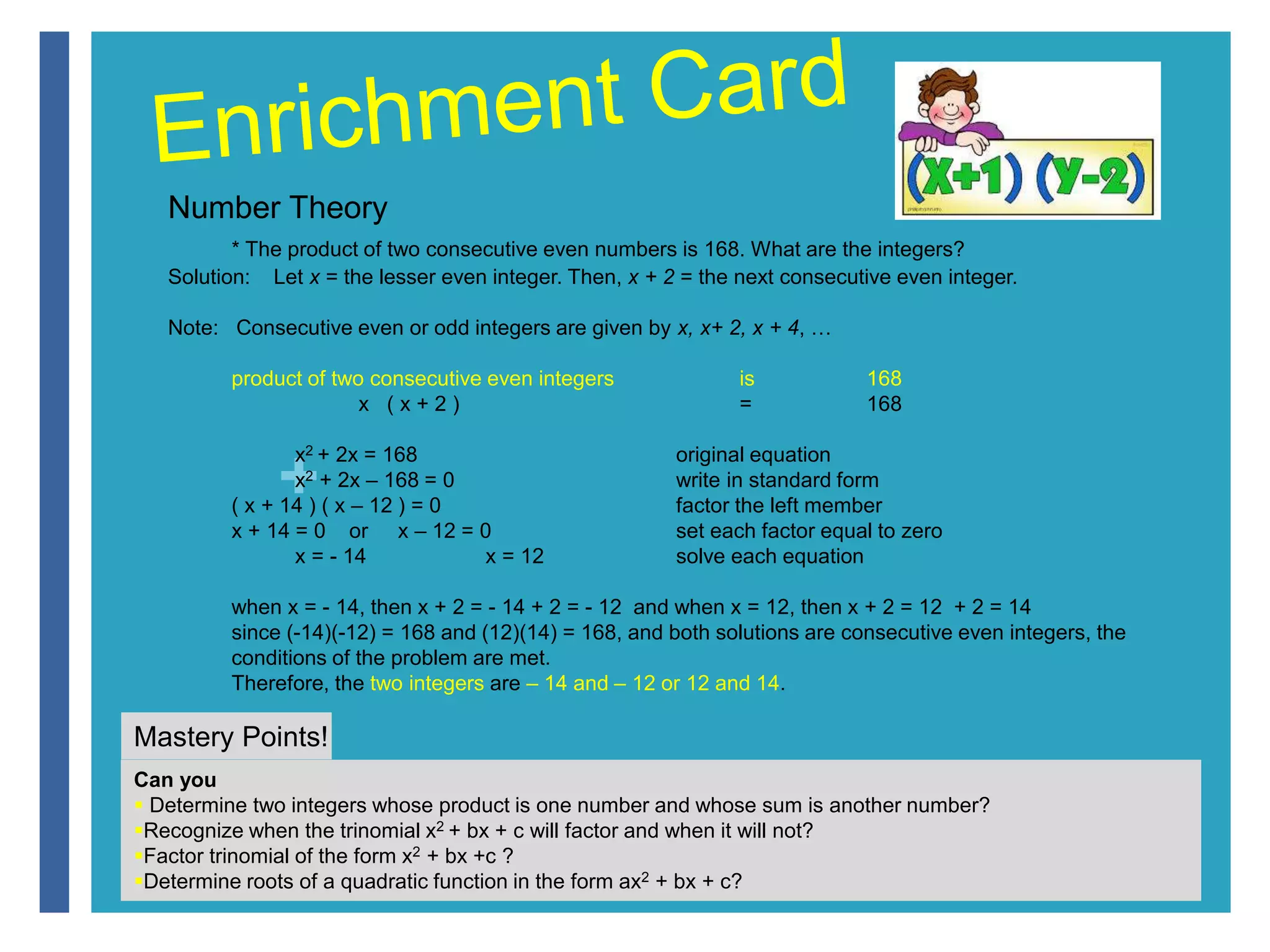
Number Theory 
* The product of two consecutive even numbers is 168. What are the integers? 
Solution: Let x = the lesser even integer. Then, x + 2 = the next consecutive even integer. 
Note: Consecutive even or odd integers are given by x, x+ 2, x + 4, … 
product of two consecutive even integers is 168 
x2 + 2x = 168 original equation 
x2 + 2x – 168 = 0 write in standard form 
+ 
x ( x + 2 ) = 168 
( x + 14 ) ( x – 12 ) = 0 factor the left member 
x + 14 = 0 or x – 12 = 0 set each factor equal to zero 
x = - 14 x = 12 solve each equation 
when x = - 14, then x + 2 = - 14 + 2 = - 12 and when x = 12, then x + 2 = 12 + 2 = 14 
since (-14)(-12) = 168 and (12)(14) = 168, and both solutions are consecutive even integers, the 
conditions of the problem are met. 
Therefore, the two integers are – 14 and – 12 or 12 and 14. 
Mastery Points! 
Can you 
 Determine two integers whose product is one number and whose sum is another number? 
Recognize when the trinomial x2 + bx + c will factor and when it will not? 
Factor trinomial of the form x2 + bx +c ? 
Determine roots of a quadratic function in the form ax2 + bx + c?
Learner’s Material – Mathematics IX, First Edition pp. 27 - 34 
Holiday, Berchie. et. al. ALGEBRA 2. USA. The McGraw – Hill 
Companies, C2008. pp. 253 – 256 
Wesner, et. al. ELEMENTARY ALGEBRA with APPLICATIONS. 
Bernard + 
J. Klein Publishing, 2006 
pp. 152 – 156
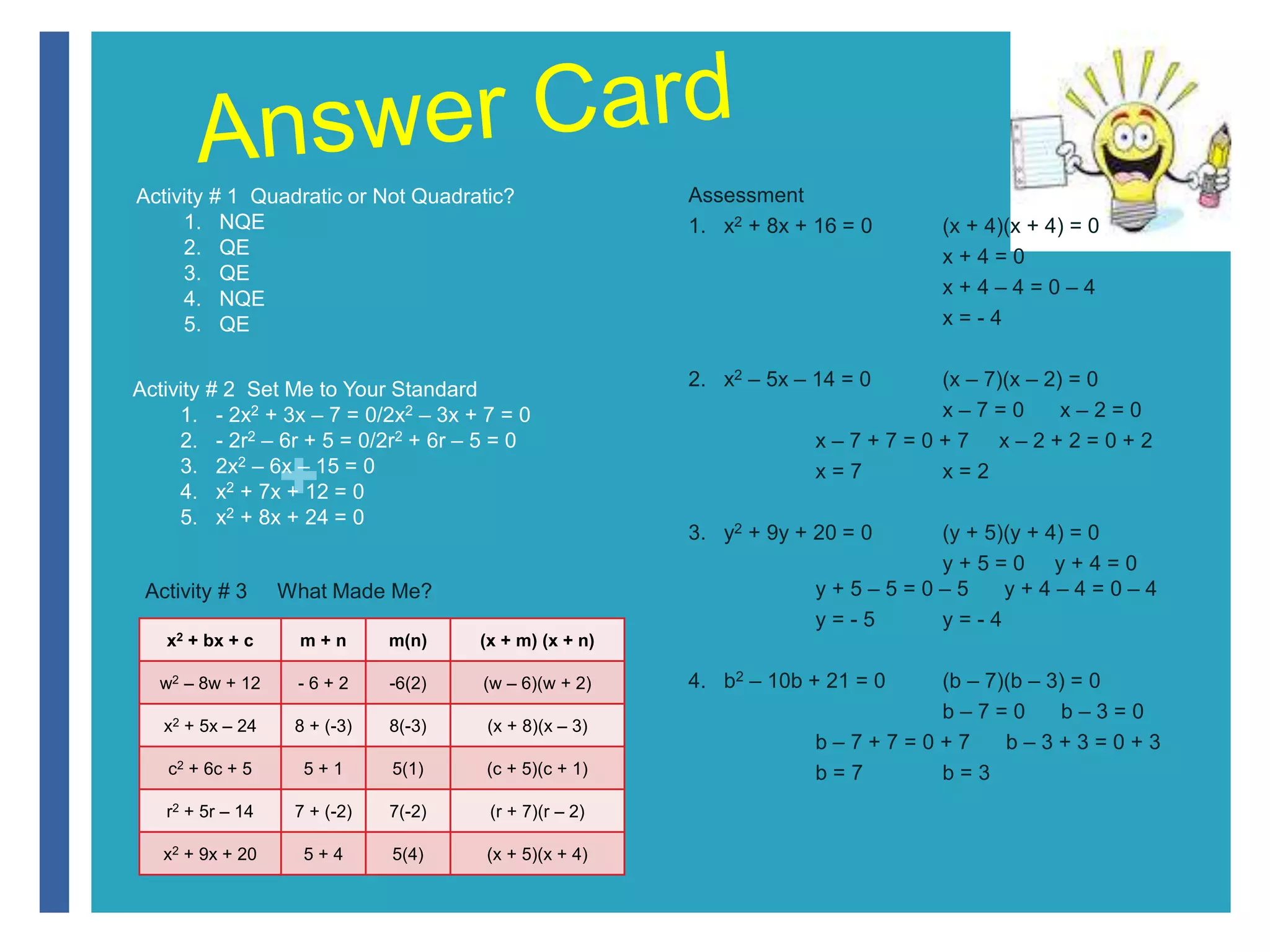
Activity # 1 Quadratic or Not Quadratic? 
+ 
1. NQE 
2. QE 
3. QE 
4. NQE 
5. QE 
Activity # 2 Set Me to Your Standard 
1. - 2x2 + 3x – 7 = 0/2x2 – 3x + 7 = 0 
2. - 2r2 – 6r + 5 = 0/2r2 + 6r – 5 = 0 
3. 2x2 – 6x – 15 = 0 
4. x2 + 7x + 12 = 0 
5. x2 + 8x + 24 = 0 
Activity # 3 What Made Me? 
x2 + bx + c m + n m(n) (x + m) (x + n) 
w2 – 8w + 12 - 6 + 2 -6(2) (w – 6)(w + 2) 
x2 + 5x – 24 8 + (-3) 8(-3) (x + 8)(x – 3) 
c2 + 6c + 5 5 + 1 5(1) (c + 5)(c + 1) 
r2 + 5r – 14 7 + (-2) 7(-2) (r + 7)(r – 2) 
x2 + 9x + 20 5 + 4 5(4) (x + 5)(x + 4) 
Assessment 
1. x2 + 8x + 16 = 0 (x + 4)(x + 4) = 0 
x + 4 = 0 
x + 4 – 4 = 0 – 4 
x = - 4 
2. x2 – 5x – 14 = 0 (x – 7)(x – 2) = 0 
x – 7 = 0 x – 2 = 0 
x – 7 + 7 = 0 + 7 x – 2 + 2 = 0 + 2 
x = 7 x = 2 
3. y2 + 9y + 20 = 0 (y + 5)(y + 4) = 0 
y + 5 = 0 y + 4 = 0 
y + 5 – 5 = 0 – 5 y + 4 – 4 = 0 – 4 
y = - 5 y = - 4 
4. b2 – 10b + 21 = 0 (b – 7)(b – 3) = 0 
b – 7 = 0 b – 3 = 0 
b – 7 + 7 = 0 + 7 b – 3 + 3 = 0 + 3 
b = 7 b = 3
+

Strategic Intervention Materials

  • 1.
    + Strategic Intervention Material Mathematics IX Solving Quadratic Equation by Factoring Prepared by: Brian M. Mary T-I
  • 2.
    LEAST MASTERED SKILLS Solving Quadratic Equation by Factoring Sub Tasks +  Identifying quadratic equations  Rewriting quadratic equations to its standard form  Factor trinomials in the form x2 + bx + c  Determine roots of quadratic equation ax2 + bx + c = 0, by factoring
  • 3.
    + Overview Aquadratic equation in one variable is a mathematical sentence of degree 2 that can be written in the following form ax2 + bx + c = 0, where a, b, and c are real numbers and a ≠ 0. How are quadratic equations used in solving real – life problems and in making decisions? Many formulas used in the physical world are quadratic in nature since they become second-degree equations when solving for one of the variables. Likewise, many word problems require the use of the quadratic equation. At the enrichment card, we will consider some of the common uses of the quadratic equations.
  • 4.
    + Activity #1 Quadratic or Not Quadratic? Direction. Identify which of the following equations are quadratic and which are not. Write QE if the equations are quadratic and NQE if not quadratic equation. __________ 1. 3m + 8 = 15 __________ 2. x2 – 5x – 10 = 0 __________ 3. 2t2 – 7t = 12 __________ 4. 12 – 4x = 0 __________ 5. 25 – r2 = 4r
  • 5.
    Activity # 2 + Set Me to Your Standard! Direction. Write each quadratic equation in standard form, ax2 + bx + c = 0.  1. 3x – 2x2 = 7 ____________________  2. 5 – 2r2 = 6r ____________________  3. 2x(x – 3) = 15 ____________________  4. (x + 3)(x + 4)= 0 ____________________  5. (x + 4)2 + 8 = 0
  • 6.
    + Activity #3 What Made Me? We learned how to multiply two binomials as follows: factors terms M u l t i p l y i n g (x+2)(x+6) = x2 + 6x + 2x + 12 = x2 + 8x + 12. In factoring, we reverse the operation F a c t o r i n g terms factors x2 + 8x + 12 = (x + 2)(x + 6) The following will enable us to see how a trinomial factors. 12 = 2 (6) x2 + 8x + 12 = (x + 2)(x + 6) 8 = 2 + 6 Product Sum
  • 7.
    In general, thetrinomial x2 + bx + c will factor only if there are two integers, which will we call m and n, such that m + n = b and m(n) = c. + Sum Product m + n m(n) x2 + bx + c = (x + m)(x + n) 1. a2 + 11a + 18 m + n = 11 m(n) = 18 2 + 9 = 11 2(9) = 18 The m and n values are 2 and 9. the factorization is, a2 + 11a + 18 = (x + 2) (x + 9) 2. b2 – 2b – 15 m + n = - 2 m(n) = - 15 3 + (-5) = - 2 3(-5) = - 15 The m and n values are 3 and - 5. the factorization is, b2 – 2b – 15 = (x + 3) (x – 5)
  • 8.
    Factor the followingtrinomial in the form x2 + bx + c. x2 + bx + c m + n m(n) (x + m)(x + n) x2 + 4x – 12 6 + (-2) 6(-2) (x + 6)(x – 2) w2 – 8w + 12 x2 + 5x - 24 c2 + 6c + 5 + r2 + 5r – 14 x2 + 5x + 7 After learning how to factor trinomial in the form x2 + bx + c, we will now determine roots of a quadratic equation using factoring.
  • 9.
    Activity # 4 + Factor then Solve! Some quadratic equations can be solved easily by factoring. To solve each equations, the following procedures can be followed. 1. Transform the quadratic equation into standard form if necessary. 2. Factor the quadratic expression. 3. Set each factor of the quadratic expression equal to 0. 4. Solve each resulting equation. Example. Find the solution of x2 + 9x = -8 by factoring. a. Transform the equation into standard form x2 + 9x = -8  x2 + 9x + 8 = 0 b. Factor the quadratic expression x2 + 9x + 8 = 0  (x + 1)(x +8) = 0 c. Set each factor equal to 0. (x + 1)(x + 8) = 0  x + 1 = 0; x + 8 = 0 d. Solve each resulting equation. x + 1 = 0  x + 1 – 1 = 0 - 1 x = - 1 x + 8 = 0  x + 8 – 8 = 0 - 8 x = - 8
  • 10.
    Direction. Determine theroots of the following quadratic equations using factoring. 1. x2 + 8x + 16 = 0 _____________________________________ + _____________________________________ _____________________________________ 2. x2 – 9x – 14 = 0 _____________________________________ _____________________________________ _____________________________________ 3. y2 + 9y + 20 = 0 _____________________________________ _____________________________________ _____________________________________ 4. b2 – 10b + 21 = 0 _____________________________________ _____________________________________ _____________________________________
  • 11.
    Number Theory *The product of two consecutive even numbers is 168. What are the integers? Solution: Let x = the lesser even integer. Then, x + 2 = the next consecutive even integer. Note: Consecutive even or odd integers are given by x, x+ 2, x + 4, … product of two consecutive even integers is 168 x2 + 2x = 168 original equation x2 + 2x – 168 = 0 write in standard form + x ( x + 2 ) = 168 ( x + 14 ) ( x – 12 ) = 0 factor the left member x + 14 = 0 or x – 12 = 0 set each factor equal to zero x = - 14 x = 12 solve each equation when x = - 14, then x + 2 = - 14 + 2 = - 12 and when x = 12, then x + 2 = 12 + 2 = 14 since (-14)(-12) = 168 and (12)(14) = 168, and both solutions are consecutive even integers, the conditions of the problem are met. Therefore, the two integers are – 14 and – 12 or 12 and 14. Mastery Points! Can you  Determine two integers whose product is one number and whose sum is another number? Recognize when the trinomial x2 + bx + c will factor and when it will not? Factor trinomial of the form x2 + bx +c ? Determine roots of a quadratic function in the form ax2 + bx + c?
  • 12.
    Learner’s Material –Mathematics IX, First Edition pp. 27 - 34 Holiday, Berchie. et. al. ALGEBRA 2. USA. The McGraw – Hill Companies, C2008. pp. 253 – 256 Wesner, et. al. ELEMENTARY ALGEBRA with APPLICATIONS. Bernard + J. Klein Publishing, 2006 pp. 152 – 156
  • 13.
    Activity # 1Quadratic or Not Quadratic? + 1. NQE 2. QE 3. QE 4. NQE 5. QE Activity # 2 Set Me to Your Standard 1. - 2x2 + 3x – 7 = 0/2x2 – 3x + 7 = 0 2. - 2r2 – 6r + 5 = 0/2r2 + 6r – 5 = 0 3. 2x2 – 6x – 15 = 0 4. x2 + 7x + 12 = 0 5. x2 + 8x + 24 = 0 Activity # 3 What Made Me? x2 + bx + c m + n m(n) (x + m) (x + n) w2 – 8w + 12 - 6 + 2 -6(2) (w – 6)(w + 2) x2 + 5x – 24 8 + (-3) 8(-3) (x + 8)(x – 3) c2 + 6c + 5 5 + 1 5(1) (c + 5)(c + 1) r2 + 5r – 14 7 + (-2) 7(-2) (r + 7)(r – 2) x2 + 9x + 20 5 + 4 5(4) (x + 5)(x + 4) Assessment 1. x2 + 8x + 16 = 0 (x + 4)(x + 4) = 0 x + 4 = 0 x + 4 – 4 = 0 – 4 x = - 4 2. x2 – 5x – 14 = 0 (x – 7)(x – 2) = 0 x – 7 = 0 x – 2 = 0 x – 7 + 7 = 0 + 7 x – 2 + 2 = 0 + 2 x = 7 x = 2 3. y2 + 9y + 20 = 0 (y + 5)(y + 4) = 0 y + 5 = 0 y + 4 = 0 y + 5 – 5 = 0 – 5 y + 4 – 4 = 0 – 4 y = - 5 y = - 4 4. b2 – 10b + 21 = 0 (b – 7)(b – 3) = 0 b – 7 = 0 b – 3 = 0 b – 7 + 7 = 0 + 7 b – 3 + 3 = 0 + 3 b = 7 b = 3
  • 14.