www.mathportal.org
Algebra Formulas
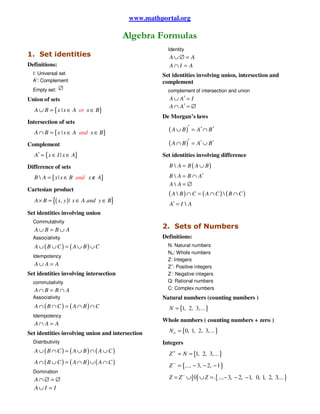
1. Set identities
Definitions:
I: Universal set
A’: Complement
Empty set: ∅
Union of sets
{ }|A B x x x BrA o∪ = ∈ ∈
Intersection of sets
{ }|A B x x x BdA an∩ = ∈ ∈
Complement
{ }|A x I x A′ = ∈ ∈
Difference of sets
{ } |B A x x B x Aand= ∈ ∉
Cartesian product
( ){ }, |A B x y x A and y B× = ∈ ∈
Set identities involving union
Commutativity
A B B A∪ = ∪
Associativity
( ) ( )A B C A B C∪ ∪ = ∪ ∪
Idempotency
A A A∪ =
Set identities involving intersection
commutativity
A B B A∩ = ∩
Associativity
( ) ( )A B C A B C∩ ∩ = ∩ ∩
Idempotency
A A A∩ =
Set identities involving union and intersection
Distributivity
( ) ( ) ( )A B C A B A C∪ ∩ = ∪ ∩ ∪
( ) ( ) ( )A B C A B A C∩ ∪ = ∩ ∪ ∩
Domination
A ∩∅ = ∅
A I I∪ =
Identity
A A∪∅ =
A I A∩ =
Set identities involving union, intersection and
complement
complement of intersection and union
A A I′∪ =
A A′∩ = ∅
De Morgan’s laws
( )A B A B′ ′ ′∪ = ∩
( )A B A B′ ′ ′∩ = ∪
Set identities involving difference
( )B A B A B= ∪
B A B A′= ∩
A A = ∅
( ) ( ) ( ) A B C A C B C∩ = ∩ ∩
A I A′ =
2. Sets of Numbers
Definitions:
N: Natural numbers
No: Whole numbers
Z: Integers
Z
+
: Positive integers
Z
-
: Negative integers
Q: Rational numbers
C: Complex numbers
Natural numbers (counting numbers )
{ }1, 2, 3,...N =
Whole numbers ( counting numbers + zero )
{ }0, 1, 2, 3,...oN =
Integers
{ }1, 2, 3,...Z N+
= =
{ }..., 3, 2, 1Z−
= − − −
{ } { }0 . .., 3, 2, 1, 0, 1, 2, 3,...Z Z Z−
= ∪ ∪ = − − −
www.mathportal.org
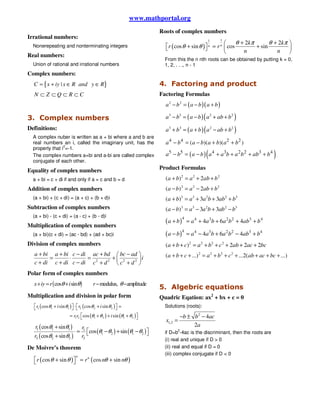
Irrational numbers:
Nonerepeating and nonterminating integers
Real numbers:
Union of rational and irrational numbers
Complex numbers:
{ }|C x iy x R and y R= + ∈ ∈
N Z Q R C⊂ ⊂ ⊂ ⊂
3. Complex numbers
Definitions:
A complex nuber is written as a + bi where a and b are
real numbers an i, called the imaginary unit, has the
property that i
2
=-1.
The complex numbers a+bi and a-bi are called complex
conjugate of each other.
Equality of complex numbers
a + bi = c + di if and only if a = c and b = d
Addition of complex numbers
(a + bi) + (c + di) = (a + c) + (b + d)i
Subtraction of complex numbers
(a + bi) - (c + di) = (a - c) + (b - d)i
Multiplication of complex numbers
(a + bi)(c + di) = (ac - bd) + (ad + bc)i
Division of complex numbers
2 2 2 2
a bi a bi c di ac bd bc ad
i
c di c di c di c d c d
+ + − + − 
= ⋅ = +  
+ + − + + 
Polar form of complex numbers
( )cos sin modulus, amplitudex iy r i rθ θ θ+ = + − −
Multiplication and division in polar form
( ) ( )
( ) ( )
1 1 1 2 2 2
1 2 1 2 1 2
cos sin cos sin
cos sin
r i r i
rr i
θ θ θ θ
θ θ θ θ
   + ⋅ + =   
 = + + + 
( )
( )
( ) ( )1 1 1 1
1 2 1 2
2 2 2 2
cos sin
cos sin
cos sin
r r
r r
θ θ
θ θ θ θ
θ θ
+
 ⋅ = − + − +
De Moivre’s theorem
( ) ( )cos sin cos sin
n n
r r n nθ θ θ θ + = + 
Roots of complex numbers
( )
11
2 2
cos sin cos sinnn
k k
r r
n n
θ π θ π
θ θ
+ + 
 + = +  
 
From this the n nth roots can be obtained by putting k = 0,
1, 2, . . ., n - 1
4. Factoring and product
Factoring Formulas
( )( )2 2
a b a b a b− = − +
( )( )3 3 2 2
a b a b a ab b− = − + +
( )( )3 3 2 2
a b a b a ab b+ = + − +
4 4 2 2
( )( )( )a b a b a b a b− = − + +
( )( )5 5 4 3 2 2 3 4
a b a b a a b a b ab b− = − + + + +
Product Formulas
2 2 2
( ) 2a b a ab b+ = + +
2 2 2
( ) 2a b a ab b− = − +
3 3 2 2 3
( ) 3 3a b a a b ab b+ = + + +
3 3 2 2 3
( ) 3 3a b a a b ab b− = − + −
( )
4 4 3 2 2 3 4
4 6 4a b a a b a b ab b+ = + + + +
( )4 4 3 2 2 3 4
4 6 4a b a a b a b ab b− = − + − +
2 2 2 2
( ) 2 2 2a b c a b c ab ac bc+ + = + + + + +
2 2 2 2
( ...) ...2( ...)a b c a b c ab ac bc+ + + = + + + + + +
5. Algebric equations
Quadric Eqation: ax2
+ bx + c = 0
Solutions (roots):
2
1,2
4
2
b b ac
x
a
− ± −
=
if D=b
2
-4ac is the discriminant, then the roots are
(i) real and unique if D > 0
(ii) real and equal if D = 0
(iii) complex conjugate if D < 0
www.mathportal.org
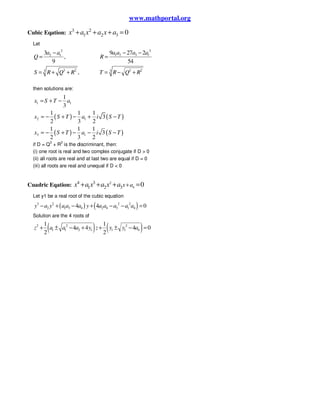
Cubic Eqation: 3 2
1 2 3 0x a x a x a+ + + =
Let
32
1 2 3 12 1
3 2 3 23 3
9 27 23
,
9 54
,
a a a aa a
Q R
S R Q R T R Q R
− −−
= =
= + + = − +
then solutions are:
( ) ( )
( ) ( )
1 1
2 1
3 1
1
3
1 1 1
3
2 3 2
1 1 1
3
2 3 2
x S T a
x S T a i S T
x S T a i S T
= + −
= − + − + −
= − + − − −
if D = Q
3
+ R
3
is the discriminant, then:
(i) one root is real and two complex conjugate if D > 0
(ii) all roots are real and at last two are equal if D = 0
(iii) all roots are real and unequal if D < 0
Cuadric Eqation: 2
4
4 3
1 2 3 0x ax a x a x a ++ + + =
Let y1 be a real root of the cubic equation
( ) ( )3 2 2 2
2 1 3 4 2 4 3 1 44 4 0y a y a a a y a a a a a− + − + − − =
Solution are the 4 roots of
( ) ( )2 2 2
1 1 2 1 1 1 4
1 1
4 4 4 0
2 2
z a a a y z y y a+ ± − + + ± − =

Algebra formulas

  • 1.
    www.mathportal.org Algebra Formulas 1. Setidentities Definitions: I: Universal set A’: Complement Empty set: ∅ Union of sets { }|A B x x x BrA o∪ = ∈ ∈ Intersection of sets { }|A B x x x BdA an∩ = ∈ ∈ Complement { }|A x I x A′ = ∈ ∈ Difference of sets { } |B A x x B x Aand= ∈ ∉ Cartesian product ( ){ }, |A B x y x A and y B× = ∈ ∈ Set identities involving union Commutativity A B B A∪ = ∪ Associativity ( ) ( )A B C A B C∪ ∪ = ∪ ∪ Idempotency A A A∪ = Set identities involving intersection commutativity A B B A∩ = ∩ Associativity ( ) ( )A B C A B C∩ ∩ = ∩ ∩ Idempotency A A A∩ = Set identities involving union and intersection Distributivity ( ) ( ) ( )A B C A B A C∪ ∩ = ∪ ∩ ∪ ( ) ( ) ( )A B C A B A C∩ ∪ = ∩ ∪ ∩ Domination A ∩∅ = ∅ A I I∪ = Identity A A∪∅ = A I A∩ = Set identities involving union, intersection and complement complement of intersection and union A A I′∪ = A A′∩ = ∅ De Morgan’s laws ( )A B A B′ ′ ′∪ = ∩ ( )A B A B′ ′ ′∩ = ∪ Set identities involving difference ( )B A B A B= ∪ B A B A′= ∩ A A = ∅ ( ) ( ) ( ) A B C A C B C∩ = ∩ ∩ A I A′ = 2. Sets of Numbers Definitions: N: Natural numbers No: Whole numbers Z: Integers Z + : Positive integers Z - : Negative integers Q: Rational numbers C: Complex numbers Natural numbers (counting numbers ) { }1, 2, 3,...N = Whole numbers ( counting numbers + zero ) { }0, 1, 2, 3,...oN = Integers { }1, 2, 3,...Z N+ = = { }..., 3, 2, 1Z− = − − − { } { }0 . .., 3, 2, 1, 0, 1, 2, 3,...Z Z Z− = ∪ ∪ = − − −
  • 2.
    www.mathportal.org Irrational numbers: Nonerepeating andnonterminating integers Real numbers: Union of rational and irrational numbers Complex numbers: { }|C x iy x R and y R= + ∈ ∈ N Z Q R C⊂ ⊂ ⊂ ⊂ 3. Complex numbers Definitions: A complex nuber is written as a + bi where a and b are real numbers an i, called the imaginary unit, has the property that i 2 =-1. The complex numbers a+bi and a-bi are called complex conjugate of each other. Equality of complex numbers a + bi = c + di if and only if a = c and b = d Addition of complex numbers (a + bi) + (c + di) = (a + c) + (b + d)i Subtraction of complex numbers (a + bi) - (c + di) = (a - c) + (b - d)i Multiplication of complex numbers (a + bi)(c + di) = (ac - bd) + (ad + bc)i Division of complex numbers 2 2 2 2 a bi a bi c di ac bd bc ad i c di c di c di c d c d + + − + −  = ⋅ = +   + + − + +  Polar form of complex numbers ( )cos sin modulus, amplitudex iy r i rθ θ θ+ = + − − Multiplication and division in polar form ( ) ( ) ( ) ( ) 1 1 1 2 2 2 1 2 1 2 1 2 cos sin cos sin cos sin r i r i rr i θ θ θ θ θ θ θ θ    + ⋅ + =     = + + +  ( ) ( ) ( ) ( )1 1 1 1 1 2 1 2 2 2 2 2 cos sin cos sin cos sin r r r r θ θ θ θ θ θ θ θ +  ⋅ = − + − + De Moivre’s theorem ( ) ( )cos sin cos sin n n r r n nθ θ θ θ + = +  Roots of complex numbers ( ) 11 2 2 cos sin cos sinnn k k r r n n θ π θ π θ θ + +   + = +     From this the n nth roots can be obtained by putting k = 0, 1, 2, . . ., n - 1 4. Factoring and product Factoring Formulas ( )( )2 2 a b a b a b− = − + ( )( )3 3 2 2 a b a b a ab b− = − + + ( )( )3 3 2 2 a b a b a ab b+ = + − + 4 4 2 2 ( )( )( )a b a b a b a b− = − + + ( )( )5 5 4 3 2 2 3 4 a b a b a a b a b ab b− = − + + + + Product Formulas 2 2 2 ( ) 2a b a ab b+ = + + 2 2 2 ( ) 2a b a ab b− = − + 3 3 2 2 3 ( ) 3 3a b a a b ab b+ = + + + 3 3 2 2 3 ( ) 3 3a b a a b ab b− = − + − ( ) 4 4 3 2 2 3 4 4 6 4a b a a b a b ab b+ = + + + + ( )4 4 3 2 2 3 4 4 6 4a b a a b a b ab b− = − + − + 2 2 2 2 ( ) 2 2 2a b c a b c ab ac bc+ + = + + + + + 2 2 2 2 ( ...) ...2( ...)a b c a b c ab ac bc+ + + = + + + + + + 5. Algebric equations Quadric Eqation: ax2 + bx + c = 0 Solutions (roots): 2 1,2 4 2 b b ac x a − ± − = if D=b 2 -4ac is the discriminant, then the roots are (i) real and unique if D > 0 (ii) real and equal if D = 0 (iii) complex conjugate if D < 0
  • 3.
    www.mathportal.org Cubic Eqation: 32 1 2 3 0x a x a x a+ + + = Let 32 1 2 3 12 1 3 2 3 23 3 9 27 23 , 9 54 , a a a aa a Q R S R Q R T R Q R − −− = = = + + = − + then solutions are: ( ) ( ) ( ) ( ) 1 1 2 1 3 1 1 3 1 1 1 3 2 3 2 1 1 1 3 2 3 2 x S T a x S T a i S T x S T a i S T = + − = − + − + − = − + − − − if D = Q 3 + R 3 is the discriminant, then: (i) one root is real and two complex conjugate if D > 0 (ii) all roots are real and at last two are equal if D = 0 (iii) all roots are real and unequal if D < 0 Cuadric Eqation: 2 4 4 3 1 2 3 0x ax a x a x a ++ + + = Let y1 be a real root of the cubic equation ( ) ( )3 2 2 2 2 1 3 4 2 4 3 1 44 4 0y a y a a a y a a a a a− + − + − − = Solution are the 4 roots of ( ) ( )2 2 2 1 1 2 1 1 1 4 1 1 4 4 4 0 2 2 z a a a y z y y a+ ± − + + ± − =