0.5 Rational Expressions
Chapter 0 Review of Basic Concepts
Concepts & Objectives
⚫ Rational expressions
⚫ Finding the domain of a rational expression
⚫ Writing rational expressions in lowest terms
⚫ Multiplying and dividing rational expressions
⚫ Adding and subtracting rational expressions
⚫ Simplifying complex fractions
Rational Expressions
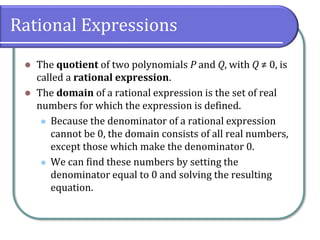
⚫ The quotient of two polynomials P and Q, with Q ≠ 0, is
called a rational expression.
⚫ The domain of a rational expression is the set of real
numbers for which the expression is defined.
⚫ Because the denominator of a rational expression
cannot be 0, the domain consists of all real numbers,
except those which make the denominator 0.
⚫ We can find these numbers by setting the
denominator equal to 0 and solving the resulting
equation.
Rational Expressions (cont.)
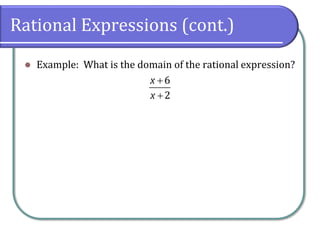
⚫ Example: What is the domain of the rational expression?
6
2
x
x
+
+
Rational Expressions (cont.)
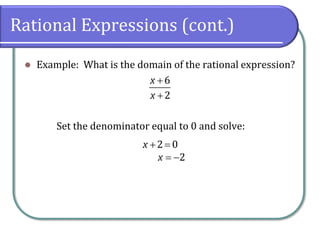
⚫ Example: What is the domain of the rational expression?
Set the denominator equal to 0 and solve:
6
2
x
x
+
+
2 0x + =
2x = −
Rational Expressions (cont.)
⚫ A rational expression is written in lowest terms when
the greatest common factor of its numerator and
denominator is 1.
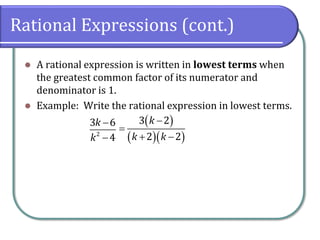
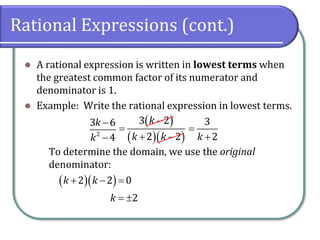
⚫ Example: Write the rational expression in lowest terms.
2
3 6
4
k
k
−
−
Rational Expressions (cont.)
⚫ A rational expression is written in lowest terms when
the greatest common factor of its numerator and
denominator is 1.
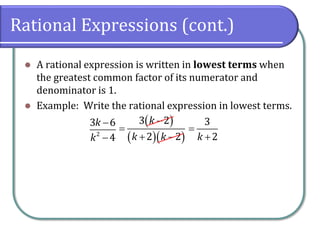
⚫ Example: Write the rational expression in lowest terms.
2
3 6
4
k
k
−
−
( )
( )( )
3 2
2 2
k
k k
−
=
+ −
Rational Expressions (cont.)
⚫ A rational expression is written in lowest terms when
the greatest common factor of its numerator and
denominator is 1.
⚫ Example: Write the rational expression in lowest terms.
2
3 6
4
k
k
−
−
( )
( )( )
3 2
2 2
k
k k
−
=
+ −
3
2k
=
+
Rational Expressions (cont.)
⚫ A rational expression is written in lowest terms when
the greatest common factor of its numerator and
denominator is 1.
⚫ Example: Write the rational expression in lowest terms.
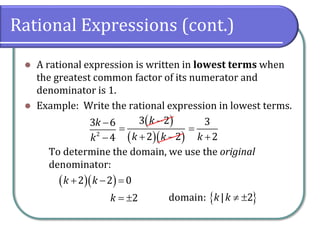
To determine the domain, we use the original
denominator:
2
3 6
4
k
k
−
−
( )
( )( )
3 2
2 2
k
k k
−
=
+ −
3
2k
=
+
( )( )2 2 0
2
k k
k
+ − =
= 
Rational Expressions (cont.)
⚫ A rational expression is written in lowest terms when
the greatest common factor of its numerator and
denominator is 1.
⚫ Example: Write the rational expression in lowest terms.
To determine the domain, we use the original
denominator:
2
3 6
4
k
k
−
−
( )
( )( )
3 2
2 2
k
k k
−
=
+ −
3
2k
=
+
( )( )2 2 0
2
k k
k
+ − =
=   domain: | 2k k  
Multiplying and Dividing
⚫ We multiply and divide rational expressions using
definitions from ealier work with fractions.
⚫ It is generally assumed that you will leave your answer
in lowest terms.
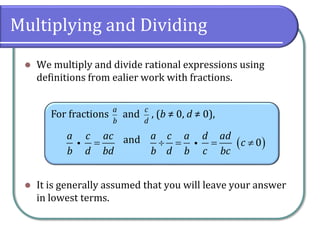
For fractions and , (b ≠ 0, d ≠ 0),
and
a
b
c
d
a c ac
b d bd
= ( )0
a c a d ad
c
b d b c bc
 = = 
Multiplying and Dividing (cont.)
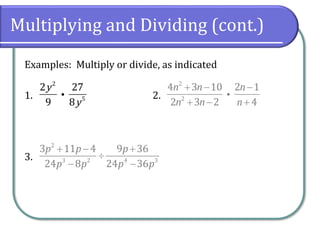
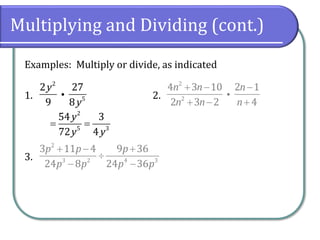
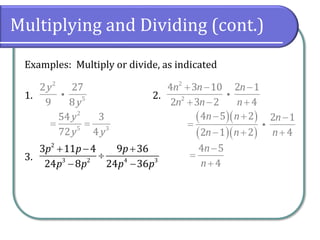
Examples: Multiply or divide, as indicated
1. 2.
3.
2
5
2 27
9 8
y
y
2
2
4 3 10 2 1
2 3 2 4
n n n
n n n
+ − −
+ − +
2
3 2 4 3
3 11 4 9 36
24 8 24 36
p p p
p p p p
+ − +

− −
Multiplying and Dividing (cont.)
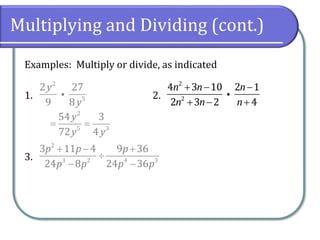
Examples: Multiply or divide, as indicated
1. 2.
3.
2
5
2 27
9 8
y
y
2
2
4 3 10 2 1
2 3 2 4
n n n
n n n
+ − −
+ − +
2
3 2 4 3
3 11 4 9 36
24 8 24 36
p p p
p p p p
+ − +

− −
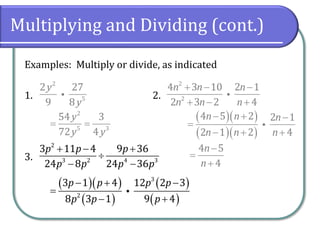
2
5 3
54 3
72 4
y
y y
= =
Multiplying and Dividing (cont.)
Examples: Multiply or divide, as indicated
1. 2.
3.
2
5
2 27
9 8
y
y
2
2
4 3 10 2 1
2 3 2 4
n n n
n n n
+ − −
+ − +
2
3 2 4 3
3 11 4 9 36
24 8 24 36
p p p
p p p p
+ − +

− −
2
5 3
54 3
72 4
y
y y
= =
Multiplying and Dividing (cont.)
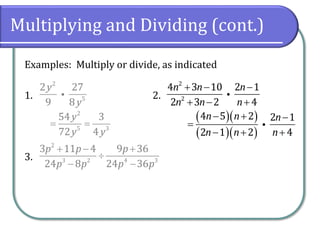
Examples: Multiply or divide, as indicated
1. 2.
3.
2
5
2 27
9 8
y
y
2
2
4 3 10 2 1
2 3 2 4
n n n
n n n
+ − −
+ − +
2
3 2 4 3
3 11 4 9 36
24 8 24 36
p p p
p p p p
+ − +

− −
2
5 3
54 3
72 4
y
y y
= =
( )( )
( )( )
4 5 2 2 1
2 1 2 4
n n n
n n n
− + −
=
− + +
Multiplying and Dividing (cont.)
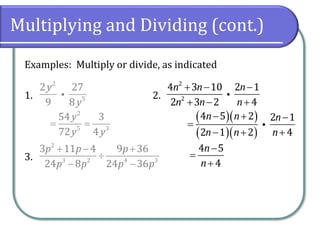
Examples: Multiply or divide, as indicated
1. 2.
3.
2
5
2 27
9 8
y
y
2
2
4 3 10 2 1
2 3 2 4
n n n
n n n
+ − −
+ − +
2
3 2 4 3
3 11 4 9 36
24 8 24 36
p p p
p p p p
+ − +

− −
2
5 3
54 3
72 4
y
y y
= =
( )( )
( )( )
4 5 2 2 1
2 1 2 4
n n n
n n n
− + −
=
− + +
4 5
4
n
n
−
=
+
Multiplying and Dividing (cont.)
Examples: Multiply or divide, as indicated
1. 2.
3.
2
5
2 27
9 8
y
y
2
2
4 3 10 2 1
2 3 2 4
n n n
n n n
+ − −
+ − +
2
3 2 4 3
3 11 4 9 36
24 8 24 36
p p p
p p p p
+ − +

− −
2
5 3
54 3
72 4
y
y y
= =
( )( )
( )( )
4 5 2 2 1
2 1 2 4
n n n
n n n
− + −
=
− + +
4 5
4
n
n
−
=
+
Multiplying and Dividing (cont.)
Examples: Multiply or divide, as indicated
1. 2.
3.
2
5
2 27
9 8
y
y
2
2
4 3 10 2 1
2 3 2 4
n n n
n n n
+ − −
+ − +
2
3 2 4 3
3 11 4 9 36
24 8 24 36
p p p
p p p p
+ − +

− −
2
5 3
54 3
72 4
y
y y
= =
( )( )
( )( )
4 5 2 2 1
2 1 2 4
n n n
n n n
− + −
=
− + +
4 5
4
n
n
−
=
+
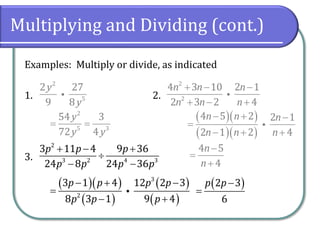
( )( )
( )
( )
( )
3
2
3 1 4 12 2 3
8 3 1 9 4
p p p p
p p p
− + −
=
− +
Multiplying and Dividing (cont.)
Examples: Multiply or divide, as indicated
1. 2.
3.
2
5
2 27
9 8
y
y
2
2
4 3 10 2 1
2 3 2 4
n n n
n n n
+ − −
+ − +
2
3 2 4 3
3 11 4 9 36
24 8 24 36
p p p
p p p p
+ − +

− −
2
5 3
54 3
72 4
y
y y
= =
( )( )
( )( )
4 5 2 2 1
2 1 2 4
n n n
n n n
− + −
=
− + +
4 5
4
n
n
−
=
+
( )( )
( )
( )
( )
3
2
3 1 4 12 2 3
8 3 1 9 4
p p p p
p p p
− + −
=
− +
( )2 3
6
p p−
=
Addition and Subtraction
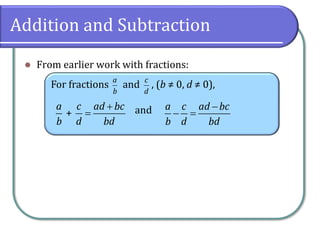
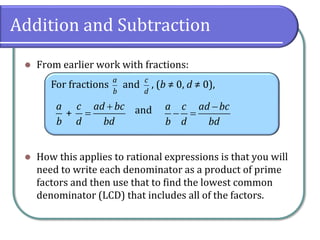
⚫ From earlier work with fractions:
For fractions and , (b ≠ 0, d ≠ 0),
and
a
b
c
d
+
a c ad bc
b d bd
+
=
a c ad bc
b d bd
−
− =
Addition and Subtraction
⚫ From earlier work with fractions:
⚫ How this applies to rational expressions is that you will
need to write each denominator as a product of prime
factors and then use that to find the lowest common
denominator (LCD) that includes all of the factors.
For fractions and , (b ≠ 0, d ≠ 0),
and
a
b
c
d
+
a c ad bc
b d bd
+
=
a c ad bc
b d bd
−
− =
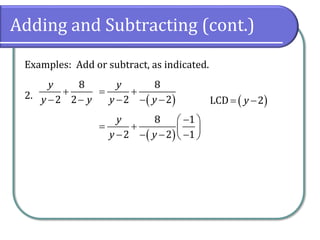
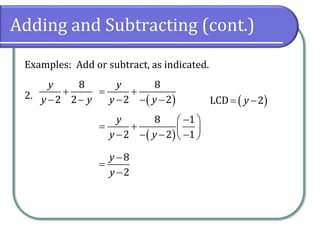
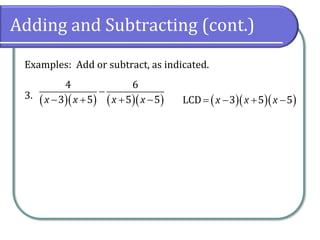
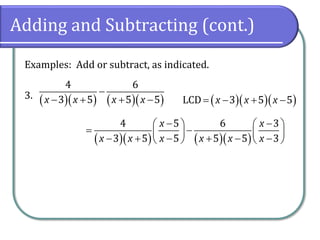
Adding and Subtracting (cont.)
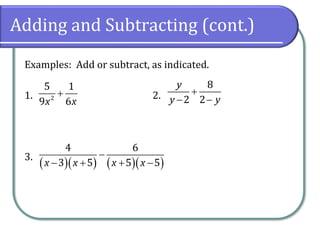
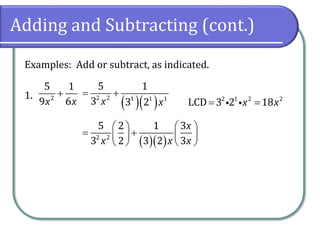
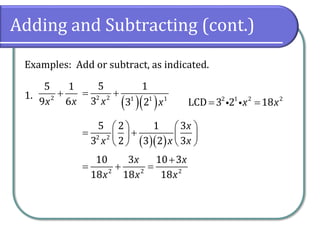
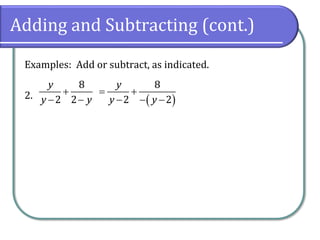
Examples: Add or subtract, as indicated.
1. 2.
3.
2
5 1
9 6x x
+
8
2 2
y
y y
+
− −
( )( ) ( )( )
4 6
3 5 5 5x x x x
−
− + + −
Adding and Subtracting (cont.)
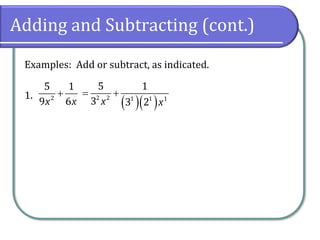
Examples: Add or subtract, as indicated.
1. 2
5 1
9 6x x
+
( )( )2 2 1 1 1
5 1
3 3 2x x
= +
Adding and Subtracting (cont.)
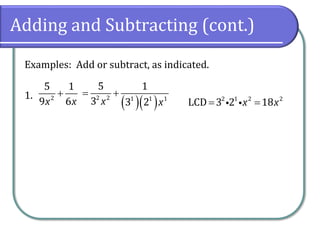
Examples: Add or subtract, as indicated.
1. 2
5 1
9 6x x
+
( )( )2 2 1 1 1
5 1
3 3 2x x
= + 2 1 2 2
LCD 3 2 18x x= =
Adding and Subtracting (cont.)
Examples: Add or subtract, as indicated.
1. 2
5 1
9 6x x
+
( )( )2 2 1 1 1
5 1
3 3 2x x
= + 2 1 2 2
LCD 3 2 18x x= =
( )( )2 2
5 2 1 3
3 2 3 2 3
x
x x x
   
= +   
   
Adding and Subtracting (cont.)
Examples: Add or subtract, as indicated.
1. 2
5 1
9 6x x
+
( )( )2 2 1 1 1
5 1
3 3 2x x
= + 2 1 2 2
LCD 3 2 18x x= =
( )( )2 2
5 2 1 3
3 2 3 2 3
x
x x x
   
= +   
   
2 2 2
10 3 10 3
18 18 18
x x
x x x
+
= + =
Adding and Subtracting (cont.)
Examples: Add or subtract, as indicated.
2.
8
2 2
y
y y
+
− − ( )
8
2 2
y
y y
= +
− − −
Adding and Subtracting (cont.)
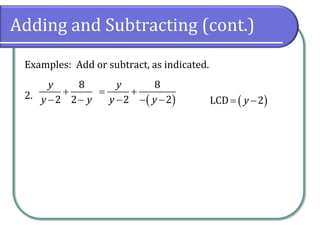
Examples: Add or subtract, as indicated.
2.
8
2 2
y
y y
+
− − ( )
8
2 2
y
y y
= +
− − − ( )LCD 2y= −
Adding and Subtracting (cont.)
Examples: Add or subtract, as indicated.
2.
8
2 2
y
y y
+
− − ( )
8
2 2
y
y y
= +
− − − ( )LCD 2y= −
( )
8 1
2 2 1
y
y y
− 
= +  − − − − 
Adding and Subtracting (cont.)
Examples: Add or subtract, as indicated.
2.
8
2 2
y
y y
+
− − ( )
8
2 2
y
y y
= +
− − − ( )LCD 2y= −
( )
8 1
2 2 1
y
y y
− 
= +  − − − − 
8
2
y
y
−
=
−
Adding and Subtracting (cont.)
Examples: Add or subtract, as indicated.
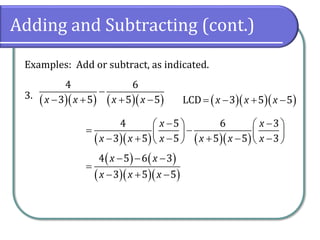
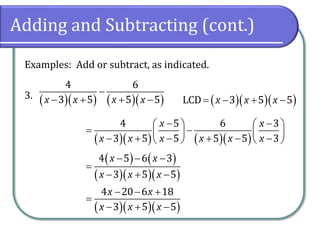
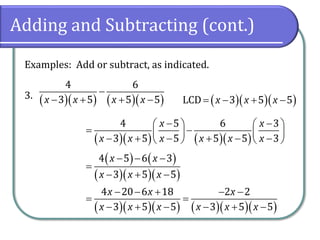
3. ( )( ) ( )( )
4 6
3 5 5 5x x x x
−
− + + − ( )( )( )LCD 3 5 5x x x= − + −
Adding and Subtracting (cont.)
Examples: Add or subtract, as indicated.
3. ( )( ) ( )( )
4 6
3 5 5 5x x x x
−
− + + − ( )( )( )LCD 3 5 5x x x= − + −
( )( ) ( )( )
4 5 6 3
3 5 5 5 5 3
x x
x x x x x x
− −   
= −   − + − + − −   
Adding and Subtracting (cont.)
Examples: Add or subtract, as indicated.
3. ( )( ) ( )( )
4 6
3 5 5 5x x x x
−
− + + − ( )( )( )LCD 3 5 5x x x= − + −
( )( ) ( )( )
4 5 6 3
3 5 5 5 5 3
x x
x x x x x x
− −   
= −   − + − + − −   
( ) ( )
( )( )( )
4 5 6 3
3 5 5
x x
x x x
− − −
=
− + −
Adding and Subtracting (cont.)
Examples: Add or subtract, as indicated.
3. ( )( ) ( )( )
4 6
3 5 5 5x x x x
−
− + + − ( )( )( )LCD 3 5 5x x x= − + −
( )( ) ( )( )
4 5 6 3
3 5 5 5 5 3
x x
x x x x x x
− −   
= −   − + − + − −   
( ) ( )
( )( )( )
4 5 6 3
3 5 5
x x
x x x
− − −
=
− + −
( )( )( )
4 20 6 18
3 5 5
x x
x x x
− − +
=
− + −
Adding and Subtracting (cont.)
Examples: Add or subtract, as indicated.
3. ( )( ) ( )( )
4 6
3 5 5 5x x x x
−
− + + − ( )( )( )LCD 3 5 5x x x= − + −
( )( ) ( )( )
4 5 6 3
3 5 5 5 5 3
x x
x x x x x x
− −   
= −   − + − + − −   
( ) ( )
( )( )( )
4 5 6 3
3 5 5
x x
x x x
− − −
=
− + −
( )( )( ) ( )( )( )
4 20 6 18 2 2
3 5 5 3 5 5
x x x
x x x x x x
− − + − −
= =
− + − − + −
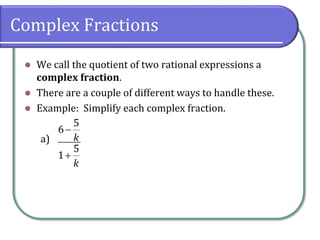
Complex Fractions
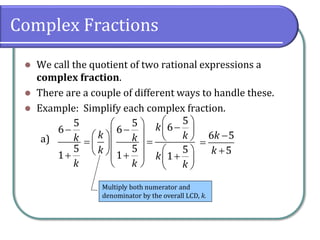
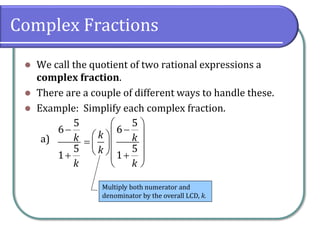
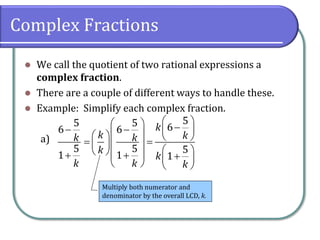
⚫ We call the quotient of two rational expressions a
complex fraction.
⚫ There are a couple of different ways to handle these.
⚫ Example: Simplify each complex fraction.
a)
5
6
5
1
k
k
−
+
Complex Fractions
⚫ We call the quotient of two rational expressions a
complex fraction.
⚫ There are a couple of different ways to handle these.
⚫ Example: Simplify each complex fraction.
a)
5
6
5
1
k
k
−
+
5
6
5
1
k k
k
k
 
−  
=   
  +
 
Multiply both numerator and
denominator by the overall LCD, k.
Complex Fractions
⚫ We call the quotient of two rational expressions a
complex fraction.
⚫ There are a couple of different ways to handle these.
⚫ Example: Simplify each complex fraction.
a)
5
6
5
1
k
k
−
+
55 66
5 5
1 1
k
k kk
k
k
k k
   −−      = =  
   + +    
Multiply both numerator and
denominator by the overall LCD, k.
Complex Fractions
⚫ We call the quotient of two rational expressions a
complex fraction.
⚫ There are a couple of different ways to handle these.
⚫ Example: Simplify each complex fraction.
a)
5
6
5
1
k
k
−
+
55 66
5 5
1 1
k
k kk
k
k
k k
   −−      = =  
   + +    
6 5
5
k
k
−
=
+
Multiply both numerator and
denominator by the overall LCD, k.
Complex Fractions (cont.)
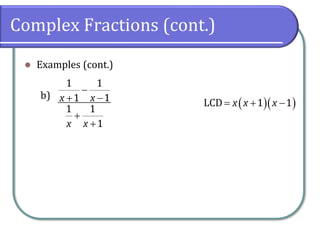
⚫ Examples (cont.)
b)
1 1
1 1
1 1
1
x x
x x
−
+ −
+
+
( )( )LCD 1 1x x x= + −
Complex Fractions (cont.)
⚫ Examples (cont.)
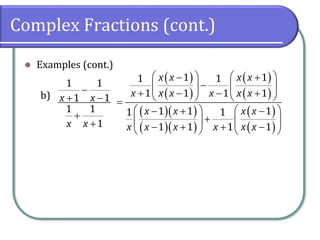
b)
1 1
1 1
1 1
1
x x
x x
−
+ −
+
+
( )
( )
( )
( )
( )( )
( )( )
( )
( )
1 11 1
1 1 1 1
1 1 11 1
1 1 1 1
x x x x
x x x x x x
x x x x
x x x x x x
   − +
−   
+ − − +   =
   − + −
+   
− + + −   
Complex Fractions (cont.)
⚫ Examples (cont.)
b)
1 1
1 1
1 1
1
x x
x x
−
+ −
+
+
( )
( )
( )
( )
( )( )
( )( )
( )
( )
1 11 1
1 1 1 1
1 1 11 1
1 1 1 1
x x x x
x x x x x x
x x x x
x x x x x x
   − +
−   
+ − − +   =
   − + −
+   
− + + −   
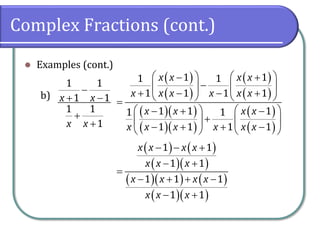
( ) ( )
( )( )
( )( ) ( )
( )( )
1 1
1 1
1 1 1
1 1
x x x x
x x x
x x x x
x x x
− − +
− +
=
− + + −
− +
Complex Fractions (cont.)
⚫ Examples (cont.)
b) ( )
( )
2 2
2
2 2
2
1
1
1
x x x x
x x
x x x
x x
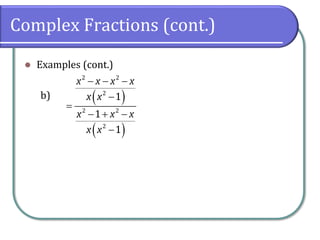
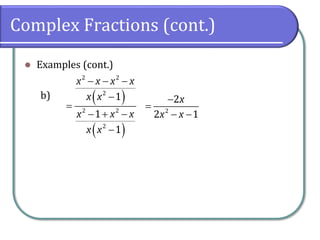
− − −
−
=
− + −
−
Complex Fractions (cont.)
⚫ Examples (cont.)
b) ( )
( )
2 2
2
2 2
2
1
1
1
x x x x
x x
x x x
x x
− − −
−
=
− + −
−
2
2
2 1
x
x x
−
=
− −
Classwork
⚫ 0.5 Assignment – Pg. 50: 12-36 (x4); pg. 41: 28-68 (x4);
pg. 31: 78-92 (even)
⚫ 0.5 Classwork Check (due 9/8)
⚫ Quiz 0.4 (due 9/8)

0.5 Rational Expressions

  • 1.
    0.5 Rational Expressions Chapter0 Review of Basic Concepts
  • 2.
    Concepts & Objectives ⚫Rational expressions ⚫ Finding the domain of a rational expression ⚫ Writing rational expressions in lowest terms ⚫ Multiplying and dividing rational expressions ⚫ Adding and subtracting rational expressions ⚫ Simplifying complex fractions
  • 3.
    Rational Expressions ⚫ Thequotient of two polynomials P and Q, with Q ≠ 0, is called a rational expression. ⚫ The domain of a rational expression is the set of real numbers for which the expression is defined. ⚫ Because the denominator of a rational expression cannot be 0, the domain consists of all real numbers, except those which make the denominator 0. ⚫ We can find these numbers by setting the denominator equal to 0 and solving the resulting equation.
  • 4.
    Rational Expressions (cont.) ⚫Example: What is the domain of the rational expression? 6 2 x x + +
  • 5.
    Rational Expressions (cont.) ⚫Example: What is the domain of the rational expression? Set the denominator equal to 0 and solve: 6 2 x x + + 2 0x + = 2x = −
  • 6.
    Rational Expressions (cont.) ⚫A rational expression is written in lowest terms when the greatest common factor of its numerator and denominator is 1. ⚫ Example: Write the rational expression in lowest terms. 2 3 6 4 k k − −
  • 7.
    Rational Expressions (cont.) ⚫A rational expression is written in lowest terms when the greatest common factor of its numerator and denominator is 1. ⚫ Example: Write the rational expression in lowest terms. 2 3 6 4 k k − − ( ) ( )( ) 3 2 2 2 k k k − = + −
  • 8.
    Rational Expressions (cont.) ⚫A rational expression is written in lowest terms when the greatest common factor of its numerator and denominator is 1. ⚫ Example: Write the rational expression in lowest terms. 2 3 6 4 k k − − ( ) ( )( ) 3 2 2 2 k k k − = + − 3 2k = +
  • 9.
    Rational Expressions (cont.) ⚫A rational expression is written in lowest terms when the greatest common factor of its numerator and denominator is 1. ⚫ Example: Write the rational expression in lowest terms. To determine the domain, we use the original denominator: 2 3 6 4 k k − − ( ) ( )( ) 3 2 2 2 k k k − = + − 3 2k = + ( )( )2 2 0 2 k k k + − = = 
  • 10.
    Rational Expressions (cont.) ⚫A rational expression is written in lowest terms when the greatest common factor of its numerator and denominator is 1. ⚫ Example: Write the rational expression in lowest terms. To determine the domain, we use the original denominator: 2 3 6 4 k k − − ( ) ( )( ) 3 2 2 2 k k k − = + − 3 2k = + ( )( )2 2 0 2 k k k + − = =   domain: | 2k k  
  • 11.
    Multiplying and Dividing ⚫We multiply and divide rational expressions using definitions from ealier work with fractions. ⚫ It is generally assumed that you will leave your answer in lowest terms. For fractions and , (b ≠ 0, d ≠ 0), and a b c d a c ac b d bd = ( )0 a c a d ad c b d b c bc  = = 
  • 12.
    Multiplying and Dividing(cont.) Examples: Multiply or divide, as indicated 1. 2. 3. 2 5 2 27 9 8 y y 2 2 4 3 10 2 1 2 3 2 4 n n n n n n + − − + − + 2 3 2 4 3 3 11 4 9 36 24 8 24 36 p p p p p p p + − +  − −
  • 13.
    Multiplying and Dividing(cont.) Examples: Multiply or divide, as indicated 1. 2. 3. 2 5 2 27 9 8 y y 2 2 4 3 10 2 1 2 3 2 4 n n n n n n + − − + − + 2 3 2 4 3 3 11 4 9 36 24 8 24 36 p p p p p p p + − +  − − 2 5 3 54 3 72 4 y y y = =
  • 14.
    Multiplying and Dividing(cont.) Examples: Multiply or divide, as indicated 1. 2. 3. 2 5 2 27 9 8 y y 2 2 4 3 10 2 1 2 3 2 4 n n n n n n + − − + − + 2 3 2 4 3 3 11 4 9 36 24 8 24 36 p p p p p p p + − +  − − 2 5 3 54 3 72 4 y y y = =
  • 15.
    Multiplying and Dividing(cont.) Examples: Multiply or divide, as indicated 1. 2. 3. 2 5 2 27 9 8 y y 2 2 4 3 10 2 1 2 3 2 4 n n n n n n + − − + − + 2 3 2 4 3 3 11 4 9 36 24 8 24 36 p p p p p p p + − +  − − 2 5 3 54 3 72 4 y y y = = ( )( ) ( )( ) 4 5 2 2 1 2 1 2 4 n n n n n n − + − = − + +
  • 16.
    Multiplying and Dividing(cont.) Examples: Multiply or divide, as indicated 1. 2. 3. 2 5 2 27 9 8 y y 2 2 4 3 10 2 1 2 3 2 4 n n n n n n + − − + − + 2 3 2 4 3 3 11 4 9 36 24 8 24 36 p p p p p p p + − +  − − 2 5 3 54 3 72 4 y y y = = ( )( ) ( )( ) 4 5 2 2 1 2 1 2 4 n n n n n n − + − = − + + 4 5 4 n n − = +
  • 17.
    Multiplying and Dividing(cont.) Examples: Multiply or divide, as indicated 1. 2. 3. 2 5 2 27 9 8 y y 2 2 4 3 10 2 1 2 3 2 4 n n n n n n + − − + − + 2 3 2 4 3 3 11 4 9 36 24 8 24 36 p p p p p p p + − +  − − 2 5 3 54 3 72 4 y y y = = ( )( ) ( )( ) 4 5 2 2 1 2 1 2 4 n n n n n n − + − = − + + 4 5 4 n n − = +
  • 18.
    Multiplying and Dividing(cont.) Examples: Multiply or divide, as indicated 1. 2. 3. 2 5 2 27 9 8 y y 2 2 4 3 10 2 1 2 3 2 4 n n n n n n + − − + − + 2 3 2 4 3 3 11 4 9 36 24 8 24 36 p p p p p p p + − +  − − 2 5 3 54 3 72 4 y y y = = ( )( ) ( )( ) 4 5 2 2 1 2 1 2 4 n n n n n n − + − = − + + 4 5 4 n n − = + ( )( ) ( ) ( ) ( ) 3 2 3 1 4 12 2 3 8 3 1 9 4 p p p p p p p − + − = − +
  • 19.
    Multiplying and Dividing(cont.) Examples: Multiply or divide, as indicated 1. 2. 3. 2 5 2 27 9 8 y y 2 2 4 3 10 2 1 2 3 2 4 n n n n n n + − − + − + 2 3 2 4 3 3 11 4 9 36 24 8 24 36 p p p p p p p + − +  − − 2 5 3 54 3 72 4 y y y = = ( )( ) ( )( ) 4 5 2 2 1 2 1 2 4 n n n n n n − + − = − + + 4 5 4 n n − = + ( )( ) ( ) ( ) ( ) 3 2 3 1 4 12 2 3 8 3 1 9 4 p p p p p p p − + − = − + ( )2 3 6 p p− =
  • 20.
    Addition and Subtraction ⚫From earlier work with fractions: For fractions and , (b ≠ 0, d ≠ 0), and a b c d + a c ad bc b d bd + = a c ad bc b d bd − − =
  • 21.
    Addition and Subtraction ⚫From earlier work with fractions: ⚫ How this applies to rational expressions is that you will need to write each denominator as a product of prime factors and then use that to find the lowest common denominator (LCD) that includes all of the factors. For fractions and , (b ≠ 0, d ≠ 0), and a b c d + a c ad bc b d bd + = a c ad bc b d bd − − =
  • 22.
    Adding and Subtracting(cont.) Examples: Add or subtract, as indicated. 1. 2. 3. 2 5 1 9 6x x + 8 2 2 y y y + − − ( )( ) ( )( ) 4 6 3 5 5 5x x x x − − + + −
  • 23.
    Adding and Subtracting(cont.) Examples: Add or subtract, as indicated. 1. 2 5 1 9 6x x + ( )( )2 2 1 1 1 5 1 3 3 2x x = +
  • 24.
    Adding and Subtracting(cont.) Examples: Add or subtract, as indicated. 1. 2 5 1 9 6x x + ( )( )2 2 1 1 1 5 1 3 3 2x x = + 2 1 2 2 LCD 3 2 18x x= =
  • 25.
    Adding and Subtracting(cont.) Examples: Add or subtract, as indicated. 1. 2 5 1 9 6x x + ( )( )2 2 1 1 1 5 1 3 3 2x x = + 2 1 2 2 LCD 3 2 18x x= = ( )( )2 2 5 2 1 3 3 2 3 2 3 x x x x     = +       
  • 26.
    Adding and Subtracting(cont.) Examples: Add or subtract, as indicated. 1. 2 5 1 9 6x x + ( )( )2 2 1 1 1 5 1 3 3 2x x = + 2 1 2 2 LCD 3 2 18x x= = ( )( )2 2 5 2 1 3 3 2 3 2 3 x x x x     = +        2 2 2 10 3 10 3 18 18 18 x x x x x + = + =
  • 27.
    Adding and Subtracting(cont.) Examples: Add or subtract, as indicated. 2. 8 2 2 y y y + − − ( ) 8 2 2 y y y = + − − −
  • 28.
    Adding and Subtracting(cont.) Examples: Add or subtract, as indicated. 2. 8 2 2 y y y + − − ( ) 8 2 2 y y y = + − − − ( )LCD 2y= −
  • 29.
    Adding and Subtracting(cont.) Examples: Add or subtract, as indicated. 2. 8 2 2 y y y + − − ( ) 8 2 2 y y y = + − − − ( )LCD 2y= − ( ) 8 1 2 2 1 y y y −  = +  − − − − 
  • 30.
    Adding and Subtracting(cont.) Examples: Add or subtract, as indicated. 2. 8 2 2 y y y + − − ( ) 8 2 2 y y y = + − − − ( )LCD 2y= − ( ) 8 1 2 2 1 y y y −  = +  − − − −  8 2 y y − = −
  • 31.
    Adding and Subtracting(cont.) Examples: Add or subtract, as indicated. 3. ( )( ) ( )( ) 4 6 3 5 5 5x x x x − − + + − ( )( )( )LCD 3 5 5x x x= − + −
  • 32.
    Adding and Subtracting(cont.) Examples: Add or subtract, as indicated. 3. ( )( ) ( )( ) 4 6 3 5 5 5x x x x − − + + − ( )( )( )LCD 3 5 5x x x= − + − ( )( ) ( )( ) 4 5 6 3 3 5 5 5 5 3 x x x x x x x x − −    = −   − + − + − −   
  • 33.
    Adding and Subtracting(cont.) Examples: Add or subtract, as indicated. 3. ( )( ) ( )( ) 4 6 3 5 5 5x x x x − − + + − ( )( )( )LCD 3 5 5x x x= − + − ( )( ) ( )( ) 4 5 6 3 3 5 5 5 5 3 x x x x x x x x − −    = −   − + − + − −    ( ) ( ) ( )( )( ) 4 5 6 3 3 5 5 x x x x x − − − = − + −
  • 34.
    Adding and Subtracting(cont.) Examples: Add or subtract, as indicated. 3. ( )( ) ( )( ) 4 6 3 5 5 5x x x x − − + + − ( )( )( )LCD 3 5 5x x x= − + − ( )( ) ( )( ) 4 5 6 3 3 5 5 5 5 3 x x x x x x x x − −    = −   − + − + − −    ( ) ( ) ( )( )( ) 4 5 6 3 3 5 5 x x x x x − − − = − + − ( )( )( ) 4 20 6 18 3 5 5 x x x x x − − + = − + −
  • 35.
    Adding and Subtracting(cont.) Examples: Add or subtract, as indicated. 3. ( )( ) ( )( ) 4 6 3 5 5 5x x x x − − + + − ( )( )( )LCD 3 5 5x x x= − + − ( )( ) ( )( ) 4 5 6 3 3 5 5 5 5 3 x x x x x x x x − −    = −   − + − + − −    ( ) ( ) ( )( )( ) 4 5 6 3 3 5 5 x x x x x − − − = − + − ( )( )( ) ( )( )( ) 4 20 6 18 2 2 3 5 5 3 5 5 x x x x x x x x x − − + − − = = − + − − + −
  • 36.
    Complex Fractions ⚫ Wecall the quotient of two rational expressions a complex fraction. ⚫ There are a couple of different ways to handle these. ⚫ Example: Simplify each complex fraction. a) 5 6 5 1 k k − +
  • 37.
    Complex Fractions ⚫ Wecall the quotient of two rational expressions a complex fraction. ⚫ There are a couple of different ways to handle these. ⚫ Example: Simplify each complex fraction. a) 5 6 5 1 k k − + 5 6 5 1 k k k k   −   =      +   Multiply both numerator and denominator by the overall LCD, k.
  • 38.
    Complex Fractions ⚫ Wecall the quotient of two rational expressions a complex fraction. ⚫ There are a couple of different ways to handle these. ⚫ Example: Simplify each complex fraction. a) 5 6 5 1 k k − + 55 66 5 5 1 1 k k kk k k k k    −−      = =      + +     Multiply both numerator and denominator by the overall LCD, k.
  • 39.
    Complex Fractions ⚫ Wecall the quotient of two rational expressions a complex fraction. ⚫ There are a couple of different ways to handle these. ⚫ Example: Simplify each complex fraction. a) 5 6 5 1 k k − + 55 66 5 5 1 1 k k kk k k k k    −−      = =      + +     6 5 5 k k − = + Multiply both numerator and denominator by the overall LCD, k.
  • 40.
    Complex Fractions (cont.) ⚫Examples (cont.) b) 1 1 1 1 1 1 1 x x x x − + − + + ( )( )LCD 1 1x x x= + −
  • 41.
    Complex Fractions (cont.) ⚫Examples (cont.) b) 1 1 1 1 1 1 1 x x x x − + − + + ( ) ( ) ( ) ( ) ( )( ) ( )( ) ( ) ( ) 1 11 1 1 1 1 1 1 1 11 1 1 1 1 1 x x x x x x x x x x x x x x x x x x x x    − + −    + − − +   =    − + − +    − + + −   
  • 42.
    Complex Fractions (cont.) ⚫Examples (cont.) b) 1 1 1 1 1 1 1 x x x x − + − + + ( ) ( ) ( ) ( ) ( )( ) ( )( ) ( ) ( ) 1 11 1 1 1 1 1 1 1 11 1 1 1 1 1 x x x x x x x x x x x x x x x x x x x x    − + −    + − − +   =    − + − +    − + + −    ( ) ( ) ( )( ) ( )( ) ( ) ( )( ) 1 1 1 1 1 1 1 1 1 x x x x x x x x x x x x x x − − + − + = − + + − − +
  • 43.
    Complex Fractions (cont.) ⚫Examples (cont.) b) ( ) ( ) 2 2 2 2 2 2 1 1 1 x x x x x x x x x x x − − − − = − + − −
  • 44.
    Complex Fractions (cont.) ⚫Examples (cont.) b) ( ) ( ) 2 2 2 2 2 2 1 1 1 x x x x x x x x x x x − − − − = − + − − 2 2 2 1 x x x − = − −
  • 45.
    Classwork ⚫ 0.5 Assignment– Pg. 50: 12-36 (x4); pg. 41: 28-68 (x4); pg. 31: 78-92 (even) ⚫ 0.5 Classwork Check (due 9/8) ⚫ Quiz 0.4 (due 9/8)