Module 11 Topic 1  Graphing and Solving Quadratic Equations Goal 4:  The learner will use relations and functions to solve problems and justify results. Objective 4.02:  Graph, factor, and evaluate quadratic functions to solve problems.
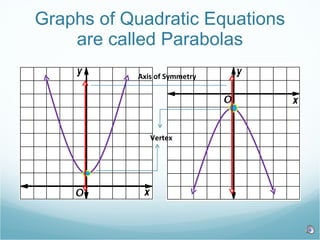
Graphs of Quadratic Equations are called Parabolas Vertex Axis of Symmetry
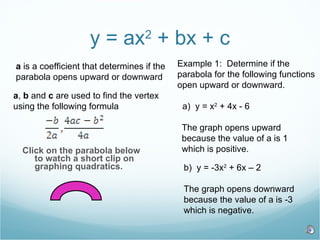
y = ax 2  + bx + c   Click on the parabola below to watch a short clip on graphing quadratics.  a  is a coefficient that determines if the  parabola opens upward or downward a ,  b  and  c  are used to find the vertex  using the following formula Example 1:  Determine if the  parabola for the following functions  open upward or downward. a)  y = x 2  + 4x - 6 The graph opens upward because the value of a is 1 which is positive.  b)  y = -3x 2  + 6x – 2  The graph opens downward because the value of a is -3 which is negative.
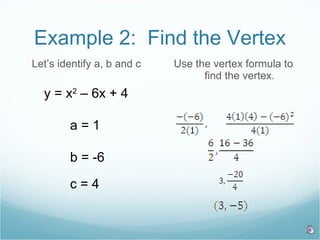
Example 2:  Find the Vertex Let’s identify a, b and c Use the vertex formula to find the vertex. y = x 2  – 6x + 4 a = 1 b = -6 c = 4
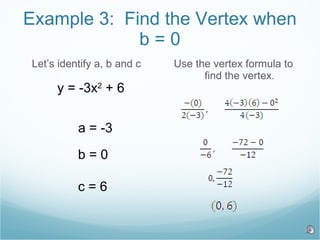
Example 3:  Find the Vertex when b = 0 Let’s identify a, b and c Use the vertex formula to find the vertex. y = -3x 2  + 6 a = -3 b = 0 c = 6
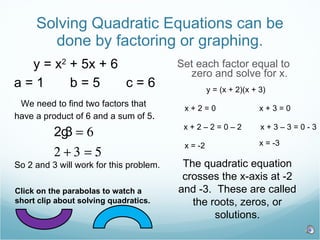
Solving Quadratic Equations can be done by factoring or graphing. Set each factor equal to zero and solve for x. y = x 2  + 5x + 6 a = 1 b = 5 c = 6 We need to find two factors that  have a product of 6 and a sum of 5 . So 2 and 3 will work for this problem. Click on the parabolas to watch a  short clip about solving quadratics.  y = (x + 2)(x + 3) x + 2 = 0 x + 2 – 2 = 0 – 2  x = -2 x + 3 = 0 x + 3 – 3 = 0 - 3 x = -3 The quadratic equation crosses the x-axis at -2 and -3.  These are called the roots, zeros, or solutions.

Module 11 Topic 1

  • 1.
    Module 11 Topic1 Graphing and Solving Quadratic Equations Goal 4: The learner will use relations and functions to solve problems and justify results. Objective 4.02: Graph, factor, and evaluate quadratic functions to solve problems.
  • 2.
    Graphs of QuadraticEquations are called Parabolas Vertex Axis of Symmetry
  • 3.
    y = ax2 + bx + c Click on the parabola below to watch a short clip on graphing quadratics. a is a coefficient that determines if the parabola opens upward or downward a , b and c are used to find the vertex using the following formula Example 1: Determine if the parabola for the following functions open upward or downward. a) y = x 2 + 4x - 6 The graph opens upward because the value of a is 1 which is positive. b) y = -3x 2 + 6x – 2 The graph opens downward because the value of a is -3 which is negative.
  • 4.
    Example 2: Find the Vertex Let’s identify a, b and c Use the vertex formula to find the vertex. y = x 2 – 6x + 4 a = 1 b = -6 c = 4
  • 5.
    Example 3: Find the Vertex when b = 0 Let’s identify a, b and c Use the vertex formula to find the vertex. y = -3x 2 + 6 a = -3 b = 0 c = 6
  • 6.
    Solving Quadratic Equationscan be done by factoring or graphing. Set each factor equal to zero and solve for x. y = x 2 + 5x + 6 a = 1 b = 5 c = 6 We need to find two factors that have a product of 6 and a sum of 5 . So 2 and 3 will work for this problem. Click on the parabolas to watch a short clip about solving quadratics. y = (x + 2)(x + 3) x + 2 = 0 x + 2 – 2 = 0 – 2 x = -2 x + 3 = 0 x + 3 – 3 = 0 - 3 x = -3 The quadratic equation crosses the x-axis at -2 and -3. These are called the roots, zeros, or solutions.

Editor's Notes