Alcohols Butan - 1, 4 - diol Butan- 1- ol Propan- 2- ol Propan- 1- ol
These all have the formula C 4 H 9 OH butan-1-ol butan-2-ol 2-methylpropan-1-ol 2-methylpropan-2-ol
Bond angles in alcohol groups
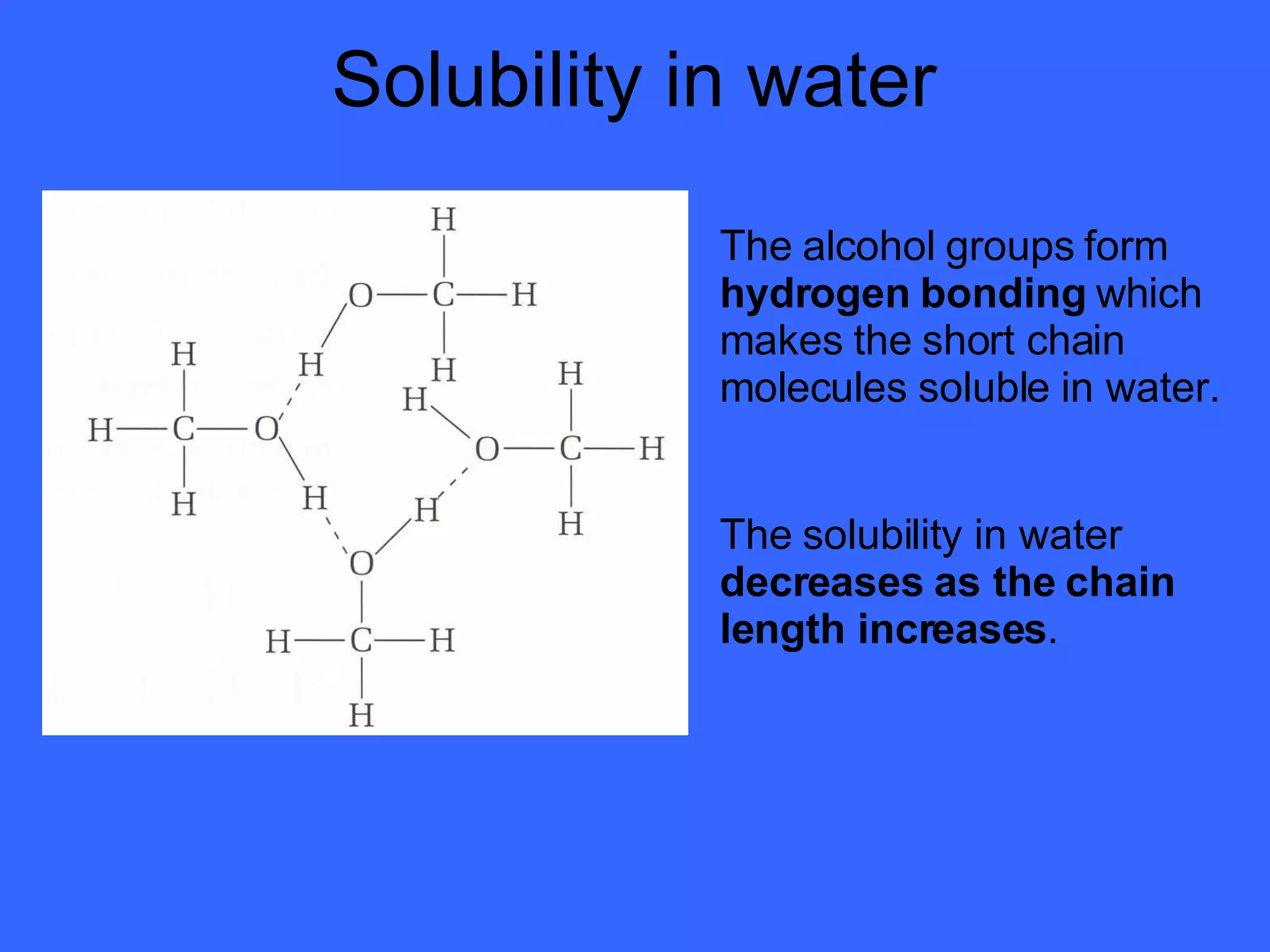
Solubility in water The alcohol groups form  hydrogen bonding  which makes the short chain molecules soluble in water. The solubility in water  decreases as the chain length increases .
Low-mass alcohols are soluble in water (because they  hydrogen bond  with water).  As the hydrocarbon chain lengthens, the solubility decreases . This photo shows ethanol, propan-1-ol and butan-1-ol in water. The first two are completely miscible in water,  while butan-1-ol is not miscible in water. Ethanol Propan-1-ol Butan-1-ol
Boiling Points of Alcohols Increases with molecular size due to increased instantaneous dipoles Alcohols have higher boiling points than similar molecular mass alkanes This is due to the added presence of inter-molecular hydrogen bonding.  More energy is required to separate the molecules     M r   bp / °C propane C 3 H 8   44   -42 just instantaneous dipoles ethanol C 2 H 5 OH   46   +78  instantaneous dipoles   +  hydrogen bonding Boiling point is higher for “straight” chain isomers.   bp / °C butan-1-ol   CH 3 CH 2 CH 2 CH 2 OH 118 butan-2-ol   CH 3 CH 2 CH(OH)CH 3 100 2-methylbutan-2-ol   (CH 3 ) 3 COH     83
CLASSIFICATION OF ALCOHOLS Aliphatic  •  general formula C n H 2n+1 OH   - provided there are no rings   •  the OH replaces an H in a basic hydrocarbon skeleton Structural differences   • alcohols are  classified according to the environment of  the OH  group   •  chemical behaviour, eg oxidation, often depends on the  structural type PRIMARY  1°  SECONDARY  2°  TERTIARY  3° NB.  Aliphatic - straight chain molecule (not a ring / cyclic)
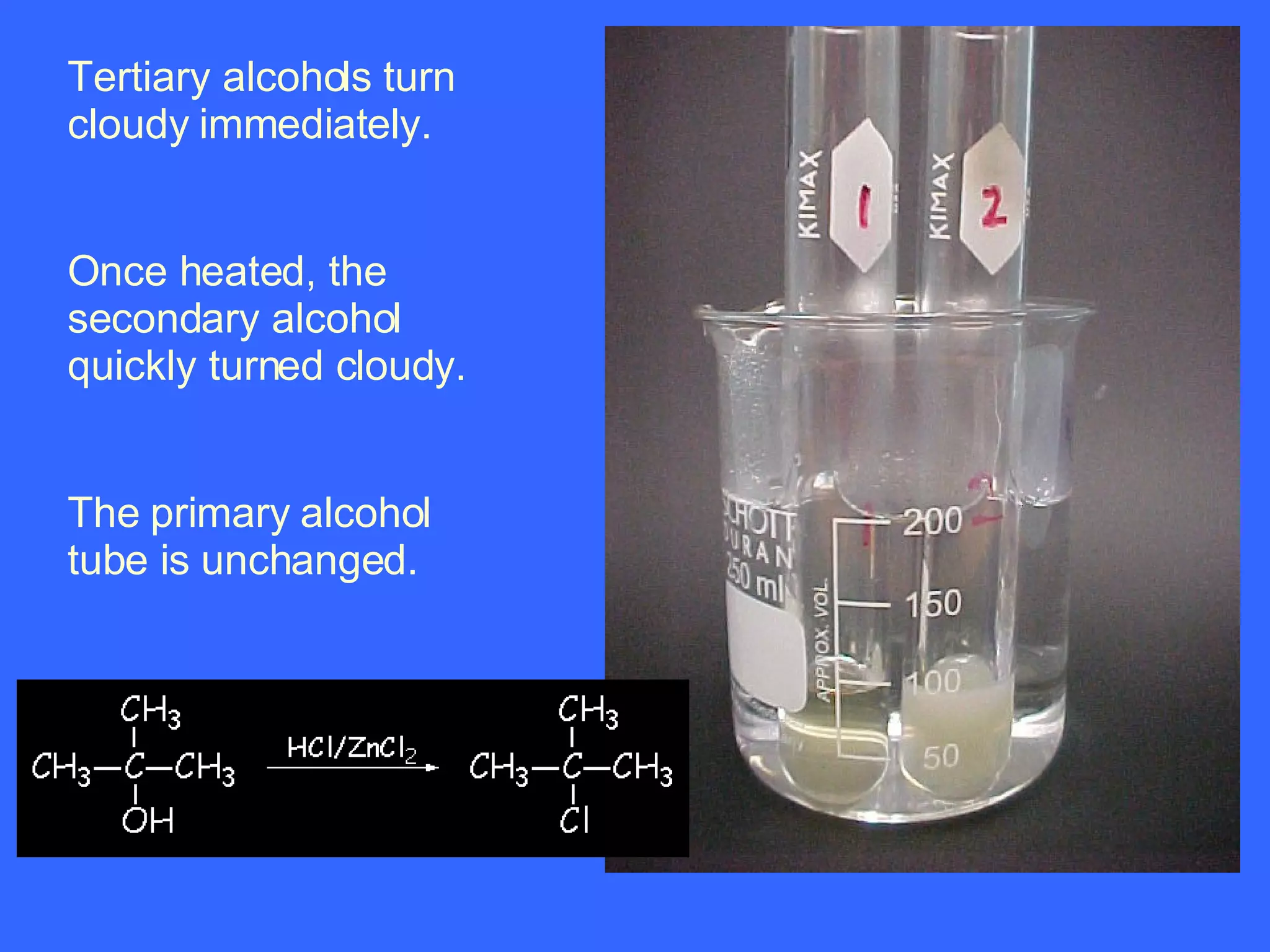
Distinguishing alcohols Lucas reagent can be used to distinguish between low mass primary, secondary and tertiary alcohols. Lucas reagent contains  anhydrous zinc chloride  dissolved in  concentrated hydrochloric acid.  It contains a very high concentration of chloride ions and the Zn 2+  ion acts as a catalyst. Take 1–2 mL of Lucas reagent in a  dry  test tube, add a few drops of the alcohol and shake. If there is no reaction, place the test tube in a beaker of boiling water for a few minutes.
Distinguishing alcohols - Lucas test Primary alcohol - remain unchanged tertiary alcohol - turns cloudy immediately Secondary alcohol - will turn cloudy but takes a bit of time Lucas reagent = conc. HCl and ZnCl 2
Tertiary alcohols turn cloudy immediately. Once heated, the secondary alcohol quickly turned cloudy.  The primary alcohol tube is unchanged.
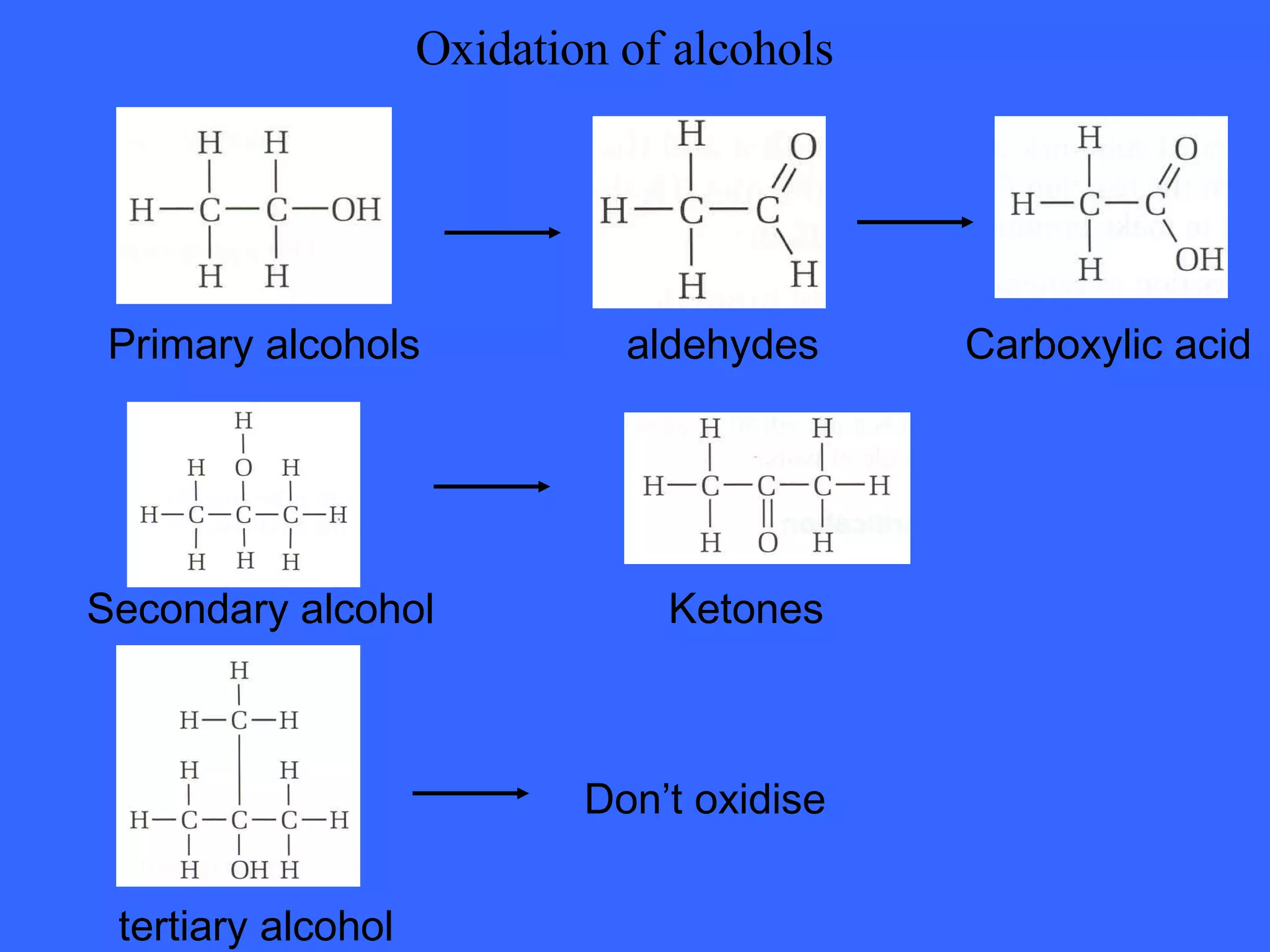
OXIDATION OF PRIMARY ALCOHOLS Primary alcohols are easily oxidised to aldehydes e.g.  CH 3 CH 2 OH(l)  +  [O]  ——>  CH 3 CHO(l)  +  H 2 O(l)   ethanol    ethanal it is essential to distil off the aldehyde before it gets oxidised to the acid   CH 3 CHO(l)  +  [O]  ——>  CH 3 COOH(l)   ethanal   ethanoic acid Practical details the alcohol is dripped into a warm solution of acidified K 2 Cr 2 O 7 aldehydes have low boiling points  - no hydrogen bonding - they  distil off immediately if it didn’t distil off it would be oxidised to the equivalent carboxylic acid to  oxidise an alcohol straight to the acid, reflux  the mixture compound   formula intermolecular bonding boiling point ETHANOL   C 2 H 5 OH HYDROGEN BONDING   78°C ETHANAL   CH 3 CHO DIPOLE-DIPOLE    23°C ETHANOIC ACID   CH 3 COOH HYDROGEN BONDING   118°C
Oxidising a primary alcohol to an aldehyde Full oxidation is not wanted: use dilute acid and less dichromate.  The reaction mixture is heated gently,  ethanal vapourises (21°C) as soon as it is formed and distils over.  This stops it being oxidised further to ethanoic acid.
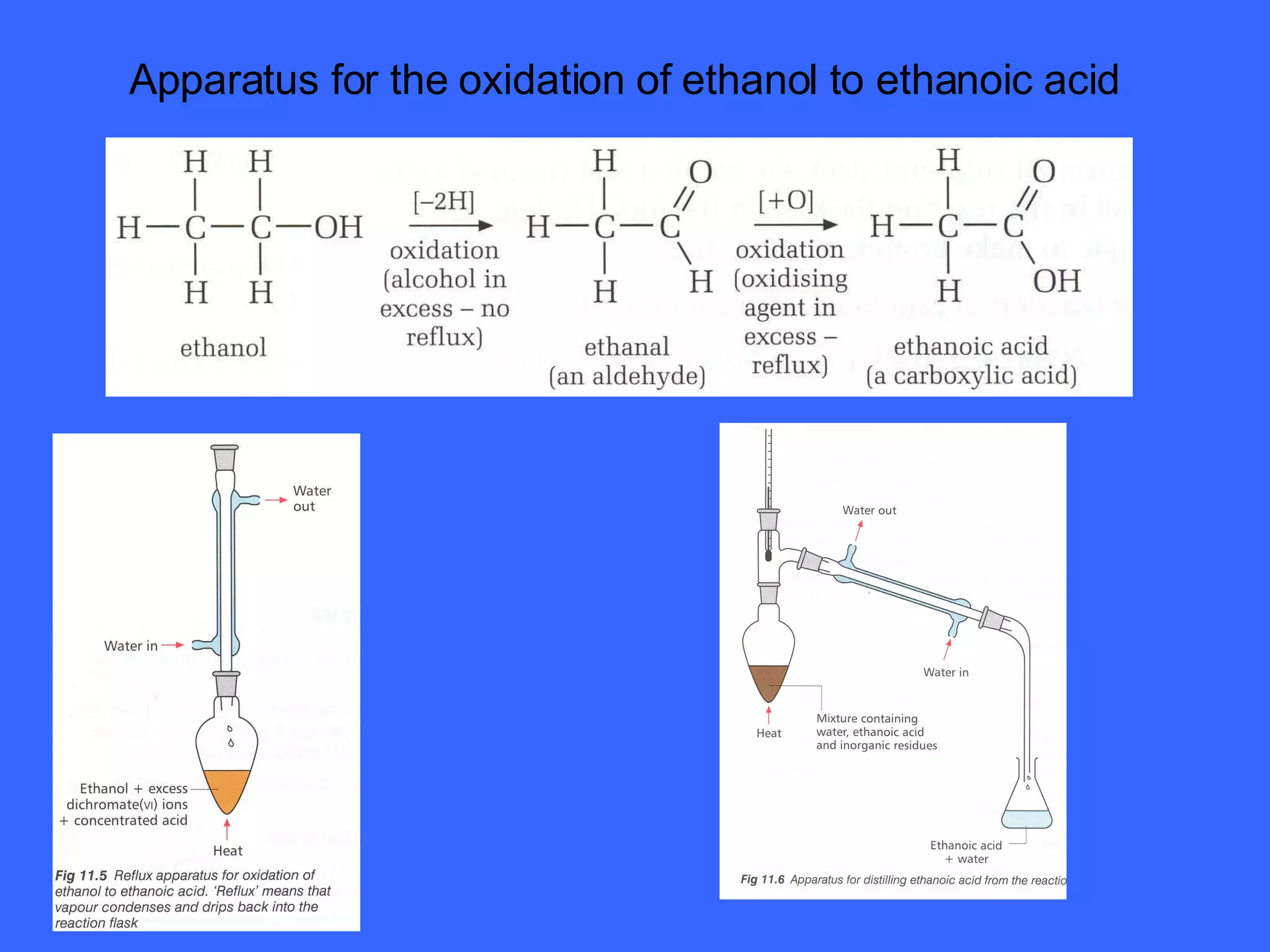
Apparatus for the oxidation of ethanol to ethanoic acid
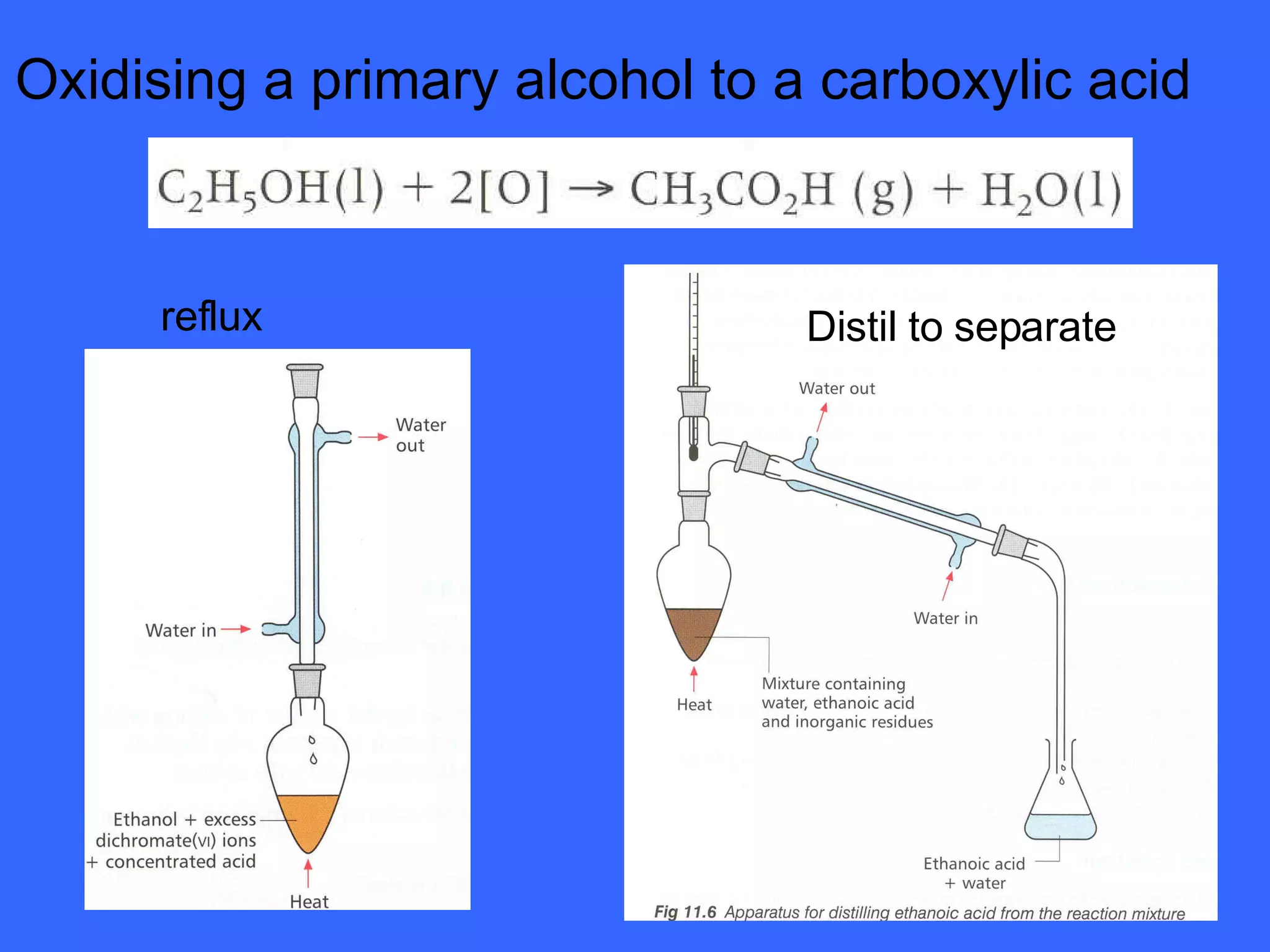
Oxidising a primary alcohol to a carboxylic acid reflux Distil to separate
Oxidising a secondary alcohol to a ketone
Oxidation of alcohols Primary and secondary alcohols are oxidised by acidified potassium dichromate.  A beaker of hot water speeds up the reaction.  There is no reaction with tertiary alcohols.
Oxidation of alcohols Primary alcohols tertiary alcohol Secondary alcohol aldehydes Carboxylic acid Don’t oxidise Ketones
Formation of ethanol by fermentation Conditions yeast warm, but no higher than 37°C (optimum temp. for yeast) Advantages LOW ENERGY PROCESS USES RENEWABLE RESOURCES - PLANT MATERIAL SIMPLE EQUIPMENT Disadvantages SLOW PRODUCES IMPURE ETHANOL - will need distilling to purify BATCH PROCESS
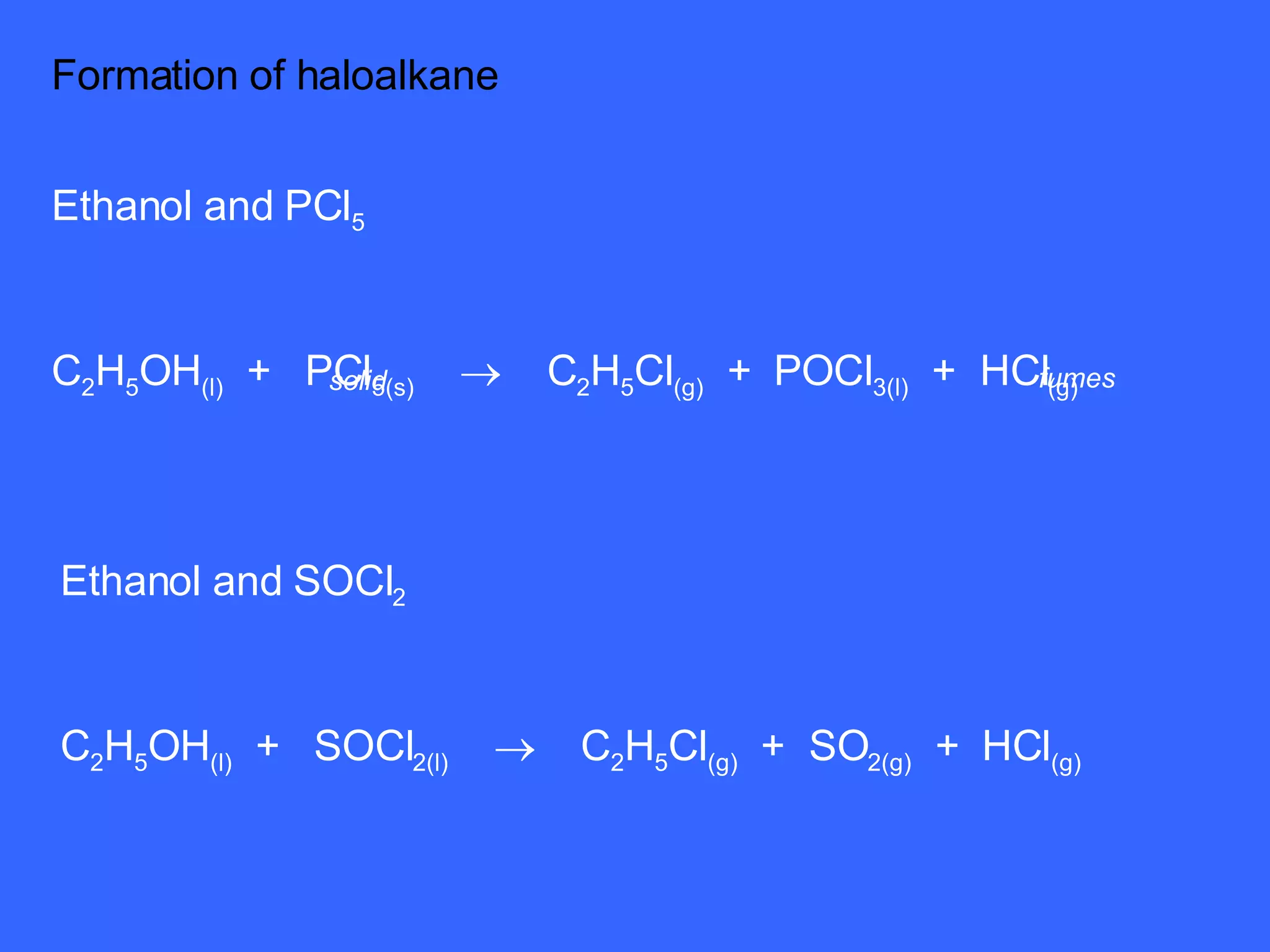
Formation of haloalkane  Ethanol and PCl 5 C 2 H 5 OH (l)   +  PCl 5(s)      C 2 H 5 Cl (g)   +  POCl 3(l)   +  HCl (g) fumes solid Ethanol and SOCl 2 C 2 H 5 OH (l)   +  SOCl 2(l)      C 2 H 5 Cl (g)   +  SO 2(g)   +  HCl (g)
Formation of ethanol from ethene Advantages FAST PURE ETHANOL PRODUCED CONTINUOUS PROCESS Disadvantages HIGH ENERGY PROCESS EXPENSIVE PLANT REQUIRED USES NON-RENEWABLE FOSSIL FUELS TO MAKE ETHENE Uses of ethanol ALCOHOLIC DRINKS SOLVENT - industrial alcohol / methylated spirits FUEL - petrol substitute in countries with limited oil reserves
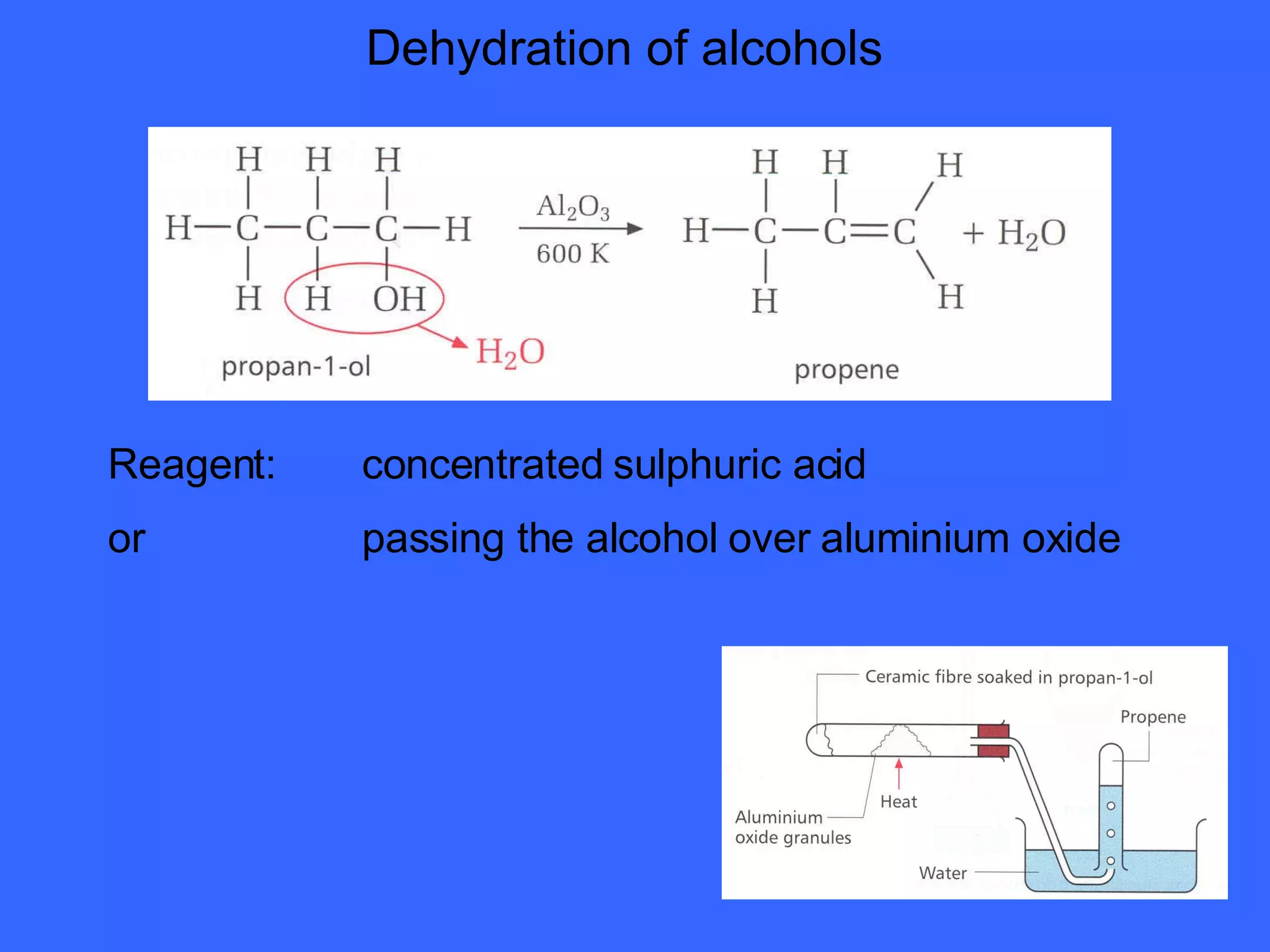
Dehydration of alcohols Reagent:  concentrated sulphuric acid or  passing the alcohol over aluminium oxide
Reaction with sodium The reaction is similar to the reaction of alkali metals with water,  but less vigorous .
Esterification Catalyst : concentrated H 2 SO 4  (dehydrating agent - it removes water    causing the equilibrium to move to the right and increases the yield Conditions: reflux
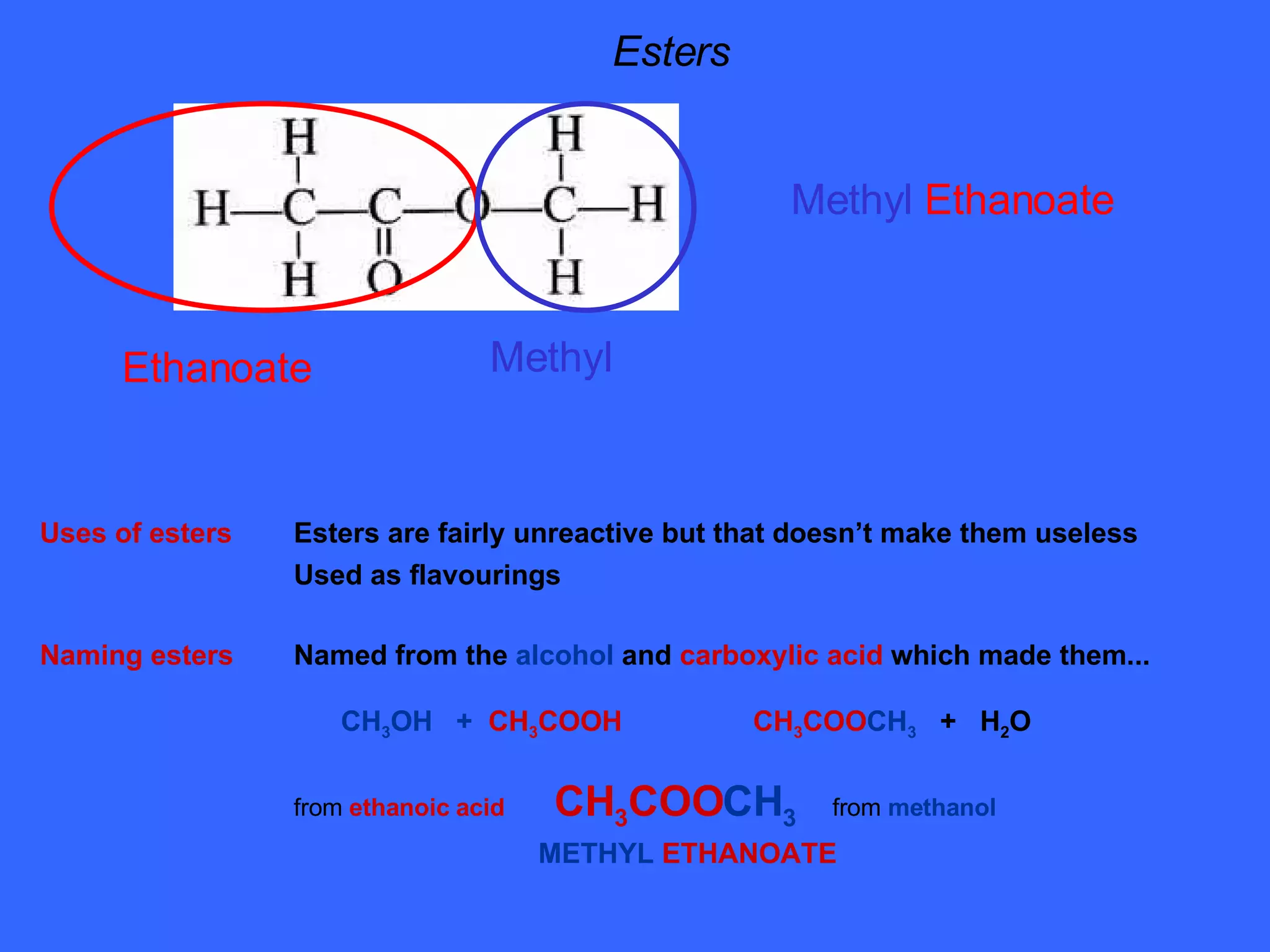
Uses of esters Esters are fairly unreactive but that doesn’t make them useless Used as flavourings Naming esters Named from the  alcohol  and  carboxylic acid  which made them...   CH 3 OH  +  CH 3 COOH   CH 3 COO CH 3   +  H 2 O from   ethanoic acid   CH 3 COO CH 3   from  methanol   METHYL   ETHANOATE Esters Ethanoate Methyl Methyl  Ethanoate

Alcohol powerpoint

  • 1.
    Alcohols Butan -1, 4 - diol Butan- 1- ol Propan- 2- ol Propan- 1- ol
  • 2.
    These all havethe formula C 4 H 9 OH butan-1-ol butan-2-ol 2-methylpropan-1-ol 2-methylpropan-2-ol
  • 3.
    Bond angles inalcohol groups
  • 4.
    Solubility in waterThe alcohol groups form hydrogen bonding which makes the short chain molecules soluble in water. The solubility in water decreases as the chain length increases .
  • 5.
    Low-mass alcohols aresoluble in water (because they hydrogen bond with water). As the hydrocarbon chain lengthens, the solubility decreases . This photo shows ethanol, propan-1-ol and butan-1-ol in water. The first two are completely miscible in water, while butan-1-ol is not miscible in water. Ethanol Propan-1-ol Butan-1-ol
  • 6.
    Boiling Points ofAlcohols Increases with molecular size due to increased instantaneous dipoles Alcohols have higher boiling points than similar molecular mass alkanes This is due to the added presence of inter-molecular hydrogen bonding. More energy is required to separate the molecules M r bp / °C propane C 3 H 8 44 -42 just instantaneous dipoles ethanol C 2 H 5 OH 46 +78 instantaneous dipoles + hydrogen bonding Boiling point is higher for “straight” chain isomers. bp / °C butan-1-ol CH 3 CH 2 CH 2 CH 2 OH 118 butan-2-ol CH 3 CH 2 CH(OH)CH 3 100 2-methylbutan-2-ol (CH 3 ) 3 COH 83
  • 7.
    CLASSIFICATION OF ALCOHOLSAliphatic • general formula C n H 2n+1 OH - provided there are no rings • the OH replaces an H in a basic hydrocarbon skeleton Structural differences • alcohols are classified according to the environment of the OH group • chemical behaviour, eg oxidation, often depends on the structural type PRIMARY 1° SECONDARY 2° TERTIARY 3° NB. Aliphatic - straight chain molecule (not a ring / cyclic)
  • 8.
    Distinguishing alcohols Lucasreagent can be used to distinguish between low mass primary, secondary and tertiary alcohols. Lucas reagent contains anhydrous zinc chloride dissolved in concentrated hydrochloric acid. It contains a very high concentration of chloride ions and the Zn 2+ ion acts as a catalyst. Take 1–2 mL of Lucas reagent in a dry test tube, add a few drops of the alcohol and shake. If there is no reaction, place the test tube in a beaker of boiling water for a few minutes.
  • 9.
    Distinguishing alcohols -Lucas test Primary alcohol - remain unchanged tertiary alcohol - turns cloudy immediately Secondary alcohol - will turn cloudy but takes a bit of time Lucas reagent = conc. HCl and ZnCl 2
  • 10.
    Tertiary alcohols turncloudy immediately. Once heated, the secondary alcohol quickly turned cloudy. The primary alcohol tube is unchanged.
  • 11.
    OXIDATION OF PRIMARYALCOHOLS Primary alcohols are easily oxidised to aldehydes e.g. CH 3 CH 2 OH(l) + [O] ——> CH 3 CHO(l) + H 2 O(l) ethanol ethanal it is essential to distil off the aldehyde before it gets oxidised to the acid CH 3 CHO(l) + [O] ——> CH 3 COOH(l) ethanal ethanoic acid Practical details the alcohol is dripped into a warm solution of acidified K 2 Cr 2 O 7 aldehydes have low boiling points - no hydrogen bonding - they distil off immediately if it didn’t distil off it would be oxidised to the equivalent carboxylic acid to oxidise an alcohol straight to the acid, reflux the mixture compound formula intermolecular bonding boiling point ETHANOL C 2 H 5 OH HYDROGEN BONDING 78°C ETHANAL CH 3 CHO DIPOLE-DIPOLE 23°C ETHANOIC ACID CH 3 COOH HYDROGEN BONDING 118°C
  • 12.
    Oxidising a primaryalcohol to an aldehyde Full oxidation is not wanted: use dilute acid and less dichromate. The reaction mixture is heated gently, ethanal vapourises (21°C) as soon as it is formed and distils over. This stops it being oxidised further to ethanoic acid.
  • 13.
    Apparatus for theoxidation of ethanol to ethanoic acid
  • 14.
    Oxidising a primaryalcohol to a carboxylic acid reflux Distil to separate
  • 15.
    Oxidising a secondaryalcohol to a ketone
  • 16.
    Oxidation of alcoholsPrimary and secondary alcohols are oxidised by acidified potassium dichromate. A beaker of hot water speeds up the reaction. There is no reaction with tertiary alcohols.
  • 17.
    Oxidation of alcoholsPrimary alcohols tertiary alcohol Secondary alcohol aldehydes Carboxylic acid Don’t oxidise Ketones
  • 18.
    Formation of ethanolby fermentation Conditions yeast warm, but no higher than 37°C (optimum temp. for yeast) Advantages LOW ENERGY PROCESS USES RENEWABLE RESOURCES - PLANT MATERIAL SIMPLE EQUIPMENT Disadvantages SLOW PRODUCES IMPURE ETHANOL - will need distilling to purify BATCH PROCESS
  • 19.
    Formation of haloalkane Ethanol and PCl 5 C 2 H 5 OH (l) + PCl 5(s)  C 2 H 5 Cl (g) + POCl 3(l) + HCl (g) fumes solid Ethanol and SOCl 2 C 2 H 5 OH (l) + SOCl 2(l)  C 2 H 5 Cl (g) + SO 2(g) + HCl (g)
  • 20.
    Formation of ethanolfrom ethene Advantages FAST PURE ETHANOL PRODUCED CONTINUOUS PROCESS Disadvantages HIGH ENERGY PROCESS EXPENSIVE PLANT REQUIRED USES NON-RENEWABLE FOSSIL FUELS TO MAKE ETHENE Uses of ethanol ALCOHOLIC DRINKS SOLVENT - industrial alcohol / methylated spirits FUEL - petrol substitute in countries with limited oil reserves
  • 21.
    Dehydration of alcoholsReagent: concentrated sulphuric acid or passing the alcohol over aluminium oxide
  • 22.
    Reaction with sodiumThe reaction is similar to the reaction of alkali metals with water, but less vigorous .
  • 23.
    Esterification Catalyst :concentrated H 2 SO 4 (dehydrating agent - it removes water causing the equilibrium to move to the right and increases the yield Conditions: reflux
  • 24.
    Uses of estersEsters are fairly unreactive but that doesn’t make them useless Used as flavourings Naming esters Named from the alcohol and carboxylic acid which made them... CH 3 OH + CH 3 COOH CH 3 COO CH 3 + H 2 O from ethanoic acid CH 3 COO CH 3 from methanol METHYL ETHANOATE Esters Ethanoate Methyl Methyl Ethanoate