SURFACE TREATMENT OF AEROSPACE COMPONENTS 2014
DSCE, CHEMICAL ENGINEERING DEPARTMENT Page 1
ACKNOWLEDGEMENT
First and foremost we wish to express our gratitude towards Dr. Ravishankar R., Head of
Department of Chemical Engineering, for all the help extended to us at every stage of the
project.
We are indebted to Mr. Sunil H., our guide and Assistant Professor in the Department of
Chemical Engineering, for his valuable guidance, encouragement and suggestions through
the course of the project. Without his guidance this project would not have been completed.
We are also grateful to Mrs. Vidhya Karthikeyan, SCI - Engr ‘SD’ and Mr R Sundara
Rajan , Manger (STF), LPSC, ISRO for their valuable guidance and such a wonderful
opportunity to be a part of such an esteemed institution.
Finally, we would like to thanks our parents for their unending support to us in all
endeavours that we pursue.
SURFACE TREATMENT OF AEROSPACE COMPONENTS 2014
DSCE, CHEMICAL ENGINEERING DEPARTMENT Page 2
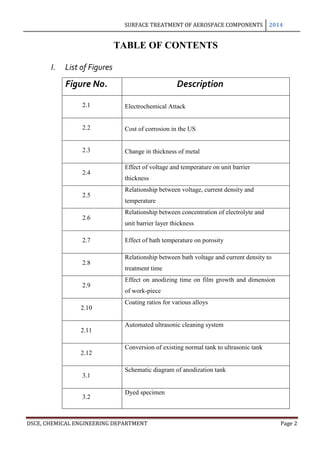
TABLE OF CONTENTS
I. List of Figures
Figure No. Description
2.1 Electrochemical Attack
2.2 Cost of corrosion in the US
2.3 Change in thickness of metal
2.4
Effect of voltage and temperature on unit barrier
thickness
2.5
Relationship between voltage, current density and
temperature
2.6
Relationship between concentration of electrolyte and
unit barrier layer thickness
2.7 Effect of bath temperature on porosity
2.8
Relationship between bath voltage and current density to
treatment time
2.9
Effect on anodizing time on film growth and dimension
of work-piece
2.10
Coating ratios for various alloys
2.11
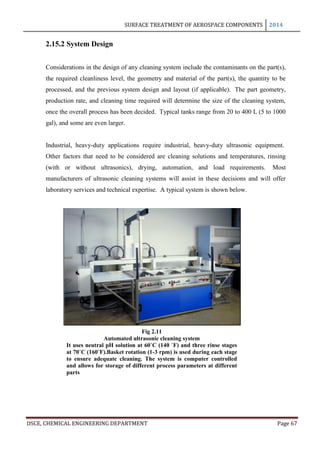
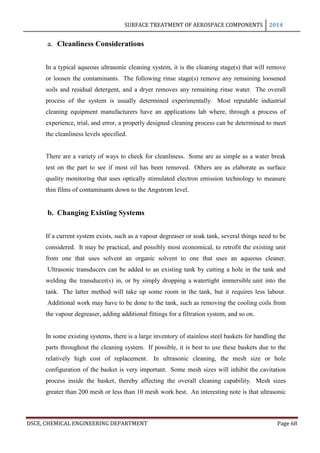
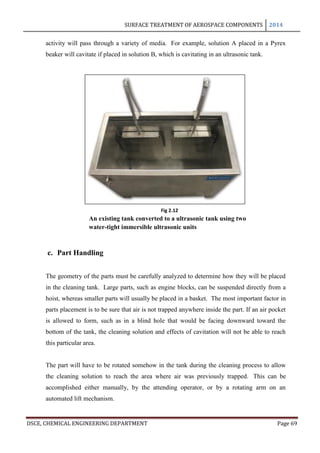
Automated ultrasonic cleaning system
2.12
Conversion of existing normal tank to ultrasonic tank
3.1
Schematic diagram of anodization tank
3.2
Dyed specimen
SURFACE TREATMENT OF AEROSPACE COMPONENTS 2014
DSCE, CHEMICAL ENGINEERING DEPARTMENT Page 3
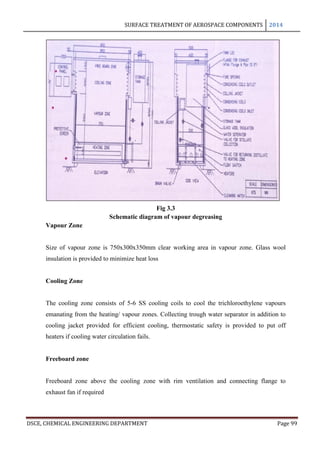
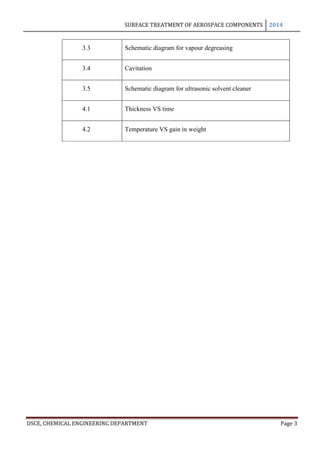
3.3 Schematic diagram for vapour degreasing
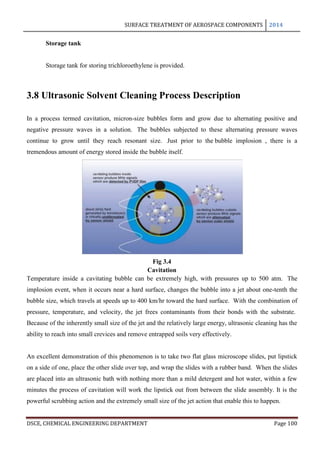
3.4 Cavitation
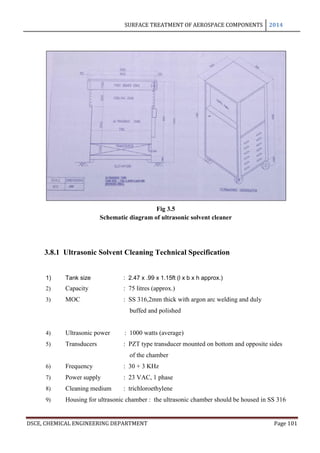
3.5 Schematic diagram for ultrasonic solvent cleaner
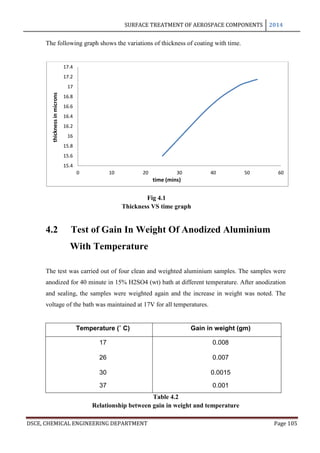
4.1 Thickness VS time
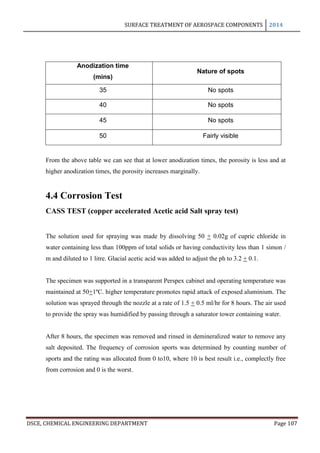
4.2 Temperature VS gain in weight
SURFACE TREATMENT OF AEROSPACE COMPONENTS 2014
DSCE, CHEMICAL ENGINEERING DEPARTMENT Page 4
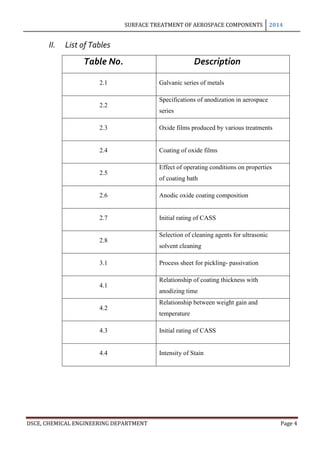
II. List of Tables
Table No. Description
2.1 Galvanic series of metals
2.2
Specifications of anodization in aerospace
series
2.3 Oxide films produced by various treatments
2.4 Coating of oxide films
2.5
Effect of operating conditions on properties
of coating bath
2.6 Anodic oxide coating composition
2.7 Initial rating of CASS
2.8
Selection of cleaning agents for ultrasonic
solvent cleaning
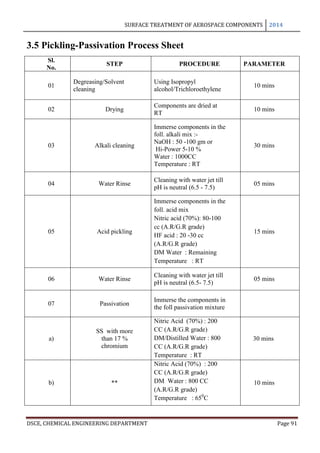
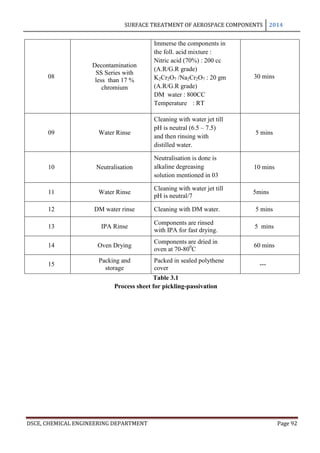
3.1 Process sheet for pickling- passivation
4.1
Relationship of coating thickness with
anodizing time
4.2
Relationship between weight gain and
temperature
4.3 Initial rating of CASS
4.4 Intensity of Stain
SURFACE TREATMENT OF AEROSPACE COMPONENTS 2014
DSCE, CHEMICAL ENGINEERING DEPARTMENT Page 5
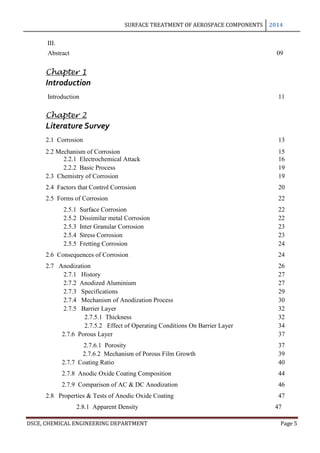
III.
Abstract 09
Chapter 1
Introduction
Introduction 11
Chapter 2
Literature Survey
2.1 Corrosion 13
2.2 Mechanism of Corrosion 15
2.2.1 Electrochemical Attack 16
2.2.2 Basic Process 19
2.3 Chemistry of Corrosion 19
2.4 Factors that Control Corrosion 20
2.5 Forms of Corrosion 22
2.5.1 Surface Corrosion 22
2.5.2 Dissimilar metal Corrosion 22
2.5.3 Inter Granular Corrosion 23
2.5.4 Stress Corrosion 23
2.5.5 Fretting Corrosion 24
2.6 Consequences of Corrosion 24
2.7 Anodization 26
2.7.1 History 27
2.7.2 Anodized Aluminium 27
2.7.3 Specifications 29
2.7.4 Mechanism of Anodization Process 30
2.7.5 Barrier Layer 32
2.7.5.1 Thickness 32
2.7.5.2 Effect of Operating Conditions On Barrier Layer 34
2.7.6 Porous Layer 37
2.7.6.1 Porosity 37
2.7.6.2 Mechanism of Porous Film Growth 39
2.7.7 Coating Ratio 40
2.7.8 Anodic Oxide Coating Composition 44
2.7.9 Comparison of AC & DC Anodization 46
2.8 Properties & Tests of Anodic Oxide Coating 47
2.8.1 Apparent Density 47
SURFACE TREATMENT OF AEROSPACE COMPONENTS 2014
DSCE, CHEMICAL ENGINEERING DEPARTMENT Page 6
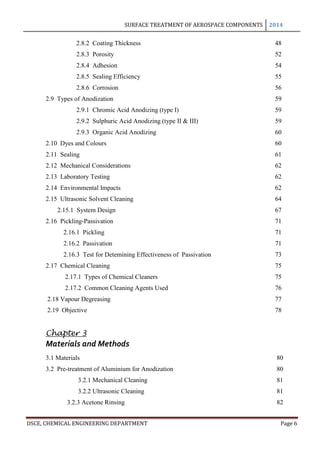
2.8.2 Coating Thickness 48
2.8.3 Porosity 52
2.8.4 Adhesion 54
2.8.5 Sealing Efficiency 55
2.8.6 Corrosion 56
2.9 Types of Anodization 59
2.9.1 Chromic Acid Anodizing (type I) 59
2.9.2 Sulphuric Acid Anodizing (type II & III) 59
2.9.3 Organic Acid Anodizing 60
2.10 Dyes and Colours 60
2.11 Sealing 61
2.12 Mechanical Considerations 62
2.13 Laboratory Testing 62
2.14 Environmental Impacts 62
2.15 Ultrasonic Solvent Cleaning 64
2.15.1 System Design 67
2.16 Pickling-Passivation 71
2.16.1 Pickling 71
2.16.2 Passivation 71
2.16.3 Test for Detemining Effectiveness of Passivation 73
2.17 Chemical Cleaning 75
2.17.1 Types of Chemical Cleaners 75
2.17.2 Common Cleaning Agents Used 76
2.18 Vapour Degreasing 77
2.19 Objective 78
Chapter 3
Materials and Methods
3.1 Materials 80
3.2 Pre-treatment of Aluminium for Anodization 80
3.2.1 Mechanical Cleaning 81
3.2.2 Ultrasonic Cleaning 81
3.2.3 Acetone Rinsing 82
SURFACE TREATMENT OF AEROSPACE COMPONENTS 2014
DSCE, CHEMICAL ENGINEERING DEPARTMENT Page 7
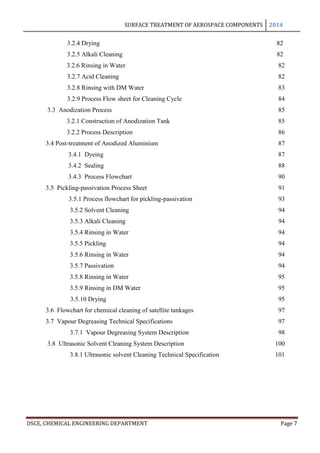
3.2.4 Drying 82
3.2.5 Alkali Cleaning 82
3.2.6 Rinsing in Water 82
3.2.7 Acid Cleaning 82
3.2.8 Rinsing with DM Water 83
3.2.9 Process Flow sheet for Cleaning Cycle 84
3.3 Anodization Process 85
3.2.1 Construction of Anodization Tank 85
3.2.2 Process Description 86
3.4 Post-treatment of Anodized Aluminium 87
3.4.1 Dyeing 87
3.4.2 Sealing 88
3.4.3 Process Flowchart 90
3.5 Pickling-passivation Process Sheet 91
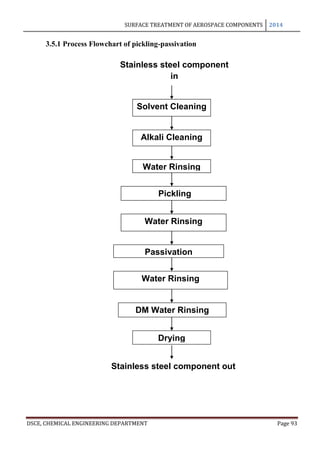
3.5.1 Process flowchart for pickling-passivation 93
3.5.2 Solvent Cleaning 94
3.5.3 Alkali Cleaning 94
3.5.4 Rinsing in Water 94
3.5.5 Pickling 94
3.5.6 Rinsing in Water 94
3.5.7 Passivation 94
3.5.8 Rinsing in Water 95
3.5.9 Rinsing in DM Water 95
3.5.10 Drying 95
3.6 Flowchart for chemical cleaning of satellite tankages 97
3.7 Vapour Degreasing Technical Specifications 97
3.7.1 Vapour Degreasing System Description 98
3.8 Ultrasonic Solvent Cleaning System Description 100
3.8.1 Ultrasonic solvent Cleaning Technical Specification 101
SURFACE TREATMENT OF AEROSPACE COMPONENTS 2014
DSCE, CHEMICAL ENGINEERING DEPARTMENT Page 8
Chapter 4
Results and Discussion
4.1 Test for Thickness 104
4.2 Test of gain in Weight with Temperature 105
4.3 Test for Porosity 106
4.4 Corrosion Test (CASS test) 107
4.5 Test for Sealing 108
Chapter 5
Conclusion
Conclusion 112
Chapter 6
References
Bibliography 114
SURFACE TREATMENT OF AEROSPACE COMPONENTS 2014
DSCE, CHEMICAL ENGINEERING DEPARTMENT Page 9
ABSTRACT
Anodization is the common designation for Anodic oxidation of the certain metals to form
stable oxide film on their surface. But prior to anodization or other coating on metal
surfaces, certain other surface treatments are employed there include pickling-passivation,
vapour degreasing, ultrasonic solvent cleaning andor chemical cleaning. All these methods
in some way or the other render corrosion and abrasion resistance to the metal surfaces.
Aerospace industries employed such surface treatment methods mainly for providing
resistance to the metal components against corrosion. The metals used predominantly
include Aluminium, Magnesium, and Stainless Steel of various grades and Titanium.
The liquid propulsion system center, ISRO, specializes in treating surfaces of components
parts of satellite launch vehicles. Being offered to carry out project work at this highly
prestigious institution is a matter of great pride. The project carried out was challenging as
high specification and accuracy had to be maintained while performing the experimental
work.
Tests were carried out to realize which treatment methods could be employed to which
specific metal for using aerospace industry and whether requirements like thickness,
hardness, porosity, corrosion resistance etc, were up to the required specifications.
SURFACE TREATMENT OF AEROSPACE COMPONENTS 2014
DSCE, CHEMICAL ENGINEERING DEPARTMENT Page 10
Chapter 1
Introduction
SURFACE TREATMENT OF AEROSPACE COMPONENTS 2014
DSCE, CHEMICAL ENGINEERING DEPARTMENT Page 11
INTRODUCTION
Most metals exist in nature in combined form as their oxides, carbonates, hydroxyl,
chlorides, and silicates. During extraction these are reduced to their metallic state from their
ores and extraction considerable amount of energy required. Consequently, isolated pure
metals can be regarded as I excited state than corresponding ores and they have natural
tendency to revert back to the combined state. Hence when metals are put into use in various
forms they are exposed to the environment such as dry gases, liquids etc. thus destruction of
metals start at the surface. This type of metal destruction may be due to direct chemical
corrosion by the environment or by electrochemical attack.
Any process of deteoriation of metal, through an unwanted chemical or electrochemical
attack, starting from its surface is termed as corrosion.
The process of corrosion is slow and occurs only at surface of metals, but losses incurred
due to corrosion are enormous. In general, the life and strength of structure is reduced very
much due to corrosion is 1/5th of the total world production. It is very difficult to assess the
exact losses incurred due to corrosion. Various methods have been developed to protect
metals and to prevent corrosion. But even today there is no method used that can assure
100% protection. The most common methods employed are painting, electroplating,
anodization, galvanizing etc.
This report gives the details about various methods of cleaning towards corrosion protection
in aerospace industry.
SURFACE TREATMENT OF AEROSPACE COMPONENTS 2014
DSCE, CHEMICAL ENGINEERING DEPARTMENT Page 12
Chapter 2
Literature Survey
SURFACE TREATMENT OF AEROSPACE COMPONENTS 2014
DSCE, CHEMICAL ENGINEERING DEPARTMENT Page 13
2.1 CORROSION
Corrosion is an irreversible interfacial reaction of a material (metal, ceramic and polymer)
with its environment which results in its consumption or dissolution into the material of a
component of the environment. Often, but not necessarily, corrosion results in effects
detrimental to the usage of the material considered. Exclusively physical or mechanical
processes such as melting and evaporation, abrasion or mechanical fracture are not included
in the term corrosion.
Corrosion is primarily associated with metallic materials but all material types are
susceptible to degradation. Degradation of polymeric insulating coatings on wiring has been
a concern in aging aircraft. Even ceramics can undergo degradation by selective dissolution.
The fundamental cause or driving force for all corrosion is the lowering of a system’s Gibbs
energy. The production of almost all metals involves adding energy to the system. As a
result of this uphill thermodynamic struggle, the metal has a strong driving force to return to
its native, low energy oxide state. This return to the native oxide state is what we call
corrosion and even though it is inevitable, substantial barriers (corrosion control methods)
can be used to slow its progress toward the equilibrium state and it is this rate of the
approach to equilibrium that is often of interest. This rate is controlled not only by the nature
of the metal surface, but also by the nature of the environment as well as the evolution of
both.
Most corrosion processes involve at least two electrochemical reactions. A corroding surface
can be thought of as a short-circuited battery; the dissolution reaction at the anode supplies
electrons for the reduction reaction at the cathode. A short circuit is the electrical connection
made by a conductor between the two physical sites, which are often separated by very
small distances. Electrode potential difference between the reinforcing bars and electrolyte is
the driving force for the charge transfer to occur. Their electrode potentials will change with
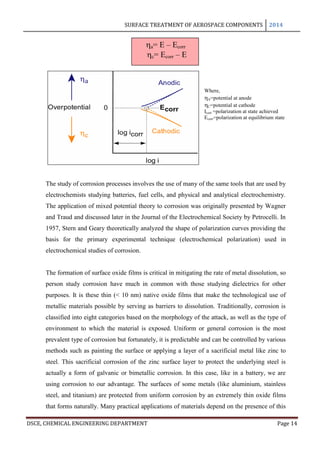
the corrosion reaction rate until a stable or equilibrium state (Ecorr) is achieved. At this
potential the anodic (ia) and cathodic (ic) current densities are opposite and equal and to the
state (Icorr) achieved. It is graphical represented as a polarization curve (shown in fig 2.1).
Deviation from the steady-state condition can be expressed by the electrode polarization
potential, also known, as over-potential (a or c) where,
SURFACE TREATMENT OF AEROSPACE COMPONENTS 2014
DSCE, CHEMICAL ENGINEERING DEPARTMENT Page 14
a= E – Ecorr
c= Ecorr – E
Where,
A=potential at anode
C=potential at cathode
Icorr =polarization at state achieved
Ecorr=polarization at equilibrium state
The study of corrosion processes involves the use of many of the same tools that are used by
electrochemists studying batteries, fuel cells, and physical and analytical electrochemistry.
The application of mixed potential theory to corrosion was originally presented by Wagner
and Traud and discussed later in the Journal of the Electrochemical Society by Petrocelli. In
1957, Stern and Geary theoretically analyzed the shape of polarization curves providing the
basis for the primary experimental technique (electrochemical polarization) used in
electrochemical studies of corrosion.
The formation of surface oxide films is critical in mitigating the rate of metal dissolution, so
person study corrosion have much in common with those studying dielectrics for other
purposes. It is these thin (< 10 nm) native oxide films that make the technological use of
metallic materials possible by serving as barriers to dissolution. Traditionally, corrosion is
classified into eight categories based on the morphology of the attack, as well as the type of
environment to which the material is exposed. Uniform or general corrosion is the most
prevalent type of corrosion but fortunately, it is predictable and can be controlled by various
methods such as painting the surface or applying a layer of a sacrificial metal like zinc to
steel. This sacrificial corrosion of the zinc surface layer to protect the underlying steel is
actually a form of galvanic or bimetallic corrosion. In this case, like in a battery, we are
using corrosion to our advantage. The surfaces of some metals (like aluminium, stainless
steel, and titanium) are protected from uniform corrosion by an extremely thin oxide films
that forms naturally. Many practical applications of materials depend on the presence of this
SURFACE TREATMENT OF AEROSPACE COMPONENTS 2014
DSCE, CHEMICAL ENGINEERING DEPARTMENT Page 15
protective oxide. We would not be able to use planes made from aluminium if it were not for
this thin protective film. Unfortunately, this film can breakdown locally, resulting in forms
of corrosion like pitting of aluminium plates, crevice corrosion of stainless steel fasteners, or
stress corrosion cracking of pipes in nuclear reactors.
In light of the thermodynamic basis for corrosion it is not surprising that costs associated
with corrosion are high. Several studies over the past 30 years have shown that the annual
direct cost of corrosion to an industrial economy is approximately 3.1% of the country’s
Gross National Product (GNP). In the US, this amount rises to over $276 billion per year.
From Fig. 1, the highest segments of the cost of corrosion are associated with utilities,
transportation, and infrastructure. The Department of Defence alone has corrosion costs of
$20 billion. Because of the significant economic, safety, and historical impact of corrosion
on society and because corrosion of metals is an electrochemical process, it is also not
surprising that the Corrosion Division is one of the oldest divisions within ECS and was
established in 1942, but corrosion has been an important topic in the Society since 1903.
Reviews of the early literature and history of the Division were prepared by Uhlig and
Uhlig’s Corrosion Handbook is a good overall source of corrosion information for
consultation purpose.
2.2 MECHANISM OF CORROSION
Modern corrosion science was set off in the early twentieth century with the local cell model
proposed by Evans and the corrosion potential model proved by Wagner and Traud. The two
models have joined into the modern electrochemical theory of corrosion. They describe
metallic corrosion as a coupled electrochemical reaction consisting of anodic metal
oxidation and cathodic oxidant reduction. The electrochemical theory is applicable not only
to wet corrosion of metals at normal temperature but also to dry oxidation of metals at high
temperature. Metallic materials corrode in a variety of gaseous and aqueous environments.
Here we restrict ourselves to the most common corrosion of metals in aqueous solution and
in wet air in the atmosphere. In general, metallic corrosion produces in its initial stage
soluble metal ions in water, and then, the metal ions develop into solid corrosion precipitates
such as metal oxide and hydroxide .We will discuss the whole process of metallic corrosion
from the basic electrochemical standpoint.
SURFACE TREATMENT OF AEROSPACE COMPONENTS 2014
DSCE, CHEMICAL ENGINEERING DEPARTMENT Page 16
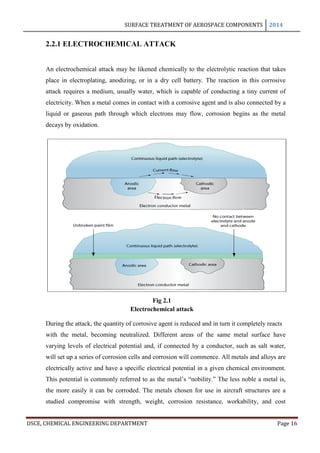
2.2.1 ELECTROCHEMICAL ATTACK
An electrochemical attack may be likened chemically to the electrolytic reaction that takes
place in electroplating, anodizing, or in a dry cell battery. The reaction in this corrosive
attack requires a medium, usually water, which is capable of conducting a tiny current of
electricity. When a metal comes in contact with a corrosive agent and is also connected by a
liquid or gaseous path through which electrons may flow, corrosion begins as the metal
decays by oxidation.
During the attack, the quantity of corrosive agent is reduced and in turn it completely reacts
with the metal, becoming neutralized. Different areas of the same metal surface have
varying levels of electrical potential and, if connected by a conductor, such as salt water,
will set up a series of corrosion cells and corrosion will commence. All metals and alloys are
electrically active and have a specific electrical potential in a given chemical environment.
This potential is commonly referred to as the metal’s “nobility.” The less noble a metal is,
the more easily it can be corroded. The metals chosen for use in aircraft structures are a
studied compromise with strength, weight, corrosion resistance, workability, and cost
Fig 2.1
Electrochemical attack
SURFACE TREATMENT OF AEROSPACE COMPONENTS 2014
DSCE, CHEMICAL ENGINEERING DEPARTMENT Page 17
balanced against the structure’s needs. The constituents in an alloy also have specific
electrical potentials that are generally different from each other. Exposure of the alloy
surface to a conductive, corrosive medium causes the more active metal to become anodic
and the less active metal to become cathodic, thereby establishing conditions for corrosion.
These are called local cells. The greater the difference in electrical potential between the two
metals, the greater will be the severity of a corrosive attack, if the proper conditions are
allowed to develop. The conditions for these corrosion reactions are the presence of a
conductive fluid and metals having a difference in potential. If, by regular cleaning and
surface refinishing, the medium is removed and the minute electrical circuit eliminated,
corrosion cannot occur. This is the basis for effective corrosion control. The electrochemical
attack is responsible for most forms of corrosion on aircraft structure and component parts.
SURFACE TREATMENT OF AEROSPACE COMPONENTS 2014
DSCE, CHEMICAL ENGINEERING DEPARTMENT Page 18
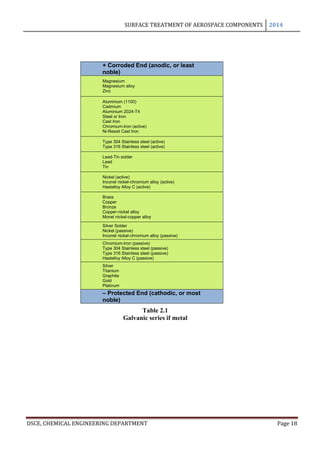
+ Corroded End (anodic, or least
noble)
Magnesium
Magnesium alloy
Zinc
Aluminium (1100)
Cadmium
Aluminium 2024-T4
Steel or Iron
Cast Iron
Chromium-Iron (active)
Ni-Resist Cast Iron
Type 304 Stainless steel (active)
Type 316 Stainless steel (active)
Lead-Tin solder
Lead
Tin
Nickel (active)
Inconel nickel-chromium alloy (active)
Hastelloy Alloy C (active)
Brass
Copper
Bronze
Copper-nickel alloy
Monel nickel-copper alloy
Silver Solder
Nickel (passive)
Inconel nickel-chromium alloy (passive)
Chromium-Iron (passive)
Type 304 Stainless steel (passive)
Type 316 Stainless steel (passive)
Hastelloy Alloy C (passive)
Silver
Titanium
Graphite
Gold
Platinum
– Protected End (cathodic, or most
noble)
Table 2.1
Galvanic series if metal
SURFACE TREATMENT OF AEROSPACE COMPONENTS 2014
DSCE, CHEMICAL ENGINEERING DEPARTMENT Page 19
2.2.2 BASIC PROCESSES
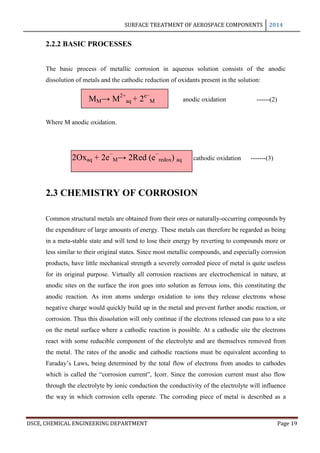
The basic process of metallic corrosion in aqueous solution consists of the anodic
dissolution of metals and the cathodic reduction of oxidants present in the solution:
MM→ M2+
aq + 2e−
M anodic oxidation ------(2)
Where M anodic oxidation.
2Oxaq + 2e−
M→ 2Red (e−
redox) aq cathodic oxidation -------(3)
2.3 CHEMISTRY OF CORROSION
Common structural metals are obtained from their ores or naturally-occurring compounds by
the expenditure of large amounts of energy. These metals can therefore be regarded as being
in a meta-stable state and will tend to lose their energy by reverting to compounds more or
less similar to their original states. Since most metallic compounds, and especially corrosion
products, have little mechanical strength a severely corroded piece of metal is quite useless
for its original purpose. Virtually all corrosion reactions are electrochemical in nature, at
anodic sites on the surface the iron goes into solution as ferrous ions, this constituting the
anodic reaction. As iron atoms undergo oxidation to ions they release electrons whose
negative charge would quickly build up in the metal and prevent further anodic reaction, or
corrosion. Thus this dissolution will only continue if the electrons released can pass to a site
on the metal surface where a cathodic reaction is possible. At a cathodic site the electrons
react with some reducible component of the electrolyte and are themselves removed from
the metal. The rates of the anodic and cathodic reactions must be equivalent according to
Faraday’s Laws, being determined by the total flow of electrons from anodes to cathodes
which is called the “corrosion current”, Icorr. Since the corrosion current must also flow
through the electrolyte by ionic conduction the conductivity of the electrolyte will influence
the way in which corrosion cells operate. The corroding piece of metal is described as a
SURFACE TREATMENT OF AEROSPACE COMPONENTS 2014
DSCE, CHEMICAL ENGINEERING DEPARTMENT Page 20
“mixed electrode” since simultaneous anodic and cathodic reactions are proceeding on its
surface. The mixed electrode is a complete electrochemical cell on one metal surface.
Such electrochemical reactions are most common in acids and in the pH range 6.5 – 8.5 the
most important reaction is oxygen reduction 2b. In this latter case corrosion is usually
accompanied by the formation of solid corrosion debris from the reaction between the
anodic and cathodic products. If solid corrosion products are produced directly on the
surface as the first result of anodic oxidation these may provide a highly protective surface
film which retards further corrosion, the surface is then said to be “passive”.
2.4 FACTORS THAT CONTROL THE CORROSION
RATE
Certain factors can tend to accelerate the action of a corrosion cell. These include:
1. Establishment of well-defined locations on the surface for the anodic and cathodic reactions.
This concentrates the damage on small areas where it may have more serious effects, this
being described as “local cell action”. Such effects can occur when metals of differing
electrochemical properties are placed in contact, giving a “galvanic couple”. Galvanic
effects may be predicted by means of a study of the Galvanic Series which is a list of metals
and alloys placed in order of their potentials in the corrosive environment, such as sea water.
Metals having a more positive (noble) potential will tend to extract electrons from a metal
which is in a more negative (base) position in the series and hence accelerate its corrosion
when in contact with it. The Galvanic Series should not be confused with the
Electrochemical Series, which lists the potentials only of pure metals in equilibrium with
standard solutions of their ions. Galvanic effects can occur on metallic surfaces which
contain more than one phase, so that “local cells” are set up on the heterogeneous surface.
Localised corrosion cells can also be set up on surfaces where the metal is in a varying
condition of stress, where rust, dirt or crevices cause differential access of air, where
temperature variations occur, or where fluid flow is not uniform.
Stimulation of the anodic or cathodic reaction. Aggressive ions such as chloride tend to
prevent the formation of protective oxide films on the metal surface and thus increase
corrosion. Sodium chloride is encountered in marine conditions and is spread on roads in
SURFACE TREATMENT OF AEROSPACE COMPONENTS 2014
DSCE, CHEMICAL ENGINEERING DEPARTMENT Page 21
winter for de-icing. Quite small concentrations of sulphur dioxide released into the
atmosphere by the combustion of fuels can dissolve in the invisibly thin surface film of
moisture which is usually present on metallic surfaces when the relative humidity is over 60-
70%. The acidic electrolyte that is formed under these conditions seems to be capable of
stimulating both the anodic and the cathodic reactions.
In practical terms it is not usually possible to eliminate completely all corrosion damage to
metals used for the construction of industrial plant. The rate at which attack is of prime
importance is usually expressed in one of two ways:
(1) Weight loss per unit area per unit time, usually mdd (milligrams per square
decimetre per day)
(2) A rate of penetration, i.e. the thickness of metal lost.
If suitable water treatment with corrosion inhibitors is used a life of at least twenty years
might be expected. This, of course, is ignoring the fact that at some time before the metal
corrodes away the tubing may have thinned to a point where its required mechanical
strength is not attained. When designing equipment for a certain service life engineers often
add a “corrosion allowance” to the metal thickness, permitting a certain amount of thinning
before serious weakening occurs. In a cooling water system the factors influencing the rate
of attack are:
a) The condition of the metal surface Corrosion debris and other deposits - corrosion
under the deposits, with a possibility of pitting (severe attack in small spots)
b) The nature of the environment
pH - in the range of 4-10 corrosion rate is fairly independent of pH, but it increases rapidly
when the pH falls below 4. Oxygen content - increase in oxygen concentration usually gives
an increase in corrosion rate.
SURFACE TREATMENT OF AEROSPACE COMPONENTS 2014
DSCE, CHEMICAL ENGINEERING DEPARTMENT Page 22
Flow rate - increased water flow increased oxygen access to the surface and removes
protective surface films, so usually increases corrosion, but can sometimes improve access
for corrosion inhibiting reactants.
Water type - very important, in general low corrosion rates are found with scale-forming
(hard) waters. Aggressive ions which accelerate corrosion are Cl-, SO4
2-
but quite complex
interactions may occur between the various dissolved species in natural waters.
2.5 FORMS OF CORROSION
There are many forms of corrosion. The form of corrosion depends on the metal involved,
its size and shape, its specific function, atmospheric conditions, and the corrosion producing
agents present. Those described in this section are the more common forms found on
airframe structures.
2.5.1 Surface Corrosion
Surface corrosion appears as a general roughening, etching, or pitting of the surface of a
metal, frequently accompanied by a powdery deposit of corrosion products. Surface
corrosion may be caused by either direct chemical or electrochemical attack. Sometimes
corrosion will spread under the surface coating and cannot be recognized by either the
roughening of the surface or the powdery deposit. Instead, closer inspection will reveal the
paint or plating is lifted off the surface in small blisters which result from the pressure of the
underlying accumulation of corrosion products.
Filiform corrosion gives the appearance of a series of small worms under the paint surface.
It is often seen on surfaces that have been improperly chemically treated prior to painting.
2.5.2 Dissimilar Metal Corrosion
Extensive pitting damage may result from contact between dissimilar metal parts in the
presence of a conductor. While surface corrosion may or may not be taking place, a galvanic
action, not unlike electroplating, occurs at the points or areas of contact where the insulation
between the surfaces has broken down or been omitted. This electrochemical attack can be
SURFACE TREATMENT OF AEROSPACE COMPONENTS 2014
DSCE, CHEMICAL ENGINEERING DEPARTMENT Page 23
very serious because in many instances the action is taking place out of sight, and the only
way to detect it prior to structural failure is by disassembly and inspection.
The contamination of a metal’s surface by mechanical means can also induce dissimilar
metal corrosion. The improper use of steel cleaning products, such as steel wool or a steel
wire brush on aluminium or magnesium, can force small pieces of steel into the metal being
cleaned, which will then further corrode and ruin the adjoining surface. Carefully monitor
the use of non-woven abrasive pads, so that pads used on one type of metal are not used
again on a different metal surface .
2.5.3 Inter-granular Corrosion
This type of corrosion is an attack along the grain boundaries of an alloy and commonly
results from a lack of uniformity in the alloy structure. Aluminium alloys and some stainless
steels are particularly susceptible to this form of electrochemical attack. The lack of
uniformity is caused by changes that occur in the alloy during heating and cooling during the
material’s manufacturing process. Inter-granular corrosion may exist without visible surface
evidence. Very severe inter-granular corrosion may sometimes cause the surface of a metal
to “exfoliate.” This is a lifting or flaking of the metal at the surface due to delamination of
the grain boundaries caused by the pressure of corrosion residual product build-up. This type
of corrosion is difficult to detect in its initial stage. Extruded components such as spars can
be subject to this type of corrosion. Ultrasonic and eddy current inspection methods are
being used with a great deal of success.
2.5.4 Stress Corrosion
Stress corrosion occurs as the result of the combined effect of sustained tensile stresses and a
corrosive environment acting on the metal. Stress corrosion cracking is found in most metal
systems; however, it is particularly characteristic of aluminium, copper, certain stainless
steels, and high strength alloy steels (over 240,000 psi). It usually occurs along lines of cold
working and may be trans-granular or inter-granular in nature.
SURFACE TREATMENT OF AEROSPACE COMPONENTS 2014
DSCE, CHEMICAL ENGINEERING DEPARTMENT Page 24
2.5.5 Fretting Corrosion
Fretting corrosion is a particularly damaging form of corrosive attack that occurs when two
mating surfaces, normally at rest with respect to one another, are subject to slight relative
motion. It is characterized by pitting of the surfaces and the generation of considerable
quantities of finely divided debris. Since the restricted movements of the two surfaces
prevent the debris from escaping very easily, an extremely localized abrasion occurs. The
presence of water vapour greatly increases this type of deterioration. If the contact areas are
small and sharp, deep grooves may be worn in the rubbing surface.
2.6 CONSEQUENCES OF CORROSION
The consequences of corrosion are many and varied and the effects of these on the safe,
reliable and efficient operation of equipment or structures are often more serious than the
simple loss of a mass of metal. Failures of various kinds and the need for expensive
replacements may occur even though the amount of metal destroyed is quite small. Some of
the major harmful effects of corrosion can be summarised as follows:
1. Reduction of metal thickness leading to loss of mechanical strength and structural failure or
breakdown. When the metal is lost in localised zones so as to give a crack like structure,
very considerable weakening may result from quite a small amount of metal loss.
2. Hazards or injuries to people arising from structural failure or breakdown (e.g. bridges, cars,
aircraft).
3. Loss of time in availability of profile-making industrial equipment.
4. Reduced value of goods due to deterioration of appearance.
5. Contamination of fluids in vessels and pipes (e.g. beer goes cloudy when small quantities of
heavy metals are released by corrosion).
6. Perforation of vessels and pipes allowing escape of their contents and possible harm to the
surroundings. For example a leaky domestic radiator can cause expensive damage to carpets
SURFACE TREATMENT OF AEROSPACE COMPONENTS 2014
DSCE, CHEMICAL ENGINEERING DEPARTMENT Page 25
and decorations, while corrosive sea water may enter the boilers of a power station if the
condenser tubes perforate.
7. Loss of technically important surface properties of a metallic component. These could
include frictional and bearing properties, ease of fluid flow over a pipe surface, electrical
conductivity of contacts, surface reflectivity or heat transfer across a surface.
8. Mechanical damage to valves, pumps, etc, or blockage of pipes by solid corrosion products.
9. Added complexity and expense of equipment which needs to be designed to withstand a
certain amount of corrosion, and to allow corroded components to be conveniently replaced.
In light of the thermodynamic basis for corrosion it is not surprising that costs associated
with corrosion are high.
Several studies over the past 30 years have shown that the annual direct cost of corrosion to
an industrial economy is approximately 3.1% of the country’s Gross National Product
(GNP). In the United States, this amounts to over $276 billion per year. It is revealed that
the highest segments of the cost of corrosion are associated with utilities, transportation, and
infrastructure. The Department of Defence alone has corrosion costs of $20 billion [6]
.
Fig 2.2
Cost of corrosion in the US
SURFACE TREATMENT OF AEROSPACE COMPONENTS 2014
DSCE, CHEMICAL ENGINEERING DEPARTMENT Page 26
2.7 ANODIZATION
Anodizing is an electrolytic passivation process used to increase the thickness of the
natural oxide layer on the surface of metal parts. The process is called "anodizing" because
the part to be treated forms the anode electrode of an electrical circuit. Anodizing
increases corrosion resistance and wear-resistance, and provides better adhesion for paint
primers and glues. Anodic films can also be used for a number of cosmetic effects, either
with thick porous coatings that can absorb dyes or with thin transparent coatings that
add interference effects to reflected light.
Anodizing is also used to prevent galling of threaded components and to make dielectric
films for electrolytic capacitors. Anodic films are most commonly applied to
protect aluminium alloys, although processes also exist
for titanium, zinc, magnesium, niobium, zirconium, hafnium, and tantalum. Iron or carbon
steel metal exfoliates when oxidized under neutral or alkaline micro-electrolytic conditions,
the iron oxide (actually "ferric hydroxide" oxy hydrated iron oxide, also known as rust)
forms minute anodic pits and large cathodic surface, these pits concentrate anions such
as sulphate and chloride accelerating the underlying metal to corrode. Carbon flakes or
nodules in iron or steel with high carbon content (high carbon steel, cast iron) may cause an
electrolytic potential and interfere with coating or plating. Ferrous metals are thus
commonly not subjected to anodization.
Anodization changes the microscopic texture of the surface and changes the crystal
structure of the metal near the surface. Thick coatings are normally porous, so a sealing
process is often needed to achieve corrosion resistance. Anodized aluminium surfaces are
harder than aluminium but have low to moderate wear resistance that can be improved with
increasing thickness or by applying suitable sealing substances. Anodic films are not only
much stronger and more adherent than most types of paint and metal plating, but also more
brittle. This makes them less likely to crack and peel from aging and wear, but more
susceptible to cracking from thermal stress.
SURFACE TREATMENT OF AEROSPACE COMPONENTS 2014
DSCE, CHEMICAL ENGINEERING DEPARTMENT Page 27
2.7.1 History
Anodizing was first used on an industrial scale in 1923 to protect Duralumin seaplane parts
from corrosion. This early chromic acid process was called the Bengough-Stuart process and
was documented in British defence specification DEF STAN 03-24/3. It is still used today
despite its legacy requirements for a complicated voltage cycle now known to be
unnecessary. Variations of this process soon evolved, and the first sulphuric acid anodizing
process was patented by Gower and O'Brien in 1927. Sulphuric acid soon became and
remains the most common anodizing electrolyte.
Oxalic acid anodizing was first patented in Japan in 1923 and later widely used in Germany,
particularly for architectural applications. Anodized aluminium extrusion was a popular
architectural material in the 1960s and 1970s, but has since been displaced by cheaper
plastics and powder coating. The phosphoric acid processes are the most recent major
development, so far only used as pre-treatments for adhesives or organic paints. A wide
variety of proprietary and increasingly complex variations of all these anodizing processes
continue to be developed by industry, so the growing trend in military and industrial
standards is to classify by coating properties rather than by process chemistry.
1.7.2 Anodized Aluminium
Aluminium and its alloys are anodized to increase corrosion resistance, to increase surface
hardness, and to allow dyeing (colouring), improved lubrication, or improved adhesion. The
anodic layer is non-conductive. When exposed to air at room temperature, or any other gas
containing oxygen, pure aluminium is capable of self passivation by forming a surface layer
of amorphous aluminium oxide 2 to 3 nm thick, which provides protection for some time but
the thickness of this layer is usually not uniform. Aluminium parts are thus anodized to
greatly increase the thickness of this layer for corrosion resistance. The corrosion resistance
of aluminium and its alloys is significantly decreased by certain alloying elements or
impurities: copper, iron, and silicon, so 2000, 4000, and 6000-series alloys tend to be most
susceptible. Anodizing the parts not only enhances corrosion resistance but also their ability
to retain dye which is not possible in case of untreated metal. Although anodizing only has
moderate wear resistance, the deeper pores can better retain a lubricating film than a smooth
surface would.
SURFACE TREATMENT OF AEROSPACE COMPONENTS 2014
DSCE, CHEMICAL ENGINEERING DEPARTMENT Page 28
Anodized coatings have a much lower thermal conductivity and coefficient of linear
expansion than aluminium. As a result, the coating will crack from thermal stress if exposed
to temperatures above 80 °C. The coating can crack, but it will not peel. The melting point
of aluminium oxide (2050 °C) is much higher than pure aluminium (658 °C). This at times
makes welding more difficult. In typical commercial aluminium anodization processes, the
aluminium oxide is grown down into the surface and out from the surface by equal amounts.
So anodizing will increase the part dimensions on each surface by half of the oxide
thickness. Anodized aluminium surfaces are harder than aluminium but have low to
moderate wear resistance. Attempts are being made to overcome this problem of further
improvement of thickness of anodized layer and sealing.
SURFACE TREATMENT OF AEROSPACE COMPONENTS 2014
DSCE, CHEMICAL ENGINEERING DEPARTMENT Page 29
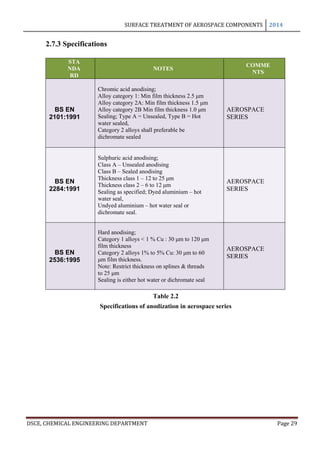
2.7.3 Specifications
STA
NDA
RD
NOTES
COMME
NTS
BS EN
2101:1991
Chromic acid anodising;
Alloy category 1: Min film thickness 2.5 μm
Alloy category 2A: Min film thickness 1.5 μm
Alloy category 2B Min film thickness 1.0 μm
Sealing; Type A = Unsealed, Type B = Hot
water sealed,
Category 2 alloys shall preferable be
dichromate sealed
AEROSPACE
SERIES
BS EN
2284:1991
Sulphuric acid anodising;
Class A – Unsealed anodising
Class B – Sealed anodising
Thickness class 1 – 12 to 25 μm
Thickness class 2 – 6 to 12 μm
Sealing as specified; Dyed aluminium – hot
water seal,
Undyed aluminium – hot water seal or
dichromate seal.
AEROSPACE
SERIES
BS EN
2536:1995
Hard anodising;
Category 1 alloys < 1 % Cu : 30 μm to 120 μm
film thickness
Category 2 alloys 1% to 5% Cu: 30 μm to 60
μm film thickness.
Note: Restrict thickness on splines & threads
to 25 μm
Sealing is either hot water or dichromate seal
AEROSPACE
SERIES
Table 2.2
Specifications of anodization in aerospace series
SURFACE TREATMENT OF AEROSPACE COMPONENTS 2014
DSCE, CHEMICAL ENGINEERING DEPARTMENT Page 30
2.7.4 MECHANISM OF ANODIZING PROCESS
When a current is passed through an electrolyte in which an aluminium anode is employed,
the negative charged anion migrates to the anode where it is discharged with loss of one or
m
o
r
e
electrons. In aqueous solution, the anion consists parts of oxygen which chemically units
with the aluminium and the result of the reaction depends on a number of factors,
particularly nature of electrolyte , the consequent reaction product which are formed, and the
operation conditions such as current potential, bath temperature, and time of treatment. In
simple terms the following oxidation reactions at the anode can occur:
1. The anode reaction products may be soluble in the electrolyte. In this case metal is dissolved
until the solution is saturated. This reaction takes place in some strong inorganic acids and
bases.
2. The reaction product may be almost insoluble in the electrolyte and from a strongly adherent
and practically non-conducting film on the anode. In this case film growth continues until
0
10
20
30
40
50
60
0 0.5 1 1.5 2 2.5 3 3.5 4
A'
A
B
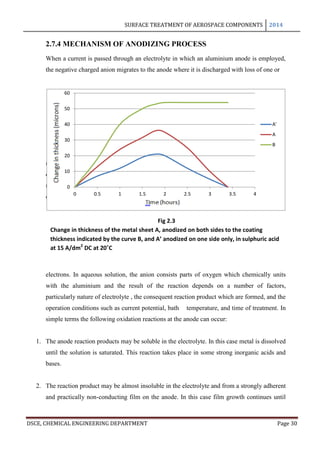
Fig 2.3
Change in thickness of the metal sheet A, anodized on both sides to the coating
thickness indicated by the curve B, and A’ anodized on one side only, in sulphuric acid
at 15 A/dm2
DC at 20˚C
SURFACE TREATMENT OF AEROSPACE COMPONENTS 2014
DSCE, CHEMICAL ENGINEERING DEPARTMENT Page 31
the resistance of the film prevents the current from reaching the anode. They can be formed
in a number of electrolytes of which borate or tartarate solutions are the most common
examples. Such films, formed at high voltage, find application in the production of the
electrolytic condensers and for protection for very thin aluminium coating, example, those
applied by vacuum deposition.
3. The reaction products may be sparingly soluble in the electrolyte and form a strongly
adherent film that is non-conducting when dry, over the anode.
In this case film growth takes place as above but is accompanied by dissolution of film at the
surface. Pores are thus formed in the coatings that are wide enough to allow continuous
access of the current to the metal. Film growth continues while the electrical resistance
increases. When the rate of film growth has decreased until it is equal to the rate of
dissolution of the film in the electrolyte, the film thickness remains constant.
The maximum film thickness varies with the electrolyte and the operating conditions,
especially the temperature which affects the dissolution velocity. The way in which the film
thickness and thickness of the basic sheet vary with time is shown in the following figure.
The curve A refers to the total increase in thickness of a sheet anodized on both sides to the
coating thickness indicated by curve B, while the curve A’ refers to the dimensional change
of a single surface. The coating reaches its maximum thickness in just almost 2 hours and it
may be seen that upto this point, for every 3 microns of coating formed the metal surface
retreats approximately to 2 microns and the exterior surface advances 1 micron.
These are the conditions of industrial anodization process that are based chiefly on chromic,
sulphuric or oxalic acid.
4. The reaction products may be moderately soluble. Under these conditions electro-polishing
may be possible if a suitable electrolyte is used. Apart from the reactions considered there
are a variety of less important possibilities, for example, where the reaction products may
form loosely adherent, spongy or powdery deposits, as when the anodizing solutions become
contaminated or when anodizing under special operations. A continuous adherent insoluble
film, a few molecules thick, may render the metal passive [7]
.
SURFACE TREATMENT OF AEROSPACE COMPONENTS 2014
DSCE, CHEMICAL ENGINEERING DEPARTMENT Page 32
2.7.5 Barrier Layer
2.7.5.1 Thickness
It was shown as early as 1932 by Steoh and Miyata that the anodic oxide film consists of
two layers, the porous thick outer layer growing on an inner layer which is thin, dense and
dielectrically compact, and usually called the active layer, barrier layer or dielectric layer.
This layer is very thin, i.e, usually between 0.1 and 2.0% of the total film, and its thickness
depends on the composition of the electrolyte and the operating conditions. It has been
established that the barrier layer formed in anodizing is of the nature of the natural oxide
film formed in the atmosphere and that the barrier layer and porous films can also be
distinguished coatings and on electro polished surfaces.
In anodizing, the barrier layer is formed first and its thickness varies directly with the
forming voltage. The barrier layer is non porous and conducts current only due to its
thinness and faults in its skeleton. The outer layer, on the other hand, is micro porous and
built upon a columnar structure. As long as no dissolution occurs in the electrolyte, the
barrier layer is formed in a thickness of 14 A per volt. This is the theoretical maximum
approached only in solutions in which little or no solvent occurs: thus, Holland and
Sutherland obtained film thicknesses of 13 A per volt in 3% ammonium tartarate solution
used in the protection of vacuum coated aluminium mirrors. Capacity measurements of
barrier layers by Ginsberg and Kadan have given values of 14 A per volt for films formed in
barrier layer electrolytes and 11.5 A per volt for barrier layers for porous anodic coatings [8]
.
SURFACE TREATMENT OF AEROSPACE COMPONENTS 2014
DSCE, CHEMICAL ENGINEERING DEPARTMENT Page 33
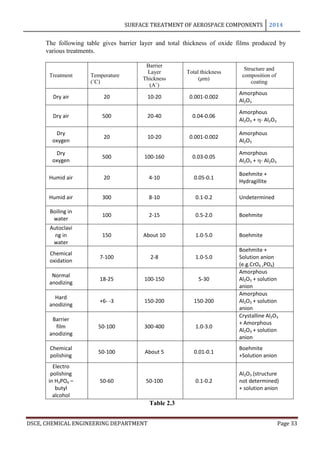
The following table gives barrier layer and total thickness of oxide films produced by
various treatments.
Treatment Temperature
(˚C)
Barrier
Layer
Thickness
(A˚)
Total thickness
( m)
Structure and
composition of
coating
Dry air 20 10-20 0.001-0.002
Amorphous
Al2O3
Dry air 500 20-40 0.04-0.06
Amorphous
Al2O3 + - Al2O3
Dry
oxygen
20 10-20 0.001-0.002
Amorphous
Al2O3
Dry
oxygen
500 100-160 0.03-0.05
Amorphous
Al2O3 + - Al2O3
Humid air 20 4-10 0.05-0.1
Boehmite +
Hydragillite
Humid air 300 8-10 0.1-0.2 Undetermined
Boiling in
water
100 2-15 0.5-2.0 Boehmite
Autoclavi
ng in
water
150 About 10 1.0-5.0 Boehmite
Chemical
oxidation
7-100 2-8 1.0-5.0
Boehmite +
Solution anion
(e.g.CrO4 ,PO4)
Normal
anodizing
18-25 100-150 5-30
Amorphous
Al2O3 + solution
anion
Hard
anodizing
+6- -3 150-200 150-200
Amorphous
Al2O3 + solution
anion
Barrier
film
anodizing
50-100 300-400 1.0-3.0
Crystalline Al2O3
+ Amorphous
Al2O3 + solution
anion
Chemical
polishing
50-100 About 5 0.01-0.1
Boehmite
+Solution anion
Electro
polishing
in H3PO4 –
butyl
alcohol
50-60 50-100 0.1-0.2
Al2O3 (structure
not determined)
+ solution anion
Table 2.3
SURFACE TREATMENT OF AEROSPACE COMPONENTS 2014
DSCE, CHEMICAL ENGINEERING DEPARTMENT Page 34
2.7.5.2 Effect of Operation Conditions On the Barrier Layer
The way in which anodizing time affects the thickness of the barrier layer has already been
discussed. The way in which other variables affect the unit barrier thickness, i.e, the
thickness per volt of applied potential is shown below.
Electrolyte Type
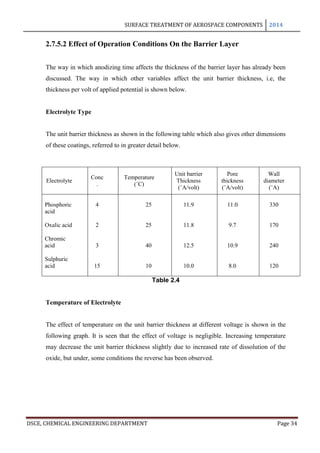
The unit barrier thickness as shown in the following table which also gives other dimensions
of these coatings, referred to in greater detail below.
Electrolyte
Conc
.
Temperature
(˚C)
Unit barrier
Thickness
(˚A/volt)
Pore
thickness
(˚A/volt)
Wall
diameter
(˚A)
Phosphoric
acid
Oxalic acid
Chromic
acid
Sulphuric
acid
4
2
3
15
25
25
40
10
11.9
11.8
12.5
10.0
11.0
9.7
10.9
8.0
330
170
240
120
Table 2.4
Temperature of Electrolyte
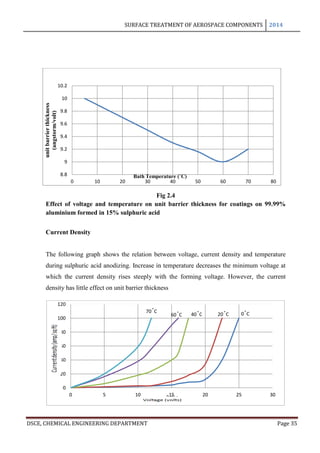
The effect of temperature on the unit barrier thickness at different voltage is shown in the
following graph. It is seen that the effect of voltage is negligible. Increasing temperature
may decrease the unit barrier thickness slightly due to increased rate of dissolution of the
oxide, but under, some conditions the reverse has been observed.
SURFACE TREATMENT OF AEROSPACE COMPONENTS 2014
DSCE, CHEMICAL ENGINEERING DEPARTMENT Page 35
Fig 2.4
Effect of voltage and temperature on unit barrier thickness for coatings on 99.99%
aluminium formed in 15% sulphuric acid
Current Density
The following graph shows the relation between voltage, current density and temperature
during sulphuric acid anodizing. Increase in temperature decreases the minimum voltage at
which the current density rises steeply with the forming voltage. However, the current
density has little effect on unit barrier thickness
8.8
9
9.2
9.4
9.6
9.8
10
10.2
0 10 20 30 40 50 60 70 80
unitbarrierthickness
(angstorm/volt)
Bath Temperature (˚C)
0˚C20˚C40˚C60˚C
70˚C
0
20
40
60
80
100
120
0 5 10 15 20 25 300 deg
SURFACE TREATMENT OF AEROSPACE COMPONENTS 2014
DSCE, CHEMICAL ENGINEERING DEPARTMENT Page 36
centration of Electrolyte
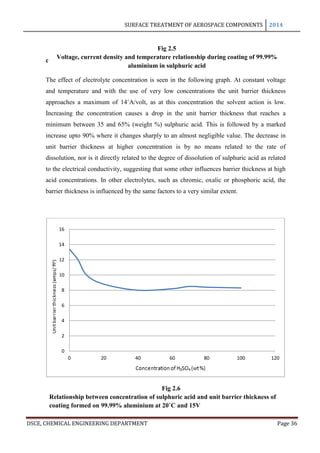
The effect of electrolyte concentration is seen in the following graph. At constant voltage
and temperature and with the use of very low concentrations the unit barrier thickness
approaches a maximum of 14˚A/volt, as at this concentration the solvent action is low.
Increasing the concentration causes a drop in the unit barrier thickness that reaches a
minimum between 35 and 65% (weight %) sulphuric acid. This is followed by a marked
increase upto 90% where it changes sharply to an almost negligible value. The decrease in
unit barrier thickness at higher concentration is by no means related to the rate of
dissolution, nor is it directly related to the degree of dissolution of sulphuric acid as related
to the electrical conductivity, suggesting that some other influences barrier thickness at high
acid concentrations. In other electrolytes, such as chromic, oxalic or phosphoric acid, the
barrier thickness is influenced by the same factors to a very similar extent.
0
2
4
6
8
10
12
14
16
0 20 40 60 80 100 120
Y-Values
Fig 2.6
Relationship between concentration of sulphuric acid and unit barrier thickness of
coating formed on 99.99% aluminium at 20˚C and 15V
Fig 2.5
Voltage, current density and temperature relationship during coating of 99.99%
aluminium in sulphuric acid
SURFACE TREATMENT OF AEROSPACE COMPONENTS 2014
DSCE, CHEMICAL ENGINEERING DEPARTMENT Page 37
2.7.6 Porous Layer
2.7.6.1 Porosity
As well as the thickness, the porosity of the coating varies with the dissolution velocity and
the conditions and rate of film growth, and these depend on the operating conditions and the
type of electrolyte.
As far as the last is concerned, it is probable the pH of the solution is the most important. An
example of this is seen most strikingly when aluminium is anodized in phosphate solutions.
While a phosphoric acid electrolyte gives a thick and extremely porous anodic oxide
coating, a buffered phosphate solution on the other hand gives a non-porous barrier film the
phosphate content of which is an integral part of the film and is proportional to its thickness.
Due to the effect of dissolution, the outer layer of the coating have the greatest porosity.
Examination by electron microscope shows the presence of pores in the striated structure.
Edwards and Keller also found vertical lines 6 x 10⁻⁹ inches apart near the metal interface,
which they believe locate the pore centres from which the coating grows.
The pores are very absorptive and it was determined that when a film, formed in sulphuric
acid with a volume of 15 ml/sq m was boiled in a 1% potassium dichromate solution for one
hour, the coating took up 0.48 gm of chromium per sq m, in other words the dichromate
content of the 140 ml of solution or 10 times the volume of the coating, was absorbed and
concentrated in the pore surface as fresh solution continued to diffuse in to the pores. The
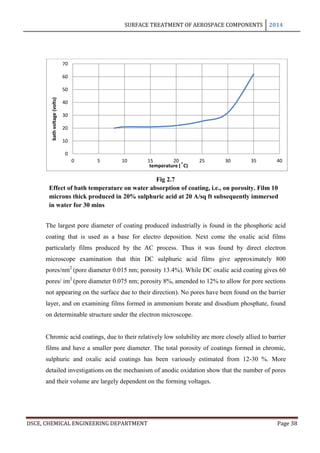
effect of anodizing temperature on the absorption capacity of the film, i.e, on its porosity, is
shown in following graph.
SURFACE TREATMENT OF AEROSPACE COMPONENTS 2014
DSCE, CHEMICAL ENGINEERING DEPARTMENT Page 38
The largest pore diameter of coating produced industrially is found in the phosphoric acid
coating that is used as a base for electro deposition. Next come the oxalic acid films
particularly films produced by the AC process. Thus it was found by direct electron
microscope examination that thin DC sulphuric acid films give approximately 800
pores/nm2
(pore diameter 0.015 nm; porosity 13.4%). While DC oxalic acid coating gives 60
pores/ im2
(pore diameter 0.075 nm; porosity 8%, amended to 12% to allow for pore sections
not appearing on the surface due to their direction). No pores have been found on the barrier
layer, and on examining films formed in ammonium borate and disodium phosphate, found
on determinable structure under the electron microscope.
Chromic acid coatings, due to their relatively low solubility are more closely allied to barrier
films and have a smaller pore diameter. The total porosity of coatings formed in chromic,
sulphuric and oxalic acid coatings has been variously estimated from 12-30 %. More
detailed investigations on the mechanism of anodic oxidation show that the number of pores
and their volume are largely dependent on the forming voltages.
0
10
20
30
40
50
60
70
0 5 10 15 20 25 30 35 40
bathvoltage(volts)
temperature (˚C)
Fig 2.7
Effect of bath temperature on water absorption of coating, i.e., on porosity. Film 10
microns thick produced in 20% sulphuric acid at 20 A/sq ft subsequently immersed
in water for 30 mins
SURFACE TREATMENT OF AEROSPACE COMPONENTS 2014
DSCE, CHEMICAL ENGINEERING DEPARTMENT Page 39
While the ratio of effective “metal surface” apparent surface is extremely low. i.e., the
effective current density is much larger than the calculated values. The pore area is
extremely large. True values for the current density of porous film formation cannot easily
be determined.
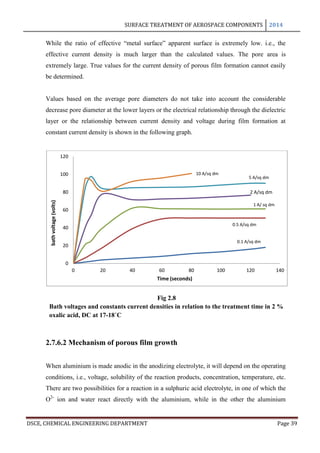
Values based on the average pore diameters do not take into account the considerable
decrease pore diameter at the lower layers or the electrical relationship through the dielectric
layer or the relationship between current density and voltage during film formation at
constant current density is shown in the following graph.
2.7.6.2 Mechanism of porous film growth
When aluminium is made anodic in the anodizing electrolyte, it will depend on the operating
conditions, i.e., voltage, solubility of the reaction products, concentration, temperature, etc.
There are two possibilities for a reaction in a sulphuric acid electrolyte, in one of which the
O2-
ion and water react directly with the aluminium, while in the other the aluminium
0.1 A/sq dm
0.5 A/sq dm
1 A/ sq dm
2 A/sq dm
5 A/sq dm
10 A/sq dm
0
20
40
60
80
100
120
0 20 40 60 80 100 120 140
bathvoltage(volts)
Time (seconds)
Fig 2.8
Bath voltages and constants current densities in relation to the treatment time in 2 %
oxalic acid, DC at 17-18˚C
SURFACE TREATMENT OF AEROSPACE COMPONENTS 2014
DSCE, CHEMICAL ENGINEERING DEPARTMENT Page 40
sulphate first formed is hydrolysed to the hydrate. Once oxide has been formed on the metal
surface, the anion can no longer make contact with the aluminium.
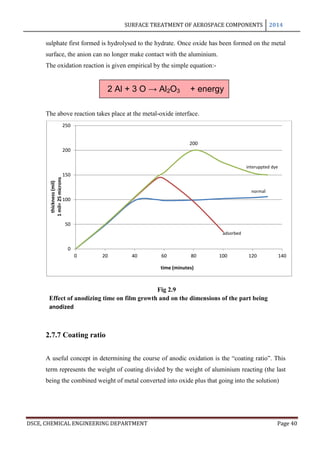
The oxidation reaction is given empirical by the simple equation:-
2 Al + 3 O → Al2O3 + energy
The above reaction takes place at the metal-oxide interface.
2.7.7 Coating ratio
A useful concept in determining the course of anodic oxidation is the “coating ratio”. This
term represents the weight of coating divided by the weight of aluminium reacting (the last
being the combined weight of metal converted into oxide plus that going into the solution)
200
interuppted dye
adsorbed
normal
0
50
100
150
200
250
0 20 40 60 80 100 120 140
thickness(mil)
1mil=25microns
time (minutes)
Fig 2.9
Effect of anodizing time on film growth and on the dimensions of the part being
anodized
SURFACE TREATMENT OF AEROSPACE COMPONENTS 2014
DSCE, CHEMICAL ENGINEERING DEPARTMENT Page 41
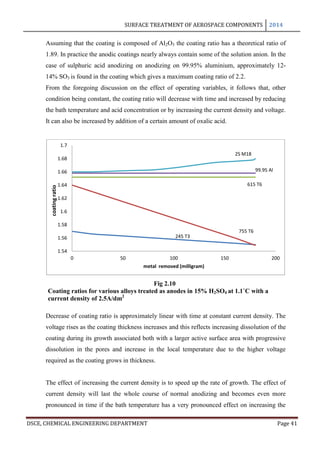
Assuming that the coating is composed of Al2O3 the coating ratio has a theoretical ratio of
1.89. In practice the anodic coatings nearly always contain some of the solution anion. In the
case of sulphuric acid anodizing on anodizing on 99.95% aluminium, approximately 12-
14% SO3 is found in the coating which gives a maximum coating ratio of 2.2.
From the foregoing discussion on the effect of operating variables, it follows that, other
condition being constant, the coating ratio will decrease with time and increased by reducing
the bath temperature and acid concentration or by increasing the current density and voltage.
It can also be increased by addition of a certain amount of oxalic acid.
Decrease of coating ratio is approximately linear with time at constant current density. The
voltage rises as the coating thickness increases and this reflects increasing dissolution of the
coating during its growth associated both with a larger active surface area with progressive
dissolution in the pores and increase in the local temperature due to the higher voltage
required as the coating grows in thickness.
The effect of increasing the current density is to speed up the rate of growth. The effect of
current density will last the whole course of normal anodizing and becomes even more
pronounced in time if the bath temperature has a very pronounced effect on increasing the
2S M18
245 T3
755 T6
99.95 Al
615 T6
1.54
1.56
1.58
1.6
1.62
1.64
1.66
1.68
1.7
0 50 100 150 200
coatingratio
metal removed (milligram)
Fig 2.10
Coating ratios for various alloys treated as anodes in 15% H2SO4 at 1.1˚C with a
current density of 2.5A/dm2
SURFACE TREATMENT OF AEROSPACE COMPONENTS 2014
DSCE, CHEMICAL ENGINEERING DEPARTMENT Page 42
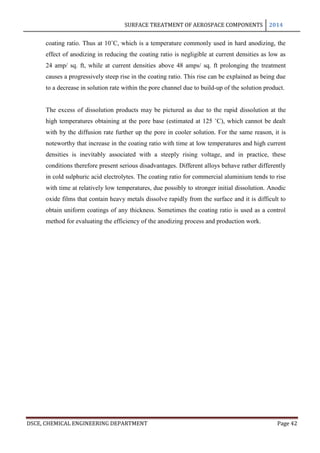
coating ratio. Thus at 10˚C, which is a temperature commonly used in hard anodizing, the
effect of anodizing in reducing the coating ratio is negligible at current densities as low as
24 amp/ sq. ft, while at current densities above 48 amps/ sq. ft prolonging the treatment
causes a progressively steep rise in the coating ratio. This rise can be explained as being due
to a decrease in solution rate within the pore channel due to build-up of the solution product.
The excess of dissolution products may be pictured as due to the rapid dissolution at the
high temperatures obtaining at the pore base (estimated at 125 ˚C), which cannot be dealt
with by the diffusion rate further up the pore in cooler solution. For the same reason, it is
noteworthy that increase in the coating ratio with time at low temperatures and high current
densities is inevitably associated with a steeply rising voltage, and in practice, these
conditions therefore present serious disadvantages. Different alloys behave rather differently
in cold sulphuric acid electrolytes. The coating ratio for commercial aluminium tends to rise
with time at relatively low temperatures, due possibly to stronger initial dissolution. Anodic
oxide films that contain heavy metals dissolve rapidly from the surface and it is difficult to
obtain uniform coatings of any thickness. Sometimes the coating ratio is used as a control
method for evaluating the efficiency of the anodizing process and production work.
SURFACE TREATMENT OF AEROSPACE COMPONENTS 2014
DSCE, CHEMICAL ENGINEERING DEPARTMENT Page 43
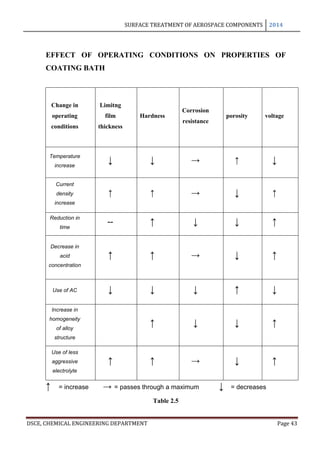
EFFECT OF OPERATING CONDITIONS ON PROPERTIES OF
COATING BATH
Change in
operating
conditions
Limitng
film
thickness
Hardness
Corrosion
resistance
porosity voltage
Temperature
increase
↓ ↓ → ↑ ↓
Current
density
increase
↑ ↑ → ↓ ↑
Reduction in
time
-- ↑ ↓ ↓ ↑
Decrease in
acid
concentration
↑ ↑ → ↓ ↑
Use of AC ↓ ↓ ↓ ↑ ↓
Increase in
homogeneity
of alloy
structure
↑ ↓ ↓ ↑
Use of less
aggressive
electrolyte
↑ ↑ → ↓ ↑
↑ = increase → = passes through a maximum ↓ = decreases
Table 2.5
SURFACE TREATMENT OF AEROSPACE COMPONENTS 2014
DSCE, CHEMICAL ENGINEERING DEPARTMENT Page 44
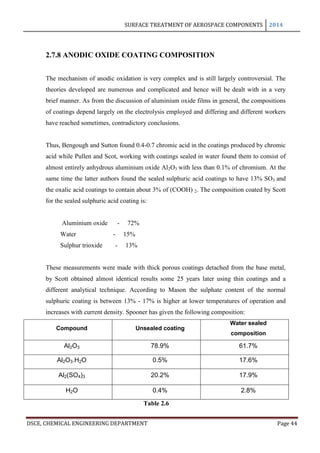
2.7.8 ANODIC OXIDE COATING COMPOSITION
The mechanism of anodic oxidation is very complex and is still largely controversial. The
theories developed are numerous and complicated and hence will be dealt with in a very
brief manner. As from the discussion of aluminium oxide films in general, the compositions
of coatings depend largely on the electrolysis employed and differing and different workers
have reached sometimes, contradictory conclusions.
Thus, Bengough and Sutton found 0.4-0.7 chromic acid in the coatings produced by chromic
acid while Pullen and Scot, working with coatings sealed in water found them to consist of
almost entirely anhydrous aluminium oxide Al2O3 with less than 0.1% of chromium. At the
same time the latter authors found the sealed sulphuric acid coatings to have 13% SO3 and
the oxalic acid coatings to contain about 3% of (COOH) 2. The composition coated by Scott
for the sealed sulphuric acid coating is:
Aluminium oxide - 72%
Water - 15%
Sulphur trioxide - 13%
These measurements were made with thick porous coatings detached from the base metal,
by Scott obtained almost identical results some 25 years later using thin coatings and a
different analytical technique. According to Mason the sulphate content of the normal
sulphuric coating is between 13% - 17% is higher at lower temperatures of operation and
increases with current density. Spooner has given the following composition:
Compound Unsealed coating
Water sealed
composition
Al2O3 78.9% 61.7%
Al2O3.H2O 0.5% 17.6%
Al2(SO4)3 20.2% 17.9%
H2O 0.4% 2.8%
Table 2.6
SURFACE TREATMENT OF AEROSPACE COMPONENTS 2014
DSCE, CHEMICAL ENGINEERING DEPARTMENT Page 45
These figures are equivalent to SO3 contents of 14.2 and 12.6% respectively but the H2O
contents are 0.5 and 5.4%. Edwards and Keller have reported water contents of 1.0% and
6.0% in sulphuric acid and anodized coatings. These figures suggest a possibility of a partial
hydration of the coating. Phillips reports water content in coatings produced in oxalic acid
equivalent to the formula 2 Al2O3.H2O.
The use of radioactive tracer methods for estimating sulphate by using sulphuric acid
incorporating some of the isotopes of S35
has enabled the role of sulphate to be examined
with much more precision. Thus Brace and Baker have detected sulphate during the first few
seconds of anodizing at about 15% slowly falling as anodizing proceeds, and it even reaches
1.5% during chromic anodizing. E.Raub and his co-workers have more recently applied the
same techniques to quiet a detailed examination of sulphate incorporation from coatings
prepared in electrolytes of very low sulphate content based on sulphur sulphosalicyclic acid
or maleic acid. They have demonstrated that although the electrolytes contained only 0.35%
and 0.5% of sulphuric acid, this was essential for the proper operation of the process and the
coatings was found to contain from 5-10% of the sulphate ion.
Anhydrous aluminium oxide is very hygroscopic even when heated to red heat, and the
electrolytically produced coating is like a gel in equilibrium with the vapour pressure.
Change in weight of the anodized aluminium rises steeply with humidity above about 70%
relative humidity and on a 20 micron coating the weight may rise to as much as 600mg/sq
cm. As might be expected, water uptake by sealed coatings is markedly lower at the higher
humidities, although at lower humidity there is often little difference.
On heating, anodic oxide films lose ionic conductance, due probably to a decrease in
aluminium ion, until the film is undistinguishable from an amorphous film formed in dry
oxygen. As electric conductance of the film is proportional to its moisture content, this
property has been utilized has been utilized in an instrument designed to determine
humidity.
Most investigators agree that the coating consists mainly of anhydrous aluminium oxide
which is either amorphous or in the ƴ - Al2O3 or ƴ1
- Al2O3 state, though there is
disagreement concerning these forms. ƴ - Al2O3 is intermediate in formation temperature
SURFACE TREATMENT OF AEROSPACE COMPONENTS 2014
DSCE, CHEMICAL ENGINEERING DEPARTMENT Page 46
between the two ƴ - Al2O3 stages while ƴ1
- Al2O3 is the form produced on heating the
monohydrate ƴ - Al2O3.H2O to 650˚C. Ruziewiez observed changes in the
photoluminescence of anodic films when heated at 450˚C and 680˚C.
Franklin found at least 3 types of oxide in films formed in boric acid-borax solution:
1. Anhydrate layer at the outside of the film
2. Irregular patches of crystalline ƴ1
- Al2O3 within the coating.
3. Amorphous oxide as bulk of the film
On the other hand there is now a great deal of support, example for the view that the
proportion of crystalline oxide in the film increases with the film thickness while the effect
of pre-treatment on the structure of anodic oxide coatings on aluminium cannot be ruled out.
Thus there is some evidence that absorbed chloride, present example, on the aluminium foil
that has to be etched before use in capacitators increases the amount of boehmite present
after anodizing in barrier film electrolytes compared with foil that is etched in hydrofluoric
acid. In practice, this effect is removed by rinsing in hot water containing silicon after
hydrochloric acid etching.
2.7.9 Comparison of AC and DC anodization
In order to overcome the problem of liberated oxygen forming a passive layer on the surface
on which anodization is to be done, it is desired to use AC instead of DC.
The use of AC is done not with the change of polarities but in a pulsated mode DC so that
the passivation of the surface is reduced. In industry AC has also been used successively but
anodized surfaces with AC have certain inherent deficiencies.
The film produced by AC is more transparent. The advantage of AC is due to the lower of
film in comparison with DC films obtained at lower current densities.
AC films can be dyed more deeply and more uniformly than DC films. DC anodizing at low
voltages could also obtain most of the advantages of AC processes. But in some cast
materials, more uniform dyeing can be obtained by using AC process due to the very
efficient degreasing action of AC.
SURFACE TREATMENT OF AEROSPACE COMPONENTS 2014
DSCE, CHEMICAL ENGINEERING DEPARTMENT Page 47
No sound film, thicker than about 12 microns, could be obtained with AC and therefore this
process is not suitable when a high degree of resistance to pitting corrosion is required.
The pore numbers of Ac films are slightly higher than for equivalent DC films, butt AC
films have a tendency to hydrate in sealing to a much greater extent.
The natural colours of AC films are yellowish. The depth of the colour is a function of the
film thickness only and not of other anodizing conditions. The colour is greatly diminished
by boiling water sealing and is greatly intensified by copper or ferrous ions in anodizing
bath.
Abrasion and corrosion resistances of AC films are much lower than those of equivalent DC
films. When the comparison is made is made between films thicker than 6 mm at low
temperatures and high current densities, the comparison becomes more favourable to AC
films.
1.8 PROPERTIES AND TESTS OF ANODIC OXIDE
COATINGS
As discussed previously, the properties of the coatings obtained by the various anodizing
processes may vary considerably, and depending on the specific application for which the
work is to be treated, it is often possible by varying the solution, the operating conditions,
the after-treatment, or even the composition of the basic metal or alloy, to obtain
improvement in the properties aimed at. This section comprises of discussing the physical
and chemical properties of anodic coatings along with the testing methods that have been
employed, certain of which might with advantage be incorporated in routine control and
inspection in aerospace practices, where being specific is particularly important.
2.8.1 Apparent density
The apparent density (specific gravity) of anodic oxide coatings may vary within quiet
appreciable limits depending upon the operating conditions and the basic metal. The
SURFACE TREATMENT OF AEROSPACE COMPONENTS 2014
DSCE, CHEMICAL ENGINEERING DEPARTMENT Page 48
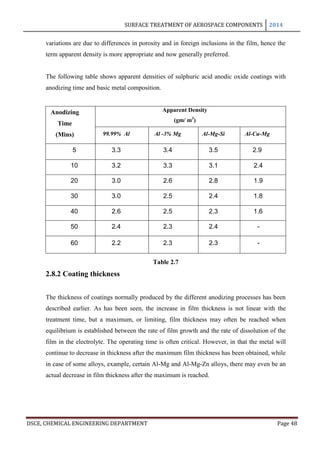
variations are due to differences in porosity and in foreign inclusions in the film, hence the
term apparent density is more appropriate and now generally preferred.
The following table shows apparent densities of sulphuric acid anodic oxide coatings with
anodizing time and basic metal composition.
Anodizing
Time
(Mins)
Apparent Density
(gm/ m3
)
99.99% Al Al -3% Mg Al-Mg-Si Al-Cu-Mg
5 3.3 3.4 3.5 2.9
10 3.2 3.3 3.1 2.4
20 3.0 2.6 2.8 1.9
30 3.0 2.5 2.4 1.8
40 2.6 2.5 2.3 1.6
50 2.4 2.3 2.4 -
60 2.2 2.3 2.3 -
Table 2.7
2.8.2 Coating thickness
The thickness of coatings normally produced by the different anodizing processes has been
described earlier. As has been seen, the increase in film thickness is not linear with the
treatment time, but a maximum, or limiting, film thickness may often be reached when
equilibrium is established between the rate of film growth and the rate of dissolution of the
film in the electrolyte. The operating time is often critical. However, in that the metal will
continue to decrease in thickness after the maximum film thickness has been obtained, while
in case of some alloys, example, certain Al-Mg and Al-Mg-Zn alloys, there may even be an
actual decrease in film thickness after the maximum is reached.
SURFACE TREATMENT OF AEROSPACE COMPONENTS 2014
DSCE, CHEMICAL ENGINEERING DEPARTMENT Page 49
In general, the limiting thickness and the rate of film growth increase with rise in current
density and pH of the solution, with vigorous agitation and with greater homogeneity of the
alloy, and decrease with rise in temperature and the presence of heterogenous phases of
alloying constituents that accelerate the dissolution of the film in the electrolyte. The most
effective method of producing thicker coatings is to use low temperatures. In the case of
dielectric non-porous films, which are practically insoluble in solution, such as films
produced in the boric acid electrolyte, the film growth of the barrier type film ceases when
the breakdown voltage is equal to the voltage applied.
In most cases anodizing first increases the dimensions of the work and then reduces them
again after reaching a maximum. In general, the sulphuric acid film itself has a volume
approximately 1.5 times that of the metal from which it is formed but this ratio is slightly
higher in oxalic acid anodizing and hard anodic films may be 2.0 times the volume of the
metal removed during their formation.
In practice, it is often desirable to measure the film thickness periodically, both as a check
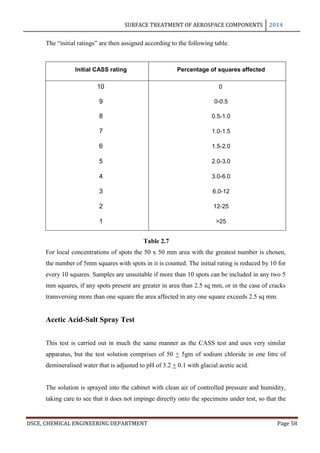
on the solution and on the quality of the work, as the thickness of the coating influences its
resistance to corrosion and wear. This is of particular importance where the work is to be
dyed or where close dimensional tolerances have to be obtained together with adequate
protection. It is of course, essential where specification is to be maintained.
DETERMINATION OF COATING THICKNESS
Numerous methods have been suggested, but no technique that is both simple and accurate
has been evolved suitable for all types of techniques that is both simple and accurate has
been evolved suitable for all types of techniques. Methods for determining the thickness of
anodic coatings in routine inspection should preferably not destroy the film and at least
should not affect the basic metal. Some film thickness meters are now accurate and
dependable but the referee methods in cases of dispute inevitable involve destruction of the
coating.
a) Direct Microscopic Measurement
This is an adaptation of the method for determination of thickness of mirrors and can be
only used for transparent films. It is a non-destructive method for measuring coating
SURFACE TREATMENT OF AEROSPACE COMPONENTS 2014
DSCE, CHEMICAL ENGINEERING DEPARTMENT Page 50
thickness. A microscope is employed whose adjustment includes a micrometer device. The
microscope is first focussed on the surface of the coating, then on the coating-metal
interface. The difference measured on the micrometer device gives the optical film thickness
that must then be multiplied by the refractive index, which is 1.59 for unsealed and 1.62 for
hot-water sealed films. The accuracy of this method increases with the thickness of the
coating and the magnification of the microscope (should be upto 1000 dia). Modification of
this technique is to immerse the article in oil which causes a reduction in the effective
refractive index.
The air-film interface may be focussed with greater accuracy by rubbing the surface lightly
with pencil. If the surface is highly reflective, the shadow of the pencil mark is taken as the
metal-coating interface, or the distance between the pencil marking and its mirror image is
determined, being equivalent to twice the optical thickness.
b) Eddy current measurement
The most reliable non-destructive methods for measuring coating thickness are those carried
out with meters based on the eddy current principle which are designed so that the strength
of a high frequency current flowing through the search coil is dependent on the distance of
the coil from a conducting surface.
Out of the earliest commercial instrument was the Isometer, in which the test head is a small
coil energized by a high-frequency oscillator. The associated magnetic field induces eddy
currents in the basic metal. The depth of penetration of the current is inversely proportional
to the square root of the frequency and directly proportional to the conductivity of the basic
metal. Thus, when the conductivity of the coating differs from that of the basic metal the
coating thickness (i.e., the distance between the probe and the basic metal) is linear to the
output of the amplifier, which is measured on a dial. In order to prepare calibration curves
for the specified aluminium alloy, non-metallic foil of known thickness is placed on the
uncoated metal.
Eddy Current instruments have been used for several years, principally as flow detectors, as
alloy sorters or resistivity-measuring devices. The majority of instruments require a zero-
setting on uncoated metal of the same composition or alloy type as the anodized metal to be
SURFACE TREATMENT OF AEROSPACE COMPONENTS 2014
DSCE, CHEMICAL ENGINEERING DEPARTMENT Page 51
measured, and standardizing on coatings of accurately known thickness, which are
sometimes supplied as plastic films.
The commercial instruments vary in accuracy, stability and dependability with the course of
time. Defects of the earlier models were associated with zero drift requiring very frequent
rechecking, a high sensitivity to temperature changes, a response that was not always linear
and probes whose characteristics are not always stable.
c) Micro-section
The traditional method for determining the anodic coating thickness without equivocation is
the preparation of a standard metallurgical micro-section that can be viewed with a high-
power microscope fitted with a calibrated micrometer eye-piece, or which is equipped with a
projection screen on which direct measurements at a known magnification can be made. It is
destructive, very time consuming, allows only a small portion of the surface to the surface to
be examined and requires some skill and experience because of the tendency for the edge of
the coating to bevel or chip. In fact, in inexperienced hands it can be less certain than the
eddy current method.
The British Non-Ferrous Metals Research Association has given the following guidance:
“Sections shall be cut using a fine jeweller’s saw to avoid deformation and blurring of cut
edges. The cut edges of anodic coatings require support to retain a true profile during
polishing and for ease of differentiation between coating and mounting medium. This may
be achieved in a variety of ways, the following method being recommended.”
The anodized surface of the specimen should be tightly wrapped with a single layer of
smooth aluminium foil and folded at one end to retain in place. The wrapped specimen is
mounted using a suitable thermosetting resin. Fine particles of resin powder should be first
packed around the specimen to ensure the complete filling of voids and the pores finely
filled using the coarser resin particles. The anodized specimen should be perpendicular to
the face of the completed mount, a deviation of 100
introducing, however, only an error of
2% in the thickness. After mounting, the specimen must be free from voids between the
section and the mounting medium.
SURFACE TREATMENT OF AEROSPACE COMPONENTS 2014
DSCE, CHEMICAL ENGINEERING DEPARTMENT Page 52
Mounted specimens are ground on emery paper using water or white spirit lubrication and
the minimum pressure applied to avoid bevelling of the surface. Initial grinding should
employ 100 or 180 grade emery to reveal the true specimen profile and remove any
deformed areas. A final polish for 2-3 minutes on a rotating wheel charged with 4-8
micrometer diamond paste particles and white spirit lubrication should suffice to remove
emery scratched for final examinations.
Where very soft aluminium substrates are being prepared emery particles may become
embedded during grinding. This may be minimised by totally immersing emery papers in
lubricant during grinding or by using a copious flow of lubricant. If emery particles do
become embedded they may be removed by applying a short, light hand polish with metal
polish after grinding and before diamond finishing.
The most convenient microscope magnification for viewing the section is 1000 because
1mm on the screen is equal to 1 micron film thickness. The accuracy with which the coating
can be measured is generally about + 0.5m, and the average of several determinations is
taken.
It should be noted in passing that most other method of film thickness determination are
calibrated by means of standards that have, or should have been measured by micro-section.
They cannot therefore be any better in absolute accuracy than the micro-section method, and
determinations of density are subject to proportionate errors that obviously become greater
when applied to thinner films. The most accurate calibrations require the techniques of
interferometry and expensive equipment.
2.8.3 Porosity
There are semantic problems associated with applying the concept of porosity to anodic
oxide coatings because here we are dealing with materials whose nature is inherently
porous, while at the same time superimposing on this secondary concept borrowed from the
terminologies of electrodeposits which is related more to discontinuities in an essential
homogenous medium. These two properties are sometimes distinguished by referring to
them as micro and macro porosity, but this is not altogether ambiguous because the micro
SURFACE TREATMENT OF AEROSPACE COMPONENTS 2014
DSCE, CHEMICAL ENGINEERING DEPARTMENT Page 53
porosity is on a scale far below the reach of any microscope and can only be imperfectly
seen at magnifications approaching 100,000 with an electron microscope, while macro
porosity can be associated with a number of factors, including inter-metallic constituents,
which are of truly microscopic dimensions.
The porosity, which is part and parcel of anodic oxide coatings, formed in acid electrolyte
arises from dissolution of the coating in the electrolyte so that continuous film formation
becomes possible, and the dimensions of these pores are a function of the electrolyte, the
operating conditions and the thickness of the coating. The nature and magnitude of this
porosity is important because it affects the resistance to abrasion, to corrosion, the case with
which a coating may be dyed or otherwise impregnated, and the efficiency with which it can
be sealed. In very thin anodic coatings the pores can be produced to an extremely uniform
size, example, to within + 10%, and much of our knowledge of pore structure has come
from observation of such films, while in practice they have been used for the filtration of
gaseous colloids or colloidal suspensions. It has also been shown that micro porosity can
also be influenced by the texture of the metal surface, decreasing with the smoothness of the
surface, and being less in electro-polished surfaces than in mechanically polished surfaces
after anodizing.
While micro porosity is closely linked with the physical properties of the coating as noted
above, the continuity or macro-scale features are related to corresponding features or faults
in the basic metal, or to extreme operating conditions, and these may be detrimental to
appearance or corrosion resistance.
The quantitative estimation of porosity will vary to an extent with the method of definition
or test because the dimensions involved are such that they will admit some molecules and
not others and so that gaseous absorption or theoretical calculation of the void space may not
correspond with what can be absorbed in the nature of a solid pigment.
Lead Acetate Absorption
A number of methods have been devised which are based on impregnation of the anodic
coating. In one such test, the specimen is anodized, dipped for 10 minutes in distilled water
SURFACE TREATMENT OF AEROSPACE COMPONENTS 2014
DSCE, CHEMICAL ENGINEERING DEPARTMENT Page 54
in order to remove traces of electrolyte, dried at 110˚C for 30 minutes, and weighed.
Subsequently the specimen is immersed in lead acetate solution for 2 hours, again washed in
distilled water, dried and re-weighed. The gain in weight caused by impregnation with lead
acetate is determined and porosity is calculated.
Toluene Absorption (real density)
Immersing coatings in toluene and using Archimedes principle, to measure the density as
opposed to the apparent density, pore volume can be calculated. With unsealed coatings
formed on 99% Al in sulphuric acid, the density was found to be 2.96 which corresponded
to a pore volume of 15.8% while after sealing the real density became 2.65. Using an alloy
containing 4.5% Cu, 1.5% Mg, a pore volume of 47% was found. In an oxalic acid
electrolyte there was very little change in real density with rise in anodizing temperature and
only a slight increase in porosity, which is different from sulphuric acid where the role of
temperature is very important.
Dielectric constant
Making measurements of the apparent density and the apparent dielectric constant and then
assuming values for the real density and the real dielectric constant, which is assumed to be
2.95 and 8.70 respectively, the porosity of coatings formed in sulphuric acid can be
estimated. The porosity of oxide formed is 15% in sulphuric acid at 4 A/sq dm, 30˚C for 30
minutes is 24-26% while the porosity of film formed at 1˚C is 10-14%. When aluminium is
anodized at more than 20˚C a rapid increase in porosity is observed. The results can be
confirmed by measuring the amount of transformer oil that can be absorbed by unsealed
coating.
2.8.4 Adhesion
The adhesion of the oxide coating is normally much better than that of the electrodeposits
but the film tends to be weak vertically to the surface, i.e. , the film is apt to crack
transversely to the direction of rolling. When bent, the coating cracks in parallel lines but
will not strip off as electrodeposits do. Care must be taken, however not to leave anodized
SURFACE TREATMENT OF AEROSPACE COMPONENTS 2014
DSCE, CHEMICAL ENGINEERING DEPARTMENT Page 55
work in the electrolyte when the current is switched off as this tends to loosen the film and
to decrease adhesion. In general, the adhesion of the film increases with increasing
temperature, acidity and the use of DC, as well as low current densities and longer treatment
times. As the coating is an integral part of the surface, no adhesion test is used for anodized
aluminium in normal circumstances.
2.8.5 Sealing Efficiency
In spite of the profound effects of sealing on properties and performance of anodic oxide
coatings, there has been a need for a good infallible test since many years to indicate how
efficiently sealing has been performed. The most frequently employed property has been the
increased resistance to chemical attack and this can be judged visibly by the appearance of
the coating, or by the extent to which it absorbs a dye-stuff. After attack, it can also be
assessed quantitatively by a photometric measurement of the depth of this dyeing, or finally
with more certainity by measuring the loss of weight. Recently impedance measurements
have become popular. The various methods that have been employed as discussed below.
Certain tests have been used in production control to assess the efficiency of sealing. It is
important to note that sealing tests (as well as those which measure electrical breakdown of
the sealed anodic oxide coating) may give misleading results on coatings that have been
stored for some time before testing. The changes that take place in the film are so profound
that after a period of 7 to 8 weeks of storage, it may be impossible to distinguish between
well and badly sealed films by some tests.
Dye Stain Test
These are commonly employed when one needs to know whether sealing has been
performed or omitted. At one time this was all that one needed to know and they were the
sole tests of sealing, but it is now known that failure to absorb dye represents only the initial
stages of the sealing operations and they are therefore regarded as resistance-to-marking
tests that may be specified where a surface is intended for mild indoor service.
SURFACE TREATMENT OF AEROSPACE COMPONENTS 2014
DSCE, CHEMICAL ENGINEERING DEPARTMENT Page 56
The acid violet test is a commonly used test. Two separate drops of a dye solution is made
by dissolving 1gm C.I Acid Violet No. 34 or a corresponding dyestuff in 50ml distilled or
deionised water , are applied at room temperature to the anodized surface and allowed to
stand for 5 minutes. The test piece is then rinsed in running water and the test area swabbed
for 15 seconds with cotton wool in a detergent solution (1gm sodium dioctylsulphosuccinate
in distilled or deionised water, allowed to stand for 12 hours and made upto 100ml). The test
piece is rinsed and dried with filter paper without rubbing. The sample passes the test if no
mark remains.
Acidified Sulphite Test
In the sodium sulphite sealing test the specimen is immersed in a solution containing
10gm/lt anhydrous sodium sulphite adjusted to pH 3.75 with glacial acetic acid and then to
pH 2.5 with 5N sulphuric acid. The solution is kept at 90-98˚C and the specimens are
immersed for 30 minutes.
A numerical rating system is based on visual standards and ranges from 5 for a perfect
specimen with little or no change in appearance and no bloom to 0 for removal of the
coatings.
In practice, a rating of 3, which is accorded to a surface with a light bluish tinge and “light”
bloom, is usually considered acceptable, while a rating of 2, corresponding to a blue-grey
surface with “moderate” bloom is normally considered to be insufficient for acceptance. On
bright-anodized materials, there is little visual difference between ratings 5 and 0 (coating
removed) and a simple test with a flashlight and battery must be performed to check whether
any coating is left.
2.8.6 Corrosion
CASS Test
The letters CASS stands for “copper-accelerated acetic acid-salt spray test” which is
operated at a higher temperature than the acetic acid-salt spray test and includes a proportion
SURFACE TREATMENT OF AEROSPACE COMPONENTS 2014
DSCE, CHEMICAL ENGINEERING DEPARTMENT Page 57
of cupric chloride which is perhaps the best additive for promoting rapid attack of exposed
aluminium.
The solution used for spraying is made by dissolving 50 + 0.02gm of cupric chloride in
water containing less than that 100ppm of total solids or having a conductivity of less than
0.002 s/m, and diluting to 1 litre. Glacial acetic acid is added to adjust the pH to 3.2 + 0.1.
The cabinet in which the test is carried out in frequently made from Perspex but may be
constructed from, or lined with a material resistant to corrosion, and containing supports to
hold the specimens so that the significant surfaces are at an angle of 15-30˚ to the vertical
and facing upwards. The operating temperature inside the cabinet is 50 + 1˚ and the test
solution is sprayed through nozzles at a rate that the spray collected over a horizontal area of
8000 sq. mm during 8 hours averages 1.5 + 0.5 ml/hr, taking care that no liquid falling from
the specimens or parts of the cabinet is collected. Baffles prevent direct impingement of the
spray onto the specimens. The air used to provide the spray is humidified by passing through
saturation tower containing water at a slightly higher temperature than the enclosure so that
the latter is maintained, about 57˚C usually being about the required level.
The test requires 8 hours to complete, after which the specimens are rinsed in clean running
water to remove any deposits of salts, and dried. The frequency of corrosion spots is
determined by counting the number of spots where there is evidence of basic metal
corrosion and a rating is allocated from 0-10 according to the frequency of pitting, where,
where 10 is the best result completely free from corrosion and 0 is the worst. The method of
counting is described by British Standard 3745: 1964. The significant area is divided into
5mm squares and the corrosion frequency is the ratio of squares with corrosion pits
expressed as a percentage of the total number of squares. The size of a corrosion spot is
defined, as the area of penetration and discolouration without penetrations are not counted.
Spots of more than 1 square amounted only once, but cracks are continued in all squares
entered.
SURFACE TREATMENT OF AEROSPACE COMPONENTS 2014
DSCE, CHEMICAL ENGINEERING DEPARTMENT Page 58
The “initial ratings” are then assigned according to the following table.
Initial CASS rating Percentage of squares affected
10 0
9 0-0.5
8 0.5-1.0
7 1.0-1.5
6 1.5-2.0
5 2.0-3.0
4 3.0-6.0
3 6.0-12
2 12-25
1 >25
Table 2.7
For local concentrations of spots the 50 x 50 mm area with the greatest number is chosen,
the number of 5mm squares with spots in it is counted. The initial rating is reduced by 10 for
every 10 squares. Samples are unsuitable if more than 10 spots can be included in any two 5
mm squares, if any spots present are greater in area than 2.5 sq mm, or in the case of cracks
transversing more than one square the area affected in any one square exceeds 2.5 sq mm.
Acetic Acid-Salt Spray Test
This test is carried out in much the same manner as the CASS test and uses very similar
apparatus, but the test solution comprises of 50 + 5gm of sodium chloride in one litre of
demineralised water that is adjusted to pH of 3.2 + 0.1 with glacial acetic acid.
The solution is sprayed into the cabinet with clean air of controlled pressure and humidity,
taking care to see that it does not impinge directly onto the specimens under test, so that the
SURFACE TREATMENT OF AEROSPACE COMPONENTS 2014
DSCE, CHEMICAL ENGINEERING DEPARTMENT Page 59
collected spray rate averaged over a period of atleast 8 hours on 8000 sq mm of horizontal
surface is 1.5 + 0.5 ml/hr measured with atleast 2 collector vessels. The solution must not be
recirculated. The temperature inside the cabinet is maintained at 35 + 2˚C and the specimens
are supported on inert supports as far as possible with the significant surfaces at an angle of
15-30˚ to the vertical.
After an exposure period of 24 hours the specimens are rinsed in cleaning running water and
dried for inspection. The present requirement is that there shall be no pitting to comply with
the test. The acetic acid-salt spray test is quick to reveal defects in the continuity of the
coating but is quiet a mild test for the coating itself, and its use on thicker coatings has been
largely superseded by the CASS test as described above.
2.9 TYPES OF ANODIZATION
2.9.1 Chromic Acid Anodizing (Type I)
The oldest anodizing process uses chromic acid. It is widely known as the Bengough-Stuart
process. In North America it is known as Type I because it is so designated by the MIL-A-
8625 standard, but it is also covered by AMS 2470 and MIL-A-8625 Type IB. In the UK it
is normally specified as Def Stan 03/24 and used in areas that are prone to come into contact
with propellants etc. There are also Boeing and Airbus standards. Chromic acid produces
thinner, 0.5 μm to 18 μm (0.00002" to 0.0007") more opaque films that are softer, ductile,
and to a degree self-healing. They are harder to dye and may be applied as a pre-treatment
before painting. The method of film formation is different from using sulphuric acid in that
the voltage is ramped up through the process cycle.
2.9.2 Sulphuric Acid Anodizing (Type II & III)
Sulphuric acid is the most widely used solution to produce anodized coating. coatings of
moderate thickness 1.8 μm to 25 μm (0.00007" to 0.001") are known as Type II in North
America, as named by MIL-A-8625, while coatings thicker than 25 μm (0.001") are known
as Type III, hard-coat, hard anodizing, or engineered anodizing. Very thin coatings similar
to those produced by chromic anodizing are known as Type IIB. Thick coatings require
SURFACE TREATMENT OF AEROSPACE COMPONENTS 2014
DSCE, CHEMICAL ENGINEERING DEPARTMENT Page 60
more process control, and are produced in a refrigerated tank near the freezing point of
water with higher voltages than the thinner coatings. Hard anodizing can be made between
25 and 150 μm (0.001" to 0.006") thick. Anodizing thickness increases wear resistance,
corrosion resistance, ability to retain lubricants and PTFE coatings, and electrical and
thermal insulation.
2.9.3 Organic Acid Anodizing
Anodizing can produce yellowish integral colours without dyes if it is carried out in weak
acids with high voltages, high current densities, and strong refrigeration. Shades of colour
are restricted to a range which includes pale yellow, gold, deep bronze, brown, grey, and
black. Some advanced variations can produce a white coating with 80% reflectivity. The
shade of colour produced is sensitive to variations in the metallurgy of the underlying alloy
and cannot be reproduced consistently.
Anodization in some organic acids, for example malic acid, can enter a 'runaway' situation,
in which the current drives the acid to attack the aluminium far more aggressively than
normal, resulting in huge pits and scarring. Also, if the current or voltage is driven too high,
'burning' can set in; in this case the supplies act as if nearly shorted and large, uneven and
amorphous black regions develop. Integral colour anodizing is generally done with organic
acids, but the same effect has been produced in laboratory with very dilute sulphuric acid.
Integral colour anodizing was originally performed with oxalic acid, but sulphonated
aromatic compounds containing oxygen, particularly sulphosalicylic acid, have been more
common since the 1960s. Thicknesses up to 50μm can be achieved. Organic acid anodizing
is called Type IC by MIL-A-8625.
2.10 DYES AND COLOURS
Sulphuric acid anodising produces a porous surface which can easily accept dyes, the larger
the pore the better the dye will take. The range of colours is huge, however alloy choice will
limit some of the colours, and hard anodise film tend to be a dark grey colour which will
limit the choice even more. It is worth remembering that the surface finish of the component
before anodising and the amount of etching and de-smutting will have an effect on the
brightness of the coloured film at the end of the process, castings particular can be difficult
SURFACE TREATMENT OF AEROSPACE COMPONENTS 2014
DSCE, CHEMICAL ENGINEERING DEPARTMENT Page 61
and lead to patchy finishes. In general the surface finish of the part will not improve by hard
anodising in fact the surface roughness is more likely to double during processing. Organic
pigments are the most cost effective but do not have the same colourfast stability and
performance in sunlight than that of the more expensive inorganic systems. They also have a
ceiling of around 150oc before the pigment starts to break down. More lightfast systems are
available with inorganic systems which are electrolytically deposited but they are
considerably more expensive to apply.
A third method of colouring is to introduce the colour within the anodic film; here organic
acids are mixed with the electrolyte. This process is limited to use on high volume bespoke
lines where the need to change to a clean or alternative colour is not required.
2.11 SEALING
Any recently anodised aluminium substrates will have a porous surface to the anodic film,
these pores at this stage absorb any colouring or lubricants. The larger the pore size the more
important it is to seal. The time taken to seal a part is roughly equivalent to the time taken to
anodise. If no additional requirements are specified the surface can be left and allowed to
seal naturally over time or can be sealed. Sealing can be accomplished in a number of ways,
the simplest being a hot de-min dip which converts the oxides into its hydrated form, the
resultant swelling fills the surface pores, this method does have a downside in that it reduces
the abrasion resistance slightly.
A second method is cold sealing. Here the pores are filled with a nickel solution which has
the added advantage of significantly reducing energy costs compared to hot sealing and does
not produce a seal smut. The downside being the part must be dry before handling.
The third method of seal is a hot sodium or potassium dichromate seal; this does leave a
slight yellowish colour on the part.
Additional materials can be added to a seal such as PTFE, typically parts are also printed
before sealing to stop any dye bleed out. Processes such as silkscreen, sublimation transfer
or digital printer are frequently used.
SURFACE TREATMENT OF AEROSPACE COMPONENTS 2014
DSCE, CHEMICAL ENGINEERING DEPARTMENT Page 62
2.12 Mechanical Considerations
Anodizing will raise the surface, since the oxide created occupies more space than the base
metal converted. This will generally not be of consequence except where there are small
tolerances. If so, the thickness of the anodizing has to be taken into account when choosing
the machining dimension. Also in the case of small holes threaded to
accept screws, anodizing may cause the screws to bind, thus the threaded holes may need to
be chased with a tap to restore the original dimensions. Alternatively, special oversize taps
may be used to pre-compensate for this growth. In the case of unthreaded holes that accept
fixed diameter pins or rods, a slightly oversized hole to allow for the dimension change may
be appropriate.
2.13 LABORATORY TESTING
All testing of product in laboratory in done strictly in accordance to following
standards.
Coating Thickness - ASTM B244 - Eddy Current
Coating Weight - ASTM B137 - Acid Dissolution
Seal Quality
- ASTM B136 -Modified Dye Stain
- ASTM B680 - Acid Dissolution
Abrasion Resistance - FED-STD-141 Method 6192.1
Gloss - ASTM D523
Corrosion Resistance
- ASTM B117 - Salt Spray
- ASTM B368 – CASS
2.14 ENVIRONMENTAL IMPACTS
Anodizing is one of the more environmentally friendly metal finishing processes. With the
exception of organic anodizing, the by-products contain only small amounts of heavy
metals, halogens, or volatile organic compounds. Integral colour anodizing produces no
SURFACE TREATMENT OF AEROSPACE COMPONENTS 2014
DSCE, CHEMICAL ENGINEERING DEPARTMENT Page 63
VOCs, heavy metals, or halogens as all of the by-products found in the effluent streams of
other processes come from their dyes or plating materials. The most common anodizing
effluents, aluminium hydroxide and aluminium sulphate, are recycled for the manufacturing
of alum, baking powder, cosmetics, newsprint and fertilizer or used by industrial wastewater
treatment systems.
SURFACE TREATMENT OF AEROSPACE COMPONENTS 2014
DSCE, CHEMICAL ENGINEERING DEPARTMENT Page 64
2.15 ULTRASONIC SOLVENT CLEANING
Ultrasonic Cleaning involves the use of high-frequency sound waves (above the upper
range of human hearing, or about 18 kHz) to remove a variety of contaminants from parts
immersed in aqueous media. The contaminants can be dirt, oil, grease, buffing/polishing
compounds, and mould release agents, just to name a few. Materials that can be cleaned
include metals, glass, ceramics, and so on. Ultrasonic agitation can be used with a variety of
cleaning agents.
Typical applications found in the metals industry are removing chips and cutting oils from
cutting and machining operations, removing buffing and polishing compounds prior to
plating operations, and cleaning greases and sludge from rebuilt components for automotive
and aircraft applications.
Ultrasonic cleaning is powerful enough to remove tough contaminants, yet gentle enough
not to damage the substrate. It provides excellent penetration and cleaning in the smallest
crevices and between tightly spaced parts in a cleaning tank.
The use of ultrasonics in cleaning has become increasingly popular due to the restrictions on
the use of chlorofluorocarbons such as 1,1,1-trichloroethane. Because of these restrictions,
many manufacturers and surface treaters are now using immersion cleaning technologies
rather than solvent-based vapour degreasing. The use of ultrasonics enables the cleaning of
intricately shaped parts with an effectiveness that corresponds to that achieved by vapor
degreasing. Additional information about the regulation of surface cleaning chemicals is
contained in the article “Environmental Regulation of Surface Engineering” in this Volume.
The article “Vapor Degreasing Alternatives” in this Volume includes descriptions of
cleaning systems (some using ultrasonics) that have been designed to meet regulatory
requirements while at the same time providing effective surface cleaning.
SURFACE TREATMENT OF AEROSPACE COMPONENTS 2014
DSCE, CHEMICAL ENGINEERING DEPARTMENT Page 65
2.15.1 Solution
The solution used in ultrasonic cleaning is a very important consideration. Solvents such as
1,1,1-trichloroethane and freon have been used effectively for many years, with and without
ultrasonics. However, with the advent of the Montreal protocol, which calls for elimination
of key ozone-depleting substances by 1996, companies are searching for more
environmentally friendly methods to clean their parts. Chemical formulators are developing
products that meet the demands of cleaning operations, yet are compatible with the health
and well-being of society.
Whenever possible, it is best to use a water-based detergent in the ultrasonic cleaning
process. Water is an excellent solvent, nontoxic, non-flammable, and environmentally
friendly. However, it can be difficult and expensive to dispose of soiled water. Rinsing and
drying can also be difficult without detergents. High surface tension exists in solutions
without detergents,
thus making rinsing difficult in hard-to-reach areas. Detergents can therefore be added to
lower the surface tension and provide the necessary wetting action to loosen the bond of a
contaminant to a substrate. As an added bonus, the cavitation energy in a water-based
solution is more intense than in an organic solvent.
Solution temperature has a profound effect on ultrasonic cleaning effectiveness. In general,
higher temperatures will result in higher cavitation intensity and better cleaning. However,
if the temperature too closely approaches the boiling point of the solution, the liquid will
boil in the negative pressure areas of the sound waves, reducing or eliminating cavitation.
Water cavitates most effectively at about 70ºC (160ºF); a caustic/water solution, on the other
hand, cleans most effectively at about 82ºC (180ºF) because of the increased effectiveness of
the chemicals at the higher temperature. Solvents should be used at temperatures at least 6ºC
(10ºF) below their boiling points.
SURFACE TREATMENT OF AEROSPACE COMPONENTS 2014
DSCE, CHEMICAL ENGINEERING DEPARTMENT Page 66
Table 2.8 is a guide for selection of appropriate cleaning agents for use with ultrasonic
cleaning.
Table 2.8
SURFACE TREATMENT OF AEROSPACE COMPONENTS 2014
DSCE, CHEMICAL ENGINEERING DEPARTMENT Page 67
2.15.2 System Design
Considerations in the design of any cleaning system include the contaminants on the part(s),
the required cleanliness level, the geometry and material of the part(s), the quantity to be
processed, and the previous system design and layout (if applicable). The part geometry,
production rate, and cleaning time required will determine the size of the cleaning system,
once the overall process has been decided. Typical tanks range from 20 to 400 L (5 to 1000
gal), and some are even larger.
Industrial, heavy-duty applications require industrial, heavy-duty ultrasonic equipment.
Other factors that need to be considered are cleaning solutions and temperatures, rinsing
(with or without ultrasonics), drying, automation, and load requirements. Most
manufacturers of ultrasonic cleaning systems will assist in these decisions and will offer
laboratory services and technical expertise. A typical system is shown below.
Fig 2.11
Automated ultrasonic cleaning system
It uses neutral pH solution at 60˚C (140 ˚F) and three rinse stages
at 70˚C (160˚F).Basket rotation (1-3 rpm) is used during each stage
to ensure adequate cleaning. The system is computer controlled
and allows for storage of different process parameters at different
parts
SURFACE TREATMENT OF AEROSPACE COMPONENTS 2014
DSCE, CHEMICAL ENGINEERING DEPARTMENT Page 68
a. Cleanliness Considerations
In a typical aqueous ultrasonic cleaning system, it is the cleaning stage(s) that will remove
or loosen the contaminants. The following rinse stage(s) remove any remaining loosened
soils and residual detergent, and a dryer removes any remaining rinse water. The overall
process of the system is usually determined experimentally. Most reputable industrial
cleaning equipment manufacturers have an applications lab where, through a process of
experience, trial, and error, a properly designed cleaning process can be determined to meet
the cleanliness levels specified.
There are a variety of ways to check for cleanliness. Some are as simple as a water break
test on the part to see if most oil has been removed. Others are as elaborate as surface
quality monitoring that uses optically stimulated electron emission technology to measure
thin films of contaminants down to the Angstrom level.
b. Changing Existing Systems
If a current system exists, such as a vapour degreaser or soak tank, several things need to be
considered. It may be practical, and possibly most economical, to retrofit the existing unit
from one that uses solvent an organic solvent to one that uses an aqueous cleaner.
Ultrasonic transducers can be added to an existing tank by cutting a hole in the tank and
welding the transducer(s) in, or by simply dropping a watertight immersible unit into the
tank. The latter method will take up some room in the tank, but it requires less labour.
Additional work may have to be done to the tank, such as removing the cooling coils from
the vapour degreaser, adding additional fittings for a filtration system, and so on.
In some existing systems, there is a large inventory of stainless steel baskets for handling the
parts throughout the cleaning system. If possible, it is best to use these baskets due to the
relatively high cost of replacement. In ultrasonic cleaning, the mesh size or hole
configuration of the basket is very important. Some mesh sizes will inhibit the cavitation
process inside the basket, thereby affecting the overall cleaning capability. Mesh sizes
greater than 200 mesh or less than 10 mesh work best. An interesting note is that ultrasonic
SURFACE TREATMENT OF AEROSPACE COMPONENTS 2014
DSCE, CHEMICAL ENGINEERING DEPARTMENT Page 69
activity will pass through a variety of media. For example, solution A placed in a Pyrex
beaker will cavitate if placed in solution B, which is cavitating in an ultrasonic tank.
c. Part Handling
The geometry of the parts must be carefully analyzed to determine how they will be placed
in the cleaning tank. Large parts, such as engine blocks, can be suspended directly from a
hoist, whereas smaller parts will usually be placed in a basket. The most important factor in
parts placement is to be sure that air is not trapped anywhere inside the part. If an air pocket
is allowed to form, such as in a blind hole that would be facing downward toward the
bottom of the tank, the cleaning solution and effects of cavitation will not be able to reach
this particular area.
The part will have to be rotated somehow in the tank during the cleaning process to allow
the cleaning solution to reach the area where air was previously trapped. This can be
accomplished either manually, by the attending operator, or by a rotating arm on an
automated lift mechanism.
Fig 2.12
An existing tank converted to a ultrasonic tank using two
water-tight immersible ultrasonic units
SURFACE TREATMENT OF AEROSPACE COMPONENTS 2014
DSCE, CHEMICAL ENGINEERING DEPARTMENT Page 70
It is best if small parts can be physically separated when placed in a basket. An example
would be to place machined valve bodies in a basket with some type of divider or locator for
each one. Many times, however, in high output lines it is not possible to separate parts
physically, such as in the manufacture of electrical connector pins where thousands of parts
may need to be cleaned at one time because of the high production output and the small size.
Ultrasonic agitation will be able to reach between these parts and allow the solution’s
scrubbing power to remove the contaminants, even if the parts are stacked on top of one
another. On the other hand, rinse water may not remove all of the residual detergent, and a
dryer has a very hard time removing moisture from embedded parts. The problem is easily
solved by having an automated hoist with a constant rotating fixture on the arm that allows
the basket to tumble at 1 to 3 rpm. This rotation allows the parts to tumble slowly and
exposes the embedded pieces for proper rinsing and drying.
SURFACE TREATMENT OF AEROSPACE COMPONENTS 2014
DSCE, CHEMICAL ENGINEERING DEPARTMENT Page 71
2.16 PICKLING- PASSIVATION
Stainless steel can corrode in service if there is contamination of the surface. Both pickling
and passivation are chemical treatments applied to the surface of stainless steel to remove
contaminants and assist the formation of a continuous chromium-oxide, passive film.
Pickling and passivation are both acid treatments and neither will remove grease or oil. If
the fabrication is dirty, it may be necessary to use a detergent or alkaline clean before
pickling or passivation.
2.16.1 Pickling
Pickling is a metal surface treatment used to remove impurities, such as stains, inorganic
contaminants, rust or scales from ferrous metals, copper and certain aluminium alloys.
Solution called pickle liquor, which contains strong acids, is used to remove the surface
impurities. It is commonly used to descale or clean steel in various steel making processes.
Pickling is typically performed to remove tightly adherent oxide films resulting from hot-
forming, heat treating, welding and other high temperature operations. Welding or heat
treatments often produce complex oxides that can vary in colour. All these oxides are
generally referred to as “scale” and must be removed. Where applicable, alternative
mechanical methods such as blasting, shot peening, tumbling, and wheel abrading may also
be performed. Abrasives containing iron should not be used. In many cases, pickling of
stainless steel is performed in two steps, one for softening the scale and one for the final
scale removal. Over-pickling, under-pickling and pitting usually are the direct results of lack
of control over process variables including acid concentrations, solution temperature and
contact time.
2.16.2 Passivation
Manufactures and users of processing equipment very often demand a final step of surface
treatment, i.e. passivation, in order to achieve a product with acceptable visual appearance
and high corrosion resistance. The passivation process removes chips and “free iron”
contaminations left behind on the surface from different fabrication operations.
SURFACE TREATMENT OF AEROSPACE COMPONENTS 2014
DSCE, CHEMICAL ENGINEERING DEPARTMENT Page 72
Passivation in physical chemistry and engineering refers to a material becoming “passive”,
that is being less affected by environmental factors such as air or water. It involves a
shielding outer layer of corrosion which can be applied as a micro coating or found
occurring spontaneous in nature. Passivation is useful in strengthening and preservation of
appearance of metals. Passivation with nitric acid enhances the chromium fraction in the
passive film. The main mechanism for this process is selective dissolution of predominantly
iron, which results in an increased corrosion resistance. Although several investigations have
found that passivation treatments usually have a beneficial effect on the corrosion resistance,
very little is known about the passivation effect with time.
Although there are many options of passivation solutions, the overwhelming choice is still
the nitric acid based solutions. Nitric acid has the disadvantage of being hazardous from
health and environmental point of view. Another option is passivation with citric acid, a
milder alternative to nitric acid. Even though citric acid is milder to stainless steel it gives
acidic waste and thereby still causes environmental problems.
A passivation solution recently widely advertised is the use of chelating agents. It is claimed
that these comprise extremely versatile, highly effective compounds, which complex and
remove a variety of metallic ions that would otherwise adversely affect the corrosion
resistance of the alloy. Chelat comes from the Greek word “chela” meaning claw. Its
function is explained in that way that a ring structure is formed around a contaminant
metallic ion that is removed and strongly held. The chemicals bond of the metallic ion are
fixed within and inactivated by the ring structure of the chelat surrounding it. It cannot
function as a metallic element any longer and is removed by the chelating agent.
Commonly used chelats are poly-functional organic carboxylic acids, such as EDTA and
citric acid, with salts containing hydroxyl and amine constituents. However, a forthcoming
problem with at least some of the chelat agents is that the wastewater treatment plants are
not able to decompose these sequestering agents, which implies that heavy metals are
transported through the wastewater plant untreated directly into nature.
SURFACE TREATMENT OF AEROSPACE COMPONENTS 2014
DSCE, CHEMICAL ENGINEERING DEPARTMENT Page 73
The specimens were immersed in the solutions at room temperature for 30 minutes after
thorough cleaning. After passivation the specimens were rinsed in distilled water, and left in
air for a minimum of 18 hours before any test was performed.
2.16.3 Tests for Determination Of Effective Passivation
Visual inspection
It is based on the Basic principle of illuminate the test specimen with light and then
examining the specimen with the eye. It is used to magnify defects which cannot be detected
by the unaided eye. It is very simple means to assist in the inspection of defects. It also
permits the visual checks of areas not accessible to unaided eye.
It is the most widely used of all the non-destructive tests as it is simple, easy to apply,
quickly carried out and usually does not involve costly complex equipments.
Ferroxyl Test
This test is usually done for determining free iron content. It is done when the presence of
traces of iron or iron oxides is objectionable. Ferroxyl test for free iron is a highly sensitive
test to detect even traces of free iron or iron oxide.
The test solution is prepared by first adding Nitric acid to distilled/DM water and then
adding potassium ferricyanide in the following proportion.
Distilled/DM water : 94 ml
Nitric acid (70%) : 03 gms
Potassium ferricyanide : 03 gms
The test specimen is dipped in the above solution and taken out or the test solution is
sprayed on the test specimen.
The appearance of blue stain within 15 sec of application is evidence of surface iron
contamination due to improper pickling & passivation / decontamination. The solution
SURFACE TREATMENT OF AEROSPACE COMPONENTS 2014
DSCE, CHEMICAL ENGINEERING DEPARTMENT Page 74
should be removed from the surface as quickly as possible after testing, using DM/Distilled
water.
Rubber gloves, clothing and face shields should be used when applying the test solution and
inhalation of the spray should be avoided,
The test solution will change colour if it is kept for 30 mins and must be prepared fresh prior
to each use.
Wipe Test
The surface to be inspected is rubbed with a clean, lint free white cotton cloth or filter paper
moistened, with high purity solvent. The presence of a smudge in the cloth is evidence of
contamination.
Surface Analysis
X-ray photoelectron spectroscopy (XPS) was used for surface analysis.For quantitative
analysis the obtained spectra were fitted with different components, after back ground
subtraction. The measured XPS intensities allowed evaluation of the composition and the
thickness of the passive film.
Duration Studies
In order to study the durability of the passivation treatments, i.e. if the passivation effect last
even after some time in service, the passivated specimens were immersed in 0.5 weight-%
sulphuric acid for 3 days. Dilute sulphuric acid was chosen as it is a fair common
environment for stainless steels and also an environment where the investigated grade is
resistant, i.e. showing a passive behaviour.
SURFACE TREATMENT OF AEROSPACE COMPONENTS 2014
DSCE, CHEMICAL ENGINEERING DEPARTMENT Page 75
2.17 CHEMICAL CLEANING
Chemical cleaning has long been regarded as the most efficient and least disruptive method
for cleaning piping and cooling water systems, boilers, tanks and reactors. Chemical
cleaning is required on new build systems to ensure that residual contamination and excess
depositions such as mill scale, welding slag and grease do not contaminate product or cause
severe damage to rotating machinery or valves. Existing piping systems in service that are
affected by contaminants, organic and inorganic scales, may in time reduce flowrates or
affect heat transfer. Weatherford can provide the most technically advanced, cost-effective
chemical cleaning solution for any combination of problems.
2.17.1 Types of chemical cleaners
Cleaning agents normally water solutions that might be acidic, alkaline, or neutral,
depending on the use. Cleaning agents may also be solvent-based or solvent-containing and
are then called degreasers.
Acidic
Acidic washing agents are mainly used for removal of inorganic deposits like scaling. The
active ingredients are normally strong mineral acids and chelants. Often, there are added
surfactants and corrosion inhibitors. One common mineral acid is Hydrochloric Acid, (also
called Muriatic Acid), is typically used for cleaning swimming pools and concrete. Vinegar
can also be used to clean hard surfaces, and aid in the removal of calcium deposit build-
up. Sulphuric acid is added into domestic acidic drain cleaners to unblock clogged pipes by
dissolving greases, proteins and even carbohydrate-containing substances (like tissue paper).
Alkaline
Alkaline washing agents contain strong bases like sodium hydroxide or potassium
hydroxide. The alkali also dissolves grease, oils, fats, and protein-based deposits. Often
there are added dispersing agents to prevent re-deposition of dissolved dirt and/or chelants to
attack rust on metal parts.
SURFACE TREATMENT OF AEROSPACE COMPONENTS 2014
DSCE, CHEMICAL ENGINEERING DEPARTMENT Page 76
Bleach (pH 12) and Ammonia (pH 11) are also common alkaline cleaning agents. While
many people believe that mixing cleaning agents together will create a compound that is
more powerful, this is false. Mixing cleaning agents such as bleach and ammonia together
can be dangerous or fatal.
Neutral
Neutral washing agents are pH-neutral and based on non-ionic surfactants that disperse
different types of dirt.
Degreaser
Cleaning agents specially made for removal of grease are called degreasers. These may
be solvent-based or solvent-containing and may also have surfactants as active ingredients.
The solvents have a dissolving action on grease and similar dirt. The solvent-containing
degreaser may have an alkaline washing agent added to a solvent to promote further
degreasing. Degreasing agents may also be made solvent-free based on alkaline chemicals
and/or surfactants.
2.17.2 Common Cleaning Agents Used
The most common cleaning agent is water which is a very powerful polar solvent
1. Carbon tetrachloride(former)
2. Ammonia
3. Borax
4. Sodium bicarbonate (baking soda)
5. Carbon dioxide
6. Calcium hypochlorite
7. Chromic acid
8. Ethanol or methanol (only in solutions)
9. Various forms of alcohol
10. Various chlorine compounds
SURFACE TREATMENT OF AEROSPACE COMPONENTS 2014
DSCE, CHEMICAL ENGINEERING DEPARTMENT Page 77
2.18 Vapour Degreasing
Greasy surfaces of the items machined or pressed are hydrophobic and are not wetted by
aqueous solution of salts or acids. In such cases the preparation begins with degreasing and/
or pickling.
The composition of degreasing solution depends on the metals to be treated and the degree
of its contamination. Electrochemical degreasing in alkali solution is quicker than chemical
degreasing. The items to be degreased mostly form the cathode, although anodic degreasing
is sometimes employed.
Electrochemical degreasing consists of emulsifying the fats by means of hydrogen bubbles
evolved at the cathode or oxygen bubbles evolved at the anode. When a greasy item is
immersed in an alkali solution the fatty film is broken down and surface tension causes the
grease to coagulate into drops. If the metal is polarised the contact angles of the oil droplets
become smaller and their adhesion to the metal surface is reduced while wettability by water
increases. Small gas bubbles which become detached from the electrode near an oil drop are
retained at the interface between the oil and the solution. As the gas bubble grow due to
further evolution of gas, the gas, the oil drops become extended, their adhesion to the metal
surface decreases when the contact angle becomes small and they are removed by gas
bubbles from the metal surface into the solution. The operating temperature is usually 60-
80˚C.
The acting principle behind the vapour –degreaser process is that the solvents will dissolve
the contaminants on the work piece and remove them by dripping of the part. A basin of
solvent is set-up with a heating coil to bring the solvent to boil. As the solvent evaporates it
rises to the fill-line in the chamber, above which the air with a much lower density than the
solvent is present. This contains the vaporised solvent in a closed space where the work-
piece is placed. The solvent condenses on the more frigid work piece and now the liquid
solvent dissolves the greases on the part. With the impurities contained in the liquid beads,
the solvent runs off the part. Some systems are designed to capture and reclaim this solvent,
making the process much more economical.
SURFACE TREATMENT OF AEROSPACE COMPONENTS 2014
DSCE, CHEMICAL ENGINEERING DEPARTMENT Page 78
2.19 OBJECTIVES
 To determine the parameters for obtaining optimum coating thickness of between 17-
27mm (aerospace specifications).
 To perform tests to find out the correct electrolyte among a group of choices available.
 To determination of optimum temperature to obtain uniform coating of moderate
thickness and minimum porosity.
 To determine the type of current supply to be used and the operating voltage for best
anodize coating.
 To determine the method and agents for sealing so as to provide better corrosion
resistance
SURFACE TREATMENT OF AEROSPACE COMPONENTS 2014
DSCE, CHEMICAL ENGINEERING DEPARTMENT Page 79
Chapter 3
Materials and Methods
SURFACE TREATMENT OF AEROSPACE COMPONENTS 2014
DSCE, CHEMICAL ENGINEERING DEPARTMENT Page 80
3.1 Materials
 Aluminium test component (99.99% Al, 99.5% Al, Al-3% Mg,, Al-Mg-Si, Al-Cu-Mg)
 IPA (Isopropyl Alcohol)
 1,1,1 –trichloroethylene
 Stainless Steel 316
 Titanium test component
 Nitric Acid
 Distilled Water
 Demineralized Water
 NaOH (sodium Hydroxide)
 HF (hydrofluoric acid)
 ABF (Ammonium Bifluoride)
 Sodium Carbonate
 Trisodium Phosphate
3.2 Pre-treatment of Aluminium For Anodization
Successful anodization depends upon the pre-treatment of the metal, the choice of the
electrochemical process and the aluminium alloy being oxidized. There must be no oil and
greases on the metal surface and the metal should be free from blemishes such as scratches,
blow holes and pits since anodizing emphasizes defects. In general the method of fabrication
of casting affects the final appearance of the oxide. Final grain die-castings are most suitable
for anodizing, pressure die casting give good anodized films although high silicon alloys
may carry a detrimental grey surface film, whilst the rough surface produced with the sand
castling is least suitable for anodizing unless properly pre-treated.
SURFACE TREATMENT OF AEROSPACE COMPONENTS 2014
DSCE, CHEMICAL ENGINEERING DEPARTMENT Page 81
Purpose of pre-treatment
The purpose of pre-treatment is to fulfill the following requirements:
1. Removal of oxide layer and unsound surface layers e.g., corrosion products formed
due to exposure to air.
2. Removal of lubricants used in forming aluminium by rolling, drawing, stamping,
threading etc., as well as quenching media used in heat treatments. The lubricants used
may be fatty acid compounds of vegetable, animal origin or mineral oils.
3. Removal of polishing compounds e.g, stearin and paraffin waxes containing abrasive
and absorbent minerals such as fine silica, lime etc.
4. Removal of dust, metal chips, solid dirt and foreign matters.
5. Removal of corrosive salts and scales formed after welding and brazing.
6. Removal of handling grease, finger marks etc which are mainly fatty acids and
nitrogenous compounds.
The entire pre treatment of aluminium consists of cleaning the surface and making it ready
for anodization. Many processes are commonly used in cleaning aluminium, depending on
the work and nature of contamination. The cleaning cycle was carried out in the following
manner.
3.2.1 Mechanical Cleaning
The aluminium component was first cleaned using a cloth dipped in 8% isopropyl alcohol.
This was done to remove dust or other material sticking to the metal surface.
3.2.2 Ultrasonic Cleaning
The mechanically cleaned component free from any dust was then placed in an ultrasonic
bath containing isopropyl alcohol. Sound waves with a frequency above 20000 Hz were
SURFACE TREATMENT OF AEROSPACE COMPONENTS 2014
DSCE, CHEMICAL ENGINEERING DEPARTMENT Page 82
passed through the bath for about 2 minutes. The purpose of this was to remove any oil and
grease from the metal surface. The cleaning tank is made up of stainless steel.
3.2.3 Acetone Rinsing
The component from ultrasonic bath was then rinsed with 10% acetone to ensure fast and
spotless drying of aluminium.
3.2.4 Drying
The aluminium was then dried in an oven at 40ºC for about 2 minutes and was then ready
for alkali cleaning.
3.2.5Alkali Cleaning
The dried component was placed in alkaline bath. The alkaline bath has a composition of
5% sodium hydroxide, 3% sodium carbonate and 2% trisodium phosphate. The cleaning was
made to remove the unwanted oxide film formed on the surface of aluminium by exposure
to air. The component was immersed in this bath till it turned black. The black colour was
due to formation of smut, which is result of reaction between alkali and aluminium-oxide.
This process also helps in removal of oils and grease that are not removed in ultrasonic
cleaning process. The alkali cleaning tank was made up of mild steel with rubber lining. It
was fitted with fume exhauster to remove any harmful vapours coming out of the tank.
3.2.6 Rinsing in water
The component from alkaline bath was then rinsed with water to remove any alkali present
on the metal surface. This was done to avoid contamination of the acid bath. The rinsing
tank is made up of PVC.
3.2.7 Acid Cleaning
This process is also called desmutting. The smut formed in alkali cleaning process is
removed in this process. The component was immersed in the acid bath, having a
composition of 10% nitric acid and 2% phosphoric acid, till the component turned bright.
Hence the process is also called Bright Aluminium Process. The tank is made up of mild
steel with rubber lining and is fitted with fume exhaustor.
SURFACE TREATMENT OF AEROSPACE COMPONENTS 2014
DSCE, CHEMICAL ENGINEERING DEPARTMENT Page 83
3.2.8 Rinsing with Demineralised water
The component from acid bath was then rinsed in water before being rinsed in running DM
water. This removes any traces of acid from the surface. Now, the component is ready for
anodization and is taken to anodization tank.
SURFACE TREATMENT OF AEROSPACE COMPONENTS 2014
DSCE, CHEMICAL ENGINEERING DEPARTMENT Page 84
3.2.9 Process Flowchart For Cleaning Cycle
Cleaned Aluminium Out
Mechanical Cleaning
Ultrasonic Cleaning
Acetone Rinsing
Drying
Alkali Cleaning
Rinsing in Water
Acid Cleaning
Rinsing in water
Rinsing in Running DM water
Aluminium
in
SURFACE TREATMENT OF AEROSPACE COMPONENTS 2014
DSCE, CHEMICAL ENGINEERING DEPARTMENT Page 85
3.3 Anodization Process
3.3.1 Construction of Anodization Tank
The anodization tank is a mild steel tank with PVC lining.. the dimensions of the tank are
4x3x3 feet.
The cathode is made of a lead (96%) - antimony(4%) alloy. The aluminium to be anodized is
taken as the anode. This aluminium is often referred as “job”.
The tank is provided with chilling coils, which is made of lead. The chilling coils are
circulated with brine solution. A pump is provided for circulation of the brine solution. The
purpose of chilling is to absorb the heat evolved from the anodization reaction and to
maintain the temperature to the specific requirements. Normally when the temperature of the
bath is between 15-17ºC a soft coating is obtained. By lowering the bath temperature, upto
almost -5ºC, harder coatings are obtained.
Fig 3.1
Schematic diagram of anodization tank
SURFACE TREATMENT OF AEROSPACE COMPONENTS 2014
DSCE, CHEMICAL ENGINEERING DEPARTMENT Page 86
An air agitator, made of lead, is provided for dissipating the heat from the reaction
uniformly throughout the bath.
A fume exhauster is provided around the top section of the tank for drawing any fumes
coming of the tank.
3.3.2 Process Description
Preceding the anodization process, wrought alloys are cleaned in either a hot soak cleaner or
in a solvent bath and may be etched in sodium hydroxide (normally with added sodium
gluconate), ammonium bifluoride or brightened in a mix of acids. Cast alloys are normally
best just cleaned due to the presence of inter-metallic substances unless they are a high
purity alloy such as LM0.
The anodized aluminium layer is grown by passing a direct current through an electrolytic
solution, with the aluminium object serving as the anode (the positive electrode). The
current releases hydrogen at the cathode (the negative electrode) and oxygen at the surface
of the aluminium anode, creating a build-up of aluminium oxide. Alternating current and
pulsed current is also possible but rarely used. The voltage required by various solutions
may range from 1 to 300 V DC, although most fall in the range of 15 to 21 V. Higher
voltages are typically required for thicker coatings formed in sulphuric and organic acid.
The anodizing current varies with the area of aluminium being anodized, and typically
ranges from 0.3 to 3 amperes of current per square decimeter (20 to 200 mA/in²).
Aluminium anodizing is usually performed in an acid solution which slowly dissolves the
aluminium oxide. The acid action is balanced with the oxidation rate to form a coating with
nanopores, 10-150 nm in diameter. These pores are what allow the electrolyte solution and
current to reach the aluminium substrate and continue growing the coating to greater
thickness beyond what is produced by auto-passivation. However, these same pores will
later permit air or water to reach the substrate and initiate corrosion if not sealed. They are
often filled with coloured dyes and/or corrosion inhibitors before sealing. Because the dye is
only superficial, the underlying oxide may continue to provide corrosion protection even if
minor wear and scratches may break through the dyed layer.
SURFACE TREATMENT OF AEROSPACE COMPONENTS 2014
DSCE, CHEMICAL ENGINEERING DEPARTMENT Page 87
Conditions such as electrolyte concentration, acidity, solution temperature, and current must
be controlled to allow the formation of a consistent oxide layer. Harder, thicker films tend to
be produced by more dilute solutions at lower temperatures with higher voltages and
currents. The film thickness can range from under 0.5 micrometers for bright decorative
work up to 150 micrometers for architectural applications.
3.4 Post-Treatment of Anodized Aluminium
The post-treatment of anodized aluminium includes the dyeing and sealing operations. The
purpose of dyeing is to impart a colour to the anodized surface by fitting into the pores
formed on the surface of aluminium during anodization. The purpose of sealing is to seal the
pores, thereby forming a smooth impermeable layer on the dyed aluminium surface.
3.4.1 Dyeing
The anodized aluminium after rinsing in DM water is dipped in the dye solution. The dye
solution was pre-heated to around 60ºC. the dye solution consists of around 7gm/lt of
organic dye with a 5% nickel acetate solution that helps the dye molecules to get fixed into
the pores. The Al was kept immersed in the dye solution for 30 seconds and by this time a
uniform colour was imparted on the surface of the work-piece.
Fig 3.2
Dyed Specimen
SURFACE TREATMENT OF AEROSPACE COMPONENTS 2014
DSCE, CHEMICAL ENGINEERING DEPARTMENT Page 88
In the aerospace industry, dyeing is done to identify different system lines in the launch,
control and engine systems. The following table shows the colours of dyes used for different
lines :
COLOURS LINES
Red Propellant line
Blue Water line
Yellow Oxidizer line
Orange Differential pressure transducer line
Green Nitrogen line
Table 3.1
3.4.2 Sealing
The anodic film consisting of a thin, non-porous barrier layer and a thicker porous outer
layer was then subjected to sealing treatment. The barrier layer does not require sealing
while the outer layer must be sealed.
Fig 3.3
Schematic Diagram of sealing
SURFACE TREATMENT OF AEROSPACE COMPONENTS 2014
DSCE, CHEMICAL ENGINEERING DEPARTMENT Page 89
The sealing process was carried out by boiling the dyed component in DM water at 90-
100ºC for 2 hours. During this process, the porous aluminium oxide is converted into
aluminium monohydrate. This causes increase in volume of the outer oxide layer and hence
sealing of the pores. Sealing of anodic film makes the dye permanent by closing the pores
and forming a smooth and impermeable layer on the surface.
The sealed anodized component was then washed with water and rinsed in isopropyl alcohol
and dried in atmospheric conditions. The IPA provides for a fast and spotless drying.
SURFACE TREATMENT OF AEROSPACE COMPONENTS 2014
DSCE, CHEMICAL ENGINEERING DEPARTMENT Page 90
3.4.3 Process flowchart for anodization
Cleaning cycle
Aluminium to be anodized
Anodization
Water Rinsing
DM Water Rinsing
Sealing
Dyeing
Rinsing in running DM water
IPA Rinsing
Drying
Aluminium to be anodized
SURFACE TREATMENT OF AEROSPACE COMPONENTS 2014
DSCE, CHEMICAL ENGINEERING DEPARTMENT Page 91
3.5 Pickling-Passivation Process Sheet
Sl.
No.
STEP PROCEDURE PARAMETER
01
Degreasing/Solvent
cleaning
Using Isopropyl
alcohol/Trichloroethylene
10 mins
02 Drying
Components are dried at
RT
10 mins
03 Alkali cleaning
Immerse components in the
foll. alkali mix :-
NaOH : 50 -100 gm or
Hi-Power 5-10 %
Water : 1000CC
Temperature : RT
30 mins
04 Water Rinse
Cleaning with water jet till
pH is neutral (6.5 - 7.5)
05 mins
05 Acid pickling
Immerse components in the
foll. acid mix
Nitric acid (70%): 80-100
cc (A.R/G.R grade)
HF acid : 20 -30 cc
(A.R/G.R grade)
DM Water : Remaining
Temperature : RT
15 mins
06 Water Rinse
Cleaning with water jet till
pH is neutral (6.5- 7.5)
05 mins
07 Passivation
Immerse the components in
the foll passivation mixture
a)
SS with more
than 17 %
chromium
Nitric Acid (70%) : 200
CC (A.R/G.R grade)
DM/Distilled Water : 800
CC (A.R/G.R grade)
Temperature : RT
30 mins
b) **
Nitric Acid (70%) : 200
CC (A.R/G.R grade)
DM Water : 800 CC
(A.R/G.R grade)
Temperature : 650
C
10 mins
SURFACE TREATMENT OF AEROSPACE COMPONENTS 2014
DSCE, CHEMICAL ENGINEERING DEPARTMENT Page 92
08
Decontamination
SS Series with
less than 17 %
chromium
Immerse the components in
the foll. acid mixture :
Nitric acid (70%) : 200 cc
(A.R/G.R grade)
K2Cr2O7 /Na2Cr2O7 : 20 gm
(A.R/G.R grade)
DM water : 800CC
Temperature : RT
30 mins
09 Water Rinse
Cleaning with water jet till
pH is neutral (6.5 – 7.5)
and then rinsing with
distilled water.
5 mins
10 Neutralisation
Neutralisation is done is
alkaline degreasing
solution mentioned in 03
10 mins
11 Water Rinse
Cleaning with water jet till
pH is neutral/7
5mins
12 DM water rinse Cleaning with DM water. 5 mins
13 IPA Rinse
Components are rinsed
with IPA for fast drying.
5 mins
14 Oven Drying
Components are dried in
oven at 70-800
C
60 mins
15
Packing and
storage
Packed in sealed polythene
cover
---
Table 3.1
Process sheet for pickling-passivation
SURFACE TREATMENT OF AEROSPACE COMPONENTS 2014
DSCE, CHEMICAL ENGINEERING DEPARTMENT Page 93
3.5.1 Process Flowchart of pickling-passivation
Solvent Cleaning
Stainless steel component
in
Alkali Cleaning
Water Rinsing
Pickling
Water Rinsing
Passivation
Water Rinsing
DM Water Rinsing
Drying
Stainless steel component out
SURFACE TREATMENT OF AEROSPACE COMPONENTS 2014
DSCE, CHEMICAL ENGINEERING DEPARTMENT Page 94
3.5.2 Solvent Cleaning
The component free from any dust was then placed in an bath containing isopropyl alcohol.
The purpose of this was to remove any oil and grease from the metal surface. The cleaning
tank is made up of stainless steel.
3.5.3 Alkali Cleaning
The dried component was placed in alkaline bath. The alkaline bath has a composition of
5% sodium hydroxide. The cleaning was made to remove the unwanted oxide film formed
on the surface of aluminium by exposure to air. The component was immersed in this bath
till it turned black. The black colour was due to formation of smut, which is result of
reaction between alkali and metal-oxide. This process also helps in removal of oils and
grease that are not removed in solvent cleaning process. The alkali cleaning tank was made
up of mild steel with rubber lining. It was fitted with fume exhauster to remove any harmful
vapours coming out of the tank.
3.5.4 Rinsing in water
The component from alkaline bath was then rinsed with water to remove any alkali present
on the metal surface. This was done to avoid contamination of the acid bath. The rinsing
tank is made up of PVC.
3.5.5 Pickling
The component was dipped in a solution of 8% sodium hydroxide and 2-3% of hydrofluoric
acid for 15 mins.
3.5.6 Rinsing in water
The component from alkaline bath was then rinsed with water to remove any alkali present
on the metal surface. This was done to avoid contamination of the acid bath. The rinsing
tank is made up of PVC.
3.4.7 Passivation
The component was then dipped in 10% nitric acid for 30 minutes for passivation to occur.
SURFACE TREATMENT OF AEROSPACE COMPONENTS 2014
DSCE, CHEMICAL ENGINEERING DEPARTMENT Page 95
3.4.8 Rinsing in water
The passivated component was then rinsed with water to remove any acid present on the
metal surface. This was done to avoid contamination of the acid bath. The rinsing tank is
made up of PVC.
3.4.9 Rinsing with Demineralised water
The component was then rinsed in water before being rinsed in running DM water. This
removes any traces of acid from the surface.
3.4.10 Drying
The component was then dried in an oven at 40ºC for about 2 minutes and was then ready
for further inspection and packing.
3.6 Chemical Cleaning Process Sheet
The process of chemical cleaning applies to any metals before they are made to undergo
surface treatments like anodization, electro-plating, galvanization etc.
The process is as follows:
Sl STEP PROCEDURE
PARAME
TER
01
Solvent
cleaning
Component immersed
/ wiped using IPA
5 mins
02. Drying
Dry the components at
room temperature
10 min
03.
Alkaline
degreasing
Hi-power (5 % by
vol)/NaOH(50-100g)
in distilled water at
room temperature.
15-20 mins
04.
Water
Rinsing
Rinse the components
thoroughly with
running water.
pH-7
05.
DM Water
Rinse
Cleaning with DM
water till pH is neutral
SURFACE TREATMENT OF AEROSPACE COMPONENTS 2014
DSCE, CHEMICAL ENGINEERING DEPARTMENT Page 96
06. Acid cleaning
Acid cleaning in a
solution of
Ammonium bifluoride
2 % by wt (or) HF 2-
3%by volume Nitric
acid 10 % by volume
and remaining distilled
water at room
temperature.
5 - 10 mins
07. Water Rinse
Rinse the component
thoroughly with
running water
pH-7
08. Neutralisation
Neutralisation is done
in alkaline degreasing
solution mentioned in
03
2-3 mins
09. Water Rinse
Rinse the components
thoroughly with
running water.
pH-7
10.
DM water
Rinse
Cleaning with DM
water till pH is neutral.
11. IPA Rinse
Component
immersed/wiped using
IPA.
5 mins
12. Oven drying
Component is dried in
oven at 700
C
60-70 mins
SURFACE TREATMENT OF AEROSPACE COMPONENTS 2014
DSCE, CHEMICAL ENGINEERING DEPARTMENT Page 97
3.6.1 Flow Chart For Chemical Cleaning Of Satellite Tankages
SOLVENT
CLEANING 
DRYING

ALKALINE
DEGREASING

WATER
RINSING

NEUTRALISATION 
WATER
RINSING

ACID
CLEANING

DM WATER
RINSING

WATER
RINSING

DM WATER
RINSING

IPA
RINSING

DRYING
3.7 Vapour Degreasing Technical Specification
1) Heating zone : 750 x 300 x 150mm (l x b x h approx.)
2) Vapour zone : 750 x 300 x 350mm (l x b x h approx.)
3) Cooling zone : 750 x 300 x 300mm (l x b x h approx.)
4) Free zone : 750 x 300 x 150mm (l x b x h approx.)
5) Overall dimension of : 950 x 500 x 1050mm (l x b x h approx.)
vapour degreasing plant
6) Heaters : 2 x 1.5 KW heaters in cartridge type housed in
Stainless steel tube
7) Power input : 230 V AC 1 phase
8) Temperature control : by digital temperature indicator cum controller
and backup thermostat
9) Cleaning medium : trichloroethylene
10) Condensing coils : 5-6 turns of ¾ “ diameter SS tubes
11) Boiler zone/ liquid capacity : 30 litres (approx)
SURFACE TREATMENT OF AEROSPACE COMPONENTS 2014
DSCE, CHEMICAL ENGINEERING DEPARTMENT Page 98
12) Tank material : SS 316,2 mm thick plates duly polished
13) Water separator : to separate water droplets made of SS316
14) Safety : Float switch to protect heaters from dry run and
liquid level control Thermostatic safety:
thermostatic safety is provided to put off
heaters , if cooling water circulation fails.
15) Basket : SS basket with swing handles of max. Height of
900mm
16) Cooling of vapour zone : by water circulation from tank
17) Drain : SS ball cock of 1” BSP
18) Housing/outer cabine t : the entire assembly is housed in SS 316, 18G
housing with suitable angles.lid (drop seal
cover) is provided to close the unit when not in
use and the entire system is movable with SS
castor wheel.
19) Insulation for heating : is with 25 mm thick glass wool and vapour
zone
20) Control panel : control panel is a integral part of the unit
3.7.1 Vapour Degreasing System Description
Heating zone
Size of heating zone is 750 x 300x 150mm and capacity of 30 litres
(approx). Cartridge type heaters encased in SS tubes and should be easily replaceable. The
temperature is controlled by digital temperature controller mounted on the control panel and
pt 100 sensor is mounted in the bath. A SS wire mesh platform is provided to keep the
loaded basket above the liquid level. Float switch is provided to put off the
heaters, if the liquid level is below the heaters for protection. Glass wool insulation is
provided to minimize heat loss. A cleaning hatch with a blind flange, drain valve, non-
corrosive pockets for the stems of dial thermometer and thermostat is provided.
SURFACE TREATMENT OF AEROSPACE COMPONENTS 2014
DSCE, CHEMICAL ENGINEERING DEPARTMENT Page 99
Fig 3.3
Schematic diagram of vapour degreasing
Vapour Zone
Size of vapour zone is 750x300x350mm clear working area in vapour zone. Glass wool
insulation is provided to minimize heat loss
Cooling Zone
The cooling zone consists of 5-6 SS cooling coils to cool the trichloroethylene vapours
emanating from the heating/ vapour zones. Collecting trough water separator in addition to
cooling jacket provided for efficient cooling, thermostatic safety is provided to put off
heaters if cooling water circulation fails.
Freeboard zone
Freeboard zone above the cooling zone with rim ventilation and connecting flange to
exhaust fan if required
SURFACE TREATMENT OF AEROSPACE COMPONENTS 2014
DSCE, CHEMICAL ENGINEERING DEPARTMENT Page 100
Storage tank
Storage tank for storing trichloroethylene is provided.
3.8 Ultrasonic Solvent Cleaning Process Description
In a process termed cavitation, micron-size bubbles form and grow due to alternating positive and
negative pressure waves in a solution. The bubbles subjected to these alternating pressure waves
continue to grow until they reach resonant size. Just prior to the bubble implosion , there is a
tremendous amount of energy stored inside the bubble itself.
Fig 3.4
Cavitation
Temperature inside a cavitating bubble can be extremely high, with pressures up to 500 atm. The
implosion event, when it occurs near a hard surface, changes the bubble into a jet about one-tenth the
bubble size, which travels at speeds up to 400 km/hr toward the hard surface. With the combination of
pressure, temperature, and velocity, the jet frees contaminants from their bonds with the substrate.
Because of the inherently small size of the jet and the relatively large energy, ultrasonic cleaning has the
ability to reach into small crevices and remove entrapped soils very effectively.
An excellent demonstration of this phenomenon is to take two flat glass microscope slides, put lipstick
on a side of one, place the other slide over top, and wrap the slides with a rubber band. When the slides
are placed into an ultrasonic bath with nothing more than a mild detergent and hot water, within a few
minutes the process of cavitation will work the lipstick out from between the slide assembly. It is the
powerful scrubbing action and the extremely small size of the jet action that enable this to happen.
SURFACE TREATMENT OF AEROSPACE COMPONENTS 2014
DSCE, CHEMICAL ENGINEERING DEPARTMENT Page 101
Fig 3.5
Schematic diagram of ultrasonic solvent cleaner
3.8.1 Ultrasonic Solvent Cleaning Technical Specification
1) Tank size : 2.47 x .99 x 1.15ft (l x b x h approx.)
2) Capacity : 75 litres (approx.)
3) MOC : SS 316,2mm thick with argon arc welding and duly
buffed and polished
4) Ultrasonic power : 1000 watts (average)
5) Transducers : PZT type transducer mounted on bottom and opposite sides
of the chamber
6) Frequency : 30 + 3 KHz
7) Power supply : 23 VAC, 1 phase
8) Cleaning medium : trichloroethylene
9) Housing for ultrasonic chamber : the ultrasonic chamber should be housed in SS 316
SURFACE TREATMENT OF AEROSPACE COMPONENTS 2014
DSCE, CHEMICAL ENGINEERING DEPARTMENT Page 102
housing with air tight lid(drop seal cover) and SS
ball cock of 1” BSP should be provided for draining
of TCE
10) Ultrasonic generator : US generator should be housed in separate powder
coated MS cabinet with castor wheels. It should
make use of solid state technology with automatic tuning
and should be in modular form. Cooling fan should be
provided to connect the output of the ultrasonic bath.
11) Control panel : with necessary digital timers for process, MCBS
and fuse indicator lamps should be provided to indicate
the status
12) Baskets : SS baskets of wire mesh with solid rod framed and fixed
hook for height 350 mm.
13) Overall size approx : ultrasonic cleaner – 850 x 400 x 700 mm
Ultrasonic generator- 700 x 550 x 750mm
SURFACE TREATMENT OF AEROSPACE COMPONENTS 2014
DSCE, CHEMICAL ENGINEERING DEPARTMENT Page 103
Chapter 4
Results and Discussion
SURFACE TREATMENT OF AEROSPACE COMPONENTS 2014
DSCE, CHEMICAL ENGINEERING DEPARTMENT Page 104
The thickness and quality of the surface coating were measured by carrying out the
following tests;
4.1 Test For Thickness
The thickness of anodic coating was measured by using on Eddy current permascope Anodic
coating Thickness Tester or Auto Tester. The permascope was first calibrated using on non-
anodized component. The thickness of the anodized at aluminium at six different points
measured for different times and the average values of the thickness are giving in the
following table.
Time
(min)
Thickness in microns
1 2 3 4 5 6 Avg
35 16.0 16.1 15.8 15.8 15.9 15.7 15.8
40 16.6 16.7 16.7 16.8 16.6 16.6 16.6
45 16.8 17.2 16.9 16.9 17.1 17.3 17.0
50 17.0 16.9 17.3 16.9 17.2 17.2 17.0
Table 6.1
From the table it can be seen that the anodization is carried out at 45 and 50 minutes, results
in the thickness between 17 and 27 microns and this satisfies the aerospace requirements.
The anodization carried out at 35 and 40minutes results in thickness less than 17 microns
and are therefore rejected.
SURFACE TREATMENT OF AEROSPACE COMPONENTS 2014
DSCE, CHEMICAL ENGINEERING DEPARTMENT Page 105
The following graph shows the variations of thickness of coating with time.
4.2 Test of Gain In Weight Of Anodized Aluminium
With Temperature
The test was carried out of four clean and weighted aluminium samples. The samples were
anodized for 40 minute in 15% H2SO4 (wt) bath at different temperature. After anodization
and sealing, the samples were weighted again and the increase in weight was noted. The
voltage of the bath was maintained at 17V for all temperatures.
Temperature (˚ C) Gain in weight (gm)
17 0.008
26 0.007
30 0.0015
37 0.001
Table 4.2
Relationship between gain in weight and temperature
15.4
15.6
15.8
16
16.2
16.4
16.6
16.8
17
17.2
17.4
0 10 20 30 40 50 60
thicknessinmicrons
time (mins)
Fig 4.1
Thickness VS time graph
SURFACE TREATMENT OF AEROSPACE COMPONENTS 2014
DSCE, CHEMICAL ENGINEERING DEPARTMENT Page 106
The following graph represents the above tabulated values
Fig 4.2
Temperature vs gain in weight
4.3 Test For Porosity
Many deposits have small pits or pores, which produce this protective value. Therefore the
porosity of the coating is vary important as it affects the corrosion resistance properties and
abrasion resistance properties. The method of determining porosities of anodized coating
was carried out as follows.
The plated material was immersed in a cold aqueous solution containing 6% acetic acid, 0.1
to 0.5% copper sulphate and 1.5 % zinc chloride. If any pores were present they would
appear as red brown sports of copper after a few minutes. The following table indicates the
nature of the sports for the various anodization times.
0
0.001
0.002
0.003
0.004
0.005
0.006
0.007
0.008
0.009
0 5 10 15 20 25 30 35 40
gaininweight
Temperature (˚ C)
SURFACE TREATMENT OF AEROSPACE COMPONENTS 2014
DSCE, CHEMICAL ENGINEERING DEPARTMENT Page 107
Anodization time
(mins)
Nature of spots
35 No spots
40 No spots
45 No spots
50 Fairly visible
From the above table we can see that at lower anodization times, the porosity is less and at
higher anodization times, the porosity increases marginally.
4.4 Corrosion Test
CASS TEST (copper accelerated Acetic acid Salt spray test)
The solution used for spraying was made by dissolving 50 + 0.02g of cupric chloride in
water containing less than 100ppm of total solids or having conductivity less than 1 simon /
m and diluted to 1 litre. Glacial acetic acid was added to adjust the ph to 3.2 + 0.1.
The specimen was supported in a transparent Perspex cabinet and operating temperature was
maintained at 50+1ºC. higher temperature promotes rapid attack of exposed aluminium. The
solution was sprayed through the nozzle at a rate of 1.5 + 0.5 ml/hr for 8 hours. The air used
to provide the spray was humidified by passing through a saturator tower containing water.
After 8 hours, the specimen was removed and rinsed in demineralized water to remove any
salt deposited. The frequency of corrosion sports was determined by counting number of
sports and the rating was allocated from 0 to10, where 10 is best result i.e., complectly free
from corrosion and 0 is the worst.
SURFACE TREATMENT OF AEROSPACE COMPONENTS 2014
DSCE, CHEMICAL ENGINEERING DEPARTMENT Page 108
The method of counting is described by British Standards 3745:1964. The significant area is
divided into 5mm squires and corrosion frequency is the ratio of squires with corrosion pits
expressed as percentage of total number of squires.
The rating obtained in our test was 8 which corresponds to 0.5-1.0% of the squires affected.
The CASS rating table below.
Initial CASS rating Percentage of squares affected
10 0
9 0-0.5
8 0.5-1.0
7 1.0-1.5
6 1.5-2.0
5 2.0-3.0
4 3.0-6.0
3 6.0-12
2 12-25
1 >25
Table 4.3
4.5 Tests For Sealing
Anodic coating will have better corrosion resistance in a proper way only if it is sealed
perfectly. Therefore the following test was carried out to ensure the qulity of sealing
operations. The anodized components were cleaned well and a drop of 40% nitric acid was
poured on the clean surface and kept for 2 minutes. The acid was than cleaned an on the
same sport a drop of methyl violet ink in alcohol was poured and allowed to dry.
After drying the ink was wiped off using a wet cloth. The area was visually observed for
stain.
SURFACE TREATMENT OF AEROSPACE COMPONENTS 2014
DSCE, CHEMICAL ENGINEERING DEPARTMENT Page 109
The intensity of stain is categorized under 6 headings as shown in the table:
The intensity of staining that was obtained was of category 1, hence we inferred that the
quality of sealing was good.
Category Stains Quality
0 No stain Very good
1 Faint intensity Good
2 Visible but more than 1 Acceptable
3 Fairly visible Not acceptable
4 Clearly visible Not acceptable
5 Dark stain Not acceptable
Table 4.4
SURFACE TREATMENT OF AEROSPACE COMPONENTS 2014
DSCE, CHEMICAL ENGINEERING DEPARTMENT Page 110
Chapter 5
Conclusion
SURFACE TREATMENT OF AEROSPACE COMPONENTS 2014
DSCE, CHEMICAL ENGINEERING DEPARTMENT Page 111
CONCLUSION
The coating thickness required for aerospace industries is 17-27mm. the experimental result
shows that the required thickness can be obtained by using 15% (wt) sulphuric acid as the
electrolyte with operating conditions of 17 V DC and temperature 70˚C.
The sulphuric acid electrolyte is used because it can provide thicker coating compared to
others organic acid electrolytes. The concentration of electrolyte used is maintained at 15%
(wt), because at high concentrations the rate of dissolution of aluminium in sulphuric acid
increases.
The operating temperature is regulated to 17˚C to ensure that uniform coating of moderate
hardness is obtained. At high temperature porous and softer coatings are obtained. On the
other side, lower temperatures yield a harder and low porosity coating.
DC current is used, as anodizing using AC current requires higher voltages. Also AC current
draws twice as much as current as DC anodization. Film thickness greater than 12mm
cannot be obtained with AC. Abrasion and corrosion resistance of AC films is also lower
than DC films. Taking the above points in consideration, DC current is preferred.
Anodic coatings are porous in nature. The pores are formed due to the dissolution of
aluminium oxide formed in the electrolyte. Anodic coating will have better corrosion
resistance properly only if it is sealed perfectly. These minute pores can be sealed with oils,
waxes, chromates etc. alternatively the pores can be sealed by treating with boiling
demineralized water. This method is easier and cheaper way of sealing the pores and hence
it is used in the process.
Thus the experiments and tests that we have carried out in our project satisfactorily meet the
requirements of the aerospace industries and thus can be scaled up for use in the industry.
SURFACE TREATMENT OF AEROSPACE COMPONENTS 2014
DSCE, CHEMICAL ENGINEERING DEPARTMENT Page 112
Chapter 6
References
SURFACE TREATMENT OF AEROSPACE COMPONENTS 2014
DSCE, CHEMICAL ENGINEERING DEPARTMENT Page 113
[1] Sheas by & Pinner 2001, pp. 427–596.
[2] Sheas by & Pinner 2001, pp. 597–742.
[3] Davis 1993, p. 376.
[4] Sheasby & Pinner 2001, p. 5.
[5] Sheasby & Pinner 2001, p. 9.
[6] Edwards, Joseph (1997). Coating and Surface Treatment Systems for Metals. Finishing
Publications Ltd. (pp. 34–38).
[7] Kutz, Myer. "Protective coatings for aluminum alloys". Handbook of Environmental
Degradation of Materials. Norwich, NY: William Andrew. p. 353.
[8] Sheasby & Pinner 2001, pp. 327–425.
[9] US Military Specification MIL-A-8625, ASSIST database
[10] http://www.ecmjournal.org/journal/supplements/vol005supp01/pdf/vol005supp01a18.df
[11] Edwards, Joseph (1997). Coating and Surface Treatment Systems for Metals. Finishing
Publications Ltd. pp. 39–40. .
[12] ANODIZING OF ZINC FOR IMPROVED SURFACE PROPERTIES M. A.
[13] Biason Gomes, M. A.; S. Onofre, S. Juanto, L. O. de S. Bulhões (1991). "Anodization
of niobium in sulphuric acid media". Journal of Applied Electrochemistry 21 (11
[14] Chiou, Y. L. (1971). "A note on the thicknesses of anodized niobium oxide films". Thin
Solid Films 8 (4): R37–R39.
[15] "Anodizing and the environment". Archived from the original on 8 September Retrieved
2008-09
[16] Davis, Joseph R. (1993). Aluminum and Aluminum Alloys (4th ed.). ASM International.
[17] Sheasby, P. G.; Pinner, R. (2001). The Surface Treatment and Finishing of Aluminum
and its Alloys 2 (sixth ed.). Materials Park, Ohio & Stevenage, UK: ASM International &
Finishing Publications.
[18] Wisniewski, Karen (2007). "All-Purpose Cleaners and their Formulation". In Tsoler,
Uri. Handbook of detergents, Part 2. Surfactant science series.
[19] Corrosion in aerospace industry. Pdf
[20] Corrosion protection- basic corrosion theory and methods by Dr. Thomas J. Langill
[21] What is Corrosion? Pdf by Barbara A. Shaw and Robert G. Kelly
[22] Durability Of Concrete Structures ch – 2 Mechanism Of Corrosion
[23] Anodizing Aluminum By Ron Newman
SURFACE TREATMENT OF AEROSPACE COMPONENTS 2014
DSCE, CHEMICAL ENGINEERING DEPARTMENT Page 114
[24] Stereometry specification of anodization surface of casting aluminium alloys J.
Konieczny , K. Labisz a, J. Wieczorek , L. A. Dobrzański
[25] TECHNICAL BULLETIN Anodize & Hardcoat Anodize ALUMINUM PROTECTION
FROM WITHIN (Type II Sulfuric Acid & Type III Sulfuric Acid) MIL-A-8625
[26] 204-R1 Anodized Finish
[27] HM wire international Inc.pdf
[28] INFORMATION SHEET anodizing. Pdf
[29] Anodising.pdf
[30] Aluminum Anodizingby AACOA, Inc.
[31] Weatherfoerd process chemical cleaning and flushing
[32] Chemical Surface Treatment of Stainless Steel Types of Process,
[33] A designers handbook cleaning and descaling of stainless steel
[34] Tech tips: Passivation of Stainless Steel. Pdf
[35] FUNDAMENTALS OF ULTRASONIC CLEANING By James R Heson
[36] Ultrasonic Vapor Degreaser

final report.edit

  • 1.
    SURFACE TREATMENT OFAEROSPACE COMPONENTS 2014 DSCE, CHEMICAL ENGINEERING DEPARTMENT Page 1 ACKNOWLEDGEMENT First and foremost we wish to express our gratitude towards Dr. Ravishankar R., Head of Department of Chemical Engineering, for all the help extended to us at every stage of the project. We are indebted to Mr. Sunil H., our guide and Assistant Professor in the Department of Chemical Engineering, for his valuable guidance, encouragement and suggestions through the course of the project. Without his guidance this project would not have been completed. We are also grateful to Mrs. Vidhya Karthikeyan, SCI - Engr ‘SD’ and Mr R Sundara Rajan , Manger (STF), LPSC, ISRO for their valuable guidance and such a wonderful opportunity to be a part of such an esteemed institution. Finally, we would like to thanks our parents for their unending support to us in all endeavours that we pursue.
  • 2.
    SURFACE TREATMENT OFAEROSPACE COMPONENTS 2014 DSCE, CHEMICAL ENGINEERING DEPARTMENT Page 2 TABLE OF CONTENTS I. List of Figures Figure No. Description 2.1 Electrochemical Attack 2.2 Cost of corrosion in the US 2.3 Change in thickness of metal 2.4 Effect of voltage and temperature on unit barrier thickness 2.5 Relationship between voltage, current density and temperature 2.6 Relationship between concentration of electrolyte and unit barrier layer thickness 2.7 Effect of bath temperature on porosity 2.8 Relationship between bath voltage and current density to treatment time 2.9 Effect on anodizing time on film growth and dimension of work-piece 2.10 Coating ratios for various alloys 2.11 Automated ultrasonic cleaning system 2.12 Conversion of existing normal tank to ultrasonic tank 3.1 Schematic diagram of anodization tank 3.2 Dyed specimen
  • 3.
    SURFACE TREATMENT OFAEROSPACE COMPONENTS 2014 DSCE, CHEMICAL ENGINEERING DEPARTMENT Page 3 3.3 Schematic diagram for vapour degreasing 3.4 Cavitation 3.5 Schematic diagram for ultrasonic solvent cleaner 4.1 Thickness VS time 4.2 Temperature VS gain in weight
  • 4.
    SURFACE TREATMENT OFAEROSPACE COMPONENTS 2014 DSCE, CHEMICAL ENGINEERING DEPARTMENT Page 4 II. List of Tables Table No. Description 2.1 Galvanic series of metals 2.2 Specifications of anodization in aerospace series 2.3 Oxide films produced by various treatments 2.4 Coating of oxide films 2.5 Effect of operating conditions on properties of coating bath 2.6 Anodic oxide coating composition 2.7 Initial rating of CASS 2.8 Selection of cleaning agents for ultrasonic solvent cleaning 3.1 Process sheet for pickling- passivation 4.1 Relationship of coating thickness with anodizing time 4.2 Relationship between weight gain and temperature 4.3 Initial rating of CASS 4.4 Intensity of Stain
  • 5.
    SURFACE TREATMENT OFAEROSPACE COMPONENTS 2014 DSCE, CHEMICAL ENGINEERING DEPARTMENT Page 5 III. Abstract 09 Chapter 1 Introduction Introduction 11 Chapter 2 Literature Survey 2.1 Corrosion 13 2.2 Mechanism of Corrosion 15 2.2.1 Electrochemical Attack 16 2.2.2 Basic Process 19 2.3 Chemistry of Corrosion 19 2.4 Factors that Control Corrosion 20 2.5 Forms of Corrosion 22 2.5.1 Surface Corrosion 22 2.5.2 Dissimilar metal Corrosion 22 2.5.3 Inter Granular Corrosion 23 2.5.4 Stress Corrosion 23 2.5.5 Fretting Corrosion 24 2.6 Consequences of Corrosion 24 2.7 Anodization 26 2.7.1 History 27 2.7.2 Anodized Aluminium 27 2.7.3 Specifications 29 2.7.4 Mechanism of Anodization Process 30 2.7.5 Barrier Layer 32 2.7.5.1 Thickness 32 2.7.5.2 Effect of Operating Conditions On Barrier Layer 34 2.7.6 Porous Layer 37 2.7.6.1 Porosity 37 2.7.6.2 Mechanism of Porous Film Growth 39 2.7.7 Coating Ratio 40 2.7.8 Anodic Oxide Coating Composition 44 2.7.9 Comparison of AC & DC Anodization 46 2.8 Properties & Tests of Anodic Oxide Coating 47 2.8.1 Apparent Density 47
  • 6.
    SURFACE TREATMENT OFAEROSPACE COMPONENTS 2014 DSCE, CHEMICAL ENGINEERING DEPARTMENT Page 6 2.8.2 Coating Thickness 48 2.8.3 Porosity 52 2.8.4 Adhesion 54 2.8.5 Sealing Efficiency 55 2.8.6 Corrosion 56 2.9 Types of Anodization 59 2.9.1 Chromic Acid Anodizing (type I) 59 2.9.2 Sulphuric Acid Anodizing (type II & III) 59 2.9.3 Organic Acid Anodizing 60 2.10 Dyes and Colours 60 2.11 Sealing 61 2.12 Mechanical Considerations 62 2.13 Laboratory Testing 62 2.14 Environmental Impacts 62 2.15 Ultrasonic Solvent Cleaning 64 2.15.1 System Design 67 2.16 Pickling-Passivation 71 2.16.1 Pickling 71 2.16.2 Passivation 71 2.16.3 Test for Detemining Effectiveness of Passivation 73 2.17 Chemical Cleaning 75 2.17.1 Types of Chemical Cleaners 75 2.17.2 Common Cleaning Agents Used 76 2.18 Vapour Degreasing 77 2.19 Objective 78 Chapter 3 Materials and Methods 3.1 Materials 80 3.2 Pre-treatment of Aluminium for Anodization 80 3.2.1 Mechanical Cleaning 81 3.2.2 Ultrasonic Cleaning 81 3.2.3 Acetone Rinsing 82
  • 7.
    SURFACE TREATMENT OFAEROSPACE COMPONENTS 2014 DSCE, CHEMICAL ENGINEERING DEPARTMENT Page 7 3.2.4 Drying 82 3.2.5 Alkali Cleaning 82 3.2.6 Rinsing in Water 82 3.2.7 Acid Cleaning 82 3.2.8 Rinsing with DM Water 83 3.2.9 Process Flow sheet for Cleaning Cycle 84 3.3 Anodization Process 85 3.2.1 Construction of Anodization Tank 85 3.2.2 Process Description 86 3.4 Post-treatment of Anodized Aluminium 87 3.4.1 Dyeing 87 3.4.2 Sealing 88 3.4.3 Process Flowchart 90 3.5 Pickling-passivation Process Sheet 91 3.5.1 Process flowchart for pickling-passivation 93 3.5.2 Solvent Cleaning 94 3.5.3 Alkali Cleaning 94 3.5.4 Rinsing in Water 94 3.5.5 Pickling 94 3.5.6 Rinsing in Water 94 3.5.7 Passivation 94 3.5.8 Rinsing in Water 95 3.5.9 Rinsing in DM Water 95 3.5.10 Drying 95 3.6 Flowchart for chemical cleaning of satellite tankages 97 3.7 Vapour Degreasing Technical Specifications 97 3.7.1 Vapour Degreasing System Description 98 3.8 Ultrasonic Solvent Cleaning System Description 100 3.8.1 Ultrasonic solvent Cleaning Technical Specification 101
  • 8.
    SURFACE TREATMENT OFAEROSPACE COMPONENTS 2014 DSCE, CHEMICAL ENGINEERING DEPARTMENT Page 8 Chapter 4 Results and Discussion 4.1 Test for Thickness 104 4.2 Test of gain in Weight with Temperature 105 4.3 Test for Porosity 106 4.4 Corrosion Test (CASS test) 107 4.5 Test for Sealing 108 Chapter 5 Conclusion Conclusion 112 Chapter 6 References Bibliography 114
  • 9.
    SURFACE TREATMENT OFAEROSPACE COMPONENTS 2014 DSCE, CHEMICAL ENGINEERING DEPARTMENT Page 9 ABSTRACT Anodization is the common designation for Anodic oxidation of the certain metals to form stable oxide film on their surface. But prior to anodization or other coating on metal surfaces, certain other surface treatments are employed there include pickling-passivation, vapour degreasing, ultrasonic solvent cleaning andor chemical cleaning. All these methods in some way or the other render corrosion and abrasion resistance to the metal surfaces. Aerospace industries employed such surface treatment methods mainly for providing resistance to the metal components against corrosion. The metals used predominantly include Aluminium, Magnesium, and Stainless Steel of various grades and Titanium. The liquid propulsion system center, ISRO, specializes in treating surfaces of components parts of satellite launch vehicles. Being offered to carry out project work at this highly prestigious institution is a matter of great pride. The project carried out was challenging as high specification and accuracy had to be maintained while performing the experimental work. Tests were carried out to realize which treatment methods could be employed to which specific metal for using aerospace industry and whether requirements like thickness, hardness, porosity, corrosion resistance etc, were up to the required specifications.
  • 10.
    SURFACE TREATMENT OFAEROSPACE COMPONENTS 2014 DSCE, CHEMICAL ENGINEERING DEPARTMENT Page 10 Chapter 1 Introduction
  • 11.
    SURFACE TREATMENT OFAEROSPACE COMPONENTS 2014 DSCE, CHEMICAL ENGINEERING DEPARTMENT Page 11 INTRODUCTION Most metals exist in nature in combined form as their oxides, carbonates, hydroxyl, chlorides, and silicates. During extraction these are reduced to their metallic state from their ores and extraction considerable amount of energy required. Consequently, isolated pure metals can be regarded as I excited state than corresponding ores and they have natural tendency to revert back to the combined state. Hence when metals are put into use in various forms they are exposed to the environment such as dry gases, liquids etc. thus destruction of metals start at the surface. This type of metal destruction may be due to direct chemical corrosion by the environment or by electrochemical attack. Any process of deteoriation of metal, through an unwanted chemical or electrochemical attack, starting from its surface is termed as corrosion. The process of corrosion is slow and occurs only at surface of metals, but losses incurred due to corrosion are enormous. In general, the life and strength of structure is reduced very much due to corrosion is 1/5th of the total world production. It is very difficult to assess the exact losses incurred due to corrosion. Various methods have been developed to protect metals and to prevent corrosion. But even today there is no method used that can assure 100% protection. The most common methods employed are painting, electroplating, anodization, galvanizing etc. This report gives the details about various methods of cleaning towards corrosion protection in aerospace industry.
  • 12.
    SURFACE TREATMENT OFAEROSPACE COMPONENTS 2014 DSCE, CHEMICAL ENGINEERING DEPARTMENT Page 12 Chapter 2 Literature Survey
  • 13.
    SURFACE TREATMENT OFAEROSPACE COMPONENTS 2014 DSCE, CHEMICAL ENGINEERING DEPARTMENT Page 13 2.1 CORROSION Corrosion is an irreversible interfacial reaction of a material (metal, ceramic and polymer) with its environment which results in its consumption or dissolution into the material of a component of the environment. Often, but not necessarily, corrosion results in effects detrimental to the usage of the material considered. Exclusively physical or mechanical processes such as melting and evaporation, abrasion or mechanical fracture are not included in the term corrosion. Corrosion is primarily associated with metallic materials but all material types are susceptible to degradation. Degradation of polymeric insulating coatings on wiring has been a concern in aging aircraft. Even ceramics can undergo degradation by selective dissolution. The fundamental cause or driving force for all corrosion is the lowering of a system’s Gibbs energy. The production of almost all metals involves adding energy to the system. As a result of this uphill thermodynamic struggle, the metal has a strong driving force to return to its native, low energy oxide state. This return to the native oxide state is what we call corrosion and even though it is inevitable, substantial barriers (corrosion control methods) can be used to slow its progress toward the equilibrium state and it is this rate of the approach to equilibrium that is often of interest. This rate is controlled not only by the nature of the metal surface, but also by the nature of the environment as well as the evolution of both. Most corrosion processes involve at least two electrochemical reactions. A corroding surface can be thought of as a short-circuited battery; the dissolution reaction at the anode supplies electrons for the reduction reaction at the cathode. A short circuit is the electrical connection made by a conductor between the two physical sites, which are often separated by very small distances. Electrode potential difference between the reinforcing bars and electrolyte is the driving force for the charge transfer to occur. Their electrode potentials will change with the corrosion reaction rate until a stable or equilibrium state (Ecorr) is achieved. At this potential the anodic (ia) and cathodic (ic) current densities are opposite and equal and to the state (Icorr) achieved. It is graphical represented as a polarization curve (shown in fig 2.1). Deviation from the steady-state condition can be expressed by the electrode polarization potential, also known, as over-potential (a or c) where,
  • 14.
    SURFACE TREATMENT OFAEROSPACE COMPONENTS 2014 DSCE, CHEMICAL ENGINEERING DEPARTMENT Page 14 a= E – Ecorr c= Ecorr – E Where, A=potential at anode C=potential at cathode Icorr =polarization at state achieved Ecorr=polarization at equilibrium state The study of corrosion processes involves the use of many of the same tools that are used by electrochemists studying batteries, fuel cells, and physical and analytical electrochemistry. The application of mixed potential theory to corrosion was originally presented by Wagner and Traud and discussed later in the Journal of the Electrochemical Society by Petrocelli. In 1957, Stern and Geary theoretically analyzed the shape of polarization curves providing the basis for the primary experimental technique (electrochemical polarization) used in electrochemical studies of corrosion. The formation of surface oxide films is critical in mitigating the rate of metal dissolution, so person study corrosion have much in common with those studying dielectrics for other purposes. It is these thin (< 10 nm) native oxide films that make the technological use of metallic materials possible by serving as barriers to dissolution. Traditionally, corrosion is classified into eight categories based on the morphology of the attack, as well as the type of environment to which the material is exposed. Uniform or general corrosion is the most prevalent type of corrosion but fortunately, it is predictable and can be controlled by various methods such as painting the surface or applying a layer of a sacrificial metal like zinc to steel. This sacrificial corrosion of the zinc surface layer to protect the underlying steel is actually a form of galvanic or bimetallic corrosion. In this case, like in a battery, we are using corrosion to our advantage. The surfaces of some metals (like aluminium, stainless steel, and titanium) are protected from uniform corrosion by an extremely thin oxide films that forms naturally. Many practical applications of materials depend on the presence of this
  • 15.
    SURFACE TREATMENT OFAEROSPACE COMPONENTS 2014 DSCE, CHEMICAL ENGINEERING DEPARTMENT Page 15 protective oxide. We would not be able to use planes made from aluminium if it were not for this thin protective film. Unfortunately, this film can breakdown locally, resulting in forms of corrosion like pitting of aluminium plates, crevice corrosion of stainless steel fasteners, or stress corrosion cracking of pipes in nuclear reactors. In light of the thermodynamic basis for corrosion it is not surprising that costs associated with corrosion are high. Several studies over the past 30 years have shown that the annual direct cost of corrosion to an industrial economy is approximately 3.1% of the country’s Gross National Product (GNP). In the US, this amount rises to over $276 billion per year. From Fig. 1, the highest segments of the cost of corrosion are associated with utilities, transportation, and infrastructure. The Department of Defence alone has corrosion costs of $20 billion. Because of the significant economic, safety, and historical impact of corrosion on society and because corrosion of metals is an electrochemical process, it is also not surprising that the Corrosion Division is one of the oldest divisions within ECS and was established in 1942, but corrosion has been an important topic in the Society since 1903. Reviews of the early literature and history of the Division were prepared by Uhlig and Uhlig’s Corrosion Handbook is a good overall source of corrosion information for consultation purpose. 2.2 MECHANISM OF CORROSION Modern corrosion science was set off in the early twentieth century with the local cell model proposed by Evans and the corrosion potential model proved by Wagner and Traud. The two models have joined into the modern electrochemical theory of corrosion. They describe metallic corrosion as a coupled electrochemical reaction consisting of anodic metal oxidation and cathodic oxidant reduction. The electrochemical theory is applicable not only to wet corrosion of metals at normal temperature but also to dry oxidation of metals at high temperature. Metallic materials corrode in a variety of gaseous and aqueous environments. Here we restrict ourselves to the most common corrosion of metals in aqueous solution and in wet air in the atmosphere. In general, metallic corrosion produces in its initial stage soluble metal ions in water, and then, the metal ions develop into solid corrosion precipitates such as metal oxide and hydroxide .We will discuss the whole process of metallic corrosion from the basic electrochemical standpoint.
  • 16.
    SURFACE TREATMENT OFAEROSPACE COMPONENTS 2014 DSCE, CHEMICAL ENGINEERING DEPARTMENT Page 16 2.2.1 ELECTROCHEMICAL ATTACK An electrochemical attack may be likened chemically to the electrolytic reaction that takes place in electroplating, anodizing, or in a dry cell battery. The reaction in this corrosive attack requires a medium, usually water, which is capable of conducting a tiny current of electricity. When a metal comes in contact with a corrosive agent and is also connected by a liquid or gaseous path through which electrons may flow, corrosion begins as the metal decays by oxidation. During the attack, the quantity of corrosive agent is reduced and in turn it completely reacts with the metal, becoming neutralized. Different areas of the same metal surface have varying levels of electrical potential and, if connected by a conductor, such as salt water, will set up a series of corrosion cells and corrosion will commence. All metals and alloys are electrically active and have a specific electrical potential in a given chemical environment. This potential is commonly referred to as the metal’s “nobility.” The less noble a metal is, the more easily it can be corroded. The metals chosen for use in aircraft structures are a studied compromise with strength, weight, corrosion resistance, workability, and cost Fig 2.1 Electrochemical attack
  • 17.
    SURFACE TREATMENT OFAEROSPACE COMPONENTS 2014 DSCE, CHEMICAL ENGINEERING DEPARTMENT Page 17 balanced against the structure’s needs. The constituents in an alloy also have specific electrical potentials that are generally different from each other. Exposure of the alloy surface to a conductive, corrosive medium causes the more active metal to become anodic and the less active metal to become cathodic, thereby establishing conditions for corrosion. These are called local cells. The greater the difference in electrical potential between the two metals, the greater will be the severity of a corrosive attack, if the proper conditions are allowed to develop. The conditions for these corrosion reactions are the presence of a conductive fluid and metals having a difference in potential. If, by regular cleaning and surface refinishing, the medium is removed and the minute electrical circuit eliminated, corrosion cannot occur. This is the basis for effective corrosion control. The electrochemical attack is responsible for most forms of corrosion on aircraft structure and component parts.
  • 18.
    SURFACE TREATMENT OFAEROSPACE COMPONENTS 2014 DSCE, CHEMICAL ENGINEERING DEPARTMENT Page 18 + Corroded End (anodic, or least noble) Magnesium Magnesium alloy Zinc Aluminium (1100) Cadmium Aluminium 2024-T4 Steel or Iron Cast Iron Chromium-Iron (active) Ni-Resist Cast Iron Type 304 Stainless steel (active) Type 316 Stainless steel (active) Lead-Tin solder Lead Tin Nickel (active) Inconel nickel-chromium alloy (active) Hastelloy Alloy C (active) Brass Copper Bronze Copper-nickel alloy Monel nickel-copper alloy Silver Solder Nickel (passive) Inconel nickel-chromium alloy (passive) Chromium-Iron (passive) Type 304 Stainless steel (passive) Type 316 Stainless steel (passive) Hastelloy Alloy C (passive) Silver Titanium Graphite Gold Platinum – Protected End (cathodic, or most noble) Table 2.1 Galvanic series if metal
  • 19.
    SURFACE TREATMENT OFAEROSPACE COMPONENTS 2014 DSCE, CHEMICAL ENGINEERING DEPARTMENT Page 19 2.2.2 BASIC PROCESSES The basic process of metallic corrosion in aqueous solution consists of the anodic dissolution of metals and the cathodic reduction of oxidants present in the solution: MM→ M2+ aq + 2e− M anodic oxidation ------(2) Where M anodic oxidation. 2Oxaq + 2e− M→ 2Red (e− redox) aq cathodic oxidation -------(3) 2.3 CHEMISTRY OF CORROSION Common structural metals are obtained from their ores or naturally-occurring compounds by the expenditure of large amounts of energy. These metals can therefore be regarded as being in a meta-stable state and will tend to lose their energy by reverting to compounds more or less similar to their original states. Since most metallic compounds, and especially corrosion products, have little mechanical strength a severely corroded piece of metal is quite useless for its original purpose. Virtually all corrosion reactions are electrochemical in nature, at anodic sites on the surface the iron goes into solution as ferrous ions, this constituting the anodic reaction. As iron atoms undergo oxidation to ions they release electrons whose negative charge would quickly build up in the metal and prevent further anodic reaction, or corrosion. Thus this dissolution will only continue if the electrons released can pass to a site on the metal surface where a cathodic reaction is possible. At a cathodic site the electrons react with some reducible component of the electrolyte and are themselves removed from the metal. The rates of the anodic and cathodic reactions must be equivalent according to Faraday’s Laws, being determined by the total flow of electrons from anodes to cathodes which is called the “corrosion current”, Icorr. Since the corrosion current must also flow through the electrolyte by ionic conduction the conductivity of the electrolyte will influence the way in which corrosion cells operate. The corroding piece of metal is described as a
  • 20.
    SURFACE TREATMENT OFAEROSPACE COMPONENTS 2014 DSCE, CHEMICAL ENGINEERING DEPARTMENT Page 20 “mixed electrode” since simultaneous anodic and cathodic reactions are proceeding on its surface. The mixed electrode is a complete electrochemical cell on one metal surface. Such electrochemical reactions are most common in acids and in the pH range 6.5 – 8.5 the most important reaction is oxygen reduction 2b. In this latter case corrosion is usually accompanied by the formation of solid corrosion debris from the reaction between the anodic and cathodic products. If solid corrosion products are produced directly on the surface as the first result of anodic oxidation these may provide a highly protective surface film which retards further corrosion, the surface is then said to be “passive”. 2.4 FACTORS THAT CONTROL THE CORROSION RATE Certain factors can tend to accelerate the action of a corrosion cell. These include: 1. Establishment of well-defined locations on the surface for the anodic and cathodic reactions. This concentrates the damage on small areas where it may have more serious effects, this being described as “local cell action”. Such effects can occur when metals of differing electrochemical properties are placed in contact, giving a “galvanic couple”. Galvanic effects may be predicted by means of a study of the Galvanic Series which is a list of metals and alloys placed in order of their potentials in the corrosive environment, such as sea water. Metals having a more positive (noble) potential will tend to extract electrons from a metal which is in a more negative (base) position in the series and hence accelerate its corrosion when in contact with it. The Galvanic Series should not be confused with the Electrochemical Series, which lists the potentials only of pure metals in equilibrium with standard solutions of their ions. Galvanic effects can occur on metallic surfaces which contain more than one phase, so that “local cells” are set up on the heterogeneous surface. Localised corrosion cells can also be set up on surfaces where the metal is in a varying condition of stress, where rust, dirt or crevices cause differential access of air, where temperature variations occur, or where fluid flow is not uniform. Stimulation of the anodic or cathodic reaction. Aggressive ions such as chloride tend to prevent the formation of protective oxide films on the metal surface and thus increase corrosion. Sodium chloride is encountered in marine conditions and is spread on roads in
  • 21.
    SURFACE TREATMENT OFAEROSPACE COMPONENTS 2014 DSCE, CHEMICAL ENGINEERING DEPARTMENT Page 21 winter for de-icing. Quite small concentrations of sulphur dioxide released into the atmosphere by the combustion of fuels can dissolve in the invisibly thin surface film of moisture which is usually present on metallic surfaces when the relative humidity is over 60- 70%. The acidic electrolyte that is formed under these conditions seems to be capable of stimulating both the anodic and the cathodic reactions. In practical terms it is not usually possible to eliminate completely all corrosion damage to metals used for the construction of industrial plant. The rate at which attack is of prime importance is usually expressed in one of two ways: (1) Weight loss per unit area per unit time, usually mdd (milligrams per square decimetre per day) (2) A rate of penetration, i.e. the thickness of metal lost. If suitable water treatment with corrosion inhibitors is used a life of at least twenty years might be expected. This, of course, is ignoring the fact that at some time before the metal corrodes away the tubing may have thinned to a point where its required mechanical strength is not attained. When designing equipment for a certain service life engineers often add a “corrosion allowance” to the metal thickness, permitting a certain amount of thinning before serious weakening occurs. In a cooling water system the factors influencing the rate of attack are: a) The condition of the metal surface Corrosion debris and other deposits - corrosion under the deposits, with a possibility of pitting (severe attack in small spots) b) The nature of the environment pH - in the range of 4-10 corrosion rate is fairly independent of pH, but it increases rapidly when the pH falls below 4. Oxygen content - increase in oxygen concentration usually gives an increase in corrosion rate.
  • 22.
    SURFACE TREATMENT OFAEROSPACE COMPONENTS 2014 DSCE, CHEMICAL ENGINEERING DEPARTMENT Page 22 Flow rate - increased water flow increased oxygen access to the surface and removes protective surface films, so usually increases corrosion, but can sometimes improve access for corrosion inhibiting reactants. Water type - very important, in general low corrosion rates are found with scale-forming (hard) waters. Aggressive ions which accelerate corrosion are Cl-, SO4 2- but quite complex interactions may occur between the various dissolved species in natural waters. 2.5 FORMS OF CORROSION There are many forms of corrosion. The form of corrosion depends on the metal involved, its size and shape, its specific function, atmospheric conditions, and the corrosion producing agents present. Those described in this section are the more common forms found on airframe structures. 2.5.1 Surface Corrosion Surface corrosion appears as a general roughening, etching, or pitting of the surface of a metal, frequently accompanied by a powdery deposit of corrosion products. Surface corrosion may be caused by either direct chemical or electrochemical attack. Sometimes corrosion will spread under the surface coating and cannot be recognized by either the roughening of the surface or the powdery deposit. Instead, closer inspection will reveal the paint or plating is lifted off the surface in small blisters which result from the pressure of the underlying accumulation of corrosion products. Filiform corrosion gives the appearance of a series of small worms under the paint surface. It is often seen on surfaces that have been improperly chemically treated prior to painting. 2.5.2 Dissimilar Metal Corrosion Extensive pitting damage may result from contact between dissimilar metal parts in the presence of a conductor. While surface corrosion may or may not be taking place, a galvanic action, not unlike electroplating, occurs at the points or areas of contact where the insulation between the surfaces has broken down or been omitted. This electrochemical attack can be
  • 23.
    SURFACE TREATMENT OFAEROSPACE COMPONENTS 2014 DSCE, CHEMICAL ENGINEERING DEPARTMENT Page 23 very serious because in many instances the action is taking place out of sight, and the only way to detect it prior to structural failure is by disassembly and inspection. The contamination of a metal’s surface by mechanical means can also induce dissimilar metal corrosion. The improper use of steel cleaning products, such as steel wool or a steel wire brush on aluminium or magnesium, can force small pieces of steel into the metal being cleaned, which will then further corrode and ruin the adjoining surface. Carefully monitor the use of non-woven abrasive pads, so that pads used on one type of metal are not used again on a different metal surface . 2.5.3 Inter-granular Corrosion This type of corrosion is an attack along the grain boundaries of an alloy and commonly results from a lack of uniformity in the alloy structure. Aluminium alloys and some stainless steels are particularly susceptible to this form of electrochemical attack. The lack of uniformity is caused by changes that occur in the alloy during heating and cooling during the material’s manufacturing process. Inter-granular corrosion may exist without visible surface evidence. Very severe inter-granular corrosion may sometimes cause the surface of a metal to “exfoliate.” This is a lifting or flaking of the metal at the surface due to delamination of the grain boundaries caused by the pressure of corrosion residual product build-up. This type of corrosion is difficult to detect in its initial stage. Extruded components such as spars can be subject to this type of corrosion. Ultrasonic and eddy current inspection methods are being used with a great deal of success. 2.5.4 Stress Corrosion Stress corrosion occurs as the result of the combined effect of sustained tensile stresses and a corrosive environment acting on the metal. Stress corrosion cracking is found in most metal systems; however, it is particularly characteristic of aluminium, copper, certain stainless steels, and high strength alloy steels (over 240,000 psi). It usually occurs along lines of cold working and may be trans-granular or inter-granular in nature.
  • 24.
    SURFACE TREATMENT OFAEROSPACE COMPONENTS 2014 DSCE, CHEMICAL ENGINEERING DEPARTMENT Page 24 2.5.5 Fretting Corrosion Fretting corrosion is a particularly damaging form of corrosive attack that occurs when two mating surfaces, normally at rest with respect to one another, are subject to slight relative motion. It is characterized by pitting of the surfaces and the generation of considerable quantities of finely divided debris. Since the restricted movements of the two surfaces prevent the debris from escaping very easily, an extremely localized abrasion occurs. The presence of water vapour greatly increases this type of deterioration. If the contact areas are small and sharp, deep grooves may be worn in the rubbing surface. 2.6 CONSEQUENCES OF CORROSION The consequences of corrosion are many and varied and the effects of these on the safe, reliable and efficient operation of equipment or structures are often more serious than the simple loss of a mass of metal. Failures of various kinds and the need for expensive replacements may occur even though the amount of metal destroyed is quite small. Some of the major harmful effects of corrosion can be summarised as follows: 1. Reduction of metal thickness leading to loss of mechanical strength and structural failure or breakdown. When the metal is lost in localised zones so as to give a crack like structure, very considerable weakening may result from quite a small amount of metal loss. 2. Hazards or injuries to people arising from structural failure or breakdown (e.g. bridges, cars, aircraft). 3. Loss of time in availability of profile-making industrial equipment. 4. Reduced value of goods due to deterioration of appearance. 5. Contamination of fluids in vessels and pipes (e.g. beer goes cloudy when small quantities of heavy metals are released by corrosion). 6. Perforation of vessels and pipes allowing escape of their contents and possible harm to the surroundings. For example a leaky domestic radiator can cause expensive damage to carpets
  • 25.
    SURFACE TREATMENT OFAEROSPACE COMPONENTS 2014 DSCE, CHEMICAL ENGINEERING DEPARTMENT Page 25 and decorations, while corrosive sea water may enter the boilers of a power station if the condenser tubes perforate. 7. Loss of technically important surface properties of a metallic component. These could include frictional and bearing properties, ease of fluid flow over a pipe surface, electrical conductivity of contacts, surface reflectivity or heat transfer across a surface. 8. Mechanical damage to valves, pumps, etc, or blockage of pipes by solid corrosion products. 9. Added complexity and expense of equipment which needs to be designed to withstand a certain amount of corrosion, and to allow corroded components to be conveniently replaced. In light of the thermodynamic basis for corrosion it is not surprising that costs associated with corrosion are high. Several studies over the past 30 years have shown that the annual direct cost of corrosion to an industrial economy is approximately 3.1% of the country’s Gross National Product (GNP). In the United States, this amounts to over $276 billion per year. It is revealed that the highest segments of the cost of corrosion are associated with utilities, transportation, and infrastructure. The Department of Defence alone has corrosion costs of $20 billion [6] . Fig 2.2 Cost of corrosion in the US
  • 26.
    SURFACE TREATMENT OFAEROSPACE COMPONENTS 2014 DSCE, CHEMICAL ENGINEERING DEPARTMENT Page 26 2.7 ANODIZATION Anodizing is an electrolytic passivation process used to increase the thickness of the natural oxide layer on the surface of metal parts. The process is called "anodizing" because the part to be treated forms the anode electrode of an electrical circuit. Anodizing increases corrosion resistance and wear-resistance, and provides better adhesion for paint primers and glues. Anodic films can also be used for a number of cosmetic effects, either with thick porous coatings that can absorb dyes or with thin transparent coatings that add interference effects to reflected light. Anodizing is also used to prevent galling of threaded components and to make dielectric films for electrolytic capacitors. Anodic films are most commonly applied to protect aluminium alloys, although processes also exist for titanium, zinc, magnesium, niobium, zirconium, hafnium, and tantalum. Iron or carbon steel metal exfoliates when oxidized under neutral or alkaline micro-electrolytic conditions, the iron oxide (actually "ferric hydroxide" oxy hydrated iron oxide, also known as rust) forms minute anodic pits and large cathodic surface, these pits concentrate anions such as sulphate and chloride accelerating the underlying metal to corrode. Carbon flakes or nodules in iron or steel with high carbon content (high carbon steel, cast iron) may cause an electrolytic potential and interfere with coating or plating. Ferrous metals are thus commonly not subjected to anodization. Anodization changes the microscopic texture of the surface and changes the crystal structure of the metal near the surface. Thick coatings are normally porous, so a sealing process is often needed to achieve corrosion resistance. Anodized aluminium surfaces are harder than aluminium but have low to moderate wear resistance that can be improved with increasing thickness or by applying suitable sealing substances. Anodic films are not only much stronger and more adherent than most types of paint and metal plating, but also more brittle. This makes them less likely to crack and peel from aging and wear, but more susceptible to cracking from thermal stress.
  • 27.
    SURFACE TREATMENT OFAEROSPACE COMPONENTS 2014 DSCE, CHEMICAL ENGINEERING DEPARTMENT Page 27 2.7.1 History Anodizing was first used on an industrial scale in 1923 to protect Duralumin seaplane parts from corrosion. This early chromic acid process was called the Bengough-Stuart process and was documented in British defence specification DEF STAN 03-24/3. It is still used today despite its legacy requirements for a complicated voltage cycle now known to be unnecessary. Variations of this process soon evolved, and the first sulphuric acid anodizing process was patented by Gower and O'Brien in 1927. Sulphuric acid soon became and remains the most common anodizing electrolyte. Oxalic acid anodizing was first patented in Japan in 1923 and later widely used in Germany, particularly for architectural applications. Anodized aluminium extrusion was a popular architectural material in the 1960s and 1970s, but has since been displaced by cheaper plastics and powder coating. The phosphoric acid processes are the most recent major development, so far only used as pre-treatments for adhesives or organic paints. A wide variety of proprietary and increasingly complex variations of all these anodizing processes continue to be developed by industry, so the growing trend in military and industrial standards is to classify by coating properties rather than by process chemistry. 1.7.2 Anodized Aluminium Aluminium and its alloys are anodized to increase corrosion resistance, to increase surface hardness, and to allow dyeing (colouring), improved lubrication, or improved adhesion. The anodic layer is non-conductive. When exposed to air at room temperature, or any other gas containing oxygen, pure aluminium is capable of self passivation by forming a surface layer of amorphous aluminium oxide 2 to 3 nm thick, which provides protection for some time but the thickness of this layer is usually not uniform. Aluminium parts are thus anodized to greatly increase the thickness of this layer for corrosion resistance. The corrosion resistance of aluminium and its alloys is significantly decreased by certain alloying elements or impurities: copper, iron, and silicon, so 2000, 4000, and 6000-series alloys tend to be most susceptible. Anodizing the parts not only enhances corrosion resistance but also their ability to retain dye which is not possible in case of untreated metal. Although anodizing only has moderate wear resistance, the deeper pores can better retain a lubricating film than a smooth surface would.
  • 28.
    SURFACE TREATMENT OFAEROSPACE COMPONENTS 2014 DSCE, CHEMICAL ENGINEERING DEPARTMENT Page 28 Anodized coatings have a much lower thermal conductivity and coefficient of linear expansion than aluminium. As a result, the coating will crack from thermal stress if exposed to temperatures above 80 °C. The coating can crack, but it will not peel. The melting point of aluminium oxide (2050 °C) is much higher than pure aluminium (658 °C). This at times makes welding more difficult. In typical commercial aluminium anodization processes, the aluminium oxide is grown down into the surface and out from the surface by equal amounts. So anodizing will increase the part dimensions on each surface by half of the oxide thickness. Anodized aluminium surfaces are harder than aluminium but have low to moderate wear resistance. Attempts are being made to overcome this problem of further improvement of thickness of anodized layer and sealing.
  • 29.
    SURFACE TREATMENT OFAEROSPACE COMPONENTS 2014 DSCE, CHEMICAL ENGINEERING DEPARTMENT Page 29 2.7.3 Specifications STA NDA RD NOTES COMME NTS BS EN 2101:1991 Chromic acid anodising; Alloy category 1: Min film thickness 2.5 μm Alloy category 2A: Min film thickness 1.5 μm Alloy category 2B Min film thickness 1.0 μm Sealing; Type A = Unsealed, Type B = Hot water sealed, Category 2 alloys shall preferable be dichromate sealed AEROSPACE SERIES BS EN 2284:1991 Sulphuric acid anodising; Class A – Unsealed anodising Class B – Sealed anodising Thickness class 1 – 12 to 25 μm Thickness class 2 – 6 to 12 μm Sealing as specified; Dyed aluminium – hot water seal, Undyed aluminium – hot water seal or dichromate seal. AEROSPACE SERIES BS EN 2536:1995 Hard anodising; Category 1 alloys < 1 % Cu : 30 μm to 120 μm film thickness Category 2 alloys 1% to 5% Cu: 30 μm to 60 μm film thickness. Note: Restrict thickness on splines & threads to 25 μm Sealing is either hot water or dichromate seal AEROSPACE SERIES Table 2.2 Specifications of anodization in aerospace series
  • 30.
    SURFACE TREATMENT OFAEROSPACE COMPONENTS 2014 DSCE, CHEMICAL ENGINEERING DEPARTMENT Page 30 2.7.4 MECHANISM OF ANODIZING PROCESS When a current is passed through an electrolyte in which an aluminium anode is employed, the negative charged anion migrates to the anode where it is discharged with loss of one or m o r e electrons. In aqueous solution, the anion consists parts of oxygen which chemically units with the aluminium and the result of the reaction depends on a number of factors, particularly nature of electrolyte , the consequent reaction product which are formed, and the operation conditions such as current potential, bath temperature, and time of treatment. In simple terms the following oxidation reactions at the anode can occur: 1. The anode reaction products may be soluble in the electrolyte. In this case metal is dissolved until the solution is saturated. This reaction takes place in some strong inorganic acids and bases. 2. The reaction product may be almost insoluble in the electrolyte and from a strongly adherent and practically non-conducting film on the anode. In this case film growth continues until 0 10 20 30 40 50 60 0 0.5 1 1.5 2 2.5 3 3.5 4 A' A B Fig 2.3 Change in thickness of the metal sheet A, anodized on both sides to the coating thickness indicated by the curve B, and A’ anodized on one side only, in sulphuric acid at 15 A/dm2 DC at 20˚C
  • 31.
    SURFACE TREATMENT OFAEROSPACE COMPONENTS 2014 DSCE, CHEMICAL ENGINEERING DEPARTMENT Page 31 the resistance of the film prevents the current from reaching the anode. They can be formed in a number of electrolytes of which borate or tartarate solutions are the most common examples. Such films, formed at high voltage, find application in the production of the electrolytic condensers and for protection for very thin aluminium coating, example, those applied by vacuum deposition. 3. The reaction products may be sparingly soluble in the electrolyte and form a strongly adherent film that is non-conducting when dry, over the anode. In this case film growth takes place as above but is accompanied by dissolution of film at the surface. Pores are thus formed in the coatings that are wide enough to allow continuous access of the current to the metal. Film growth continues while the electrical resistance increases. When the rate of film growth has decreased until it is equal to the rate of dissolution of the film in the electrolyte, the film thickness remains constant. The maximum film thickness varies with the electrolyte and the operating conditions, especially the temperature which affects the dissolution velocity. The way in which the film thickness and thickness of the basic sheet vary with time is shown in the following figure. The curve A refers to the total increase in thickness of a sheet anodized on both sides to the coating thickness indicated by curve B, while the curve A’ refers to the dimensional change of a single surface. The coating reaches its maximum thickness in just almost 2 hours and it may be seen that upto this point, for every 3 microns of coating formed the metal surface retreats approximately to 2 microns and the exterior surface advances 1 micron. These are the conditions of industrial anodization process that are based chiefly on chromic, sulphuric or oxalic acid. 4. The reaction products may be moderately soluble. Under these conditions electro-polishing may be possible if a suitable electrolyte is used. Apart from the reactions considered there are a variety of less important possibilities, for example, where the reaction products may form loosely adherent, spongy or powdery deposits, as when the anodizing solutions become contaminated or when anodizing under special operations. A continuous adherent insoluble film, a few molecules thick, may render the metal passive [7] .
  • 32.
    SURFACE TREATMENT OFAEROSPACE COMPONENTS 2014 DSCE, CHEMICAL ENGINEERING DEPARTMENT Page 32 2.7.5 Barrier Layer 2.7.5.1 Thickness It was shown as early as 1932 by Steoh and Miyata that the anodic oxide film consists of two layers, the porous thick outer layer growing on an inner layer which is thin, dense and dielectrically compact, and usually called the active layer, barrier layer or dielectric layer. This layer is very thin, i.e, usually between 0.1 and 2.0% of the total film, and its thickness depends on the composition of the electrolyte and the operating conditions. It has been established that the barrier layer formed in anodizing is of the nature of the natural oxide film formed in the atmosphere and that the barrier layer and porous films can also be distinguished coatings and on electro polished surfaces. In anodizing, the barrier layer is formed first and its thickness varies directly with the forming voltage. The barrier layer is non porous and conducts current only due to its thinness and faults in its skeleton. The outer layer, on the other hand, is micro porous and built upon a columnar structure. As long as no dissolution occurs in the electrolyte, the barrier layer is formed in a thickness of 14 A per volt. This is the theoretical maximum approached only in solutions in which little or no solvent occurs: thus, Holland and Sutherland obtained film thicknesses of 13 A per volt in 3% ammonium tartarate solution used in the protection of vacuum coated aluminium mirrors. Capacity measurements of barrier layers by Ginsberg and Kadan have given values of 14 A per volt for films formed in barrier layer electrolytes and 11.5 A per volt for barrier layers for porous anodic coatings [8] .
  • 33.
    SURFACE TREATMENT OFAEROSPACE COMPONENTS 2014 DSCE, CHEMICAL ENGINEERING DEPARTMENT Page 33 The following table gives barrier layer and total thickness of oxide films produced by various treatments. Treatment Temperature (˚C) Barrier Layer Thickness (A˚) Total thickness ( m) Structure and composition of coating Dry air 20 10-20 0.001-0.002 Amorphous Al2O3 Dry air 500 20-40 0.04-0.06 Amorphous Al2O3 + - Al2O3 Dry oxygen 20 10-20 0.001-0.002 Amorphous Al2O3 Dry oxygen 500 100-160 0.03-0.05 Amorphous Al2O3 + - Al2O3 Humid air 20 4-10 0.05-0.1 Boehmite + Hydragillite Humid air 300 8-10 0.1-0.2 Undetermined Boiling in water 100 2-15 0.5-2.0 Boehmite Autoclavi ng in water 150 About 10 1.0-5.0 Boehmite Chemical oxidation 7-100 2-8 1.0-5.0 Boehmite + Solution anion (e.g.CrO4 ,PO4) Normal anodizing 18-25 100-150 5-30 Amorphous Al2O3 + solution anion Hard anodizing +6- -3 150-200 150-200 Amorphous Al2O3 + solution anion Barrier film anodizing 50-100 300-400 1.0-3.0 Crystalline Al2O3 + Amorphous Al2O3 + solution anion Chemical polishing 50-100 About 5 0.01-0.1 Boehmite +Solution anion Electro polishing in H3PO4 – butyl alcohol 50-60 50-100 0.1-0.2 Al2O3 (structure not determined) + solution anion Table 2.3
  • 34.
    SURFACE TREATMENT OFAEROSPACE COMPONENTS 2014 DSCE, CHEMICAL ENGINEERING DEPARTMENT Page 34 2.7.5.2 Effect of Operation Conditions On the Barrier Layer The way in which anodizing time affects the thickness of the barrier layer has already been discussed. The way in which other variables affect the unit barrier thickness, i.e, the thickness per volt of applied potential is shown below. Electrolyte Type The unit barrier thickness as shown in the following table which also gives other dimensions of these coatings, referred to in greater detail below. Electrolyte Conc . Temperature (˚C) Unit barrier Thickness (˚A/volt) Pore thickness (˚A/volt) Wall diameter (˚A) Phosphoric acid Oxalic acid Chromic acid Sulphuric acid 4 2 3 15 25 25 40 10 11.9 11.8 12.5 10.0 11.0 9.7 10.9 8.0 330 170 240 120 Table 2.4 Temperature of Electrolyte The effect of temperature on the unit barrier thickness at different voltage is shown in the following graph. It is seen that the effect of voltage is negligible. Increasing temperature may decrease the unit barrier thickness slightly due to increased rate of dissolution of the oxide, but under, some conditions the reverse has been observed.
  • 35.
    SURFACE TREATMENT OFAEROSPACE COMPONENTS 2014 DSCE, CHEMICAL ENGINEERING DEPARTMENT Page 35 Fig 2.4 Effect of voltage and temperature on unit barrier thickness for coatings on 99.99% aluminium formed in 15% sulphuric acid Current Density The following graph shows the relation between voltage, current density and temperature during sulphuric acid anodizing. Increase in temperature decreases the minimum voltage at which the current density rises steeply with the forming voltage. However, the current density has little effect on unit barrier thickness 8.8 9 9.2 9.4 9.6 9.8 10 10.2 0 10 20 30 40 50 60 70 80 unitbarrierthickness (angstorm/volt) Bath Temperature (˚C) 0˚C20˚C40˚C60˚C 70˚C 0 20 40 60 80 100 120 0 5 10 15 20 25 300 deg
  • 36.
    SURFACE TREATMENT OFAEROSPACE COMPONENTS 2014 DSCE, CHEMICAL ENGINEERING DEPARTMENT Page 36 centration of Electrolyte The effect of electrolyte concentration is seen in the following graph. At constant voltage and temperature and with the use of very low concentrations the unit barrier thickness approaches a maximum of 14˚A/volt, as at this concentration the solvent action is low. Increasing the concentration causes a drop in the unit barrier thickness that reaches a minimum between 35 and 65% (weight %) sulphuric acid. This is followed by a marked increase upto 90% where it changes sharply to an almost negligible value. The decrease in unit barrier thickness at higher concentration is by no means related to the rate of dissolution, nor is it directly related to the degree of dissolution of sulphuric acid as related to the electrical conductivity, suggesting that some other influences barrier thickness at high acid concentrations. In other electrolytes, such as chromic, oxalic or phosphoric acid, the barrier thickness is influenced by the same factors to a very similar extent. 0 2 4 6 8 10 12 14 16 0 20 40 60 80 100 120 Y-Values Fig 2.6 Relationship between concentration of sulphuric acid and unit barrier thickness of coating formed on 99.99% aluminium at 20˚C and 15V Fig 2.5 Voltage, current density and temperature relationship during coating of 99.99% aluminium in sulphuric acid
  • 37.
    SURFACE TREATMENT OFAEROSPACE COMPONENTS 2014 DSCE, CHEMICAL ENGINEERING DEPARTMENT Page 37 2.7.6 Porous Layer 2.7.6.1 Porosity As well as the thickness, the porosity of the coating varies with the dissolution velocity and the conditions and rate of film growth, and these depend on the operating conditions and the type of electrolyte. As far as the last is concerned, it is probable the pH of the solution is the most important. An example of this is seen most strikingly when aluminium is anodized in phosphate solutions. While a phosphoric acid electrolyte gives a thick and extremely porous anodic oxide coating, a buffered phosphate solution on the other hand gives a non-porous barrier film the phosphate content of which is an integral part of the film and is proportional to its thickness. Due to the effect of dissolution, the outer layer of the coating have the greatest porosity. Examination by electron microscope shows the presence of pores in the striated structure. Edwards and Keller also found vertical lines 6 x 10⁻⁹ inches apart near the metal interface, which they believe locate the pore centres from which the coating grows. The pores are very absorptive and it was determined that when a film, formed in sulphuric acid with a volume of 15 ml/sq m was boiled in a 1% potassium dichromate solution for one hour, the coating took up 0.48 gm of chromium per sq m, in other words the dichromate content of the 140 ml of solution or 10 times the volume of the coating, was absorbed and concentrated in the pore surface as fresh solution continued to diffuse in to the pores. The effect of anodizing temperature on the absorption capacity of the film, i.e, on its porosity, is shown in following graph.
  • 38.
    SURFACE TREATMENT OFAEROSPACE COMPONENTS 2014 DSCE, CHEMICAL ENGINEERING DEPARTMENT Page 38 The largest pore diameter of coating produced industrially is found in the phosphoric acid coating that is used as a base for electro deposition. Next come the oxalic acid films particularly films produced by the AC process. Thus it was found by direct electron microscope examination that thin DC sulphuric acid films give approximately 800 pores/nm2 (pore diameter 0.015 nm; porosity 13.4%). While DC oxalic acid coating gives 60 pores/ im2 (pore diameter 0.075 nm; porosity 8%, amended to 12% to allow for pore sections not appearing on the surface due to their direction). No pores have been found on the barrier layer, and on examining films formed in ammonium borate and disodium phosphate, found on determinable structure under the electron microscope. Chromic acid coatings, due to their relatively low solubility are more closely allied to barrier films and have a smaller pore diameter. The total porosity of coatings formed in chromic, sulphuric and oxalic acid coatings has been variously estimated from 12-30 %. More detailed investigations on the mechanism of anodic oxidation show that the number of pores and their volume are largely dependent on the forming voltages. 0 10 20 30 40 50 60 70 0 5 10 15 20 25 30 35 40 bathvoltage(volts) temperature (˚C) Fig 2.7 Effect of bath temperature on water absorption of coating, i.e., on porosity. Film 10 microns thick produced in 20% sulphuric acid at 20 A/sq ft subsequently immersed in water for 30 mins
  • 39.
    SURFACE TREATMENT OFAEROSPACE COMPONENTS 2014 DSCE, CHEMICAL ENGINEERING DEPARTMENT Page 39 While the ratio of effective “metal surface” apparent surface is extremely low. i.e., the effective current density is much larger than the calculated values. The pore area is extremely large. True values for the current density of porous film formation cannot easily be determined. Values based on the average pore diameters do not take into account the considerable decrease pore diameter at the lower layers or the electrical relationship through the dielectric layer or the relationship between current density and voltage during film formation at constant current density is shown in the following graph. 2.7.6.2 Mechanism of porous film growth When aluminium is made anodic in the anodizing electrolyte, it will depend on the operating conditions, i.e., voltage, solubility of the reaction products, concentration, temperature, etc. There are two possibilities for a reaction in a sulphuric acid electrolyte, in one of which the O2- ion and water react directly with the aluminium, while in the other the aluminium 0.1 A/sq dm 0.5 A/sq dm 1 A/ sq dm 2 A/sq dm 5 A/sq dm 10 A/sq dm 0 20 40 60 80 100 120 0 20 40 60 80 100 120 140 bathvoltage(volts) Time (seconds) Fig 2.8 Bath voltages and constants current densities in relation to the treatment time in 2 % oxalic acid, DC at 17-18˚C
  • 40.
    SURFACE TREATMENT OFAEROSPACE COMPONENTS 2014 DSCE, CHEMICAL ENGINEERING DEPARTMENT Page 40 sulphate first formed is hydrolysed to the hydrate. Once oxide has been formed on the metal surface, the anion can no longer make contact with the aluminium. The oxidation reaction is given empirical by the simple equation:- 2 Al + 3 O → Al2O3 + energy The above reaction takes place at the metal-oxide interface. 2.7.7 Coating ratio A useful concept in determining the course of anodic oxidation is the “coating ratio”. This term represents the weight of coating divided by the weight of aluminium reacting (the last being the combined weight of metal converted into oxide plus that going into the solution) 200 interuppted dye adsorbed normal 0 50 100 150 200 250 0 20 40 60 80 100 120 140 thickness(mil) 1mil=25microns time (minutes) Fig 2.9 Effect of anodizing time on film growth and on the dimensions of the part being anodized
  • 41.
    SURFACE TREATMENT OFAEROSPACE COMPONENTS 2014 DSCE, CHEMICAL ENGINEERING DEPARTMENT Page 41 Assuming that the coating is composed of Al2O3 the coating ratio has a theoretical ratio of 1.89. In practice the anodic coatings nearly always contain some of the solution anion. In the case of sulphuric acid anodizing on anodizing on 99.95% aluminium, approximately 12- 14% SO3 is found in the coating which gives a maximum coating ratio of 2.2. From the foregoing discussion on the effect of operating variables, it follows that, other condition being constant, the coating ratio will decrease with time and increased by reducing the bath temperature and acid concentration or by increasing the current density and voltage. It can also be increased by addition of a certain amount of oxalic acid. Decrease of coating ratio is approximately linear with time at constant current density. The voltage rises as the coating thickness increases and this reflects increasing dissolution of the coating during its growth associated both with a larger active surface area with progressive dissolution in the pores and increase in the local temperature due to the higher voltage required as the coating grows in thickness. The effect of increasing the current density is to speed up the rate of growth. The effect of current density will last the whole course of normal anodizing and becomes even more pronounced in time if the bath temperature has a very pronounced effect on increasing the 2S M18 245 T3 755 T6 99.95 Al 615 T6 1.54 1.56 1.58 1.6 1.62 1.64 1.66 1.68 1.7 0 50 100 150 200 coatingratio metal removed (milligram) Fig 2.10 Coating ratios for various alloys treated as anodes in 15% H2SO4 at 1.1˚C with a current density of 2.5A/dm2
  • 42.
    SURFACE TREATMENT OFAEROSPACE COMPONENTS 2014 DSCE, CHEMICAL ENGINEERING DEPARTMENT Page 42 coating ratio. Thus at 10˚C, which is a temperature commonly used in hard anodizing, the effect of anodizing in reducing the coating ratio is negligible at current densities as low as 24 amp/ sq. ft, while at current densities above 48 amps/ sq. ft prolonging the treatment causes a progressively steep rise in the coating ratio. This rise can be explained as being due to a decrease in solution rate within the pore channel due to build-up of the solution product. The excess of dissolution products may be pictured as due to the rapid dissolution at the high temperatures obtaining at the pore base (estimated at 125 ˚C), which cannot be dealt with by the diffusion rate further up the pore in cooler solution. For the same reason, it is noteworthy that increase in the coating ratio with time at low temperatures and high current densities is inevitably associated with a steeply rising voltage, and in practice, these conditions therefore present serious disadvantages. Different alloys behave rather differently in cold sulphuric acid electrolytes. The coating ratio for commercial aluminium tends to rise with time at relatively low temperatures, due possibly to stronger initial dissolution. Anodic oxide films that contain heavy metals dissolve rapidly from the surface and it is difficult to obtain uniform coatings of any thickness. Sometimes the coating ratio is used as a control method for evaluating the efficiency of the anodizing process and production work.
  • 43.
    SURFACE TREATMENT OFAEROSPACE COMPONENTS 2014 DSCE, CHEMICAL ENGINEERING DEPARTMENT Page 43 EFFECT OF OPERATING CONDITIONS ON PROPERTIES OF COATING BATH Change in operating conditions Limitng film thickness Hardness Corrosion resistance porosity voltage Temperature increase ↓ ↓ → ↑ ↓ Current density increase ↑ ↑ → ↓ ↑ Reduction in time -- ↑ ↓ ↓ ↑ Decrease in acid concentration ↑ ↑ → ↓ ↑ Use of AC ↓ ↓ ↓ ↑ ↓ Increase in homogeneity of alloy structure ↑ ↓ ↓ ↑ Use of less aggressive electrolyte ↑ ↑ → ↓ ↑ ↑ = increase → = passes through a maximum ↓ = decreases Table 2.5
  • 44.
    SURFACE TREATMENT OFAEROSPACE COMPONENTS 2014 DSCE, CHEMICAL ENGINEERING DEPARTMENT Page 44 2.7.8 ANODIC OXIDE COATING COMPOSITION The mechanism of anodic oxidation is very complex and is still largely controversial. The theories developed are numerous and complicated and hence will be dealt with in a very brief manner. As from the discussion of aluminium oxide films in general, the compositions of coatings depend largely on the electrolysis employed and differing and different workers have reached sometimes, contradictory conclusions. Thus, Bengough and Sutton found 0.4-0.7 chromic acid in the coatings produced by chromic acid while Pullen and Scot, working with coatings sealed in water found them to consist of almost entirely anhydrous aluminium oxide Al2O3 with less than 0.1% of chromium. At the same time the latter authors found the sealed sulphuric acid coatings to have 13% SO3 and the oxalic acid coatings to contain about 3% of (COOH) 2. The composition coated by Scott for the sealed sulphuric acid coating is: Aluminium oxide - 72% Water - 15% Sulphur trioxide - 13% These measurements were made with thick porous coatings detached from the base metal, by Scott obtained almost identical results some 25 years later using thin coatings and a different analytical technique. According to Mason the sulphate content of the normal sulphuric coating is between 13% - 17% is higher at lower temperatures of operation and increases with current density. Spooner has given the following composition: Compound Unsealed coating Water sealed composition Al2O3 78.9% 61.7% Al2O3.H2O 0.5% 17.6% Al2(SO4)3 20.2% 17.9% H2O 0.4% 2.8% Table 2.6
  • 45.
    SURFACE TREATMENT OFAEROSPACE COMPONENTS 2014 DSCE, CHEMICAL ENGINEERING DEPARTMENT Page 45 These figures are equivalent to SO3 contents of 14.2 and 12.6% respectively but the H2O contents are 0.5 and 5.4%. Edwards and Keller have reported water contents of 1.0% and 6.0% in sulphuric acid and anodized coatings. These figures suggest a possibility of a partial hydration of the coating. Phillips reports water content in coatings produced in oxalic acid equivalent to the formula 2 Al2O3.H2O. The use of radioactive tracer methods for estimating sulphate by using sulphuric acid incorporating some of the isotopes of S35 has enabled the role of sulphate to be examined with much more precision. Thus Brace and Baker have detected sulphate during the first few seconds of anodizing at about 15% slowly falling as anodizing proceeds, and it even reaches 1.5% during chromic anodizing. E.Raub and his co-workers have more recently applied the same techniques to quiet a detailed examination of sulphate incorporation from coatings prepared in electrolytes of very low sulphate content based on sulphur sulphosalicyclic acid or maleic acid. They have demonstrated that although the electrolytes contained only 0.35% and 0.5% of sulphuric acid, this was essential for the proper operation of the process and the coatings was found to contain from 5-10% of the sulphate ion. Anhydrous aluminium oxide is very hygroscopic even when heated to red heat, and the electrolytically produced coating is like a gel in equilibrium with the vapour pressure. Change in weight of the anodized aluminium rises steeply with humidity above about 70% relative humidity and on a 20 micron coating the weight may rise to as much as 600mg/sq cm. As might be expected, water uptake by sealed coatings is markedly lower at the higher humidities, although at lower humidity there is often little difference. On heating, anodic oxide films lose ionic conductance, due probably to a decrease in aluminium ion, until the film is undistinguishable from an amorphous film formed in dry oxygen. As electric conductance of the film is proportional to its moisture content, this property has been utilized has been utilized in an instrument designed to determine humidity. Most investigators agree that the coating consists mainly of anhydrous aluminium oxide which is either amorphous or in the ƴ - Al2O3 or ƴ1 - Al2O3 state, though there is disagreement concerning these forms. ƴ - Al2O3 is intermediate in formation temperature
  • 46.
    SURFACE TREATMENT OFAEROSPACE COMPONENTS 2014 DSCE, CHEMICAL ENGINEERING DEPARTMENT Page 46 between the two ƴ - Al2O3 stages while ƴ1 - Al2O3 is the form produced on heating the monohydrate ƴ - Al2O3.H2O to 650˚C. Ruziewiez observed changes in the photoluminescence of anodic films when heated at 450˚C and 680˚C. Franklin found at least 3 types of oxide in films formed in boric acid-borax solution: 1. Anhydrate layer at the outside of the film 2. Irregular patches of crystalline ƴ1 - Al2O3 within the coating. 3. Amorphous oxide as bulk of the film On the other hand there is now a great deal of support, example for the view that the proportion of crystalline oxide in the film increases with the film thickness while the effect of pre-treatment on the structure of anodic oxide coatings on aluminium cannot be ruled out. Thus there is some evidence that absorbed chloride, present example, on the aluminium foil that has to be etched before use in capacitators increases the amount of boehmite present after anodizing in barrier film electrolytes compared with foil that is etched in hydrofluoric acid. In practice, this effect is removed by rinsing in hot water containing silicon after hydrochloric acid etching. 2.7.9 Comparison of AC and DC anodization In order to overcome the problem of liberated oxygen forming a passive layer on the surface on which anodization is to be done, it is desired to use AC instead of DC. The use of AC is done not with the change of polarities but in a pulsated mode DC so that the passivation of the surface is reduced. In industry AC has also been used successively but anodized surfaces with AC have certain inherent deficiencies. The film produced by AC is more transparent. The advantage of AC is due to the lower of film in comparison with DC films obtained at lower current densities. AC films can be dyed more deeply and more uniformly than DC films. DC anodizing at low voltages could also obtain most of the advantages of AC processes. But in some cast materials, more uniform dyeing can be obtained by using AC process due to the very efficient degreasing action of AC.
  • 47.
    SURFACE TREATMENT OFAEROSPACE COMPONENTS 2014 DSCE, CHEMICAL ENGINEERING DEPARTMENT Page 47 No sound film, thicker than about 12 microns, could be obtained with AC and therefore this process is not suitable when a high degree of resistance to pitting corrosion is required. The pore numbers of Ac films are slightly higher than for equivalent DC films, butt AC films have a tendency to hydrate in sealing to a much greater extent. The natural colours of AC films are yellowish. The depth of the colour is a function of the film thickness only and not of other anodizing conditions. The colour is greatly diminished by boiling water sealing and is greatly intensified by copper or ferrous ions in anodizing bath. Abrasion and corrosion resistances of AC films are much lower than those of equivalent DC films. When the comparison is made is made between films thicker than 6 mm at low temperatures and high current densities, the comparison becomes more favourable to AC films. 1.8 PROPERTIES AND TESTS OF ANODIC OXIDE COATINGS As discussed previously, the properties of the coatings obtained by the various anodizing processes may vary considerably, and depending on the specific application for which the work is to be treated, it is often possible by varying the solution, the operating conditions, the after-treatment, or even the composition of the basic metal or alloy, to obtain improvement in the properties aimed at. This section comprises of discussing the physical and chemical properties of anodic coatings along with the testing methods that have been employed, certain of which might with advantage be incorporated in routine control and inspection in aerospace practices, where being specific is particularly important. 2.8.1 Apparent density The apparent density (specific gravity) of anodic oxide coatings may vary within quiet appreciable limits depending upon the operating conditions and the basic metal. The
  • 48.
    SURFACE TREATMENT OFAEROSPACE COMPONENTS 2014 DSCE, CHEMICAL ENGINEERING DEPARTMENT Page 48 variations are due to differences in porosity and in foreign inclusions in the film, hence the term apparent density is more appropriate and now generally preferred. The following table shows apparent densities of sulphuric acid anodic oxide coatings with anodizing time and basic metal composition. Anodizing Time (Mins) Apparent Density (gm/ m3 ) 99.99% Al Al -3% Mg Al-Mg-Si Al-Cu-Mg 5 3.3 3.4 3.5 2.9 10 3.2 3.3 3.1 2.4 20 3.0 2.6 2.8 1.9 30 3.0 2.5 2.4 1.8 40 2.6 2.5 2.3 1.6 50 2.4 2.3 2.4 - 60 2.2 2.3 2.3 - Table 2.7 2.8.2 Coating thickness The thickness of coatings normally produced by the different anodizing processes has been described earlier. As has been seen, the increase in film thickness is not linear with the treatment time, but a maximum, or limiting, film thickness may often be reached when equilibrium is established between the rate of film growth and the rate of dissolution of the film in the electrolyte. The operating time is often critical. However, in that the metal will continue to decrease in thickness after the maximum film thickness has been obtained, while in case of some alloys, example, certain Al-Mg and Al-Mg-Zn alloys, there may even be an actual decrease in film thickness after the maximum is reached.
  • 49.
    SURFACE TREATMENT OFAEROSPACE COMPONENTS 2014 DSCE, CHEMICAL ENGINEERING DEPARTMENT Page 49 In general, the limiting thickness and the rate of film growth increase with rise in current density and pH of the solution, with vigorous agitation and with greater homogeneity of the alloy, and decrease with rise in temperature and the presence of heterogenous phases of alloying constituents that accelerate the dissolution of the film in the electrolyte. The most effective method of producing thicker coatings is to use low temperatures. In the case of dielectric non-porous films, which are practically insoluble in solution, such as films produced in the boric acid electrolyte, the film growth of the barrier type film ceases when the breakdown voltage is equal to the voltage applied. In most cases anodizing first increases the dimensions of the work and then reduces them again after reaching a maximum. In general, the sulphuric acid film itself has a volume approximately 1.5 times that of the metal from which it is formed but this ratio is slightly higher in oxalic acid anodizing and hard anodic films may be 2.0 times the volume of the metal removed during their formation. In practice, it is often desirable to measure the film thickness periodically, both as a check on the solution and on the quality of the work, as the thickness of the coating influences its resistance to corrosion and wear. This is of particular importance where the work is to be dyed or where close dimensional tolerances have to be obtained together with adequate protection. It is of course, essential where specification is to be maintained. DETERMINATION OF COATING THICKNESS Numerous methods have been suggested, but no technique that is both simple and accurate has been evolved suitable for all types of techniques that is both simple and accurate has been evolved suitable for all types of techniques. Methods for determining the thickness of anodic coatings in routine inspection should preferably not destroy the film and at least should not affect the basic metal. Some film thickness meters are now accurate and dependable but the referee methods in cases of dispute inevitable involve destruction of the coating. a) Direct Microscopic Measurement This is an adaptation of the method for determination of thickness of mirrors and can be only used for transparent films. It is a non-destructive method for measuring coating
  • 50.
    SURFACE TREATMENT OFAEROSPACE COMPONENTS 2014 DSCE, CHEMICAL ENGINEERING DEPARTMENT Page 50 thickness. A microscope is employed whose adjustment includes a micrometer device. The microscope is first focussed on the surface of the coating, then on the coating-metal interface. The difference measured on the micrometer device gives the optical film thickness that must then be multiplied by the refractive index, which is 1.59 for unsealed and 1.62 for hot-water sealed films. The accuracy of this method increases with the thickness of the coating and the magnification of the microscope (should be upto 1000 dia). Modification of this technique is to immerse the article in oil which causes a reduction in the effective refractive index. The air-film interface may be focussed with greater accuracy by rubbing the surface lightly with pencil. If the surface is highly reflective, the shadow of the pencil mark is taken as the metal-coating interface, or the distance between the pencil marking and its mirror image is determined, being equivalent to twice the optical thickness. b) Eddy current measurement The most reliable non-destructive methods for measuring coating thickness are those carried out with meters based on the eddy current principle which are designed so that the strength of a high frequency current flowing through the search coil is dependent on the distance of the coil from a conducting surface. Out of the earliest commercial instrument was the Isometer, in which the test head is a small coil energized by a high-frequency oscillator. The associated magnetic field induces eddy currents in the basic metal. The depth of penetration of the current is inversely proportional to the square root of the frequency and directly proportional to the conductivity of the basic metal. Thus, when the conductivity of the coating differs from that of the basic metal the coating thickness (i.e., the distance between the probe and the basic metal) is linear to the output of the amplifier, which is measured on a dial. In order to prepare calibration curves for the specified aluminium alloy, non-metallic foil of known thickness is placed on the uncoated metal. Eddy Current instruments have been used for several years, principally as flow detectors, as alloy sorters or resistivity-measuring devices. The majority of instruments require a zero- setting on uncoated metal of the same composition or alloy type as the anodized metal to be
  • 51.
    SURFACE TREATMENT OFAEROSPACE COMPONENTS 2014 DSCE, CHEMICAL ENGINEERING DEPARTMENT Page 51 measured, and standardizing on coatings of accurately known thickness, which are sometimes supplied as plastic films. The commercial instruments vary in accuracy, stability and dependability with the course of time. Defects of the earlier models were associated with zero drift requiring very frequent rechecking, a high sensitivity to temperature changes, a response that was not always linear and probes whose characteristics are not always stable. c) Micro-section The traditional method for determining the anodic coating thickness without equivocation is the preparation of a standard metallurgical micro-section that can be viewed with a high- power microscope fitted with a calibrated micrometer eye-piece, or which is equipped with a projection screen on which direct measurements at a known magnification can be made. It is destructive, very time consuming, allows only a small portion of the surface to the surface to be examined and requires some skill and experience because of the tendency for the edge of the coating to bevel or chip. In fact, in inexperienced hands it can be less certain than the eddy current method. The British Non-Ferrous Metals Research Association has given the following guidance: “Sections shall be cut using a fine jeweller’s saw to avoid deformation and blurring of cut edges. The cut edges of anodic coatings require support to retain a true profile during polishing and for ease of differentiation between coating and mounting medium. This may be achieved in a variety of ways, the following method being recommended.” The anodized surface of the specimen should be tightly wrapped with a single layer of smooth aluminium foil and folded at one end to retain in place. The wrapped specimen is mounted using a suitable thermosetting resin. Fine particles of resin powder should be first packed around the specimen to ensure the complete filling of voids and the pores finely filled using the coarser resin particles. The anodized specimen should be perpendicular to the face of the completed mount, a deviation of 100 introducing, however, only an error of 2% in the thickness. After mounting, the specimen must be free from voids between the section and the mounting medium.
  • 52.
    SURFACE TREATMENT OFAEROSPACE COMPONENTS 2014 DSCE, CHEMICAL ENGINEERING DEPARTMENT Page 52 Mounted specimens are ground on emery paper using water or white spirit lubrication and the minimum pressure applied to avoid bevelling of the surface. Initial grinding should employ 100 or 180 grade emery to reveal the true specimen profile and remove any deformed areas. A final polish for 2-3 minutes on a rotating wheel charged with 4-8 micrometer diamond paste particles and white spirit lubrication should suffice to remove emery scratched for final examinations. Where very soft aluminium substrates are being prepared emery particles may become embedded during grinding. This may be minimised by totally immersing emery papers in lubricant during grinding or by using a copious flow of lubricant. If emery particles do become embedded they may be removed by applying a short, light hand polish with metal polish after grinding and before diamond finishing. The most convenient microscope magnification for viewing the section is 1000 because 1mm on the screen is equal to 1 micron film thickness. The accuracy with which the coating can be measured is generally about + 0.5m, and the average of several determinations is taken. It should be noted in passing that most other method of film thickness determination are calibrated by means of standards that have, or should have been measured by micro-section. They cannot therefore be any better in absolute accuracy than the micro-section method, and determinations of density are subject to proportionate errors that obviously become greater when applied to thinner films. The most accurate calibrations require the techniques of interferometry and expensive equipment. 2.8.3 Porosity There are semantic problems associated with applying the concept of porosity to anodic oxide coatings because here we are dealing with materials whose nature is inherently porous, while at the same time superimposing on this secondary concept borrowed from the terminologies of electrodeposits which is related more to discontinuities in an essential homogenous medium. These two properties are sometimes distinguished by referring to them as micro and macro porosity, but this is not altogether ambiguous because the micro
  • 53.
    SURFACE TREATMENT OFAEROSPACE COMPONENTS 2014 DSCE, CHEMICAL ENGINEERING DEPARTMENT Page 53 porosity is on a scale far below the reach of any microscope and can only be imperfectly seen at magnifications approaching 100,000 with an electron microscope, while macro porosity can be associated with a number of factors, including inter-metallic constituents, which are of truly microscopic dimensions. The porosity, which is part and parcel of anodic oxide coatings, formed in acid electrolyte arises from dissolution of the coating in the electrolyte so that continuous film formation becomes possible, and the dimensions of these pores are a function of the electrolyte, the operating conditions and the thickness of the coating. The nature and magnitude of this porosity is important because it affects the resistance to abrasion, to corrosion, the case with which a coating may be dyed or otherwise impregnated, and the efficiency with which it can be sealed. In very thin anodic coatings the pores can be produced to an extremely uniform size, example, to within + 10%, and much of our knowledge of pore structure has come from observation of such films, while in practice they have been used for the filtration of gaseous colloids or colloidal suspensions. It has also been shown that micro porosity can also be influenced by the texture of the metal surface, decreasing with the smoothness of the surface, and being less in electro-polished surfaces than in mechanically polished surfaces after anodizing. While micro porosity is closely linked with the physical properties of the coating as noted above, the continuity or macro-scale features are related to corresponding features or faults in the basic metal, or to extreme operating conditions, and these may be detrimental to appearance or corrosion resistance. The quantitative estimation of porosity will vary to an extent with the method of definition or test because the dimensions involved are such that they will admit some molecules and not others and so that gaseous absorption or theoretical calculation of the void space may not correspond with what can be absorbed in the nature of a solid pigment. Lead Acetate Absorption A number of methods have been devised which are based on impregnation of the anodic coating. In one such test, the specimen is anodized, dipped for 10 minutes in distilled water
  • 54.
    SURFACE TREATMENT OFAEROSPACE COMPONENTS 2014 DSCE, CHEMICAL ENGINEERING DEPARTMENT Page 54 in order to remove traces of electrolyte, dried at 110˚C for 30 minutes, and weighed. Subsequently the specimen is immersed in lead acetate solution for 2 hours, again washed in distilled water, dried and re-weighed. The gain in weight caused by impregnation with lead acetate is determined and porosity is calculated. Toluene Absorption (real density) Immersing coatings in toluene and using Archimedes principle, to measure the density as opposed to the apparent density, pore volume can be calculated. With unsealed coatings formed on 99% Al in sulphuric acid, the density was found to be 2.96 which corresponded to a pore volume of 15.8% while after sealing the real density became 2.65. Using an alloy containing 4.5% Cu, 1.5% Mg, a pore volume of 47% was found. In an oxalic acid electrolyte there was very little change in real density with rise in anodizing temperature and only a slight increase in porosity, which is different from sulphuric acid where the role of temperature is very important. Dielectric constant Making measurements of the apparent density and the apparent dielectric constant and then assuming values for the real density and the real dielectric constant, which is assumed to be 2.95 and 8.70 respectively, the porosity of coatings formed in sulphuric acid can be estimated. The porosity of oxide formed is 15% in sulphuric acid at 4 A/sq dm, 30˚C for 30 minutes is 24-26% while the porosity of film formed at 1˚C is 10-14%. When aluminium is anodized at more than 20˚C a rapid increase in porosity is observed. The results can be confirmed by measuring the amount of transformer oil that can be absorbed by unsealed coating. 2.8.4 Adhesion The adhesion of the oxide coating is normally much better than that of the electrodeposits but the film tends to be weak vertically to the surface, i.e. , the film is apt to crack transversely to the direction of rolling. When bent, the coating cracks in parallel lines but will not strip off as electrodeposits do. Care must be taken, however not to leave anodized
  • 55.
    SURFACE TREATMENT OFAEROSPACE COMPONENTS 2014 DSCE, CHEMICAL ENGINEERING DEPARTMENT Page 55 work in the electrolyte when the current is switched off as this tends to loosen the film and to decrease adhesion. In general, the adhesion of the film increases with increasing temperature, acidity and the use of DC, as well as low current densities and longer treatment times. As the coating is an integral part of the surface, no adhesion test is used for anodized aluminium in normal circumstances. 2.8.5 Sealing Efficiency In spite of the profound effects of sealing on properties and performance of anodic oxide coatings, there has been a need for a good infallible test since many years to indicate how efficiently sealing has been performed. The most frequently employed property has been the increased resistance to chemical attack and this can be judged visibly by the appearance of the coating, or by the extent to which it absorbs a dye-stuff. After attack, it can also be assessed quantitatively by a photometric measurement of the depth of this dyeing, or finally with more certainity by measuring the loss of weight. Recently impedance measurements have become popular. The various methods that have been employed as discussed below. Certain tests have been used in production control to assess the efficiency of sealing. It is important to note that sealing tests (as well as those which measure electrical breakdown of the sealed anodic oxide coating) may give misleading results on coatings that have been stored for some time before testing. The changes that take place in the film are so profound that after a period of 7 to 8 weeks of storage, it may be impossible to distinguish between well and badly sealed films by some tests. Dye Stain Test These are commonly employed when one needs to know whether sealing has been performed or omitted. At one time this was all that one needed to know and they were the sole tests of sealing, but it is now known that failure to absorb dye represents only the initial stages of the sealing operations and they are therefore regarded as resistance-to-marking tests that may be specified where a surface is intended for mild indoor service.
  • 56.
    SURFACE TREATMENT OFAEROSPACE COMPONENTS 2014 DSCE, CHEMICAL ENGINEERING DEPARTMENT Page 56 The acid violet test is a commonly used test. Two separate drops of a dye solution is made by dissolving 1gm C.I Acid Violet No. 34 or a corresponding dyestuff in 50ml distilled or deionised water , are applied at room temperature to the anodized surface and allowed to stand for 5 minutes. The test piece is then rinsed in running water and the test area swabbed for 15 seconds with cotton wool in a detergent solution (1gm sodium dioctylsulphosuccinate in distilled or deionised water, allowed to stand for 12 hours and made upto 100ml). The test piece is rinsed and dried with filter paper without rubbing. The sample passes the test if no mark remains. Acidified Sulphite Test In the sodium sulphite sealing test the specimen is immersed in a solution containing 10gm/lt anhydrous sodium sulphite adjusted to pH 3.75 with glacial acetic acid and then to pH 2.5 with 5N sulphuric acid. The solution is kept at 90-98˚C and the specimens are immersed for 30 minutes. A numerical rating system is based on visual standards and ranges from 5 for a perfect specimen with little or no change in appearance and no bloom to 0 for removal of the coatings. In practice, a rating of 3, which is accorded to a surface with a light bluish tinge and “light” bloom, is usually considered acceptable, while a rating of 2, corresponding to a blue-grey surface with “moderate” bloom is normally considered to be insufficient for acceptance. On bright-anodized materials, there is little visual difference between ratings 5 and 0 (coating removed) and a simple test with a flashlight and battery must be performed to check whether any coating is left. 2.8.6 Corrosion CASS Test The letters CASS stands for “copper-accelerated acetic acid-salt spray test” which is operated at a higher temperature than the acetic acid-salt spray test and includes a proportion
  • 57.
    SURFACE TREATMENT OFAEROSPACE COMPONENTS 2014 DSCE, CHEMICAL ENGINEERING DEPARTMENT Page 57 of cupric chloride which is perhaps the best additive for promoting rapid attack of exposed aluminium. The solution used for spraying is made by dissolving 50 + 0.02gm of cupric chloride in water containing less than that 100ppm of total solids or having a conductivity of less than 0.002 s/m, and diluting to 1 litre. Glacial acetic acid is added to adjust the pH to 3.2 + 0.1. The cabinet in which the test is carried out in frequently made from Perspex but may be constructed from, or lined with a material resistant to corrosion, and containing supports to hold the specimens so that the significant surfaces are at an angle of 15-30˚ to the vertical and facing upwards. The operating temperature inside the cabinet is 50 + 1˚ and the test solution is sprayed through nozzles at a rate that the spray collected over a horizontal area of 8000 sq. mm during 8 hours averages 1.5 + 0.5 ml/hr, taking care that no liquid falling from the specimens or parts of the cabinet is collected. Baffles prevent direct impingement of the spray onto the specimens. The air used to provide the spray is humidified by passing through saturation tower containing water at a slightly higher temperature than the enclosure so that the latter is maintained, about 57˚C usually being about the required level. The test requires 8 hours to complete, after which the specimens are rinsed in clean running water to remove any deposits of salts, and dried. The frequency of corrosion spots is determined by counting the number of spots where there is evidence of basic metal corrosion and a rating is allocated from 0-10 according to the frequency of pitting, where, where 10 is the best result completely free from corrosion and 0 is the worst. The method of counting is described by British Standard 3745: 1964. The significant area is divided into 5mm squares and the corrosion frequency is the ratio of squares with corrosion pits expressed as a percentage of the total number of squares. The size of a corrosion spot is defined, as the area of penetration and discolouration without penetrations are not counted. Spots of more than 1 square amounted only once, but cracks are continued in all squares entered.
  • 58.
    SURFACE TREATMENT OFAEROSPACE COMPONENTS 2014 DSCE, CHEMICAL ENGINEERING DEPARTMENT Page 58 The “initial ratings” are then assigned according to the following table. Initial CASS rating Percentage of squares affected 10 0 9 0-0.5 8 0.5-1.0 7 1.0-1.5 6 1.5-2.0 5 2.0-3.0 4 3.0-6.0 3 6.0-12 2 12-25 1 >25 Table 2.7 For local concentrations of spots the 50 x 50 mm area with the greatest number is chosen, the number of 5mm squares with spots in it is counted. The initial rating is reduced by 10 for every 10 squares. Samples are unsuitable if more than 10 spots can be included in any two 5 mm squares, if any spots present are greater in area than 2.5 sq mm, or in the case of cracks transversing more than one square the area affected in any one square exceeds 2.5 sq mm. Acetic Acid-Salt Spray Test This test is carried out in much the same manner as the CASS test and uses very similar apparatus, but the test solution comprises of 50 + 5gm of sodium chloride in one litre of demineralised water that is adjusted to pH of 3.2 + 0.1 with glacial acetic acid. The solution is sprayed into the cabinet with clean air of controlled pressure and humidity, taking care to see that it does not impinge directly onto the specimens under test, so that the
  • 59.
    SURFACE TREATMENT OFAEROSPACE COMPONENTS 2014 DSCE, CHEMICAL ENGINEERING DEPARTMENT Page 59 collected spray rate averaged over a period of atleast 8 hours on 8000 sq mm of horizontal surface is 1.5 + 0.5 ml/hr measured with atleast 2 collector vessels. The solution must not be recirculated. The temperature inside the cabinet is maintained at 35 + 2˚C and the specimens are supported on inert supports as far as possible with the significant surfaces at an angle of 15-30˚ to the vertical. After an exposure period of 24 hours the specimens are rinsed in cleaning running water and dried for inspection. The present requirement is that there shall be no pitting to comply with the test. The acetic acid-salt spray test is quick to reveal defects in the continuity of the coating but is quiet a mild test for the coating itself, and its use on thicker coatings has been largely superseded by the CASS test as described above. 2.9 TYPES OF ANODIZATION 2.9.1 Chromic Acid Anodizing (Type I) The oldest anodizing process uses chromic acid. It is widely known as the Bengough-Stuart process. In North America it is known as Type I because it is so designated by the MIL-A- 8625 standard, but it is also covered by AMS 2470 and MIL-A-8625 Type IB. In the UK it is normally specified as Def Stan 03/24 and used in areas that are prone to come into contact with propellants etc. There are also Boeing and Airbus standards. Chromic acid produces thinner, 0.5 μm to 18 μm (0.00002" to 0.0007") more opaque films that are softer, ductile, and to a degree self-healing. They are harder to dye and may be applied as a pre-treatment before painting. The method of film formation is different from using sulphuric acid in that the voltage is ramped up through the process cycle. 2.9.2 Sulphuric Acid Anodizing (Type II & III) Sulphuric acid is the most widely used solution to produce anodized coating. coatings of moderate thickness 1.8 μm to 25 μm (0.00007" to 0.001") are known as Type II in North America, as named by MIL-A-8625, while coatings thicker than 25 μm (0.001") are known as Type III, hard-coat, hard anodizing, or engineered anodizing. Very thin coatings similar to those produced by chromic anodizing are known as Type IIB. Thick coatings require
  • 60.
    SURFACE TREATMENT OFAEROSPACE COMPONENTS 2014 DSCE, CHEMICAL ENGINEERING DEPARTMENT Page 60 more process control, and are produced in a refrigerated tank near the freezing point of water with higher voltages than the thinner coatings. Hard anodizing can be made between 25 and 150 μm (0.001" to 0.006") thick. Anodizing thickness increases wear resistance, corrosion resistance, ability to retain lubricants and PTFE coatings, and electrical and thermal insulation. 2.9.3 Organic Acid Anodizing Anodizing can produce yellowish integral colours without dyes if it is carried out in weak acids with high voltages, high current densities, and strong refrigeration. Shades of colour are restricted to a range which includes pale yellow, gold, deep bronze, brown, grey, and black. Some advanced variations can produce a white coating with 80% reflectivity. The shade of colour produced is sensitive to variations in the metallurgy of the underlying alloy and cannot be reproduced consistently. Anodization in some organic acids, for example malic acid, can enter a 'runaway' situation, in which the current drives the acid to attack the aluminium far more aggressively than normal, resulting in huge pits and scarring. Also, if the current or voltage is driven too high, 'burning' can set in; in this case the supplies act as if nearly shorted and large, uneven and amorphous black regions develop. Integral colour anodizing is generally done with organic acids, but the same effect has been produced in laboratory with very dilute sulphuric acid. Integral colour anodizing was originally performed with oxalic acid, but sulphonated aromatic compounds containing oxygen, particularly sulphosalicylic acid, have been more common since the 1960s. Thicknesses up to 50μm can be achieved. Organic acid anodizing is called Type IC by MIL-A-8625. 2.10 DYES AND COLOURS Sulphuric acid anodising produces a porous surface which can easily accept dyes, the larger the pore the better the dye will take. The range of colours is huge, however alloy choice will limit some of the colours, and hard anodise film tend to be a dark grey colour which will limit the choice even more. It is worth remembering that the surface finish of the component before anodising and the amount of etching and de-smutting will have an effect on the brightness of the coloured film at the end of the process, castings particular can be difficult
  • 61.
    SURFACE TREATMENT OFAEROSPACE COMPONENTS 2014 DSCE, CHEMICAL ENGINEERING DEPARTMENT Page 61 and lead to patchy finishes. In general the surface finish of the part will not improve by hard anodising in fact the surface roughness is more likely to double during processing. Organic pigments are the most cost effective but do not have the same colourfast stability and performance in sunlight than that of the more expensive inorganic systems. They also have a ceiling of around 150oc before the pigment starts to break down. More lightfast systems are available with inorganic systems which are electrolytically deposited but they are considerably more expensive to apply. A third method of colouring is to introduce the colour within the anodic film; here organic acids are mixed with the electrolyte. This process is limited to use on high volume bespoke lines where the need to change to a clean or alternative colour is not required. 2.11 SEALING Any recently anodised aluminium substrates will have a porous surface to the anodic film, these pores at this stage absorb any colouring or lubricants. The larger the pore size the more important it is to seal. The time taken to seal a part is roughly equivalent to the time taken to anodise. If no additional requirements are specified the surface can be left and allowed to seal naturally over time or can be sealed. Sealing can be accomplished in a number of ways, the simplest being a hot de-min dip which converts the oxides into its hydrated form, the resultant swelling fills the surface pores, this method does have a downside in that it reduces the abrasion resistance slightly. A second method is cold sealing. Here the pores are filled with a nickel solution which has the added advantage of significantly reducing energy costs compared to hot sealing and does not produce a seal smut. The downside being the part must be dry before handling. The third method of seal is a hot sodium or potassium dichromate seal; this does leave a slight yellowish colour on the part. Additional materials can be added to a seal such as PTFE, typically parts are also printed before sealing to stop any dye bleed out. Processes such as silkscreen, sublimation transfer or digital printer are frequently used.
  • 62.
    SURFACE TREATMENT OFAEROSPACE COMPONENTS 2014 DSCE, CHEMICAL ENGINEERING DEPARTMENT Page 62 2.12 Mechanical Considerations Anodizing will raise the surface, since the oxide created occupies more space than the base metal converted. This will generally not be of consequence except where there are small tolerances. If so, the thickness of the anodizing has to be taken into account when choosing the machining dimension. Also in the case of small holes threaded to accept screws, anodizing may cause the screws to bind, thus the threaded holes may need to be chased with a tap to restore the original dimensions. Alternatively, special oversize taps may be used to pre-compensate for this growth. In the case of unthreaded holes that accept fixed diameter pins or rods, a slightly oversized hole to allow for the dimension change may be appropriate. 2.13 LABORATORY TESTING All testing of product in laboratory in done strictly in accordance to following standards. Coating Thickness - ASTM B244 - Eddy Current Coating Weight - ASTM B137 - Acid Dissolution Seal Quality - ASTM B136 -Modified Dye Stain - ASTM B680 - Acid Dissolution Abrasion Resistance - FED-STD-141 Method 6192.1 Gloss - ASTM D523 Corrosion Resistance - ASTM B117 - Salt Spray - ASTM B368 – CASS 2.14 ENVIRONMENTAL IMPACTS Anodizing is one of the more environmentally friendly metal finishing processes. With the exception of organic anodizing, the by-products contain only small amounts of heavy metals, halogens, or volatile organic compounds. Integral colour anodizing produces no
  • 63.
    SURFACE TREATMENT OFAEROSPACE COMPONENTS 2014 DSCE, CHEMICAL ENGINEERING DEPARTMENT Page 63 VOCs, heavy metals, or halogens as all of the by-products found in the effluent streams of other processes come from their dyes or plating materials. The most common anodizing effluents, aluminium hydroxide and aluminium sulphate, are recycled for the manufacturing of alum, baking powder, cosmetics, newsprint and fertilizer or used by industrial wastewater treatment systems.
  • 64.
    SURFACE TREATMENT OFAEROSPACE COMPONENTS 2014 DSCE, CHEMICAL ENGINEERING DEPARTMENT Page 64 2.15 ULTRASONIC SOLVENT CLEANING Ultrasonic Cleaning involves the use of high-frequency sound waves (above the upper range of human hearing, or about 18 kHz) to remove a variety of contaminants from parts immersed in aqueous media. The contaminants can be dirt, oil, grease, buffing/polishing compounds, and mould release agents, just to name a few. Materials that can be cleaned include metals, glass, ceramics, and so on. Ultrasonic agitation can be used with a variety of cleaning agents. Typical applications found in the metals industry are removing chips and cutting oils from cutting and machining operations, removing buffing and polishing compounds prior to plating operations, and cleaning greases and sludge from rebuilt components for automotive and aircraft applications. Ultrasonic cleaning is powerful enough to remove tough contaminants, yet gentle enough not to damage the substrate. It provides excellent penetration and cleaning in the smallest crevices and between tightly spaced parts in a cleaning tank. The use of ultrasonics in cleaning has become increasingly popular due to the restrictions on the use of chlorofluorocarbons such as 1,1,1-trichloroethane. Because of these restrictions, many manufacturers and surface treaters are now using immersion cleaning technologies rather than solvent-based vapour degreasing. The use of ultrasonics enables the cleaning of intricately shaped parts with an effectiveness that corresponds to that achieved by vapor degreasing. Additional information about the regulation of surface cleaning chemicals is contained in the article “Environmental Regulation of Surface Engineering” in this Volume. The article “Vapor Degreasing Alternatives” in this Volume includes descriptions of cleaning systems (some using ultrasonics) that have been designed to meet regulatory requirements while at the same time providing effective surface cleaning.
  • 65.
    SURFACE TREATMENT OFAEROSPACE COMPONENTS 2014 DSCE, CHEMICAL ENGINEERING DEPARTMENT Page 65 2.15.1 Solution The solution used in ultrasonic cleaning is a very important consideration. Solvents such as 1,1,1-trichloroethane and freon have been used effectively for many years, with and without ultrasonics. However, with the advent of the Montreal protocol, which calls for elimination of key ozone-depleting substances by 1996, companies are searching for more environmentally friendly methods to clean their parts. Chemical formulators are developing products that meet the demands of cleaning operations, yet are compatible with the health and well-being of society. Whenever possible, it is best to use a water-based detergent in the ultrasonic cleaning process. Water is an excellent solvent, nontoxic, non-flammable, and environmentally friendly. However, it can be difficult and expensive to dispose of soiled water. Rinsing and drying can also be difficult without detergents. High surface tension exists in solutions without detergents, thus making rinsing difficult in hard-to-reach areas. Detergents can therefore be added to lower the surface tension and provide the necessary wetting action to loosen the bond of a contaminant to a substrate. As an added bonus, the cavitation energy in a water-based solution is more intense than in an organic solvent. Solution temperature has a profound effect on ultrasonic cleaning effectiveness. In general, higher temperatures will result in higher cavitation intensity and better cleaning. However, if the temperature too closely approaches the boiling point of the solution, the liquid will boil in the negative pressure areas of the sound waves, reducing or eliminating cavitation. Water cavitates most effectively at about 70ºC (160ºF); a caustic/water solution, on the other hand, cleans most effectively at about 82ºC (180ºF) because of the increased effectiveness of the chemicals at the higher temperature. Solvents should be used at temperatures at least 6ºC (10ºF) below their boiling points.
  • 66.
    SURFACE TREATMENT OFAEROSPACE COMPONENTS 2014 DSCE, CHEMICAL ENGINEERING DEPARTMENT Page 66 Table 2.8 is a guide for selection of appropriate cleaning agents for use with ultrasonic cleaning. Table 2.8
  • 67.
    SURFACE TREATMENT OFAEROSPACE COMPONENTS 2014 DSCE, CHEMICAL ENGINEERING DEPARTMENT Page 67 2.15.2 System Design Considerations in the design of any cleaning system include the contaminants on the part(s), the required cleanliness level, the geometry and material of the part(s), the quantity to be processed, and the previous system design and layout (if applicable). The part geometry, production rate, and cleaning time required will determine the size of the cleaning system, once the overall process has been decided. Typical tanks range from 20 to 400 L (5 to 1000 gal), and some are even larger. Industrial, heavy-duty applications require industrial, heavy-duty ultrasonic equipment. Other factors that need to be considered are cleaning solutions and temperatures, rinsing (with or without ultrasonics), drying, automation, and load requirements. Most manufacturers of ultrasonic cleaning systems will assist in these decisions and will offer laboratory services and technical expertise. A typical system is shown below. Fig 2.11 Automated ultrasonic cleaning system It uses neutral pH solution at 60˚C (140 ˚F) and three rinse stages at 70˚C (160˚F).Basket rotation (1-3 rpm) is used during each stage to ensure adequate cleaning. The system is computer controlled and allows for storage of different process parameters at different parts
  • 68.
    SURFACE TREATMENT OFAEROSPACE COMPONENTS 2014 DSCE, CHEMICAL ENGINEERING DEPARTMENT Page 68 a. Cleanliness Considerations In a typical aqueous ultrasonic cleaning system, it is the cleaning stage(s) that will remove or loosen the contaminants. The following rinse stage(s) remove any remaining loosened soils and residual detergent, and a dryer removes any remaining rinse water. The overall process of the system is usually determined experimentally. Most reputable industrial cleaning equipment manufacturers have an applications lab where, through a process of experience, trial, and error, a properly designed cleaning process can be determined to meet the cleanliness levels specified. There are a variety of ways to check for cleanliness. Some are as simple as a water break test on the part to see if most oil has been removed. Others are as elaborate as surface quality monitoring that uses optically stimulated electron emission technology to measure thin films of contaminants down to the Angstrom level. b. Changing Existing Systems If a current system exists, such as a vapour degreaser or soak tank, several things need to be considered. It may be practical, and possibly most economical, to retrofit the existing unit from one that uses solvent an organic solvent to one that uses an aqueous cleaner. Ultrasonic transducers can be added to an existing tank by cutting a hole in the tank and welding the transducer(s) in, or by simply dropping a watertight immersible unit into the tank. The latter method will take up some room in the tank, but it requires less labour. Additional work may have to be done to the tank, such as removing the cooling coils from the vapour degreaser, adding additional fittings for a filtration system, and so on. In some existing systems, there is a large inventory of stainless steel baskets for handling the parts throughout the cleaning system. If possible, it is best to use these baskets due to the relatively high cost of replacement. In ultrasonic cleaning, the mesh size or hole configuration of the basket is very important. Some mesh sizes will inhibit the cavitation process inside the basket, thereby affecting the overall cleaning capability. Mesh sizes greater than 200 mesh or less than 10 mesh work best. An interesting note is that ultrasonic
  • 69.
    SURFACE TREATMENT OFAEROSPACE COMPONENTS 2014 DSCE, CHEMICAL ENGINEERING DEPARTMENT Page 69 activity will pass through a variety of media. For example, solution A placed in a Pyrex beaker will cavitate if placed in solution B, which is cavitating in an ultrasonic tank. c. Part Handling The geometry of the parts must be carefully analyzed to determine how they will be placed in the cleaning tank. Large parts, such as engine blocks, can be suspended directly from a hoist, whereas smaller parts will usually be placed in a basket. The most important factor in parts placement is to be sure that air is not trapped anywhere inside the part. If an air pocket is allowed to form, such as in a blind hole that would be facing downward toward the bottom of the tank, the cleaning solution and effects of cavitation will not be able to reach this particular area. The part will have to be rotated somehow in the tank during the cleaning process to allow the cleaning solution to reach the area where air was previously trapped. This can be accomplished either manually, by the attending operator, or by a rotating arm on an automated lift mechanism. Fig 2.12 An existing tank converted to a ultrasonic tank using two water-tight immersible ultrasonic units
  • 70.
    SURFACE TREATMENT OFAEROSPACE COMPONENTS 2014 DSCE, CHEMICAL ENGINEERING DEPARTMENT Page 70 It is best if small parts can be physically separated when placed in a basket. An example would be to place machined valve bodies in a basket with some type of divider or locator for each one. Many times, however, in high output lines it is not possible to separate parts physically, such as in the manufacture of electrical connector pins where thousands of parts may need to be cleaned at one time because of the high production output and the small size. Ultrasonic agitation will be able to reach between these parts and allow the solution’s scrubbing power to remove the contaminants, even if the parts are stacked on top of one another. On the other hand, rinse water may not remove all of the residual detergent, and a dryer has a very hard time removing moisture from embedded parts. The problem is easily solved by having an automated hoist with a constant rotating fixture on the arm that allows the basket to tumble at 1 to 3 rpm. This rotation allows the parts to tumble slowly and exposes the embedded pieces for proper rinsing and drying.
  • 71.
    SURFACE TREATMENT OFAEROSPACE COMPONENTS 2014 DSCE, CHEMICAL ENGINEERING DEPARTMENT Page 71 2.16 PICKLING- PASSIVATION Stainless steel can corrode in service if there is contamination of the surface. Both pickling and passivation are chemical treatments applied to the surface of stainless steel to remove contaminants and assist the formation of a continuous chromium-oxide, passive film. Pickling and passivation are both acid treatments and neither will remove grease or oil. If the fabrication is dirty, it may be necessary to use a detergent or alkaline clean before pickling or passivation. 2.16.1 Pickling Pickling is a metal surface treatment used to remove impurities, such as stains, inorganic contaminants, rust or scales from ferrous metals, copper and certain aluminium alloys. Solution called pickle liquor, which contains strong acids, is used to remove the surface impurities. It is commonly used to descale or clean steel in various steel making processes. Pickling is typically performed to remove tightly adherent oxide films resulting from hot- forming, heat treating, welding and other high temperature operations. Welding or heat treatments often produce complex oxides that can vary in colour. All these oxides are generally referred to as “scale” and must be removed. Where applicable, alternative mechanical methods such as blasting, shot peening, tumbling, and wheel abrading may also be performed. Abrasives containing iron should not be used. In many cases, pickling of stainless steel is performed in two steps, one for softening the scale and one for the final scale removal. Over-pickling, under-pickling and pitting usually are the direct results of lack of control over process variables including acid concentrations, solution temperature and contact time. 2.16.2 Passivation Manufactures and users of processing equipment very often demand a final step of surface treatment, i.e. passivation, in order to achieve a product with acceptable visual appearance and high corrosion resistance. The passivation process removes chips and “free iron” contaminations left behind on the surface from different fabrication operations.
  • 72.
    SURFACE TREATMENT OFAEROSPACE COMPONENTS 2014 DSCE, CHEMICAL ENGINEERING DEPARTMENT Page 72 Passivation in physical chemistry and engineering refers to a material becoming “passive”, that is being less affected by environmental factors such as air or water. It involves a shielding outer layer of corrosion which can be applied as a micro coating or found occurring spontaneous in nature. Passivation is useful in strengthening and preservation of appearance of metals. Passivation with nitric acid enhances the chromium fraction in the passive film. The main mechanism for this process is selective dissolution of predominantly iron, which results in an increased corrosion resistance. Although several investigations have found that passivation treatments usually have a beneficial effect on the corrosion resistance, very little is known about the passivation effect with time. Although there are many options of passivation solutions, the overwhelming choice is still the nitric acid based solutions. Nitric acid has the disadvantage of being hazardous from health and environmental point of view. Another option is passivation with citric acid, a milder alternative to nitric acid. Even though citric acid is milder to stainless steel it gives acidic waste and thereby still causes environmental problems. A passivation solution recently widely advertised is the use of chelating agents. It is claimed that these comprise extremely versatile, highly effective compounds, which complex and remove a variety of metallic ions that would otherwise adversely affect the corrosion resistance of the alloy. Chelat comes from the Greek word “chela” meaning claw. Its function is explained in that way that a ring structure is formed around a contaminant metallic ion that is removed and strongly held. The chemicals bond of the metallic ion are fixed within and inactivated by the ring structure of the chelat surrounding it. It cannot function as a metallic element any longer and is removed by the chelating agent. Commonly used chelats are poly-functional organic carboxylic acids, such as EDTA and citric acid, with salts containing hydroxyl and amine constituents. However, a forthcoming problem with at least some of the chelat agents is that the wastewater treatment plants are not able to decompose these sequestering agents, which implies that heavy metals are transported through the wastewater plant untreated directly into nature.
  • 73.
    SURFACE TREATMENT OFAEROSPACE COMPONENTS 2014 DSCE, CHEMICAL ENGINEERING DEPARTMENT Page 73 The specimens were immersed in the solutions at room temperature for 30 minutes after thorough cleaning. After passivation the specimens were rinsed in distilled water, and left in air for a minimum of 18 hours before any test was performed. 2.16.3 Tests for Determination Of Effective Passivation Visual inspection It is based on the Basic principle of illuminate the test specimen with light and then examining the specimen with the eye. It is used to magnify defects which cannot be detected by the unaided eye. It is very simple means to assist in the inspection of defects. It also permits the visual checks of areas not accessible to unaided eye. It is the most widely used of all the non-destructive tests as it is simple, easy to apply, quickly carried out and usually does not involve costly complex equipments. Ferroxyl Test This test is usually done for determining free iron content. It is done when the presence of traces of iron or iron oxides is objectionable. Ferroxyl test for free iron is a highly sensitive test to detect even traces of free iron or iron oxide. The test solution is prepared by first adding Nitric acid to distilled/DM water and then adding potassium ferricyanide in the following proportion. Distilled/DM water : 94 ml Nitric acid (70%) : 03 gms Potassium ferricyanide : 03 gms The test specimen is dipped in the above solution and taken out or the test solution is sprayed on the test specimen. The appearance of blue stain within 15 sec of application is evidence of surface iron contamination due to improper pickling & passivation / decontamination. The solution
  • 74.
    SURFACE TREATMENT OFAEROSPACE COMPONENTS 2014 DSCE, CHEMICAL ENGINEERING DEPARTMENT Page 74 should be removed from the surface as quickly as possible after testing, using DM/Distilled water. Rubber gloves, clothing and face shields should be used when applying the test solution and inhalation of the spray should be avoided, The test solution will change colour if it is kept for 30 mins and must be prepared fresh prior to each use. Wipe Test The surface to be inspected is rubbed with a clean, lint free white cotton cloth or filter paper moistened, with high purity solvent. The presence of a smudge in the cloth is evidence of contamination. Surface Analysis X-ray photoelectron spectroscopy (XPS) was used for surface analysis.For quantitative analysis the obtained spectra were fitted with different components, after back ground subtraction. The measured XPS intensities allowed evaluation of the composition and the thickness of the passive film. Duration Studies In order to study the durability of the passivation treatments, i.e. if the passivation effect last even after some time in service, the passivated specimens were immersed in 0.5 weight-% sulphuric acid for 3 days. Dilute sulphuric acid was chosen as it is a fair common environment for stainless steels and also an environment where the investigated grade is resistant, i.e. showing a passive behaviour.
  • 75.
    SURFACE TREATMENT OFAEROSPACE COMPONENTS 2014 DSCE, CHEMICAL ENGINEERING DEPARTMENT Page 75 2.17 CHEMICAL CLEANING Chemical cleaning has long been regarded as the most efficient and least disruptive method for cleaning piping and cooling water systems, boilers, tanks and reactors. Chemical cleaning is required on new build systems to ensure that residual contamination and excess depositions such as mill scale, welding slag and grease do not contaminate product or cause severe damage to rotating machinery or valves. Existing piping systems in service that are affected by contaminants, organic and inorganic scales, may in time reduce flowrates or affect heat transfer. Weatherford can provide the most technically advanced, cost-effective chemical cleaning solution for any combination of problems. 2.17.1 Types of chemical cleaners Cleaning agents normally water solutions that might be acidic, alkaline, or neutral, depending on the use. Cleaning agents may also be solvent-based or solvent-containing and are then called degreasers. Acidic Acidic washing agents are mainly used for removal of inorganic deposits like scaling. The active ingredients are normally strong mineral acids and chelants. Often, there are added surfactants and corrosion inhibitors. One common mineral acid is Hydrochloric Acid, (also called Muriatic Acid), is typically used for cleaning swimming pools and concrete. Vinegar can also be used to clean hard surfaces, and aid in the removal of calcium deposit build- up. Sulphuric acid is added into domestic acidic drain cleaners to unblock clogged pipes by dissolving greases, proteins and even carbohydrate-containing substances (like tissue paper). Alkaline Alkaline washing agents contain strong bases like sodium hydroxide or potassium hydroxide. The alkali also dissolves grease, oils, fats, and protein-based deposits. Often there are added dispersing agents to prevent re-deposition of dissolved dirt and/or chelants to attack rust on metal parts.
  • 76.
    SURFACE TREATMENT OFAEROSPACE COMPONENTS 2014 DSCE, CHEMICAL ENGINEERING DEPARTMENT Page 76 Bleach (pH 12) and Ammonia (pH 11) are also common alkaline cleaning agents. While many people believe that mixing cleaning agents together will create a compound that is more powerful, this is false. Mixing cleaning agents such as bleach and ammonia together can be dangerous or fatal. Neutral Neutral washing agents are pH-neutral and based on non-ionic surfactants that disperse different types of dirt. Degreaser Cleaning agents specially made for removal of grease are called degreasers. These may be solvent-based or solvent-containing and may also have surfactants as active ingredients. The solvents have a dissolving action on grease and similar dirt. The solvent-containing degreaser may have an alkaline washing agent added to a solvent to promote further degreasing. Degreasing agents may also be made solvent-free based on alkaline chemicals and/or surfactants. 2.17.2 Common Cleaning Agents Used The most common cleaning agent is water which is a very powerful polar solvent 1. Carbon tetrachloride(former) 2. Ammonia 3. Borax 4. Sodium bicarbonate (baking soda) 5. Carbon dioxide 6. Calcium hypochlorite 7. Chromic acid 8. Ethanol or methanol (only in solutions) 9. Various forms of alcohol 10. Various chlorine compounds
  • 77.
    SURFACE TREATMENT OFAEROSPACE COMPONENTS 2014 DSCE, CHEMICAL ENGINEERING DEPARTMENT Page 77 2.18 Vapour Degreasing Greasy surfaces of the items machined or pressed are hydrophobic and are not wetted by aqueous solution of salts or acids. In such cases the preparation begins with degreasing and/ or pickling. The composition of degreasing solution depends on the metals to be treated and the degree of its contamination. Electrochemical degreasing in alkali solution is quicker than chemical degreasing. The items to be degreased mostly form the cathode, although anodic degreasing is sometimes employed. Electrochemical degreasing consists of emulsifying the fats by means of hydrogen bubbles evolved at the cathode or oxygen bubbles evolved at the anode. When a greasy item is immersed in an alkali solution the fatty film is broken down and surface tension causes the grease to coagulate into drops. If the metal is polarised the contact angles of the oil droplets become smaller and their adhesion to the metal surface is reduced while wettability by water increases. Small gas bubbles which become detached from the electrode near an oil drop are retained at the interface between the oil and the solution. As the gas bubble grow due to further evolution of gas, the gas, the oil drops become extended, their adhesion to the metal surface decreases when the contact angle becomes small and they are removed by gas bubbles from the metal surface into the solution. The operating temperature is usually 60- 80˚C. The acting principle behind the vapour –degreaser process is that the solvents will dissolve the contaminants on the work piece and remove them by dripping of the part. A basin of solvent is set-up with a heating coil to bring the solvent to boil. As the solvent evaporates it rises to the fill-line in the chamber, above which the air with a much lower density than the solvent is present. This contains the vaporised solvent in a closed space where the work- piece is placed. The solvent condenses on the more frigid work piece and now the liquid solvent dissolves the greases on the part. With the impurities contained in the liquid beads, the solvent runs off the part. Some systems are designed to capture and reclaim this solvent, making the process much more economical.
  • 78.
    SURFACE TREATMENT OFAEROSPACE COMPONENTS 2014 DSCE, CHEMICAL ENGINEERING DEPARTMENT Page 78 2.19 OBJECTIVES  To determine the parameters for obtaining optimum coating thickness of between 17- 27mm (aerospace specifications).  To perform tests to find out the correct electrolyte among a group of choices available.  To determination of optimum temperature to obtain uniform coating of moderate thickness and minimum porosity.  To determine the type of current supply to be used and the operating voltage for best anodize coating.  To determine the method and agents for sealing so as to provide better corrosion resistance
  • 79.
    SURFACE TREATMENT OFAEROSPACE COMPONENTS 2014 DSCE, CHEMICAL ENGINEERING DEPARTMENT Page 79 Chapter 3 Materials and Methods
  • 80.
    SURFACE TREATMENT OFAEROSPACE COMPONENTS 2014 DSCE, CHEMICAL ENGINEERING DEPARTMENT Page 80 3.1 Materials  Aluminium test component (99.99% Al, 99.5% Al, Al-3% Mg,, Al-Mg-Si, Al-Cu-Mg)  IPA (Isopropyl Alcohol)  1,1,1 –trichloroethylene  Stainless Steel 316  Titanium test component  Nitric Acid  Distilled Water  Demineralized Water  NaOH (sodium Hydroxide)  HF (hydrofluoric acid)  ABF (Ammonium Bifluoride)  Sodium Carbonate  Trisodium Phosphate 3.2 Pre-treatment of Aluminium For Anodization Successful anodization depends upon the pre-treatment of the metal, the choice of the electrochemical process and the aluminium alloy being oxidized. There must be no oil and greases on the metal surface and the metal should be free from blemishes such as scratches, blow holes and pits since anodizing emphasizes defects. In general the method of fabrication of casting affects the final appearance of the oxide. Final grain die-castings are most suitable for anodizing, pressure die casting give good anodized films although high silicon alloys may carry a detrimental grey surface film, whilst the rough surface produced with the sand castling is least suitable for anodizing unless properly pre-treated.
  • 81.
    SURFACE TREATMENT OFAEROSPACE COMPONENTS 2014 DSCE, CHEMICAL ENGINEERING DEPARTMENT Page 81 Purpose of pre-treatment The purpose of pre-treatment is to fulfill the following requirements: 1. Removal of oxide layer and unsound surface layers e.g., corrosion products formed due to exposure to air. 2. Removal of lubricants used in forming aluminium by rolling, drawing, stamping, threading etc., as well as quenching media used in heat treatments. The lubricants used may be fatty acid compounds of vegetable, animal origin or mineral oils. 3. Removal of polishing compounds e.g, stearin and paraffin waxes containing abrasive and absorbent minerals such as fine silica, lime etc. 4. Removal of dust, metal chips, solid dirt and foreign matters. 5. Removal of corrosive salts and scales formed after welding and brazing. 6. Removal of handling grease, finger marks etc which are mainly fatty acids and nitrogenous compounds. The entire pre treatment of aluminium consists of cleaning the surface and making it ready for anodization. Many processes are commonly used in cleaning aluminium, depending on the work and nature of contamination. The cleaning cycle was carried out in the following manner. 3.2.1 Mechanical Cleaning The aluminium component was first cleaned using a cloth dipped in 8% isopropyl alcohol. This was done to remove dust or other material sticking to the metal surface. 3.2.2 Ultrasonic Cleaning The mechanically cleaned component free from any dust was then placed in an ultrasonic bath containing isopropyl alcohol. Sound waves with a frequency above 20000 Hz were
  • 82.
    SURFACE TREATMENT OFAEROSPACE COMPONENTS 2014 DSCE, CHEMICAL ENGINEERING DEPARTMENT Page 82 passed through the bath for about 2 minutes. The purpose of this was to remove any oil and grease from the metal surface. The cleaning tank is made up of stainless steel. 3.2.3 Acetone Rinsing The component from ultrasonic bath was then rinsed with 10% acetone to ensure fast and spotless drying of aluminium. 3.2.4 Drying The aluminium was then dried in an oven at 40ºC for about 2 minutes and was then ready for alkali cleaning. 3.2.5Alkali Cleaning The dried component was placed in alkaline bath. The alkaline bath has a composition of 5% sodium hydroxide, 3% sodium carbonate and 2% trisodium phosphate. The cleaning was made to remove the unwanted oxide film formed on the surface of aluminium by exposure to air. The component was immersed in this bath till it turned black. The black colour was due to formation of smut, which is result of reaction between alkali and aluminium-oxide. This process also helps in removal of oils and grease that are not removed in ultrasonic cleaning process. The alkali cleaning tank was made up of mild steel with rubber lining. It was fitted with fume exhauster to remove any harmful vapours coming out of the tank. 3.2.6 Rinsing in water The component from alkaline bath was then rinsed with water to remove any alkali present on the metal surface. This was done to avoid contamination of the acid bath. The rinsing tank is made up of PVC. 3.2.7 Acid Cleaning This process is also called desmutting. The smut formed in alkali cleaning process is removed in this process. The component was immersed in the acid bath, having a composition of 10% nitric acid and 2% phosphoric acid, till the component turned bright. Hence the process is also called Bright Aluminium Process. The tank is made up of mild steel with rubber lining and is fitted with fume exhaustor.
  • 83.
    SURFACE TREATMENT OFAEROSPACE COMPONENTS 2014 DSCE, CHEMICAL ENGINEERING DEPARTMENT Page 83 3.2.8 Rinsing with Demineralised water The component from acid bath was then rinsed in water before being rinsed in running DM water. This removes any traces of acid from the surface. Now, the component is ready for anodization and is taken to anodization tank.
  • 84.
    SURFACE TREATMENT OFAEROSPACE COMPONENTS 2014 DSCE, CHEMICAL ENGINEERING DEPARTMENT Page 84 3.2.9 Process Flowchart For Cleaning Cycle Cleaned Aluminium Out Mechanical Cleaning Ultrasonic Cleaning Acetone Rinsing Drying Alkali Cleaning Rinsing in Water Acid Cleaning Rinsing in water Rinsing in Running DM water Aluminium in
  • 85.
    SURFACE TREATMENT OFAEROSPACE COMPONENTS 2014 DSCE, CHEMICAL ENGINEERING DEPARTMENT Page 85 3.3 Anodization Process 3.3.1 Construction of Anodization Tank The anodization tank is a mild steel tank with PVC lining.. the dimensions of the tank are 4x3x3 feet. The cathode is made of a lead (96%) - antimony(4%) alloy. The aluminium to be anodized is taken as the anode. This aluminium is often referred as “job”. The tank is provided with chilling coils, which is made of lead. The chilling coils are circulated with brine solution. A pump is provided for circulation of the brine solution. The purpose of chilling is to absorb the heat evolved from the anodization reaction and to maintain the temperature to the specific requirements. Normally when the temperature of the bath is between 15-17ºC a soft coating is obtained. By lowering the bath temperature, upto almost -5ºC, harder coatings are obtained. Fig 3.1 Schematic diagram of anodization tank
  • 86.
    SURFACE TREATMENT OFAEROSPACE COMPONENTS 2014 DSCE, CHEMICAL ENGINEERING DEPARTMENT Page 86 An air agitator, made of lead, is provided for dissipating the heat from the reaction uniformly throughout the bath. A fume exhauster is provided around the top section of the tank for drawing any fumes coming of the tank. 3.3.2 Process Description Preceding the anodization process, wrought alloys are cleaned in either a hot soak cleaner or in a solvent bath and may be etched in sodium hydroxide (normally with added sodium gluconate), ammonium bifluoride or brightened in a mix of acids. Cast alloys are normally best just cleaned due to the presence of inter-metallic substances unless they are a high purity alloy such as LM0. The anodized aluminium layer is grown by passing a direct current through an electrolytic solution, with the aluminium object serving as the anode (the positive electrode). The current releases hydrogen at the cathode (the negative electrode) and oxygen at the surface of the aluminium anode, creating a build-up of aluminium oxide. Alternating current and pulsed current is also possible but rarely used. The voltage required by various solutions may range from 1 to 300 V DC, although most fall in the range of 15 to 21 V. Higher voltages are typically required for thicker coatings formed in sulphuric and organic acid. The anodizing current varies with the area of aluminium being anodized, and typically ranges from 0.3 to 3 amperes of current per square decimeter (20 to 200 mA/in²). Aluminium anodizing is usually performed in an acid solution which slowly dissolves the aluminium oxide. The acid action is balanced with the oxidation rate to form a coating with nanopores, 10-150 nm in diameter. These pores are what allow the electrolyte solution and current to reach the aluminium substrate and continue growing the coating to greater thickness beyond what is produced by auto-passivation. However, these same pores will later permit air or water to reach the substrate and initiate corrosion if not sealed. They are often filled with coloured dyes and/or corrosion inhibitors before sealing. Because the dye is only superficial, the underlying oxide may continue to provide corrosion protection even if minor wear and scratches may break through the dyed layer.
  • 87.
    SURFACE TREATMENT OFAEROSPACE COMPONENTS 2014 DSCE, CHEMICAL ENGINEERING DEPARTMENT Page 87 Conditions such as electrolyte concentration, acidity, solution temperature, and current must be controlled to allow the formation of a consistent oxide layer. Harder, thicker films tend to be produced by more dilute solutions at lower temperatures with higher voltages and currents. The film thickness can range from under 0.5 micrometers for bright decorative work up to 150 micrometers for architectural applications. 3.4 Post-Treatment of Anodized Aluminium The post-treatment of anodized aluminium includes the dyeing and sealing operations. The purpose of dyeing is to impart a colour to the anodized surface by fitting into the pores formed on the surface of aluminium during anodization. The purpose of sealing is to seal the pores, thereby forming a smooth impermeable layer on the dyed aluminium surface. 3.4.1 Dyeing The anodized aluminium after rinsing in DM water is dipped in the dye solution. The dye solution was pre-heated to around 60ºC. the dye solution consists of around 7gm/lt of organic dye with a 5% nickel acetate solution that helps the dye molecules to get fixed into the pores. The Al was kept immersed in the dye solution for 30 seconds and by this time a uniform colour was imparted on the surface of the work-piece. Fig 3.2 Dyed Specimen
  • 88.
    SURFACE TREATMENT OFAEROSPACE COMPONENTS 2014 DSCE, CHEMICAL ENGINEERING DEPARTMENT Page 88 In the aerospace industry, dyeing is done to identify different system lines in the launch, control and engine systems. The following table shows the colours of dyes used for different lines : COLOURS LINES Red Propellant line Blue Water line Yellow Oxidizer line Orange Differential pressure transducer line Green Nitrogen line Table 3.1 3.4.2 Sealing The anodic film consisting of a thin, non-porous barrier layer and a thicker porous outer layer was then subjected to sealing treatment. The barrier layer does not require sealing while the outer layer must be sealed. Fig 3.3 Schematic Diagram of sealing
  • 89.
    SURFACE TREATMENT OFAEROSPACE COMPONENTS 2014 DSCE, CHEMICAL ENGINEERING DEPARTMENT Page 89 The sealing process was carried out by boiling the dyed component in DM water at 90- 100ºC for 2 hours. During this process, the porous aluminium oxide is converted into aluminium monohydrate. This causes increase in volume of the outer oxide layer and hence sealing of the pores. Sealing of anodic film makes the dye permanent by closing the pores and forming a smooth and impermeable layer on the surface. The sealed anodized component was then washed with water and rinsed in isopropyl alcohol and dried in atmospheric conditions. The IPA provides for a fast and spotless drying.
  • 90.
    SURFACE TREATMENT OFAEROSPACE COMPONENTS 2014 DSCE, CHEMICAL ENGINEERING DEPARTMENT Page 90 3.4.3 Process flowchart for anodization Cleaning cycle Aluminium to be anodized Anodization Water Rinsing DM Water Rinsing Sealing Dyeing Rinsing in running DM water IPA Rinsing Drying Aluminium to be anodized
  • 91.
    SURFACE TREATMENT OFAEROSPACE COMPONENTS 2014 DSCE, CHEMICAL ENGINEERING DEPARTMENT Page 91 3.5 Pickling-Passivation Process Sheet Sl. No. STEP PROCEDURE PARAMETER 01 Degreasing/Solvent cleaning Using Isopropyl alcohol/Trichloroethylene 10 mins 02 Drying Components are dried at RT 10 mins 03 Alkali cleaning Immerse components in the foll. alkali mix :- NaOH : 50 -100 gm or Hi-Power 5-10 % Water : 1000CC Temperature : RT 30 mins 04 Water Rinse Cleaning with water jet till pH is neutral (6.5 - 7.5) 05 mins 05 Acid pickling Immerse components in the foll. acid mix Nitric acid (70%): 80-100 cc (A.R/G.R grade) HF acid : 20 -30 cc (A.R/G.R grade) DM Water : Remaining Temperature : RT 15 mins 06 Water Rinse Cleaning with water jet till pH is neutral (6.5- 7.5) 05 mins 07 Passivation Immerse the components in the foll passivation mixture a) SS with more than 17 % chromium Nitric Acid (70%) : 200 CC (A.R/G.R grade) DM/Distilled Water : 800 CC (A.R/G.R grade) Temperature : RT 30 mins b) ** Nitric Acid (70%) : 200 CC (A.R/G.R grade) DM Water : 800 CC (A.R/G.R grade) Temperature : 650 C 10 mins
  • 92.
    SURFACE TREATMENT OFAEROSPACE COMPONENTS 2014 DSCE, CHEMICAL ENGINEERING DEPARTMENT Page 92 08 Decontamination SS Series with less than 17 % chromium Immerse the components in the foll. acid mixture : Nitric acid (70%) : 200 cc (A.R/G.R grade) K2Cr2O7 /Na2Cr2O7 : 20 gm (A.R/G.R grade) DM water : 800CC Temperature : RT 30 mins 09 Water Rinse Cleaning with water jet till pH is neutral (6.5 – 7.5) and then rinsing with distilled water. 5 mins 10 Neutralisation Neutralisation is done is alkaline degreasing solution mentioned in 03 10 mins 11 Water Rinse Cleaning with water jet till pH is neutral/7 5mins 12 DM water rinse Cleaning with DM water. 5 mins 13 IPA Rinse Components are rinsed with IPA for fast drying. 5 mins 14 Oven Drying Components are dried in oven at 70-800 C 60 mins 15 Packing and storage Packed in sealed polythene cover --- Table 3.1 Process sheet for pickling-passivation
  • 93.
    SURFACE TREATMENT OFAEROSPACE COMPONENTS 2014 DSCE, CHEMICAL ENGINEERING DEPARTMENT Page 93 3.5.1 Process Flowchart of pickling-passivation Solvent Cleaning Stainless steel component in Alkali Cleaning Water Rinsing Pickling Water Rinsing Passivation Water Rinsing DM Water Rinsing Drying Stainless steel component out
  • 94.
    SURFACE TREATMENT OFAEROSPACE COMPONENTS 2014 DSCE, CHEMICAL ENGINEERING DEPARTMENT Page 94 3.5.2 Solvent Cleaning The component free from any dust was then placed in an bath containing isopropyl alcohol. The purpose of this was to remove any oil and grease from the metal surface. The cleaning tank is made up of stainless steel. 3.5.3 Alkali Cleaning The dried component was placed in alkaline bath. The alkaline bath has a composition of 5% sodium hydroxide. The cleaning was made to remove the unwanted oxide film formed on the surface of aluminium by exposure to air. The component was immersed in this bath till it turned black. The black colour was due to formation of smut, which is result of reaction between alkali and metal-oxide. This process also helps in removal of oils and grease that are not removed in solvent cleaning process. The alkali cleaning tank was made up of mild steel with rubber lining. It was fitted with fume exhauster to remove any harmful vapours coming out of the tank. 3.5.4 Rinsing in water The component from alkaline bath was then rinsed with water to remove any alkali present on the metal surface. This was done to avoid contamination of the acid bath. The rinsing tank is made up of PVC. 3.5.5 Pickling The component was dipped in a solution of 8% sodium hydroxide and 2-3% of hydrofluoric acid for 15 mins. 3.5.6 Rinsing in water The component from alkaline bath was then rinsed with water to remove any alkali present on the metal surface. This was done to avoid contamination of the acid bath. The rinsing tank is made up of PVC. 3.4.7 Passivation The component was then dipped in 10% nitric acid for 30 minutes for passivation to occur.
  • 95.
    SURFACE TREATMENT OFAEROSPACE COMPONENTS 2014 DSCE, CHEMICAL ENGINEERING DEPARTMENT Page 95 3.4.8 Rinsing in water The passivated component was then rinsed with water to remove any acid present on the metal surface. This was done to avoid contamination of the acid bath. The rinsing tank is made up of PVC. 3.4.9 Rinsing with Demineralised water The component was then rinsed in water before being rinsed in running DM water. This removes any traces of acid from the surface. 3.4.10 Drying The component was then dried in an oven at 40ºC for about 2 minutes and was then ready for further inspection and packing. 3.6 Chemical Cleaning Process Sheet The process of chemical cleaning applies to any metals before they are made to undergo surface treatments like anodization, electro-plating, galvanization etc. The process is as follows: Sl STEP PROCEDURE PARAME TER 01 Solvent cleaning Component immersed / wiped using IPA 5 mins 02. Drying Dry the components at room temperature 10 min 03. Alkaline degreasing Hi-power (5 % by vol)/NaOH(50-100g) in distilled water at room temperature. 15-20 mins 04. Water Rinsing Rinse the components thoroughly with running water. pH-7 05. DM Water Rinse Cleaning with DM water till pH is neutral
  • 96.
    SURFACE TREATMENT OFAEROSPACE COMPONENTS 2014 DSCE, CHEMICAL ENGINEERING DEPARTMENT Page 96 06. Acid cleaning Acid cleaning in a solution of Ammonium bifluoride 2 % by wt (or) HF 2- 3%by volume Nitric acid 10 % by volume and remaining distilled water at room temperature. 5 - 10 mins 07. Water Rinse Rinse the component thoroughly with running water pH-7 08. Neutralisation Neutralisation is done in alkaline degreasing solution mentioned in 03 2-3 mins 09. Water Rinse Rinse the components thoroughly with running water. pH-7 10. DM water Rinse Cleaning with DM water till pH is neutral. 11. IPA Rinse Component immersed/wiped using IPA. 5 mins 12. Oven drying Component is dried in oven at 700 C 60-70 mins
  • 97.
    SURFACE TREATMENT OFAEROSPACE COMPONENTS 2014 DSCE, CHEMICAL ENGINEERING DEPARTMENT Page 97 3.6.1 Flow Chart For Chemical Cleaning Of Satellite Tankages SOLVENT CLEANING  DRYING  ALKALINE DEGREASING  WATER RINSING  NEUTRALISATION  WATER RINSING  ACID CLEANING  DM WATER RINSING  WATER RINSING  DM WATER RINSING  IPA RINSING  DRYING 3.7 Vapour Degreasing Technical Specification 1) Heating zone : 750 x 300 x 150mm (l x b x h approx.) 2) Vapour zone : 750 x 300 x 350mm (l x b x h approx.) 3) Cooling zone : 750 x 300 x 300mm (l x b x h approx.) 4) Free zone : 750 x 300 x 150mm (l x b x h approx.) 5) Overall dimension of : 950 x 500 x 1050mm (l x b x h approx.) vapour degreasing plant 6) Heaters : 2 x 1.5 KW heaters in cartridge type housed in Stainless steel tube 7) Power input : 230 V AC 1 phase 8) Temperature control : by digital temperature indicator cum controller and backup thermostat 9) Cleaning medium : trichloroethylene 10) Condensing coils : 5-6 turns of ¾ “ diameter SS tubes 11) Boiler zone/ liquid capacity : 30 litres (approx)
  • 98.
    SURFACE TREATMENT OFAEROSPACE COMPONENTS 2014 DSCE, CHEMICAL ENGINEERING DEPARTMENT Page 98 12) Tank material : SS 316,2 mm thick plates duly polished 13) Water separator : to separate water droplets made of SS316 14) Safety : Float switch to protect heaters from dry run and liquid level control Thermostatic safety: thermostatic safety is provided to put off heaters , if cooling water circulation fails. 15) Basket : SS basket with swing handles of max. Height of 900mm 16) Cooling of vapour zone : by water circulation from tank 17) Drain : SS ball cock of 1” BSP 18) Housing/outer cabine t : the entire assembly is housed in SS 316, 18G housing with suitable angles.lid (drop seal cover) is provided to close the unit when not in use and the entire system is movable with SS castor wheel. 19) Insulation for heating : is with 25 mm thick glass wool and vapour zone 20) Control panel : control panel is a integral part of the unit 3.7.1 Vapour Degreasing System Description Heating zone Size of heating zone is 750 x 300x 150mm and capacity of 30 litres (approx). Cartridge type heaters encased in SS tubes and should be easily replaceable. The temperature is controlled by digital temperature controller mounted on the control panel and pt 100 sensor is mounted in the bath. A SS wire mesh platform is provided to keep the loaded basket above the liquid level. Float switch is provided to put off the heaters, if the liquid level is below the heaters for protection. Glass wool insulation is provided to minimize heat loss. A cleaning hatch with a blind flange, drain valve, non- corrosive pockets for the stems of dial thermometer and thermostat is provided.
  • 99.
    SURFACE TREATMENT OFAEROSPACE COMPONENTS 2014 DSCE, CHEMICAL ENGINEERING DEPARTMENT Page 99 Fig 3.3 Schematic diagram of vapour degreasing Vapour Zone Size of vapour zone is 750x300x350mm clear working area in vapour zone. Glass wool insulation is provided to minimize heat loss Cooling Zone The cooling zone consists of 5-6 SS cooling coils to cool the trichloroethylene vapours emanating from the heating/ vapour zones. Collecting trough water separator in addition to cooling jacket provided for efficient cooling, thermostatic safety is provided to put off heaters if cooling water circulation fails. Freeboard zone Freeboard zone above the cooling zone with rim ventilation and connecting flange to exhaust fan if required
  • 100.
    SURFACE TREATMENT OFAEROSPACE COMPONENTS 2014 DSCE, CHEMICAL ENGINEERING DEPARTMENT Page 100 Storage tank Storage tank for storing trichloroethylene is provided. 3.8 Ultrasonic Solvent Cleaning Process Description In a process termed cavitation, micron-size bubbles form and grow due to alternating positive and negative pressure waves in a solution. The bubbles subjected to these alternating pressure waves continue to grow until they reach resonant size. Just prior to the bubble implosion , there is a tremendous amount of energy stored inside the bubble itself. Fig 3.4 Cavitation Temperature inside a cavitating bubble can be extremely high, with pressures up to 500 atm. The implosion event, when it occurs near a hard surface, changes the bubble into a jet about one-tenth the bubble size, which travels at speeds up to 400 km/hr toward the hard surface. With the combination of pressure, temperature, and velocity, the jet frees contaminants from their bonds with the substrate. Because of the inherently small size of the jet and the relatively large energy, ultrasonic cleaning has the ability to reach into small crevices and remove entrapped soils very effectively. An excellent demonstration of this phenomenon is to take two flat glass microscope slides, put lipstick on a side of one, place the other slide over top, and wrap the slides with a rubber band. When the slides are placed into an ultrasonic bath with nothing more than a mild detergent and hot water, within a few minutes the process of cavitation will work the lipstick out from between the slide assembly. It is the powerful scrubbing action and the extremely small size of the jet action that enable this to happen.
  • 101.
    SURFACE TREATMENT OFAEROSPACE COMPONENTS 2014 DSCE, CHEMICAL ENGINEERING DEPARTMENT Page 101 Fig 3.5 Schematic diagram of ultrasonic solvent cleaner 3.8.1 Ultrasonic Solvent Cleaning Technical Specification 1) Tank size : 2.47 x .99 x 1.15ft (l x b x h approx.) 2) Capacity : 75 litres (approx.) 3) MOC : SS 316,2mm thick with argon arc welding and duly buffed and polished 4) Ultrasonic power : 1000 watts (average) 5) Transducers : PZT type transducer mounted on bottom and opposite sides of the chamber 6) Frequency : 30 + 3 KHz 7) Power supply : 23 VAC, 1 phase 8) Cleaning medium : trichloroethylene 9) Housing for ultrasonic chamber : the ultrasonic chamber should be housed in SS 316
  • 102.
    SURFACE TREATMENT OFAEROSPACE COMPONENTS 2014 DSCE, CHEMICAL ENGINEERING DEPARTMENT Page 102 housing with air tight lid(drop seal cover) and SS ball cock of 1” BSP should be provided for draining of TCE 10) Ultrasonic generator : US generator should be housed in separate powder coated MS cabinet with castor wheels. It should make use of solid state technology with automatic tuning and should be in modular form. Cooling fan should be provided to connect the output of the ultrasonic bath. 11) Control panel : with necessary digital timers for process, MCBS and fuse indicator lamps should be provided to indicate the status 12) Baskets : SS baskets of wire mesh with solid rod framed and fixed hook for height 350 mm. 13) Overall size approx : ultrasonic cleaner – 850 x 400 x 700 mm Ultrasonic generator- 700 x 550 x 750mm
  • 103.
    SURFACE TREATMENT OFAEROSPACE COMPONENTS 2014 DSCE, CHEMICAL ENGINEERING DEPARTMENT Page 103 Chapter 4 Results and Discussion
  • 104.
    SURFACE TREATMENT OFAEROSPACE COMPONENTS 2014 DSCE, CHEMICAL ENGINEERING DEPARTMENT Page 104 The thickness and quality of the surface coating were measured by carrying out the following tests; 4.1 Test For Thickness The thickness of anodic coating was measured by using on Eddy current permascope Anodic coating Thickness Tester or Auto Tester. The permascope was first calibrated using on non- anodized component. The thickness of the anodized at aluminium at six different points measured for different times and the average values of the thickness are giving in the following table. Time (min) Thickness in microns 1 2 3 4 5 6 Avg 35 16.0 16.1 15.8 15.8 15.9 15.7 15.8 40 16.6 16.7 16.7 16.8 16.6 16.6 16.6 45 16.8 17.2 16.9 16.9 17.1 17.3 17.0 50 17.0 16.9 17.3 16.9 17.2 17.2 17.0 Table 6.1 From the table it can be seen that the anodization is carried out at 45 and 50 minutes, results in the thickness between 17 and 27 microns and this satisfies the aerospace requirements. The anodization carried out at 35 and 40minutes results in thickness less than 17 microns and are therefore rejected.
  • 105.
    SURFACE TREATMENT OFAEROSPACE COMPONENTS 2014 DSCE, CHEMICAL ENGINEERING DEPARTMENT Page 105 The following graph shows the variations of thickness of coating with time. 4.2 Test of Gain In Weight Of Anodized Aluminium With Temperature The test was carried out of four clean and weighted aluminium samples. The samples were anodized for 40 minute in 15% H2SO4 (wt) bath at different temperature. After anodization and sealing, the samples were weighted again and the increase in weight was noted. The voltage of the bath was maintained at 17V for all temperatures. Temperature (˚ C) Gain in weight (gm) 17 0.008 26 0.007 30 0.0015 37 0.001 Table 4.2 Relationship between gain in weight and temperature 15.4 15.6 15.8 16 16.2 16.4 16.6 16.8 17 17.2 17.4 0 10 20 30 40 50 60 thicknessinmicrons time (mins) Fig 4.1 Thickness VS time graph
  • 106.
    SURFACE TREATMENT OFAEROSPACE COMPONENTS 2014 DSCE, CHEMICAL ENGINEERING DEPARTMENT Page 106 The following graph represents the above tabulated values Fig 4.2 Temperature vs gain in weight 4.3 Test For Porosity Many deposits have small pits or pores, which produce this protective value. Therefore the porosity of the coating is vary important as it affects the corrosion resistance properties and abrasion resistance properties. The method of determining porosities of anodized coating was carried out as follows. The plated material was immersed in a cold aqueous solution containing 6% acetic acid, 0.1 to 0.5% copper sulphate and 1.5 % zinc chloride. If any pores were present they would appear as red brown sports of copper after a few minutes. The following table indicates the nature of the sports for the various anodization times. 0 0.001 0.002 0.003 0.004 0.005 0.006 0.007 0.008 0.009 0 5 10 15 20 25 30 35 40 gaininweight Temperature (˚ C)
  • 107.
    SURFACE TREATMENT OFAEROSPACE COMPONENTS 2014 DSCE, CHEMICAL ENGINEERING DEPARTMENT Page 107 Anodization time (mins) Nature of spots 35 No spots 40 No spots 45 No spots 50 Fairly visible From the above table we can see that at lower anodization times, the porosity is less and at higher anodization times, the porosity increases marginally. 4.4 Corrosion Test CASS TEST (copper accelerated Acetic acid Salt spray test) The solution used for spraying was made by dissolving 50 + 0.02g of cupric chloride in water containing less than 100ppm of total solids or having conductivity less than 1 simon / m and diluted to 1 litre. Glacial acetic acid was added to adjust the ph to 3.2 + 0.1. The specimen was supported in a transparent Perspex cabinet and operating temperature was maintained at 50+1ºC. higher temperature promotes rapid attack of exposed aluminium. The solution was sprayed through the nozzle at a rate of 1.5 + 0.5 ml/hr for 8 hours. The air used to provide the spray was humidified by passing through a saturator tower containing water. After 8 hours, the specimen was removed and rinsed in demineralized water to remove any salt deposited. The frequency of corrosion sports was determined by counting number of sports and the rating was allocated from 0 to10, where 10 is best result i.e., complectly free from corrosion and 0 is the worst.
  • 108.
    SURFACE TREATMENT OFAEROSPACE COMPONENTS 2014 DSCE, CHEMICAL ENGINEERING DEPARTMENT Page 108 The method of counting is described by British Standards 3745:1964. The significant area is divided into 5mm squires and corrosion frequency is the ratio of squires with corrosion pits expressed as percentage of total number of squires. The rating obtained in our test was 8 which corresponds to 0.5-1.0% of the squires affected. The CASS rating table below. Initial CASS rating Percentage of squares affected 10 0 9 0-0.5 8 0.5-1.0 7 1.0-1.5 6 1.5-2.0 5 2.0-3.0 4 3.0-6.0 3 6.0-12 2 12-25 1 >25 Table 4.3 4.5 Tests For Sealing Anodic coating will have better corrosion resistance in a proper way only if it is sealed perfectly. Therefore the following test was carried out to ensure the qulity of sealing operations. The anodized components were cleaned well and a drop of 40% nitric acid was poured on the clean surface and kept for 2 minutes. The acid was than cleaned an on the same sport a drop of methyl violet ink in alcohol was poured and allowed to dry. After drying the ink was wiped off using a wet cloth. The area was visually observed for stain.
  • 109.
    SURFACE TREATMENT OFAEROSPACE COMPONENTS 2014 DSCE, CHEMICAL ENGINEERING DEPARTMENT Page 109 The intensity of stain is categorized under 6 headings as shown in the table: The intensity of staining that was obtained was of category 1, hence we inferred that the quality of sealing was good. Category Stains Quality 0 No stain Very good 1 Faint intensity Good 2 Visible but more than 1 Acceptable 3 Fairly visible Not acceptable 4 Clearly visible Not acceptable 5 Dark stain Not acceptable Table 4.4
  • 110.
    SURFACE TREATMENT OFAEROSPACE COMPONENTS 2014 DSCE, CHEMICAL ENGINEERING DEPARTMENT Page 110 Chapter 5 Conclusion
  • 111.
    SURFACE TREATMENT OFAEROSPACE COMPONENTS 2014 DSCE, CHEMICAL ENGINEERING DEPARTMENT Page 111 CONCLUSION The coating thickness required for aerospace industries is 17-27mm. the experimental result shows that the required thickness can be obtained by using 15% (wt) sulphuric acid as the electrolyte with operating conditions of 17 V DC and temperature 70˚C. The sulphuric acid electrolyte is used because it can provide thicker coating compared to others organic acid electrolytes. The concentration of electrolyte used is maintained at 15% (wt), because at high concentrations the rate of dissolution of aluminium in sulphuric acid increases. The operating temperature is regulated to 17˚C to ensure that uniform coating of moderate hardness is obtained. At high temperature porous and softer coatings are obtained. On the other side, lower temperatures yield a harder and low porosity coating. DC current is used, as anodizing using AC current requires higher voltages. Also AC current draws twice as much as current as DC anodization. Film thickness greater than 12mm cannot be obtained with AC. Abrasion and corrosion resistance of AC films is also lower than DC films. Taking the above points in consideration, DC current is preferred. Anodic coatings are porous in nature. The pores are formed due to the dissolution of aluminium oxide formed in the electrolyte. Anodic coating will have better corrosion resistance properly only if it is sealed perfectly. These minute pores can be sealed with oils, waxes, chromates etc. alternatively the pores can be sealed by treating with boiling demineralized water. This method is easier and cheaper way of sealing the pores and hence it is used in the process. Thus the experiments and tests that we have carried out in our project satisfactorily meet the requirements of the aerospace industries and thus can be scaled up for use in the industry.
  • 112.
    SURFACE TREATMENT OFAEROSPACE COMPONENTS 2014 DSCE, CHEMICAL ENGINEERING DEPARTMENT Page 112 Chapter 6 References
  • 113.
    SURFACE TREATMENT OFAEROSPACE COMPONENTS 2014 DSCE, CHEMICAL ENGINEERING DEPARTMENT Page 113 [1] Sheas by & Pinner 2001, pp. 427–596. [2] Sheas by & Pinner 2001, pp. 597–742. [3] Davis 1993, p. 376. [4] Sheasby & Pinner 2001, p. 5. [5] Sheasby & Pinner 2001, p. 9. [6] Edwards, Joseph (1997). Coating and Surface Treatment Systems for Metals. Finishing Publications Ltd. (pp. 34–38). [7] Kutz, Myer. "Protective coatings for aluminum alloys". Handbook of Environmental Degradation of Materials. Norwich, NY: William Andrew. p. 353. [8] Sheasby & Pinner 2001, pp. 327–425. [9] US Military Specification MIL-A-8625, ASSIST database [10] http://www.ecmjournal.org/journal/supplements/vol005supp01/pdf/vol005supp01a18.df [11] Edwards, Joseph (1997). Coating and Surface Treatment Systems for Metals. Finishing Publications Ltd. pp. 39–40. . [12] ANODIZING OF ZINC FOR IMPROVED SURFACE PROPERTIES M. A. [13] Biason Gomes, M. A.; S. Onofre, S. Juanto, L. O. de S. Bulhões (1991). "Anodization of niobium in sulphuric acid media". Journal of Applied Electrochemistry 21 (11 [14] Chiou, Y. L. (1971). "A note on the thicknesses of anodized niobium oxide films". Thin Solid Films 8 (4): R37–R39. [15] "Anodizing and the environment". Archived from the original on 8 September Retrieved 2008-09 [16] Davis, Joseph R. (1993). Aluminum and Aluminum Alloys (4th ed.). ASM International. [17] Sheasby, P. G.; Pinner, R. (2001). The Surface Treatment and Finishing of Aluminum and its Alloys 2 (sixth ed.). Materials Park, Ohio & Stevenage, UK: ASM International & Finishing Publications. [18] Wisniewski, Karen (2007). "All-Purpose Cleaners and their Formulation". In Tsoler, Uri. Handbook of detergents, Part 2. Surfactant science series. [19] Corrosion in aerospace industry. Pdf [20] Corrosion protection- basic corrosion theory and methods by Dr. Thomas J. Langill [21] What is Corrosion? Pdf by Barbara A. Shaw and Robert G. Kelly [22] Durability Of Concrete Structures ch – 2 Mechanism Of Corrosion [23] Anodizing Aluminum By Ron Newman
  • 114.
    SURFACE TREATMENT OFAEROSPACE COMPONENTS 2014 DSCE, CHEMICAL ENGINEERING DEPARTMENT Page 114 [24] Stereometry specification of anodization surface of casting aluminium alloys J. Konieczny , K. Labisz a, J. Wieczorek , L. A. Dobrzański [25] TECHNICAL BULLETIN Anodize & Hardcoat Anodize ALUMINUM PROTECTION FROM WITHIN (Type II Sulfuric Acid & Type III Sulfuric Acid) MIL-A-8625 [26] 204-R1 Anodized Finish [27] HM wire international Inc.pdf [28] INFORMATION SHEET anodizing. Pdf [29] Anodising.pdf [30] Aluminum Anodizingby AACOA, Inc. [31] Weatherfoerd process chemical cleaning and flushing [32] Chemical Surface Treatment of Stainless Steel Types of Process, [33] A designers handbook cleaning and descaling of stainless steel [34] Tech tips: Passivation of Stainless Steel. Pdf [35] FUNDAMENTALS OF ULTRASONIC CLEANING By James R Heson [36] Ultrasonic Vapor Degreaser