PRINCIPLES OF CORROSION Dr. T. K. G. Namboodhiri (Retd. Professor, Inst. Of  Tech. , Banaras Hindu University) Consultant-Metallurgy & Corrosion, Tiruvalla, Kerala
INTRODUCTION Metallic corrosion reactions are electrochemical in nature. An electrochemical reaction is associated with charge transfer in addition to mass transfer. All electrochemical reactions may be split into two or more partial oxidation and reduction reactions.
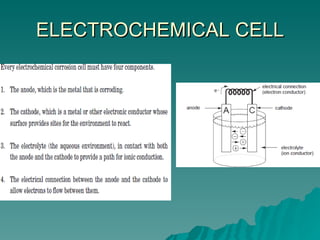
ELECTROCHEMICAL CELL
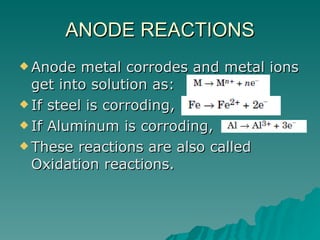
ANODE REACTIONS Anode metal corrodes and metal ions get into solution as:  If steel is corroding,  If Aluminum is corroding, These reactions are also called Oxidation reactions.
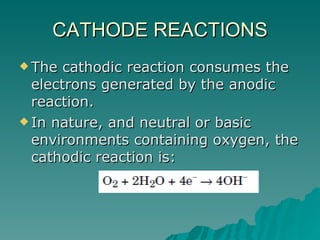
CATHODE REACTIONS The cathodic reaction consumes the electrons generated by the anodic reaction. In nature, and neutral or basic environments containing oxygen, the cathodic reaction is:
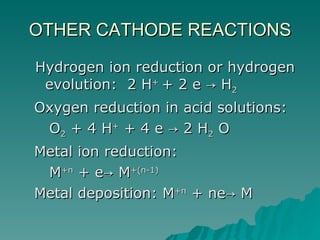
OTHER CATHODE REACTIONS Hydrogen ion reduction or hydrogen evolution:  2 H +   + 2 e -> H 2   Oxygen reduction in acid solutions:  O 2  + 4 H +  + 4 e -> 2 H 2  O Metal ion reduction: M +n  + e-> M +(n-1)   Metal deposition: M +n  + ne-> M
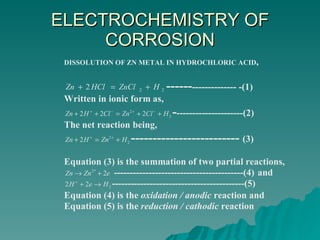
ELECTROCHEMISTRY OF CORROSION
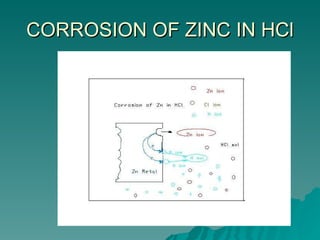
CORROSION OF ZINC IN HCl
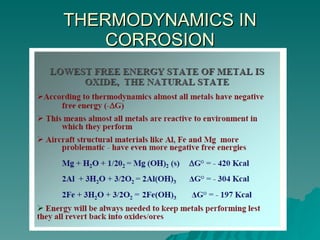
THERMODYNAMICS IN CORROSION
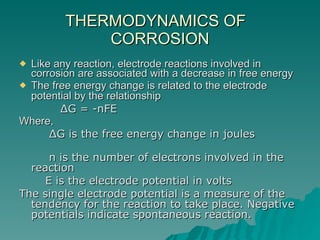
THERMODYNAMICS OF  CORROSION Like any reaction, electrode reactions involved in corrosion are associated with a decrease in free energy The free energy change is related to the electrode potential by the relationship  ∆ G = -nFE  Where,  ∆ G is the free energy change in joules n is the number of electrons involved in the reaction E is the electrode potential in volts The single electrode potential is a measure of the tendency for the reaction to take place. Negative potentials indicate spontaneous reaction.
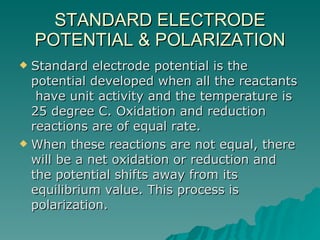
STANDARD ELECTRODE POTENTIAL & POLARIZATION Standard electrode potential is the potential developed when all the reactants  have unit activity and the temperature is 25 degree C. Oxidation and reduction reactions are of equal rate. When these reactions are not equal, there will be a net oxidation or reduction and the potential shifts away from its equilibrium value. This process is polarization.
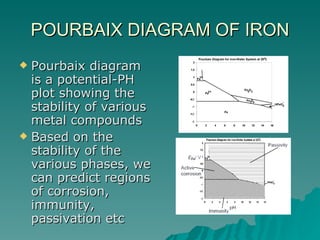
POURBAIX DIAGRAM OF IRON Pourbaix diagram is a potential-PH plot showing the stability of various metal compounds Based on the stability of the various phases, we can predict regions of corrosion, immunity, passivation etc
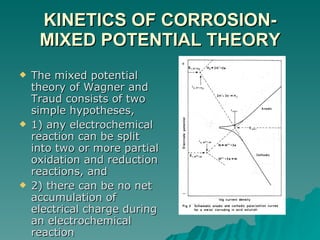
KINETICS OF CORROSION-MIXED POTENTIAL THEORY The mixed potential theory of Wagner and Traud consists of two simple hypotheses,  1) any electrochemical reaction can be split into two or more partial oxidation and reduction reactions, and  2) there can be no net accumulation of electrical charge during an electrochemical reaction
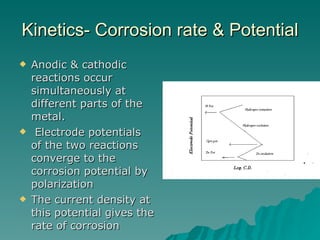
Kinetics- Corrosion rate & Potential Anodic & cathodic reactions occur simultaneously at different parts of the metal. Electrode potentials of the two reactions converge to the corrosion potential by polarization The current density at this potential gives the rate of corrosion
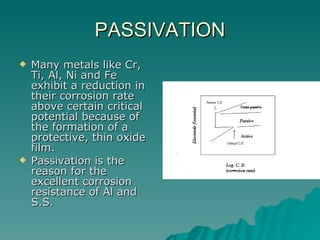
PASSIVATION Many metals like Cr, Ti, Al, Ni and Fe exhibit a reduction in their corrosion rate above certain critical potential because of the formation of a protective, thin oxide film. Passivation is the reason for the excellent corrosion resistance of Al and S.S.

Principles of corrosion

  • 1.
    PRINCIPLES OF CORROSIONDr. T. K. G. Namboodhiri (Retd. Professor, Inst. Of Tech. , Banaras Hindu University) Consultant-Metallurgy & Corrosion, Tiruvalla, Kerala
  • 2.
    INTRODUCTION Metallic corrosionreactions are electrochemical in nature. An electrochemical reaction is associated with charge transfer in addition to mass transfer. All electrochemical reactions may be split into two or more partial oxidation and reduction reactions.
  • 3.
  • 4.
    ANODE REACTIONS Anodemetal corrodes and metal ions get into solution as: If steel is corroding, If Aluminum is corroding, These reactions are also called Oxidation reactions.
  • 5.
    CATHODE REACTIONS Thecathodic reaction consumes the electrons generated by the anodic reaction. In nature, and neutral or basic environments containing oxygen, the cathodic reaction is:
  • 6.
    OTHER CATHODE REACTIONSHydrogen ion reduction or hydrogen evolution: 2 H + + 2 e -> H 2 Oxygen reduction in acid solutions: O 2 + 4 H + + 4 e -> 2 H 2 O Metal ion reduction: M +n + e-> M +(n-1) Metal deposition: M +n + ne-> M
  • 7.
  • 8.
  • 9.
  • 10.
    THERMODYNAMICS OF CORROSION Like any reaction, electrode reactions involved in corrosion are associated with a decrease in free energy The free energy change is related to the electrode potential by the relationship ∆ G = -nFE Where, ∆ G is the free energy change in joules n is the number of electrons involved in the reaction E is the electrode potential in volts The single electrode potential is a measure of the tendency for the reaction to take place. Negative potentials indicate spontaneous reaction.
  • 11.
    STANDARD ELECTRODE POTENTIAL& POLARIZATION Standard electrode potential is the potential developed when all the reactants have unit activity and the temperature is 25 degree C. Oxidation and reduction reactions are of equal rate. When these reactions are not equal, there will be a net oxidation or reduction and the potential shifts away from its equilibrium value. This process is polarization.
  • 12.
    POURBAIX DIAGRAM OFIRON Pourbaix diagram is a potential-PH plot showing the stability of various metal compounds Based on the stability of the various phases, we can predict regions of corrosion, immunity, passivation etc
  • 13.
    KINETICS OF CORROSION-MIXEDPOTENTIAL THEORY The mixed potential theory of Wagner and Traud consists of two simple hypotheses, 1) any electrochemical reaction can be split into two or more partial oxidation and reduction reactions, and 2) there can be no net accumulation of electrical charge during an electrochemical reaction
  • 14.
    Kinetics- Corrosion rate& Potential Anodic & cathodic reactions occur simultaneously at different parts of the metal. Electrode potentials of the two reactions converge to the corrosion potential by polarization The current density at this potential gives the rate of corrosion
  • 15.
    PASSIVATION Many metalslike Cr, Ti, Al, Ni and Fe exhibit a reduction in their corrosion rate above certain critical potential because of the formation of a protective, thin oxide film. Passivation is the reason for the excellent corrosion resistance of Al and S.S.