Anisa Chowdhury
Polymerisation of alkenes,
Ethanol Production
&
Classification and reactions
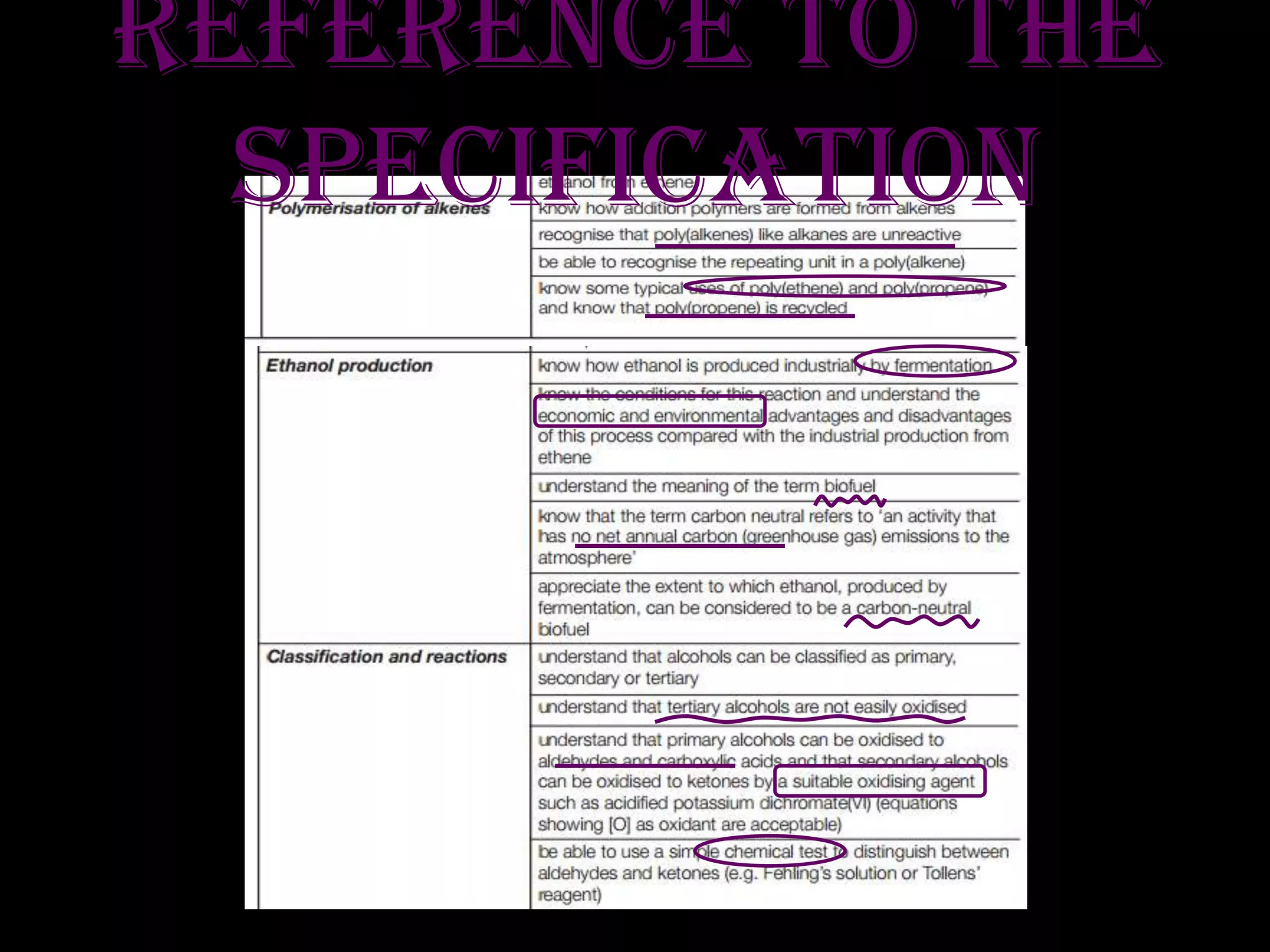
Reference to the
Specification
Polymerisation of
alkenesMANY MONOMERS SINGLE POLYMER→
The monomer used is
an unsaturated alkene
containing a double
C=C bond.
The addition polymer formed is
a saturated compound without a
double bond.
Addition Reaction
E.G
Repeating unit
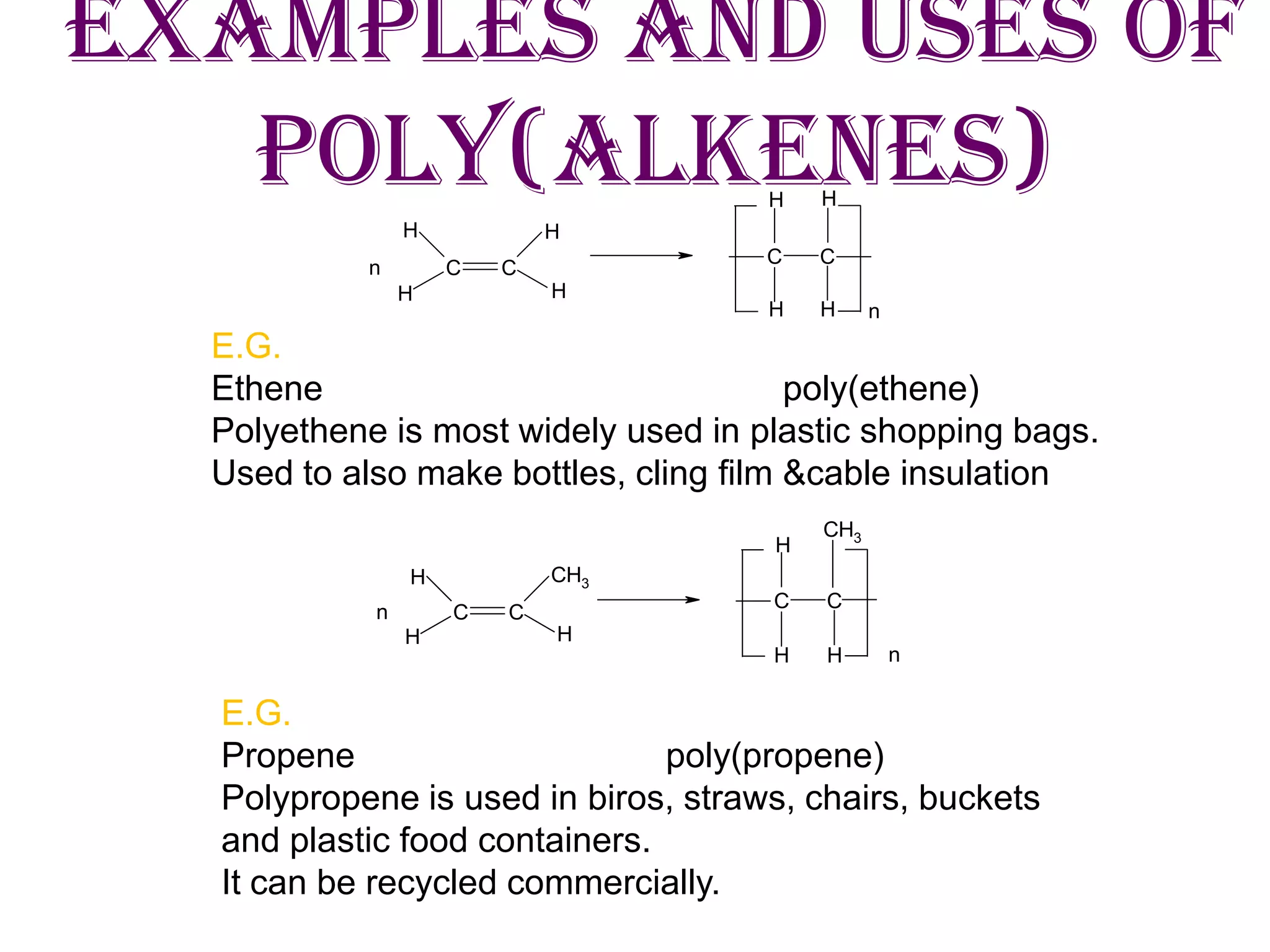
Examples and uses of
Poly(alkenes)
C C
HH
H H
HH
HH
n
C C
n
H H
H
H H
H
CH3
CH3
C Cn
C C
n
E.G.
Ethene poly(ethene)
Polyethene is most widely used in plastic shopping bags.
Used to also make bottles, cling film &cable insulation
E.G.
Propene poly(propene)
Polypropene is used in biros, straws, chairs, buckets
and plastic food containers.
It can be recycled commercially.
Recycling
Polymers
Lots of crude oil is used to make polymers =
waste to throw away
Poly(propene) > recycled via feedstock recycling = decomposing at high temps to produce naptha
Reuse Polymers
e.g. making more durable
plastic bags that can be used
again
Reprocessing scraps from
manufacturing processes
So can melt and re-use for
manufacturing processes
Incineration. Burning
polymers release thermal
energy for generating
electricity.
But releases co2 so
contributes to global
warming
Ethanol
Production
fermentation of
sugars
C6H12O6  2C2H5OH + 2CO2
Optimum temp = 36
degrees
(High temps denature
enzyme and kills yeast)
Advantages:
•it is a relatively fast process
•it is a continuous flow process,
which means that ethene can be
entered into the vessel
continuously and the reaction
never has to be stopped
•it produces pure ethanol
Disadvantages:
•it requires fairly high technology
•it uses a lot of energy
•the ethene comes from crude oil,
which is a non-renewable resource
Ethanol as a
biofuelEthanol is a useful fuel; it burns with a clean flame and
is increasingly used in cars:
C2H6O(l) + 3O2(g)  3CO2(g) + 3H2O(g)
• Ethanol produced by fermentation = renewable fuel
• Biofuels are carbon-neutral
= there are no net annual carbon (greenhouse gas)
emissions to the atmosphere
secondary and
tertiary
alcoholsPrimary alcohols are those in which the carbon attached to the OH is attached to 0 or 1
other carbon atom.
Eg propan-1-ol
C C C
H
H
H H
H
HOH
H
secondary and
tertiary
alcoholsSecondary alcohols are those in which the carbon attached to the OH is attached to 2
other carbon atoms. In other words, they are molecules in which the functional group is
not at the end of the chain.
Eg propan-2-ol
H C
H
HC
H
C
H
H
H
OH
H C
H
HC
H
C
H
H
H
OH
secondary and
tertiary
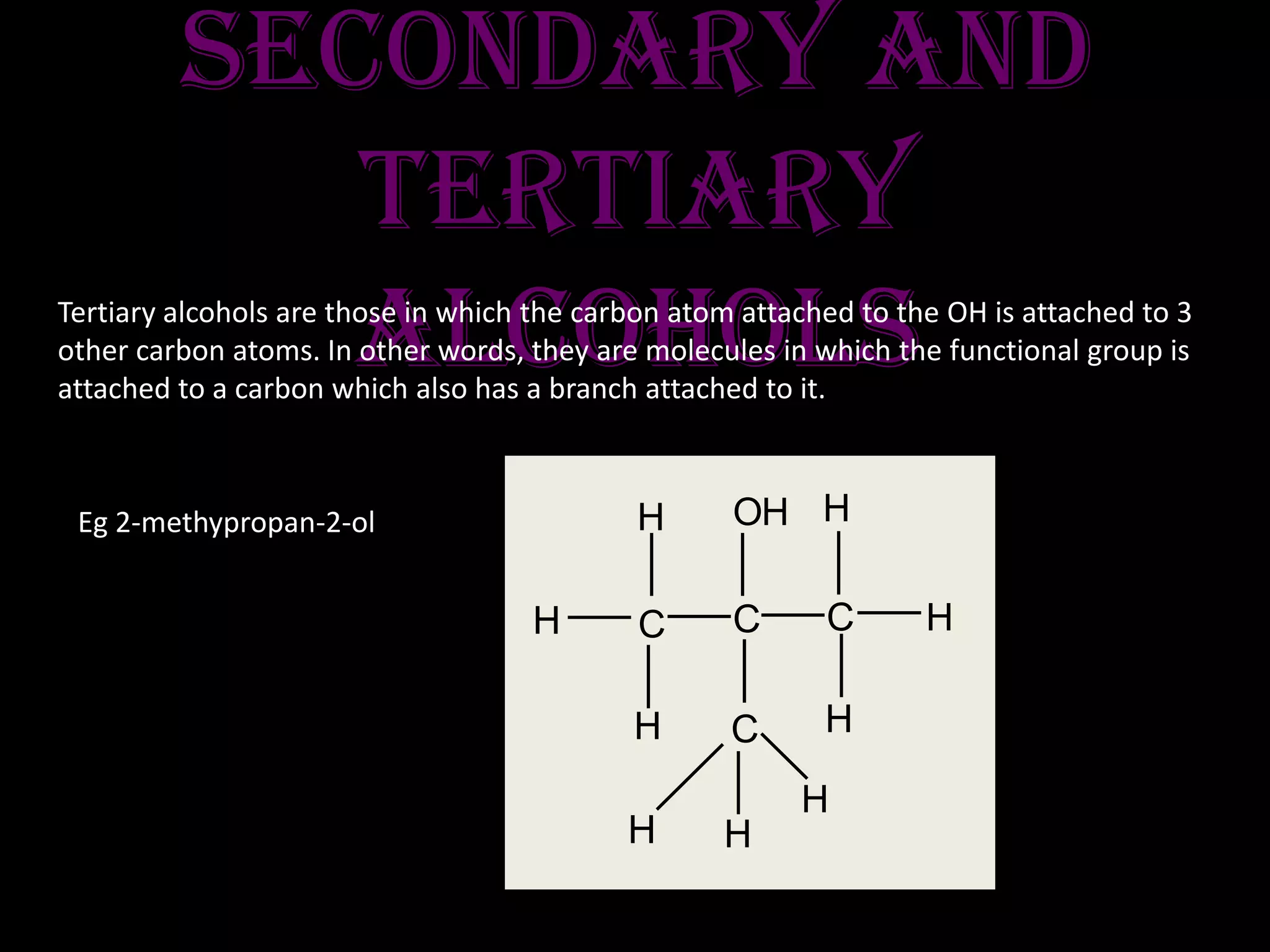
alcoholsTertiary alcohols are those in which the carbon atom attached to the OH is attached to 3
other carbon atoms. In other words, they are molecules in which the functional group is
attached to a carbon which also has a branch attached to it.
Eg 2-methypropan-2-ol
H C
H
HC
H
C
H
H
OH
H H
C
H
H H
HH
CC OHH
+ [O]
+ H2OC
O
H
H
H
CH
C
O
H
C
O
CH3
CH3
CH
OH
CH3
CH3
+ [O] + H2O
C
O
If a primary alcohol is mixed with an oxidising agent, two hydrogen atoms can be removed and an aldehyde will be formed:
Eg CH3CH2OH + [O]  CH3CHO + H2O
Ethanol Ethanal
An aldehyde is a molecule containing the following group:
If a secondary alcohol is mixed with an oxidising agent, two hydrogen atoms can be removed and a ketone will be formed:
Eg CH3CH(OH)CH3 + [O]  CH3COCH3 + H2O
Propan-2-ol propanone
A ketone is a molecule containing the following group:
mild oxidation of primary and
secondary alcohols
Tertiary alcohols are not readily oxidised since they do not have available H atoms to give up.
Aldehydes and ketones are collectively known as carbonyls and can be represented by the general formula CnH2nO
C
O
R
R
In aldehydes, one of the R groups is a H atom. In ketones, neither of the R groups is a H atom.
Further oxidation of aldehydes
If an aldehyde is mixed with an oxidising agent, an oxygen atom can be added to the group and a carboxylic
acid will be formed:
Eg CH3CHO + [O]  CH3COOH
Ethanal Ethanoic acid
A carboxylic acid is a molecule containing the following group:
Ketones cannot be oxidised into carboxylic acids since there is no C-H bond into which an oxygen
atom can be inserted.
Summary of oxidation
reactions of alcohols
and carbonylsprimary
alcohols
secondary
alcohols
tertiary
alcohols
aldehydes ketones
carboxylic
acids
X
[O]
[O]
[O]
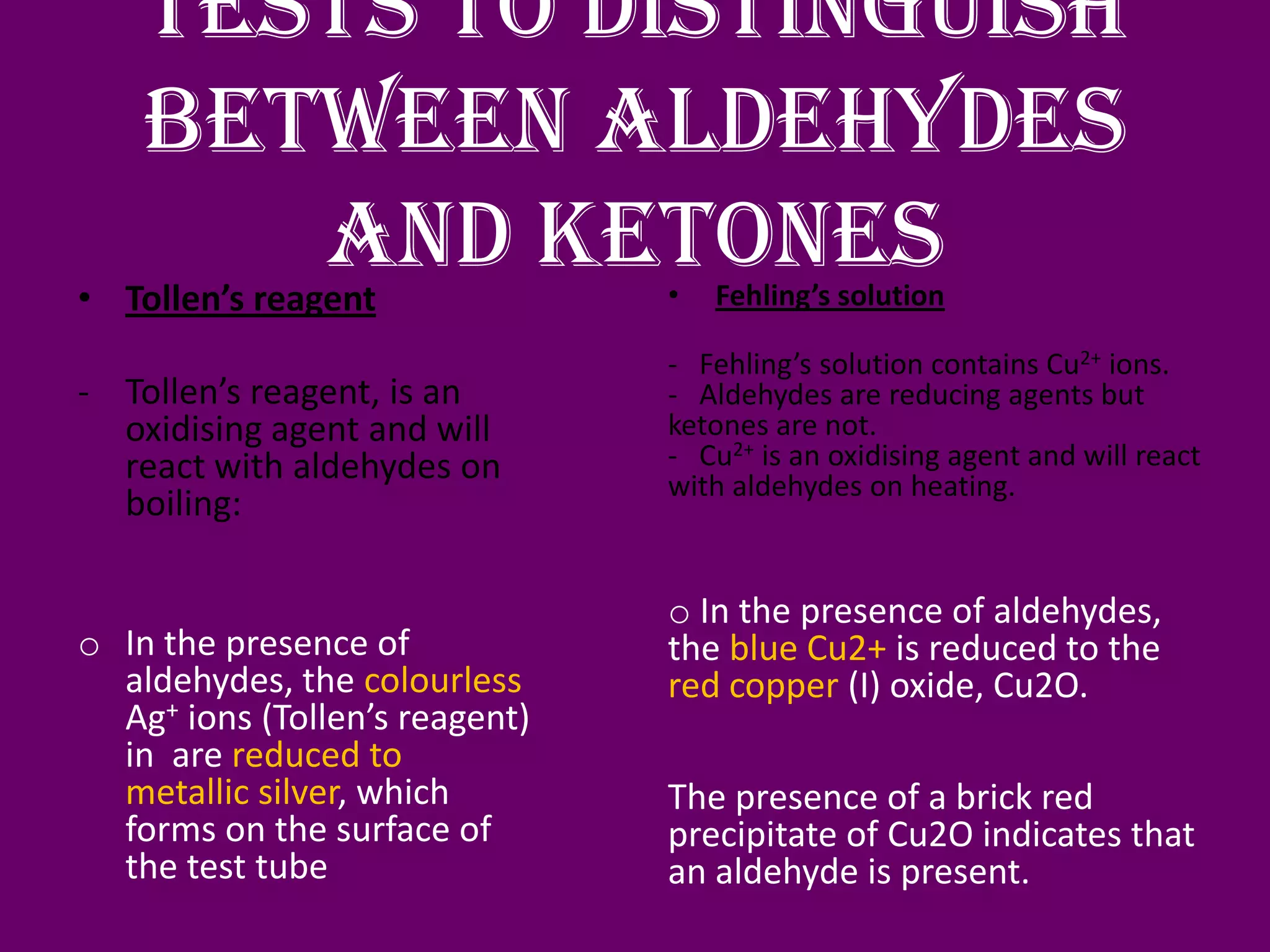
Tests to distinguish
between aldehydes
and ketones• Tollen’s reagent
- Tollen’s reagent, is an
oxidising agent and will
react with aldehydes on
boiling:
o In the presence of
aldehydes, the colourless
Ag+ ions (Tollen’s reagent)
in are reduced to
metallic silver, which
forms on the surface of
the test tube
• Fehling’s solution
- Fehling’s solution contains Cu2+ ions.
- Aldehydes are reducing agents but
ketones are not.
- Cu2+ is an oxidising agent and will react
with aldehydes on heating.
o In the presence of aldehydes,
the blue Cu2+ is reduced to the
red copper (I) oxide, Cu2O.
The presence of a brick red
precipitate of Cu2O indicates that
an aldehyde is present.
Thank
You for
Listenin

Ethanol production

  • 1.
    Anisa Chowdhury Polymerisation ofalkenes, Ethanol Production & Classification and reactions
  • 2.
  • 3.
    Polymerisation of alkenesMANY MONOMERSSINGLE POLYMER→ The monomer used is an unsaturated alkene containing a double C=C bond. The addition polymer formed is a saturated compound without a double bond. Addition Reaction E.G Repeating unit
  • 4.
    Examples and usesof Poly(alkenes) C C HH H H HH HH n C C n H H H H H H CH3 CH3 C Cn C C n E.G. Ethene poly(ethene) Polyethene is most widely used in plastic shopping bags. Used to also make bottles, cling film &cable insulation E.G. Propene poly(propene) Polypropene is used in biros, straws, chairs, buckets and plastic food containers. It can be recycled commercially.
  • 5.
    Recycling Polymers Lots of crudeoil is used to make polymers = waste to throw away Poly(propene) > recycled via feedstock recycling = decomposing at high temps to produce naptha Reuse Polymers e.g. making more durable plastic bags that can be used again Reprocessing scraps from manufacturing processes So can melt and re-use for manufacturing processes Incineration. Burning polymers release thermal energy for generating electricity. But releases co2 so contributes to global warming
  • 6.
    Ethanol Production fermentation of sugars C6H12O6 2C2H5OH + 2CO2 Optimum temp = 36 degrees (High temps denature enzyme and kills yeast) Advantages: •it is a relatively fast process •it is a continuous flow process, which means that ethene can be entered into the vessel continuously and the reaction never has to be stopped •it produces pure ethanol Disadvantages: •it requires fairly high technology •it uses a lot of energy •the ethene comes from crude oil, which is a non-renewable resource
  • 7.
    Ethanol as a biofuelEthanolis a useful fuel; it burns with a clean flame and is increasingly used in cars: C2H6O(l) + 3O2(g)  3CO2(g) + 3H2O(g) • Ethanol produced by fermentation = renewable fuel • Biofuels are carbon-neutral = there are no net annual carbon (greenhouse gas) emissions to the atmosphere
  • 8.
    secondary and tertiary alcoholsPrimary alcoholsare those in which the carbon attached to the OH is attached to 0 or 1 other carbon atom. Eg propan-1-ol C C C H H H H H HOH H
  • 9.
    secondary and tertiary alcoholsSecondary alcoholsare those in which the carbon attached to the OH is attached to 2 other carbon atoms. In other words, they are molecules in which the functional group is not at the end of the chain. Eg propan-2-ol H C H HC H C H H H OH H C H HC H C H H H OH
  • 10.
    secondary and tertiary alcoholsTertiary alcoholsare those in which the carbon atom attached to the OH is attached to 3 other carbon atoms. In other words, they are molecules in which the functional group is attached to a carbon which also has a branch attached to it. Eg 2-methypropan-2-ol H C H HC H C H H OH H H C H
  • 11.
    H H HH CC OHH +[O] + H2OC O H H H CH C O H C O CH3 CH3 CH OH CH3 CH3 + [O] + H2O C O If a primary alcohol is mixed with an oxidising agent, two hydrogen atoms can be removed and an aldehyde will be formed: Eg CH3CH2OH + [O]  CH3CHO + H2O Ethanol Ethanal An aldehyde is a molecule containing the following group: If a secondary alcohol is mixed with an oxidising agent, two hydrogen atoms can be removed and a ketone will be formed: Eg CH3CH(OH)CH3 + [O]  CH3COCH3 + H2O Propan-2-ol propanone A ketone is a molecule containing the following group: mild oxidation of primary and secondary alcohols
  • 12.
    Tertiary alcohols arenot readily oxidised since they do not have available H atoms to give up. Aldehydes and ketones are collectively known as carbonyls and can be represented by the general formula CnH2nO C O R R In aldehydes, one of the R groups is a H atom. In ketones, neither of the R groups is a H atom. Further oxidation of aldehydes If an aldehyde is mixed with an oxidising agent, an oxygen atom can be added to the group and a carboxylic acid will be formed: Eg CH3CHO + [O]  CH3COOH Ethanal Ethanoic acid A carboxylic acid is a molecule containing the following group: Ketones cannot be oxidised into carboxylic acids since there is no C-H bond into which an oxygen atom can be inserted.
  • 13.
    Summary of oxidation reactionsof alcohols and carbonylsprimary alcohols secondary alcohols tertiary alcohols aldehydes ketones carboxylic acids X [O] [O] [O]
  • 14.
    Tests to distinguish betweenaldehydes and ketones• Tollen’s reagent - Tollen’s reagent, is an oxidising agent and will react with aldehydes on boiling: o In the presence of aldehydes, the colourless Ag+ ions (Tollen’s reagent) in are reduced to metallic silver, which forms on the surface of the test tube • Fehling’s solution - Fehling’s solution contains Cu2+ ions. - Aldehydes are reducing agents but ketones are not. - Cu2+ is an oxidising agent and will react with aldehydes on heating. o In the presence of aldehydes, the blue Cu2+ is reduced to the red copper (I) oxide, Cu2O. The presence of a brick red precipitate of Cu2O indicates that an aldehyde is present.
  • 15.