AI and Cybersecurity
Food For Thought
Angela Huang and Tian Jing
#ISSLearningFest
Outline
• Cybersecurity – a quick recap
• Overview of AI
• Security of AI systems
• AI-aided Attacks/Maliciousness
• Use of AI in CyberSecurity
• Demo
#ISSLearningFest
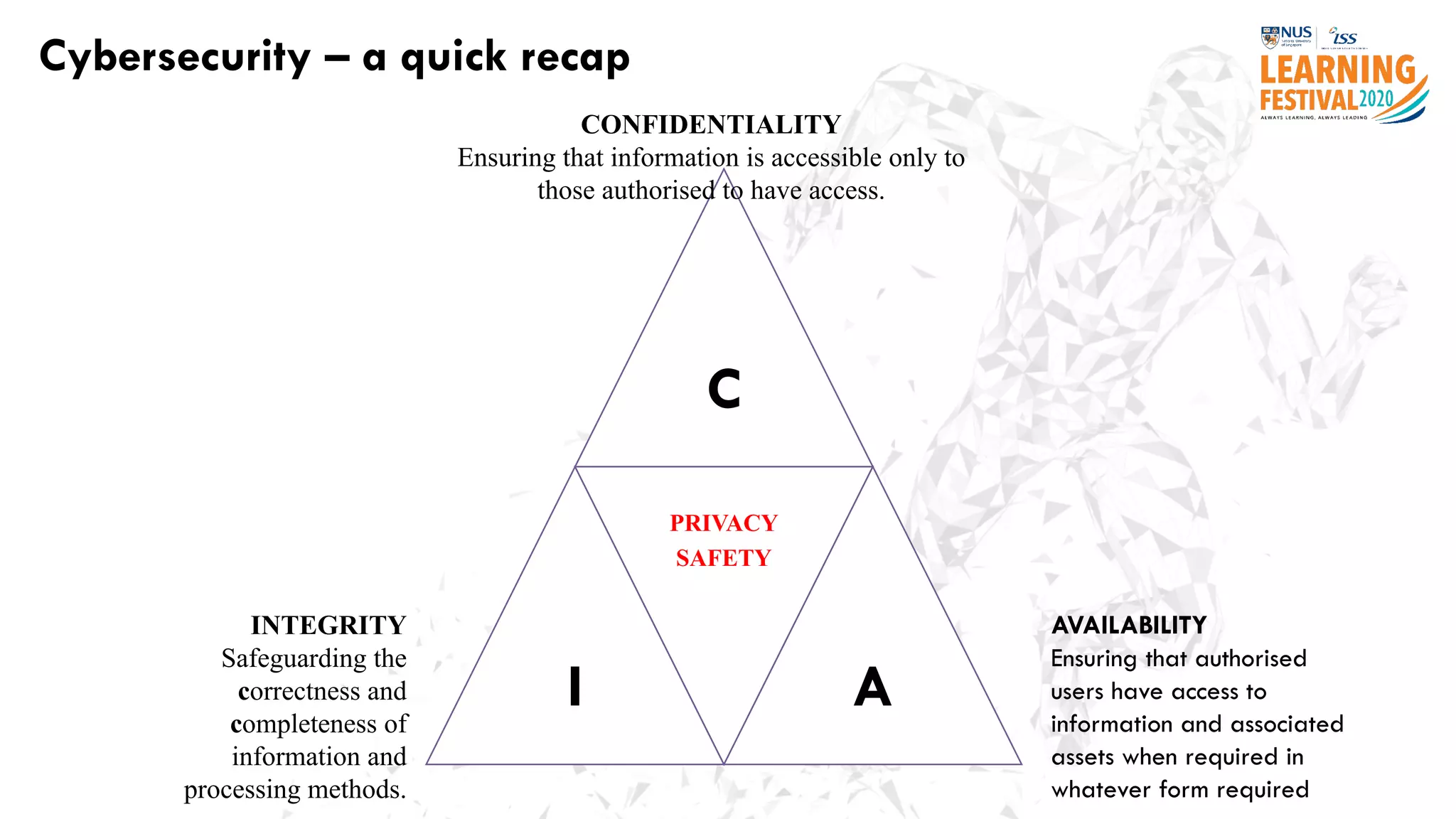
Cybersecurity – a quick recap
C
I
PRIVACY
SAFETY
A
CONFIDENTIALITY
Ensuring that information is accessible only to
those authorised to have access.
INTEGRITY
Safeguarding the
correctness and
completeness of
information and
processing methods.
AVAILABILITY
Ensuring that authorised
users have access to
information and associated
assets when required in
whatever form required
Overview of AI
#ISSLearningFest
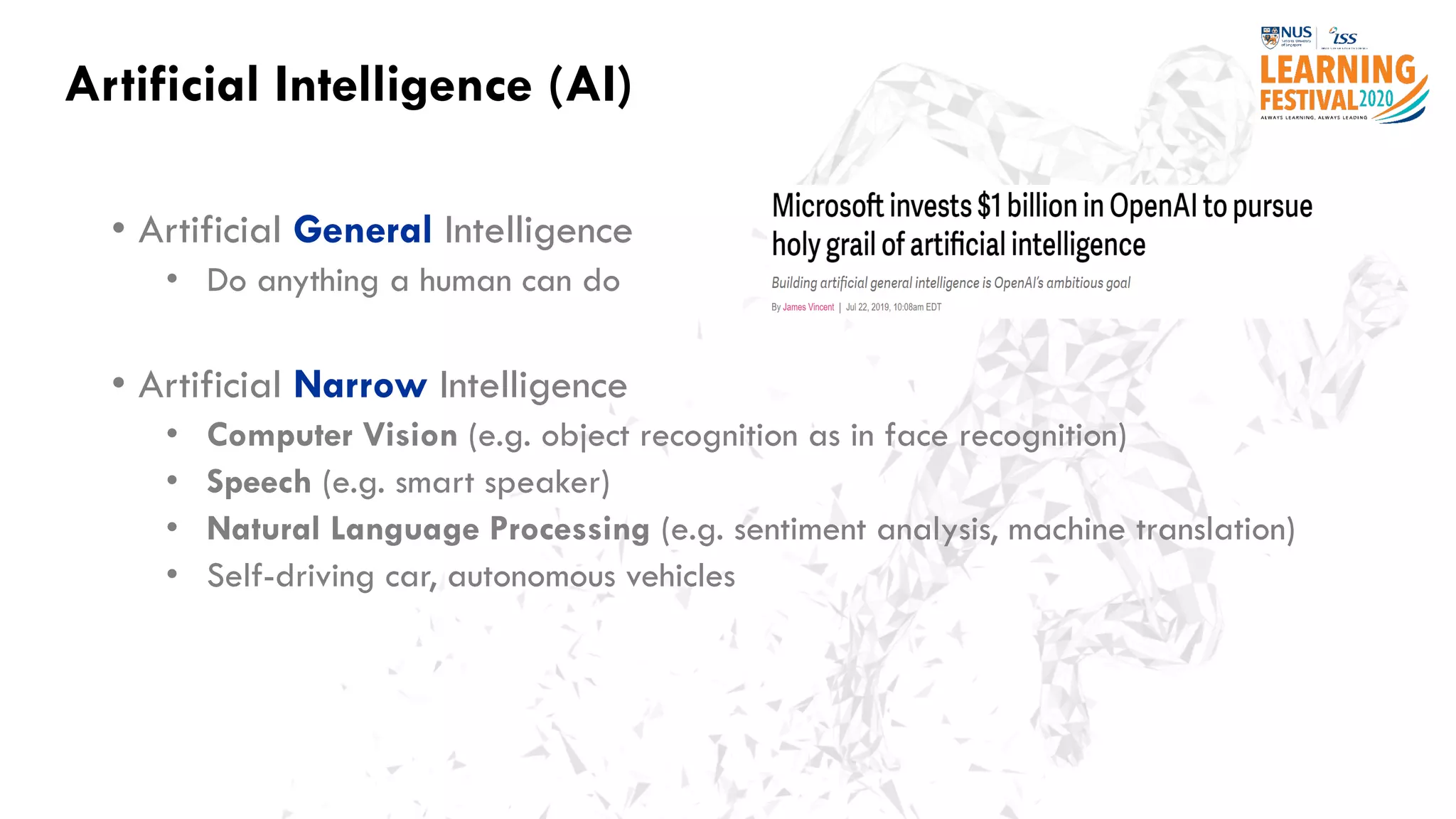
Artificial Intelligence (AI)
• Artificial General Intelligence
• Do anything a human can do
• Artificial Narrow Intelligence
• Computer Vision (e.g. object recognition as in face recognition)
• Speech (e.g. smart speaker)
• Natural Language Processing (e.g. sentiment analysis, machine translation)
• Self-driving car, autonomous vehicles
Example: Social Distancing Detector
https://landing.ai/landing-ai-creates-an-ai-tool-to-help-customers-monitor-social-distancing-in-the-workplace/
Example: Baidu’s face-enabled entrance
Source: https://www.youtube.com/watch?v=wr4rx0Spihs (Jan 2017)
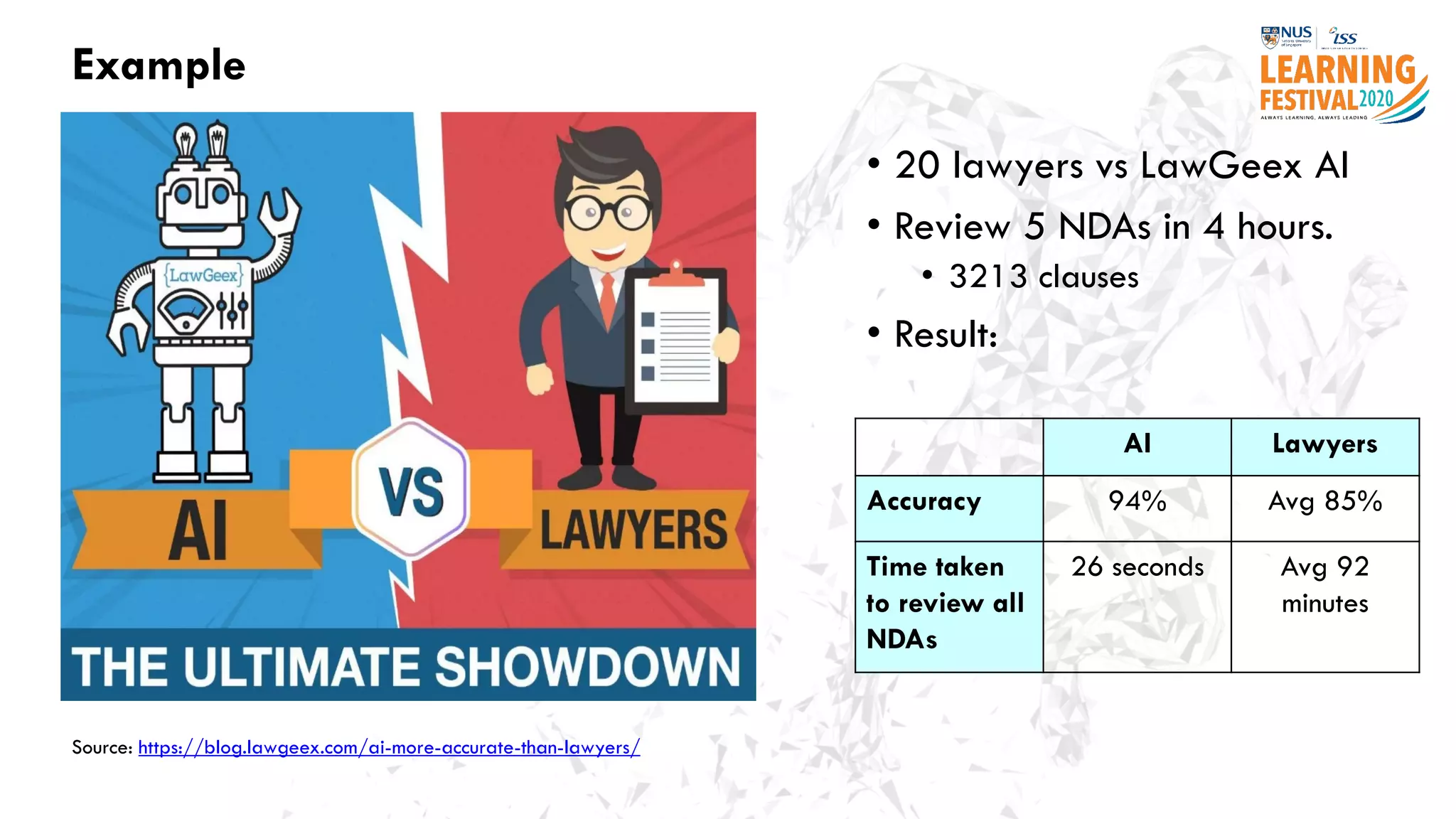
Example
• 20 lawyers vs LawGeex AI
• Review 5 NDAs in 4 hours.
• 3213 clauses
• Result:
Source: https://blog.lawgeex.com/ai-more-accurate-than-lawyers/
AI Lawyers
Accuracy 94% Avg 85%
Time taken
to review all
NDAs
26 seconds Avg 92
minutes
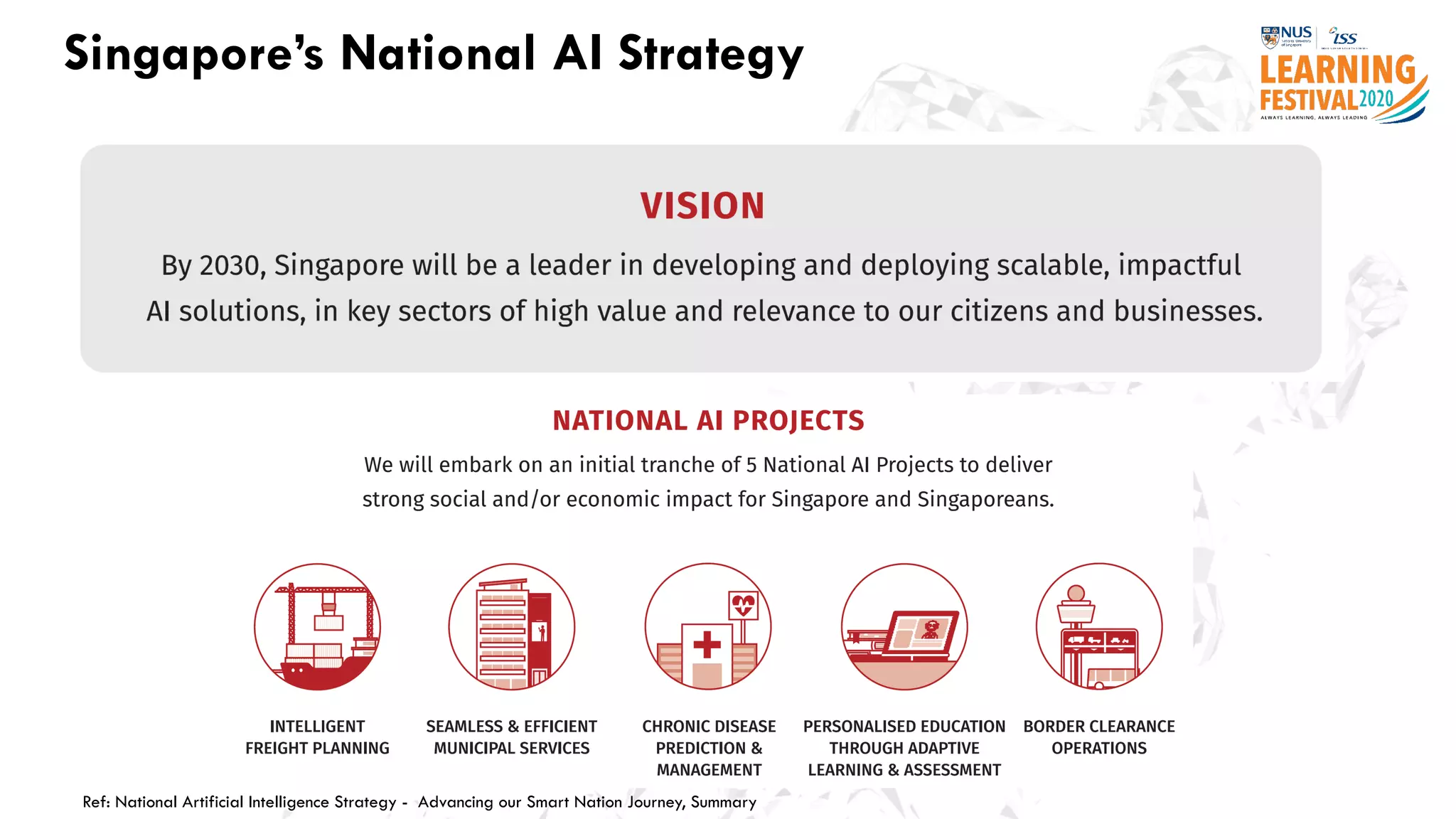
Singapore’s National AI Strategy
Ref: National Artificial Intelligence Strategy - Advancing our Smart Nation Journey, Summary
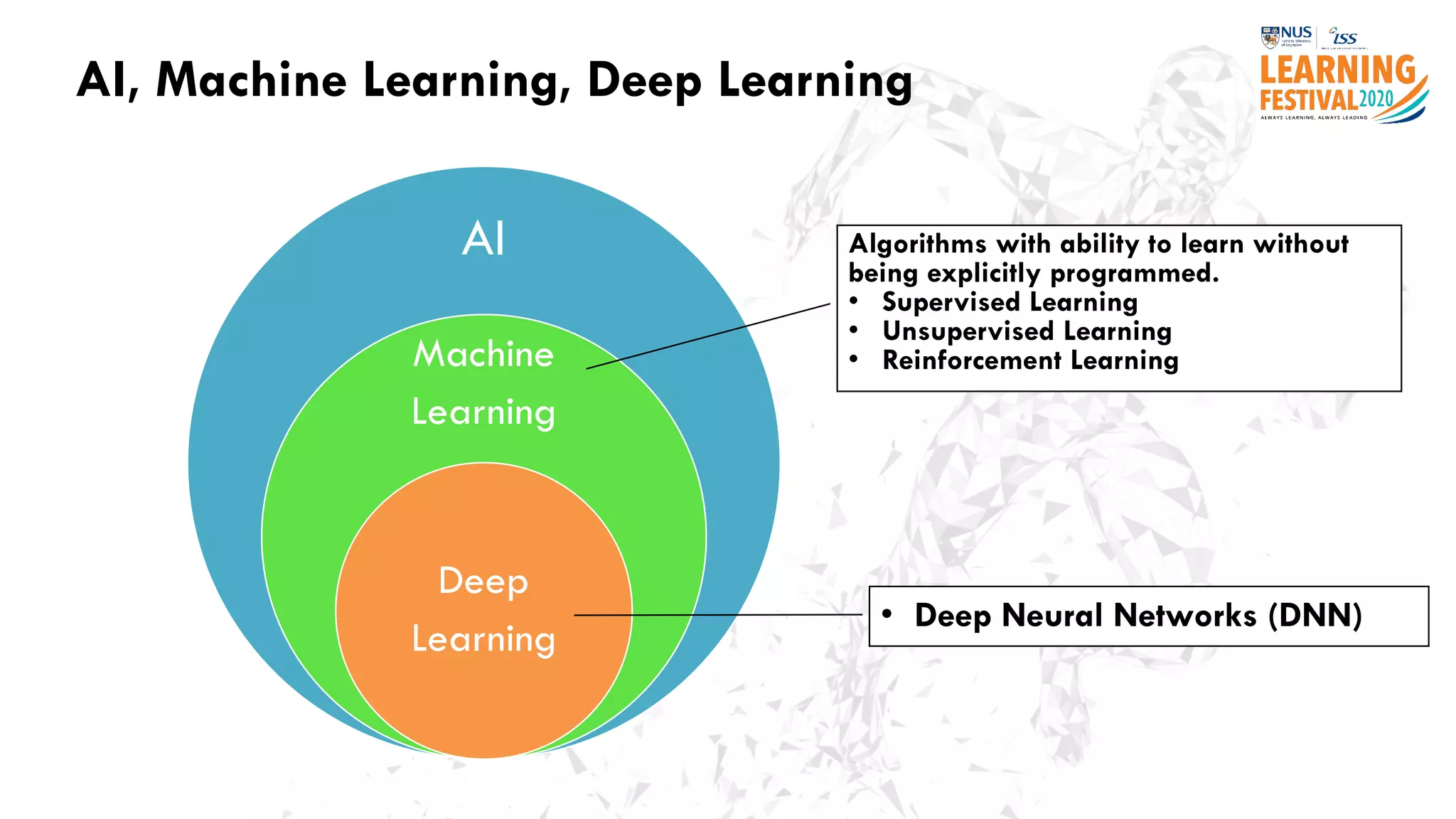
AI, Machine Learning, Deep Learning
AI
Machine
Learning
Deep
Learning
Algorithms with ability to learn without
being explicitly programmed.
• Supervised Learning
• Unsupervised Learning
• Reinforcement Learning
• Deep Neural Networks (DNN)
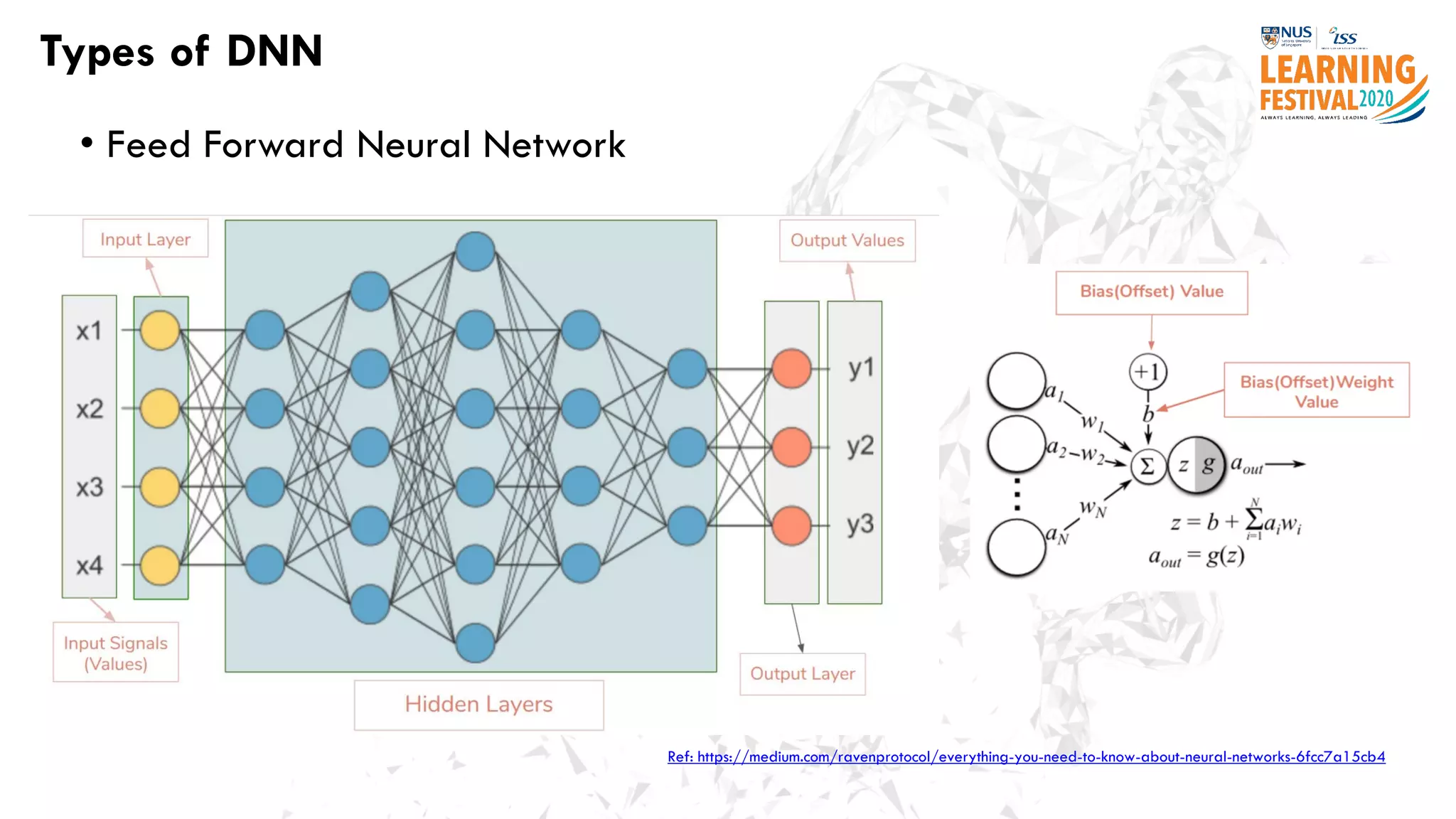
Types of DNN
• Feed Forward Neural Network
Ref: https://medium.com/ravenprotocol/everything-you-need-to-know-about-neural-networks-6fcc7a15cb4
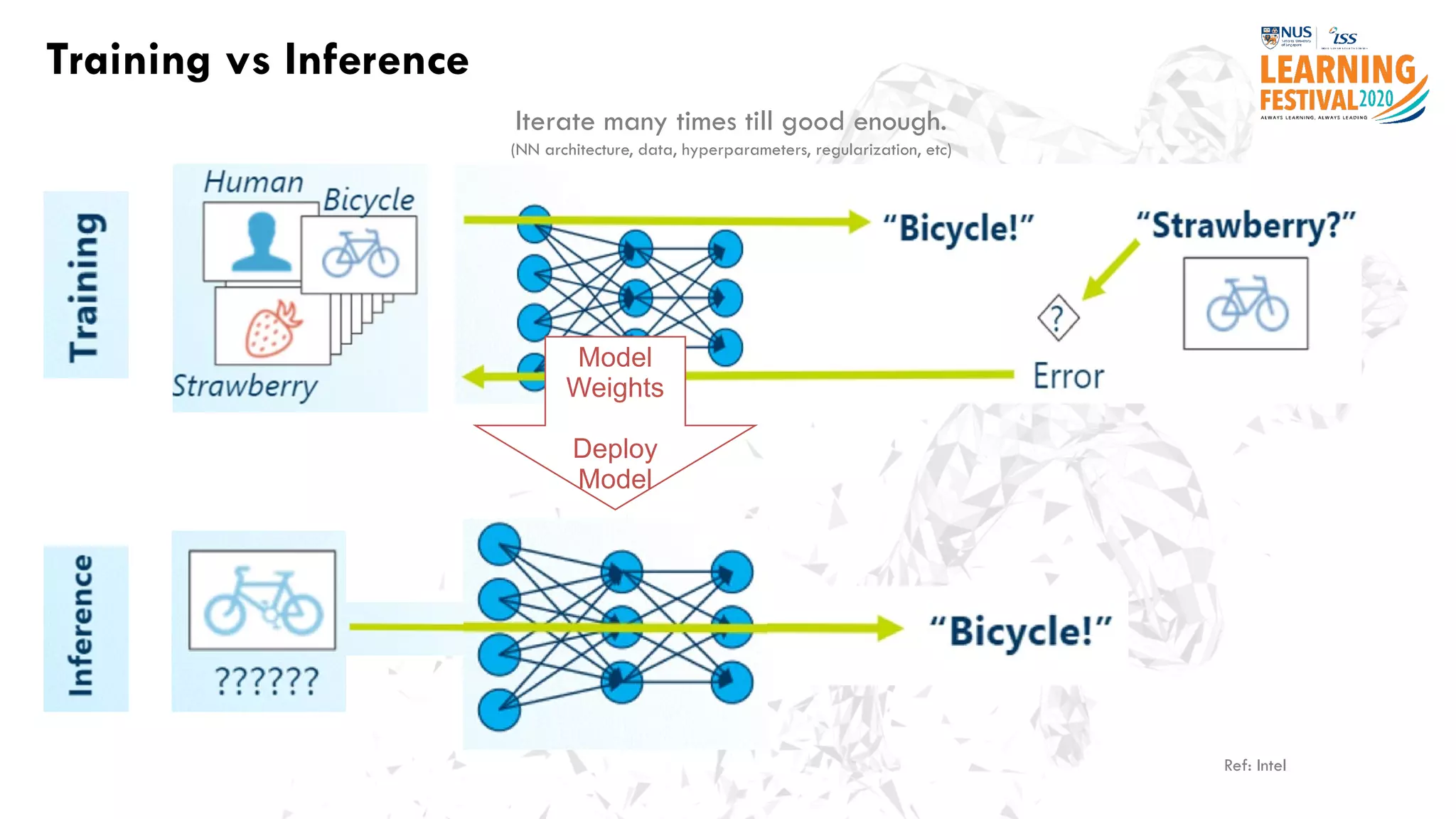
Training vs Inference
Model
Weights
Deploy
Model
Iterate many times till good enough.
(NN architecture, data, hyperparameters, regularization, etc)
Ref: Intel
Security of AI Systems
Exploring the additional attack surface, if any, resulting from utilizing AI
#ISSLearningFest
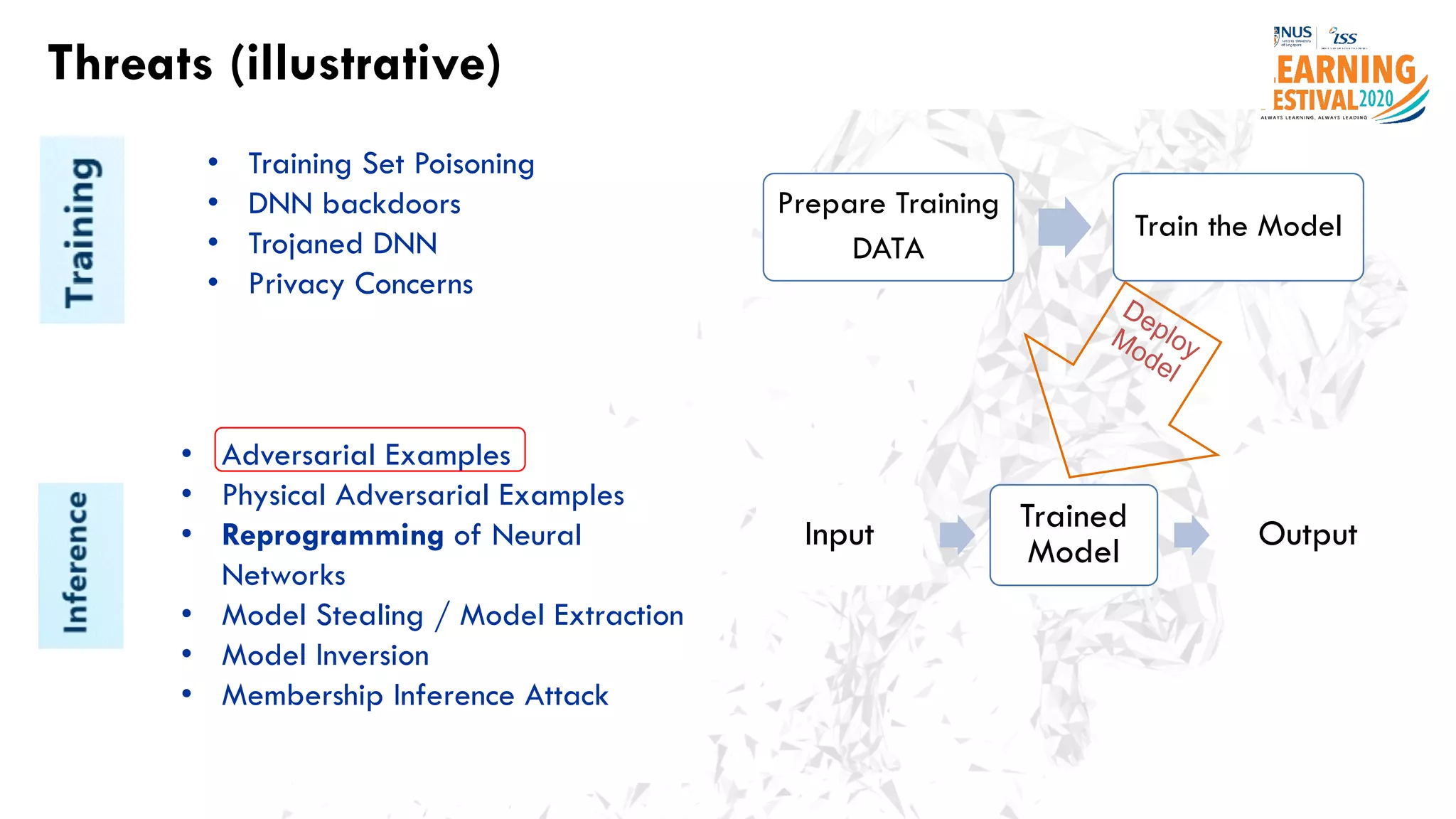
Threats (illustrative)
Prepare Training
DATA
Train the Model
• Training Set Poisoning
• DNN backdoors
• Trojaned DNN
• Privacy Concerns
• Adversarial Examples
• Physical Adversarial Examples
• Reprogramming of Neural
Networks
• Model Stealing / Model Extraction
• Model Inversion
• Membership Inference Attack
Input Trained
Model Output
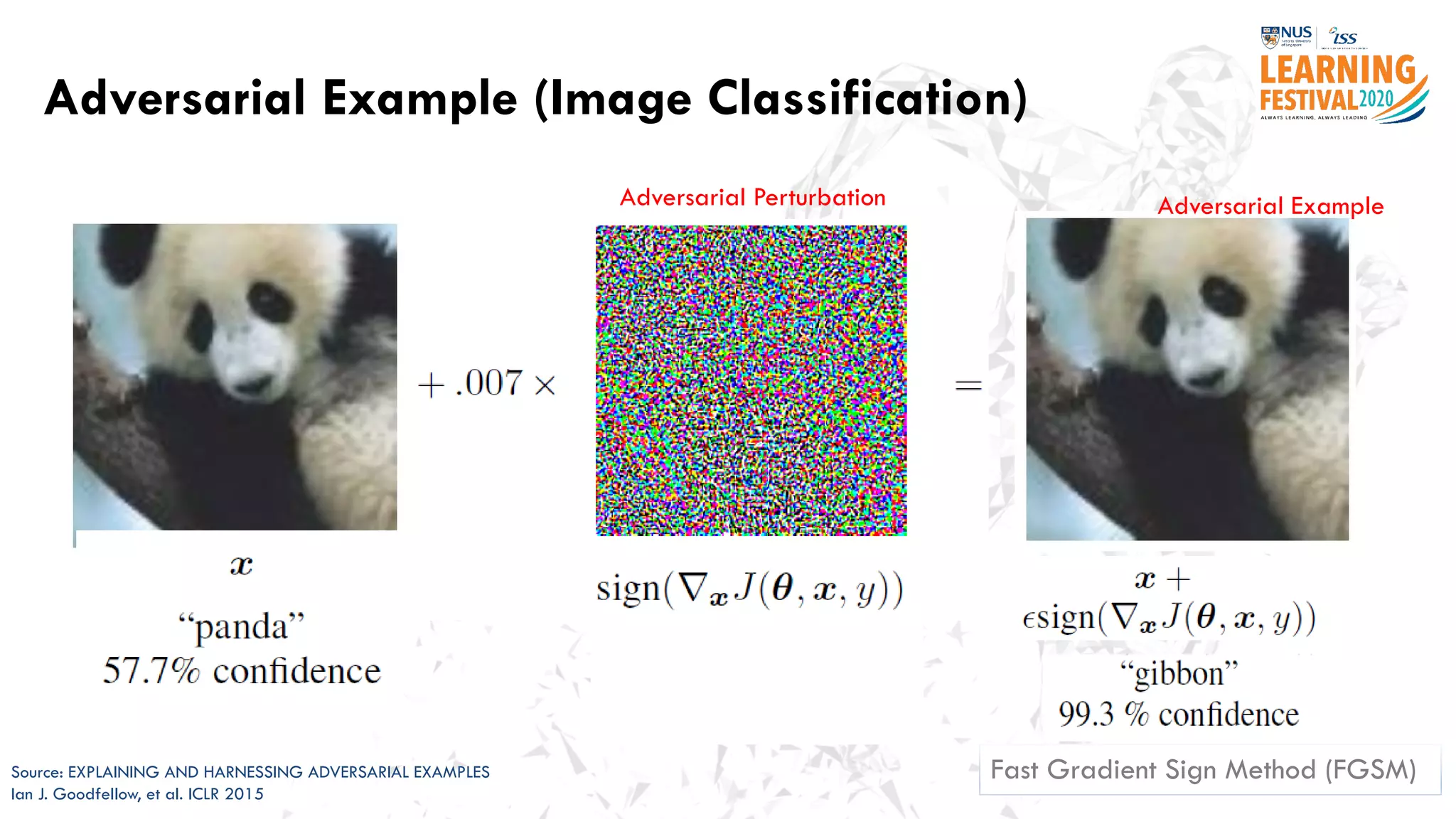
Adversarial Example (Image Classification)
Fast Gradient Sign Method (FGSM)Source: EXPLAINING AND HARNESSING ADVERSARIAL EXAMPLES
Ian J. Goodfellow, et al. ICLR 2015
Adversarial Perturbation Adversarial Example
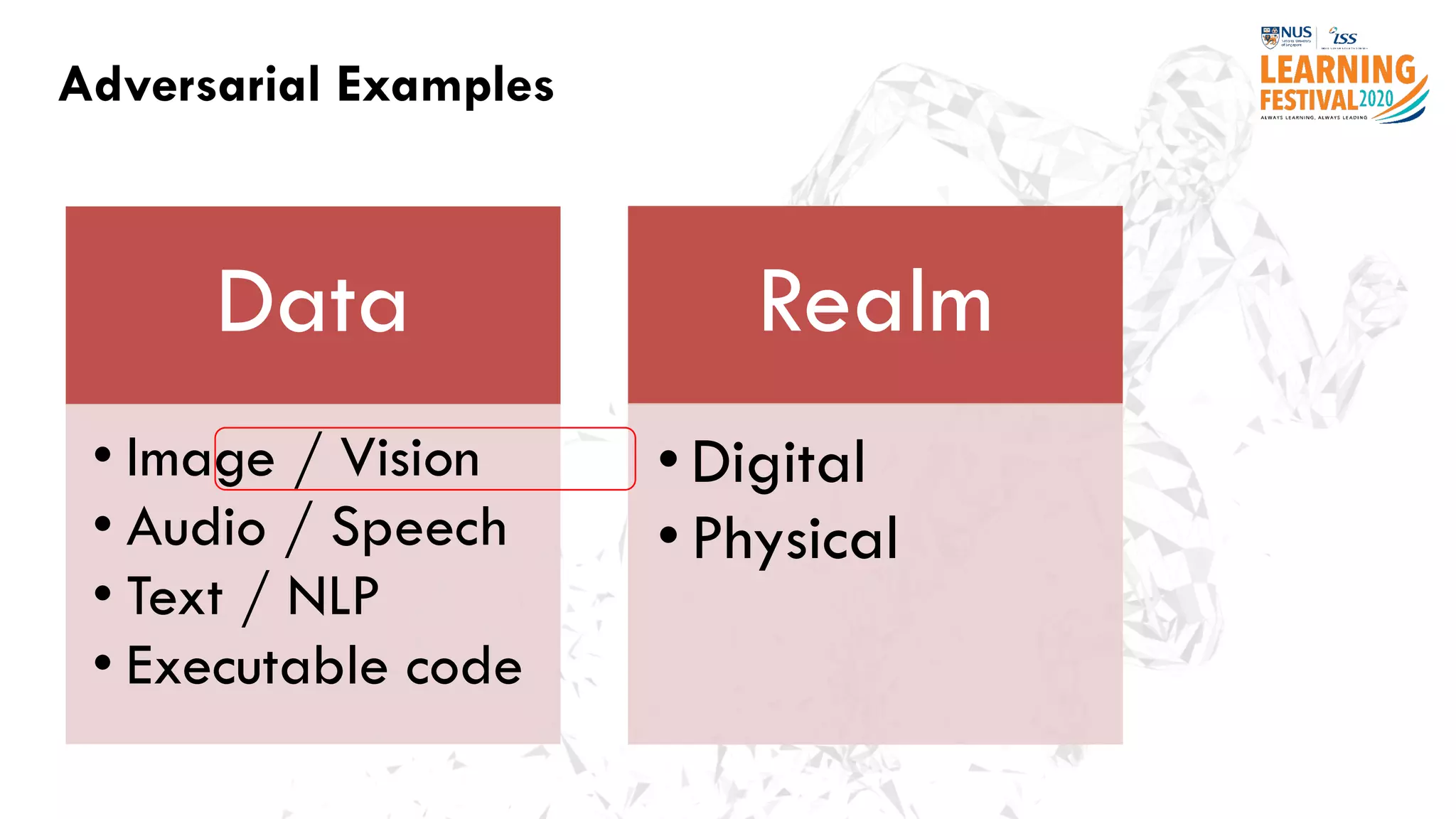
Adversarial Examples
Data
• Image / Vision
• Audio / Speech
• Text / NLP
• Executable code
Realm
• Digital
• Physical
Adversarial Examples …
• … affect the integrity of the ML model
• Could lead to various cybersecurity risks and corresponding business impact
such as …
#ISSLearningFest
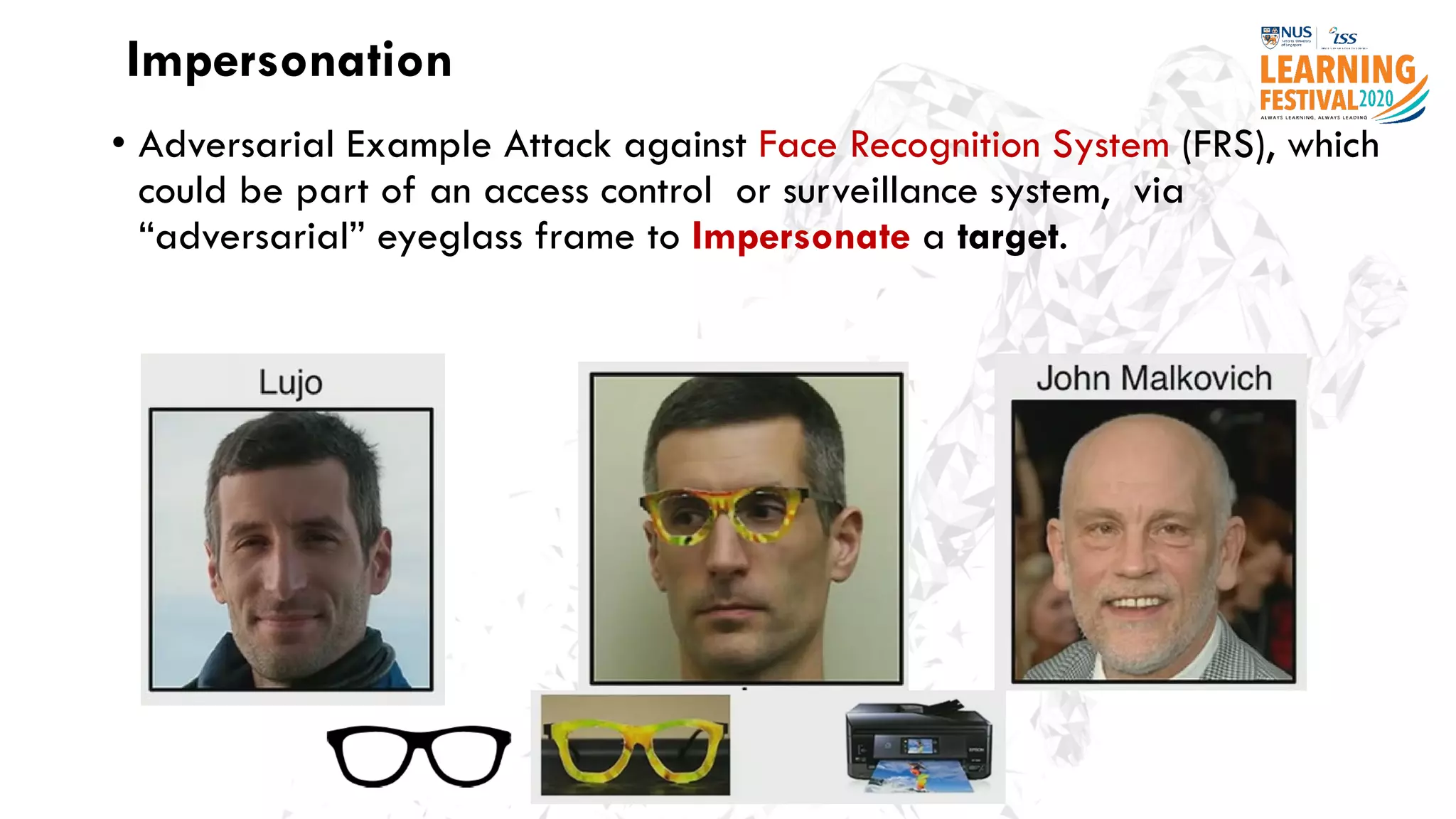
Impersonation
• Adversarial Example Attack against Face Recognition System (FRS), which
could be part of an access control or surveillance system, via
“adversarial” eyeglass frame to Impersonate a target.
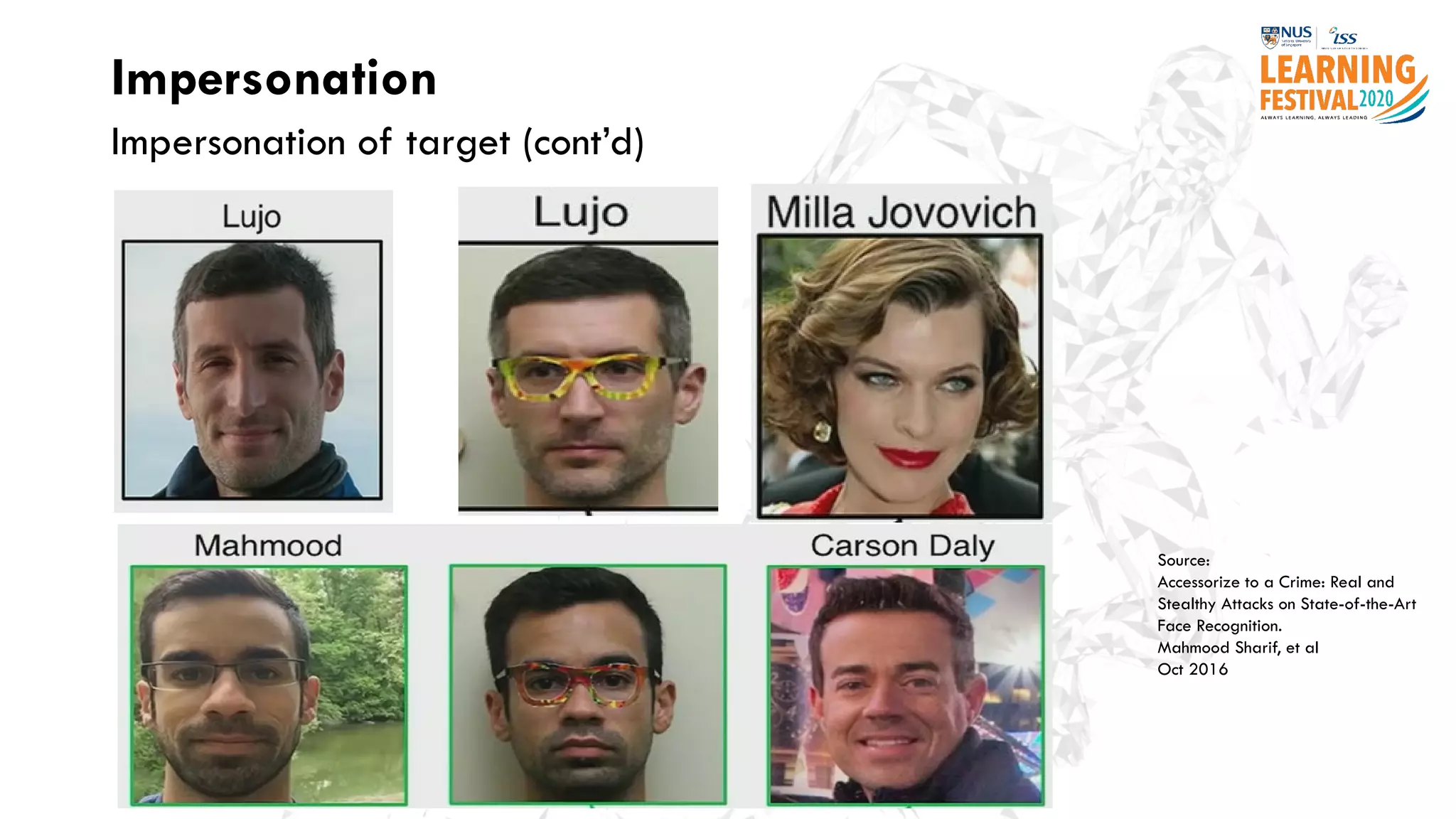
Impersonation
Impersonation of target (cont’d)
Source:
Accessorize to a Crime: Real and
Stealthy Attacks on State-of-the-Art
Face Recognition.
Mahmood Sharif, et al
Oct 2016
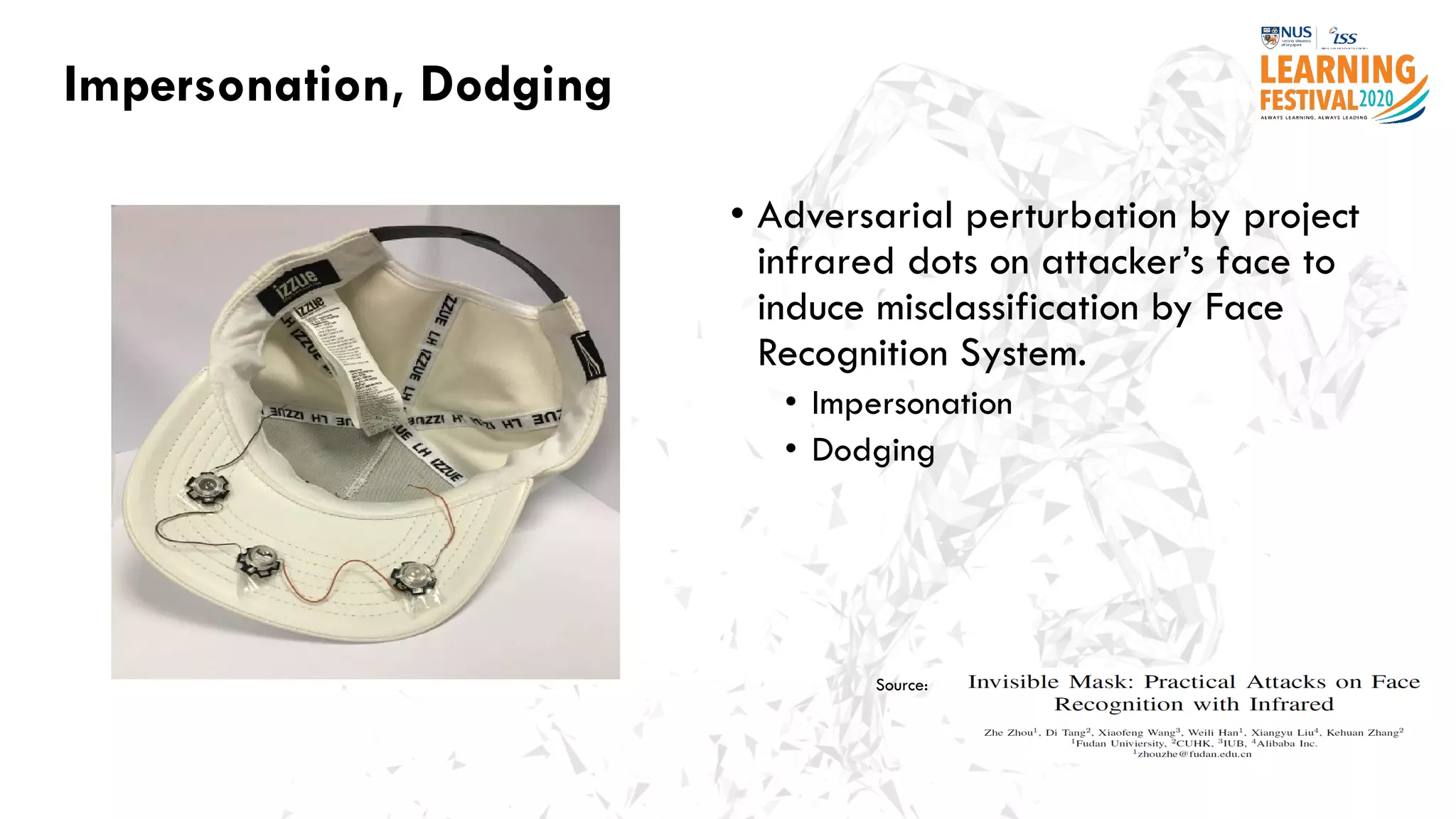
Impersonation, Dodging
• Adversarial perturbation by project
infrared dots on attacker’s face to
induce misclassification by Face
Recognition System.
• Impersonation
• Dodging
Source:
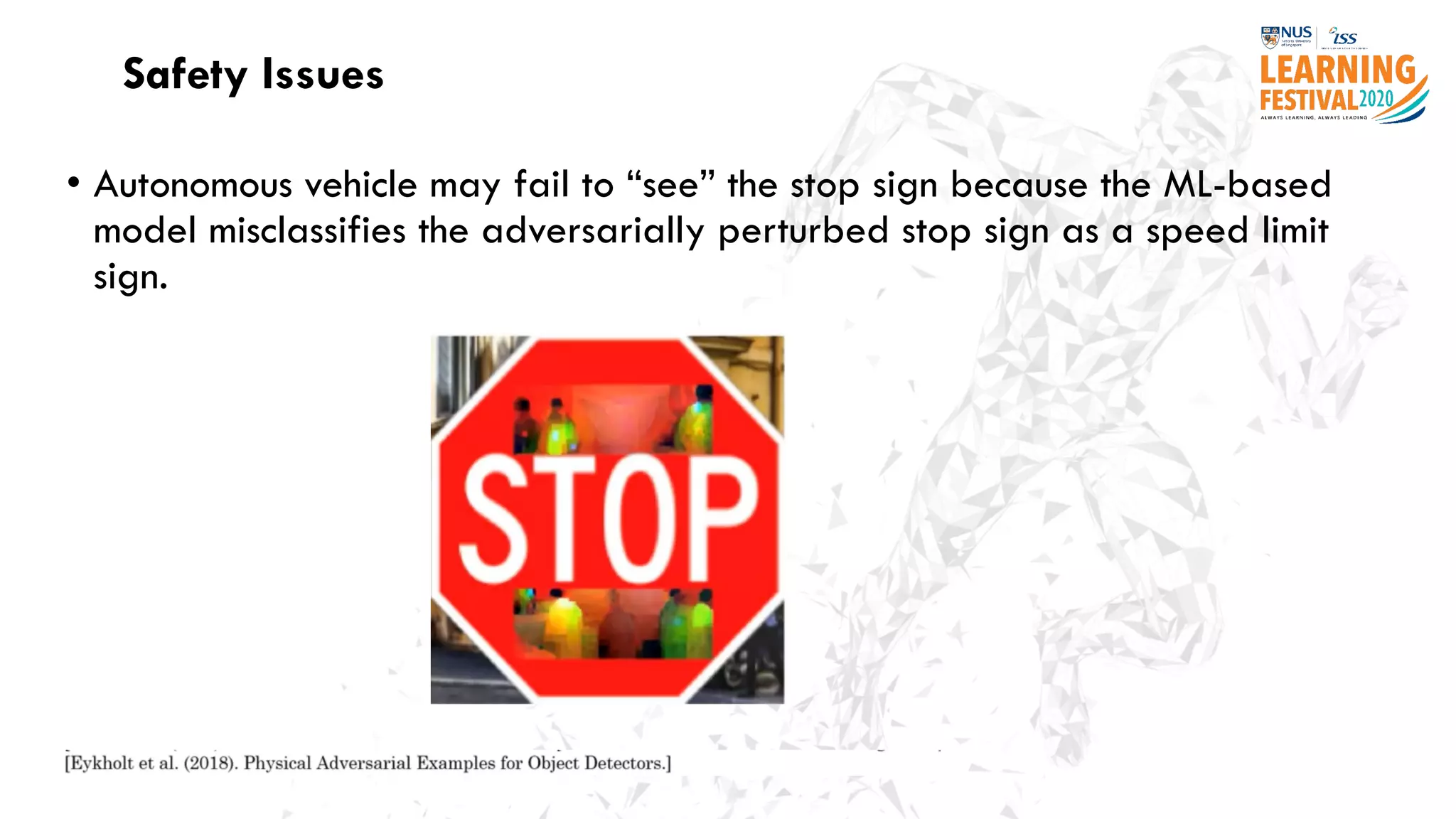
Safety Issues
• Autonomous vehicle may fail to “see” the stop sign because the ML-based
model misclassifies the adversarially perturbed stop sign as a speed limit
sign.
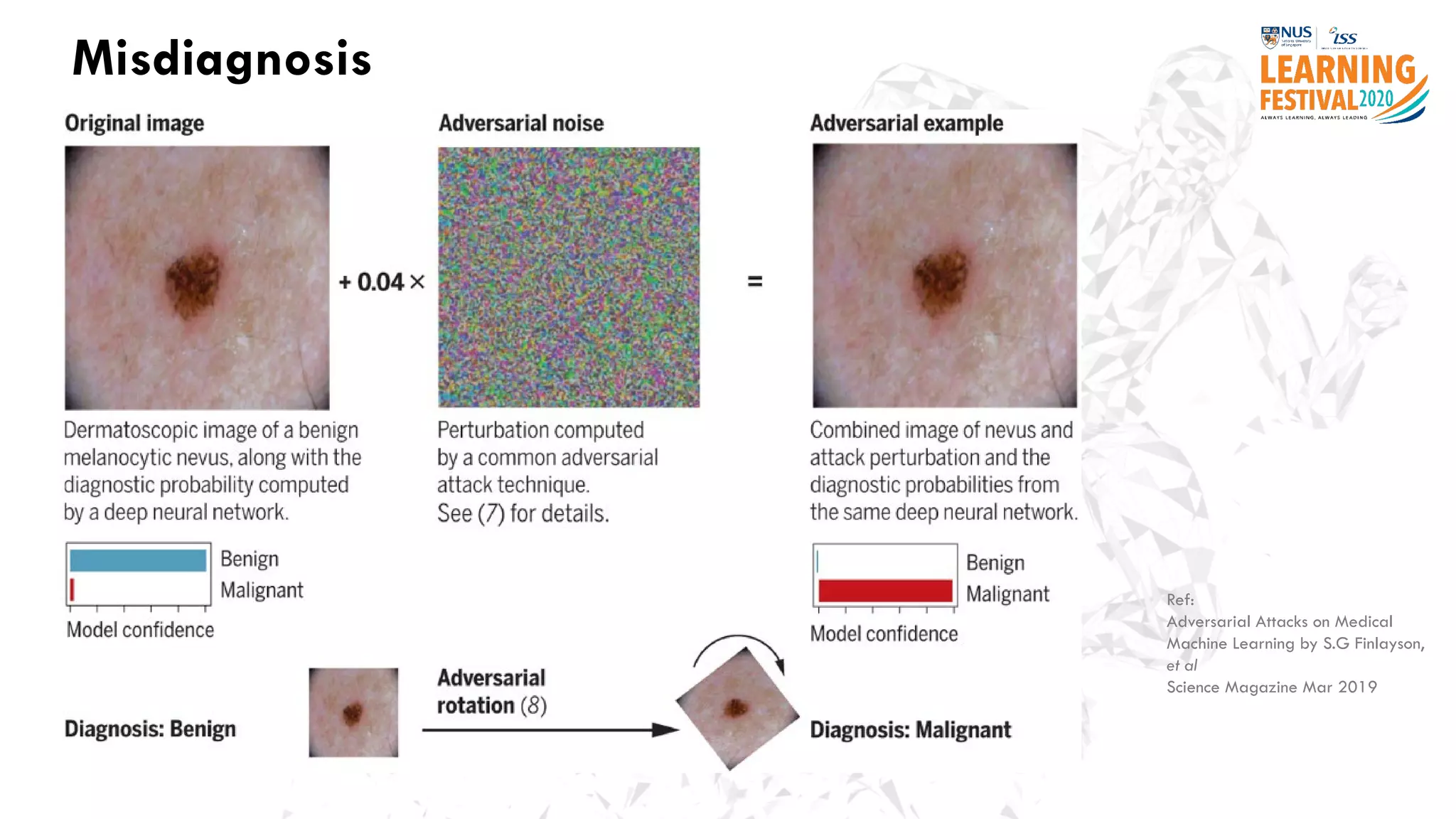
Misdiagnosis
Ref:
Adversarial Attacks on Medical
Machine Learning by S.G Finlayson,
et al
Science Magazine Mar 2019
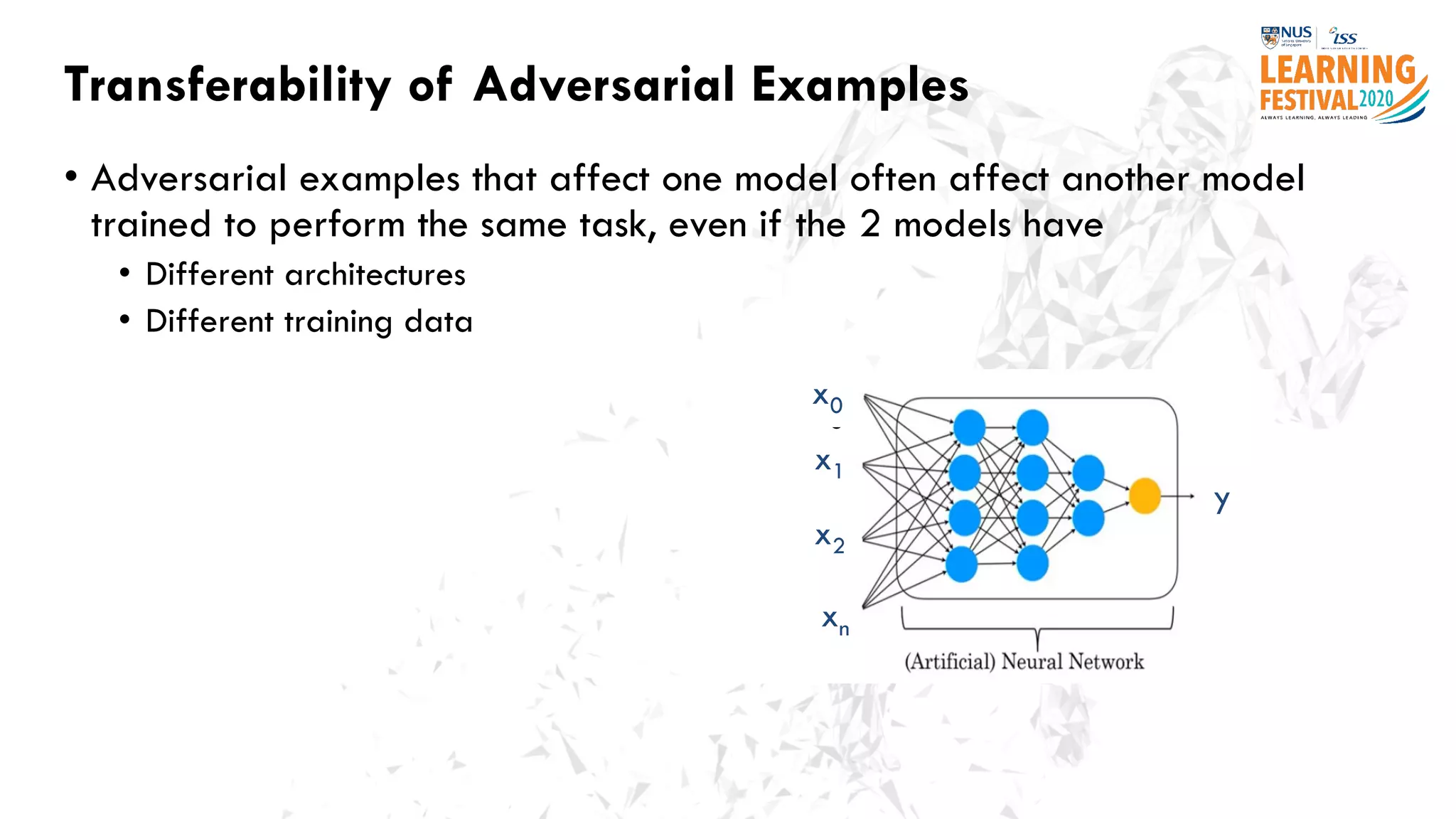
Transferability of Adversarial Examples
• Adversarial examples that affect one model often affect another model
trained to perform the same task, even if the 2 models have
• Different architectures
• Different training data
x
1
x0
x2
x1
xn
y
x0
Mitigation?
Security will be one of the biggest challenges in deploying AI
Dawn Song
Professor
Computer Science Division
University of California, Berkeley
New Challenges
• “Traditional software attack vectors are still critical to address, but they do
not provide sufficient coverage in the AI/ML threat landscape.”
• “The tech industry must avoid fighting next-gen issues with last-gen solutions
by building new frameworks and adopting new approaches which address
gaps in the design and operation of AI/ML-based services.”
Source: Securing the Future of Artificial Intelligence and Machine Learning at Microsoft
• Meanwhile, the following slide provides additional food for thought in this
area…
Protecting AI Initiatives
• How are we protecting our AI-based products, tools, and services?
• How do we keep our training data pristine and protect against biased inputs and poisoning?
• How do we protect the algorithms (or their implementation)?
• Do we have control procedures that stop abnormal events from happening and a Plan B in case we
notice that our AI programs are behaving abnormally?
• Do we have the technical and human monitoring capabilities to detect if our AI has been tampered
with?
• Have we made conscious decisions about who (or what) can decide and control which capabilities? Did
we assign AI systems an appropriate responsibility matrix entry? Do we constrain AI to decision support
or expert systems, or do we let AI programs make decisions on their own (and if so, which ones)?
• Do we have the appropriate governance policies and an agreed code of conduct that specify which of
our processes or activities are off-limits for AI for security reasons?
• When using AI in conjunction with decisions on cyber-physical systems, do we have appropriate ethical,
process, technical, and legal safeguards in place? Do we have compensating controls? How do we test
them?
• Have we aligned our cybersecurity organization, processes, policies, and technology to include AI, to
protect AI, and to protect us from AI malfunctions?
Source: https://www.bcg.com/en-sea/publications/2018/artificial-intelligence-threat-cybersecurity-solution.aspx
AI-Aided Attacks
#ISSLearningFest
Examples
• Impersonation
• Speech synthesis systems that learn to imitate individuals’ voices
• Deepfake videos
• Generative Adversarial Network (GAN)-based tools
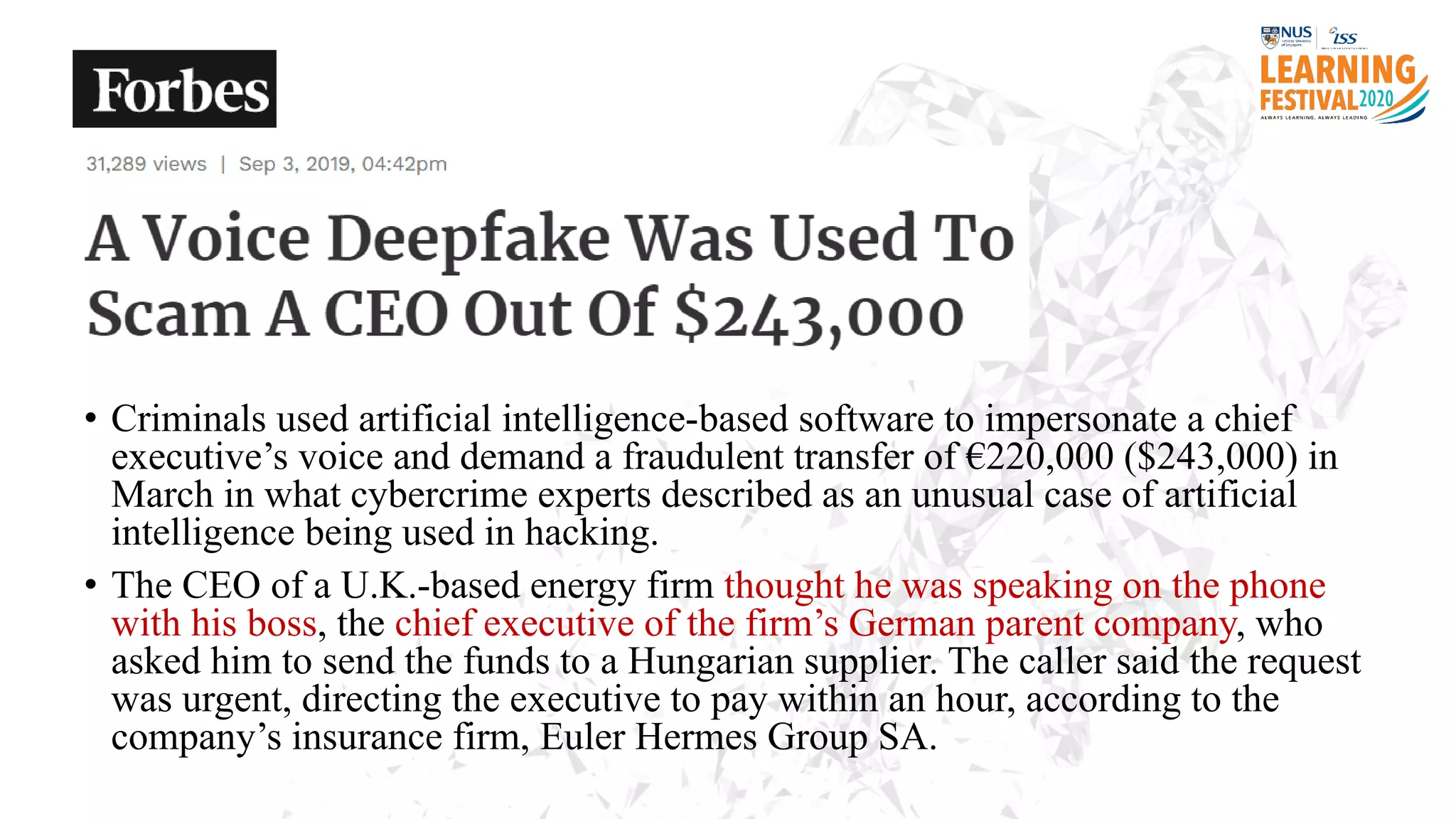
• Criminals used artificial intelligence-based software to impersonate a chief
executive’s voice and demand a fraudulent transfer of €220,000 ($243,000) in
March in what cybercrime experts described as an unusual case of artificial
intelligence being used in hacking.
• The CEO of a U.K.-based energy firm thought he was speaking on the phone
with his boss, the chief executive of the firm’s German parent company, who
asked him to send the funds to a Hungarian supplier. The caller said the request
was urgent, directing the executive to pay within an hour, according to the
company’s insurance firm, Euler Hermes Group SA.
Deepfake Videos
• Did Obama really say this?
Ref:
https://www.youtube.com/
watch?v=cQ54GDm1eL0
GAN-based tools - Examples
• MalGAN
• Generates malware that can bypass ML-based malware detectors
• PassGAN
• autonomously learn the distribution of real passwords from actual password leaks and
to generate high-quality password guesses
Use of AI in Cybersecurity
#ISSLearningFest
Use of AI in Cybersecurity – some examples
• Malware detection
and classification
• Spam identification
• Tier 1 analyst automation
• User and Entity Behaviour Analytics
(UEBA)
But it may not be robust…
DefCon AI Village (2019)
Machine Learning Static
Evasion Competition
Use hybrid approach
• AI/ML for the unknown
• Verify with tried and tested classical techniques
Summary
• Security will be one of the biggest challenges in deploying AI.
• New challenges require new approaches
• Malicious use of AI and AI-powered attacks must be considered as part
of an organization’s cybersecurity risk assessment.
• Consider ML-based security solutions as an augmentation (not
replacement) of your traditional security solutions and security staff.
Demo Time …….
#ISSLearningFest
Thank You!
#ISSLearningFest
Give Us Your Feedback
#ISSLearningFest
Day 1 Programme

AI and Cybersecurity - Food for Thought

  • 1.
    AI and Cybersecurity FoodFor Thought Angela Huang and Tian Jing #ISSLearningFest
  • 2.
    Outline • Cybersecurity –a quick recap • Overview of AI • Security of AI systems • AI-aided Attacks/Maliciousness • Use of AI in CyberSecurity • Demo #ISSLearningFest
  • 3.
    Cybersecurity – aquick recap C I PRIVACY SAFETY A CONFIDENTIALITY Ensuring that information is accessible only to those authorised to have access. INTEGRITY Safeguarding the correctness and completeness of information and processing methods. AVAILABILITY Ensuring that authorised users have access to information and associated assets when required in whatever form required
  • 4.
  • 5.
    Artificial Intelligence (AI) •Artificial General Intelligence • Do anything a human can do • Artificial Narrow Intelligence • Computer Vision (e.g. object recognition as in face recognition) • Speech (e.g. smart speaker) • Natural Language Processing (e.g. sentiment analysis, machine translation) • Self-driving car, autonomous vehicles
  • 6.
    Example: Social DistancingDetector https://landing.ai/landing-ai-creates-an-ai-tool-to-help-customers-monitor-social-distancing-in-the-workplace/
  • 7.
    Example: Baidu’s face-enabledentrance Source: https://www.youtube.com/watch?v=wr4rx0Spihs (Jan 2017)
  • 8.
    Example • 20 lawyersvs LawGeex AI • Review 5 NDAs in 4 hours. • 3213 clauses • Result: Source: https://blog.lawgeex.com/ai-more-accurate-than-lawyers/ AI Lawyers Accuracy 94% Avg 85% Time taken to review all NDAs 26 seconds Avg 92 minutes
  • 9.
    Singapore’s National AIStrategy Ref: National Artificial Intelligence Strategy - Advancing our Smart Nation Journey, Summary
  • 10.
    AI, Machine Learning,Deep Learning AI Machine Learning Deep Learning Algorithms with ability to learn without being explicitly programmed. • Supervised Learning • Unsupervised Learning • Reinforcement Learning • Deep Neural Networks (DNN)
  • 11.
    Types of DNN •Feed Forward Neural Network Ref: https://medium.com/ravenprotocol/everything-you-need-to-know-about-neural-networks-6fcc7a15cb4
  • 12.
    Training vs Inference Model Weights Deploy Model Iteratemany times till good enough. (NN architecture, data, hyperparameters, regularization, etc) Ref: Intel
  • 13.
    Security of AISystems Exploring the additional attack surface, if any, resulting from utilizing AI #ISSLearningFest
  • 14.
    Threats (illustrative) Prepare Training DATA Trainthe Model • Training Set Poisoning • DNN backdoors • Trojaned DNN • Privacy Concerns • Adversarial Examples • Physical Adversarial Examples • Reprogramming of Neural Networks • Model Stealing / Model Extraction • Model Inversion • Membership Inference Attack Input Trained Model Output
  • 15.
    Adversarial Example (ImageClassification) Fast Gradient Sign Method (FGSM)Source: EXPLAINING AND HARNESSING ADVERSARIAL EXAMPLES Ian J. Goodfellow, et al. ICLR 2015 Adversarial Perturbation Adversarial Example
  • 16.
    Adversarial Examples Data • Image/ Vision • Audio / Speech • Text / NLP • Executable code Realm • Digital • Physical
  • 17.
    Adversarial Examples … •… affect the integrity of the ML model • Could lead to various cybersecurity risks and corresponding business impact such as … #ISSLearningFest
  • 18.
    Impersonation • Adversarial ExampleAttack against Face Recognition System (FRS), which could be part of an access control or surveillance system, via “adversarial” eyeglass frame to Impersonate a target.
  • 19.
    Impersonation Impersonation of target(cont’d) Source: Accessorize to a Crime: Real and Stealthy Attacks on State-of-the-Art Face Recognition. Mahmood Sharif, et al Oct 2016
  • 20.
    Impersonation, Dodging • Adversarialperturbation by project infrared dots on attacker’s face to induce misclassification by Face Recognition System. • Impersonation • Dodging Source:
  • 21.
    Safety Issues • Autonomousvehicle may fail to “see” the stop sign because the ML-based model misclassifies the adversarially perturbed stop sign as a speed limit sign.
  • 22.
    Misdiagnosis Ref: Adversarial Attacks onMedical Machine Learning by S.G Finlayson, et al Science Magazine Mar 2019
  • 23.
    Transferability of AdversarialExamples • Adversarial examples that affect one model often affect another model trained to perform the same task, even if the 2 models have • Different architectures • Different training data x 1 x0 x2 x1 xn y x0
  • 24.
  • 25.
    Security will beone of the biggest challenges in deploying AI Dawn Song Professor Computer Science Division University of California, Berkeley
  • 26.
    New Challenges • “Traditionalsoftware attack vectors are still critical to address, but they do not provide sufficient coverage in the AI/ML threat landscape.” • “The tech industry must avoid fighting next-gen issues with last-gen solutions by building new frameworks and adopting new approaches which address gaps in the design and operation of AI/ML-based services.” Source: Securing the Future of Artificial Intelligence and Machine Learning at Microsoft
  • 27.
    • Meanwhile, thefollowing slide provides additional food for thought in this area…
  • 28.
    Protecting AI Initiatives •How are we protecting our AI-based products, tools, and services? • How do we keep our training data pristine and protect against biased inputs and poisoning? • How do we protect the algorithms (or their implementation)? • Do we have control procedures that stop abnormal events from happening and a Plan B in case we notice that our AI programs are behaving abnormally? • Do we have the technical and human monitoring capabilities to detect if our AI has been tampered with? • Have we made conscious decisions about who (or what) can decide and control which capabilities? Did we assign AI systems an appropriate responsibility matrix entry? Do we constrain AI to decision support or expert systems, or do we let AI programs make decisions on their own (and if so, which ones)? • Do we have the appropriate governance policies and an agreed code of conduct that specify which of our processes or activities are off-limits for AI for security reasons? • When using AI in conjunction with decisions on cyber-physical systems, do we have appropriate ethical, process, technical, and legal safeguards in place? Do we have compensating controls? How do we test them? • Have we aligned our cybersecurity organization, processes, policies, and technology to include AI, to protect AI, and to protect us from AI malfunctions? Source: https://www.bcg.com/en-sea/publications/2018/artificial-intelligence-threat-cybersecurity-solution.aspx
  • 29.
  • 30.
    Examples • Impersonation • Speechsynthesis systems that learn to imitate individuals’ voices • Deepfake videos • Generative Adversarial Network (GAN)-based tools
  • 31.
    • Criminals usedartificial intelligence-based software to impersonate a chief executive’s voice and demand a fraudulent transfer of €220,000 ($243,000) in March in what cybercrime experts described as an unusual case of artificial intelligence being used in hacking. • The CEO of a U.K.-based energy firm thought he was speaking on the phone with his boss, the chief executive of the firm’s German parent company, who asked him to send the funds to a Hungarian supplier. The caller said the request was urgent, directing the executive to pay within an hour, according to the company’s insurance firm, Euler Hermes Group SA.
  • 32.
    Deepfake Videos • DidObama really say this? Ref: https://www.youtube.com/ watch?v=cQ54GDm1eL0
  • 33.
    GAN-based tools -Examples • MalGAN • Generates malware that can bypass ML-based malware detectors • PassGAN • autonomously learn the distribution of real passwords from actual password leaks and to generate high-quality password guesses
  • 34.
    Use of AIin Cybersecurity #ISSLearningFest
  • 35.
    Use of AIin Cybersecurity – some examples • Malware detection and classification • Spam identification • Tier 1 analyst automation • User and Entity Behaviour Analytics (UEBA)
  • 36.
    But it maynot be robust… DefCon AI Village (2019) Machine Learning Static Evasion Competition Use hybrid approach • AI/ML for the unknown • Verify with tried and tested classical techniques
  • 37.
    Summary • Security willbe one of the biggest challenges in deploying AI. • New challenges require new approaches • Malicious use of AI and AI-powered attacks must be considered as part of an organization’s cybersecurity risk assessment. • Consider ML-based security solutions as an augmentation (not replacement) of your traditional security solutions and security staff.
  • 38.
  • 39.
  • 40.
    Give Us YourFeedback #ISSLearningFest Day 1 Programme