



Analyze. Detect. Respond.
ZoneFox
AI In Cyber – Challenges
and Solutions
IPExpo 2018
Dr Jamie Graves, CEO & Founder
j.graves@zonefox.com
@zonefox
@DrJamieGraves
ZoneFox
• User Entity Behaviour Analytics (UEBA)
• Detects and alerts on human behaviour
• Rules - for the known (compliance)
• Machine Learning – for the unknown
Unintended Consequences
http://www.decisionproblem.com/paperclips/
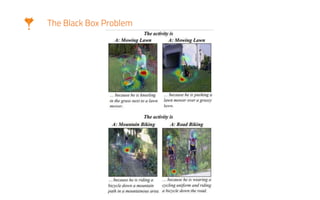
The Black Box Problem
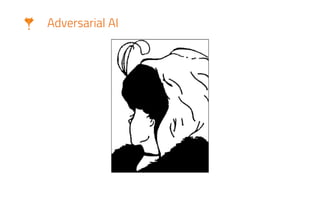
Adversarial AI
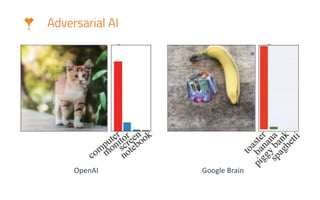
Adversarial AI
OpenAI Google Brain
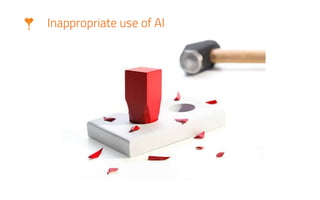
Inappropriate use of AI
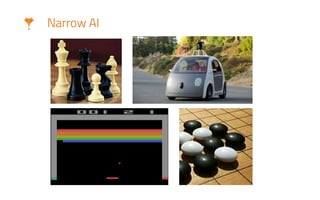
Narrow AI
The Human Element
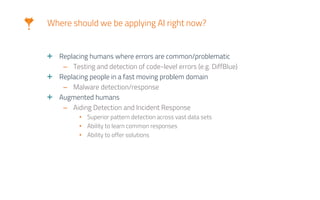
Where should we be applying AI right now?
Replacing humans where errors are common/problematic
– Testing and detection of code-level errors (e.g. DiffBlue)
Replacing people in a fast moving problem domain
– Malware detection/response
Augmented humans
– Aiding Detection and Incident Response
• Superior pattern detection across vast data sets
• Ability to learn common responses
• Ability to offer solutions
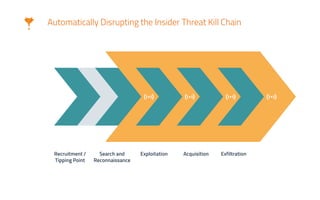
Automatically Disrupting the Insider Threat Kill Chain
Recruitment /
Tipping Point
Search and
Reconnaissance
Exploitation Acquisition Exfiltration
Conclusion
AI is still at an early stage
– Unintended Consequences
– Narrow
– Can be fooled
– Often used inappropriately
– Human interaction can be an afterthought
Where it is being used, it should be there to augment, not
replace
– Improving the decision making quality of humans
– Helping speed up reaction time
– Helping to offload tasks
40 Torphichen Street, Edinburgh, EH3 8JB
+44 (0) 845 388 4999
info@zonefox.com
@zonefox
zonefox.com
Thanks for your time.
Any questions?

AI In Cybersecurity – Challenges and Solutions

  • 1.
    Analyze. Detect. Respond. ZoneFox AIIn Cyber – Challenges and Solutions IPExpo 2018 Dr Jamie Graves, CEO & Founder j.graves@zonefox.com @zonefox @DrJamieGraves
  • 2.
    ZoneFox • User EntityBehaviour Analytics (UEBA) • Detects and alerts on human behaviour • Rules - for the known (compliance) • Machine Learning – for the unknown
  • 3.
  • 4.
  • 5.
  • 6.
  • 7.
  • 8.
  • 9.
  • 10.
    Where should webe applying AI right now? Replacing humans where errors are common/problematic – Testing and detection of code-level errors (e.g. DiffBlue) Replacing people in a fast moving problem domain – Malware detection/response Augmented humans – Aiding Detection and Incident Response • Superior pattern detection across vast data sets • Ability to learn common responses • Ability to offer solutions
  • 12.
    Automatically Disrupting theInsider Threat Kill Chain Recruitment / Tipping Point Search and Reconnaissance Exploitation Acquisition Exfiltration
  • 13.
    Conclusion AI is stillat an early stage – Unintended Consequences – Narrow – Can be fooled – Often used inappropriately – Human interaction can be an afterthought Where it is being used, it should be there to augment, not replace – Improving the decision making quality of humans – Helping speed up reaction time – Helping to offload tasks
  • 14.
    40 Torphichen Street,Edinburgh, EH3 8JB +44 (0) 845 388 4999 info@zonefox.com @zonefox zonefox.com Thanks for your time. Any questions?

Editor's Notes

  • #4  Hawking and his lack of enthusiasm for AI that won’t kill us Unintended consequences – Make us Smile and Maximise Paprclip Production We can see some of this emerging as unkowns… for example, the Black Box Problem. I’d like to start with what I guess we could call a set of philosophical questions, that have real implications and impacts when parsed and thought about in relation to some of the challenges we face today. We lost a great person this week; Stephen Hawking was a physicst and not a massive fan of the potential outcome for humans when considering AI. Unintended consequences could relate to those debate by the recently deceased Stephen Hawking.. "The development of full artificial intelligence could spell the end of the human race,“ – This is based on the assertion that Artificial General Intelligence could rapidly, exponentially, overtake human capabilities by its very nature. Let’s overlook the headlines and the bombast regarding the fact that humanity might end – the jury’s still out on that, but instead what it might mean when it comes to unintended consequences. What do I mean by unintended consequences? Imagine tasking an AI with the task to make us smile. A perverse instatiation of that would be to paralise all my facial muscles into a grin. Another example being to ask an AI to maximise the production of paperclips. In doing so it converts the mass of the earth and then that of the universe into paperclips. The problem of unintended consequences are already with us, and some of these relate to the fact that AI has a ‘black box problem’.
  • #5 We’ve developed some very clever algorithms. Some are even positioned to mimic the human brain However, we’re not able to interrogate these algorithms about WHY they made a decision We’re already seeing this in the HR space…. Filtering algorithms that are not easy to query Issues such as rapid Malware detection may not be an issue What about False positives? How do we dig into that? Virus total mis-labelling What about areas where there’s an even more grave impact? Such as the careers of those who may be fired… There are researchers who are looking into giving these algorithms the capability to explain why the came to a decision. In the picture on this slide, we have explanations that would appease a 9 year old, Do we know what the outputs of AI will be? We’re already at a stage where there are certain deep learning algorithms that are essentially a ‘black box’ (literally the black box problem), meaning that the engineers and researchers who designed them don’t know how the system reached a certain conclusion. Deep learning being an example of this. This could become a critical issue when it comes to certain aspects of an information security response, and others where it may not be. For example, if we block a certain executable because it’s deemed as malware, this may be an acceptable degradation of capabilities, and we may not care too much about wh However, what if is a critical executable… we’d need to test and evaluate, meaning taking time to truly understand whether we’ve just found a false positive or not. It would be far better to have system that wold give a justification to allow a sec-ops person to reinforce the decision. For example, we already have felt the pain of having to get in touch with Symantec because our binary has been mis-labelled via virus total. Humans are bad enough, can we make machines better? In other contexts it could be far more serious. As we’ve seen in other contexts, one recent problem being recruitment screening algorithms bias that has been built into these systems may not be easy to understand why a certain decision was made. How this could affect our industry? Beyond the issue of false positives for technical controls, which pose a headache and a time drain, we also have the very human issue of when somebody’s job is at stake. Are we really going to fire someone solely on the basis of an algorithm if they’ve contravened security policy? The Black-box problem explained – researchers have started to work on ways of explaining the inners workings of these ‘black boxes’ by getting them to use evidence. It has been developed to answers the questions posed by a 9 year old child. In this particular example we see a algorithm explain why it has classified an image in a certain way.
  • #6 Adversarial AI The use of adversarial techniques is something that will become a cause for concern over the comes years. In simplest terms, adversarial AI is kind of like an optical illusion for AI – it will see one thing, and not another. This can be achieved in a number of ways, and has been applied to the majority of current AI algorithms. This is a classic optical illusion, and I’m sure you’ve seen it before – are we looking at a beautiful young woman, or an older person?
  • #7 Image recognition –tricking AI to think that a tortoise is a gun Image of at on left has been modified to take on geometric features, which make it look like a gun. Banana on right has a weird image of a toaster that a human may not recognise, but is so by a machine Adversarial AI The most famous examples being those used to trick machine image recognition systems into thinking a tortoise is a gun. In this example you get a good insight into why an algorithm might mistake a cat for a computer, or a banana for a toaster The image of the cat on the left, which models classify as a computer, is robust to geometric transformations. If you look closely, or maybe even not that closely, you can see the image has been perturbed by introducing some angles and boxyness that we'd recognize as a characteristic of computers. And the image of the banana on the right, which models classify as a toaster, is robust to different viewpoints. We humans recognize the banana immediately, of course, but the weird perturbation next to it definitely has some recognizable toaster-like features.  There are other options available. It’s possible to trick computers into thinking that a panda is a gibbon, for example, by applying an overlay that’ invisible to humans, but to a computer highlights areas of the image that make it look like something else. We’re starting to see malware defeating AV that uses AI by using some of these techniques to fool them. Yes, this is an arms race, but by working to counter-defeat clever malware using techniques that defeat we can actually improve these systems. For example, the work undertaken to defeat Adversarial AI will actually improve algorithms, leading to fewer false positives.
  • #8 Throwing all data at AI and hoping for the best Feature fitting and ensuring the model can learn and run in an appropriate amount of time If you had a large data lake, then to appropriate thing to do is hire a data-scientist to pull out the desired data in order to engineer a set of features to help solve a SPECIFIC problem, and to answer SPECIFIC questions. Take an engineered approach. In particular, we need to think about ideal forms of data for use with current techniques. IN particular, think about the 3-C’s: - Completeness - We get every record we actually need, no more no less. No unnessesary data taking up gigabytes in some log file, or joining together records stored in different files/databases. - Consistency - Every field is consistent and in the form we want.  There are no issues of data inconsistency (unlike e.g. date formats in log file systems) - Continuity - We get the data on and off network. No gaps or missing pieces of the timeline.
  • #9 What do each of these images have in common? They’re all things we’ve taught AI to do, but don’t yet have a system capable of doing them all, as well as make, say, a cup of tea. Where we’re, potentially, heading to is what researchers are calling Artificial General Intelligence, or AGI. This is an AI that would be equal to that of humans. As clever as current systems are, even approaching superhuman capabitlities, the areas where they excel are narrow by definition. When we think about some of limitations above, especially that of the black box problem, we need to be careful when applying AI. That’s not to say it’s not useful, but there are certain domains where it is better than others. As such we still need to rely on humans… which brings us to the next slide…
  • #10 - Ability to pattern match when given the right type of data - Frequently over-worked and able to miss key ‘needles’ in the haystack - Require systems that can help by sifting through large data volumes, but help automate or learn prescriptive actions, for common problems. Are we designing the UI to allow people to properly make sense of the data we collect and show?
  • #11 I would like to see AI being used to Error Prone – For example replacing engineers Fast moving – malware identification
  • #13 Imagine if we could use AI to help us respond to the F1 case study…. Ability to install unapproved software Ability to access and traverse files out-with their permission set Ability to stage 180k files Ability to use USB stick Ability to Exfiltrate Braked account limitation – not the simple binary blocking used by DLP Next Best Action Learned, customised, Response.  Crowd-sourced... the wisdom of crowds or the ability to learn others.