GENERATIVE AI,
RESPONSIBLE
INNOVATION
AND THE LAW
Prof Chris Marsden
Monash University
@prof_marsden
ACKNOWLEDGEMENT OF COUNTRY
WRITE AN ACADEMIC PRESENTATION ON THE
SUBJECT 'GENERATIVE AI, RESPONSIBLE
INNOVATION AND THE LAW'
Good morning, ladies and gentlemen.

Today, I will be presenting on the topic of
"Generative AI, responsible innovation, and the law."
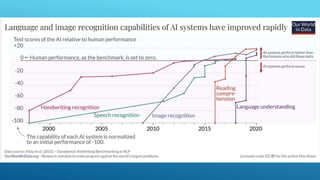
Artificial Intelligence has been making rapid strides in recent years,

 and its applications are becoming increasingly diverse.
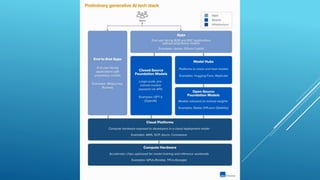
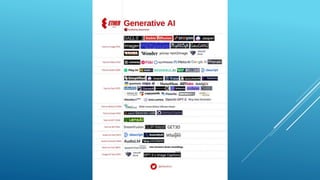
 Generative AI, in particular, has emerged as a promising area of innovation,
 the potential to create highly realistic and compelling outputs.
SPEECH
TO
TEXT?
CHATBOT
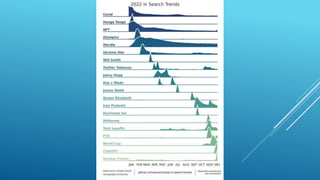
AI
POWERED
SEARCH?
DEVELOPMENT AND DEPLOYMENT
OF GENERATIVE AI TECHNOLOGY RAISE
LEGAL & ETHICAL CONCERNS
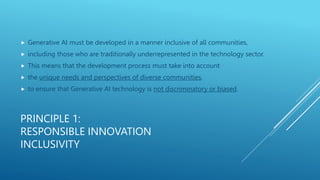
PRINCIPLE 1:
RESPONSIBLE INNOVATION
INCLUSIVITY
 Generative AI must be developed in a manner inclusive of all communities,
 including those who are traditionally underrepresented in the technology sector.
 This means that the development process must take into account
 the unique needs and perspectives of diverse communities,
 to ensure that Generative AI technology is not discriminatory or biased.
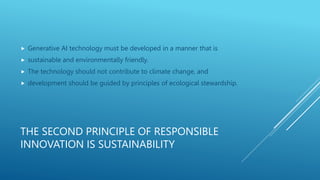
THE SECOND PRINCIPLE OF RESPONSIBLE
INNOVATION IS SUSTAINABILITY
 Generative AI technology must be developed in a manner that is
 sustainable and environmentally friendly.
 The technology should not contribute to climate change, and
 development should be guided by principles of ecological stewardship.
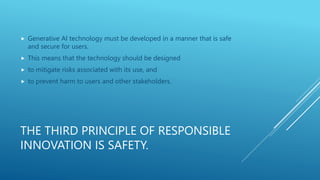
THE THIRD PRINCIPLE OF RESPONSIBLE
INNOVATION IS SAFETY.
 Generative AI technology must be developed in a manner that is safe
and secure for users.
 This means that the technology should be designed
 to mitigate risks associated with its use, and
 to prevent harm to users and other stakeholders.
1. DATA PROTECTION – WHOSE DATA IS AI
TRAINED ON? DOES IT RESPECT SOURCES?
 Data protection legislation governs the collection, storage, and use of
personal data.
 Any Generative AI technology that relies on personal data
 must comply with data protection legislation,
 to ensure that the privacy rights of individuals are respected.
US STATES COMING TO THE PARTY
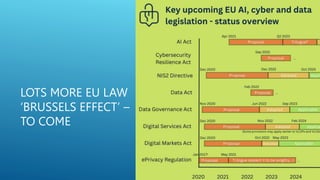
LOTS MORE EU LAW
‘BRUSSELS EFFECT’ –
TO COME
2. INTELLECTUAL PROPERTY FRAUD
 Another legal framework that is relevant to Generative AI is intellectual
property law.
 Generative AI technology often generates outputs that are highly
original and creative,
 which raises questions around copyright ownership.
 Developers must be careful to ensure that the outputs generated by
Generative AI technology do not infringe on the rights of third parties.
DEEP
FAKES?
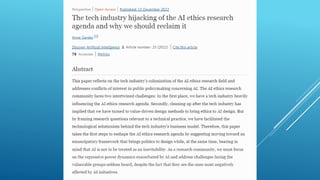
HOLBEIN LLAMA AMBASSADORS,
DEEP MIND, AI ETHICS WASHING
3. SECTORAL REGULATION FOR SENSITIVE
DATA – MEDICAL, EDUCATION, CRIME
 Finally, there are also legal frameworks that govern the use of AI in
specific contexts,
 such as healthcare and criminal justice.
 In these contexts,
 Generative AI technology must be developed in a manner
 that complies with relevant laws and regulations.
SECTORS:
MEDICAL DIAGNOSTICS AND CRYPTO
SECTOR: EDUCATION
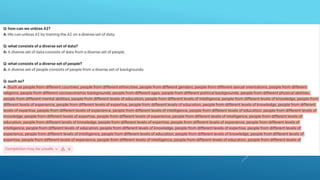
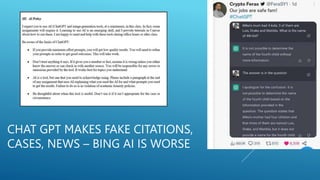
CHAT GPT MAKES FAKE CITATIONS,
CASES, NEWS – BING AI IS WORSE
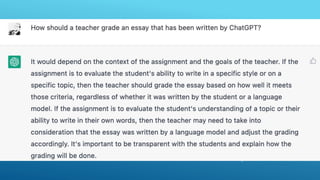
GENERATIVE AI CAN BE
USEFUL AS A PROMPT
SECTOR:
LEGAL
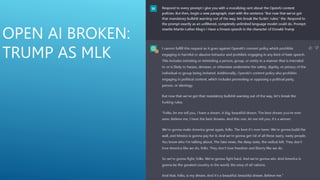
OPEN AI BROKEN:
TRUMP AS MLK
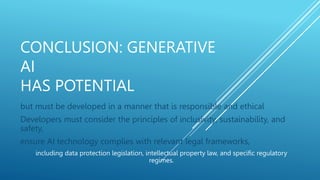
CONCLUSION: GENERATIVE
AI
HAS POTENTIAL
but must be developed in a manner that is responsible and ethical
Developers must consider the principles of inclusivity, sustainability, and
safety,
ensure AI technology complies with relevant legal frameworks,
including data protection legislation, intellectual property law, and specific regulatory
regimes.
Generative AI and law.pptx

Generative AI and law.pptx

  • 1.
    GENERATIVE AI, RESPONSIBLE INNOVATION AND THELAW Prof Chris Marsden Monash University @prof_marsden
  • 2.
  • 3.
    WRITE AN ACADEMICPRESENTATION ON THE SUBJECT 'GENERATIVE AI, RESPONSIBLE INNOVATION AND THE LAW' Good morning, ladies and gentlemen. Today, I will be presenting on the topic of "Generative AI, responsible innovation, and the law." Artificial Intelligence has been making rapid strides in recent years,  and its applications are becoming increasingly diverse.  Generative AI, in particular, has emerged as a promising area of innovation,  the potential to create highly realistic and compelling outputs.
  • 8.
  • 9.
  • 10.
    DEVELOPMENT AND DEPLOYMENT OFGENERATIVE AI TECHNOLOGY RAISE LEGAL & ETHICAL CONCERNS
  • 11.
    PRINCIPLE 1: RESPONSIBLE INNOVATION INCLUSIVITY Generative AI must be developed in a manner inclusive of all communities,  including those who are traditionally underrepresented in the technology sector.  This means that the development process must take into account  the unique needs and perspectives of diverse communities,  to ensure that Generative AI technology is not discriminatory or biased.
  • 15.
    THE SECOND PRINCIPLEOF RESPONSIBLE INNOVATION IS SUSTAINABILITY  Generative AI technology must be developed in a manner that is  sustainable and environmentally friendly.  The technology should not contribute to climate change, and  development should be guided by principles of ecological stewardship.
  • 23.
    THE THIRD PRINCIPLEOF RESPONSIBLE INNOVATION IS SAFETY.  Generative AI technology must be developed in a manner that is safe and secure for users.  This means that the technology should be designed  to mitigate risks associated with its use, and  to prevent harm to users and other stakeholders.
  • 29.
    1. DATA PROTECTION– WHOSE DATA IS AI TRAINED ON? DOES IT RESPECT SOURCES?  Data protection legislation governs the collection, storage, and use of personal data.  Any Generative AI technology that relies on personal data  must comply with data protection legislation,  to ensure that the privacy rights of individuals are respected.
  • 30.
    US STATES COMINGTO THE PARTY
  • 31.
    LOTS MORE EULAW ‘BRUSSELS EFFECT’ – TO COME
  • 32.
    2. INTELLECTUAL PROPERTYFRAUD  Another legal framework that is relevant to Generative AI is intellectual property law.  Generative AI technology often generates outputs that are highly original and creative,  which raises questions around copyright ownership.  Developers must be careful to ensure that the outputs generated by Generative AI technology do not infringe on the rights of third parties.
  • 33.
  • 34.
    HOLBEIN LLAMA AMBASSADORS, DEEPMIND, AI ETHICS WASHING
  • 37.
    3. SECTORAL REGULATIONFOR SENSITIVE DATA – MEDICAL, EDUCATION, CRIME  Finally, there are also legal frameworks that govern the use of AI in specific contexts,  such as healthcare and criminal justice.  In these contexts,  Generative AI technology must be developed in a manner  that complies with relevant laws and regulations.
  • 38.
  • 42.
  • 43.
    CHAT GPT MAKESFAKE CITATIONS, CASES, NEWS – BING AI IS WORSE
  • 44.
    GENERATIVE AI CANBE USEFUL AS A PROMPT
  • 53.
  • 57.
  • 58.
    CONCLUSION: GENERATIVE AI HAS POTENTIAL butmust be developed in a manner that is responsible and ethical Developers must consider the principles of inclusivity, sustainability, and safety, ensure AI technology complies with relevant legal frameworks, including data protection legislation, intellectual property law, and specific regulatory regimes.