OVERVIEW OF
ARTIFICIAL INTELLIGENCE
IN CYBERSECURITY
Helping CISOs to navigate the AI hype,
and make informed decisions
Olivier Busolini
Geneva, June 2019
© Olivier Busolini
WHAT ARE WE TALKING ABOUT ?1
| June 2019 |Overview of AI in Cybersecurity 2
© Olivier Busolini
Artificial Imitation
Augmented Intelligence
| June 2019 |Overview of AI in Cybersecurity 3
Cybersecurity use case
sifting through events, correlating them with other events, and presenting analytics for
a human analyst to determine the next actions
Orchestrate and Automate tasks
that humans can perform without a problem to a much larger volume we could ever handle
Process and structure huge volumes of data
including analysis of the complex relationships within it
© Olivier Busolini
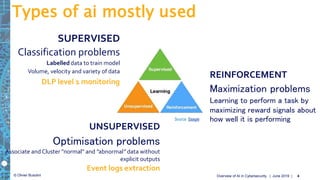
Types of ai mostly used
| June 2019 |Overview of AI in Cybersecurity 4
Source: Saagie
SUPERVISED
Classification problems
Labelled data to train model
Volume, velocity and variety of data
UNSUPERVISED
Optimisation problems
Associate and Cluster "normal" and "abnormal” data without
explicit outputs
REINFORCEMENT
Maximization problems
Learning to perform a task by
maximizing reward signals about
how well it is performing
DLP level 1 monitoring
Event logs extraction
© Olivier Busolini
Careful of the hype
 Cloud, Blockchain, and now AI ?
 “Cool” products have to have AI
Difficulty to develop AI solutions
 AI is Math (advanced and new application of Statistics) not software
 Rely on the qualifications of people developing the models
• Data scientists, often PhDs in Math and Computer Science, sometimes with (pending) pattent
• And Cybersecurity experts, with knowledge of CyberThreats and the most appropriate types of defenses
 Hiring and retaining is a major challenge
• Industry, projects and compensation (incl. equities) are key
• Salaries for Data scientists are sky rocking, and not all companies can compete
• Start-up are more able to provide equities to top talent but less able to
 Develop mature piece of software with this cutting edge technology
Have access to big data for training and testing
AI software are a quantum leap ?
| June 2019 |Overview of AI in Cybersecurity 5
© Olivier Busolini
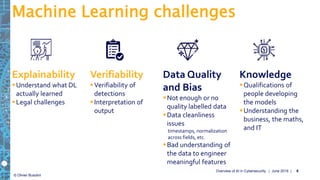
Machine Learning challenges
| June 2019 |Overview of AI in Cybersecurity 6
Explainability
Understand what DL
actually learned
Legal challenges
Verifiability
Verifiability of
detections
Interpretation of
output
Data Quality
and Bias
Not enough or no
quality labelled data
Data cleanliness
issues
timestamps, normalization
across fields, etc.
Bad understanding of
the data to engineer
meaningful features
Knowledge
Qualifications of
people developing
the models
Understanding the
business, the maths,
and IT
© Olivier Busolini
AI IN CYBERSECURITY2
| June 2019 |Overview of AI in Cybersecurity 7
© Olivier Busolini
 I am still running after more than 20 years in the field
 (Sterile ?) race to arms
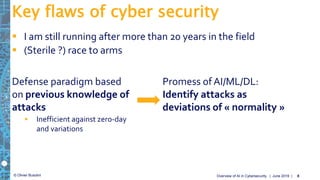
Key flaws of cyber security
| June 2019 |Overview of AI in Cybersecurity 8
Defense paradigm based
on previous knowledge of
attacks
 Inefficient against zero-day
and variations
Promess of AI/ML/DL:
Identify attacks as
deviations of « normality »
© Olivier Busolini
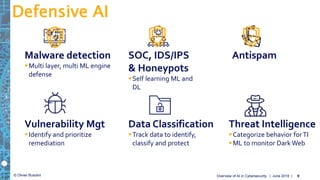
Defensive AI
| June 2019 |Overview of AI in Cybersecurity 9
Malware detection
Multi layer, multi ML engine
defense
SOC, IDS/IPS
& Honeypots
Self learning ML and
DL
Antispam
Vulnerability Mgt
Identify and prioritize
remediation
Data Classification
Track data to identify,
classify and protect
Threat Intelligence
Categorize behavior forTI
ML to monitor Dark Web
© Olivier Busolini | June 2019 |Overview of AI in Cybersecurity 10
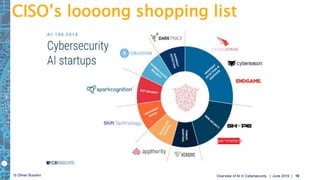
CISO’s loooong shopping list
© Olivier Busolini
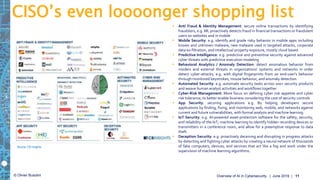
CISO’s even loooonger shopping list
| June 2019 |Overview of AI in Cybersecurity 11
Source: CB Insights
 Anti Fraud & Identity Management: secure online transactions by identifying
fraudsters, e.g. ML proactively detects fraud in financial transactions or fraudulent
users on websites and in mobile
 Mobile Security: e.g. identify and grade risky behavior in mobile apps including
known and unknown malware, new malware used in targeted attacks, corporate
data ex-filtration, and intellectual property exposure, mostly cloud based
 Predictive Intelligence: e.g. predictive and preventive security against advanced
cyber threats with predictive execution modeling
 Behavioral Analytics / Anomaly Detection: detect anomalous behavior from
insiders and external threats in organizations’ systems and networks in order
detect cyber-attacks, e.g. with digital fingerprints from an end-user’s behavior
through monitored keystrokes, mouse behavior, and anomaly detection
 Automated Security: e.g. automate security tasks across 100+ security products
and weave human analyst activities and workflows together
 Cyber-Risk Management: More focus on defining cyber risk appetite and cyber
risk tolerance, to better enable business considering the cost of security controls
 App Security: securing applications e.g. By helping developers secure
applications by finding, fixing, and monitoring web, mobile, and networks against
current and future vulnerabilities, with formal analysis and machine learning
 IoT Security: e.g. AI-powered asset-protection software for the safety, security,
and reliability of the IoT; machine learning to identify hidden recording devices or
transmitters in a conference room, and allow for a preemptive response to data
theft.
 Deception Security: e.g. proactively deceiving and disrupting in progress attacks
by detecting and fighting cyber attacks by creating a neural network of thousands
of fake computers, devices, and services that act like a fog and work under the
supervision of machine learning algorithms.
© Olivier Busolini
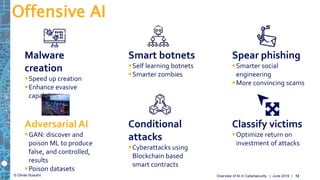
Offensive AI
| June 2019 |Overview of AI in Cybersecurity 12
Malware
creation
Speed up creation
Enhance evasive
capabilities
Smart botnets
Self learning botnets
Smarter zombies
Spear phishing
Smarter social
engineering
More convincing scams
Adversarial AI
GAN: discover and
poison ML to produce
false, and controlled,
results
Poison datasets
Conditional
attacks
Cyberattacks using
Blockchain based
smart contracts
Classify victims
Optimize return on
investment of attacks
© Olivier Busolini
Adversarial AI
| June 2019 |Overview of AI in Cybersecurity 13
Adversarial
inputs
Artefacts designed to
fool Defensive AIs
Data poisonig
Feed poisoned
training data to
cybersecurity tools
Feedback
weaponization
Poison ML to DoS AI
users with False Alarm
Model stealing
To enhance abilities
of adversarial inputs
Source: 2018 DEFCON “AI Village”
© Olivier Busolini
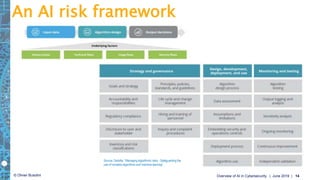
An AI risk framework
| June 2019 |Overview of AI in Cybersecurity 14
Source: Deloitte. “Managing algorithmic risks - Safeguarding the
use of complex algorithms and machine learning”
© Olivier Busolini
TAKEAWAYS FOR THE
ORDINARY CISO
4
| June 2019 |Overview of AI in Cybersecurity 15
© Olivier Busolini
 Asses your threats and risks – are AI based solutions the best answers to
some of them ?
 What is your current maturity in cybersecurity ? Up to where can you climb
the ladder from detective, preventative or even predictive controls?
A few points to look at
| June 2019 |Overview of AI in Cybersecurity 16
Do you need AI ?
 How does it learn ?
• Learning ‘on the job’ within the user’s environment or the provider’s ?
• What volume of data is required ? How often is retraining needed ?
 What's the mechanism for collaboration with human ?
 What are the error rates ?
• False positive, and false negative
• Is the error rate acceptable to achieve detection ? Automatic remediation ?
What AI ?
 Have you defined AI’s RoI ?
 Can it detect, cluster, classify and make predictions that
• would not have been possible by humans alone ? (complexity)
• reduce the amount of human intervention and analysis required ? (scale)
• in a timeframe not achievable by humans only ? (latency)
Will you benefit
from AI ?
© Olivier Busolini
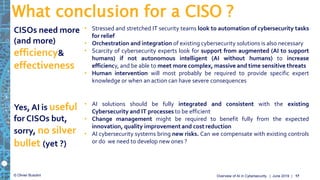
• Stressed and stretched IT security teams look to automation of cybersecurity tasks
for relief
• Orchestration and integration of existing cybersecurity solutions is also necessary
• Scarcity of cybersecurity experts look for support from augmented (AI to support
humans) if not autonomous intelligent (AI without humans) to increase
efficiency, and be able to meet more complex, massive and time sensitive threats
• Human intervention will most probably be required to provide specific expert
knowledge or when an action can have severe consequences
What conclusion for a CISO ?
| June 2019 |Overview of AI in Cybersecurity 17
CISOs need more
(and more)
efficiency&
effectiveness
• AI solutions should be fully integrated and consistent with the existing
Cybersecurity and IT processes to be efficient
• Change management might be required to benefit fully from the expected
innovation, quality improvement and cost reduction
• AI cybersecurity systems bring new risks. Can we compensate with existing controls
or do we need to develop new ones ?
Yes, AI is useful
for CISOs but,
sorry, no silver
bullet (yet ?)
© Olivier Busolini
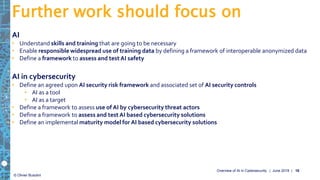
AI
• Understand skills and training that are going to be necessary
• Enable responsible widespread use of training data by defining a framework of interoperable anonymized data
• Define a framework to assess and testAI safety
AI in cybersecurity
• Define an agreed upon AI security risk framework and associated set of AI security controls
• AI as a tool
• AI as a target
• Define a framework to assess use of AI by cybersecurity threat actors
• Define a framework to assess and testAI based cybersecurity solutions
• Define an implemental maturity model for AI based cybersecurity solutions
Further work should focus on
| June 2019 |Overview of AI in Cybersecurity 18
© Olivier Busolini
Olivier Busolini
busolivier@protonmail.com
This presentation was created in my personal capacity. The opinions expressed in this
document are mine only, and do not necessarily reflect the view of my employer.
All right reserved to the author.
Additionnal sources
Accenture
Autonomous Research
Cybersecurity intelligence
CSO Online
Defcon 2018 AI Village
Microsoft
NIST
Raffael Marty
Rodney Brooks
Thanks to
Reto Aeberhardt (EY)
Jan Tietze (Cylance)
Godefroy Riegler (ICON ONG)
David Doret
Fabian Gentinetta-Parpan (Vectra)
Pierre-Alain Moellic (CEA)
Challenge my views with questions !
| June 2019 |Overview of AI in Cybersecurity 19
Icons
Flaticon.com

Overview of Artificial Intelligence in Cybersecurity

  • 1.
    OVERVIEW OF ARTIFICIAL INTELLIGENCE INCYBERSECURITY Helping CISOs to navigate the AI hype, and make informed decisions Olivier Busolini Geneva, June 2019
  • 2.
    © Olivier Busolini WHATARE WE TALKING ABOUT ?1 | June 2019 |Overview of AI in Cybersecurity 2
  • 3.
    © Olivier Busolini ArtificialImitation Augmented Intelligence | June 2019 |Overview of AI in Cybersecurity 3 Cybersecurity use case sifting through events, correlating them with other events, and presenting analytics for a human analyst to determine the next actions Orchestrate and Automate tasks that humans can perform without a problem to a much larger volume we could ever handle Process and structure huge volumes of data including analysis of the complex relationships within it
  • 4.
    © Olivier Busolini Typesof ai mostly used | June 2019 |Overview of AI in Cybersecurity 4 Source: Saagie SUPERVISED Classification problems Labelled data to train model Volume, velocity and variety of data UNSUPERVISED Optimisation problems Associate and Cluster "normal" and "abnormal” data without explicit outputs REINFORCEMENT Maximization problems Learning to perform a task by maximizing reward signals about how well it is performing DLP level 1 monitoring Event logs extraction
  • 5.
    © Olivier Busolini Carefulof the hype  Cloud, Blockchain, and now AI ?  “Cool” products have to have AI Difficulty to develop AI solutions  AI is Math (advanced and new application of Statistics) not software  Rely on the qualifications of people developing the models • Data scientists, often PhDs in Math and Computer Science, sometimes with (pending) pattent • And Cybersecurity experts, with knowledge of CyberThreats and the most appropriate types of defenses  Hiring and retaining is a major challenge • Industry, projects and compensation (incl. equities) are key • Salaries for Data scientists are sky rocking, and not all companies can compete • Start-up are more able to provide equities to top talent but less able to  Develop mature piece of software with this cutting edge technology Have access to big data for training and testing AI software are a quantum leap ? | June 2019 |Overview of AI in Cybersecurity 5
  • 6.
    © Olivier Busolini MachineLearning challenges | June 2019 |Overview of AI in Cybersecurity 6 Explainability Understand what DL actually learned Legal challenges Verifiability Verifiability of detections Interpretation of output Data Quality and Bias Not enough or no quality labelled data Data cleanliness issues timestamps, normalization across fields, etc. Bad understanding of the data to engineer meaningful features Knowledge Qualifications of people developing the models Understanding the business, the maths, and IT
  • 7.
    © Olivier Busolini AIIN CYBERSECURITY2 | June 2019 |Overview of AI in Cybersecurity 7
  • 8.
    © Olivier Busolini I am still running after more than 20 years in the field  (Sterile ?) race to arms Key flaws of cyber security | June 2019 |Overview of AI in Cybersecurity 8 Defense paradigm based on previous knowledge of attacks  Inefficient against zero-day and variations Promess of AI/ML/DL: Identify attacks as deviations of « normality »
  • 9.
    © Olivier Busolini DefensiveAI | June 2019 |Overview of AI in Cybersecurity 9 Malware detection Multi layer, multi ML engine defense SOC, IDS/IPS & Honeypots Self learning ML and DL Antispam Vulnerability Mgt Identify and prioritize remediation Data Classification Track data to identify, classify and protect Threat Intelligence Categorize behavior forTI ML to monitor Dark Web
  • 10.
    © Olivier Busolini| June 2019 |Overview of AI in Cybersecurity 10 CISO’s loooong shopping list
  • 11.
    © Olivier Busolini CISO’seven loooonger shopping list | June 2019 |Overview of AI in Cybersecurity 11 Source: CB Insights  Anti Fraud & Identity Management: secure online transactions by identifying fraudsters, e.g. ML proactively detects fraud in financial transactions or fraudulent users on websites and in mobile  Mobile Security: e.g. identify and grade risky behavior in mobile apps including known and unknown malware, new malware used in targeted attacks, corporate data ex-filtration, and intellectual property exposure, mostly cloud based  Predictive Intelligence: e.g. predictive and preventive security against advanced cyber threats with predictive execution modeling  Behavioral Analytics / Anomaly Detection: detect anomalous behavior from insiders and external threats in organizations’ systems and networks in order detect cyber-attacks, e.g. with digital fingerprints from an end-user’s behavior through monitored keystrokes, mouse behavior, and anomaly detection  Automated Security: e.g. automate security tasks across 100+ security products and weave human analyst activities and workflows together  Cyber-Risk Management: More focus on defining cyber risk appetite and cyber risk tolerance, to better enable business considering the cost of security controls  App Security: securing applications e.g. By helping developers secure applications by finding, fixing, and monitoring web, mobile, and networks against current and future vulnerabilities, with formal analysis and machine learning  IoT Security: e.g. AI-powered asset-protection software for the safety, security, and reliability of the IoT; machine learning to identify hidden recording devices or transmitters in a conference room, and allow for a preemptive response to data theft.  Deception Security: e.g. proactively deceiving and disrupting in progress attacks by detecting and fighting cyber attacks by creating a neural network of thousands of fake computers, devices, and services that act like a fog and work under the supervision of machine learning algorithms.
  • 12.
    © Olivier Busolini OffensiveAI | June 2019 |Overview of AI in Cybersecurity 12 Malware creation Speed up creation Enhance evasive capabilities Smart botnets Self learning botnets Smarter zombies Spear phishing Smarter social engineering More convincing scams Adversarial AI GAN: discover and poison ML to produce false, and controlled, results Poison datasets Conditional attacks Cyberattacks using Blockchain based smart contracts Classify victims Optimize return on investment of attacks
  • 13.
    © Olivier Busolini AdversarialAI | June 2019 |Overview of AI in Cybersecurity 13 Adversarial inputs Artefacts designed to fool Defensive AIs Data poisonig Feed poisoned training data to cybersecurity tools Feedback weaponization Poison ML to DoS AI users with False Alarm Model stealing To enhance abilities of adversarial inputs Source: 2018 DEFCON “AI Village”
  • 14.
    © Olivier Busolini AnAI risk framework | June 2019 |Overview of AI in Cybersecurity 14 Source: Deloitte. “Managing algorithmic risks - Safeguarding the use of complex algorithms and machine learning”
  • 15.
    © Olivier Busolini TAKEAWAYSFOR THE ORDINARY CISO 4 | June 2019 |Overview of AI in Cybersecurity 15
  • 16.
    © Olivier Busolini Asses your threats and risks – are AI based solutions the best answers to some of them ?  What is your current maturity in cybersecurity ? Up to where can you climb the ladder from detective, preventative or even predictive controls? A few points to look at | June 2019 |Overview of AI in Cybersecurity 16 Do you need AI ?  How does it learn ? • Learning ‘on the job’ within the user’s environment or the provider’s ? • What volume of data is required ? How often is retraining needed ?  What's the mechanism for collaboration with human ?  What are the error rates ? • False positive, and false negative • Is the error rate acceptable to achieve detection ? Automatic remediation ? What AI ?  Have you defined AI’s RoI ?  Can it detect, cluster, classify and make predictions that • would not have been possible by humans alone ? (complexity) • reduce the amount of human intervention and analysis required ? (scale) • in a timeframe not achievable by humans only ? (latency) Will you benefit from AI ?
  • 17.
    © Olivier Busolini •Stressed and stretched IT security teams look to automation of cybersecurity tasks for relief • Orchestration and integration of existing cybersecurity solutions is also necessary • Scarcity of cybersecurity experts look for support from augmented (AI to support humans) if not autonomous intelligent (AI without humans) to increase efficiency, and be able to meet more complex, massive and time sensitive threats • Human intervention will most probably be required to provide specific expert knowledge or when an action can have severe consequences What conclusion for a CISO ? | June 2019 |Overview of AI in Cybersecurity 17 CISOs need more (and more) efficiency& effectiveness • AI solutions should be fully integrated and consistent with the existing Cybersecurity and IT processes to be efficient • Change management might be required to benefit fully from the expected innovation, quality improvement and cost reduction • AI cybersecurity systems bring new risks. Can we compensate with existing controls or do we need to develop new ones ? Yes, AI is useful for CISOs but, sorry, no silver bullet (yet ?)
  • 18.
    © Olivier Busolini AI •Understand skills and training that are going to be necessary • Enable responsible widespread use of training data by defining a framework of interoperable anonymized data • Define a framework to assess and testAI safety AI in cybersecurity • Define an agreed upon AI security risk framework and associated set of AI security controls • AI as a tool • AI as a target • Define a framework to assess use of AI by cybersecurity threat actors • Define a framework to assess and testAI based cybersecurity solutions • Define an implemental maturity model for AI based cybersecurity solutions Further work should focus on | June 2019 |Overview of AI in Cybersecurity 18
  • 19.
    © Olivier Busolini OlivierBusolini busolivier@protonmail.com This presentation was created in my personal capacity. The opinions expressed in this document are mine only, and do not necessarily reflect the view of my employer. All right reserved to the author. Additionnal sources Accenture Autonomous Research Cybersecurity intelligence CSO Online Defcon 2018 AI Village Microsoft NIST Raffael Marty Rodney Brooks Thanks to Reto Aeberhardt (EY) Jan Tietze (Cylance) Godefroy Riegler (ICON ONG) David Doret Fabian Gentinetta-Parpan (Vectra) Pierre-Alain Moellic (CEA) Challenge my views with questions ! | June 2019 |Overview of AI in Cybersecurity 19 Icons Flaticon.com

Editor's Notes

  • #10 Malware creation: Customized undetectable malware using Elon Musk's OpenAI (2017 Defcon) Extension on polymorphic malware: modify code on the fly based on how and what has been detected in the environment Smart botnets Self learning botnets: actions based on local intelligence and exchanges between botnets Smarter zombies: act without the botnet C&C instructions Advanced spear phishing: text-to-speech, speech recognition, and natural language processing (NLP) for smarter social engineering Train on genuine emails and make convincing scams “Automated End2End spear phishing on Twitter”: success rate varying between 30 and 60 % (Black Hat USA 2016) Counter threat intelligence DDoS TI: raising the noise floor generates a lot of false positives to common machine learning models -> once a target recalibrates its system to filter out the false alarms, the attacker can launch a real attack that can get by the defensive ML Unauthorised access: Breaking current CAPTCHA (98% success) Poisoning machine learning engines 2017: convolutional neural networks (CNNs) attacked to produce false (but controlled) results through CNNs like Google, Microsoft, and AWS Using AI to classify victims and optimize RoI Condition based Cyberattacks e.g. Cyberattacks using Blockchain based smart contracts
  • #13 Generative adversarial networks, or GANs, which pitch two neural networks against one another, can be used to try to guess what algorithms defenders are using in their AI models. Another risk is that hackers will target data sets used to train models and poison them—for instance, by switching labels on samples of malicious code to indicate that they are safe rather than suspect. Malware creation: Customized undetectable malware using Elon Musk's OpenAI (2017 Defcon) Extension on polymorphic malware: modify code on the fly based on how and what has been detected in the environment Smart botnets Self learning botnets: actions based on local intelligence and exchanges between botnets Smarter zombies: act without the botnet C&C instructions Advanced spear phishing: text-to-speech, speech recognition, and natural language processing (NLP) for smarter social engineering Train on genuine emails and make convincing scams “Automated End2End spear phishing on Twitter”: success rate varying between 30 and 60 % (Black Hat USA 2016) Counter threat intelligence DDoS TI: raising the noise floor generates a lot of false positives to common machine learning models -> once a target recalibrates its system to filter out the false alarms, the attacker can launch a real attack that can get by the defensive ML Unauthorised access: Breaking current CAPTCHA (98% success) Poisoning machine learning engines 2017: convolutional neural networks (CNNs) attacked to produce false (but controlled) results through CNNs like Google, Microsoft, and AWS Using AI to classify victims and optimize RoI Condition based Cyberattacks e.g. Cyberattacks using Blockchain based smart contracts
  • #14 Adversarial inputs — big data inputs developed to be reliably misclassified by AI technologies to allow threat actors to evade detection. This category includes malicious documents and attachments designed to evade spam filters or antivirus technologies. Data poisoning — the method of feeding “poisoned” training data to cybersecurity tools. Poisoning attacks can occur when data is fed to a classifier to skew the machine learning model’s ability to distinguish adverse events from normal events. Feedback weaponization — a method of data poisoning that tricks a machine learning model into generating an enormous volume of false positives to create excessive noise in the SOC and evade detection. Model stealing — an attack that incorporates techniques used to create a duplicate of a machine learning model or steal model training data. This methodology can be used to steal AI models used to classify incidents, events and malicious content. Stealing models enables bad actors to develop sophisticated, highly targeted attacks against cybersecurity AI.