ARM® AMBA® AXI
Advanced eXtensible Interface
Topics
• Overview of AXI
• AXI architecture and features
• Channel definitions and signals
• Handshaking process
• Basic AXI transactions
• Types of Access (Atomic Accesses)
• Ordering model (Transaction ID tags)
• AXI4 & AXI4 Lite
Overview of AXI
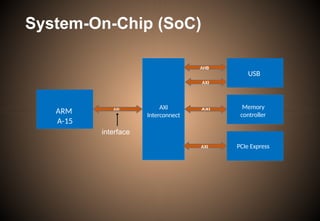
System-On-Chip (SoC)
ARM
A-15
AXI
Interconnect
USB
Memory
controller
PCIe Express
AXI
AHB
AXI
AXI
interface
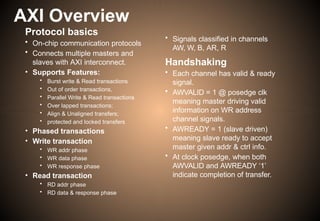
AXI Overview
Protocol basics
• On-chip communication protocols
• Connects multiple masters and
slaves with AXI interconnect.
• Supports Features:
• Burst write & Read transactions
• Out of order transactions,
• Parallel Write & Read transactions
• Over lapped transactions;
• Align & Unaligned transfers;
• protected and locked transfers
• Phased transactions
• Write transaction
• WR addr phase
• WR data phase
• WR response phase
• Read transaction
• RD addr phase
• RD data & response phase
• Signals classified in channels
AW, W, B, AR, R
Handshaking
• Each channel has valid & ready
signal.
• AWVALID = 1 @ posedge clk
meaning master driving valid
information on WR address
channel signals.
• AWREADY = 1 (slave driven)
meaning slave ready to accept
master given addr & ctrl info.
• At clock posedge, when both
AWVALID and AWREADY ‘1’
indicate completion of transfer.
Topics
• Overview of AXI
• AXI Architecture and Features
• Channel definitions and Signals
• Handshaking process
• Basic AXI transactions
• Types of Access (Atomic Access)
• Ordering Model (Transaction ID tags)
• AXI4 & AXI4 Lite
Architecture
Terminology
• AXI : Advanced eXtensible Interface (Interface divided into 5 channels)
• Protocol : Set of rules.
• Channel : Physical transmission medium (wires) to carry signals.
• Signal : It’s an electric current or electromagnetic field that carries
information from one place (source) to another (destination).
• Master : Initiates transactions.
• Slave : receives and responds to transactions.
• Interface : A point where two blocks meet and interact.
• Interconnect : a device that allows to connect multiple masters and
multiple slaves.
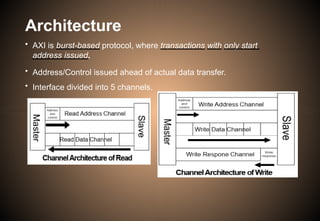
Architecture
• AXI is burst-based protocol, where transactions with only start
address issued.
• Address/Control issued ahead of actual data transfer.
• Interface divided into 5 channels.
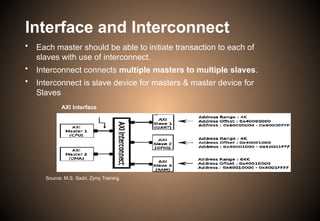
Interface and Interconnect
• Each master should be able to initiate transaction to each of
slaves with use of interconnect.
• Interconnect connects multiple masters to multiple slaves.
• Interconnect is slave device for masters & master device for
Slaves
AXI Interface
Source: M.S. Sadri, Zynq Training
Features
Terminology
• Transaction : Multiple transfers of data or an entire burst of transfers.
• Transfer : A single exchange of information, with one valid and ready
handshake.
• Beat : An individual data transfer within an AXI burst.
• Burst : A transaction where multiple data items are transferred based
upon a single address.
• Aligned : Each data transfer is aligned to the size of the transfer. E.g.: 32-
bit transfer aligned to 4-byte boundaries (0, 4, 8, C).
• Unaligned : A data access performed to an address which is not aligned to the
size of the access. E.g.: A 32-bit data packet that starts at a byte address of
0x1002 is not aligned to the natural 32-bit address boundary.
• Multiple outstanding addresses : Master able to provide transaction
addresses without waiting for earlier transactions to complete.
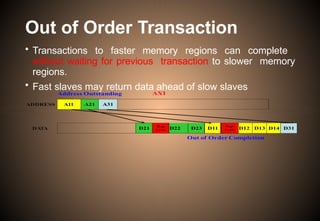
• Out of order transaction : Transactions to faster memory regions can
complete without waiting for last transaction to slower memory regions
• Data Interleaving : Masters producing write data sequence to same slave but
data not arriving each clock, interleave to avoid idle cycles on bus.
Features
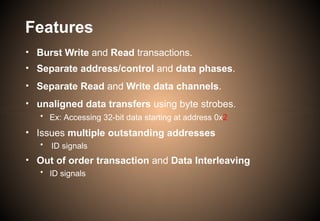
• Burst Write and Read transactions.
• Separate address/control and data phases.
• Separate Read and Write data channels.
• unaligned data transfers using byte strobes.
• Ex: Accessing 32-bit data starting at address 0x2
• Issues multiple outstanding addresses
• ID signals
• Out of order transaction and Data Interleaving
• ID signals
Topics
• Overview of AXI
• AXI Architecture and Features
• Channel Definitions and Signals
• Handshaking Process
• Basic AXI Transactions
• Types of Access (Atomic Access)
• Ordering Model (Transaction ID tags)
• AXI4 & AXI4 Lite
Channel Definitions
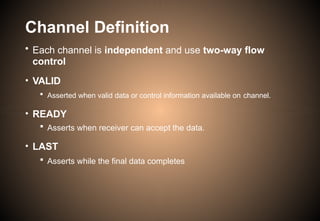
Channel Definition
• Each channel is independent and use two-way flow
control
• VALID
 Asserted when valid data or control information available on channel.
• READY
 Asserts when receiver can accept the data.
• LAST
 Asserts while the final data completes
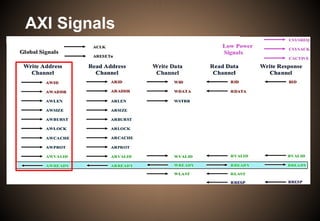
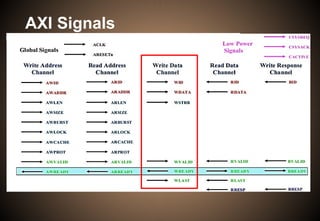
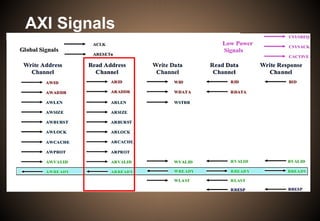
AXI Signals
AXI Signals
Source:
ARM
AMBA
AXI
Protocol
v1.0:
Specification
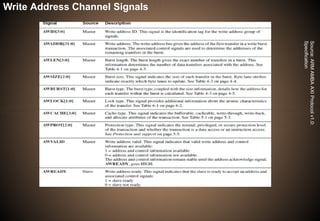
Write Address Channel Signals
AXI Signals
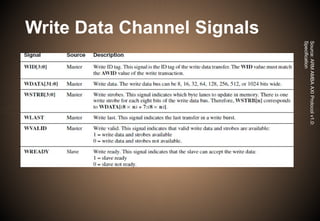
Write Data Channel Signals
Source:
ARM
AMBA
AXI
Protocol
v1.0:
Specification
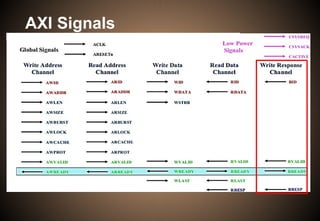
AXI Signals
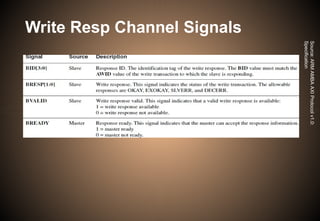
Write Resp Channel Signals
Source:
ARM
AMBA
AXI
Protocol
v1.0:
Specification
AXI Signals
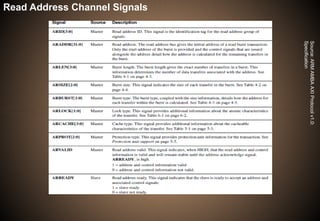
Read Address Channel Signals
Source:
ARM
AMBA
AXI
Protocol
v1.0:
Specification
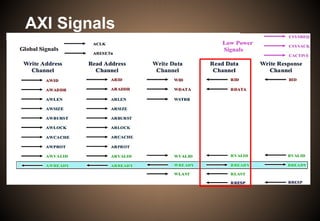
AXI Signals
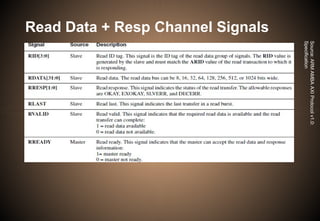
Read Data + Resp Channel Signals
Source:
ARM
AMBA
AXI
Protocol
v1.0:
Specification
Topics
• Overview of AXI
• AXI Architecture and Features
• Channel Definitions and Signals
• Handshaking Process
• Basic AXI Transactions
• Types of Access (Atomic Access)
• Ordering Model (Transaction ID tags)
• AXI4 & AXI4 Lite
Handshaking Process
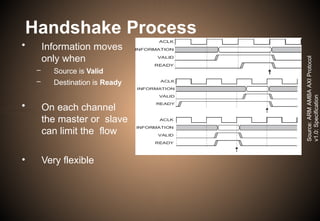
Handshake Process
Source:
ARM
AMBA
AXI
Protocol
v1.0:
Specification
• Information moves
only when
– Source is Valid
– Destination is Ready
• On each channel
the master or slave
can limit the flow
• Very flexible
Write channel handshaking
• Master provides awvalid to show
information valid on write addr channel.
• Slave gives awready indicating
address information accepted.
• Master provides wvalid to say
information is valid in write data
channel.
• Slave gives wready indicating write
data information accepted.
• BVALID from slave shows valid
information on write response channel
• Master gives BREADY indicating write
response information accepted.
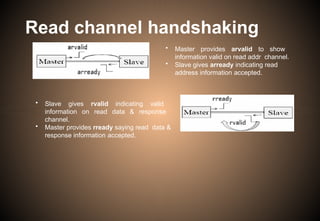
Read channel handshaking
• Master provides arvalid to show
information valid on read addr channel.
• Slave gives arready indicating read
address information accepted.
• Slave gives rvalid indicating valid
information on read data & response
channel.
• Master provides rready saying read data &
response information accepted.
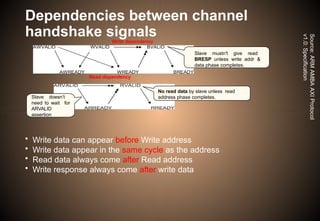
Dependencies between channel
handshake signals
• Write data can appear before Write address
• Write data appear in the same cycle as the address
• Read data always come after Read address
• Write response always come after write data
Write dependency
Slave mustn't give read
BRESP unless write addr &
data phase completes.
Read dependency
No read data by slave unless read
address phase completes.
Slave doesn’t
need to wait for
ARVALID
assertion
Source:
ARM
AMBA
AXI
Protocol
v1.0:
Specification
Topics
• Overview of AXI
• AXI Architecture and Features
• Channel Definitions and Signals
• Handshaking Process
• Basic AXI Transactions
• Types of Access (Atomic Accesses)
• Ordering Model (Transaction ID tags)
• AXI4 & AXI4 Lite
AXI Transactions
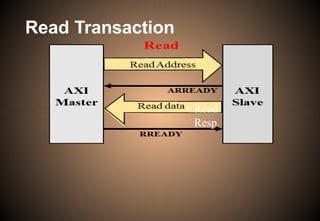
Read Transaction
+ Read
Resp
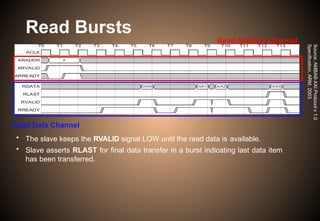
Read Bursts
Source:
AMBA®
AXI
Protocol
v
1.0
Specification,
ARM,
2003.
Read Address Channel
Read Data Channel
• The slave keeps the RVALID signal LOW until the read data is available.
• Slave asserts RLAST for final data transfer in a burst indicating last data item
has been transferred.
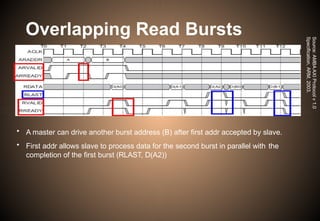
Overlapping Read Bursts
Source:
AMBA
AXI
Protocol
v
1.0
Specification,
ARM,
2003.
• A master can drive another burst address (B) after first addr accepted by slave.
• First addr allows slave to process data for the second burst in parallel with the
completion of the first burst (RLAST, D(A2))
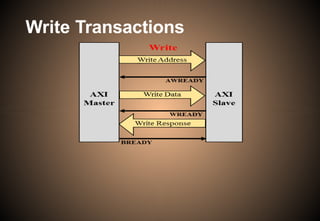
Write Transactions
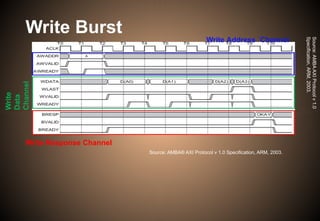
Write Burst
Source: AMBA® AXI Protocol v 1.0 Specification, ARM, 2003.
Write Address `Channel
Write Response Channel
Write
Data
Channel
Source:
AMBA
AXI
Protocol
v
1.0
Specification,
ARM,
2003.
Addressing Options
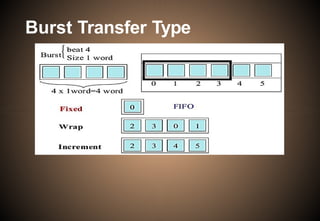
Burst Operation[5]
Burst length
1 beat
2 beats
16 beats
Undefined
length
4 beats
8 beats
SIZE
Word
halfword
…
…
Burst
Transfer
………
………
Burst Transfer Type
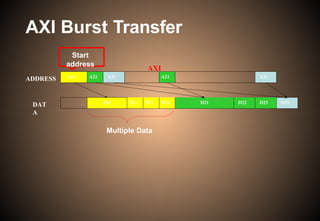
AXI Burst Transfer
D11 D12 D13 D14 D21 D22 D23 D31
ADDRESS
DAT
A
AXI
A11 A21 A31 A21 A31
Start
address
Multiple Data
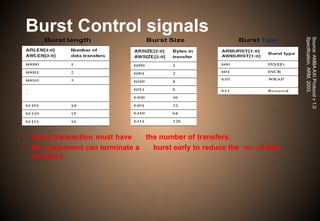
Burst Control signals
• Every transaction must have the number of transfers.
• No component can terminate a burst early to reduce the no. of data
transfers.
Source:
AMBA
AXI
Protocol
v
1.0
Specification,
ARM,
2003.
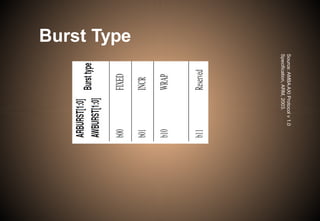
Burst Type
Source:
AMBA
AXI
Protocol
v
1.0
Specification,
ARM,
2003.
Address calculations
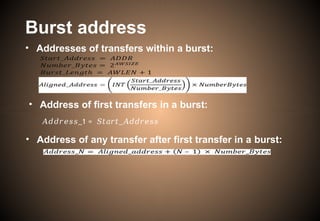
Burst address
• Addresses of transfers within a burst:
• Address of first transfers in a burst:
𝐴𝑑𝑑𝑟𝑒𝑠𝑠_1 = _
𝑆𝑡𝑎𝑟𝑡 𝐴𝑑𝑑𝑟𝑒𝑠𝑠
• Address of any transfer after first transfer in a burst:
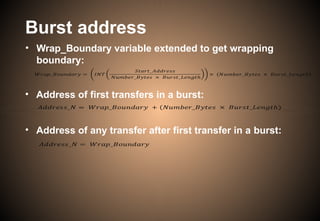
Burst address
• Wrap_Boundary variable extended to get wrapping
boundary:
• Address of first transfers in a burst:
• Address of any transfer after first transfer in a burst:
INCR
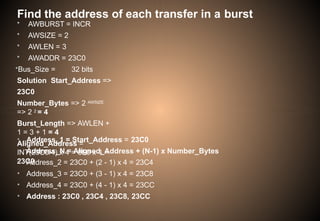
Find the address of each transfer in a burst
• AWBURST = INCR
• AWSIZE = 2
• AWLEN = 3
• AWADDR = 23C0
•Bus_Size = 32 bits
Solution Start_Address =>
23C0
Number_Bytes => 2 AWSIZE
=> 2 2 = 4
Burst_Length => AWLEN +
1 = 3 + 1 = 4
Aligned_Address =
INT(23C0/4) x 4 = 8F0 x 4 =
23C0
• Address_1 = Start_Address = 23C0
• Address_N = Aligned_Address + (N-1) x Number_Bytes
• Address_2 = 23C0 + (2 - 1) x 4 = 23C4
• Address_3 = 23C0 + (3 - 1) x 4 = 23C8
• Address_4 = 23C0 + (4 - 1) x 4 = 23CC
• Address : 23C0 , 23C4 , 23C8, 23CC
Fixed
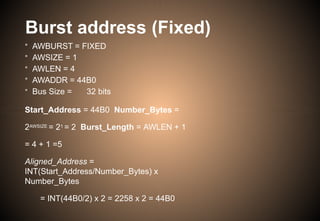
Burst address (Fixed)
• AWBURST = FIXED
• AWSIZE = 1
• AWLEN = 4
• AWADDR = 44B0
• Bus Size = 32 bits
Start_Address = 44B0 Number_Bytes =
2AWSIZE = 21 = 2 Burst_Length = AWLEN + 1
= 4 + 1 =5
Aligned_Address =
INT(Start_Address/Number_Bytes) x
Number_Bytes
= INT(44B0/2) x 2 = 2258 x 2 = 44B0
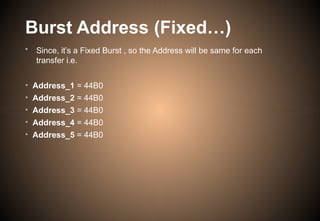
Burst Address (Fixed…)
• Since, it’s a Fixed Burst , so the Address will be same for each
transfer i.e.
• Address_1 = 44B0
• Address_2 = 44B0
• Address_3 = 44B0
• Address_4 = 44B0
• Address_5 = 44B0
Wrap
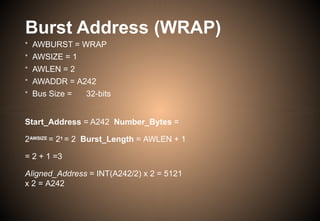
Burst Address (WRAP)
• AWBURST = WRAP
• AWSIZE = 1
• AWLEN = 2
• AWADDR = A242
• Bus Size = 32-bits
Start_Address = A242 Number_Bytes =
2AWSIZE = 21 = 2 Burst_Length = AWLEN + 1
= 2 + 1 =3
Aligned_Address = INT(A242/2) x 2 = 5121
x 2 = A242
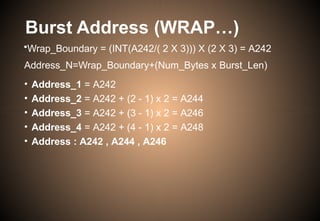
Burst Address (WRAP…)
•Wrap_Boundary = (INT(A242/( 2 X 3))) X (2 X 3) = A242
Address_N=Wrap_Boundary+(Num_Bytes x Burst_Len)
• Address_1 = A242
• Address_2 = A242 + (2 - 1) x 2 = A244
• Address_3 = A242 + (3 - 1) x 2 = A246
• Address_4 = A242 + (4 - 1) x 2 = A248
• Address : A242 , A244 , A246
Additional
Control Information
• Support for system level caches and other
performance enhancing components
• Bufferable (B) bit, ARCACHE[0] and AWCACHE[0]
• Cacheable (C) bit, ARCACHE[1] and AWCACHE[1]
• Read Allocate (RA) bit, ARCACHE[2] and AWCACHE[2]
• Write Allocate (WA) bit, ARCACHE[3] and AWCACHE[3]
Cache Support
• Cacheable Bit
• Write : a number of different writes can be merged
together.
• Read : a location can be pre-fetched or can be
fetched just once for multiple read transactions
• Read Allocate Bit
• If the transfer is a read and it misses in the cache
then it should be allocated
• Write Allocate Bit
• If the transfer is a write and it misses in the cache
then it should be allocated
Cache Support
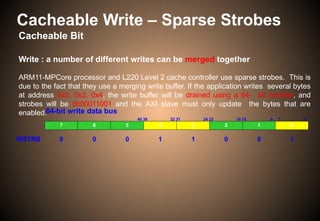
Cacheable Write – Sparse Strobes
64-bit write data bus
63 56 55 48 47
40 39 32 31 24 23 16 15
7 6 5 4 3 2 1 0
8 7 0
WSTRB 0 0 0 1 1 0 0 1
Cacheable Bit
Write : a number of different writes can be merged together
ARM11-MPCore processor and L220 Level 2 cache controller use sparse strobes. This is
due to the fact that they use a merging write buffer. If the application writes several bytes
at address 0x0, 0x3, 0x4, the write buffer will be drained using a 64- bit transfer, and
strobes will be 0b00011001 and the AXI slave must only update the bytes that are
enabled.
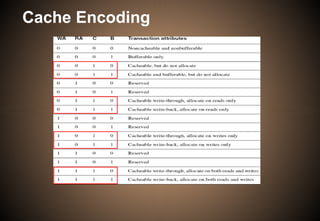
Cache Encoding
• To support complex system design, for the interconnect and
other devices in the system to provide protection against
illegal transactions
• Normal or privileged, ARPROT[0] andAWPROT[0]
• Low High
• Secure or non-secure, ARPROT[1] andAWPROT[1]
• Low High
• Data or instruction, ARPROT[2] andAWPROT[2]
• Low High
Protection Unit Support
Topics
• Overview of AXI
• AXI Architecture and Features
• Channel Definitions and Signals
• Handshaking Process
• Basic AXI Transactions
• Types of Access (Atomic Access)
• Ordering Model (Transaction ID tags)
• AXI4 & AXI4 Lite
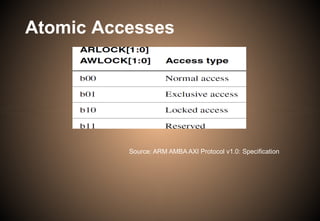
Atomic Access
Atomic Accesses
Source: ARM AMBA AXI Protocol v1.0: Specification
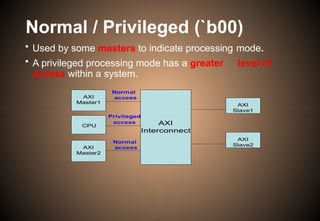
Normal / Privileged (`b00)
• Used by some masters to indicate processing mode.
• A privileged processing mode has a greater level of
access within a system.
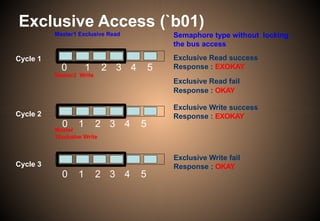
Exclusive Access (`b01)
0 1 2 3 4 5
Master2 Write
Cycle 1
Cycle 2
0 1 2 3 4 5
0 1 2 3 4 5
Cycle 3
Master1 Exclusive Read
Master
1Exclusive Write
Exclusive Write success
Response : EXOKAY
Exclusive Write fail
Response : OKAY
Semaphore type without locking
the bus access
Exclusive Read success
Response : EXOKAY
Exclusive Read fail
Response : OKAY
Locked Access
• Interconnect makes sure only one specific master is
allowed access to the slave region until an unlocked
transfer from the same master completes.
• Purpose of use for longer and undisturbed transfers
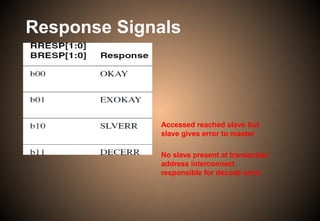
Response Signals
Accessed reached slave but
slave gives error to master
No slave present at transaction
address interconnect
responsible for decode error
Topics
• Overview of AXI
• AXI Architecture and Features
• Channel Definitions and Signals
• Handshaking Process
• Basic AXI Transactions
• Types of Access (Atomic Access)
• Ordering Model (Transaction ID tags)
• AXI4 & AXI4 Lite
Ordering Model
Ordering Model
• AXI protocol enables out-of-order transaction
completion and issuing of multiple outstanding
addresses.
• These features help maximize data throughput
and system efficiency.
• All transactions with same ID must be ordered,
but there is no restriction on the ordering of
transactions with different IDs.
Ordering Model [1]
• Multiple Outstanding Address
• Master is able to provide transaction addresses without waiting for
earlier transactions to complete.
• Write data Interleaving
• If two masters generate write data sequence to the same slave, but
write data doesn't arrive every clock cycle.
• Instead of waiting for a data sequence to complete before other
sequence starts, AXI system can interleave write data sequences
avoiding idle cycles on the bus.
[1] AMBA AXI Protocol v 1.0 Specification, ARM, 2003.
Read Ordering
• At master interface, read data from read
transactions with same ARID value must arrive in
same order in which master issued addresses.
• Data from read transactions with different
ARID values can return in any order and it is
also acceptable to interleave the read data of
transactions with different ARID fields.
Read Data Interleaving[5]
Normal Write Ordering
• If a slave does not support write data interleaving
the master must issue the data of write
transactions in the same order in which it issues
the transaction addresses.
• Write data does not support out-of-order
transactions but support data interleaving.
Write Data Interleaving[5]
• Write data interleaving enables a slave interface
to accept interleaved write data with different
AWID values.
Figure: Write data Interleaving
Out of Order Transaction
• Transactions to faster memory regions can complete
without waiting for previous transaction to slower memory
regions.
• Fast slaves may return data ahead of slow slaves
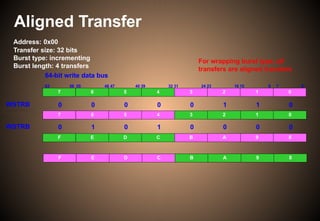
Aligned Transfer
40 39 32 31 24 23 16 15
7 6 5 4 3 2 1 0
8 7 0
7 6 5 4 3 2 1 0
F E D C B A 9 8
7 6 5 4 3 2 1 0
7 6 5 4 3 2 1 0
F E D C B A 9 8
Address: 0x00
Transfer size: 32 bits
Burst type: incrementing
Burst length: 4 transfers
WSTRB 0 0 0 0 0 1 1 0
WSTRB 0 1 0 1 0 0 0 0
For wrapping burst type, all
transfers are aligned transfers
64-bit write data bus
63 56 55 48 47
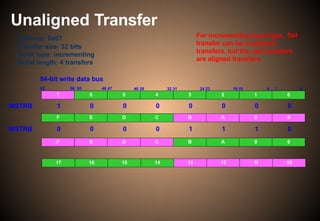
Unaligned Transfer
40 39 32 31 24 23 16 15
7 6 5 4 3 2 1 0
8 7 0
7 6 5 4 3 2 1 0
7 6 5 4 3 2 1 0
17 16 15 14 13 12 11 10
F E D C B A 9 8
F E D C B A 9 8
WSTRB 1 0 0 0 0 0 0 0
WSTRB 0 0 0 0 1 1 1 0
Address: 0x07
Transfer size: 32 bits
Burst type: incrementing
Burst length: 4 transfers
For incrementing burst type, fist
transfer can be unaligned
transfers, but the rest transfers
are aligned transfers
64-bit write data bus
63 56 55 48 47
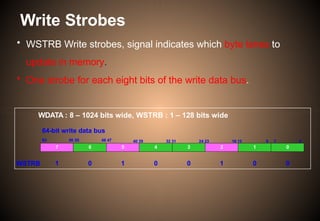
Write Strobes
40 39 32 31 24 23 16 15
7 6 5 4 3 2 1 0
8 7 0
64-bit write data bus
63 56 55 48 47
WSTRB 1 0 1 0 0 1 0 0
• WSTRB Write strobes, signal indicates which byte lanes to
update in memory.
• One strobe for each eight bits of the write data bus.
WDATA : 8 – 1024 bits wide, WSTRB : 1 – 128 bits wide
Topics
• Overview of AXI
• AXI Architecture and Features
• Channel Definitions and Signals
• Handshaking Process
• Basic AXI Transactions
• Types of Access (atomic accesses)
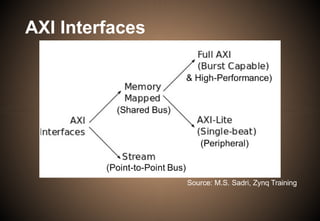
• Ordering Model (AXI ID transaction)
• AXI4 & AXI4 Lite
AXI4
Source: M.S. Sadri, Zynq Training
AXI Interfaces
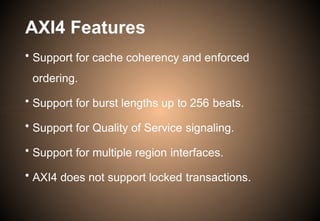
AXI4 Features
• Support for cache coherency and enforced
ordering.
• Support for burst lengths up to 256 beats.
• Support for Quality of Service signaling.
• Support for multiple region interfaces.
• AXI4 does not support locked transactions.
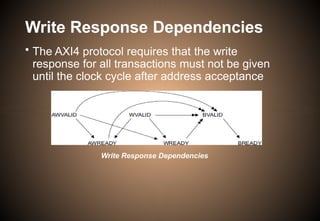
Write Response Dependencies
• The AXI4 protocol requires that the write
response for all transactions must not be given
until the clock cycle after address acceptance
Write Response Dependencies
AXI4-Lite
AXI4-Lite
Key functionality of AXI4-Lite operation.
• all transactions are of burst length of 1
• all data accesses use full width of the data bus
• Supports a data bus width of 32-bit or 64-bit.
• all accesses are Non-modifiable, Non-bufferable
• Exclusive accesses are not supported.
• EXOKAY response is not supported on the read
data and write response channels
• Length, Burst, Size related signals are not
supported.
• Bus Width can be 32/64 bit and supports strobe.
AXI4-Lite
• No support data interleaving, the burst length is
defined as 1.
• Does not support AXI IDs. Meaning, all transactions
must be in order, and all accesses use a single fixed ID
value.
• Supports multiple outstanding transactions, but a
slave can restrict this by the appropriate use of the
handshake signals.
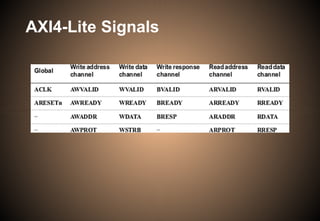
AXI4-Lite Signals
AXI4-Lite applications
• Simple, low-performance peripherals
• General Purpose Input Output (GPIO).
• It’s a port used to connect any peripheral based on
requirement where same port is used as input and output.
• Universal Asynchronous Receiver Transmitter
(UART Lite)
References
[1]
[2]
[3]
[4]
[5]
AMBA AXI Protocol v 1.0 Specification, ARM, 2003.
AMBA Specification, Rev 2.0, ARM, 1999.
AMBA 4 AXI4-Stream Protocol Version 1.0
http://infocenter.arm.com/help/topic/com.arm.doc.set.amba https://
www.slideshare.net/AzadMishra1/axi-protocol-55779579
Thank you

AXI Protocol amba axi architecture protocol

  • 1.
    ARM® AMBA® AXI AdvancedeXtensible Interface
  • 2.
    Topics • Overview ofAXI • AXI architecture and features • Channel definitions and signals • Handshaking process • Basic AXI transactions • Types of Access (Atomic Accesses) • Ordering model (Transaction ID tags) • AXI4 & AXI4 Lite
  • 3.
  • 4.
  • 5.
    AXI Overview Protocol basics •On-chip communication protocols • Connects multiple masters and slaves with AXI interconnect. • Supports Features: • Burst write & Read transactions • Out of order transactions, • Parallel Write & Read transactions • Over lapped transactions; • Align & Unaligned transfers; • protected and locked transfers • Phased transactions • Write transaction • WR addr phase • WR data phase • WR response phase • Read transaction • RD addr phase • RD data & response phase • Signals classified in channels AW, W, B, AR, R Handshaking • Each channel has valid & ready signal. • AWVALID = 1 @ posedge clk meaning master driving valid information on WR address channel signals. • AWREADY = 1 (slave driven) meaning slave ready to accept master given addr & ctrl info. • At clock posedge, when both AWVALID and AWREADY ‘1’ indicate completion of transfer.
  • 6.
    Topics • Overview ofAXI • AXI Architecture and Features • Channel definitions and Signals • Handshaking process • Basic AXI transactions • Types of Access (Atomic Access) • Ordering Model (Transaction ID tags) • AXI4 & AXI4 Lite
  • 7.
  • 8.
    Terminology • AXI :Advanced eXtensible Interface (Interface divided into 5 channels) • Protocol : Set of rules. • Channel : Physical transmission medium (wires) to carry signals. • Signal : It’s an electric current or electromagnetic field that carries information from one place (source) to another (destination). • Master : Initiates transactions. • Slave : receives and responds to transactions. • Interface : A point where two blocks meet and interact. • Interconnect : a device that allows to connect multiple masters and multiple slaves.
  • 9.
    Architecture • AXI isburst-based protocol, where transactions with only start address issued. • Address/Control issued ahead of actual data transfer. • Interface divided into 5 channels.
  • 10.
    Interface and Interconnect •Each master should be able to initiate transaction to each of slaves with use of interconnect. • Interconnect connects multiple masters to multiple slaves. • Interconnect is slave device for masters & master device for Slaves AXI Interface Source: M.S. Sadri, Zynq Training
  • 11.
  • 12.
    Terminology • Transaction :Multiple transfers of data or an entire burst of transfers. • Transfer : A single exchange of information, with one valid and ready handshake. • Beat : An individual data transfer within an AXI burst. • Burst : A transaction where multiple data items are transferred based upon a single address. • Aligned : Each data transfer is aligned to the size of the transfer. E.g.: 32- bit transfer aligned to 4-byte boundaries (0, 4, 8, C). • Unaligned : A data access performed to an address which is not aligned to the size of the access. E.g.: A 32-bit data packet that starts at a byte address of 0x1002 is not aligned to the natural 32-bit address boundary. • Multiple outstanding addresses : Master able to provide transaction addresses without waiting for earlier transactions to complete. • Out of order transaction : Transactions to faster memory regions can complete without waiting for last transaction to slower memory regions • Data Interleaving : Masters producing write data sequence to same slave but data not arriving each clock, interleave to avoid idle cycles on bus.
  • 13.
    Features • Burst Writeand Read transactions. • Separate address/control and data phases. • Separate Read and Write data channels. • unaligned data transfers using byte strobes. • Ex: Accessing 32-bit data starting at address 0x2 • Issues multiple outstanding addresses • ID signals • Out of order transaction and Data Interleaving • ID signals
  • 14.
    Topics • Overview ofAXI • AXI Architecture and Features • Channel Definitions and Signals • Handshaking Process • Basic AXI Transactions • Types of Access (Atomic Access) • Ordering Model (Transaction ID tags) • AXI4 & AXI4 Lite
  • 15.
  • 16.
    Channel Definition • Eachchannel is independent and use two-way flow control • VALID  Asserted when valid data or control information available on channel. • READY  Asserts when receiver can accept the data. • LAST  Asserts while the final data completes
  • 17.
  • 18.
  • 19.
  • 20.
  • 21.
    Write Data ChannelSignals Source: ARM AMBA AXI Protocol v1.0: Specification
  • 22.
  • 23.
    Write Resp ChannelSignals Source: ARM AMBA AXI Protocol v1.0: Specification
  • 24.
  • 25.
    Read Address ChannelSignals Source: ARM AMBA AXI Protocol v1.0: Specification
  • 26.
  • 27.
    Read Data +Resp Channel Signals Source: ARM AMBA AXI Protocol v1.0: Specification
  • 28.
    Topics • Overview ofAXI • AXI Architecture and Features • Channel Definitions and Signals • Handshaking Process • Basic AXI Transactions • Types of Access (Atomic Access) • Ordering Model (Transaction ID tags) • AXI4 & AXI4 Lite
  • 29.
  • 30.
    Handshake Process Source: ARM AMBA AXI Protocol v1.0: Specification • Informationmoves only when – Source is Valid – Destination is Ready • On each channel the master or slave can limit the flow • Very flexible
  • 31.
    Write channel handshaking •Master provides awvalid to show information valid on write addr channel. • Slave gives awready indicating address information accepted. • Master provides wvalid to say information is valid in write data channel. • Slave gives wready indicating write data information accepted. • BVALID from slave shows valid information on write response channel • Master gives BREADY indicating write response information accepted.
  • 32.
    Read channel handshaking •Master provides arvalid to show information valid on read addr channel. • Slave gives arready indicating read address information accepted. • Slave gives rvalid indicating valid information on read data & response channel. • Master provides rready saying read data & response information accepted.
  • 33.
    Dependencies between channel handshakesignals • Write data can appear before Write address • Write data appear in the same cycle as the address • Read data always come after Read address • Write response always come after write data Write dependency Slave mustn't give read BRESP unless write addr & data phase completes. Read dependency No read data by slave unless read address phase completes. Slave doesn’t need to wait for ARVALID assertion Source: ARM AMBA AXI Protocol v1.0: Specification
  • 34.
    Topics • Overview ofAXI • AXI Architecture and Features • Channel Definitions and Signals • Handshaking Process • Basic AXI Transactions • Types of Access (Atomic Accesses) • Ordering Model (Transaction ID tags) • AXI4 & AXI4 Lite
  • 35.
  • 36.
  • 37.
    Read Bursts Source: AMBA® AXI Protocol v 1.0 Specification, ARM, 2003. Read AddressChannel Read Data Channel • The slave keeps the RVALID signal LOW until the read data is available. • Slave asserts RLAST for final data transfer in a burst indicating last data item has been transferred.
  • 38.
    Overlapping Read Bursts Source: AMBA AXI Protocol v 1.0 Specification, ARM, 2003. •A master can drive another burst address (B) after first addr accepted by slave. • First addr allows slave to process data for the second burst in parallel with the completion of the first burst (RLAST, D(A2))
  • 39.
  • 40.
    Write Burst Source: AMBA®AXI Protocol v 1.0 Specification, ARM, 2003. Write Address `Channel Write Response Channel Write Data Channel Source: AMBA AXI Protocol v 1.0 Specification, ARM, 2003.
  • 41.
  • 42.
    Burst Operation[5] Burst length 1beat 2 beats 16 beats Undefined length 4 beats 8 beats SIZE Word halfword … … Burst Transfer ……… ………
  • 43.
  • 44.
    AXI Burst Transfer D11D12 D13 D14 D21 D22 D23 D31 ADDRESS DAT A AXI A11 A21 A31 A21 A31 Start address Multiple Data
  • 45.
    Burst Control signals •Every transaction must have the number of transfers. • No component can terminate a burst early to reduce the no. of data transfers. Source: AMBA AXI Protocol v 1.0 Specification, ARM, 2003.
  • 46.
  • 47.
  • 48.
    Burst address • Addressesof transfers within a burst: • Address of first transfers in a burst: 𝐴𝑑𝑑𝑟𝑒𝑠𝑠_1 = _ 𝑆𝑡𝑎𝑟𝑡 𝐴𝑑𝑑𝑟𝑒𝑠𝑠 • Address of any transfer after first transfer in a burst:
  • 49.
    Burst address • Wrap_Boundaryvariable extended to get wrapping boundary: • Address of first transfers in a burst: • Address of any transfer after first transfer in a burst:
  • 50.
  • 51.
    Find the addressof each transfer in a burst • AWBURST = INCR • AWSIZE = 2 • AWLEN = 3 • AWADDR = 23C0 •Bus_Size = 32 bits Solution Start_Address => 23C0 Number_Bytes => 2 AWSIZE => 2 2 = 4 Burst_Length => AWLEN + 1 = 3 + 1 = 4 Aligned_Address = INT(23C0/4) x 4 = 8F0 x 4 = 23C0 • Address_1 = Start_Address = 23C0 • Address_N = Aligned_Address + (N-1) x Number_Bytes • Address_2 = 23C0 + (2 - 1) x 4 = 23C4 • Address_3 = 23C0 + (3 - 1) x 4 = 23C8 • Address_4 = 23C0 + (4 - 1) x 4 = 23CC • Address : 23C0 , 23C4 , 23C8, 23CC
  • 52.
  • 53.
    Burst address (Fixed) •AWBURST = FIXED • AWSIZE = 1 • AWLEN = 4 • AWADDR = 44B0 • Bus Size = 32 bits Start_Address = 44B0 Number_Bytes = 2AWSIZE = 21 = 2 Burst_Length = AWLEN + 1 = 4 + 1 =5 Aligned_Address = INT(Start_Address/Number_Bytes) x Number_Bytes = INT(44B0/2) x 2 = 2258 x 2 = 44B0
  • 54.
    Burst Address (Fixed…) •Since, it’s a Fixed Burst , so the Address will be same for each transfer i.e. • Address_1 = 44B0 • Address_2 = 44B0 • Address_3 = 44B0 • Address_4 = 44B0 • Address_5 = 44B0
  • 55.
  • 56.
    Burst Address (WRAP) •AWBURST = WRAP • AWSIZE = 1 • AWLEN = 2 • AWADDR = A242 • Bus Size = 32-bits Start_Address = A242 Number_Bytes = 2AWSIZE = 21 = 2 Burst_Length = AWLEN + 1 = 2 + 1 =3 Aligned_Address = INT(A242/2) x 2 = 5121 x 2 = A242
  • 57.
    Burst Address (WRAP…) •Wrap_Boundary= (INT(A242/( 2 X 3))) X (2 X 3) = A242 Address_N=Wrap_Boundary+(Num_Bytes x Burst_Len) • Address_1 = A242 • Address_2 = A242 + (2 - 1) x 2 = A244 • Address_3 = A242 + (3 - 1) x 2 = A246 • Address_4 = A242 + (4 - 1) x 2 = A248 • Address : A242 , A244 , A246
  • 58.
  • 59.
    • Support forsystem level caches and other performance enhancing components • Bufferable (B) bit, ARCACHE[0] and AWCACHE[0] • Cacheable (C) bit, ARCACHE[1] and AWCACHE[1] • Read Allocate (RA) bit, ARCACHE[2] and AWCACHE[2] • Write Allocate (WA) bit, ARCACHE[3] and AWCACHE[3] Cache Support
  • 60.
    • Cacheable Bit •Write : a number of different writes can be merged together. • Read : a location can be pre-fetched or can be fetched just once for multiple read transactions • Read Allocate Bit • If the transfer is a read and it misses in the cache then it should be allocated • Write Allocate Bit • If the transfer is a write and it misses in the cache then it should be allocated Cache Support
  • 61.
    Cacheable Write –Sparse Strobes 64-bit write data bus 63 56 55 48 47 40 39 32 31 24 23 16 15 7 6 5 4 3 2 1 0 8 7 0 WSTRB 0 0 0 1 1 0 0 1 Cacheable Bit Write : a number of different writes can be merged together ARM11-MPCore processor and L220 Level 2 cache controller use sparse strobes. This is due to the fact that they use a merging write buffer. If the application writes several bytes at address 0x0, 0x3, 0x4, the write buffer will be drained using a 64- bit transfer, and strobes will be 0b00011001 and the AXI slave must only update the bytes that are enabled.
  • 62.
  • 63.
    • To supportcomplex system design, for the interconnect and other devices in the system to provide protection against illegal transactions • Normal or privileged, ARPROT[0] andAWPROT[0] • Low High • Secure or non-secure, ARPROT[1] andAWPROT[1] • Low High • Data or instruction, ARPROT[2] andAWPROT[2] • Low High Protection Unit Support
  • 64.
    Topics • Overview ofAXI • AXI Architecture and Features • Channel Definitions and Signals • Handshaking Process • Basic AXI Transactions • Types of Access (Atomic Access) • Ordering Model (Transaction ID tags) • AXI4 & AXI4 Lite
  • 65.
  • 66.
    Atomic Accesses Source: ARMAMBA AXI Protocol v1.0: Specification
  • 67.
    Normal / Privileged(`b00) • Used by some masters to indicate processing mode. • A privileged processing mode has a greater level of access within a system.
  • 68.
    Exclusive Access (`b01) 01 2 3 4 5 Master2 Write Cycle 1 Cycle 2 0 1 2 3 4 5 0 1 2 3 4 5 Cycle 3 Master1 Exclusive Read Master 1Exclusive Write Exclusive Write success Response : EXOKAY Exclusive Write fail Response : OKAY Semaphore type without locking the bus access Exclusive Read success Response : EXOKAY Exclusive Read fail Response : OKAY
  • 69.
    Locked Access • Interconnectmakes sure only one specific master is allowed access to the slave region until an unlocked transfer from the same master completes. • Purpose of use for longer and undisturbed transfers
  • 70.
    Response Signals Accessed reachedslave but slave gives error to master No slave present at transaction address interconnect responsible for decode error
  • 71.
    Topics • Overview ofAXI • AXI Architecture and Features • Channel Definitions and Signals • Handshaking Process • Basic AXI Transactions • Types of Access (Atomic Access) • Ordering Model (Transaction ID tags) • AXI4 & AXI4 Lite
  • 72.
  • 73.
    Ordering Model • AXIprotocol enables out-of-order transaction completion and issuing of multiple outstanding addresses. • These features help maximize data throughput and system efficiency. • All transactions with same ID must be ordered, but there is no restriction on the ordering of transactions with different IDs.
  • 74.
    Ordering Model [1] •Multiple Outstanding Address • Master is able to provide transaction addresses without waiting for earlier transactions to complete. • Write data Interleaving • If two masters generate write data sequence to the same slave, but write data doesn't arrive every clock cycle. • Instead of waiting for a data sequence to complete before other sequence starts, AXI system can interleave write data sequences avoiding idle cycles on the bus. [1] AMBA AXI Protocol v 1.0 Specification, ARM, 2003.
  • 75.
    Read Ordering • Atmaster interface, read data from read transactions with same ARID value must arrive in same order in which master issued addresses. • Data from read transactions with different ARID values can return in any order and it is also acceptable to interleave the read data of transactions with different ARID fields.
  • 76.
  • 77.
    Normal Write Ordering •If a slave does not support write data interleaving the master must issue the data of write transactions in the same order in which it issues the transaction addresses. • Write data does not support out-of-order transactions but support data interleaving.
  • 78.
    Write Data Interleaving[5] •Write data interleaving enables a slave interface to accept interleaved write data with different AWID values. Figure: Write data Interleaving
  • 79.
    Out of OrderTransaction • Transactions to faster memory regions can complete without waiting for previous transaction to slower memory regions. • Fast slaves may return data ahead of slow slaves
  • 80.
    Aligned Transfer 40 3932 31 24 23 16 15 7 6 5 4 3 2 1 0 8 7 0 7 6 5 4 3 2 1 0 F E D C B A 9 8 7 6 5 4 3 2 1 0 7 6 5 4 3 2 1 0 F E D C B A 9 8 Address: 0x00 Transfer size: 32 bits Burst type: incrementing Burst length: 4 transfers WSTRB 0 0 0 0 0 1 1 0 WSTRB 0 1 0 1 0 0 0 0 For wrapping burst type, all transfers are aligned transfers 64-bit write data bus 63 56 55 48 47
  • 81.
    Unaligned Transfer 40 3932 31 24 23 16 15 7 6 5 4 3 2 1 0 8 7 0 7 6 5 4 3 2 1 0 7 6 5 4 3 2 1 0 17 16 15 14 13 12 11 10 F E D C B A 9 8 F E D C B A 9 8 WSTRB 1 0 0 0 0 0 0 0 WSTRB 0 0 0 0 1 1 1 0 Address: 0x07 Transfer size: 32 bits Burst type: incrementing Burst length: 4 transfers For incrementing burst type, fist transfer can be unaligned transfers, but the rest transfers are aligned transfers 64-bit write data bus 63 56 55 48 47
  • 82.
    Write Strobes 40 3932 31 24 23 16 15 7 6 5 4 3 2 1 0 8 7 0 64-bit write data bus 63 56 55 48 47 WSTRB 1 0 1 0 0 1 0 0 • WSTRB Write strobes, signal indicates which byte lanes to update in memory. • One strobe for each eight bits of the write data bus. WDATA : 8 – 1024 bits wide, WSTRB : 1 – 128 bits wide
  • 83.
    Topics • Overview ofAXI • AXI Architecture and Features • Channel Definitions and Signals • Handshaking Process • Basic AXI Transactions • Types of Access (atomic accesses) • Ordering Model (AXI ID transaction) • AXI4 & AXI4 Lite
  • 84.
  • 85.
    Source: M.S. Sadri,Zynq Training AXI Interfaces
  • 86.
    AXI4 Features • Supportfor cache coherency and enforced ordering. • Support for burst lengths up to 256 beats. • Support for Quality of Service signaling. • Support for multiple region interfaces. • AXI4 does not support locked transactions.
  • 87.
    Write Response Dependencies •The AXI4 protocol requires that the write response for all transactions must not be given until the clock cycle after address acceptance Write Response Dependencies
  • 88.
  • 89.
    AXI4-Lite Key functionality ofAXI4-Lite operation. • all transactions are of burst length of 1 • all data accesses use full width of the data bus • Supports a data bus width of 32-bit or 64-bit. • all accesses are Non-modifiable, Non-bufferable • Exclusive accesses are not supported. • EXOKAY response is not supported on the read data and write response channels • Length, Burst, Size related signals are not supported. • Bus Width can be 32/64 bit and supports strobe.
  • 90.
    AXI4-Lite • No supportdata interleaving, the burst length is defined as 1. • Does not support AXI IDs. Meaning, all transactions must be in order, and all accesses use a single fixed ID value. • Supports multiple outstanding transactions, but a slave can restrict this by the appropriate use of the handshake signals.
  • 91.
  • 92.
    AXI4-Lite applications • Simple,low-performance peripherals • General Purpose Input Output (GPIO). • It’s a port used to connect any peripheral based on requirement where same port is used as input and output. • Universal Asynchronous Receiver Transmitter (UART Lite)
  • 93.
    References [1] [2] [3] [4] [5] AMBA AXI Protocolv 1.0 Specification, ARM, 2003. AMBA Specification, Rev 2.0, ARM, 1999. AMBA 4 AXI4-Stream Protocol Version 1.0 http://infocenter.arm.com/help/topic/com.arm.doc.set.amba https:// www.slideshare.net/AzadMishra1/axi-protocol-55779579
  • 94.