PROSOCIAL
BEHAVIOR
 What is Pro Social Behavior?
 voluntary behavior intended to benefit another,
consists of actions which benefit other people
or society as a whole, such as helping, sharing,
donating, co-operating, and volunteering
 It is central to the well-being of social groups
across a range of scales
 empathy is also the most important factor
leading to pro social behavior
 Attention to prosocial behavior in psychology
originated with McDougall (1908), who argued
that prosocial
 behavior is the result of “tender emotions”
created by the parental instinct, but
 most current research has its roots in lay and
scientific reactions to the nonresponsive
bystanders in the brutal murder of Katherine
“Kitty” Genovese in 1964.
Bystander effect?
 The term bystander effect refers to the
phenomenon in which the greater the number
of people present, the less likely people are to
help a person in distress. When an emergency
situation occurs, observers are more likely to
take action if there are few or no other
witnesses
 It has now evolved to encompass a broad
range of biological, motivational, cognitive, and
social processes
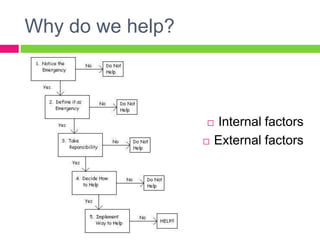
Why do we help?
 Internal factors
 External factors
Theories on Prosocial Behavior
1. Empathy-Altruism
actions may be motivated by empathy –
capacity to recognize emotions that are being
experienced by another sentient or fictional
being
Altruism: Behavior that reflects an unselfish
concern for the welfare of others
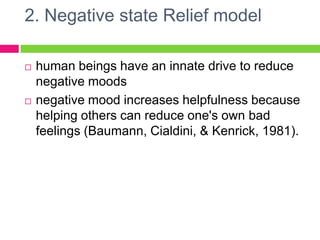
2. Negative state Relief model
 human beings have an innate drive to reduce
negative moods
 negative mood increases helpfulness because
helping others can reduce one's own bad
feelings (Baumann, Cialdini, & Kenrick, 1981).
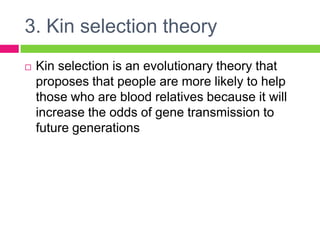
3. Kin selection theory
 Kin selection is an evolutionary theory that
proposes that people are more likely to help
those who are blood relatives because it will
increase the odds of gene transmission to
future generations
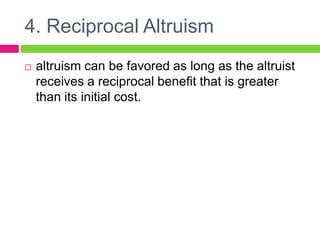
4. Reciprocal Altruism
 altruism can be favored as long as the altruist
receives a reciprocal benefit that is greater
than its initial cost.
Volunteering
 Have you ever volunteered before?
 Biological benefits of Volunteering (Video)
 happiness and health have consistently
found a strong connection through
volunteering
 a conscious focus on gratitude led to
reductions in negative affect and increases
in optimistic appraisals, positive affect,
offering emotional support, sleep quality,
and well-being
 Happier people are also naturally kinder
 http://www.youtube.com/watch?v=YEyyVQga3
jM
 Thank you

Prosocial behavior ppt final

  • 1.
  • 2.
     What isPro Social Behavior?  voluntary behavior intended to benefit another, consists of actions which benefit other people or society as a whole, such as helping, sharing, donating, co-operating, and volunteering  It is central to the well-being of social groups across a range of scales  empathy is also the most important factor leading to pro social behavior
  • 3.
     Attention toprosocial behavior in psychology originated with McDougall (1908), who argued that prosocial  behavior is the result of “tender emotions” created by the parental instinct, but  most current research has its roots in lay and scientific reactions to the nonresponsive bystanders in the brutal murder of Katherine “Kitty” Genovese in 1964.
  • 4.
    Bystander effect?  Theterm bystander effect refers to the phenomenon in which the greater the number of people present, the less likely people are to help a person in distress. When an emergency situation occurs, observers are more likely to take action if there are few or no other witnesses
  • 5.
     It hasnow evolved to encompass a broad range of biological, motivational, cognitive, and social processes
  • 6.
    Why do wehelp?  Internal factors  External factors
  • 7.
    Theories on ProsocialBehavior 1. Empathy-Altruism actions may be motivated by empathy – capacity to recognize emotions that are being experienced by another sentient or fictional being Altruism: Behavior that reflects an unselfish concern for the welfare of others
  • 8.
    2. Negative stateRelief model  human beings have an innate drive to reduce negative moods  negative mood increases helpfulness because helping others can reduce one's own bad feelings (Baumann, Cialdini, & Kenrick, 1981).
  • 9.
    3. Kin selectiontheory  Kin selection is an evolutionary theory that proposes that people are more likely to help those who are blood relatives because it will increase the odds of gene transmission to future generations
  • 10.
    4. Reciprocal Altruism altruism can be favored as long as the altruist receives a reciprocal benefit that is greater than its initial cost.
  • 11.
    Volunteering  Have youever volunteered before?
  • 12.
     Biological benefitsof Volunteering (Video)  happiness and health have consistently found a strong connection through volunteering  a conscious focus on gratitude led to reductions in negative affect and increases in optimistic appraisals, positive affect, offering emotional support, sleep quality, and well-being  Happier people are also naturally kinder
  • 13.
  • 14.