- ASHISH BUDHWAR
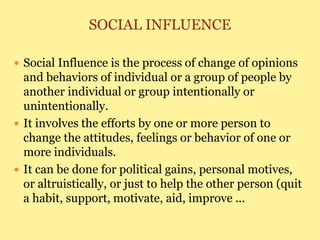
SOCIAL INFLUENCE
 Social Influence is the process of change of opinions
and behaviors of individual or a group of people by
another individual or group intentionally or
unintentionally.
 It involves the efforts by one or more person to
change the attitudes, feelings or behavior of one or
more individuals.
 It can be done for political gains, personal motives,
or altruistically, or just to help the other person (quit
a habit, support, motivate, aid, improve ...
PROCESSES IN SOCIAL PSYCHOLOGY
 The process of social influence, may include
processes but the main ones are:
1. Persuasion
2. Conformity
3. Compliance
4. Obedience
PERSUASION
 Persuasion is the process by which a message
induces change in beliefs, attitudes, or behaviors.
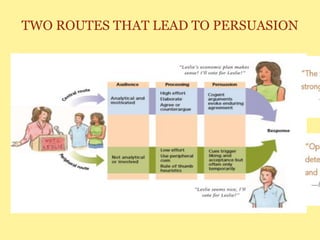
 Two route approach that leads to persuasion:
1. Central Route- Occurs when interested people
focus on the arguments and respond with favorable
thoughts.
2. Peripheral Route- Occurs when people are
influenced by incidental cues, such as a speaker’s
attractiveness
TWO ROUTES THAT LEAD TO PERSUASION
IMPORTANT FACTORS IN PERSUASION
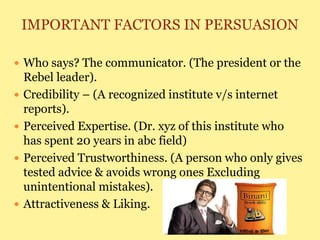
 Who says? The communicator. (The president or the
Rebel leader).
 Credibility – (A recognized institute v/s internet
reports).
 Perceived Expertise. (Dr. xyz of this institute who
has spent 20 years in abc field)
 Perceived Trustworthiness. (A person who only gives
tested advice & avoids wrong ones Excluding
unintentional mistakes).
 Attractiveness & Liking.
CONFORMITY
 A type of social influence in which individuals change their
attitudes or behavior or beliefs to match the behaviors of
the majority or to adhere to certain norms.
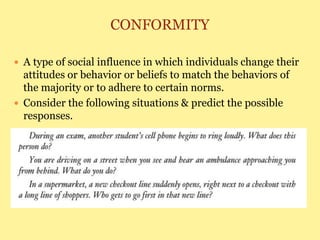
 Consider the following situations & predict the possible
responses.
CONFORMITY
 In all these situations and many similar ones, we can
predict ours as well as the behavior of the others
because of the pressure we experience to conform to
social norms.
 Conformity, in other words, refers to the pressure(s)
to behave in ways consistent with certain rules
indicating how we ought to behave. These rules are
known as social norms (can be explicit or implicit),
and they often exert powerful effects on our
behavior.
CONFORMITY
 The tendency to conform or to act according to the
expectations of the society or a group may seem to put
some restrictions on the personal freedom.
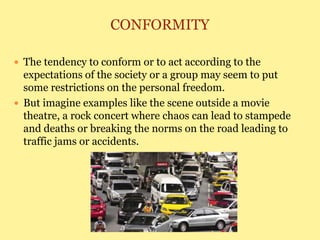
 But imagine examples like the scene outside a movie
theatre, a rock concert where chaos can lead to stampede
and deaths or breaking the norms on the road leading to
traffic jams or accidents.
WHY DO PEOPLE CONFORM?
 Although there can be many reasons for people to conform 2 main ones are
1. Informational Influence – The desire to be right : The behavior of others
provides us with useful information, so we observe them and act
accordingly and blend in easily. eg – hiring an auto in a new town. Also
when a task is ambiguous & we are not certain about our decisions, we
conform to group decisions. Sherif’s study on norm formation.
2. Normative Influence - The desire to be liked :The second reason for us to
conform to social rules that we desire for social approval. We want others
to like us and treat us well so we change our choices to match those of the
group. eg 3 people of a group decide to stay at a place the 4th will also
conform to the decision despite he may not like the place & can have
good access & comfortable stay on his own for the sake of the group
unity.
-Also we want to avoid being teased and made fun of. eg - we dress
accordingly to an event. We don’t go for interviews in pyjamas.
-Group Training in military services.
WHEN DO PEOPLE CONFORM?
 Sometimes the situations in which we are also define how much we
conform. 3 main factors in this are:
1. Group Size – Conformity increases as the size of the majority increases
(to a limit). eg- if majority of people in a group feel the weather to be
warm, the opinion of the person changes even if it is comparatively cold.
2. Group Unanimity – A person faces tremendous pressure to conform to
the group idea if it is unanimous. Even if one person doesn’t conform, the
opinion drops about ¼ & it does not even matter who the non-
conforming person is (may be the most unimportant person of the
group).
3. Our Commitment To The Group – Conformity is also affected by the
bonds between each individual & the group. Commitment refers to all the
forces +ve & -ve that act to keep an individual in a relation or a group.
Positive factors include liking other group members, believing that the
group accomplishes important goals, feeling that the group members
work well together, and expecting to gain from belonging to the group.
WHY DO PEOPLE NOT CONFORM?
 A replication of Zimbardo’s prsion
study by Reicher & Haslam showed
contradictory results.
 At first, the prisoners conformed to
the rules, but gradually they formed
cohesive bonds & rebelled against the
oppressive prison authority.
 Similar attempts of non-
conformation are visible in forms of
protests against senseless laws &
price hikes
POWER AS A SHIELD AGAINST CONFORMITY
 Power – the word alone brings images of people who are
truly in charge, politicians, heads, generals, big
corporations. Such people enjoy more freedom than the
common population when it comes to conformity to laws,
norms, rules.
 A reason is that powerful people are less dependent on
others in any way.
 Although we can have the freedom to conform or not-
conform to social norms & be confident in our skins but
consider the example for rules – who checks if Mr.
President wears or not his seatbelts while in a car?
MINORITY V/S MAJORITY
 Is it so that the majority always rule?
 By minority & majority I want to exclude the concept of caste or
religion, sadly, widely prevalent in our nation.
 Minority, in terms of the number of people possessing an idea &
how other people conform to that idea.
 A good example is of environmentalists, those who were seen as
weird radicals against development, now their ideas are considered
to grant industries permissions & regulate their existence.
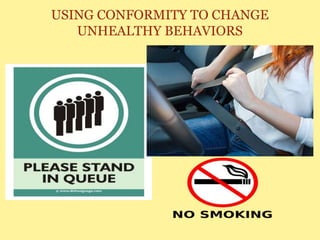
USING CONFORMITY TO CHANGE
UNHEALTHY BEHAVIORS
COMPLIANCE
 It is a type of social influence by which we do something we
are asked even if we primarily don’t want to do it. eg donating
at the traffic lights, sign up for a campaign, taking up a
advertising poster outside an exam centre, etc..
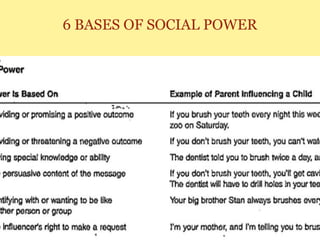
 There are 6 major basis of social power that are useful in
compliance. These are
1. Reward
2. Coercion
3. Expertise
4. Information
5. Referent Power
6. Legitimate Authority
6 BASES OF SOCIAL POWER
OTHER SOCIAL POWERS
 The Power of Helplessness- we are likely to comply
to helpless people, a foreign tourist asking for
directions, a vision impaired person crossing the
road, a person waiting for someone to help her lift a
heavy bag, a pregnant woman/elderly person
standing in a coach.
 Mood – If we want to convince someone we wait for
them to be in a good mood. eg – Waiting for parents
to be in a good mood to ask about your tour to Goa.
COMPLIANCE TECHNIQUES
1. Foot-in-the-door technique – once you convince people to agree to a
small request, they are more likely to comply for a bigger request.
2. Door-in-the-face technique – in this technique an unusually large
request is made then slowly the favor asked is decreased to a level that
the target feel comfortable to comply.
3. Low ball – making a reasonable request, then revealing the details that
increase the costs involved. The person involved is reluctant to back out
even if the ground rules are changed just because of the public
commitment he has made. This technique is deceptive. eg – fake job
advertisements we read in newspapers. Some rules have also made low-
balling illegal.
4. That’s not all – First, a large request is made then a discount or bonus is
offered which makes the request reasonable.
5. Pique – we sometimes turn down some requests without even
considering them this is called refusal script. For example we avoid eye
contact with panhandlers. The Pique technique aims at disrupting this
refusal script and get our attention. Some eg used by panhandlers are –
“can you spare me a quarter?” “can you spare Rs 10/-?”
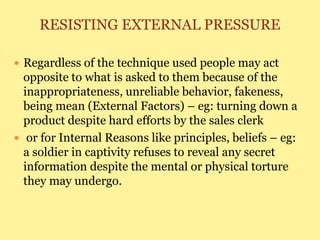
RESISTING EXTERNAL PRESSURE
 Regardless of the technique used people may act
opposite to what is asked to them because of the
inappropriateness, unreliable behavior, fakeness,
being mean (External Factors) – eg: turning down a
product despite hard efforts by the sales clerk
 or for Internal Reasons like principles, beliefs – eg:
a soldier in captivity refuses to reveal any secret
information despite the mental or physical torture
they may undergo.
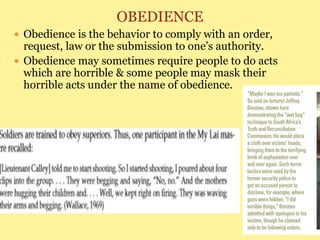
OBEDIENCE
 Obedience is the behavior to comply with an order,
request, law or the submission to one’s authority.
 Obedience may sometimes require people to do acts
which are horrible & some people may mask their
horrible acts under the name of obedience.
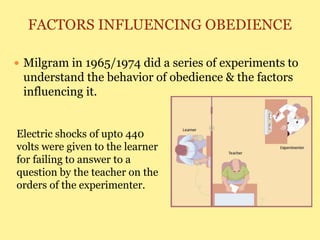
FACTORS INFLUENCING OBEDIENCE
 Milgram in 1965/1974 did a series of experiments to
understand the behavior of obedience & the factors
influencing it.
Electric shocks of upto 440
volts were given to the learner
for failing to answer to a
question by the teacher on the
orders of the experimenter.
FACTORS THAT BREED OBEDIENCE
 On the basis of his studies, Milgram concluded that following 3 factors
breed or increase obedience in people.
1. The distance of the victim
2. Closeness & legitimacy of the authority
3. Institutional Authority
 The distance of the victim – its was easy for the pilots to drop nuclear
bombs on innocent villages than to go and kill in person. Also arms like
artillery & armored find easy to shell a village than the infantry to go &
kill each individual.
The Nazi extermination camps were a solution to increase the distance
between executioners & the Jews to increase obedience & decrease stress
on soldiers.
Also executioners also distance the those being executed by putting a
mask on their face.
Hence more the distance from the victim, more is the obedience in
subject towards an order.
FACTORS THAT BREED OBEDIENCE
 Closeness & Legitimacy of the Authority – Milgrom in
his experiment dramatized a phone call & left the lab &
appointed a “clerk” in his authority, the obedience
dropped significantly, the teacher refused to continue
giving shocks on the orders of the clerk & when the
clerk decided to himself give the shock, the teacher,
resisted , plugged out the electric supply
Also the physical presence of the authority matters, the
obedience drops to 21% on orders given on a phone
call.
 Institutional Authority – The fact that the orders come
from a reputed institution or an authority backed by
such, also influences the subject to obey orders.
DESTRUCTIVE OBEDIENCE
 Why do people show destructive obedience, like the
extermination of 6 million Jews?
 Maybe some sadistic people enjoy hurting others,
another explanation for destructive obedience is that
obedience relieves the follower from personal
responsibility –
 “THEY WERE JUST FOLLOWING
ORDERS.”

Social influence

  • 1.
  • 2.
    SOCIAL INFLUENCE  SocialInfluence is the process of change of opinions and behaviors of individual or a group of people by another individual or group intentionally or unintentionally.  It involves the efforts by one or more person to change the attitudes, feelings or behavior of one or more individuals.  It can be done for political gains, personal motives, or altruistically, or just to help the other person (quit a habit, support, motivate, aid, improve ...
  • 3.
    PROCESSES IN SOCIALPSYCHOLOGY  The process of social influence, may include processes but the main ones are: 1. Persuasion 2. Conformity 3. Compliance 4. Obedience
  • 4.
    PERSUASION  Persuasion isthe process by which a message induces change in beliefs, attitudes, or behaviors.  Two route approach that leads to persuasion: 1. Central Route- Occurs when interested people focus on the arguments and respond with favorable thoughts. 2. Peripheral Route- Occurs when people are influenced by incidental cues, such as a speaker’s attractiveness
  • 5.
    TWO ROUTES THATLEAD TO PERSUASION
  • 6.
    IMPORTANT FACTORS INPERSUASION  Who says? The communicator. (The president or the Rebel leader).  Credibility – (A recognized institute v/s internet reports).  Perceived Expertise. (Dr. xyz of this institute who has spent 20 years in abc field)  Perceived Trustworthiness. (A person who only gives tested advice & avoids wrong ones Excluding unintentional mistakes).  Attractiveness & Liking.
  • 7.
    CONFORMITY  A typeof social influence in which individuals change their attitudes or behavior or beliefs to match the behaviors of the majority or to adhere to certain norms.  Consider the following situations & predict the possible responses.
  • 8.
    CONFORMITY  In allthese situations and many similar ones, we can predict ours as well as the behavior of the others because of the pressure we experience to conform to social norms.  Conformity, in other words, refers to the pressure(s) to behave in ways consistent with certain rules indicating how we ought to behave. These rules are known as social norms (can be explicit or implicit), and they often exert powerful effects on our behavior.
  • 9.
    CONFORMITY  The tendencyto conform or to act according to the expectations of the society or a group may seem to put some restrictions on the personal freedom.  But imagine examples like the scene outside a movie theatre, a rock concert where chaos can lead to stampede and deaths or breaking the norms on the road leading to traffic jams or accidents.
  • 10.
    WHY DO PEOPLECONFORM?  Although there can be many reasons for people to conform 2 main ones are 1. Informational Influence – The desire to be right : The behavior of others provides us with useful information, so we observe them and act accordingly and blend in easily. eg – hiring an auto in a new town. Also when a task is ambiguous & we are not certain about our decisions, we conform to group decisions. Sherif’s study on norm formation. 2. Normative Influence - The desire to be liked :The second reason for us to conform to social rules that we desire for social approval. We want others to like us and treat us well so we change our choices to match those of the group. eg 3 people of a group decide to stay at a place the 4th will also conform to the decision despite he may not like the place & can have good access & comfortable stay on his own for the sake of the group unity. -Also we want to avoid being teased and made fun of. eg - we dress accordingly to an event. We don’t go for interviews in pyjamas. -Group Training in military services.
  • 11.
    WHEN DO PEOPLECONFORM?  Sometimes the situations in which we are also define how much we conform. 3 main factors in this are: 1. Group Size – Conformity increases as the size of the majority increases (to a limit). eg- if majority of people in a group feel the weather to be warm, the opinion of the person changes even if it is comparatively cold. 2. Group Unanimity – A person faces tremendous pressure to conform to the group idea if it is unanimous. Even if one person doesn’t conform, the opinion drops about ¼ & it does not even matter who the non- conforming person is (may be the most unimportant person of the group). 3. Our Commitment To The Group – Conformity is also affected by the bonds between each individual & the group. Commitment refers to all the forces +ve & -ve that act to keep an individual in a relation or a group. Positive factors include liking other group members, believing that the group accomplishes important goals, feeling that the group members work well together, and expecting to gain from belonging to the group.
  • 12.
    WHY DO PEOPLENOT CONFORM?  A replication of Zimbardo’s prsion study by Reicher & Haslam showed contradictory results.  At first, the prisoners conformed to the rules, but gradually they formed cohesive bonds & rebelled against the oppressive prison authority.  Similar attempts of non- conformation are visible in forms of protests against senseless laws & price hikes
  • 13.
    POWER AS ASHIELD AGAINST CONFORMITY  Power – the word alone brings images of people who are truly in charge, politicians, heads, generals, big corporations. Such people enjoy more freedom than the common population when it comes to conformity to laws, norms, rules.  A reason is that powerful people are less dependent on others in any way.  Although we can have the freedom to conform or not- conform to social norms & be confident in our skins but consider the example for rules – who checks if Mr. President wears or not his seatbelts while in a car?
  • 14.
    MINORITY V/S MAJORITY Is it so that the majority always rule?  By minority & majority I want to exclude the concept of caste or religion, sadly, widely prevalent in our nation.  Minority, in terms of the number of people possessing an idea & how other people conform to that idea.  A good example is of environmentalists, those who were seen as weird radicals against development, now their ideas are considered to grant industries permissions & regulate their existence.
  • 15.
    USING CONFORMITY TOCHANGE UNHEALTHY BEHAVIORS
  • 16.
    COMPLIANCE  It isa type of social influence by which we do something we are asked even if we primarily don’t want to do it. eg donating at the traffic lights, sign up for a campaign, taking up a advertising poster outside an exam centre, etc..  There are 6 major basis of social power that are useful in compliance. These are 1. Reward 2. Coercion 3. Expertise 4. Information 5. Referent Power 6. Legitimate Authority
  • 17.
    6 BASES OFSOCIAL POWER
  • 18.
    OTHER SOCIAL POWERS The Power of Helplessness- we are likely to comply to helpless people, a foreign tourist asking for directions, a vision impaired person crossing the road, a person waiting for someone to help her lift a heavy bag, a pregnant woman/elderly person standing in a coach.  Mood – If we want to convince someone we wait for them to be in a good mood. eg – Waiting for parents to be in a good mood to ask about your tour to Goa.
  • 19.
    COMPLIANCE TECHNIQUES 1. Foot-in-the-doortechnique – once you convince people to agree to a small request, they are more likely to comply for a bigger request. 2. Door-in-the-face technique – in this technique an unusually large request is made then slowly the favor asked is decreased to a level that the target feel comfortable to comply. 3. Low ball – making a reasonable request, then revealing the details that increase the costs involved. The person involved is reluctant to back out even if the ground rules are changed just because of the public commitment he has made. This technique is deceptive. eg – fake job advertisements we read in newspapers. Some rules have also made low- balling illegal. 4. That’s not all – First, a large request is made then a discount or bonus is offered which makes the request reasonable. 5. Pique – we sometimes turn down some requests without even considering them this is called refusal script. For example we avoid eye contact with panhandlers. The Pique technique aims at disrupting this refusal script and get our attention. Some eg used by panhandlers are – “can you spare me a quarter?” “can you spare Rs 10/-?”
  • 20.
    RESISTING EXTERNAL PRESSURE Regardless of the technique used people may act opposite to what is asked to them because of the inappropriateness, unreliable behavior, fakeness, being mean (External Factors) – eg: turning down a product despite hard efforts by the sales clerk  or for Internal Reasons like principles, beliefs – eg: a soldier in captivity refuses to reveal any secret information despite the mental or physical torture they may undergo.
  • 21.
    OBEDIENCE  Obedience isthe behavior to comply with an order, request, law or the submission to one’s authority.  Obedience may sometimes require people to do acts which are horrible & some people may mask their horrible acts under the name of obedience.
  • 22.
    FACTORS INFLUENCING OBEDIENCE Milgram in 1965/1974 did a series of experiments to understand the behavior of obedience & the factors influencing it. Electric shocks of upto 440 volts were given to the learner for failing to answer to a question by the teacher on the orders of the experimenter.
  • 23.
    FACTORS THAT BREEDOBEDIENCE  On the basis of his studies, Milgram concluded that following 3 factors breed or increase obedience in people. 1. The distance of the victim 2. Closeness & legitimacy of the authority 3. Institutional Authority  The distance of the victim – its was easy for the pilots to drop nuclear bombs on innocent villages than to go and kill in person. Also arms like artillery & armored find easy to shell a village than the infantry to go & kill each individual. The Nazi extermination camps were a solution to increase the distance between executioners & the Jews to increase obedience & decrease stress on soldiers. Also executioners also distance the those being executed by putting a mask on their face. Hence more the distance from the victim, more is the obedience in subject towards an order.
  • 24.
    FACTORS THAT BREEDOBEDIENCE  Closeness & Legitimacy of the Authority – Milgrom in his experiment dramatized a phone call & left the lab & appointed a “clerk” in his authority, the obedience dropped significantly, the teacher refused to continue giving shocks on the orders of the clerk & when the clerk decided to himself give the shock, the teacher, resisted , plugged out the electric supply Also the physical presence of the authority matters, the obedience drops to 21% on orders given on a phone call.  Institutional Authority – The fact that the orders come from a reputed institution or an authority backed by such, also influences the subject to obey orders.
  • 25.
    DESTRUCTIVE OBEDIENCE  Whydo people show destructive obedience, like the extermination of 6 million Jews?  Maybe some sadistic people enjoy hurting others, another explanation for destructive obedience is that obedience relieves the follower from personal responsibility –  “THEY WERE JUST FOLLOWING ORDERS.”

Editor's Notes

  • #9 EXPLICIT LIKE – A govt. functions according to a constitution, no parking signs, IMPLCIT NORMS – Don’t talk during an important discussion, classroom, reciprocity
  • #10 Muzafer Sherif’s 1936 research using auto-kinetic effect.
  • #11 Muzafer Sherif used the auto-kinetic effect to study the formation of norms in a group.
  • #15 * Al Gore, the brainchild of campaign against global warming receiving The Nobel
  • #23 *can the foot-in-the-door technique play a role when the teacher was asked to give a mild shock of just 15 volts and gradually increase it?
  • #26 * ADOLF EICHMANN – the architect of the final solution claimed that he was just following the orders.