BOWLBY ATTACHMENT
THEORY
MUNA SHRESTHA
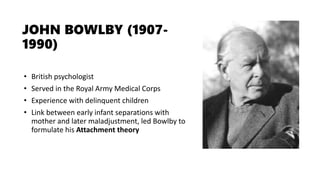
JOHN BOWLBY (1907-
1990)
• British psychologist
• Served in the Royal Army Medical Corps
• Experience with delinquent children
• Link between early infant separations with
mother and later maladjustment, led Bowlby to
formulate his Attachment theory
• Attachment is a 'lasting psychological connectedness between
human beings.'
• Evolution based theory- Infants are biologically pre-programmed
to form attachments with primary caregivers in early life to
increase their likelihood of survival
Characteristics of attachment
• Proximity Maintenance - The desire to be near the people we are
attached to.
• Safe Haven - Returning to the attachment figure for comfort and
safety in the face of a fear or threat.
• Secure Base - The attachment figure acts as a base of security from
which the child can explore the surrounding environment.
• Separation Distress - Anxiety that occurs in the absence of the
attachment figure.
Three key propositions about attachment
theory
• First, When children are raised with confidence that their primary caregiver will
be available to them, they are less likely to experience fear than those who are
raised without such conviction.
• Secondly, This confidence is forged during a critical period of development,
during the years of infancy, childhood, and adolescence. The expectations that
are formed during that period tend to remain relatively unchanged for the rest of
the person's life.
• Finally, These expectations that are formed are directly tied to experience. In
other words, children develop expectations that their caregivers will be
responsive to their needs because, in their experience, their caregivers have been
responsive in the past.
1. A child has an innate (i.e., inborn) need to attach to one main
attachment figure (i.e., monotropy)
2. A child should receive the continuous care of this single most important
attachment figure for approximately the first two years of life.
3. The long-term consequences of maternal deprivation might include the
following: delinquency, reduced intelligence, increased aggression,
depression, affectionless psychopathy
4. Robertson and Bowlby (1952) believe that short-term separation from an
attachment figure leads to distress (i.e., the PDD model).
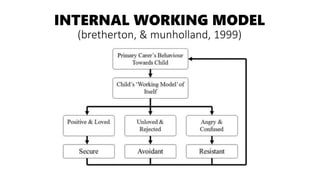
5. The child’s attachment relationship with their primary caregiver leads to
the development of an internal working model (Bowlby, 1969).
BOWLBY ATTACHEMENT THEORY
PDD MODEL
Stages of distress
• Protest: The child cries, screams and protests angrily when the parent
leaves. They will try to cling on to the parent to stop them leaving.
• Despair: The child’s protesting begins to stop, and they appear to be
calmer although still upset. The child refuses others’ attempts for
comfort and often seems withdrawn and uninterested in anything.
• Detachment: If separation continues the child will start to engage
with other people again. They will reject the caregiver on their return
and show strong signs of anger.
INTERNAL WORKING MODEL
(bretherton, & munholland, 1999)
Ainsworth's Strange Situation
Assessment
• 1970s: further expanded upon Bowlby's work in her now-
famous "Strange Situation" study.
• Observing children between the ages of 12 to 18 months responding
to a situation in which they were briefly left alone and then reunited
with their mother.
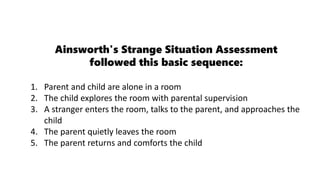
Ainsworth's Strange Situation Assessment
followed this basic sequence:
1. Parent and child are alone in a room
2. The child explores the room with parental supervision
3. A stranger enters the room, talks to the parent, and approaches the
child
4. The parent quietly leaves the room
5. The parent returns and comforts the child
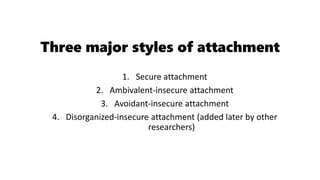
Three major styles of attachment
1. Secure attachment
2. Ambivalent-insecure attachment
3. Avoidant-insecure attachment
4. Disorganized-insecure attachment (added later by other
researchers)
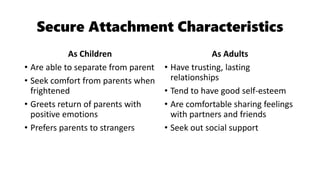
Secure Attachment Characteristics
As Children
• Are able to separate from parent
• Seek comfort from parents when
frightened
• Greets return of parents with
positive emotions
• Prefers parents to strangers
As Adults
• Have trusting, lasting
relationships
• Tend to have good self-esteem
• Are comfortable sharing feelings
with partners and friends
• Seek out social support
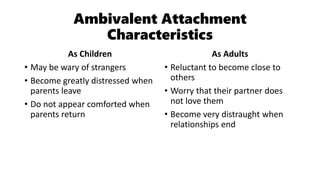
Ambivalent Attachment
Characteristics
As Children
• May be wary of strangers
• Become greatly distressed when
parents leave
• Do not appear comforted when
parents return
As Adults
• Reluctant to become close to
others
• Worry that their partner does
not love them
• Become very distraught when
relationships end
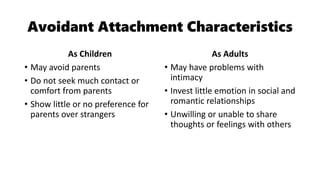
Avoidant Attachment Characteristics
As Children
• May avoid parents
• Do not seek much contact or
comfort from parents
• Show little or no preference for
parents over strangers
As Adults
• May have problems with
intimacy
• Invest little emotion in social and
romantic relationships
• Unwilling or unable to share
thoughts or feelings with others
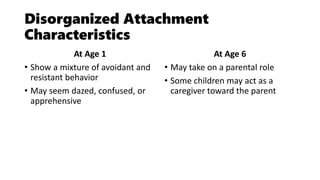
Disorganized Attachment
Characteristics
At Age 1
• Show a mixture of avoidant and
resistant behavior
• May seem dazed, confused, or
apprehensive
At Age 6
• May take on a parental role
• Some children may act as a
caregiver toward the parent
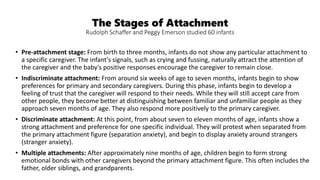
The Stages of Attachment
Rudolph Schaffer and Peggy Emerson studied 60 infants
• Pre-attachment stage: From birth to three months, infants do not show any particular attachment to
a specific caregiver. The infant's signals, such as crying and fussing, naturally attract the attention of
the caregiver and the baby's positive responses encourage the caregiver to remain close.
• Indiscriminate attachment: From around six weeks of age to seven months, infants begin to show
preferences for primary and secondary caregivers. During this phase, infants begin to develop a
feeling of trust that the caregiver will respond to their needs. While they will still accept care from
other people, they become better at distinguishing between familiar and unfamiliar people as they
approach seven months of age. They also respond more positively to the primary caregiver.
• Discriminate attachment: At this point, from about seven to eleven months of age, infants show a
strong attachment and preference for one specific individual. They will protest when separated from
the primary attachment figure (separation anxiety), and begin to display anxiety around strangers
(stranger anxiety).
• Multiple attachments: After approximately nine months of age, children begin to form strong
emotional bonds with other caregivers beyond the primary attachment figure. This often includes the
father, older siblings, and grandparents.
References
1. McLeod, S. A. (2017, Feb 05). Attachment theory. Simply psychology:
https://www.simplypsychology.org/attachment.html
2. John Bowlby. (n.d.). In Alleydog.com's online glossary. Retrieved
from: https://www.alleydog.com/glossary/definition-
cit.php?term=John+Bowlby
3. John Bowlby. (n.d.). In Totally History. Retrieved from:
http://totallyhistory.com/john-bowlby/
4. Sarah Mae Sincero (May 17, 2012). Bowlby Attachment Theory. Retrieved Mar
14, 2020 from Explorable.com: https://explorable.com/bowlby-attachment-
theory
5. Kendra Cherry (2019). In verywellmind. Retrieved from:
https://www.verywellmind.com/attachment-styles-2795344
https://www.verywellmind.com/what-is-attachment-theory-2795337

Bowlby Attachment Theory

  • 1.
  • 2.
    JOHN BOWLBY (1907- 1990) •British psychologist • Served in the Royal Army Medical Corps • Experience with delinquent children • Link between early infant separations with mother and later maladjustment, led Bowlby to formulate his Attachment theory
  • 3.
    • Attachment isa 'lasting psychological connectedness between human beings.' • Evolution based theory- Infants are biologically pre-programmed to form attachments with primary caregivers in early life to increase their likelihood of survival
  • 4.
    Characteristics of attachment •Proximity Maintenance - The desire to be near the people we are attached to. • Safe Haven - Returning to the attachment figure for comfort and safety in the face of a fear or threat. • Secure Base - The attachment figure acts as a base of security from which the child can explore the surrounding environment. • Separation Distress - Anxiety that occurs in the absence of the attachment figure.
  • 5.
    Three key propositionsabout attachment theory • First, When children are raised with confidence that their primary caregiver will be available to them, they are less likely to experience fear than those who are raised without such conviction. • Secondly, This confidence is forged during a critical period of development, during the years of infancy, childhood, and adolescence. The expectations that are formed during that period tend to remain relatively unchanged for the rest of the person's life. • Finally, These expectations that are formed are directly tied to experience. In other words, children develop expectations that their caregivers will be responsive to their needs because, in their experience, their caregivers have been responsive in the past.
  • 6.
    1. A childhas an innate (i.e., inborn) need to attach to one main attachment figure (i.e., monotropy) 2. A child should receive the continuous care of this single most important attachment figure for approximately the first two years of life. 3. The long-term consequences of maternal deprivation might include the following: delinquency, reduced intelligence, increased aggression, depression, affectionless psychopathy 4. Robertson and Bowlby (1952) believe that short-term separation from an attachment figure leads to distress (i.e., the PDD model). 5. The child’s attachment relationship with their primary caregiver leads to the development of an internal working model (Bowlby, 1969). BOWLBY ATTACHEMENT THEORY
  • 7.
    PDD MODEL Stages ofdistress • Protest: The child cries, screams and protests angrily when the parent leaves. They will try to cling on to the parent to stop them leaving. • Despair: The child’s protesting begins to stop, and they appear to be calmer although still upset. The child refuses others’ attempts for comfort and often seems withdrawn and uninterested in anything. • Detachment: If separation continues the child will start to engage with other people again. They will reject the caregiver on their return and show strong signs of anger.
  • 8.
  • 9.
    Ainsworth's Strange Situation Assessment •1970s: further expanded upon Bowlby's work in her now- famous "Strange Situation" study. • Observing children between the ages of 12 to 18 months responding to a situation in which they were briefly left alone and then reunited with their mother.
  • 10.
    Ainsworth's Strange SituationAssessment followed this basic sequence: 1. Parent and child are alone in a room 2. The child explores the room with parental supervision 3. A stranger enters the room, talks to the parent, and approaches the child 4. The parent quietly leaves the room 5. The parent returns and comforts the child
  • 11.
    Three major stylesof attachment 1. Secure attachment 2. Ambivalent-insecure attachment 3. Avoidant-insecure attachment 4. Disorganized-insecure attachment (added later by other researchers)
  • 12.
    Secure Attachment Characteristics AsChildren • Are able to separate from parent • Seek comfort from parents when frightened • Greets return of parents with positive emotions • Prefers parents to strangers As Adults • Have trusting, lasting relationships • Tend to have good self-esteem • Are comfortable sharing feelings with partners and friends • Seek out social support
  • 13.
    Ambivalent Attachment Characteristics As Children •May be wary of strangers • Become greatly distressed when parents leave • Do not appear comforted when parents return As Adults • Reluctant to become close to others • Worry that their partner does not love them • Become very distraught when relationships end
  • 14.
    Avoidant Attachment Characteristics AsChildren • May avoid parents • Do not seek much contact or comfort from parents • Show little or no preference for parents over strangers As Adults • May have problems with intimacy • Invest little emotion in social and romantic relationships • Unwilling or unable to share thoughts or feelings with others
  • 15.
    Disorganized Attachment Characteristics At Age1 • Show a mixture of avoidant and resistant behavior • May seem dazed, confused, or apprehensive At Age 6 • May take on a parental role • Some children may act as a caregiver toward the parent
  • 16.
    The Stages ofAttachment Rudolph Schaffer and Peggy Emerson studied 60 infants • Pre-attachment stage: From birth to three months, infants do not show any particular attachment to a specific caregiver. The infant's signals, such as crying and fussing, naturally attract the attention of the caregiver and the baby's positive responses encourage the caregiver to remain close. • Indiscriminate attachment: From around six weeks of age to seven months, infants begin to show preferences for primary and secondary caregivers. During this phase, infants begin to develop a feeling of trust that the caregiver will respond to their needs. While they will still accept care from other people, they become better at distinguishing between familiar and unfamiliar people as they approach seven months of age. They also respond more positively to the primary caregiver. • Discriminate attachment: At this point, from about seven to eleven months of age, infants show a strong attachment and preference for one specific individual. They will protest when separated from the primary attachment figure (separation anxiety), and begin to display anxiety around strangers (stranger anxiety). • Multiple attachments: After approximately nine months of age, children begin to form strong emotional bonds with other caregivers beyond the primary attachment figure. This often includes the father, older siblings, and grandparents.
  • 17.
    References 1. McLeod, S.A. (2017, Feb 05). Attachment theory. Simply psychology: https://www.simplypsychology.org/attachment.html 2. John Bowlby. (n.d.). In Alleydog.com's online glossary. Retrieved from: https://www.alleydog.com/glossary/definition- cit.php?term=John+Bowlby 3. John Bowlby. (n.d.). In Totally History. Retrieved from: http://totallyhistory.com/john-bowlby/ 4. Sarah Mae Sincero (May 17, 2012). Bowlby Attachment Theory. Retrieved Mar 14, 2020 from Explorable.com: https://explorable.com/bowlby-attachment- theory 5. Kendra Cherry (2019). In verywellmind. Retrieved from: https://www.verywellmind.com/attachment-styles-2795344 https://www.verywellmind.com/what-is-attachment-theory-2795337