Aggregate Planning
 Determine the resource capacity needed to
meet demand over an intermediate time
horizon
 Aggregate refers to product lines or families
Aggregate planning matches supply and demand

 Objectives
 Establish a company wide game plan for allocating
resources
Develop an economic strategy for meeting
demand

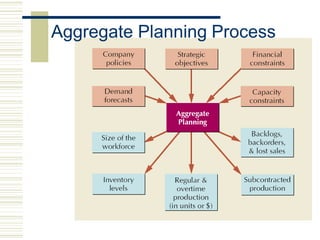
Aggregate planning is the process of developing, analyzing, and
maintaining a preliminary, approximate schedule of the overall
operations of an organization.
The aggregate plan generally contains targeted sales forecasts,
production levels, inventory levels, and customer backlogs
Aggregate resources are total number of workers, hours of machine
time, or tons of raw materials
Aggregate planning does not distinguish among sizes, colors,
features, and so forth. For example, with automobile manufacturing,
aggregate planning would consider the total number of cars planned
for not the individual models, colors, or options.
When units of aggregation are difficult to determine (for example,
when the variation in output is extreme) equivalent units are usually
determined. These equivalent units could be based on value, cost,
worker hours, or some similar measure.
Options for situations in which demand needs to be increased in order to
match capacity include:
1.Pricing. Varying pricing to increase demand in periods when demand is
less than peak. For example, matinee prices for movie theaters, off-season
rates for hotels, weekend rates for telephone service, and pricing for items
that experience seasonal demand.
2.Promotion. Advertising, direct marketing, and other forms of promotion
are used to shift demand.
3.Back ordering. By postponing delivery on current orders demand is
shifted to period when capacity is not fully utilized. This is really just a form
of smoothing demand. Service industries are able to smooth demand by
taking reservations or by making appointments in an attempt to avoid walk-
in customers. Some refer to this as "partitioning" demand.
4.New demand creation. A new, but complementary demand is created
for a product or service. When restaurant customers have to wait, they are
frequently diverted into a complementary (but not complimentary) service,
the bar. Other examples include the addition of video arcades within movie
theaters, and the expansion of services at convenience stores.
Options which can be used to increase or decrease capacity to match current demand
include:
• Hire/lay off. By hiring additional workers as needed or by laying off workers not
currently required to meet demand, firms can maintain a balance between capacity
and demand.
• Overtime. By asking or requiring workers to work extra hours a day or an extra day
per week, firms can create a temporary increase in capacity without the added
expense of hiring additional workers.
• Part-time or casual labor. By utilizing temporary workers or casual labor (workers
who are considered permanent but only work when needed, on an on-call basis, and
typically without the benefits given to full-time workers).
• Inventory. Finished-goods inventory can be built up in periods of slack demand and
then used to fill demand during periods of high demand. In this way no new workers
have to be hired, no temporary or casual labor is needed, and no overtime is incurred.
• Subcontracting. Frequently firms choose to allow another
manufacturer or service provider to provide the product or service
to the subcontracting firm's customers. By subcontracting work to
an alternative source, additional capacity is temporarily obtained.
• Cross-training. Cross-trained employees may be able to perform
tasks in several operations, creating some flexibility when
scheduling capacity.
• Other methods. While varying workforce size and utilization,
inventory buildup/backlogging, and subcontracting are well-known
alternatives, there are other, more novel ways that find use in
industry. Among these options are sharing employees with
counter-cyclical companies and attempting to find interesting and
meaningful projects for employees to do during slack times.
Aggregate Planning Process
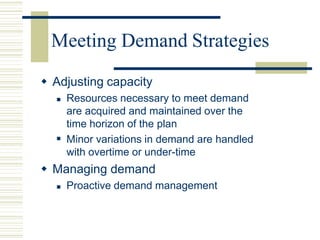
Meeting Demand Strategies
 Adjusting capacity

 Resources necessary to meet demand
are acquired and maintained over the
time horizon of the plan
Minor variations in demand are handled
with overtime or under-time
 Managing demand
 Proactive demand management
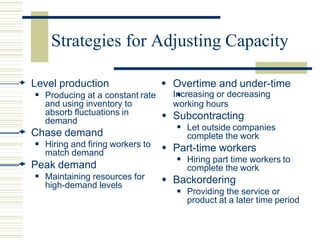
Strategies for Adjusting Capacity
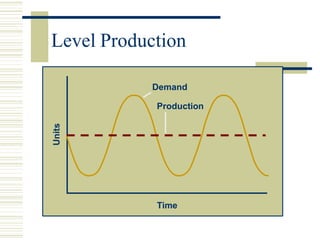
 Level production
 Producing at a constant rate
and using inventory to
absorb fluctuations in
demand
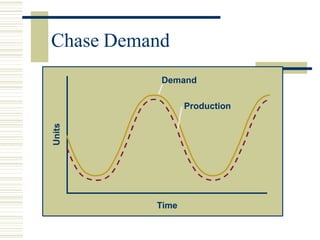
 Chase demand
 Hiring and firing workers to
match demand
 Peak demand
 Maintaining resources for
high-demand levels




 Overtime and under-time
Increasing or decreasing
working hours
 Subcontracting
Let outside companies
complete the work
 Part-time workers
Hiring part time workers to
complete the work
 Backordering
Providing the service or
product at a later time period
Level Production
Units
Time
Demand
Production
Chase Demand
Units
Time
Demand
Production
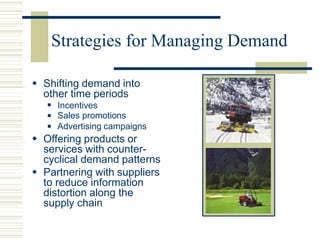
Strategies for Managing Demand
 Shifting demand into
other time periods
 Incentives
Sales promotions
Advertising campaigns


 Offering products or
services with counter-
cyclical demand patterns
 Partnering with suppliers
to reduce information
distortion along the
supply chain
Quantitative Techniques For APP
 Pure Strategies
 Mixed Strategies
 Linear Programming
 Transportation Method
 Other Quantitative
Techniques
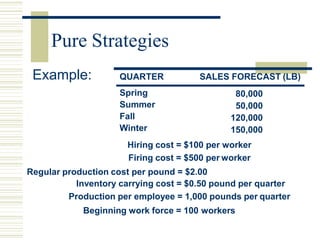
Pure Strategies
Hiring cost = $100 per worker
Firing cost = $500 per worker
Regular production cost per pound = $2.00
Inventory carrying cost = $0.50 pound per quarter
Production per employee = 1,000 pounds per quarter
Beginning work force = 100 workers
QUARTER SALES FORECAST (LB)
Spring
Summer
Fall
Winter
80,000
50,000
120,000
150,000
Example:
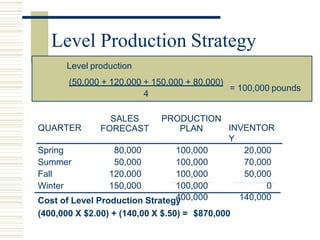
Level Production Strategy
Level production
= 100,000 pounds
(50,000 + 120,000 + 150,000 + 80,000)
4
Cost of Level Production Strategy
(400,000 X $2.00) + (140,00 X $.50) = $870,000
QUARTER
SALES
FORECAST
PRODUCTION
PLAN INVENTOR
Y
Spring 80,000 100,000 20,000
Summer 50,000 100,000 70,000
Fall 120,000 100,000 50,000
Winter 150,000 100,000 0
400,000 140,000
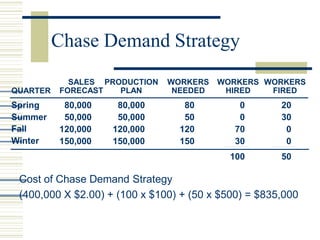
Chase Demand Strategy
Spring
Summer
Fall
Winter
80,000
50,000
120,000
150,000
80,000
50,000
120,000
150,000
80
50
120
150
0
0
70
30
20
30
0
0
100 50
SALES
FORECAST
PRODUCTION
PLAN
WORKERS
NEEDED
WORKERS WORKERS
HIRED FIRED
QUARTER
Cost of Chase Demand Strategy
(400,000 X $2.00) + (100 x $100) + (50 x $500) = $835,000
Mixed Strategy
 Combination of Level Production and
Chase Demand strategies
 Examples of management policies

 no more than x% of the workforce can be
laid off in one quarter
inventory levels cannot exceed x dollars
 Many industries may simply shut down
manufacturing during the low demand
season and schedule employee
vacations during that time
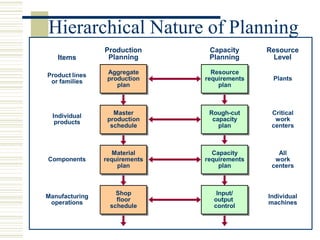
Hierarchical Nature of Planning
Items
Product lines
or families
Individual
products
Components
Manufacturing
operations
Resource
Level
Plants
Individual
machines
Critical
work
centers
Production
Planning
Capacity
Planning
Resource
requirements
plan
Rough-cut
capacity
plan
Capacity
requirements
plan
Input/
output
control
Aggregate
production
plan
Master
production
schedule
Material
requirements
plan
Shop
floor
schedule
All
work
centers
Aggregate Planning for Services
1. Most services can’t be inventoried
2. Demand for services is difficult to predict
3. Capacity is also difficult to predict
4. Service capacity must be provided at the
appropriate place and time
5. Labor is usually the most constraining
resource for services

3.1.pptx

  • 1.
    Aggregate Planning  Determinethe resource capacity needed to meet demand over an intermediate time horizon  Aggregate refers to product lines or families Aggregate planning matches supply and demand   Objectives  Establish a company wide game plan for allocating resources Develop an economic strategy for meeting demand 
  • 2.
    Aggregate planning isthe process of developing, analyzing, and maintaining a preliminary, approximate schedule of the overall operations of an organization. The aggregate plan generally contains targeted sales forecasts, production levels, inventory levels, and customer backlogs Aggregate resources are total number of workers, hours of machine time, or tons of raw materials
  • 3.
    Aggregate planning doesnot distinguish among sizes, colors, features, and so forth. For example, with automobile manufacturing, aggregate planning would consider the total number of cars planned for not the individual models, colors, or options. When units of aggregation are difficult to determine (for example, when the variation in output is extreme) equivalent units are usually determined. These equivalent units could be based on value, cost, worker hours, or some similar measure.
  • 4.
    Options for situationsin which demand needs to be increased in order to match capacity include: 1.Pricing. Varying pricing to increase demand in periods when demand is less than peak. For example, matinee prices for movie theaters, off-season rates for hotels, weekend rates for telephone service, and pricing for items that experience seasonal demand. 2.Promotion. Advertising, direct marketing, and other forms of promotion are used to shift demand. 3.Back ordering. By postponing delivery on current orders demand is shifted to period when capacity is not fully utilized. This is really just a form of smoothing demand. Service industries are able to smooth demand by taking reservations or by making appointments in an attempt to avoid walk- in customers. Some refer to this as "partitioning" demand. 4.New demand creation. A new, but complementary demand is created for a product or service. When restaurant customers have to wait, they are frequently diverted into a complementary (but not complimentary) service, the bar. Other examples include the addition of video arcades within movie theaters, and the expansion of services at convenience stores.
  • 5.
    Options which canbe used to increase or decrease capacity to match current demand include: • Hire/lay off. By hiring additional workers as needed or by laying off workers not currently required to meet demand, firms can maintain a balance between capacity and demand. • Overtime. By asking or requiring workers to work extra hours a day or an extra day per week, firms can create a temporary increase in capacity without the added expense of hiring additional workers. • Part-time or casual labor. By utilizing temporary workers or casual labor (workers who are considered permanent but only work when needed, on an on-call basis, and typically without the benefits given to full-time workers). • Inventory. Finished-goods inventory can be built up in periods of slack demand and then used to fill demand during periods of high demand. In this way no new workers have to be hired, no temporary or casual labor is needed, and no overtime is incurred.
  • 6.
    • Subcontracting. Frequentlyfirms choose to allow another manufacturer or service provider to provide the product or service to the subcontracting firm's customers. By subcontracting work to an alternative source, additional capacity is temporarily obtained. • Cross-training. Cross-trained employees may be able to perform tasks in several operations, creating some flexibility when scheduling capacity. • Other methods. While varying workforce size and utilization, inventory buildup/backlogging, and subcontracting are well-known alternatives, there are other, more novel ways that find use in industry. Among these options are sharing employees with counter-cyclical companies and attempting to find interesting and meaningful projects for employees to do during slack times.
  • 7.
  • 8.
    Meeting Demand Strategies Adjusting capacity   Resources necessary to meet demand are acquired and maintained over the time horizon of the plan Minor variations in demand are handled with overtime or under-time  Managing demand  Proactive demand management
  • 9.
    Strategies for AdjustingCapacity  Level production  Producing at a constant rate and using inventory to absorb fluctuations in demand  Chase demand  Hiring and firing workers to match demand  Peak demand  Maintaining resources for high-demand levels      Overtime and under-time Increasing or decreasing working hours  Subcontracting Let outside companies complete the work  Part-time workers Hiring part time workers to complete the work  Backordering Providing the service or product at a later time period
  • 10.
  • 11.
  • 12.
    Strategies for ManagingDemand  Shifting demand into other time periods  Incentives Sales promotions Advertising campaigns    Offering products or services with counter- cyclical demand patterns  Partnering with suppliers to reduce information distortion along the supply chain
  • 13.
    Quantitative Techniques ForAPP  Pure Strategies  Mixed Strategies  Linear Programming  Transportation Method  Other Quantitative Techniques
  • 14.
    Pure Strategies Hiring cost= $100 per worker Firing cost = $500 per worker Regular production cost per pound = $2.00 Inventory carrying cost = $0.50 pound per quarter Production per employee = 1,000 pounds per quarter Beginning work force = 100 workers QUARTER SALES FORECAST (LB) Spring Summer Fall Winter 80,000 50,000 120,000 150,000 Example:
  • 15.
    Level Production Strategy Levelproduction = 100,000 pounds (50,000 + 120,000 + 150,000 + 80,000) 4 Cost of Level Production Strategy (400,000 X $2.00) + (140,00 X $.50) = $870,000 QUARTER SALES FORECAST PRODUCTION PLAN INVENTOR Y Spring 80,000 100,000 20,000 Summer 50,000 100,000 70,000 Fall 120,000 100,000 50,000 Winter 150,000 100,000 0 400,000 140,000
  • 16.
    Chase Demand Strategy Spring Summer Fall Winter 80,000 50,000 120,000 150,000 80,000 50,000 120,000 150,000 80 50 120 150 0 0 70 30 20 30 0 0 10050 SALES FORECAST PRODUCTION PLAN WORKERS NEEDED WORKERS WORKERS HIRED FIRED QUARTER Cost of Chase Demand Strategy (400,000 X $2.00) + (100 x $100) + (50 x $500) = $835,000
  • 17.
    Mixed Strategy  Combinationof Level Production and Chase Demand strategies  Examples of management policies   no more than x% of the workforce can be laid off in one quarter inventory levels cannot exceed x dollars  Many industries may simply shut down manufacturing during the low demand season and schedule employee vacations during that time
  • 18.
    Hierarchical Nature ofPlanning Items Product lines or families Individual products Components Manufacturing operations Resource Level Plants Individual machines Critical work centers Production Planning Capacity Planning Resource requirements plan Rough-cut capacity plan Capacity requirements plan Input/ output control Aggregate production plan Master production schedule Material requirements plan Shop floor schedule All work centers
  • 19.
    Aggregate Planning forServices 1. Most services can’t be inventoried 2. Demand for services is difficult to predict 3. Capacity is also difficult to predict 4. Service capacity must be provided at the appropriate place and time 5. Labor is usually the most constraining resource for services