Capacity Requirement Planning   Presentation by:   Kesavan   Fabin
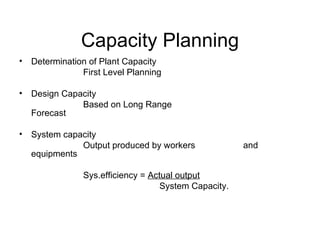
Capacity Planning Determination of Plant Capacity First Level Planning Design Capacity Based on Long Range  Forecast System capacity Output produced by workers  and equipments Sys.efficiency =  Actual output   System Capacity.
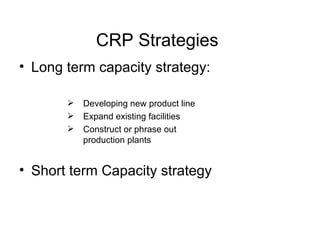
CRP Strategies Long term capacity strategy: Developing new product line Expand existing facilities Construct or phrase out  production plants Short term Capacity strategy
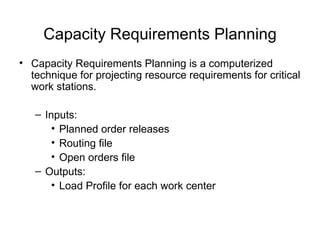
Capacity Requirements Planning Capacity Requirements Planning is a computerized technique for projecting resource requirements for critical work stations. Inputs: Planned order releases Routing file Open orders file Outputs: Load Profile for each work center
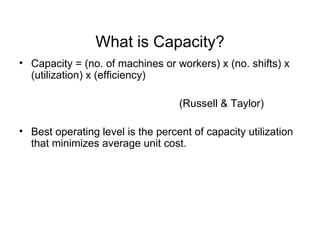
What is Capacity? Capacity = (no. of machines or workers) x (no. shifts) x (utilization) x (efficiency) (Russell & Taylor) Best operating level is the percent of capacity utilization that minimizes average unit cost.
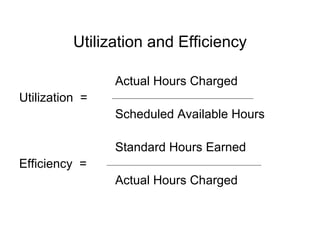
Utilization and Efficiency Actual Hours Charged Utilization  =  Scheduled Available Hours Standard Hours Earned Efficiency  =  Actual Hours Charged
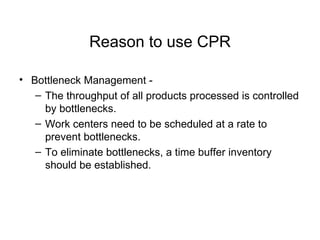
Reason to use CPR Bottleneck Management - The throughput of all products processed is controlled by bottlenecks. Work centers need to be scheduled at a rate to prevent bottlenecks. To eliminate bottlenecks, a time buffer inventory should be established.
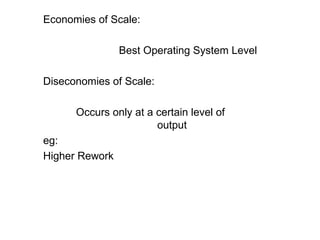
Economies of Scale: Best Operating System Level Diseconomies of Scale: Occurs only at a certain level of  output eg: Higher Rework
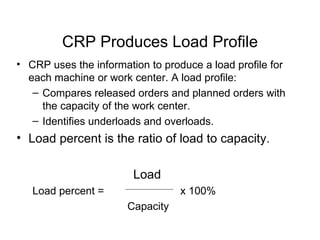
CRP Produces Load Profile CRP uses the information to produce a load profile for each machine or work center. A load profile: Compares released orders and planned orders with the capacity of the work center. Identifies underloads and overloads. Load percent is the ratio of load to capacity.   Load Load percent =    x 100%   Capacity
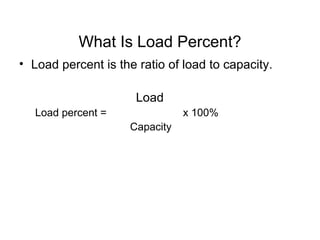
What Is Load Percent? Load percent is the ratio of load to capacity.   Load Load percent =    x 100%   Capacity
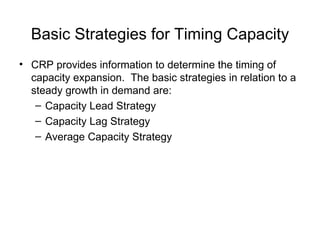
Basic Strategies for Timing Capacity CRP provides information to determine the timing of capacity expansion.  The basic strategies in relation to a steady growth in demand are: Capacity Lead Strategy Capacity Lag Strategy Average Capacity Strategy
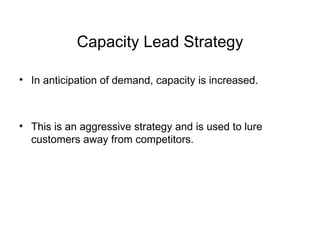
Capacity Lead Strategy In anticipation of demand, capacity is increased. This is an aggressive strategy and is used to lure customers away from competitors.
Capacity Planning How much to increase capacity demands  depend upon a number of factors, including: Anticipated demand – volume & certainty Strategic objectives  Costs of expansion and operation
Capacity Lag Strategy Increase capacity after demand has increased. This is a conservative strategy and may result in lose of customers. You assume customers will return after capacity has been met.
Average Capacity Strategy Average expected demand is calculated and capacity is increased accordingly. This is the most moderate strategy.
Adjustments to Capacity Increase capacity by: Adding extra shifts Scheduling overtime or weekends Adding equipment and/or personnel Reduce load by: Reducing lot sizes Holding work in production control Subcontracting work to outside suppliers
Adjustments to Capacity Reduce capacity by: Temporarily reassigning staff Reducing the length of shifts Eliminating shifts  Increase load by: Releasing orders early Increasing lot sizes Making items normally outsourced

Capacity Requirement Planning

  • 1.
    Capacity Requirement Planning Presentation by: Kesavan Fabin
  • 2.
    Capacity Planning Determinationof Plant Capacity First Level Planning Design Capacity Based on Long Range Forecast System capacity Output produced by workers and equipments Sys.efficiency = Actual output System Capacity.
  • 3.
    CRP Strategies Longterm capacity strategy: Developing new product line Expand existing facilities Construct or phrase out production plants Short term Capacity strategy
  • 4.
    Capacity Requirements PlanningCapacity Requirements Planning is a computerized technique for projecting resource requirements for critical work stations. Inputs: Planned order releases Routing file Open orders file Outputs: Load Profile for each work center
  • 5.
    What is Capacity?Capacity = (no. of machines or workers) x (no. shifts) x (utilization) x (efficiency) (Russell & Taylor) Best operating level is the percent of capacity utilization that minimizes average unit cost.
  • 6.
    Utilization and EfficiencyActual Hours Charged Utilization = Scheduled Available Hours Standard Hours Earned Efficiency = Actual Hours Charged
  • 7.
    Reason to useCPR Bottleneck Management - The throughput of all products processed is controlled by bottlenecks. Work centers need to be scheduled at a rate to prevent bottlenecks. To eliminate bottlenecks, a time buffer inventory should be established.
  • 8.
    Economies of Scale:Best Operating System Level Diseconomies of Scale: Occurs only at a certain level of output eg: Higher Rework
  • 9.
    CRP Produces LoadProfile CRP uses the information to produce a load profile for each machine or work center. A load profile: Compares released orders and planned orders with the capacity of the work center. Identifies underloads and overloads. Load percent is the ratio of load to capacity. Load Load percent = x 100% Capacity
  • 10.
    What Is LoadPercent? Load percent is the ratio of load to capacity. Load Load percent = x 100% Capacity
  • 11.
    Basic Strategies forTiming Capacity CRP provides information to determine the timing of capacity expansion. The basic strategies in relation to a steady growth in demand are: Capacity Lead Strategy Capacity Lag Strategy Average Capacity Strategy
  • 12.
    Capacity Lead StrategyIn anticipation of demand, capacity is increased. This is an aggressive strategy and is used to lure customers away from competitors.
  • 13.
    Capacity Planning Howmuch to increase capacity demands depend upon a number of factors, including: Anticipated demand – volume & certainty Strategic objectives Costs of expansion and operation
  • 14.
    Capacity Lag StrategyIncrease capacity after demand has increased. This is a conservative strategy and may result in lose of customers. You assume customers will return after capacity has been met.
  • 15.
    Average Capacity StrategyAverage expected demand is calculated and capacity is increased accordingly. This is the most moderate strategy.
  • 16.
    Adjustments to CapacityIncrease capacity by: Adding extra shifts Scheduling overtime or weekends Adding equipment and/or personnel Reduce load by: Reducing lot sizes Holding work in production control Subcontracting work to outside suppliers
  • 17.
    Adjustments to CapacityReduce capacity by: Temporarily reassigning staff Reducing the length of shifts Eliminating shifts Increase load by: Releasing orders early Increasing lot sizes Making items normally outsourced

Editor's Notes

  • #2 This presentation is to fulfill the requirement of the freequality presentation for Operations Management 345.