1

                         AGGREGATE PLANNING

The Concept of Aggregation

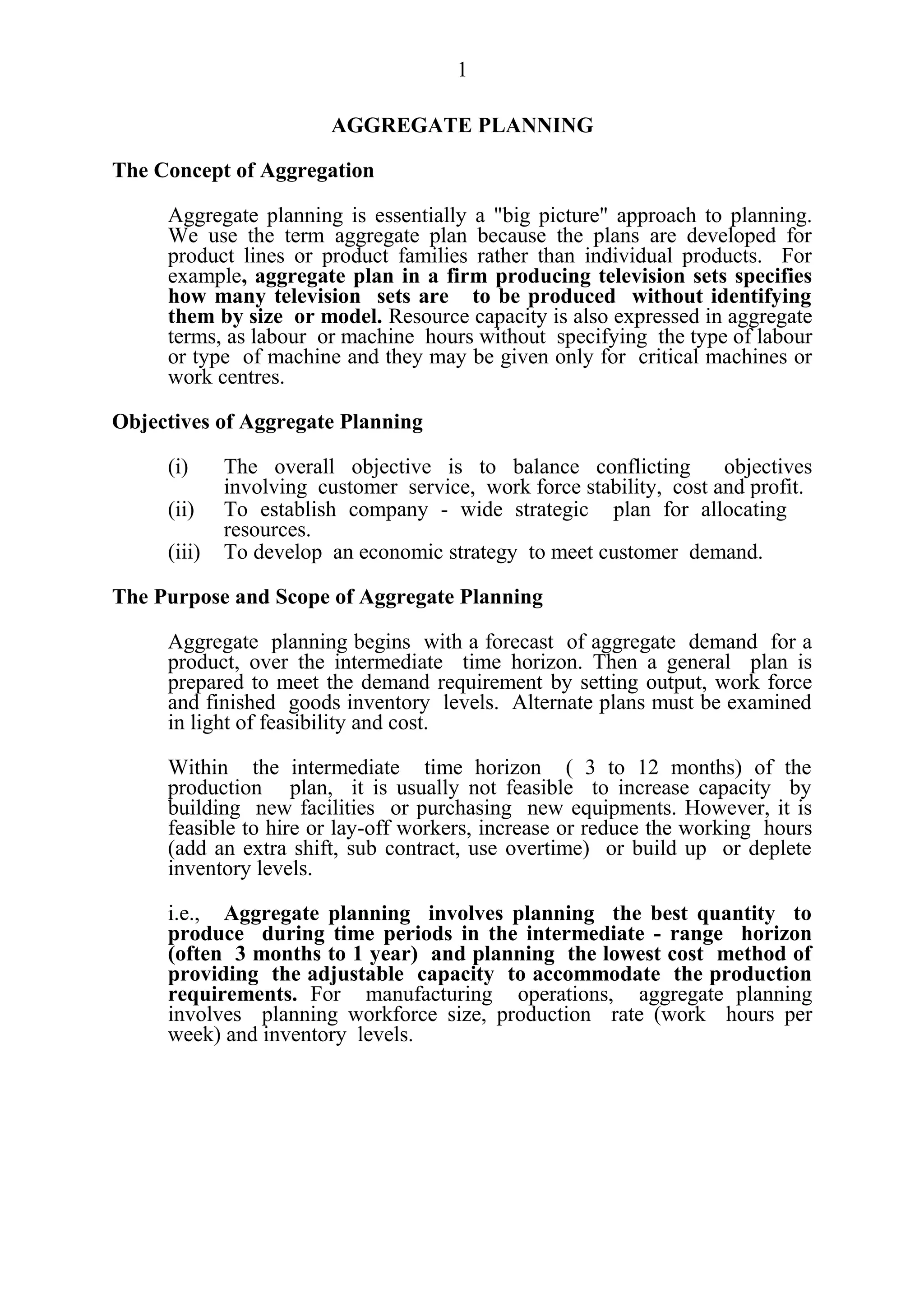
     Aggregate planning is essentially a "big picture" approach to planning.
     We use the term aggregate plan because the plans are developed for
     product lines or product families rather than individual products. For
     example, aggregate plan in a firm producing television sets specifies
     how many television sets are to be produced without identifying
     them by size or model. Resource capacity is also expressed in aggregate
     terms, as labour or machine hours without specifying the type of labour
     or type of machine and they may be given only for critical machines or
     work centres.

Objectives of Aggregate Planning

     (i)     The overall objective is to balance conflicting         objectives
             involving customer service, work force stability, cost and profit.
     (ii)    To establish company - wide strategic plan for allocating
             resources.
     (iii)   To develop an economic strategy to meet customer demand.

The Purpose and Scope of Aggregate Planning

     Aggregate planning begins with a forecast of aggregate demand for a
     product, over the intermediate time horizon. Then a general plan is
     prepared to meet the demand requirement by setting output, work force
     and finished goods inventory levels. Alternate plans must be examined
     in light of feasibility and cost.

     Within the intermediate time horizon ( 3 to 12 months) of the
     production plan, it is usually not feasible to increase capacity by
     building new facilities or purchasing new equipments. However, it is
     feasible to hire or lay-off workers, increase or reduce the working hours
     (add an extra shift, sub contract, use overtime) or build up or deplete
     inventory levels.

     i.e., Aggregate planning involves planning the best quantity to
     produce during time periods in the intermediate - range horizon
     (often 3 months to 1 year) and planning the lowest cost method of
     providing the adjustable capacity to accommodate the production
     requirements. For manufacturing operations, aggregate planning
     involves planning workforce size, production rate (work hours per
     week) and inventory levels.
2

Nature of Aggregate Planning Decisions

      The different capacities which are generally used to manufacture products are
      as listed below :

             * Regular time production capacity
             * Subcontracting capacity
             * Overtime capacity
             * Hiring and firing capacity

      Some time, the regular time production capacity may not be sufficient to cope
      with the demands of various products. Under such situation, we can use other
      optional capacities in smoothing the impact of demand fluctuations. Given the
      sales forecast, the factory capacity, aggregate inventory levels and the size of
      the work force, the manager must decide at what rate of production to operate
      the plant over the intermediate term. Intermediate -range planning is generally
      known as aggregate planning.

      Once various capacities which are available under different categories are
      known, the next task is to identify a feasible and optimal combination of these
      capacities to manufacture the given set of products as per predetermined
      production volumes such that the total cost of manufacturing is minimized.
      Since the company manufactures several products using the given set of
      facilities, requirements of resources of these products are to be aggregated into
      a common unit (Common product). Therefore the aggregate planning aims
      to find the best combination of various available capacities to match with
      the resource requirements in a given planning period at the most
      economical cost. Aggregate planning period range from an intermediate
      range of three months to one year.

Aggregate Planning Strategies

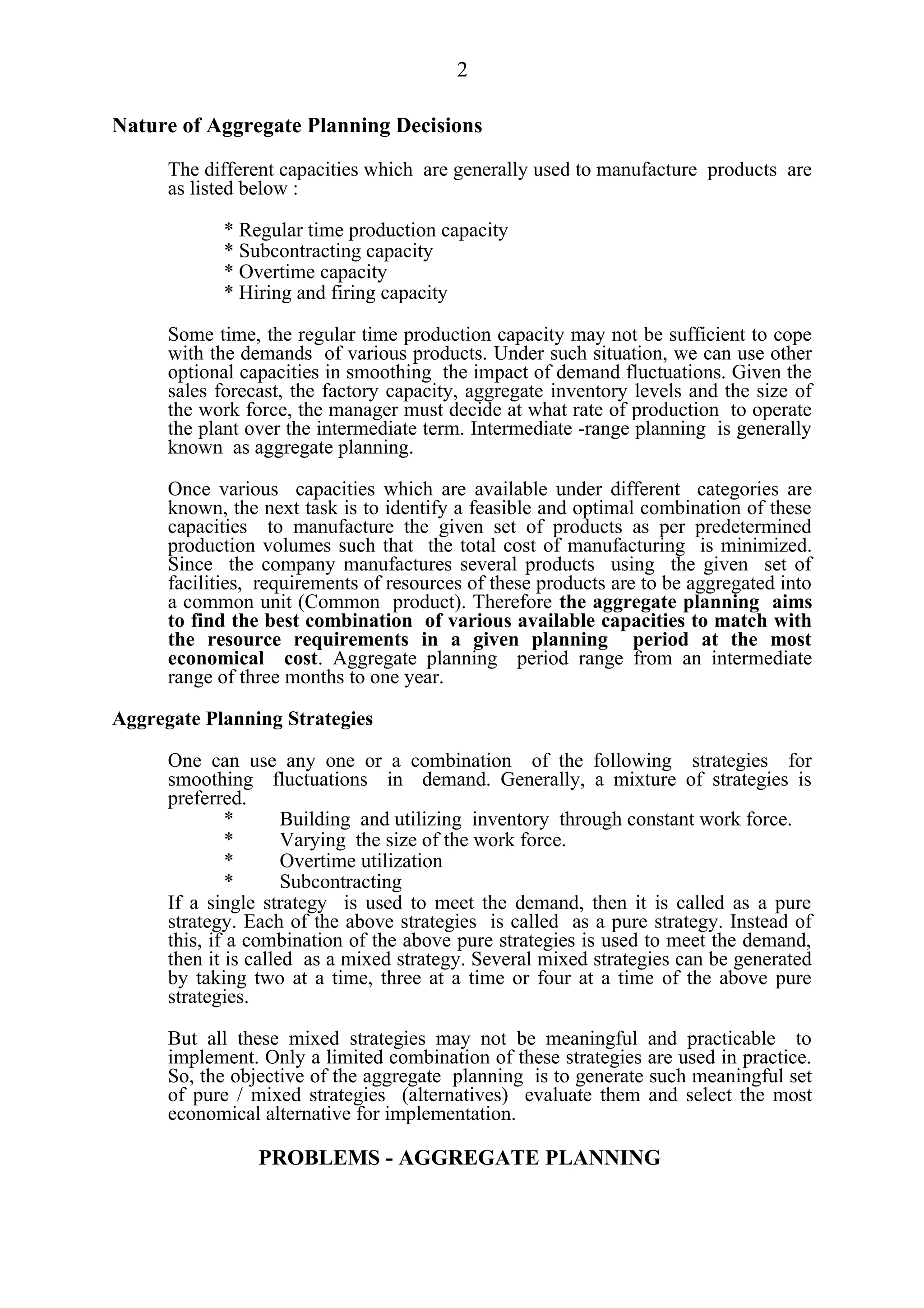
      One can use any one or a combination of the following strategies for
      smoothing fluctuations in demand. Generally, a mixture of strategies is
      preferred.
               *      Building and utilizing inventory through constant work force.
               *      Varying the size of the work force.
               *      Overtime utilization
               *      Subcontracting
      If a single strategy is used to meet the demand, then it is called as a pure
      strategy. Each of the above strategies is called as a pure strategy. Instead of
      this, if a combination of the above pure strategies is used to meet the demand,
      then it is called as a mixed strategy. Several mixed strategies can be generated
      by taking two at a time, three at a time or four at a time of the above pure
      strategies.

      But all these mixed strategies may not be meaningful and practicable to
      implement. Only a limited combination of these strategies are used in practice.
      So, the objective of the aggregate planning is to generate such meaningful set
      of pure / mixed strategies (alternatives) evaluate them and select the most
      economical alternative for implementation.

                 PROBLEMS - AGGREGATE PLANNING
3

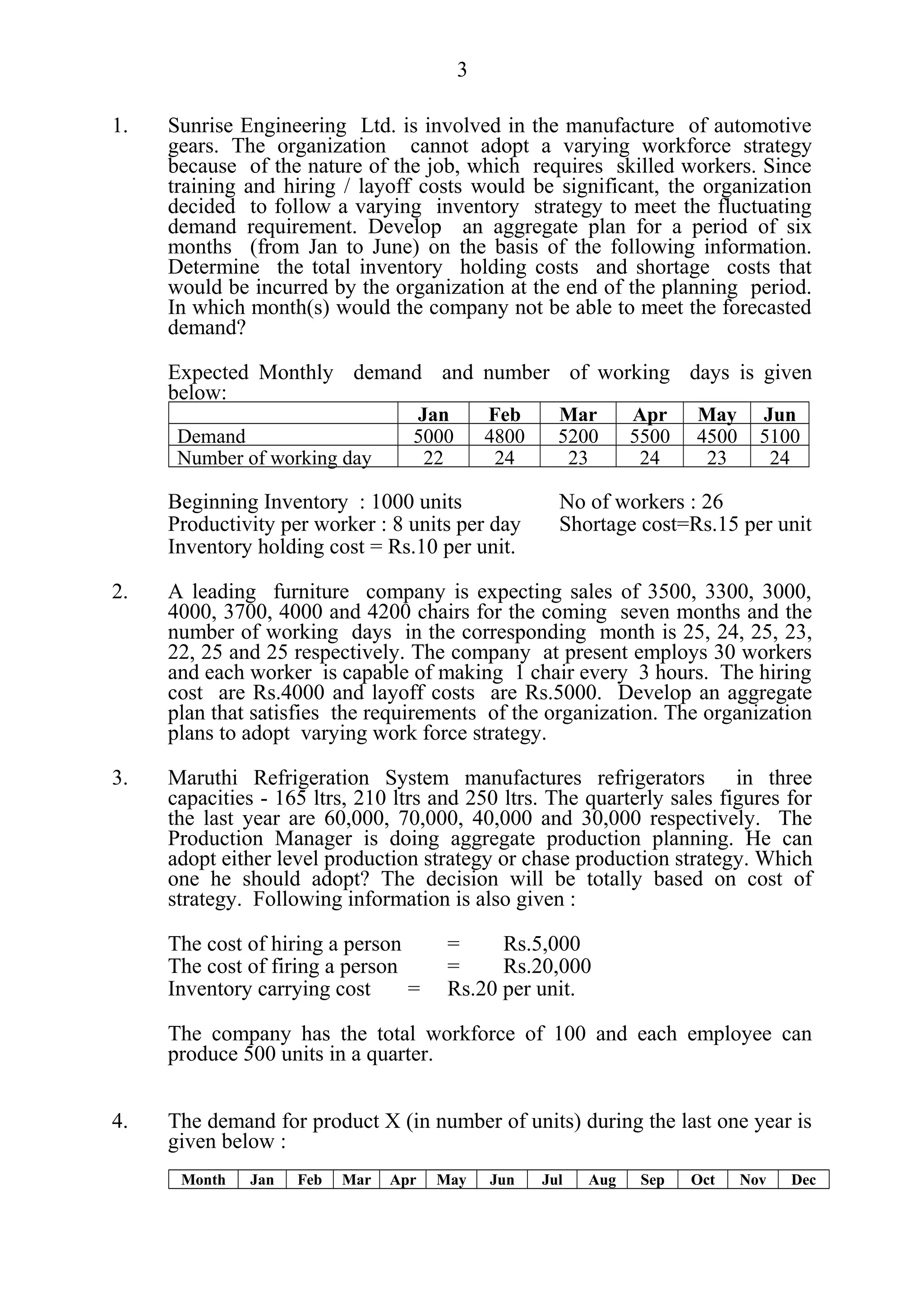
1.   Sunrise Engineering Ltd. is involved in the manufacture of automotive
     gears. The organization cannot adopt a varying workforce strategy
     because of the nature of the job, which requires skilled workers. Since
     training and hiring / layoff costs would be significant, the organization
     decided to follow a varying inventory strategy to meet the fluctuating
     demand requirement. Develop an aggregate plan for a period of six
     months (from Jan to June) on the basis of the following information.
     Determine the total inventory holding costs and shortage costs that
     would be incurred by the organization at the end of the planning period.
     In which month(s) would the company not be able to meet the forecasted
     demand?

     Expected Monthly demand and number of working days is given
     below:
                                  Jan        Feb      Mar       Apr    May      Jun
      Demand                      5000       4800     5200      5500   4500     5100
      Number of working day        22         24       23        24     23       24

     Beginning Inventory : 1000 units                 No of workers : 26
     Productivity per worker : 8 units per day        Shortage cost=Rs.15 per unit
     Inventory holding cost = Rs.10 per unit.

2.   A leading furniture company is expecting sales of 3500, 3300, 3000,
     4000, 3700, 4000 and 4200 chairs for the coming seven months and the
     number of working days in the corresponding month is 25, 24, 25, 23,
     22, 25 and 25 respectively. The company at present employs 30 workers
     and each worker is capable of making 1 chair every 3 hours. The hiring
     cost are Rs.4000 and layoff costs are Rs.5000. Develop an aggregate
     plan that satisfies the requirements of the organization. The organization
     plans to adopt varying work force strategy.

3.   Maruthi Refrigeration System manufactures refrigerators in three
     capacities - 165 ltrs, 210 ltrs and 250 ltrs. The quarterly sales figures for
     the last year are 60,000, 70,000, 40,000 and 30,000 respectively. The
     Production Manager is doing aggregate production planning. He can
     adopt either level production strategy or chase production strategy. Which
     one he should adopt? The decision will be totally based on cost of
     strategy. Following information is also given :

     The cost of hiring a person       =     Rs.5,000
     The cost of firing a person       =     Rs.20,000
     Inventory carrying cost     =     Rs.20 per unit.

     The company has the total workforce of 100 and each employee can
     produce 500 units in a quarter.


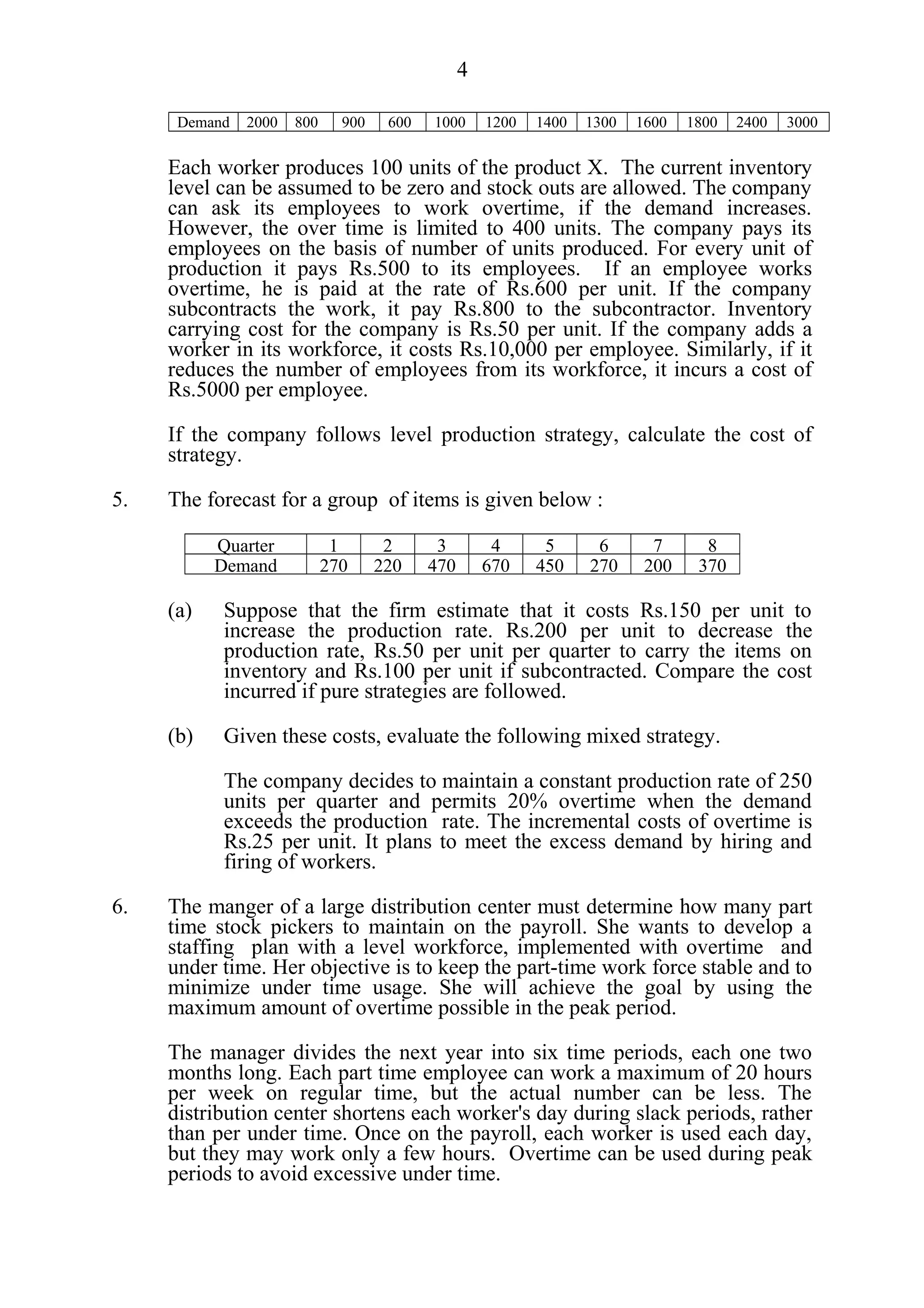
4.   The demand for product X (in number of units) during the last one year is
     given below :
      Month   Jan   Feb   Mar   Apr   May    Jun    Jul   Aug    Sep   Oct    Nov   Dec
4

      Demand   2000   800     900    600   1000      1200   1400   1300   1600   1800   2400   3000


     Each worker produces 100 units of the product X. The current inventory
     level can be assumed to be zero and stock outs are allowed. The company
     can ask its employees to work overtime, if the demand increases.
     However, the over time is limited to 400 units. The company pays its
     employees on the basis of number of units produced. For every unit of
     production it pays Rs.500 to its employees. If an employee works
     overtime, he is paid at the rate of Rs.600 per unit. If the company
     subcontracts the work, it pay Rs.800 to the subcontractor. Inventory
     carrying cost for the company is Rs.50 per unit. If the company adds a
     worker in its workforce, it costs Rs.10,000 per employee. Similarly, if it
     reduces the number of employees from its workforce, it incurs a cost of
     Rs.5000 per employee.

     If the company follows level production strategy, calculate the cost of
     strategy.

5.   The forecast for a group of items is given below :

           Quarter           1       2      3         4      5      6       7      8
           Demand           270     220    470       670    450    270     200    370

     (a)    Suppose that the firm estimate that it costs Rs.150 per unit to
            increase the production rate. Rs.200 per unit to decrease the
            production rate, Rs.50 per unit per quarter to carry the items on
            inventory and Rs.100 per unit if subcontracted. Compare the cost
            incurred if pure strategies are followed.

     (b)    Given these costs, evaluate the following mixed strategy.

            The company decides to maintain a constant production rate of 250
            units per quarter and permits 20% overtime when the demand
            exceeds the production rate. The incremental costs of overtime is
            Rs.25 per unit. It plans to meet the excess demand by hiring and
            firing of workers.

6.   The manger of a large distribution center must determine how many part
     time stock pickers to maintain on the payroll. She wants to develop a
     staffing plan with a level workforce, implemented with overtime and
     under time. Her objective is to keep the part-time work force stable and to
     minimize under time usage. She will achieve the goal by using the
     maximum amount of overtime possible in the peak period.

     The manager divides the next year into six time periods, each one two
     months long. Each part time employee can work a maximum of 20 hours
     per week on regular time, but the actual number can be less. The
     distribution center shortens each worker's day during slack periods, rather
     than per under time. Once on the payroll, each worker is used each day,
     but they may work only a few hours. Overtime can be used during peak
     periods to avoid excessive under time.
5


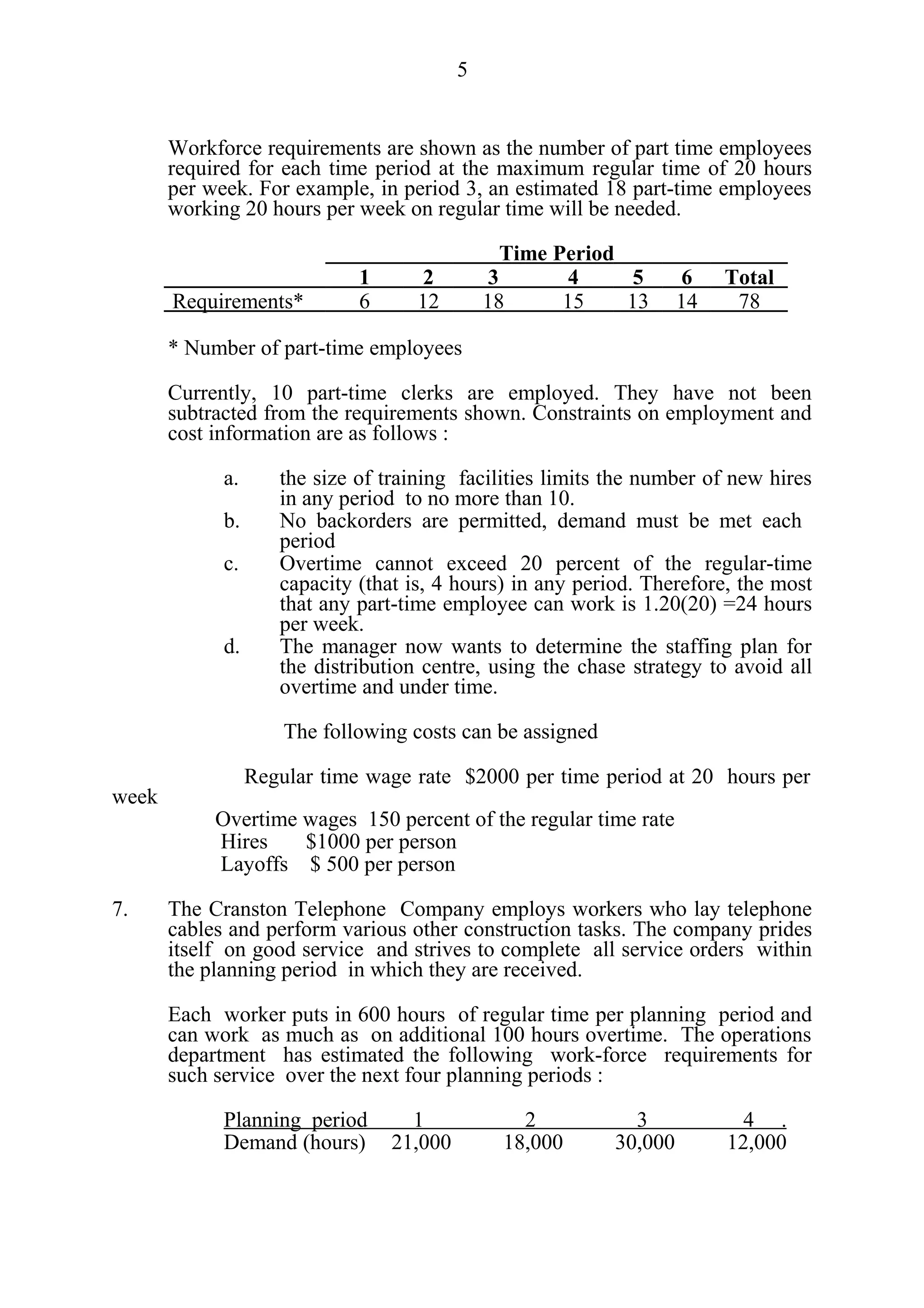
       Workforce requirements are shown as the number of part time employees
       required for each time period at the maximum regular time of 20 hours
       per week. For example, in period 3, an estimated 18 part-time employees
       working 20 hours per week on regular time will be needed.

                                                  Time Period
                              1       2         3        4     5      6   Total
       Requirements*          6      12        18       15    13     14    78

       * Number of part-time employees

       Currently, 10 part-time clerks are employed. They have not been
       subtracted from the requirements shown. Constraints on employment and
       cost information are as follows :

             a.      the size of training facilities limits the number of new hires
                     in any period to no more than 10.
             b.      No backorders are permitted, demand must be met each
                     period
             c.      Overtime cannot exceed 20 percent of the regular-time
                     capacity (that is, 4 hours) in any period. Therefore, the most
                     that any part-time employee can work is 1.20(20) =24 hours
                     per week.
             d.      The manager now wants to determine the staffing plan for
                     the distribution centre, using the chase strategy to avoid all
                     overtime and under time.

                      The following costs can be assigned

                  Regular time wage rate $2000 per time period at 20 hours per
week
            Overtime wages 150 percent of the regular time rate
            Hires    $1000 per person
            Layoffs $ 500 per person

7.     The Cranston Telephone Company employs workers who lay telephone
       cables and perform various other construction tasks. The company prides
       itself on good service and strives to complete all service orders within
       the planning period in which they are received.

       Each worker puts in 600 hours of regular time per planning period and
       can work as much as on additional 100 hours overtime. The operations
       department has estimated the following work-force requirements for
       such service over the next four planning periods :

             Planning period        1              2          3             4 .
             Demand (hours)       21,000         18,000     30,000        12,000
6

     Cranston pays regular time wages of Rs.6,000 per employee per period
     for any time worked upto 600 hours (including undertime). The
     overtime pay rate Rs.15 per hour over 600 hours. Hiring , training and
     outfitting a new employee costs Rs.8,000. Layoff costs are Rs.2, 000 per
     employee. Currently, 40 employees work for Cranston in this capacity.
     No delays in service, or backorders are allowed.

     a.     Develop a level workforce plan that uses only the overtime and
            undertime alternatives. Maximize the use of overtime during the
            peak period so as to minimize the workforce level and amount of
            undertime.
     b.     Prepare a chase strategy using only the workforce adjustment
            alternative of hiring and layoffs. What are the total numbers of
            employees hired and laid off?
     c.     Propose an effective mixed strategy plan.
     d.     Compare the total costs of the three plans.

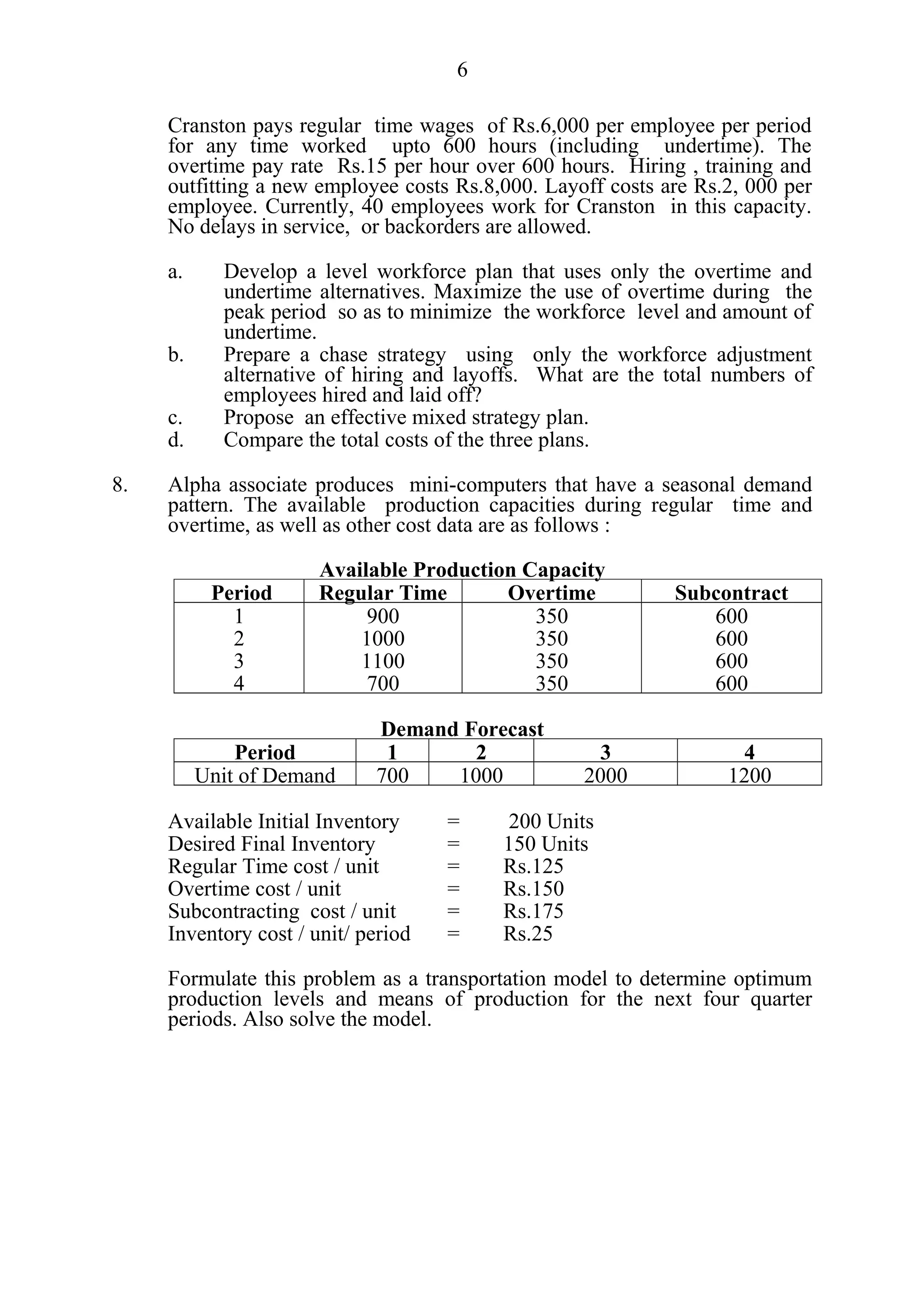
8.   Alpha associate produces mini-computers that have a seasonal demand
     pattern. The available production capacities during regular time and
     overtime, as well as other cost data are as follows :

                       Available Production Capacity
           Period      Regular Time       Overtime           Subcontract
             1              900              350                600
             2             1000              350                600
             3             1100              350                600
             4              700              350                600

                             Demand Forecast
              Period          1      2               3               4
          Unit of Demand     700   1000            2000            1200

     Available Initial Inventory     =     200 Units
     Desired Final Inventory         =    150 Units
     Regular Time cost / unit        =    Rs.125
     Overtime cost / unit            =    Rs.150
     Subcontracting cost / unit      =    Rs.175
     Inventory cost / unit/ period   =    Rs.25

     Formulate this problem as a transportation model to determine optimum
     production levels and means of production for the next four quarter
     periods. Also solve the model.
6

     Cranston pays regular time wages of Rs.6,000 per employee per period
     for any time worked upto 600 hours (including undertime). The
     overtime pay rate Rs.15 per hour over 600 hours. Hiring , training and
     outfitting a new employee costs Rs.8,000. Layoff costs are Rs.2, 000 per
     employee. Currently, 40 employees work for Cranston in this capacity.
     No delays in service, or backorders are allowed.

     a.     Develop a level workforce plan that uses only the overtime and
            undertime alternatives. Maximize the use of overtime during the
            peak period so as to minimize the workforce level and amount of
            undertime.
     b.     Prepare a chase strategy using only the workforce adjustment
            alternative of hiring and layoffs. What are the total numbers of
            employees hired and laid off?
     c.     Propose an effective mixed strategy plan.
     d.     Compare the total costs of the three plans.

8.   Alpha associate produces mini-computers that have a seasonal demand
     pattern. The available production capacities during regular time and
     overtime, as well as other cost data are as follows :

                       Available Production Capacity
           Period      Regular Time       Overtime           Subcontract
             1              900              350                600
             2             1000              350                600
             3             1100              350                600
             4              700              350                600

                             Demand Forecast
              Period          1      2               3               4
          Unit of Demand     700   1000            2000            1200

     Available Initial Inventory     =     200 Units
     Desired Final Inventory         =    150 Units
     Regular Time cost / unit        =    Rs.125
     Overtime cost / unit            =    Rs.150
     Subcontracting cost / unit      =    Rs.175
     Inventory cost / unit/ period   =    Rs.25

     Formulate this problem as a transportation model to determine optimum
     production levels and means of production for the next four quarter
     periods. Also solve the model.

Aggrigate planning copy

  • 1.
    1 AGGREGATE PLANNING The Concept of Aggregation Aggregate planning is essentially a "big picture" approach to planning. We use the term aggregate plan because the plans are developed for product lines or product families rather than individual products. For example, aggregate plan in a firm producing television sets specifies how many television sets are to be produced without identifying them by size or model. Resource capacity is also expressed in aggregate terms, as labour or machine hours without specifying the type of labour or type of machine and they may be given only for critical machines or work centres. Objectives of Aggregate Planning (i) The overall objective is to balance conflicting objectives involving customer service, work force stability, cost and profit. (ii) To establish company - wide strategic plan for allocating resources. (iii) To develop an economic strategy to meet customer demand. The Purpose and Scope of Aggregate Planning Aggregate planning begins with a forecast of aggregate demand for a product, over the intermediate time horizon. Then a general plan is prepared to meet the demand requirement by setting output, work force and finished goods inventory levels. Alternate plans must be examined in light of feasibility and cost. Within the intermediate time horizon ( 3 to 12 months) of the production plan, it is usually not feasible to increase capacity by building new facilities or purchasing new equipments. However, it is feasible to hire or lay-off workers, increase or reduce the working hours (add an extra shift, sub contract, use overtime) or build up or deplete inventory levels. i.e., Aggregate planning involves planning the best quantity to produce during time periods in the intermediate - range horizon (often 3 months to 1 year) and planning the lowest cost method of providing the adjustable capacity to accommodate the production requirements. For manufacturing operations, aggregate planning involves planning workforce size, production rate (work hours per week) and inventory levels.
  • 2.
    2 Nature of AggregatePlanning Decisions The different capacities which are generally used to manufacture products are as listed below : * Regular time production capacity * Subcontracting capacity * Overtime capacity * Hiring and firing capacity Some time, the regular time production capacity may not be sufficient to cope with the demands of various products. Under such situation, we can use other optional capacities in smoothing the impact of demand fluctuations. Given the sales forecast, the factory capacity, aggregate inventory levels and the size of the work force, the manager must decide at what rate of production to operate the plant over the intermediate term. Intermediate -range planning is generally known as aggregate planning. Once various capacities which are available under different categories are known, the next task is to identify a feasible and optimal combination of these capacities to manufacture the given set of products as per predetermined production volumes such that the total cost of manufacturing is minimized. Since the company manufactures several products using the given set of facilities, requirements of resources of these products are to be aggregated into a common unit (Common product). Therefore the aggregate planning aims to find the best combination of various available capacities to match with the resource requirements in a given planning period at the most economical cost. Aggregate planning period range from an intermediate range of three months to one year. Aggregate Planning Strategies One can use any one or a combination of the following strategies for smoothing fluctuations in demand. Generally, a mixture of strategies is preferred. * Building and utilizing inventory through constant work force. * Varying the size of the work force. * Overtime utilization * Subcontracting If a single strategy is used to meet the demand, then it is called as a pure strategy. Each of the above strategies is called as a pure strategy. Instead of this, if a combination of the above pure strategies is used to meet the demand, then it is called as a mixed strategy. Several mixed strategies can be generated by taking two at a time, three at a time or four at a time of the above pure strategies. But all these mixed strategies may not be meaningful and practicable to implement. Only a limited combination of these strategies are used in practice. So, the objective of the aggregate planning is to generate such meaningful set of pure / mixed strategies (alternatives) evaluate them and select the most economical alternative for implementation. PROBLEMS - AGGREGATE PLANNING
  • 3.
    3 1. Sunrise Engineering Ltd. is involved in the manufacture of automotive gears. The organization cannot adopt a varying workforce strategy because of the nature of the job, which requires skilled workers. Since training and hiring / layoff costs would be significant, the organization decided to follow a varying inventory strategy to meet the fluctuating demand requirement. Develop an aggregate plan for a period of six months (from Jan to June) on the basis of the following information. Determine the total inventory holding costs and shortage costs that would be incurred by the organization at the end of the planning period. In which month(s) would the company not be able to meet the forecasted demand? Expected Monthly demand and number of working days is given below: Jan Feb Mar Apr May Jun Demand 5000 4800 5200 5500 4500 5100 Number of working day 22 24 23 24 23 24 Beginning Inventory : 1000 units No of workers : 26 Productivity per worker : 8 units per day Shortage cost=Rs.15 per unit Inventory holding cost = Rs.10 per unit. 2. A leading furniture company is expecting sales of 3500, 3300, 3000, 4000, 3700, 4000 and 4200 chairs for the coming seven months and the number of working days in the corresponding month is 25, 24, 25, 23, 22, 25 and 25 respectively. The company at present employs 30 workers and each worker is capable of making 1 chair every 3 hours. The hiring cost are Rs.4000 and layoff costs are Rs.5000. Develop an aggregate plan that satisfies the requirements of the organization. The organization plans to adopt varying work force strategy. 3. Maruthi Refrigeration System manufactures refrigerators in three capacities - 165 ltrs, 210 ltrs and 250 ltrs. The quarterly sales figures for the last year are 60,000, 70,000, 40,000 and 30,000 respectively. The Production Manager is doing aggregate production planning. He can adopt either level production strategy or chase production strategy. Which one he should adopt? The decision will be totally based on cost of strategy. Following information is also given : The cost of hiring a person = Rs.5,000 The cost of firing a person = Rs.20,000 Inventory carrying cost = Rs.20 per unit. The company has the total workforce of 100 and each employee can produce 500 units in a quarter. 4. The demand for product X (in number of units) during the last one year is given below : Month Jan Feb Mar Apr May Jun Jul Aug Sep Oct Nov Dec
  • 4.
    4 Demand 2000 800 900 600 1000 1200 1400 1300 1600 1800 2400 3000 Each worker produces 100 units of the product X. The current inventory level can be assumed to be zero and stock outs are allowed. The company can ask its employees to work overtime, if the demand increases. However, the over time is limited to 400 units. The company pays its employees on the basis of number of units produced. For every unit of production it pays Rs.500 to its employees. If an employee works overtime, he is paid at the rate of Rs.600 per unit. If the company subcontracts the work, it pay Rs.800 to the subcontractor. Inventory carrying cost for the company is Rs.50 per unit. If the company adds a worker in its workforce, it costs Rs.10,000 per employee. Similarly, if it reduces the number of employees from its workforce, it incurs a cost of Rs.5000 per employee. If the company follows level production strategy, calculate the cost of strategy. 5. The forecast for a group of items is given below : Quarter 1 2 3 4 5 6 7 8 Demand 270 220 470 670 450 270 200 370 (a) Suppose that the firm estimate that it costs Rs.150 per unit to increase the production rate. Rs.200 per unit to decrease the production rate, Rs.50 per unit per quarter to carry the items on inventory and Rs.100 per unit if subcontracted. Compare the cost incurred if pure strategies are followed. (b) Given these costs, evaluate the following mixed strategy. The company decides to maintain a constant production rate of 250 units per quarter and permits 20% overtime when the demand exceeds the production rate. The incremental costs of overtime is Rs.25 per unit. It plans to meet the excess demand by hiring and firing of workers. 6. The manger of a large distribution center must determine how many part time stock pickers to maintain on the payroll. She wants to develop a staffing plan with a level workforce, implemented with overtime and under time. Her objective is to keep the part-time work force stable and to minimize under time usage. She will achieve the goal by using the maximum amount of overtime possible in the peak period. The manager divides the next year into six time periods, each one two months long. Each part time employee can work a maximum of 20 hours per week on regular time, but the actual number can be less. The distribution center shortens each worker's day during slack periods, rather than per under time. Once on the payroll, each worker is used each day, but they may work only a few hours. Overtime can be used during peak periods to avoid excessive under time.
  • 5.
    5 Workforce requirements are shown as the number of part time employees required for each time period at the maximum regular time of 20 hours per week. For example, in period 3, an estimated 18 part-time employees working 20 hours per week on regular time will be needed. Time Period 1 2 3 4 5 6 Total Requirements* 6 12 18 15 13 14 78 * Number of part-time employees Currently, 10 part-time clerks are employed. They have not been subtracted from the requirements shown. Constraints on employment and cost information are as follows : a. the size of training facilities limits the number of new hires in any period to no more than 10. b. No backorders are permitted, demand must be met each period c. Overtime cannot exceed 20 percent of the regular-time capacity (that is, 4 hours) in any period. Therefore, the most that any part-time employee can work is 1.20(20) =24 hours per week. d. The manager now wants to determine the staffing plan for the distribution centre, using the chase strategy to avoid all overtime and under time. The following costs can be assigned Regular time wage rate $2000 per time period at 20 hours per week Overtime wages 150 percent of the regular time rate Hires $1000 per person Layoffs $ 500 per person 7. The Cranston Telephone Company employs workers who lay telephone cables and perform various other construction tasks. The company prides itself on good service and strives to complete all service orders within the planning period in which they are received. Each worker puts in 600 hours of regular time per planning period and can work as much as on additional 100 hours overtime. The operations department has estimated the following work-force requirements for such service over the next four planning periods : Planning period 1 2 3 4 . Demand (hours) 21,000 18,000 30,000 12,000
  • 6.
    6 Cranston pays regular time wages of Rs.6,000 per employee per period for any time worked upto 600 hours (including undertime). The overtime pay rate Rs.15 per hour over 600 hours. Hiring , training and outfitting a new employee costs Rs.8,000. Layoff costs are Rs.2, 000 per employee. Currently, 40 employees work for Cranston in this capacity. No delays in service, or backorders are allowed. a. Develop a level workforce plan that uses only the overtime and undertime alternatives. Maximize the use of overtime during the peak period so as to minimize the workforce level and amount of undertime. b. Prepare a chase strategy using only the workforce adjustment alternative of hiring and layoffs. What are the total numbers of employees hired and laid off? c. Propose an effective mixed strategy plan. d. Compare the total costs of the three plans. 8. Alpha associate produces mini-computers that have a seasonal demand pattern. The available production capacities during regular time and overtime, as well as other cost data are as follows : Available Production Capacity Period Regular Time Overtime Subcontract 1 900 350 600 2 1000 350 600 3 1100 350 600 4 700 350 600 Demand Forecast Period 1 2 3 4 Unit of Demand 700 1000 2000 1200 Available Initial Inventory = 200 Units Desired Final Inventory = 150 Units Regular Time cost / unit = Rs.125 Overtime cost / unit = Rs.150 Subcontracting cost / unit = Rs.175 Inventory cost / unit/ period = Rs.25 Formulate this problem as a transportation model to determine optimum production levels and means of production for the next four quarter periods. Also solve the model.
  • 7.
    6 Cranston pays regular time wages of Rs.6,000 per employee per period for any time worked upto 600 hours (including undertime). The overtime pay rate Rs.15 per hour over 600 hours. Hiring , training and outfitting a new employee costs Rs.8,000. Layoff costs are Rs.2, 000 per employee. Currently, 40 employees work for Cranston in this capacity. No delays in service, or backorders are allowed. a. Develop a level workforce plan that uses only the overtime and undertime alternatives. Maximize the use of overtime during the peak period so as to minimize the workforce level and amount of undertime. b. Prepare a chase strategy using only the workforce adjustment alternative of hiring and layoffs. What are the total numbers of employees hired and laid off? c. Propose an effective mixed strategy plan. d. Compare the total costs of the three plans. 8. Alpha associate produces mini-computers that have a seasonal demand pattern. The available production capacities during regular time and overtime, as well as other cost data are as follows : Available Production Capacity Period Regular Time Overtime Subcontract 1 900 350 600 2 1000 350 600 3 1100 350 600 4 700 350 600 Demand Forecast Period 1 2 3 4 Unit of Demand 700 1000 2000 1200 Available Initial Inventory = 200 Units Desired Final Inventory = 150 Units Regular Time cost / unit = Rs.125 Overtime cost / unit = Rs.150 Subcontracting cost / unit = Rs.175 Inventory cost / unit/ period = Rs.25 Formulate this problem as a transportation model to determine optimum production levels and means of production for the next four quarter periods. Also solve the model.