Capacity Planning

    28th October
Capacity Planning (Book: B.
              Mahadevan)
• It is a long term strategic decision that
  establishes a firm overall level of resources
• It is the process of determining the necessary
  people, machines and physical resources to
  meet the production objectives of the firm
Strategies for capacity expansion
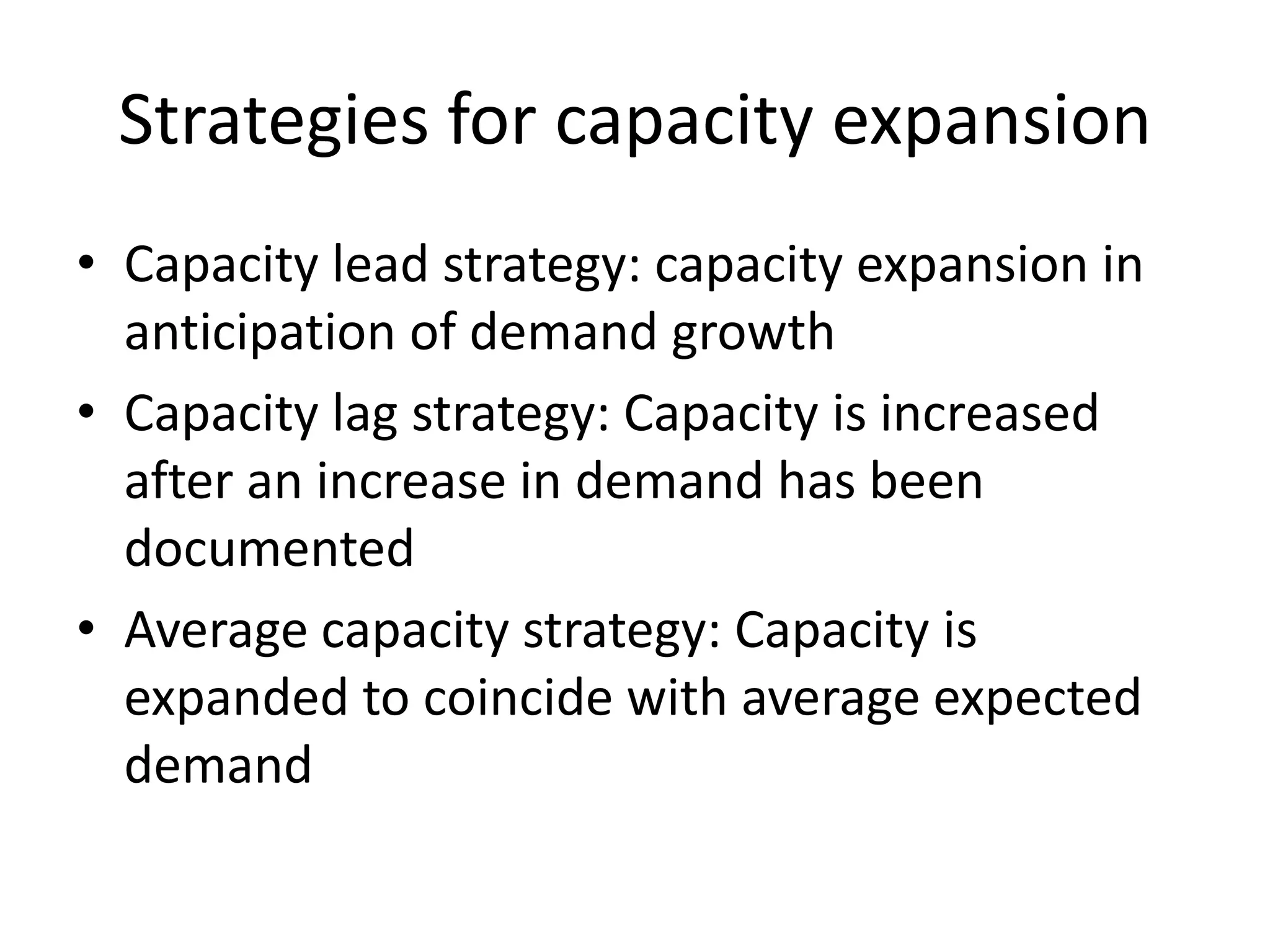
• Capacity lead strategy: capacity expansion in
  anticipation of demand growth
• Capacity lag strategy: Capacity is increased
  after an increase in demand has been
  documented
• Average capacity strategy: Capacity is
  expanded to coincide with average expected
  demand
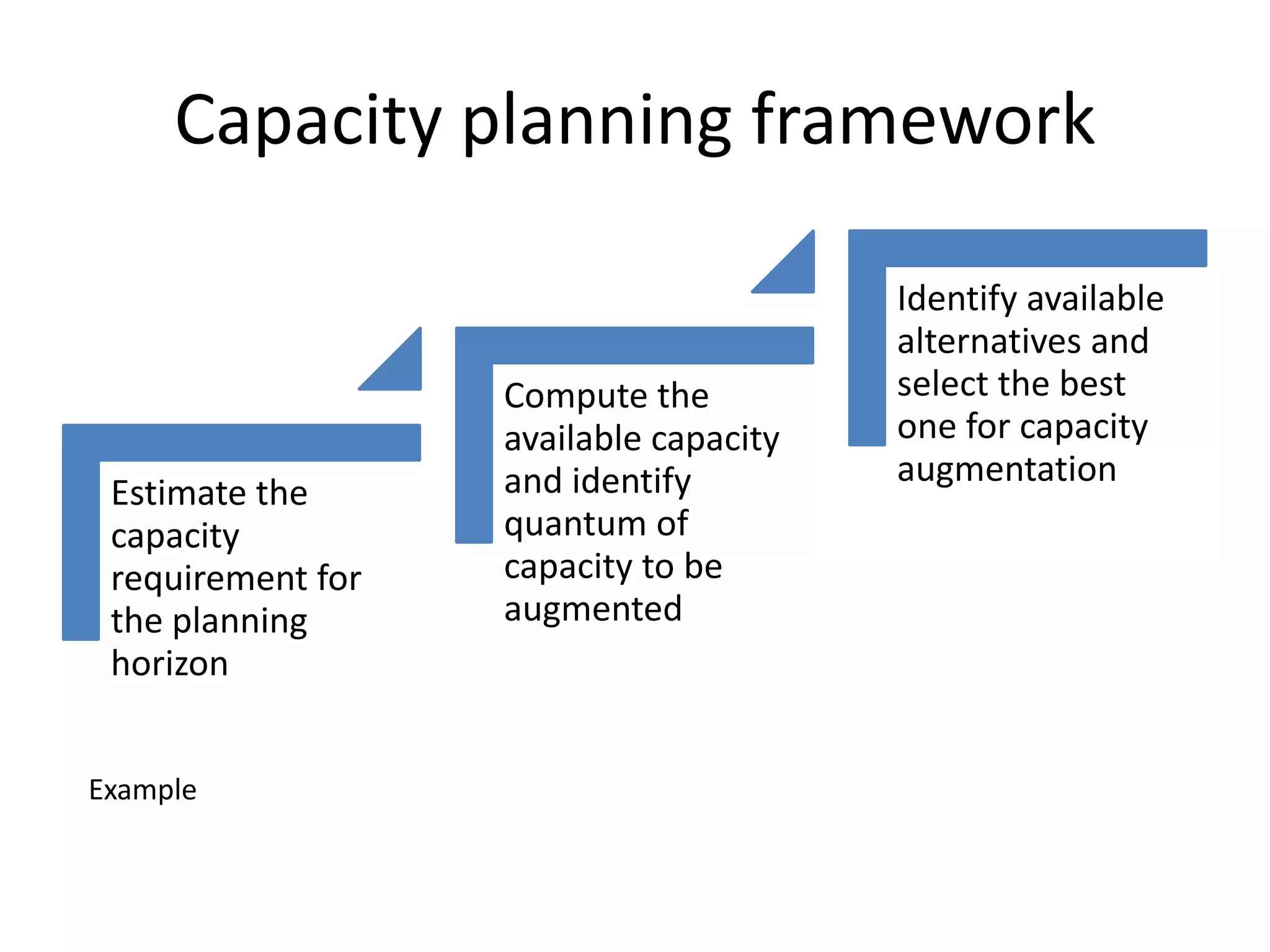
Capacity planning framework

                                        Identify available
                                        alternatives and
                   Compute the          select the best
                   available capacity   one for capacity
                   and identify         augmentation
 Estimate the
 capacity          quantum of
 requirement for   capacity to be
 the planning      augmented
 horizon


Example
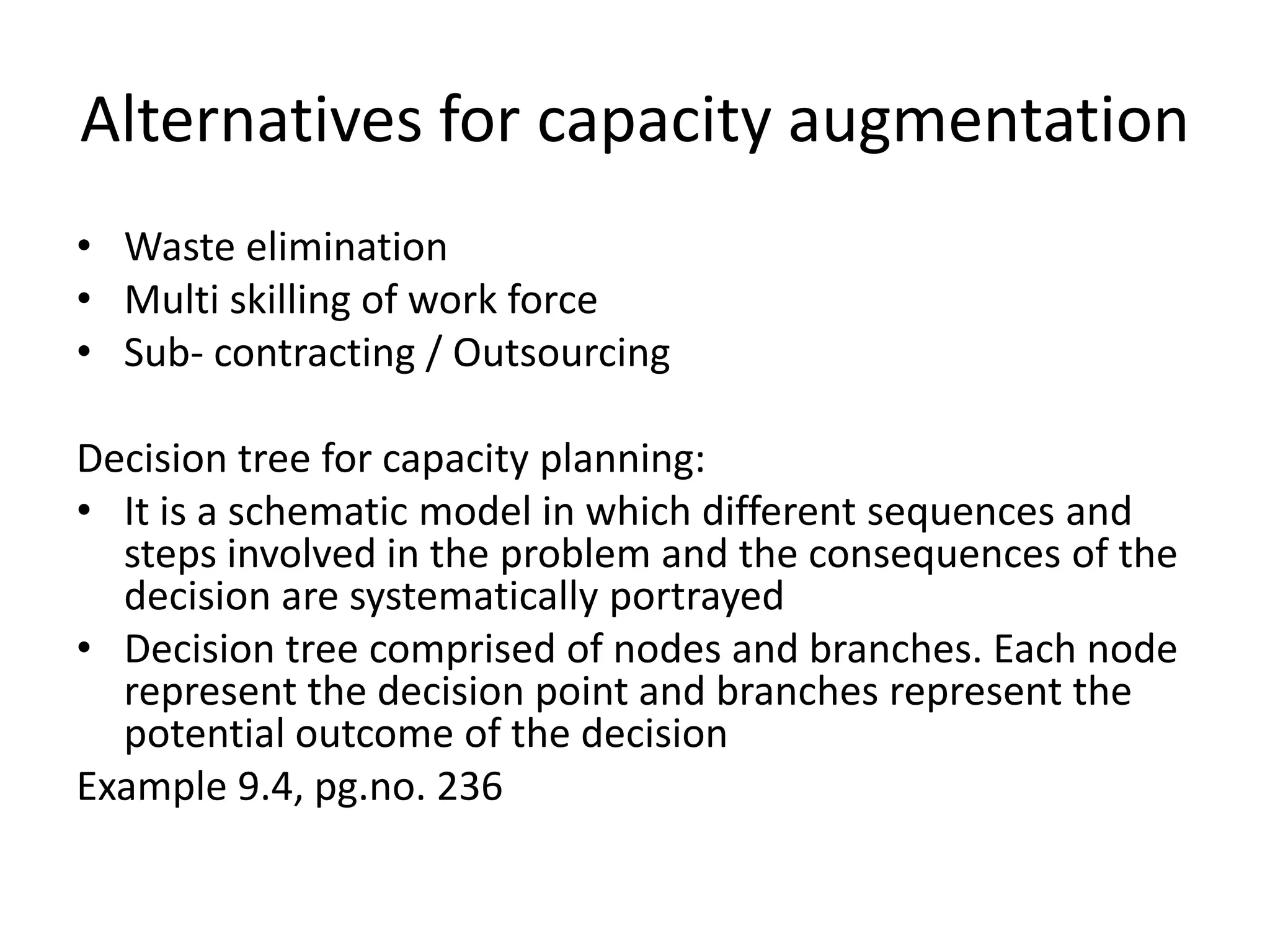
Alternatives for capacity augmentation
• Waste elimination
• Multi skilling of work force
• Sub- contracting / Outsourcing

Decision tree for capacity planning:
• It is a schematic model in which different sequences and
  steps involved in the problem and the consequences of the
  decision are systematically portrayed
• Decision tree comprised of nodes and branches. Each node
  represent the decision point and branches represent the
  potential outcome of the decision
Example 9.4, pg.no. 236
Aggregate Planning

       11th Nov 2010
  Production and Operations
Management: Everette E. adam, Jr.
       Ronald J. Ebert
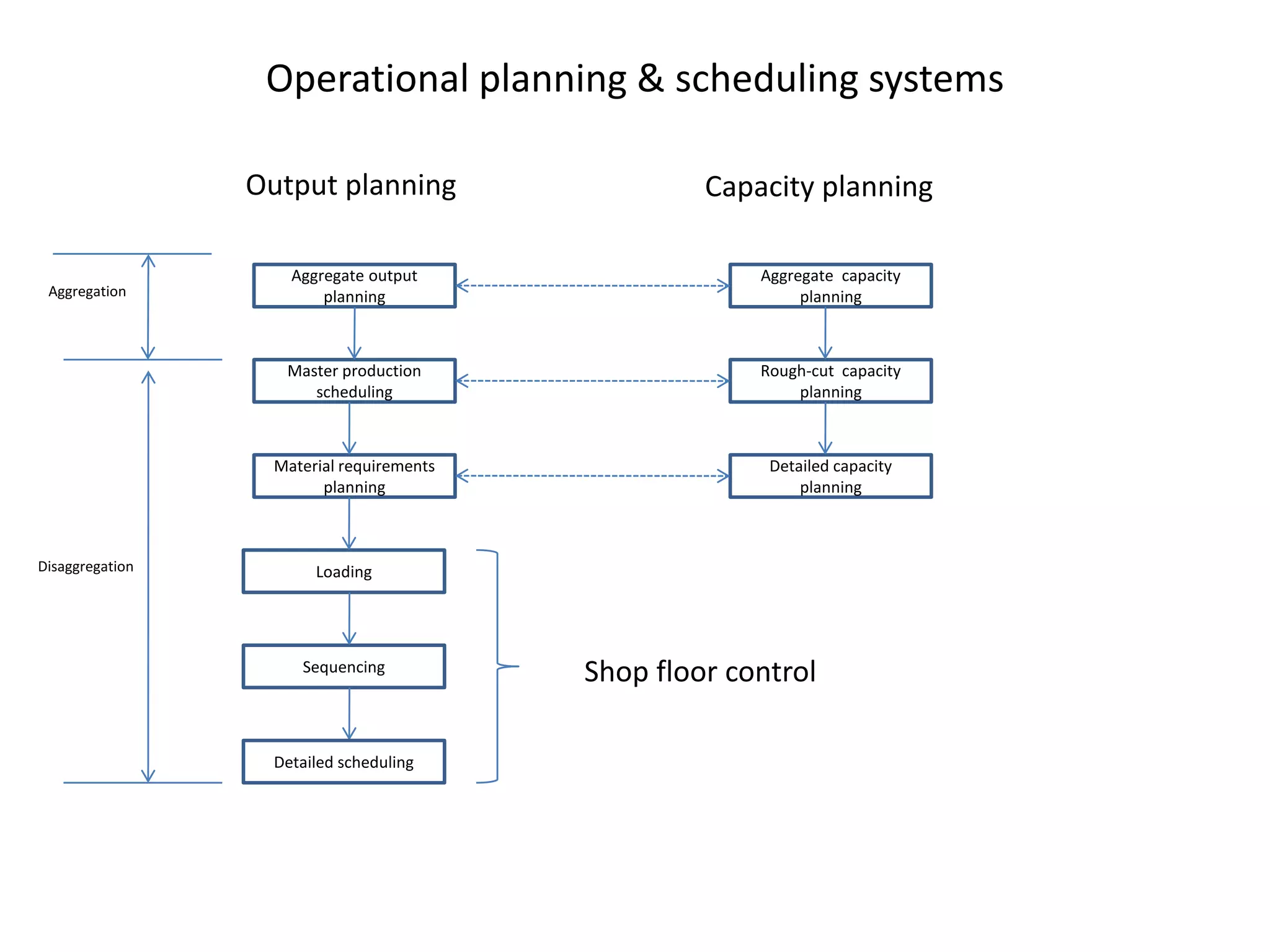
Operational planning & scheduling systems

                 Output planning                    Capacity planning

                     Aggregate output                   Aggregate capacity
 Aggregation             planning                            planning


                    Master production                   Rough-cut capacity
                       scheduling                           planning


                   Material requirements                 Detailed capacity
                         planning                            planning


Disaggregation          Loading


                      Sequencing
                                           Shop floor control

                   Detailed scheduling
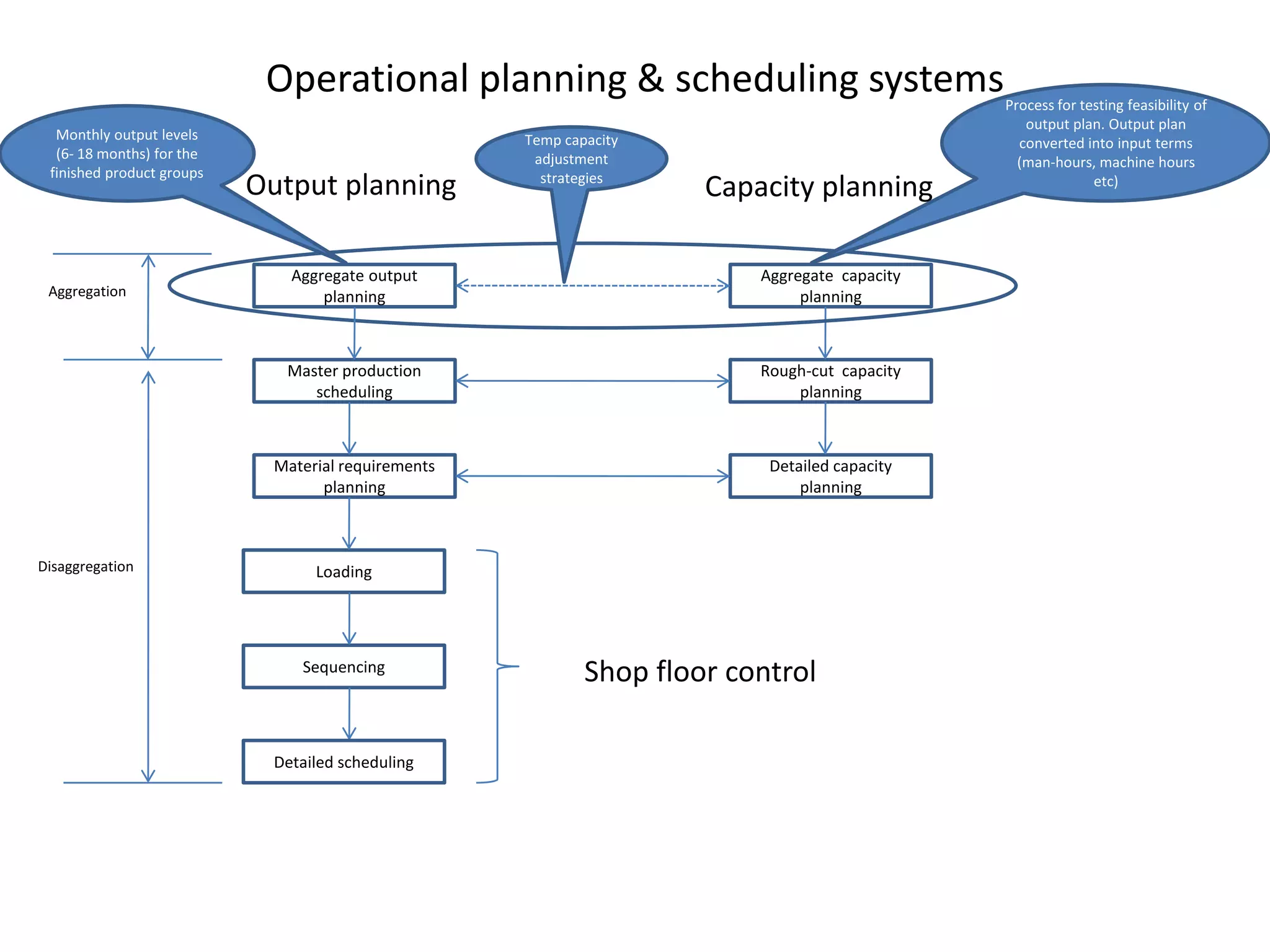
Operational planning & scheduling systems                          Process for testing feasibility of
                                                                                                  output plan. Output plan
  Monthly output levels                              Temp capacity                               converted into input terms
  (6- 18 months) for the                              adjustment                                 (man-hours, machine hours
 finished product groups
                           Output planning             strategies
                                                                      Capacity planning                      etc)


                               Aggregate output                           Aggregate capacity
 Aggregation                       planning                                    planning


                              Master production                           Rough-cut capacity
                                 scheduling                                   planning


                             Material requirements                         Detailed capacity
                                   planning                                    planning


Disaggregation                    Loading


                                Sequencing
                                                             Shop floor control

                             Detailed scheduling
The aggregate planning process

Objective of aggregate planning frequently is to minimize total cost over the planning
horizon. Other objectives should be considered:


•maximize customer service
•minimize inventory investment
•minimize changes in workforce levels
•minimize changes in production rates
•maximize utilization of plant and equipment
The aggregate planning process

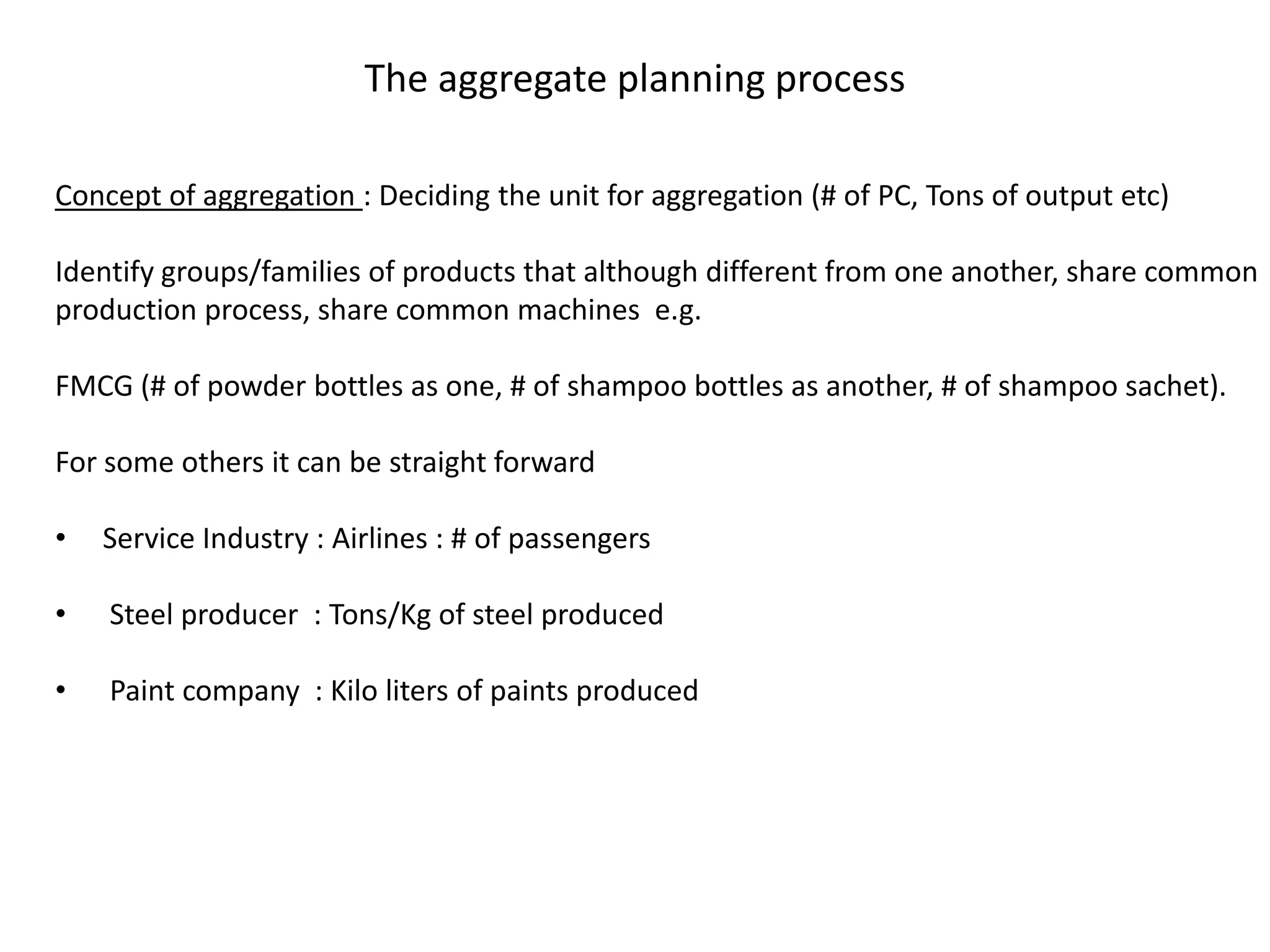
Concept of aggregation : Deciding the unit for aggregation (# of PC, Tons of output etc)

Identify groups/families of products that although different from one another, share common
production process, share common machines e.g.

FMCG (# of powder bottles as one, # of shampoo bottles as another, # of shampoo sachet).

For some others it can be straight forward

•   Service Industry : Airlines : # of passengers

•   Steel producer : Tons/Kg of steel produced

•   Paint company : Kilo liters of paints produced
The aggregate planning process

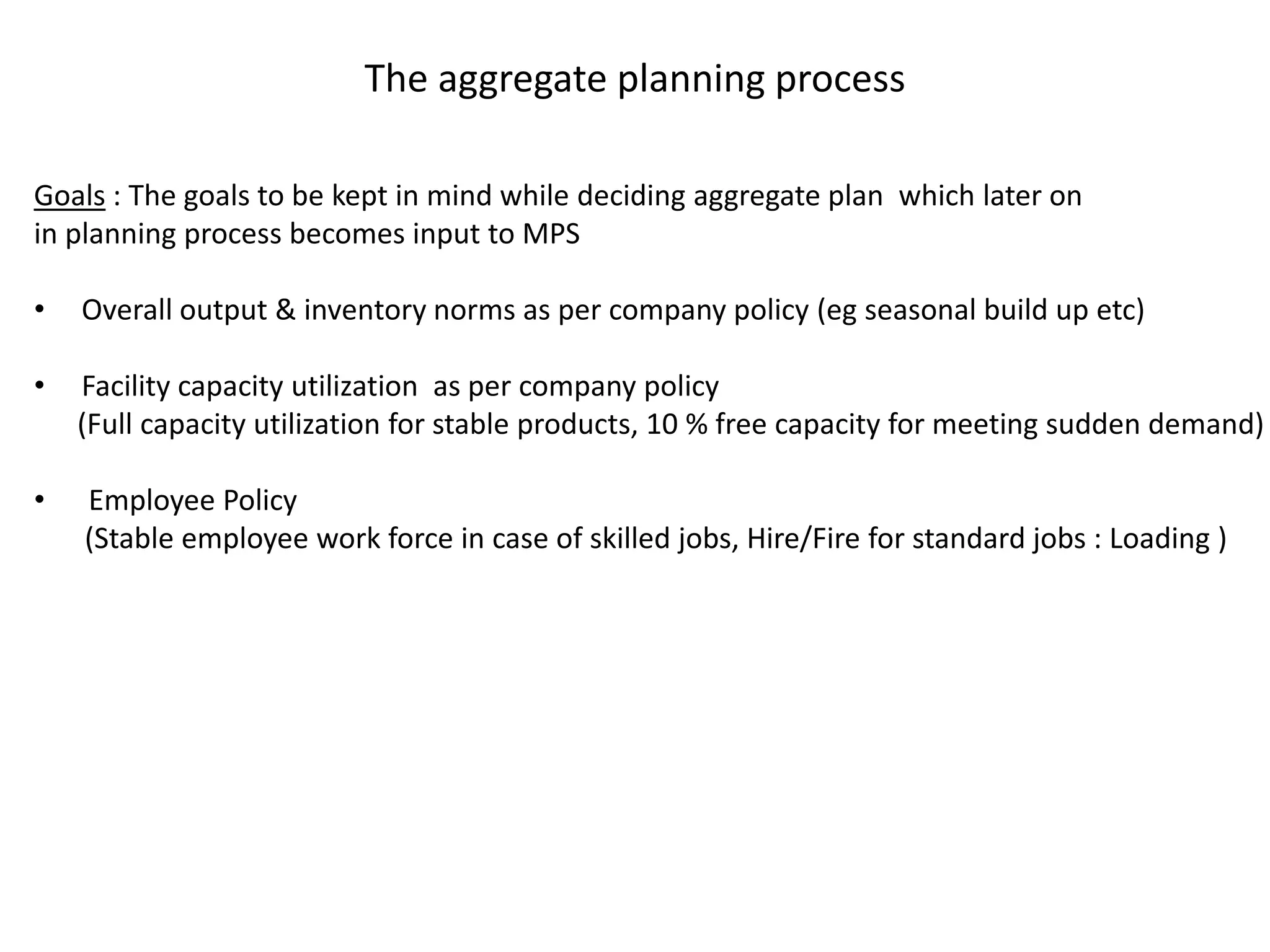
Goals : The goals to be kept in mind while deciding aggregate plan which later on
in planning process becomes input to MPS

•   Overall output & inventory norms as per company policy (eg seasonal build up etc)

•   Facility capacity utilization as per company policy
    (Full capacity utilization for stable products, 10 % free capacity for meeting sudden demand)

•   Employee Policy
    (Stable employee work force in case of skilled jobs, Hire/Fire for standard jobs : Loading )
The aggregate planning process
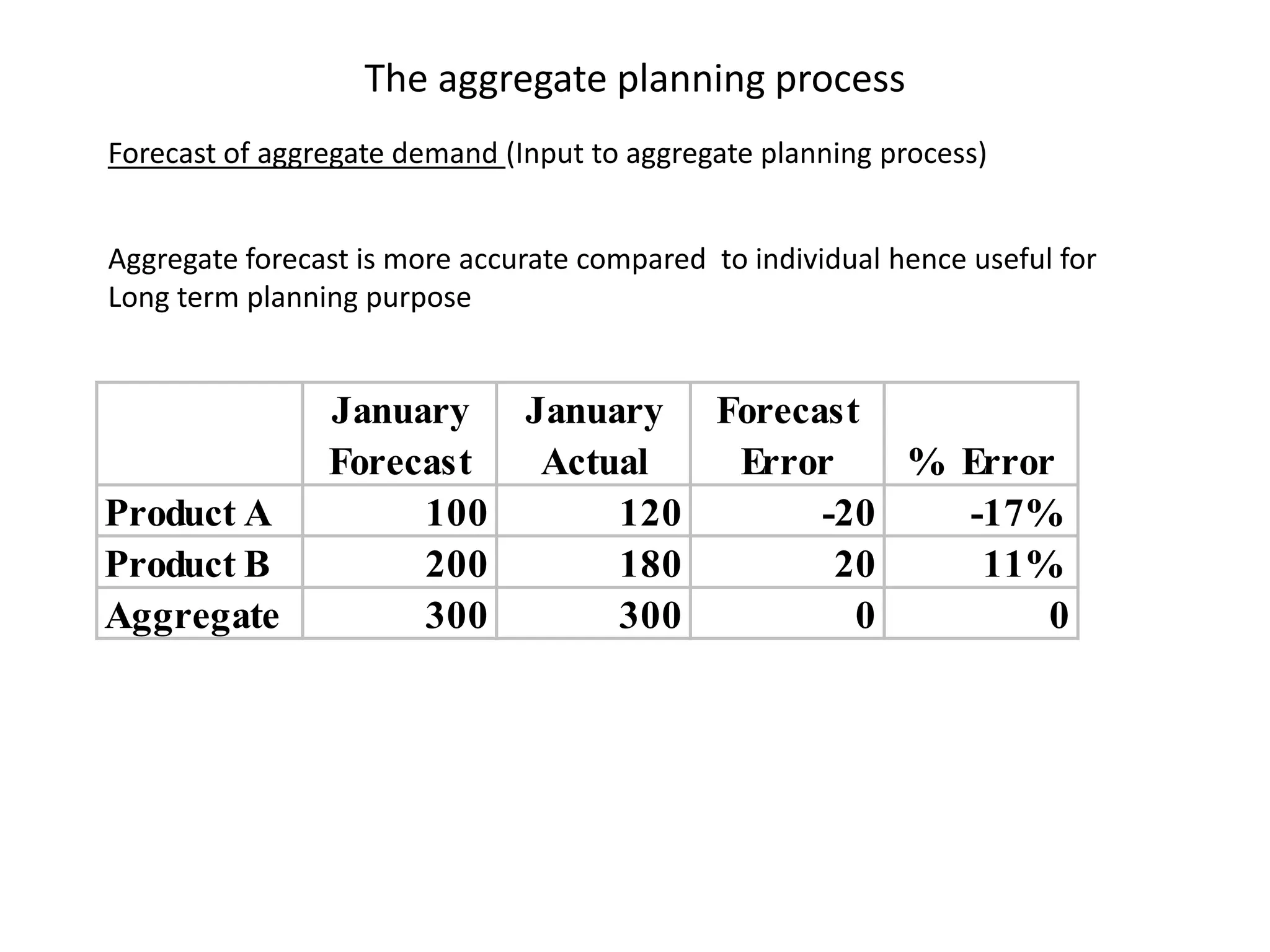
Forecast of aggregate demand (Input to aggregate planning process)


Aggregate forecast is more accurate compared to individual hence useful for
Long term planning purpose


                January January Forecast
                Forecast Actual  Error    % Error
Product A            100     120      -20   -17%
Product B            200     180       20    11%
Aggregate            300     300        0        0
The aggregate planning process
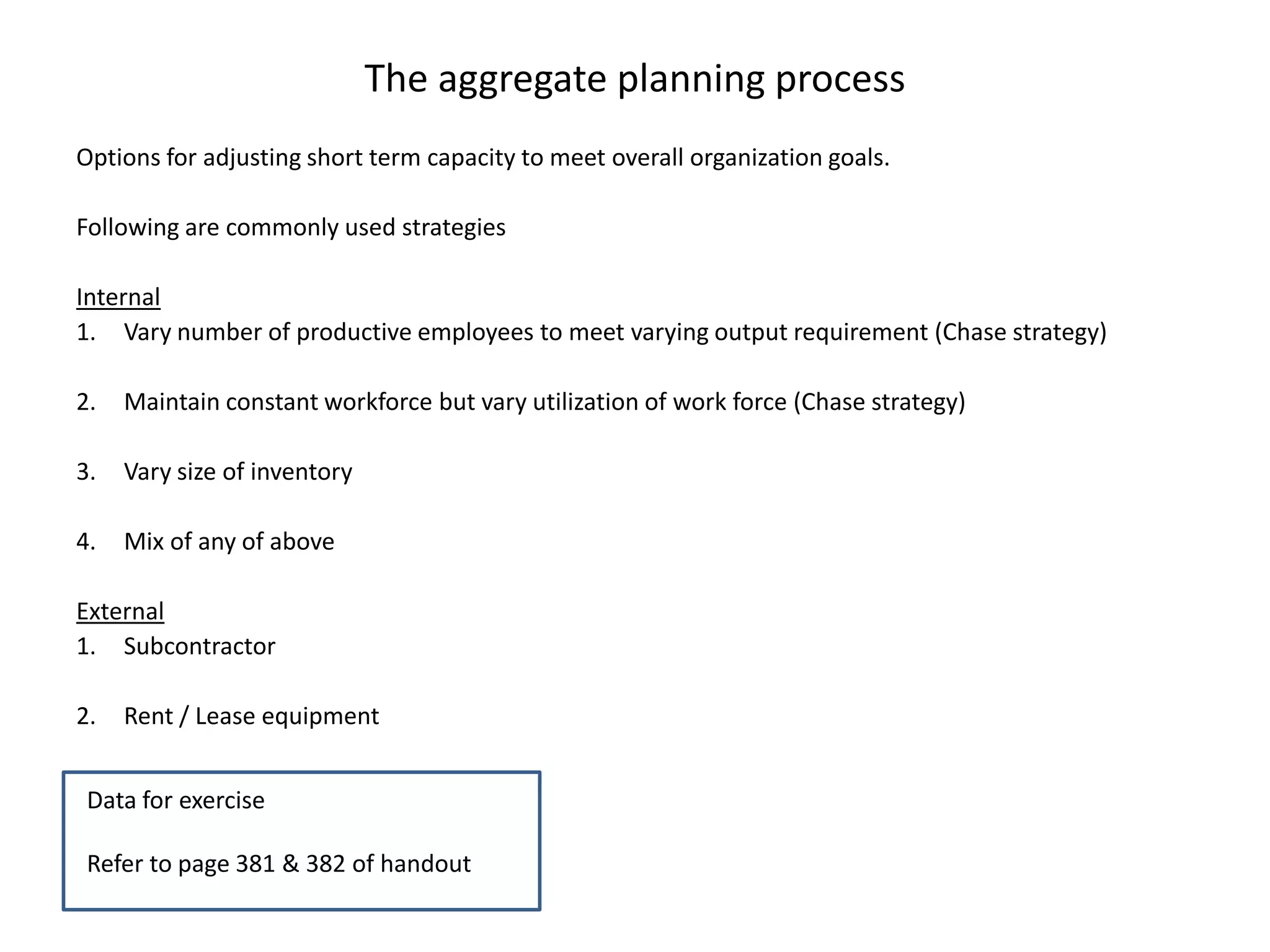
Options for adjusting short term capacity to meet overall organization goals.

Following are commonly used strategies

Internal
1. Vary number of productive employees to meet varying output requirement (Chase strategy)

2.   Maintain constant workforce but vary utilization of work force (Chase strategy)

3.   Vary size of inventory

4.   Mix of any of above

External
1. Subcontractor

2.   Rent / Lease equipment


 Data for exercise

 Refer to page 381 & 382 of handout
The aggregate planning process

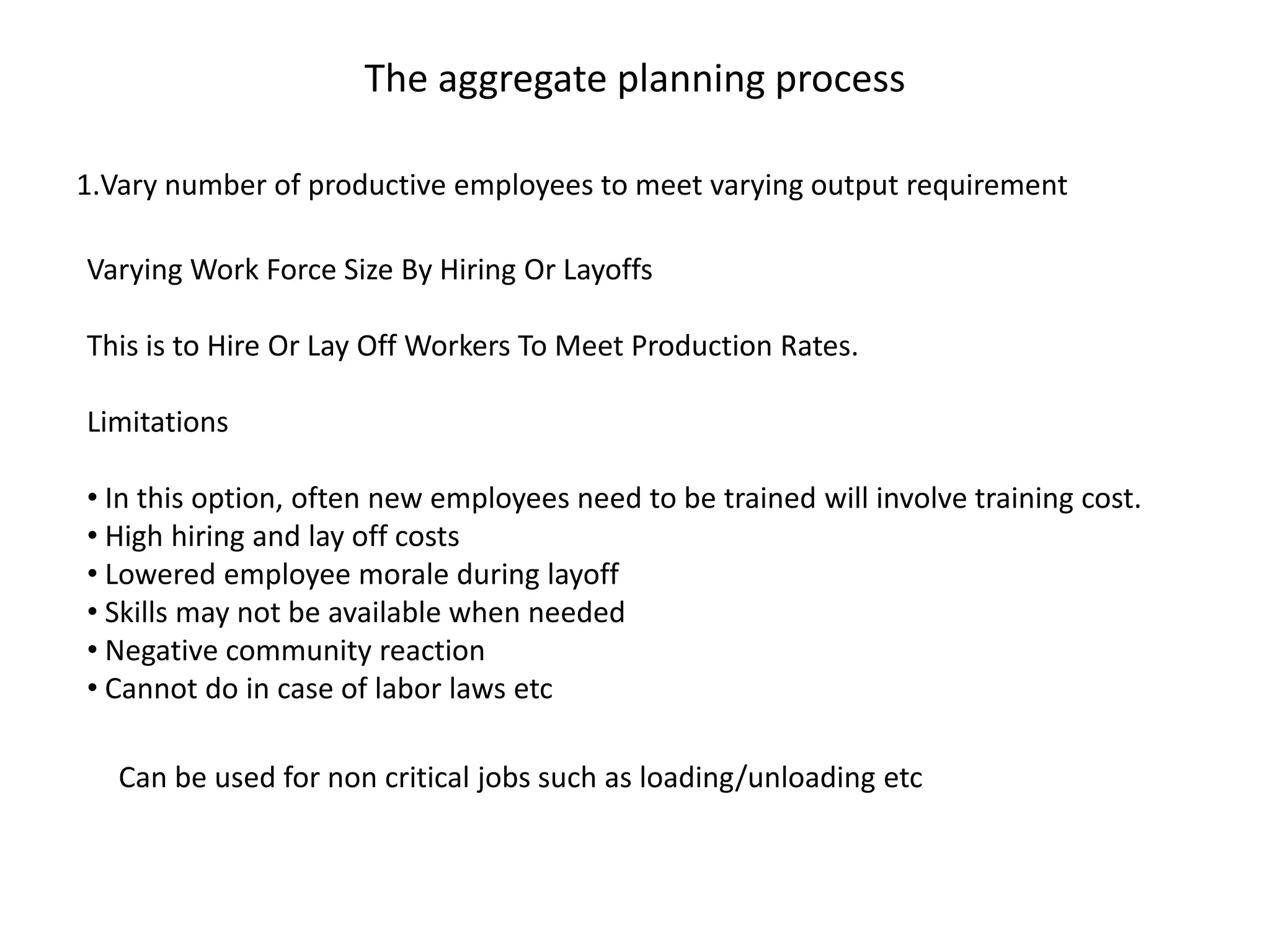
1.Vary number of productive employees to meet varying output requirement

Varying Work Force Size By Hiring Or Layoffs

This is to Hire Or Lay Off Workers To Meet Production Rates.

Limitations

• In this option, often new employees need to be trained will involve training cost.
• High hiring and lay off costs
• Lowered employee morale during layoff
• Skills may not be available when needed
• Negative community reaction
• Cannot do in case of labor laws etc

   Can be used for non critical jobs such as loading/unloading etc
The aggregate planning process

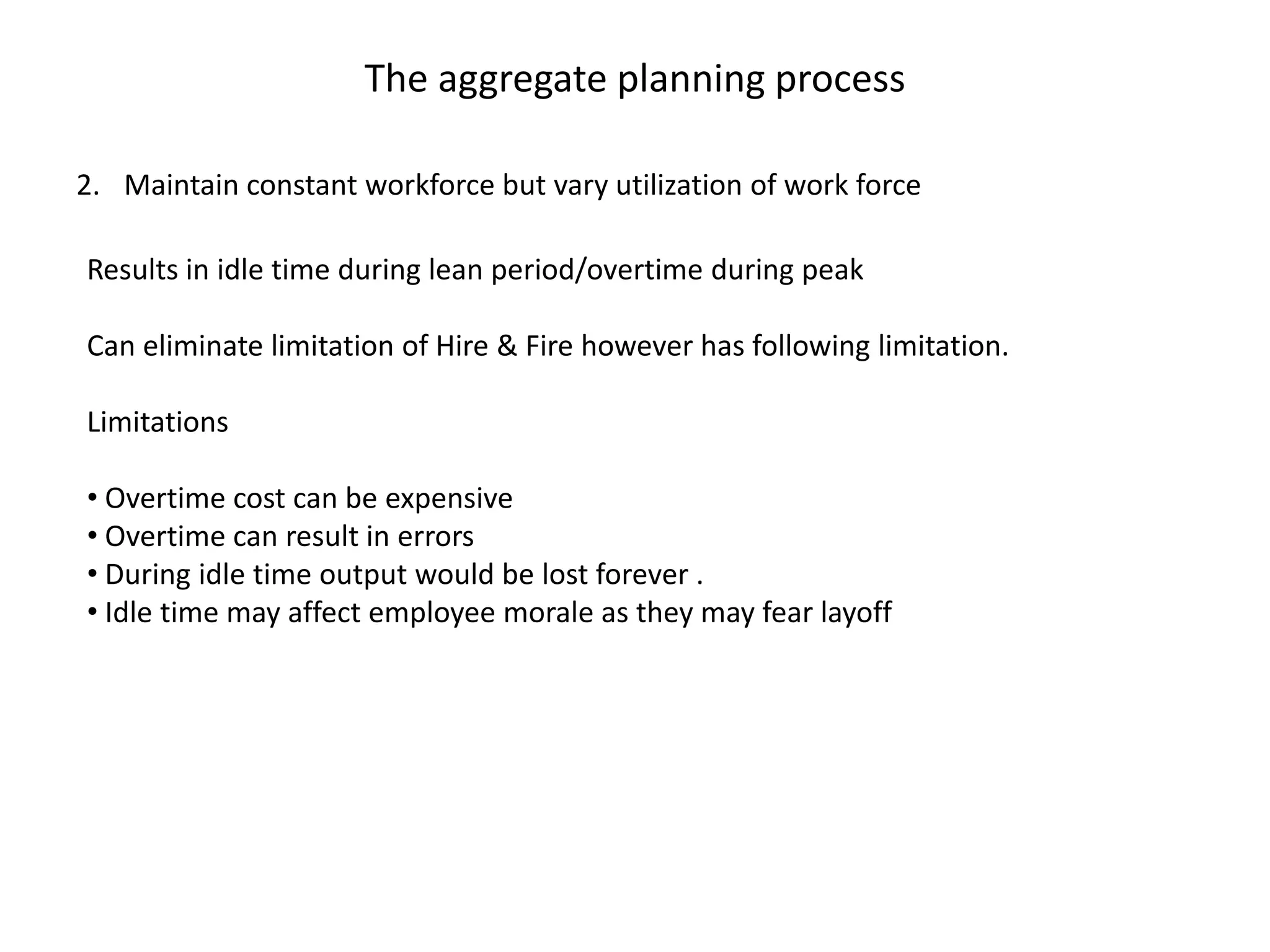
2. Maintain constant workforce but vary utilization of work force

Results in idle time during lean period/overtime during peak

Can eliminate limitation of Hire & Fire however has following limitation.

Limitations

• Overtime cost can be expensive
• Overtime can result in errors
• During idle time output would be lost forever .
• Idle time may affect employee morale as they may fear layoff
The aggregate planning process

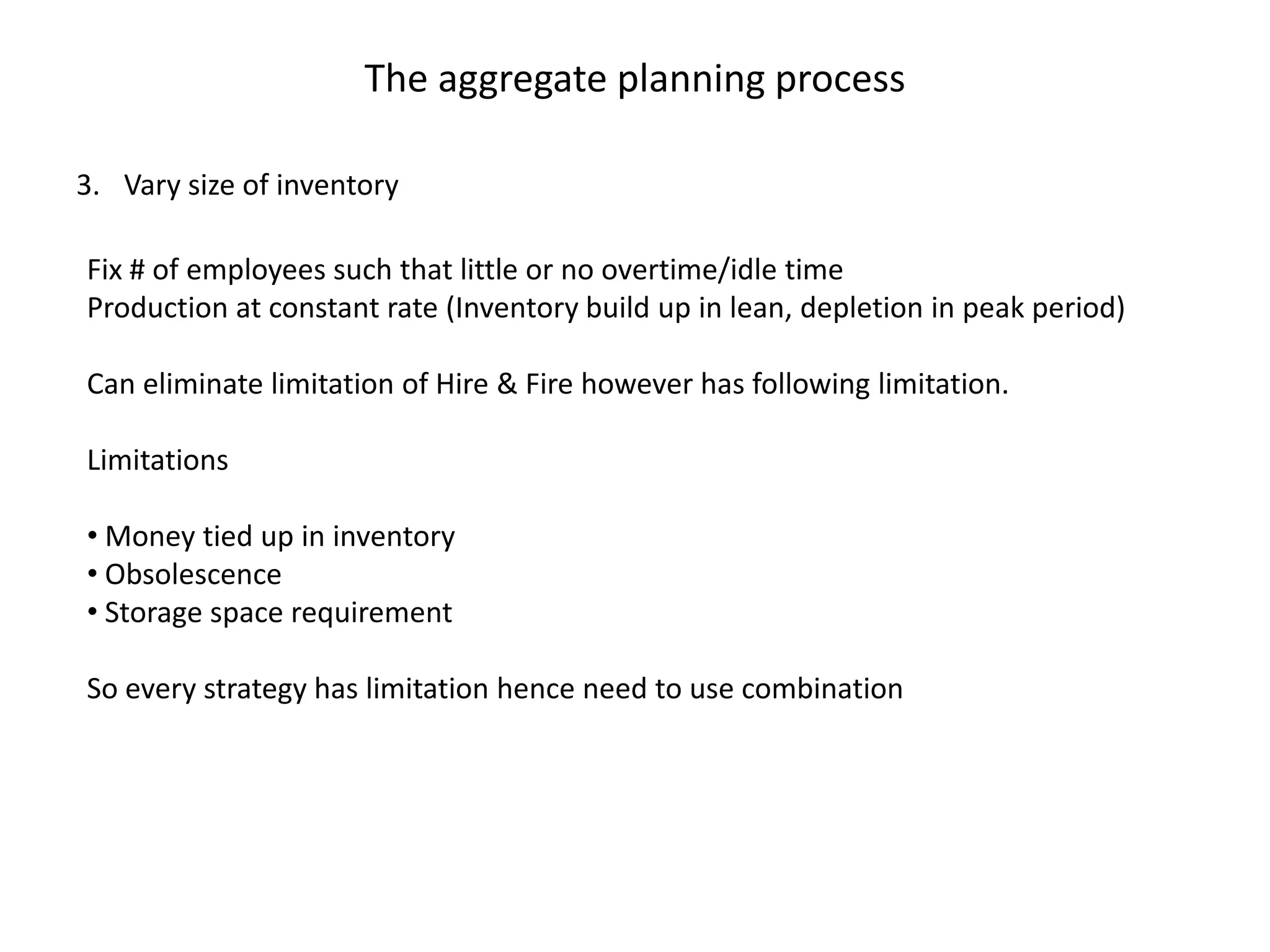
3. Vary size of inventory

Fix # of employees such that little or no overtime/idle time
Production at constant rate (Inventory build up in lean, depletion in peak period)

Can eliminate limitation of Hire & Fire however has following limitation.

Limitations

• Money tied up in inventory
• Obsolescence
• Storage space requirement

So every strategy has limitation hence need to use combination
The aggregate planning process

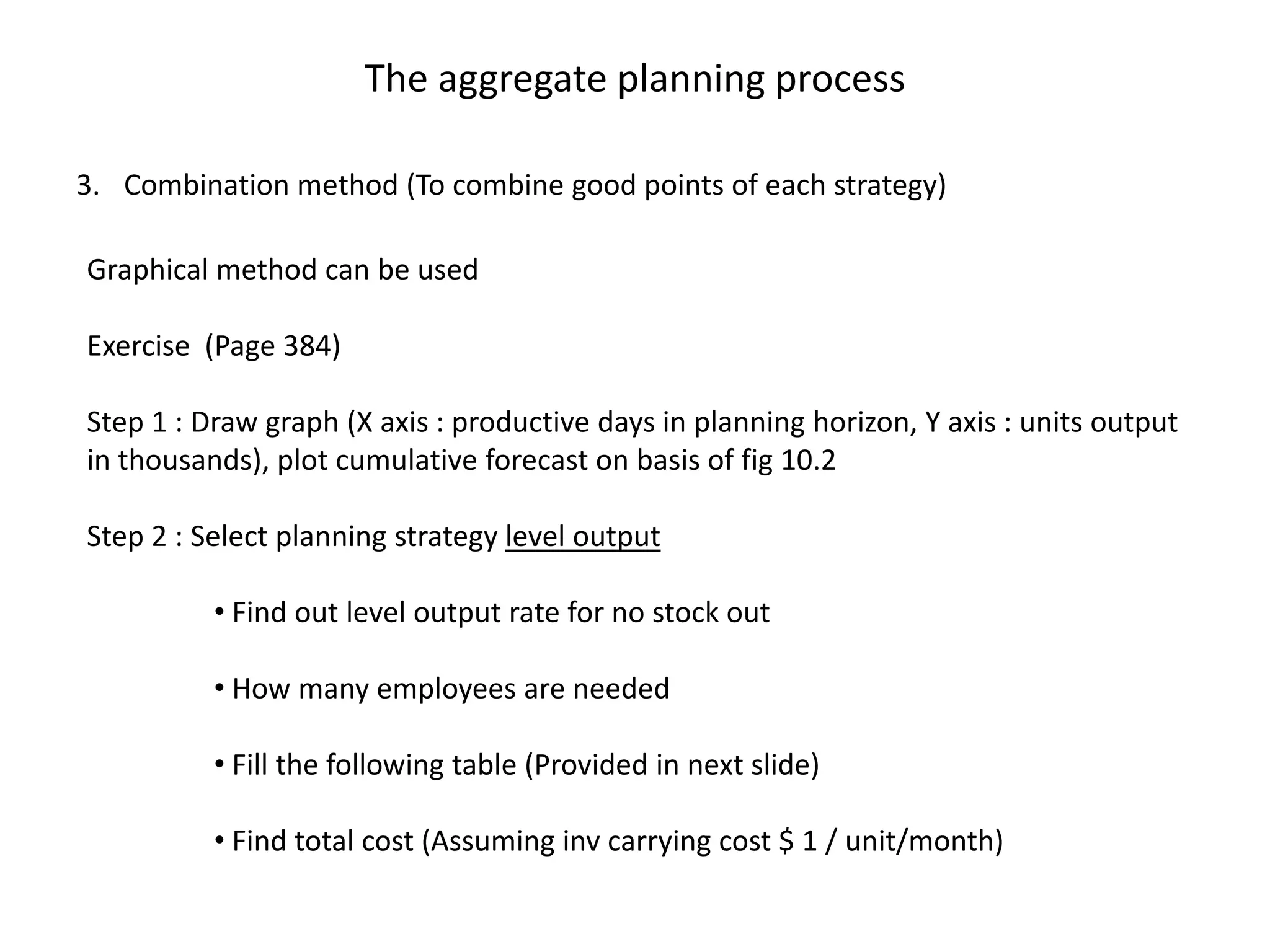
3. Combination method (To combine good points of each strategy)

Graphical method can be used

Exercise (Page 384)

Step 1 : Draw graph (X axis : productive days in planning horizon, Y axis : units output
in thousands), plot cumulative forecast on basis of fig 10.2

Step 2 : Select planning strategy level output

          • Find out level output rate for no stock out

          • How many employees are needed

          • Fill the following table (Provided in next slide)

          • Find total cost (Assuming inv carrying cost $ 1 / unit/month)
The aggregate planning process
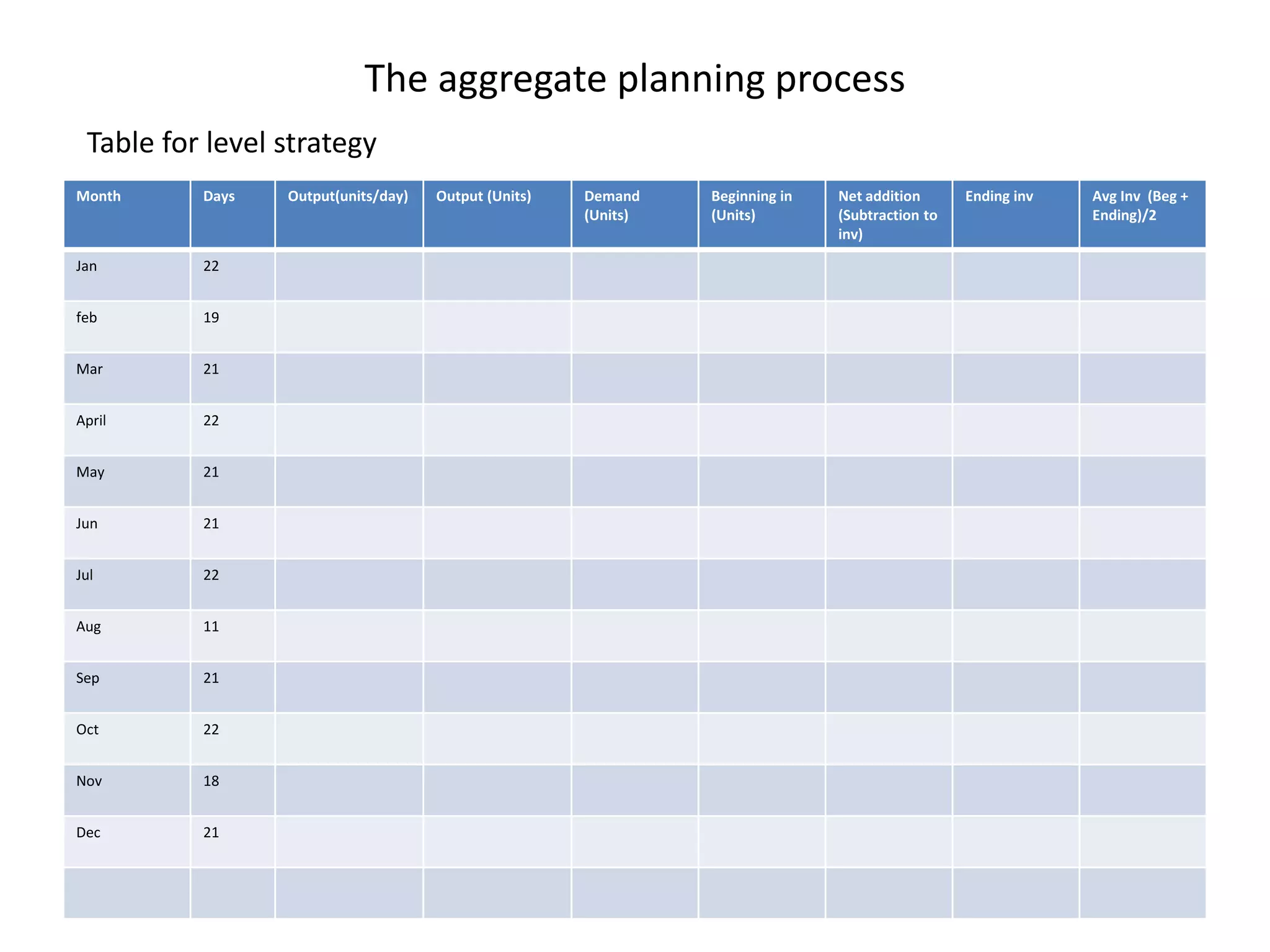
 Table for level strategy
Month     Days   Output(units/day)   Output (Units)   Demand    Beginning in   Net addition      Ending inv   Avg Inv (Beg +
                                                      (Units)   (Units)        (Subtraction to                Ending)/2
                                                                               inv)

Jan       22


feb       19


Mar       21


April     22


May       21


Jun       21


Jul       22


Aug       11


Sep       21


Oct       22


Nov       18


Dec       21
The aggregate planning process


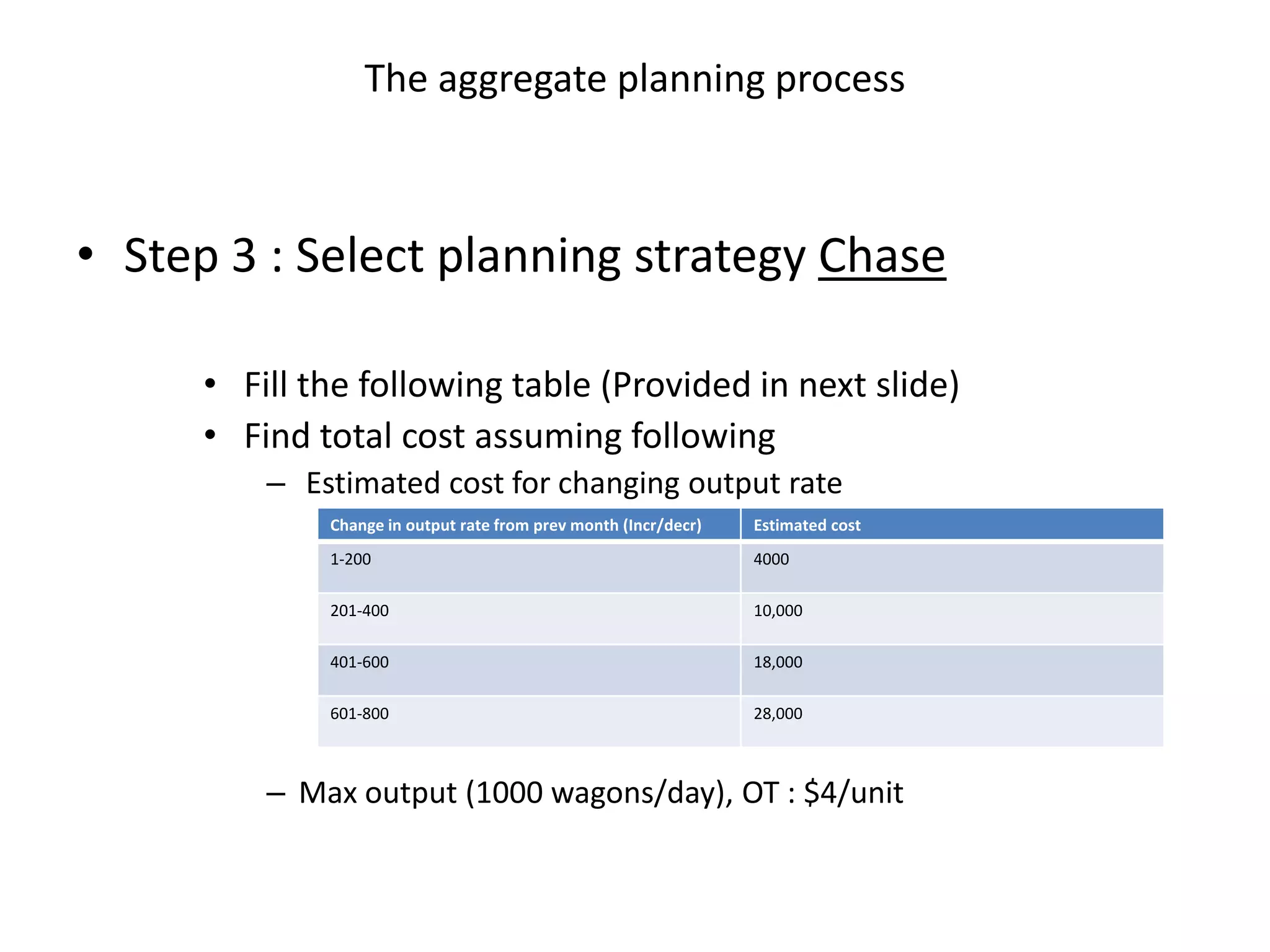
• Step 3 : Select planning strategy Chase

     • Fill the following table (Provided in next slide)
     • Find total cost assuming following
         – Estimated cost for changing output rate
             Change in output rate from prev month (Incr/decr)   Estimated cost
             1-200                                               4000

             201-400                                             10,000

             401-600                                             18,000

             601-800                                             28,000


         – Max output (1000 wagons/day), OT : $4/unit
The aggregate planning process
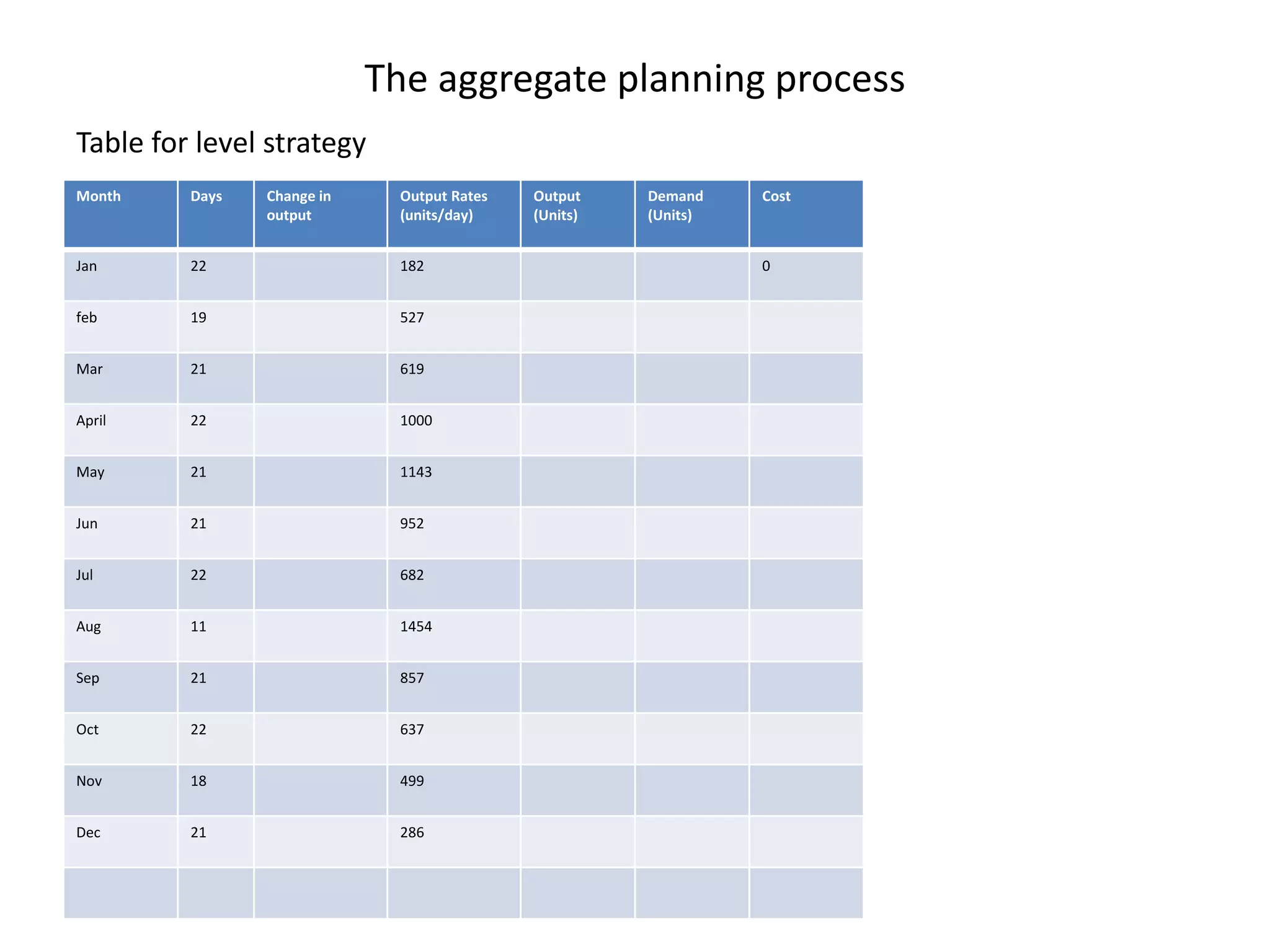
Table for level strategy
Month    Days   Change in    Output Rates   Output    Demand    Cost
                output       (units/day)    (Units)   (Units)


Jan      22                  182                                0


feb      19                  527


Mar      21                  619


April    22                  1000


May      21                  1143


Jun      21                  952


Jul      22                  682


Aug      11                  1454


Sep      21                  857


Oct      22                  637


Nov      18                  499


Dec      21                  286
The aggregate planning process
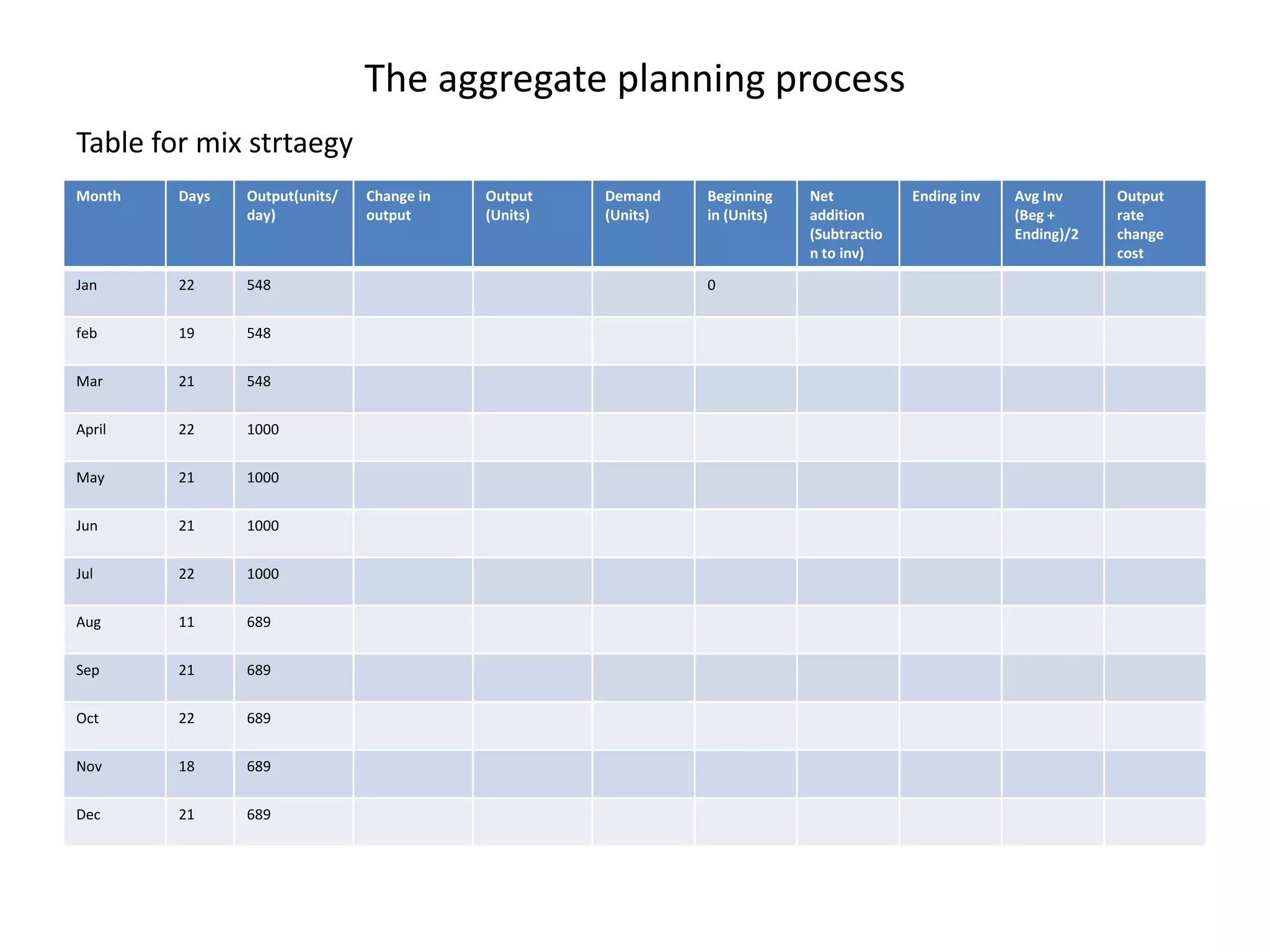
Table for mix strtaegy

• Combination method
Month   Days   Output(units/
               day)
                               Change in
                               output
                                           Output
                                           (Units)
                                                     Demand
                                                     (Units)
                                                               Beginning
                                                               in (Units)
                                                                            Net
                                                                            addition
                                                                            (Subtractio
                                                                                          Ending inv   Avg Inv
                                                                                                       (Beg +
                                                                                                       Ending)/2
                                                                                                                   Output
                                                                                                                   rate
                                                                                                                   change
                                                                            n to inv)                              cost

Jan     22     548                                             0


feb     19     548


Mar     21     548


April   22     1000


May     21     1000


Jun     21     1000


Jul     22     1000


Aug     11     689


Sep     21     689


Oct     22     689


Nov     18     689


Dec     21     689
The aggregate planning process

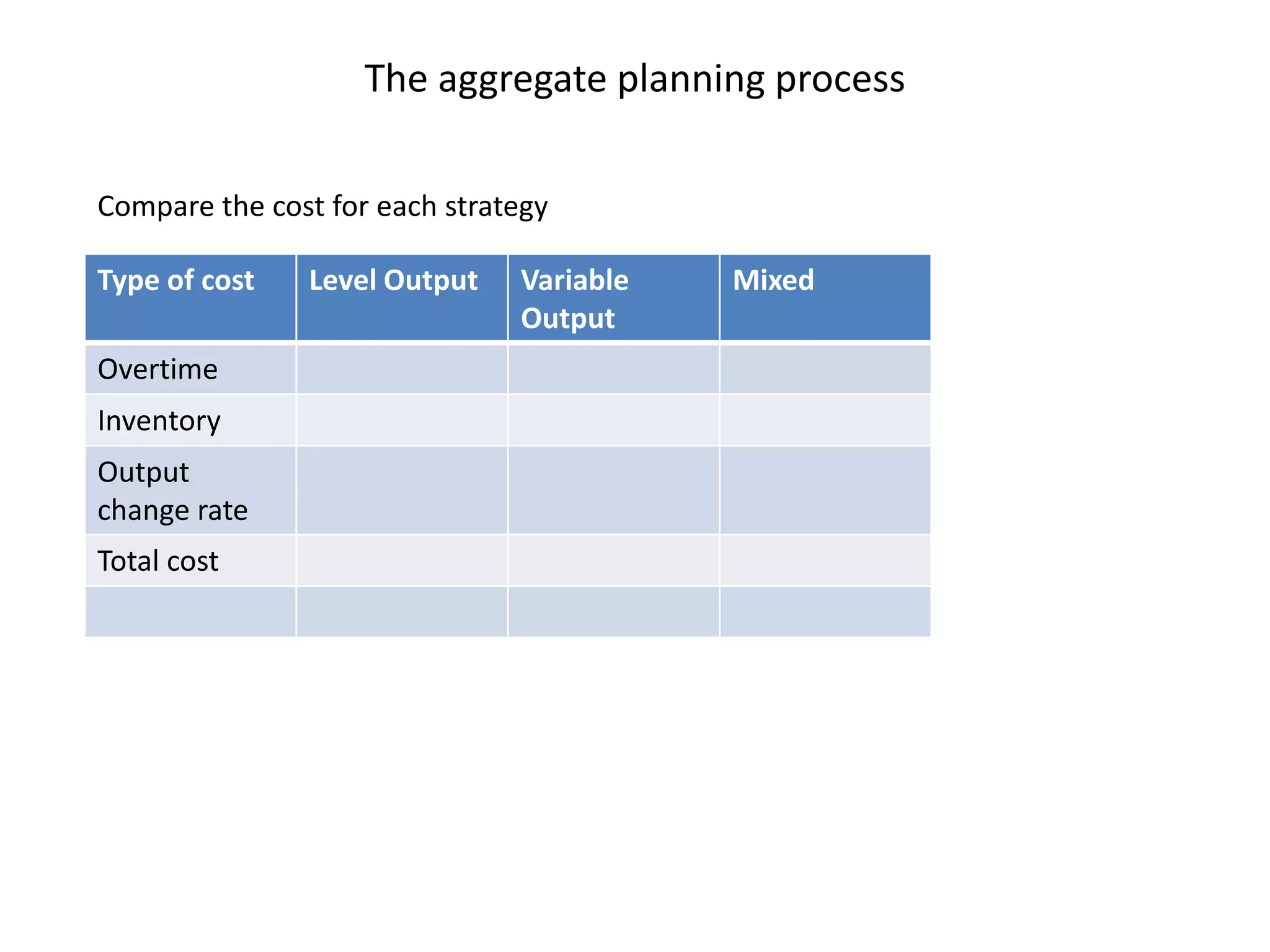
Compare the cost for each strategy

Type of cost   Level Output    Variable   Mixed
                               Output
Overtime
Inventory
Output
change rate
Total cost

Capacity and agrregate planning

  • 1.
    Capacity Planning 28th October
  • 2.
    Capacity Planning (Book:B. Mahadevan) • It is a long term strategic decision that establishes a firm overall level of resources • It is the process of determining the necessary people, machines and physical resources to meet the production objectives of the firm
  • 3.
    Strategies for capacityexpansion • Capacity lead strategy: capacity expansion in anticipation of demand growth • Capacity lag strategy: Capacity is increased after an increase in demand has been documented • Average capacity strategy: Capacity is expanded to coincide with average expected demand
  • 4.
    Capacity planning framework Identify available alternatives and Compute the select the best available capacity one for capacity and identify augmentation Estimate the capacity quantum of requirement for capacity to be the planning augmented horizon Example
  • 5.
    Alternatives for capacityaugmentation • Waste elimination • Multi skilling of work force • Sub- contracting / Outsourcing Decision tree for capacity planning: • It is a schematic model in which different sequences and steps involved in the problem and the consequences of the decision are systematically portrayed • Decision tree comprised of nodes and branches. Each node represent the decision point and branches represent the potential outcome of the decision Example 9.4, pg.no. 236
  • 6.
    Aggregate Planning 11th Nov 2010 Production and Operations Management: Everette E. adam, Jr. Ronald J. Ebert
  • 7.
    Operational planning &scheduling systems Output planning Capacity planning Aggregate output Aggregate capacity Aggregation planning planning Master production Rough-cut capacity scheduling planning Material requirements Detailed capacity planning planning Disaggregation Loading Sequencing Shop floor control Detailed scheduling
  • 8.
    Operational planning &scheduling systems Process for testing feasibility of output plan. Output plan Monthly output levels Temp capacity converted into input terms (6- 18 months) for the adjustment (man-hours, machine hours finished product groups Output planning strategies Capacity planning etc) Aggregate output Aggregate capacity Aggregation planning planning Master production Rough-cut capacity scheduling planning Material requirements Detailed capacity planning planning Disaggregation Loading Sequencing Shop floor control Detailed scheduling
  • 9.
    The aggregate planningprocess Objective of aggregate planning frequently is to minimize total cost over the planning horizon. Other objectives should be considered: •maximize customer service •minimize inventory investment •minimize changes in workforce levels •minimize changes in production rates •maximize utilization of plant and equipment
  • 10.
    The aggregate planningprocess Concept of aggregation : Deciding the unit for aggregation (# of PC, Tons of output etc) Identify groups/families of products that although different from one another, share common production process, share common machines e.g. FMCG (# of powder bottles as one, # of shampoo bottles as another, # of shampoo sachet). For some others it can be straight forward • Service Industry : Airlines : # of passengers • Steel producer : Tons/Kg of steel produced • Paint company : Kilo liters of paints produced
  • 11.
    The aggregate planningprocess Goals : The goals to be kept in mind while deciding aggregate plan which later on in planning process becomes input to MPS • Overall output & inventory norms as per company policy (eg seasonal build up etc) • Facility capacity utilization as per company policy (Full capacity utilization for stable products, 10 % free capacity for meeting sudden demand) • Employee Policy (Stable employee work force in case of skilled jobs, Hire/Fire for standard jobs : Loading )
  • 12.
    The aggregate planningprocess Forecast of aggregate demand (Input to aggregate planning process) Aggregate forecast is more accurate compared to individual hence useful for Long term planning purpose January January Forecast Forecast Actual Error % Error Product A 100 120 -20 -17% Product B 200 180 20 11% Aggregate 300 300 0 0
  • 13.
    The aggregate planningprocess Options for adjusting short term capacity to meet overall organization goals. Following are commonly used strategies Internal 1. Vary number of productive employees to meet varying output requirement (Chase strategy) 2. Maintain constant workforce but vary utilization of work force (Chase strategy) 3. Vary size of inventory 4. Mix of any of above External 1. Subcontractor 2. Rent / Lease equipment Data for exercise Refer to page 381 & 382 of handout
  • 14.
    The aggregate planningprocess 1.Vary number of productive employees to meet varying output requirement Varying Work Force Size By Hiring Or Layoffs This is to Hire Or Lay Off Workers To Meet Production Rates. Limitations • In this option, often new employees need to be trained will involve training cost. • High hiring and lay off costs • Lowered employee morale during layoff • Skills may not be available when needed • Negative community reaction • Cannot do in case of labor laws etc Can be used for non critical jobs such as loading/unloading etc
  • 15.
    The aggregate planningprocess 2. Maintain constant workforce but vary utilization of work force Results in idle time during lean period/overtime during peak Can eliminate limitation of Hire & Fire however has following limitation. Limitations • Overtime cost can be expensive • Overtime can result in errors • During idle time output would be lost forever . • Idle time may affect employee morale as they may fear layoff
  • 16.
    The aggregate planningprocess 3. Vary size of inventory Fix # of employees such that little or no overtime/idle time Production at constant rate (Inventory build up in lean, depletion in peak period) Can eliminate limitation of Hire & Fire however has following limitation. Limitations • Money tied up in inventory • Obsolescence • Storage space requirement So every strategy has limitation hence need to use combination
  • 17.
    The aggregate planningprocess 3. Combination method (To combine good points of each strategy) Graphical method can be used Exercise (Page 384) Step 1 : Draw graph (X axis : productive days in planning horizon, Y axis : units output in thousands), plot cumulative forecast on basis of fig 10.2 Step 2 : Select planning strategy level output • Find out level output rate for no stock out • How many employees are needed • Fill the following table (Provided in next slide) • Find total cost (Assuming inv carrying cost $ 1 / unit/month)
  • 18.
    The aggregate planningprocess Table for level strategy Month Days Output(units/day) Output (Units) Demand Beginning in Net addition Ending inv Avg Inv (Beg + (Units) (Units) (Subtraction to Ending)/2 inv) Jan 22 feb 19 Mar 21 April 22 May 21 Jun 21 Jul 22 Aug 11 Sep 21 Oct 22 Nov 18 Dec 21
  • 19.
    The aggregate planningprocess • Step 3 : Select planning strategy Chase • Fill the following table (Provided in next slide) • Find total cost assuming following – Estimated cost for changing output rate Change in output rate from prev month (Incr/decr) Estimated cost 1-200 4000 201-400 10,000 401-600 18,000 601-800 28,000 – Max output (1000 wagons/day), OT : $4/unit
  • 20.
    The aggregate planningprocess Table for level strategy Month Days Change in Output Rates Output Demand Cost output (units/day) (Units) (Units) Jan 22 182 0 feb 19 527 Mar 21 619 April 22 1000 May 21 1143 Jun 21 952 Jul 22 682 Aug 11 1454 Sep 21 857 Oct 22 637 Nov 18 499 Dec 21 286
  • 21.
    The aggregate planningprocess Table for mix strtaegy • Combination method Month Days Output(units/ day) Change in output Output (Units) Demand (Units) Beginning in (Units) Net addition (Subtractio Ending inv Avg Inv (Beg + Ending)/2 Output rate change n to inv) cost Jan 22 548 0 feb 19 548 Mar 21 548 April 22 1000 May 21 1000 Jun 21 1000 Jul 22 1000 Aug 11 689 Sep 21 689 Oct 22 689 Nov 18 689 Dec 21 689
  • 22.
    The aggregate planningprocess Compare the cost for each strategy Type of cost Level Output Variable Mixed Output Overtime Inventory Output change rate Total cost