Operations Management Chapter 17 –  Maintenance and Reliability PowerPoint presentation to accompany  Heizer/Render  Principles of Operations Management, 7e Operations Management, 9e
Outline Global Company Profile: Orlando Utilities Commission The Strategic Importance of Maintenance and Reliability Reliability Improving Individual Components Providing Redundancy
Outline – Continued Maintenance Implementing Preventive Maintenance Increasing Repair Capabilities Total Productive Maintenance Techniques for Enhancing Maintenance
Learning Objectives When you complete this chapter you should be able to: Describe how to improve system reliability Determine system reliability Determine mean time between failure (MTBF)
Learning Objectives When you complete this chapter you should be able to: Distinguish between preventive and breakdown maintenance Describe how to improve maintenance Compare preventive and breakdown maintenance costs
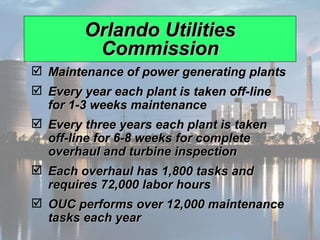
Orlando Utilities Commission Maintenance of power generating plants Every year each plant is taken off-line for 1-3 weeks maintenance Every three years each plant is taken off-line for 6-8 weeks for complete overhaul and turbine inspection Each overhaul has 1,800 tasks and requires 72,000 labor hours OUC performs over 12,000 maintenance tasks each year
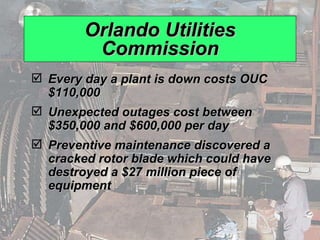
Orlando Utilities Commission Every day a plant is down costs OUC $110,000 Unexpected outages cost between $350,000 and $600,000 per day Preventive maintenance discovered a cracked rotor blade which could have destroyed a $27 million piece of equipment
Strategic Importance of Maintenance and Reliability Failure has far reaching effects on a firm’s Operation Reputation Profitability Dissatisfied customers Idle employees Profits becoming losses Reduced value of investment in plant and equipment
Maintenance and Reliability The objective of maintenance and reliability is to maintain the capability of the system while controlling costs Maintenance is all activities involved in keeping a system’s equipment in working order Reliability is the probability that a machine will function properly for a specified time
Important Tactics Reliability Improving individual components Providing redundancy Maintenance Implementing or improving preventive maintenance Increasing repair capability or speed
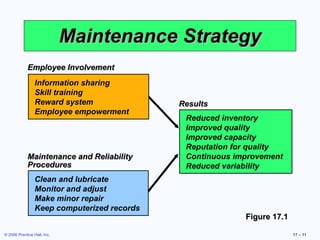
Maintenance Strategy Figure 17.1 Employee Involvement Information sharing Skill training Reward system Employee empowerment Maintenance and Reliability Procedures Clean and lubricate Monitor and adjust Make minor repair Keep computerized records Results Reduced inventory Improved quality Improved capacity Reputation for quality Continuous improvement Reduced variability
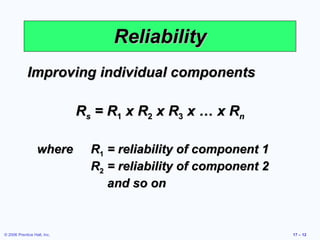
Reliability Improving individual components R s  = R 1  x R 2  x R 3  x … x R n where R 1 = reliability of component 1 R 2 = reliability of component 2 and so on
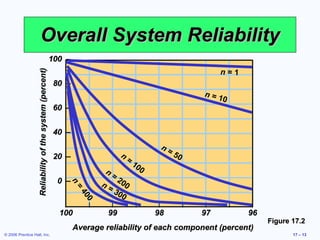
Overall System Reliability Figure 17.2 Reliability of the system (percent) Average reliability of each component (percent) | | | | | | | | | 100 99 98 97 96 100  – 80  – 60  – 40  – 20  – 0  – n  = 10 n  = 1 n  = 50 n  = 100 n  = 200 n  = 300 n  = 400
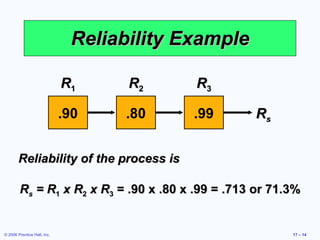
Reliability Example Reliability of the process is R s  = R 1  x R 2  x R 3   = .90 x .80 x .99 = .713 or 71.3% R s R 3 .99 R 2 .80 R 1 .90
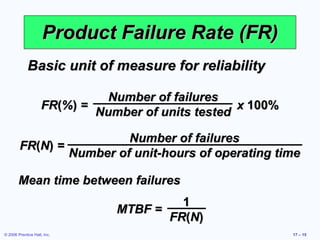
Product Failure Rate (FR) Basic unit of measure for reliability FR ( % )  =  x  100% Number of failures Number of units tested FR ( N )  = Number of failures Number of unit-hours of operating time Mean time between failures MTBF = 1 FR ( N )
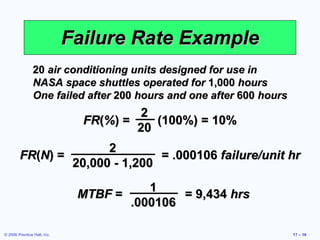
Failure Rate Example 20  air conditioning units designed for use in  NASA space shuttles operated for  1,000  hours One failed after  200  hours and one after  600  hours FR ( % )   =  (100%) = 10% 2 20 FR ( N )   =  = .000106  failure/unit hr 2 20,000 - 1,200 MTBF  =  = 9,434  hrs 1 .000106
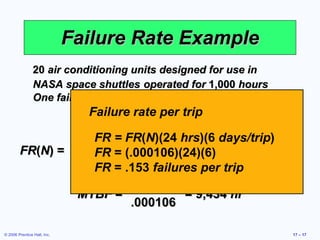
Failure Rate Example 20  air conditioning units designed for use in  NASA space shuttles   operated for  1,000  hours One failed after  200  hours and one after  600  hours FR ( % )   =  (100%) = 10% 2 20 FR ( N )   =  = .000106  failure/unit hr 2 20,000 - 1,200 MTBF  =  = 9,434  hr 1 .000106 Failure rate per trip FR = FR ( N )(24  hrs )(6  days/trip ) FR  = (.000106)(24)(6) FR  = .153  failures per trip
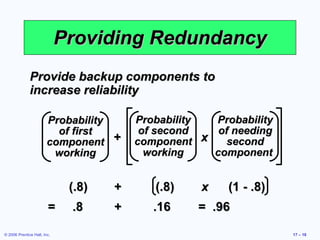
Providing Redundancy Provide backup components to increase reliability + x Probability of first component working Probability of needing second component  Probability of second component working (.8) + (.8) x (1 - .8) =  .8 + .16  =  .96
Redundancy Example A redundant process is installed to support the earlier example where R s   = .713 = [.9 + .9(1 - .9)] x [.8 + .8(1 - .8)] x .99 = [.9 + (.9)(.1)] x [.8 + (.8)(.2)] x .99 = .99 x .96 x .99 = .94 Reliability has increased from  .713  to  .94 R 1 0.90 0.90 R 2 0.80 0.80 R 3 0.99
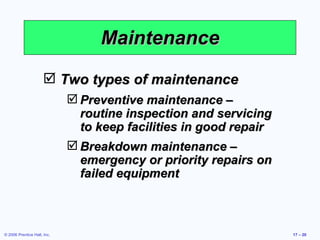
Maintenance Two types of maintenance Preventive maintenance – routine inspection and servicing to keep facilities in good repair Breakdown maintenance – emergency or priority repairs on failed equipment
Implementing Preventive Maintenance Need to know when a system requires service or is likely to fail High initial failure rates are known as infant mortality Once a product settles in, MTBF generally follows a normal distribution Good reporting and record keeping can aid the decision on when preventive maintenance should be performed
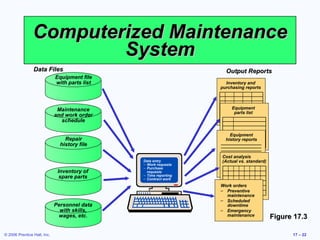
Computerized Maintenance System Figure 17.3 Output Reports Inventory and purchasing reports Equipment parts list Equipment history reports Cost analysis  (Actual vs. standard) Work orders Preventive maintenance Scheduled downtime Emergency maintenance Data entry Work requests Purchase requests Time reporting Contract work Data Files Personnel data with skills, wages, etc. Equipment file with parts list Maintenance and work order schedule Inventory of spare parts Repair history file
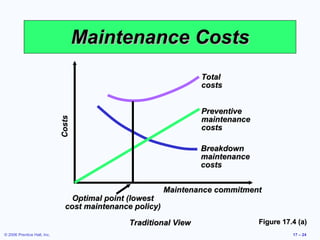
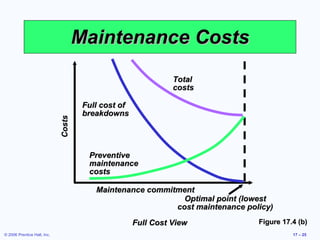
Maintenance Costs The traditional view attempted to balance preventive and breakdown maintenance costs  Typically this approach failed to consider the true total cost of breakdowns Inventory Employee morale Schedule unreliability
Maintenance Costs Figure 17.4 (a) Traditional View Total costs Breakdown maintenance costs Costs Maintenance commitment Preventive maintenance costs Optimal point (lowest cost maintenance policy)
Maintenance Costs Figure 17.4 (b) Full Cost View Costs Maintenance commitment Optimal point (lowest cost maintenance policy) Total costs Full cost of breakdowns Preventive maintenance costs
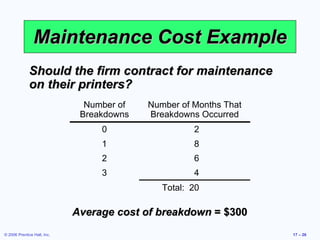
Maintenance Cost Example Should the firm contract for maintenance on their printers? Average cost of breakdown  = $300   Total:  20   4 3 6 2 8 1 2 0 Number of Months That Breakdowns Occurred Number of Breakdowns
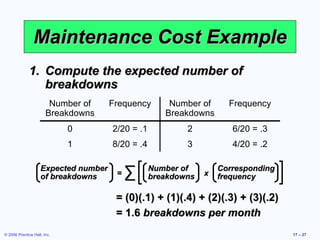
Maintenance Cost Example Compute the expected number of breakdowns = (0)(.1) + (1)(.4) + (2)(.3) + (3)(.2) = 1.6  breakdowns per month 4/20 = .2 3 8/20 = .4 1 6/20 = .3 2 2/20 = .1 0 Frequency Number of Breakdowns Frequency Number of Breakdowns ∑ Number of breakdowns Expected number of breakdowns Corresponding frequency = x
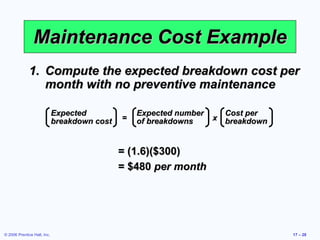
Maintenance Cost Example Compute the expected breakdown cost per month with no preventive maintenance = (1.6)($300) = $480  per month Expected breakdown cost Expected number of breakdowns Cost per breakdown = x
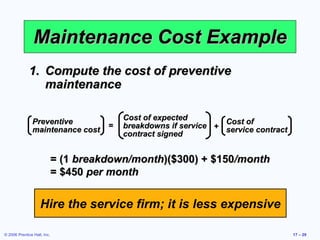
Maintenance Cost Example Compute the cost of preventive maintenance = (1  breakdown/month )($300) + $150 /month = $450  per month Hire the service firm; it is less expensive Preventive maintenance cost Cost of expected breakdowns if service contract signed Cost of  service contract = +
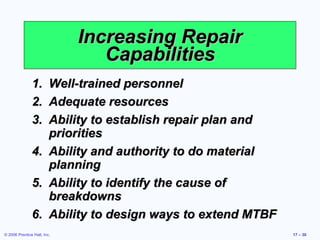
Increasing Repair Capabilities Well-trained personnel Adequate resources Ability to establish repair plan and priorities Ability and authority to do material planning Ability to identify the cause of breakdowns Ability to design ways to extend MTBF
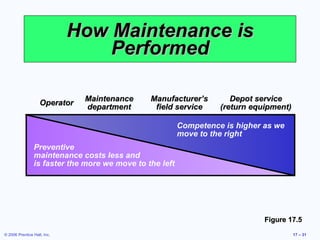
How Maintenance is Performed Figure 17.5 Operator Maintenance department Manufacturer’s field service Depot service (return equipment) Preventive  maintenance costs less and  is faster the more we move to the left Competence is higher as we  move to the right
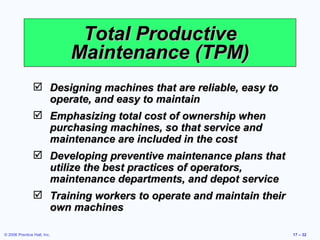
Total Productive Maintenance (TPM) Designing machines that are reliable, easy to operate, and easy to maintain Emphasizing total cost of ownership when purchasing machines, so that service and maintenance are included in the cost Developing preventive maintenance plans that utilize the best practices of operators, maintenance departments, and depot service Training workers to operate and maintain their own machines
Establishing Maintenance Policies Simulation Computer analysis of complex situations Model maintenance programs before they are implemented Physical models can also be used Expert systems Computers help users identify problems and select course of action

17.maintenance and reliability

  • 1.
    Operations Management Chapter17 – Maintenance and Reliability PowerPoint presentation to accompany Heizer/Render Principles of Operations Management, 7e Operations Management, 9e
  • 2.
    Outline Global CompanyProfile: Orlando Utilities Commission The Strategic Importance of Maintenance and Reliability Reliability Improving Individual Components Providing Redundancy
  • 3.
    Outline – ContinuedMaintenance Implementing Preventive Maintenance Increasing Repair Capabilities Total Productive Maintenance Techniques for Enhancing Maintenance
  • 4.
    Learning Objectives Whenyou complete this chapter you should be able to: Describe how to improve system reliability Determine system reliability Determine mean time between failure (MTBF)
  • 5.
    Learning Objectives Whenyou complete this chapter you should be able to: Distinguish between preventive and breakdown maintenance Describe how to improve maintenance Compare preventive and breakdown maintenance costs
  • 6.
    Orlando Utilities CommissionMaintenance of power generating plants Every year each plant is taken off-line for 1-3 weeks maintenance Every three years each plant is taken off-line for 6-8 weeks for complete overhaul and turbine inspection Each overhaul has 1,800 tasks and requires 72,000 labor hours OUC performs over 12,000 maintenance tasks each year
  • 7.
    Orlando Utilities CommissionEvery day a plant is down costs OUC $110,000 Unexpected outages cost between $350,000 and $600,000 per day Preventive maintenance discovered a cracked rotor blade which could have destroyed a $27 million piece of equipment
  • 8.
    Strategic Importance ofMaintenance and Reliability Failure has far reaching effects on a firm’s Operation Reputation Profitability Dissatisfied customers Idle employees Profits becoming losses Reduced value of investment in plant and equipment
  • 9.
    Maintenance and ReliabilityThe objective of maintenance and reliability is to maintain the capability of the system while controlling costs Maintenance is all activities involved in keeping a system’s equipment in working order Reliability is the probability that a machine will function properly for a specified time
  • 10.
    Important Tactics ReliabilityImproving individual components Providing redundancy Maintenance Implementing or improving preventive maintenance Increasing repair capability or speed
  • 11.
    Maintenance Strategy Figure17.1 Employee Involvement Information sharing Skill training Reward system Employee empowerment Maintenance and Reliability Procedures Clean and lubricate Monitor and adjust Make minor repair Keep computerized records Results Reduced inventory Improved quality Improved capacity Reputation for quality Continuous improvement Reduced variability
  • 12.
    Reliability Improving individualcomponents R s = R 1 x R 2 x R 3 x … x R n where R 1 = reliability of component 1 R 2 = reliability of component 2 and so on
  • 13.
    Overall System ReliabilityFigure 17.2 Reliability of the system (percent) Average reliability of each component (percent) | | | | | | | | | 100 99 98 97 96 100 – 80 – 60 – 40 – 20 – 0 – n = 10 n = 1 n = 50 n = 100 n = 200 n = 300 n = 400
  • 14.
    Reliability Example Reliabilityof the process is R s = R 1 x R 2 x R 3 = .90 x .80 x .99 = .713 or 71.3% R s R 3 .99 R 2 .80 R 1 .90
  • 15.
    Product Failure Rate(FR) Basic unit of measure for reliability FR ( % ) = x 100% Number of failures Number of units tested FR ( N ) = Number of failures Number of unit-hours of operating time Mean time between failures MTBF = 1 FR ( N )
  • 16.
    Failure Rate Example20 air conditioning units designed for use in NASA space shuttles operated for 1,000 hours One failed after 200 hours and one after 600 hours FR ( % ) = (100%) = 10% 2 20 FR ( N ) = = .000106 failure/unit hr 2 20,000 - 1,200 MTBF = = 9,434 hrs 1 .000106
  • 17.
    Failure Rate Example20 air conditioning units designed for use in NASA space shuttles operated for 1,000 hours One failed after 200 hours and one after 600 hours FR ( % ) = (100%) = 10% 2 20 FR ( N ) = = .000106 failure/unit hr 2 20,000 - 1,200 MTBF = = 9,434 hr 1 .000106 Failure rate per trip FR = FR ( N )(24 hrs )(6 days/trip ) FR = (.000106)(24)(6) FR = .153 failures per trip
  • 18.
    Providing Redundancy Providebackup components to increase reliability + x Probability of first component working Probability of needing second component Probability of second component working (.8) + (.8) x (1 - .8) = .8 + .16 = .96
  • 19.
    Redundancy Example Aredundant process is installed to support the earlier example where R s = .713 = [.9 + .9(1 - .9)] x [.8 + .8(1 - .8)] x .99 = [.9 + (.9)(.1)] x [.8 + (.8)(.2)] x .99 = .99 x .96 x .99 = .94 Reliability has increased from .713 to .94 R 1 0.90 0.90 R 2 0.80 0.80 R 3 0.99
  • 20.
    Maintenance Two typesof maintenance Preventive maintenance – routine inspection and servicing to keep facilities in good repair Breakdown maintenance – emergency or priority repairs on failed equipment
  • 21.
    Implementing Preventive MaintenanceNeed to know when a system requires service or is likely to fail High initial failure rates are known as infant mortality Once a product settles in, MTBF generally follows a normal distribution Good reporting and record keeping can aid the decision on when preventive maintenance should be performed
  • 22.
    Computerized Maintenance SystemFigure 17.3 Output Reports Inventory and purchasing reports Equipment parts list Equipment history reports Cost analysis (Actual vs. standard) Work orders Preventive maintenance Scheduled downtime Emergency maintenance Data entry Work requests Purchase requests Time reporting Contract work Data Files Personnel data with skills, wages, etc. Equipment file with parts list Maintenance and work order schedule Inventory of spare parts Repair history file
  • 23.
    Maintenance Costs Thetraditional view attempted to balance preventive and breakdown maintenance costs Typically this approach failed to consider the true total cost of breakdowns Inventory Employee morale Schedule unreliability
  • 24.
    Maintenance Costs Figure17.4 (a) Traditional View Total costs Breakdown maintenance costs Costs Maintenance commitment Preventive maintenance costs Optimal point (lowest cost maintenance policy)
  • 25.
    Maintenance Costs Figure17.4 (b) Full Cost View Costs Maintenance commitment Optimal point (lowest cost maintenance policy) Total costs Full cost of breakdowns Preventive maintenance costs
  • 26.
    Maintenance Cost ExampleShould the firm contract for maintenance on their printers? Average cost of breakdown = $300 Total: 20 4 3 6 2 8 1 2 0 Number of Months That Breakdowns Occurred Number of Breakdowns
  • 27.
    Maintenance Cost ExampleCompute the expected number of breakdowns = (0)(.1) + (1)(.4) + (2)(.3) + (3)(.2) = 1.6 breakdowns per month 4/20 = .2 3 8/20 = .4 1 6/20 = .3 2 2/20 = .1 0 Frequency Number of Breakdowns Frequency Number of Breakdowns ∑ Number of breakdowns Expected number of breakdowns Corresponding frequency = x
  • 28.
    Maintenance Cost ExampleCompute the expected breakdown cost per month with no preventive maintenance = (1.6)($300) = $480 per month Expected breakdown cost Expected number of breakdowns Cost per breakdown = x
  • 29.
    Maintenance Cost ExampleCompute the cost of preventive maintenance = (1 breakdown/month )($300) + $150 /month = $450 per month Hire the service firm; it is less expensive Preventive maintenance cost Cost of expected breakdowns if service contract signed Cost of service contract = +
  • 30.
    Increasing Repair CapabilitiesWell-trained personnel Adequate resources Ability to establish repair plan and priorities Ability and authority to do material planning Ability to identify the cause of breakdowns Ability to design ways to extend MTBF
  • 31.
    How Maintenance isPerformed Figure 17.5 Operator Maintenance department Manufacturer’s field service Depot service (return equipment) Preventive maintenance costs less and is faster the more we move to the left Competence is higher as we move to the right
  • 32.
    Total Productive Maintenance(TPM) Designing machines that are reliable, easy to operate, and easy to maintain Emphasizing total cost of ownership when purchasing machines, so that service and maintenance are included in the cost Developing preventive maintenance plans that utilize the best practices of operators, maintenance departments, and depot service Training workers to operate and maintain their own machines
  • 33.
    Establishing Maintenance PoliciesSimulation Computer analysis of complex situations Model maintenance programs before they are implemented Physical models can also be used Expert systems Computers help users identify problems and select course of action