Dr. Abhijeet Mane
BVDUMC, Pune
9/25/2016 1
Points to note…
 Definition
 Attributes of antigenicity
 Determinants of Antigenicity
 Chemical nature, foreignness, etc.
 Biological classes of antigens
 TD and TI
9/25/2016 2
Introduction
 Definition
 Any substance which, when introduced parenterally into
the body, stimulates the production of an antibody with
which it reacts specifically and in an observable manner
 Why ‘parenteral’
 Meaning, outside the intestinal tract
 Orally administered Ag usually denatured
 Antigenicity destroyed
 No Ab formation takes place
9/25/2016 3
 Why ‘specifically’
 Specificity is hallmark of all immunological reactions
 An Ag introduced in body reacts only with particular B
or T lymphocytes which carry specific marker for that
antigen
 And which produce an antibody or cells complementary
to that Ag only
 Ab so produced will react with only with that particular
Ag and no other
9/25/2016 4
Attributes of Antigenicity
 Induction of an immune response (immunogenicity)
 Specific reaction with Abs or sensitised cells
(immunological reactivity)
 Based on above functions, Ag may be classified as
 Complete antigen
 Hapten
9/25/2016 5
 Complete antigen
 Able to induce Ab formation and produce a specific and
observable reaction
 Hapten
 Incapable of inducing Ab formation by themselves
 Become immunogenic on combining with larger
molecule carrier
 Complex
 Can precipitate with specific Ab, polyvalent
 Simple
 Non precipitating, univalent
9/25/2016 6
 Epitope or antigenic determinant
 Smallest unit of antigenicity
 small area on the antigen
 Consists of 4-5 AA or monosaccharide residues
 Specific chemical structure, electrical charge, steric
configuration
 Capable of sensitizing an immunocyte
 And reacts with its complimentary site on specific Ab or T cell
receptor
 May be sequential or linear epitope
 Conformational epitope
 Paratope
9/25/2016 7
Determinants of Antigenicity
 Size
 Chemical Nature
 Susceptibility to tissue enzymes
 Foreignness
 Antigenic Specificity
 Species specificity
 Iso specificity
 Auto specificity
 Organ specificity
 Heterogenic (heterophile) specificity
9/25/2016 8
 Size
 Related to Molecular Weight
 Very large molecules hemocyanins (MW 6.75M) are
highly antigenic
 Particles with low MW less than 5000 are non antigenic
 LMW substances may be rendered Ag by adsorbing
them on large inert particles e.g. Bentonite or Kaolin
 Some LMW substances like picryl chloride,
formaldehyde and penicillin may be antigenic on
combining with tissue proteins. Related to
hypersensitivity
9/25/2016 9
 Chemical Nature
 Most naturally occurring are proteins and
polysaccharides
 Lipids and nucleic acids less so
 Structural diversity necessary for antigenicity
 Proteins composed of 20 different AA – more antigenic
(Exception: Gelatin, unstable structure)
 Polysaccharides – have 4-5 monosaccharide units. Less
antigenic
9/25/2016 10
 Susceptibility to tissue enzymes
 Only those substances which are metabolized and are
susceptible to action of tissue enzymes – Antigens
 Ag are degraded by host into fragments of appropriate
size
9/25/2016 11
 Foreignness
 Only Ag which are ‘foreign’ to individual (non self) induce
an immune response
 An individual does not normally mount an immune
response against his or her own normal constituent
antigens
 Ehrlich – horror autotoxicus
 Ag from other individuals of same species less antigenic
than those from other species
 Ag from related species are less antigenic than those from
distant species
9/25/2016 12
 Antigenic specificity
 Basis of antigenic specificity is stereochemical
 Difference in specificity by attachment of groups at
ortho, meta, para positions
9/25/2016 13
 Species specificity
 Tissues of all individuals in a species contain species
specific antigen
 There exists some degree of cross reaction between Ag
from related species
 Application: identification of species of blood and
seminal stains
 Individual sensitized to horse serum will react to
serum from other equines but not bovine
9/25/2016 14
 Isospecificity
 Isoantigens are Ag found in some but not all members
of a species
 Best example: human RBC antigens based on which
individuals can be classified into different blood
groups. Important in blood transfusion.
 Histocompatibility antigens – cellular determinants
specific to each individual of a species (Useful for
transplantation)
9/25/2016 15
 Autospecificity
 Autologous or sefl antigens are ordinarily non
antigenic
 Exceptions: Sequestered Ag – eye lens, sperms
9/25/2016 16
 Organ specificity
 Some organs like brain, kidney, lens protein of
different species share same antigen
 Such Ag – organ specific antigens
 Eg. Neuroparalytic complicationsfollowing antirabic
vaccine using sheep brain vaccines are consequence of
brain specific Ag shared by sheep and humans
9/25/2016 17
 Heterogenic (heterophile) specificity
 Same or closely related antigens may sometimes occur
in different biological species, classes and kingdoms
 Eg. Forssman Antigen
 Heterophile reactions: Weil Felix test in typhus fever,
Paul Bunnel test in IM, cold agglutinin test in primary
atypical pneumonia
9/25/2016 18
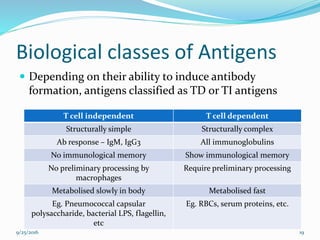
Biological classes of Antigens
 Depending on their ability to induce antibody
formation, antigens classified as TD or TI antigens
9/25/2016 19
T cell independent T cell dependent
Structurally simple Structurally complex
Ab response – IgM, IgG3 All immunoglobulins
No immunological memory Show immunological memory
No preliminary processing by
macrophages
Require preliminary processing
Metabolised slowly in body Metabolised fast
Eg. Pneumococcal capsular
polysaccharide, bacterial LPS, flagellin,
etc
Eg. RBCs, serum proteins, etc.
9/25/2016 20

Antigen

  • 1.
    Dr. Abhijeet Mane BVDUMC,Pune 9/25/2016 1
  • 2.
    Points to note… Definition  Attributes of antigenicity  Determinants of Antigenicity  Chemical nature, foreignness, etc.  Biological classes of antigens  TD and TI 9/25/2016 2
  • 3.
    Introduction  Definition  Anysubstance which, when introduced parenterally into the body, stimulates the production of an antibody with which it reacts specifically and in an observable manner  Why ‘parenteral’  Meaning, outside the intestinal tract  Orally administered Ag usually denatured  Antigenicity destroyed  No Ab formation takes place 9/25/2016 3
  • 4.
     Why ‘specifically’ Specificity is hallmark of all immunological reactions  An Ag introduced in body reacts only with particular B or T lymphocytes which carry specific marker for that antigen  And which produce an antibody or cells complementary to that Ag only  Ab so produced will react with only with that particular Ag and no other 9/25/2016 4
  • 5.
    Attributes of Antigenicity Induction of an immune response (immunogenicity)  Specific reaction with Abs or sensitised cells (immunological reactivity)  Based on above functions, Ag may be classified as  Complete antigen  Hapten 9/25/2016 5
  • 6.
     Complete antigen Able to induce Ab formation and produce a specific and observable reaction  Hapten  Incapable of inducing Ab formation by themselves  Become immunogenic on combining with larger molecule carrier  Complex  Can precipitate with specific Ab, polyvalent  Simple  Non precipitating, univalent 9/25/2016 6
  • 7.
     Epitope orantigenic determinant  Smallest unit of antigenicity  small area on the antigen  Consists of 4-5 AA or monosaccharide residues  Specific chemical structure, electrical charge, steric configuration  Capable of sensitizing an immunocyte  And reacts with its complimentary site on specific Ab or T cell receptor  May be sequential or linear epitope  Conformational epitope  Paratope 9/25/2016 7
  • 8.
    Determinants of Antigenicity Size  Chemical Nature  Susceptibility to tissue enzymes  Foreignness  Antigenic Specificity  Species specificity  Iso specificity  Auto specificity  Organ specificity  Heterogenic (heterophile) specificity 9/25/2016 8
  • 9.
     Size  Relatedto Molecular Weight  Very large molecules hemocyanins (MW 6.75M) are highly antigenic  Particles with low MW less than 5000 are non antigenic  LMW substances may be rendered Ag by adsorbing them on large inert particles e.g. Bentonite or Kaolin  Some LMW substances like picryl chloride, formaldehyde and penicillin may be antigenic on combining with tissue proteins. Related to hypersensitivity 9/25/2016 9
  • 10.
     Chemical Nature Most naturally occurring are proteins and polysaccharides  Lipids and nucleic acids less so  Structural diversity necessary for antigenicity  Proteins composed of 20 different AA – more antigenic (Exception: Gelatin, unstable structure)  Polysaccharides – have 4-5 monosaccharide units. Less antigenic 9/25/2016 10
  • 11.
     Susceptibility totissue enzymes  Only those substances which are metabolized and are susceptible to action of tissue enzymes – Antigens  Ag are degraded by host into fragments of appropriate size 9/25/2016 11
  • 12.
     Foreignness  OnlyAg which are ‘foreign’ to individual (non self) induce an immune response  An individual does not normally mount an immune response against his or her own normal constituent antigens  Ehrlich – horror autotoxicus  Ag from other individuals of same species less antigenic than those from other species  Ag from related species are less antigenic than those from distant species 9/25/2016 12
  • 13.
     Antigenic specificity Basis of antigenic specificity is stereochemical  Difference in specificity by attachment of groups at ortho, meta, para positions 9/25/2016 13
  • 14.
     Species specificity Tissues of all individuals in a species contain species specific antigen  There exists some degree of cross reaction between Ag from related species  Application: identification of species of blood and seminal stains  Individual sensitized to horse serum will react to serum from other equines but not bovine 9/25/2016 14
  • 15.
     Isospecificity  Isoantigensare Ag found in some but not all members of a species  Best example: human RBC antigens based on which individuals can be classified into different blood groups. Important in blood transfusion.  Histocompatibility antigens – cellular determinants specific to each individual of a species (Useful for transplantation) 9/25/2016 15
  • 16.
     Autospecificity  Autologousor sefl antigens are ordinarily non antigenic  Exceptions: Sequestered Ag – eye lens, sperms 9/25/2016 16
  • 17.
     Organ specificity Some organs like brain, kidney, lens protein of different species share same antigen  Such Ag – organ specific antigens  Eg. Neuroparalytic complicationsfollowing antirabic vaccine using sheep brain vaccines are consequence of brain specific Ag shared by sheep and humans 9/25/2016 17
  • 18.
     Heterogenic (heterophile)specificity  Same or closely related antigens may sometimes occur in different biological species, classes and kingdoms  Eg. Forssman Antigen  Heterophile reactions: Weil Felix test in typhus fever, Paul Bunnel test in IM, cold agglutinin test in primary atypical pneumonia 9/25/2016 18
  • 19.
    Biological classes ofAntigens  Depending on their ability to induce antibody formation, antigens classified as TD or TI antigens 9/25/2016 19 T cell independent T cell dependent Structurally simple Structurally complex Ab response – IgM, IgG3 All immunoglobulins No immunological memory Show immunological memory No preliminary processing by macrophages Require preliminary processing Metabolised slowly in body Metabolised fast Eg. Pneumococcal capsular polysaccharide, bacterial LPS, flagellin, etc Eg. RBCs, serum proteins, etc.
  • 20.