ANTIGEN & ANTIBODY
REACTIONS
INTRODUCTION
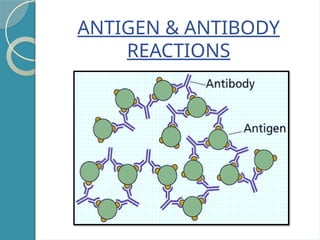
Antigens & antibodies combine specifically with each other.
This interaction between them is called ‘Antigen-Antibody
reaction’.
- Abbreviated as Ag – Ab reaction.
- They form the basis for humoral/antibody mediated
immunity.
- They are used for detection of disease , Onset of
disease(from concentration of antibodies),causing agents &
some non-specific Ag’s like enzymes,immune reaction,
treatment & prevention.
- When Ag-Ab reaction occurs in-vitro they are known as
‘serological reactions’.
- The reactions b/w Ag & Ab occurs in 3 stages:
1st
(primary stage)=
formation of Ag-Ab complex.
Initial interaction
reaction is rapid, occurs at low temperature
reaction is reversible
they are attached together by van der wall force, h2
bond,ionic bonds
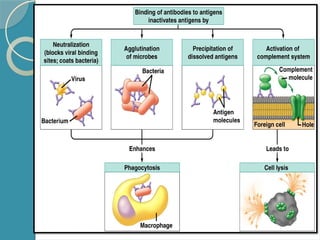
Secondary phase 2nd
= leads to visible
events like precipitation, agglutination etc.
Lysis of cell
Killing of live antigen
Example
•Precipitin-ab participate in precipitation
•Agglitinin-ab participate in agglutination
(Tertiary phase) 3rd
= destruction of Ag or
its neutralization.
Visible immunity
SALIENT FEATURES
-Specificity.
-Thereis no denaturation of the
antigen antibody during reaction.
Entirety
Surface combination
- Immune complex.
- Binding Site of Antigen.
- Binding Force of Antigen.
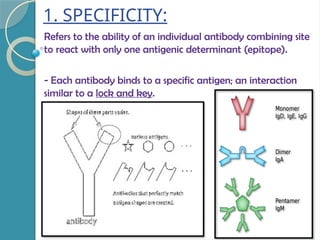
1. SPECIFICITY:
Refers to the ability of an individual antibody combining site
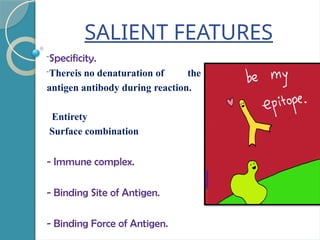
to react with only one antigenic determinant (epitope).
- Each antibody binds to a specific antigen; an interaction
similar to a lock and key.
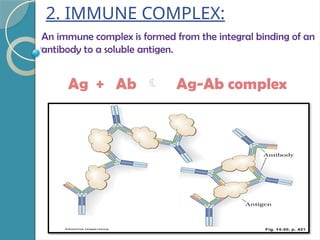
2. IMMUNE COMPLEX:
An immune complex is formed from the integral binding of an
antibody to a soluble antigen.
Ag + Ab  Ag-Ab complex
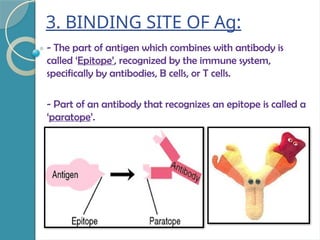
3. BINDING SITE OF Ag:
- The part of antigen which combines with antibody is
called ‘Epitope’, recognized by the immune system,
specifically by antibodies, B cells, or T cells.
- Part of an antibody that recognizes an epitope is called a
‘paratope’.
4. BINDING FORCE OF Ag:
- The binding b/w Ag & Ab in Ag – Ab reaction is due to
three factors namely:
* Closeness b/w Ag & Ab -> more close = good
strength of binding.
* Non – covalent bonds or Intermolecular forces ->
hydrogen bonds, vander walls forces, hydrophobic bonds.
* Affinity of antibody -> strength of reaction b/w a
single epitope & single paratope.
* VALENCY- antibodies are bivalent in nature, both are
multivalent
•ANTIBODY AVIDITY:
it is the overall strength of ag – ab
complex,dependes upon
affinity
valency
oerall structure
TYPES
The types of antigen-antibody reactions are:
- Precipitation Reaction.
- Agglutination Reaction.
- Complement Fixation.
- ELISA – Enzyme Linked ImmunoSorbent Assay.
- Immunofluorescence.
TYPES
 RADIOIMMUNOASSAY
 IMMUNOFLUORESENCE
 NEUTRALIZATION TEST
PRECIPITATION /
IMMUNO-PRECIPITATION
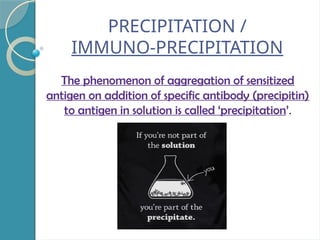
The phenomenon of aggregation of sensitized
antigen on addition of specific antibody (precipitin)
to antigen in solution is called ‘precipitation’.
DEFINITION
 CHEMICAL INTERACTION B/W
MULTIVALENT ANTIGEN & BIVALENT
ANTIBODY, LEADSTO FORM THE
INSOLUABLE PRECIPITATES UNDER
FAVORABLE CONDITION INTHE
PRESENCE OF ELECTROLYTES
- Precipitation occurs in two media:
* Liquid
* Gel
1. Precipitation in Liquids:
- Place constant amount of Ab in a series of tubes.
- Add increased amount of antigen.
- Antigen – Antibody reacts together resulting in
precipitation.
- Plotting the amount of precipitate against increasing
antigen conc. yields a ‘precipitin curve’.
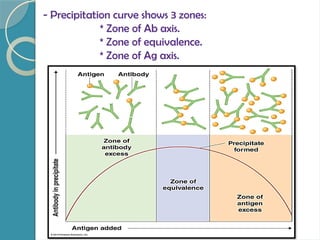
- Precipitation curve shows 3 zones:
* Zone of Ab axis.
* Zone of equivalence.
* Zone of Ag axis.
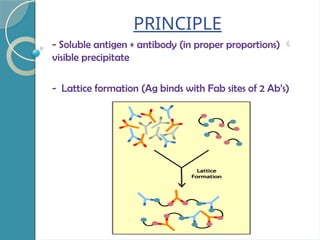
PRINCIPLE
- Soluble antigen + antibody (in proper proportions) 
visible precipitate
- Lattice formation (Ag binds with Fab sites of 2 Ab’s)
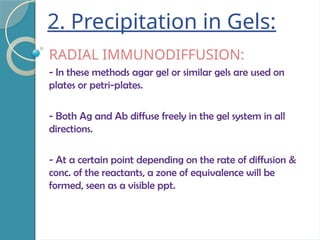
2. Precipitation in Gels:
RADIAL IMMUNODIFFUSION:
- In these methods agar gel or similar gels are used on
plates or petri-plates.
- Both Ag and Ab diffuse freely in the gel system in all
directions.
- At a certain point depending on the rate of diffusion &
conc. of the reactants, a zone of equivalence will be
formed, seen as a visible ppt.
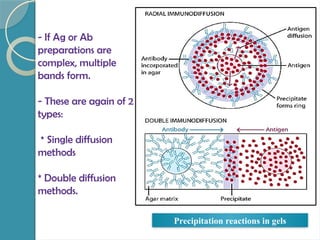
- If Ag or Ab
preparations are
complex, multiple
bands form.
- These are again of 2
types:
* Single diffusion
methods
* Double diffusion
methods.
Precipitation reactions in gels
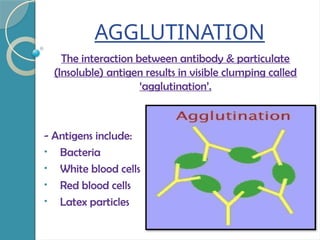
AGGLUTINATION
The interaction between antibody & particulate
(Insoluble) antigen results in visible clumping called
‘agglutination’.
- Antigens include:
• Bacteria
• White blood cells
• Red blood cells
• Latex particles
- The Ab of the serum causes the cellular Ag’s to
form clumps and these are called ‘Agglutinins’.
- The particulate antigens that are aggregated
are termed ‘Agglutinogens’.
- Agglutination can be performed in a tube or
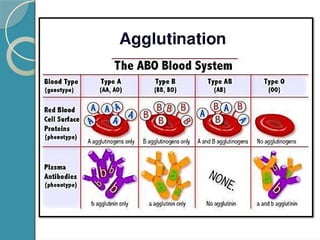
on a glass slide e.g. ABO blood grouping.
- Ab is divalent and cross links the multivalent
antigen to form clumps.
TUBE AGGLUTINATION:
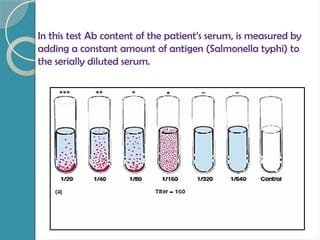
- Serum containing Ab is diluted serially with saline in small
test tubes, a constant volume of Ag suspension is added.
- Control tube is kept which has no antiserum.
- The tubes are incubated until visible agglutination is
observed.
- The tube showing highest agglutination is referred to as
the ‘titre’.
APPLICATION -> Widal test is used for the estimation
of typhoid fever
In this test Ab content of the patient’s serum, is measured by
adding a constant amount of antigen (Salmonella typhi) to
the serially diluted serum.
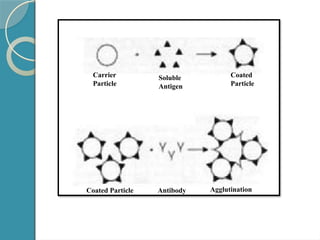
PASSIVE AGGLUTINATION:
- Ag is coated on the surface of a carrier particle.
- This helps to convert a precipitation reaction to an
agglutination reaction making the reaction more
sensitive.
- The carrier particles used can be RBC, latex particles or
bentonite.
- When patients serum is mixed with these, it leads to
agglutination.
APPLICATION -> diagnosis of Rheumatoid arthritis.
Carrier
Particle
Soluble
Antigen
Coated
Particle
Coated Particle Antibody Agglutination
PHASES OF AGGLUTINATION
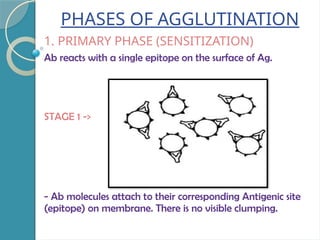
1. PRIMARY PHASE (SENSITIZATION)
Ab reacts with a single epitope on the surface of Ag.
STAGE 1 ->
- Ab molecules attach to their corresponding Antigenic site
(epitope) on membrane. There is no visible clumping.
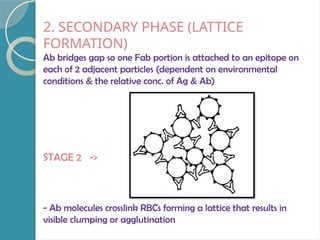
2. SECONDARY PHASE (LATTICE
FORMATION)
Ab bridges gap so one Fab portion is attached to an epitope on
each of 2 adjacent particles (dependent on environmental
conditions & the relative conc. of Ag & Ab)
STAGE 2 ->
- Ab molecules crosslink RBCs forming a lattice that results in
visible clumping or agglutination
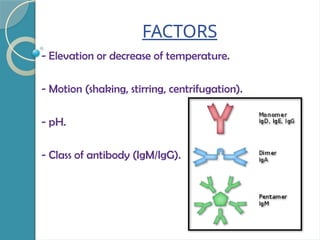
FACTORS
- Elevation or decrease of temperature.
- Motion (shaking, stirring, centrifugation).
- pH.
- Class of antibody (IgM/IgG).
HEMAGGLUTINATION TEST
- Type of agglutination test performed on RBCs.
- It has two types:
1. Active:
i) The antigen is the RBC itself.
ii) Viruses can clump red blood cells from one species or
another (active hemagglutination)
Example is the test used in ABO grouping.
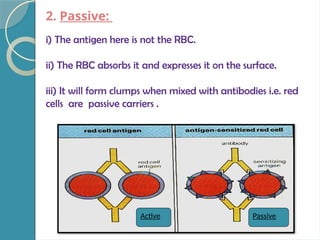
2. Passive:
i) The antigen here is not the RBC.
ii) The RBC absorbs it and expresses it on the surface.
iii) It will form clumps when mixed with antibodies i.e. red
cells are passive carriers .
Active Passive
APPLICATIONS:
- Blood typing.
- Bacterial infections
LIMITATIONS:
- Time consuming (1 day)
- Cannot distinguish IgG from IgM.
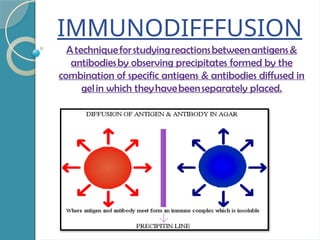
IMMUNODIFFFUSION
Atechniqueforstudyingreactionsbetweenantigens&
antibodiesby observing precipitates formed by the
combination of specific antigens & antibodies diffused in
gelin which theyhavebeenseparately placed.
ADVANTAGES:
a) Precipitin band is visible which can be stained for
preservation.
b) It can be used to detect identity, cross-reaction &
non-identity b/w antigens in a mixture.
TYPES OF IMMUNODIFFUSION
They are classified on the basis of:
a) Number of reactants diffusing
b) Direction of diffusion
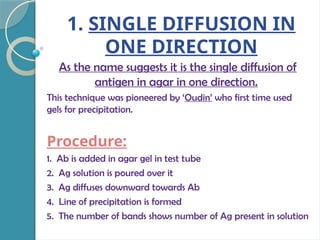
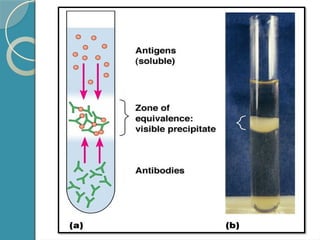
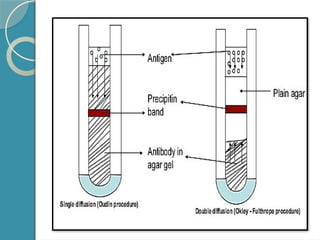
1. SINGLE DIFFUSION IN
ONE DIRECTION
As the name suggests it is the single diffusion of
antigen in agar in one direction.
This technique was pioneered by ‘Oudin’ who first time used
gels for precipitation.
Procedure:
1. Ab is added in agar gel in test tube
2. Ag solution is poured over it
3. Ag diffuses downward towards Ab
4. Line of precipitation is formed
5. The number of bands shows number of Ag present in solution
2. SINGLE DIFFUSION IN
TWO DIMENSIONS
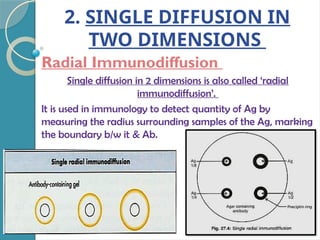
Radial Immunodiffusion
Single diffusion in 2 dimensions is also called ‘radial
immunodiffusion’.
It is used in immunology to detect quantity of Ag by
measuring the radius surrounding samples of the Ag, marking
the boundary b/w it & Ab.
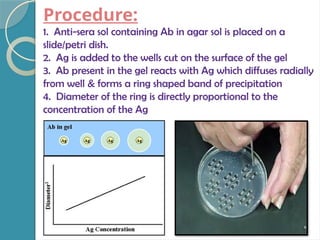
Procedure:
1. Anti-sera sol containing Ab in agar sol is placed on a
slide/petri dish.
2. Ag is added to the wells cut on the surface of the gel
3. Ab present in the gel reacts with Ag which diffuses radially
from well & forms a ring shaped band of precipitation
4. Diameter of the ring is directly proportional to the
concentration of the Ag
3. DOUBLE DIFFUSION IN
ONE DIMENSION
This method is also called ‘Oakley-Fulthrope’
procedure & is performed in a test tube.
Procedure:
1. Ab’s are incorporated in gel in test tube
2. Above which a layer of plain agar is placed.
3. Ag layer is poured on top of this plain
4. Ag’s & Ab’s moves towards each other through
intervening layer of plain agar.
5. Ag & Ab reacts to form precipitin ring at optimum
concentration.
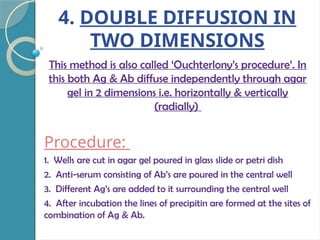
4. DOUBLE DIFFUSION IN
TWO DIMENSIONS
This method is also called ‘Ouchterlony’s procedure’. In
this both Ag & Ab diffuse independently through agar
gel in 2 dimensions i.e. horizontally & vertically
(radially)
Procedure:
1. Wells are cut in agar gel poured in glass slide or petri dish
2. Anti-serum consisting of Ab’s are poured in the central well
3. Different Ag’s are added to it surrounding the central well
4. After incubation the lines of precipitin are formed at the sites of
combination of Ag & Ab.
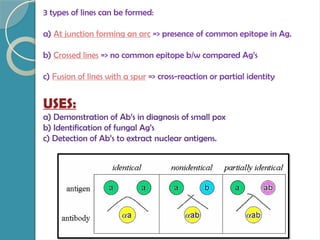
3 types of lines can be formed:
a) At junction forming an arc => presence of common epitope in Ag.
b) Crossed lines => no common epitope b/w compared Ag’s
c) Fusion of lines with a spur => cross-reaction or partial identity
USES:
a) Demonstration of Ab’s in diagnosis of small pox
b) Identification of fungal Ag’s
c) Detection of Ab’s to extract nuclear antigens.
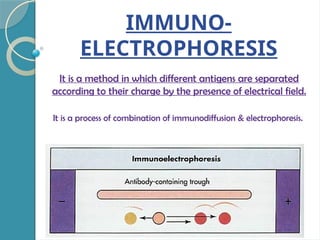
IMMUNO-
ELECTROPHORESIS
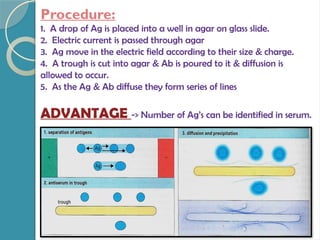
It is a method in which different antigens are separated
according to their charge by the presence of electrical field.
It is a process of combination of immunodiffusion & electrophoresis.
Procedure:
1. A drop of Ag is placed into a well in agar on glass slide.
2. Electric current is passed through agar
3. Ag move in the electric field according to their size & charge.
4. A trough is cut into agar & Ab is poured to it & diffusion is
allowed to occur.
5. As the Ag & Ab diffuse they form series of lines
ADVANTAGE -> Number of Ag’s can be identified in serum.
COUNTER-CURRENT
IMMUNOELECROPHORESIS
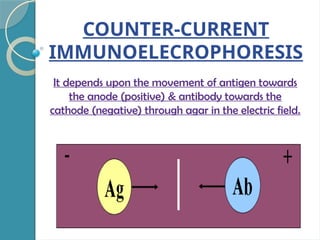
It depends upon the movement of antigen towards
the anode (positive) & antibody towards the
cathode (negative) through agar in the electric field.
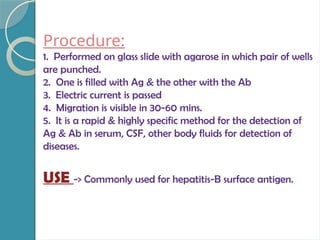
Procedure:
1. Performed on glass slide with agarose in which pair of wells
are punched.
2. One is filled with Ag & the other with the Ab
3. Electric current is passed
4. Migration is visible in 30-60 mins.
5. It is a rapid & highly specific method for the detection of
Ag & Ab in serum, CSF, other body fluids for detection of
diseases.
USE -> Commonly used for hepatitis-B surface antigen.
ROCKET
ELECTROPHORESIS
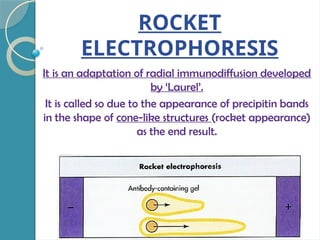
It is an adaptation of radial immunodiffusion developed
by ‘Laurel’.
It is called so due to the appearance of precipitin bands
in the shape of cone-like structures (rocket appearance)
as the end result.
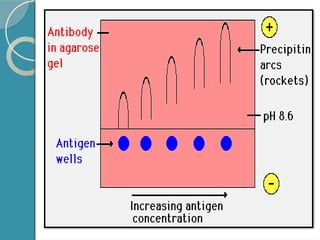
Procedure:
1. Ab is incorporated in the gel, Ag’s are placed in wells cut
in gel
2. Electric current is passed, which facilitated migration of
Ag into agar
3. This results in formation of precipitin conical in shape,
resembling rocket.
4. The height of rocket is directly proportional to
concentration of antigen.
USE -> For quantitative estimation of antigen in serum
CONCLUSION
Thus we hereby conclude with the fact that
antigen-antibody reactions are very important
for serological testing of human beings, as they
give you a complete picture of all the immune
responses occurring the body & helps
determining the immunological disorders by the
antigen (either self or non-self).
ag ab reaction.pptx,,,,,,,,,,,,,,,,,,,,,,,,,,,,,,,,,,,,,,,,,,,,,,,,,,,,,,,,,,,

ag ab reaction.pptx,,,,,,,,,,,,,,,,,,,,,,,,,,,,,,,,,,,,,,,,,,,,,,,,,,,,,,,,,,,

  • 1.
  • 2.
    INTRODUCTION Antigens & antibodiescombine specifically with each other. This interaction between them is called ‘Antigen-Antibody reaction’. - Abbreviated as Ag – Ab reaction. - They form the basis for humoral/antibody mediated immunity. - They are used for detection of disease , Onset of disease(from concentration of antibodies),causing agents & some non-specific Ag’s like enzymes,immune reaction, treatment & prevention.
  • 3.
    - When Ag-Abreaction occurs in-vitro they are known as ‘serological reactions’. - The reactions b/w Ag & Ab occurs in 3 stages: 1st (primary stage)= formation of Ag-Ab complex. Initial interaction reaction is rapid, occurs at low temperature reaction is reversible they are attached together by van der wall force, h2 bond,ionic bonds
  • 4.
    Secondary phase 2nd =leads to visible events like precipitation, agglutination etc. Lysis of cell Killing of live antigen Example •Precipitin-ab participate in precipitation •Agglitinin-ab participate in agglutination (Tertiary phase) 3rd = destruction of Ag or its neutralization. Visible immunity
  • 5.
    SALIENT FEATURES -Specificity. -Thereis nodenaturation of the antigen antibody during reaction. Entirety Surface combination - Immune complex. - Binding Site of Antigen. - Binding Force of Antigen.
  • 6.
    1. SPECIFICITY: Refers tothe ability of an individual antibody combining site to react with only one antigenic determinant (epitope). - Each antibody binds to a specific antigen; an interaction similar to a lock and key.
  • 7.
    2. IMMUNE COMPLEX: Animmune complex is formed from the integral binding of an antibody to a soluble antigen. Ag + Ab  Ag-Ab complex
  • 8.
    3. BINDING SITEOF Ag: - The part of antigen which combines with antibody is called ‘Epitope’, recognized by the immune system, specifically by antibodies, B cells, or T cells. - Part of an antibody that recognizes an epitope is called a ‘paratope’.
  • 9.
    4. BINDING FORCEOF Ag: - The binding b/w Ag & Ab in Ag – Ab reaction is due to three factors namely: * Closeness b/w Ag & Ab -> more close = good strength of binding. * Non – covalent bonds or Intermolecular forces -> hydrogen bonds, vander walls forces, hydrophobic bonds. * Affinity of antibody -> strength of reaction b/w a single epitope & single paratope. * VALENCY- antibodies are bivalent in nature, both are multivalent
  • 10.
    •ANTIBODY AVIDITY: it isthe overall strength of ag – ab complex,dependes upon affinity valency oerall structure
  • 11.
    TYPES The types ofantigen-antibody reactions are: - Precipitation Reaction. - Agglutination Reaction. - Complement Fixation. - ELISA – Enzyme Linked ImmunoSorbent Assay. - Immunofluorescence.
  • 12.
  • 14.
    PRECIPITATION / IMMUNO-PRECIPITATION The phenomenonof aggregation of sensitized antigen on addition of specific antibody (precipitin) to antigen in solution is called ‘precipitation’.
  • 15.
    DEFINITION  CHEMICAL INTERACTIONB/W MULTIVALENT ANTIGEN & BIVALENT ANTIBODY, LEADSTO FORM THE INSOLUABLE PRECIPITATES UNDER FAVORABLE CONDITION INTHE PRESENCE OF ELECTROLYTES
  • 16.
    - Precipitation occursin two media: * Liquid * Gel 1. Precipitation in Liquids: - Place constant amount of Ab in a series of tubes. - Add increased amount of antigen. - Antigen – Antibody reacts together resulting in precipitation. - Plotting the amount of precipitate against increasing antigen conc. yields a ‘precipitin curve’.
  • 17.
    - Precipitation curveshows 3 zones: * Zone of Ab axis. * Zone of equivalence. * Zone of Ag axis.
  • 18.
    PRINCIPLE - Soluble antigen+ antibody (in proper proportions)  visible precipitate - Lattice formation (Ag binds with Fab sites of 2 Ab’s)
  • 19.
    2. Precipitation inGels: RADIAL IMMUNODIFFUSION: - In these methods agar gel or similar gels are used on plates or petri-plates. - Both Ag and Ab diffuse freely in the gel system in all directions. - At a certain point depending on the rate of diffusion & conc. of the reactants, a zone of equivalence will be formed, seen as a visible ppt.
  • 20.
    - If Agor Ab preparations are complex, multiple bands form. - These are again of 2 types: * Single diffusion methods * Double diffusion methods. Precipitation reactions in gels
  • 21.
    AGGLUTINATION The interaction betweenantibody & particulate (Insoluble) antigen results in visible clumping called ‘agglutination’. - Antigens include: • Bacteria • White blood cells • Red blood cells • Latex particles
  • 22.
    - The Abof the serum causes the cellular Ag’s to form clumps and these are called ‘Agglutinins’. - The particulate antigens that are aggregated are termed ‘Agglutinogens’. - Agglutination can be performed in a tube or on a glass slide e.g. ABO blood grouping. - Ab is divalent and cross links the multivalent antigen to form clumps.
  • 23.
    TUBE AGGLUTINATION: - Serumcontaining Ab is diluted serially with saline in small test tubes, a constant volume of Ag suspension is added. - Control tube is kept which has no antiserum. - The tubes are incubated until visible agglutination is observed. - The tube showing highest agglutination is referred to as the ‘titre’. APPLICATION -> Widal test is used for the estimation of typhoid fever
  • 24.
    In this testAb content of the patient’s serum, is measured by adding a constant amount of antigen (Salmonella typhi) to the serially diluted serum.
  • 25.
    PASSIVE AGGLUTINATION: - Agis coated on the surface of a carrier particle. - This helps to convert a precipitation reaction to an agglutination reaction making the reaction more sensitive. - The carrier particles used can be RBC, latex particles or bentonite. - When patients serum is mixed with these, it leads to agglutination. APPLICATION -> diagnosis of Rheumatoid arthritis.
  • 26.
  • 27.
    PHASES OF AGGLUTINATION 1.PRIMARY PHASE (SENSITIZATION) Ab reacts with a single epitope on the surface of Ag. STAGE 1 -> - Ab molecules attach to their corresponding Antigenic site (epitope) on membrane. There is no visible clumping.
  • 28.
    2. SECONDARY PHASE(LATTICE FORMATION) Ab bridges gap so one Fab portion is attached to an epitope on each of 2 adjacent particles (dependent on environmental conditions & the relative conc. of Ag & Ab) STAGE 2 -> - Ab molecules crosslink RBCs forming a lattice that results in visible clumping or agglutination
  • 29.
    FACTORS - Elevation ordecrease of temperature. - Motion (shaking, stirring, centrifugation). - pH. - Class of antibody (IgM/IgG).
  • 30.
    HEMAGGLUTINATION TEST - Typeof agglutination test performed on RBCs. - It has two types: 1. Active: i) The antigen is the RBC itself. ii) Viruses can clump red blood cells from one species or another (active hemagglutination) Example is the test used in ABO grouping.
  • 32.
    2. Passive: i) Theantigen here is not the RBC. ii) The RBC absorbs it and expresses it on the surface. iii) It will form clumps when mixed with antibodies i.e. red cells are passive carriers . Active Passive
  • 33.
    APPLICATIONS: - Blood typing. -Bacterial infections LIMITATIONS: - Time consuming (1 day) - Cannot distinguish IgG from IgM.
  • 34.
    IMMUNODIFFFUSION Atechniqueforstudyingreactionsbetweenantigens& antibodiesby observing precipitatesformed by the combination of specific antigens & antibodies diffused in gelin which theyhavebeenseparately placed.
  • 35.
    ADVANTAGES: a) Precipitin bandis visible which can be stained for preservation. b) It can be used to detect identity, cross-reaction & non-identity b/w antigens in a mixture. TYPES OF IMMUNODIFFUSION They are classified on the basis of: a) Number of reactants diffusing b) Direction of diffusion
  • 36.
    1. SINGLE DIFFUSIONIN ONE DIRECTION As the name suggests it is the single diffusion of antigen in agar in one direction. This technique was pioneered by ‘Oudin’ who first time used gels for precipitation. Procedure: 1. Ab is added in agar gel in test tube 2. Ag solution is poured over it 3. Ag diffuses downward towards Ab 4. Line of precipitation is formed 5. The number of bands shows number of Ag present in solution
  • 38.
    2. SINGLE DIFFUSIONIN TWO DIMENSIONS Radial Immunodiffusion Single diffusion in 2 dimensions is also called ‘radial immunodiffusion’. It is used in immunology to detect quantity of Ag by measuring the radius surrounding samples of the Ag, marking the boundary b/w it & Ab.
  • 39.
    Procedure: 1. Anti-sera solcontaining Ab in agar sol is placed on a slide/petri dish. 2. Ag is added to the wells cut on the surface of the gel 3. Ab present in the gel reacts with Ag which diffuses radially from well & forms a ring shaped band of precipitation 4. Diameter of the ring is directly proportional to the concentration of the Ag
  • 40.
    3. DOUBLE DIFFUSIONIN ONE DIMENSION This method is also called ‘Oakley-Fulthrope’ procedure & is performed in a test tube. Procedure: 1. Ab’s are incorporated in gel in test tube 2. Above which a layer of plain agar is placed. 3. Ag layer is poured on top of this plain 4. Ag’s & Ab’s moves towards each other through intervening layer of plain agar. 5. Ag & Ab reacts to form precipitin ring at optimum concentration.
  • 42.
    4. DOUBLE DIFFUSIONIN TWO DIMENSIONS This method is also called ‘Ouchterlony’s procedure’. In this both Ag & Ab diffuse independently through agar gel in 2 dimensions i.e. horizontally & vertically (radially) Procedure: 1. Wells are cut in agar gel poured in glass slide or petri dish 2. Anti-serum consisting of Ab’s are poured in the central well 3. Different Ag’s are added to it surrounding the central well 4. After incubation the lines of precipitin are formed at the sites of combination of Ag & Ab.
  • 43.
    3 types oflines can be formed: a) At junction forming an arc => presence of common epitope in Ag. b) Crossed lines => no common epitope b/w compared Ag’s c) Fusion of lines with a spur => cross-reaction or partial identity USES: a) Demonstration of Ab’s in diagnosis of small pox b) Identification of fungal Ag’s c) Detection of Ab’s to extract nuclear antigens.
  • 44.
    IMMUNO- ELECTROPHORESIS It is amethod in which different antigens are separated according to their charge by the presence of electrical field. It is a process of combination of immunodiffusion & electrophoresis.
  • 45.
    Procedure: 1. A dropof Ag is placed into a well in agar on glass slide. 2. Electric current is passed through agar 3. Ag move in the electric field according to their size & charge. 4. A trough is cut into agar & Ab is poured to it & diffusion is allowed to occur. 5. As the Ag & Ab diffuse they form series of lines ADVANTAGE -> Number of Ag’s can be identified in serum.
  • 46.
    COUNTER-CURRENT IMMUNOELECROPHORESIS It depends uponthe movement of antigen towards the anode (positive) & antibody towards the cathode (negative) through agar in the electric field.
  • 47.
    Procedure: 1. Performed onglass slide with agarose in which pair of wells are punched. 2. One is filled with Ag & the other with the Ab 3. Electric current is passed 4. Migration is visible in 30-60 mins. 5. It is a rapid & highly specific method for the detection of Ag & Ab in serum, CSF, other body fluids for detection of diseases. USE -> Commonly used for hepatitis-B surface antigen.
  • 48.
    ROCKET ELECTROPHORESIS It is anadaptation of radial immunodiffusion developed by ‘Laurel’. It is called so due to the appearance of precipitin bands in the shape of cone-like structures (rocket appearance) as the end result.
  • 49.
    Procedure: 1. Ab isincorporated in the gel, Ag’s are placed in wells cut in gel 2. Electric current is passed, which facilitated migration of Ag into agar 3. This results in formation of precipitin conical in shape, resembling rocket. 4. The height of rocket is directly proportional to concentration of antigen. USE -> For quantitative estimation of antigen in serum
  • 51.
    CONCLUSION Thus we herebyconclude with the fact that antigen-antibody reactions are very important for serological testing of human beings, as they give you a complete picture of all the immune responses occurring the body & helps determining the immunological disorders by the antigen (either self or non-self).