GENERATIONS OF
COMPUTER
1ST generation
• A first-generation programming language is a machine-level
programming language.
• Originally, no translator was used to compile or assemble the
first-generation language. The first-generation programming
instructions were entered through the front panel switches of
the computer system.
• A first generation (programming) language (1GL) is a grouping
of programming languages that are machine level languages
used to program first-generation computers. The instructions
were given through the front panel switches of these
computers, directly to the CPU. There was originally no
compiler or assembler to process the instructions in 1GL.
• The instructions in 1GL are made of binary numbers,
represented by 1s and 0s. This makes the language suitable
for the understanding of the machine but very much more
difficult to interpret and learn by the human programmer.
• The main advantage of programming in 1GL is that the
code can run very fast and very efficiently, precisely
because the instructions are executed directly by the
CPU. One of the main disadvantages of programming in
a low level language is that when an error occurs, the
code is not as easy to fix.
• First generation languages are very much adapted to a
specific computer and CPU, and code portability is
therefore significantly reduced in comparison to higher
level languages.
• Modern day programmers still occasionally use
machine level code, especially when programming
lower level functions of the system, such as drivers,
interfaces with firmware and hardware devices.
Modern tools, such as native-code compilers are used
to produce machine level from a higher-level language.
2nd generation
• The second generation of computer and video games
began in 1976 with the release of the Fairchild Channel
F and Radofin Electronics' 1292 Advanced
Programmable Video System. It coincided with and was
partly fuelled by the golden age of arcade video games,
a peak era of popularity and innovation for the
medium.
• The early period saw the launch of several consoles as
various companies decided to enter the market; later
releases were in direct response to the earlier consoles.
The Atari 2600 was the dominant console for much of
the second generation, with other consoles such
as Intellivision, the Odyssey 2, and Coleco Vision also
enjoying market share.
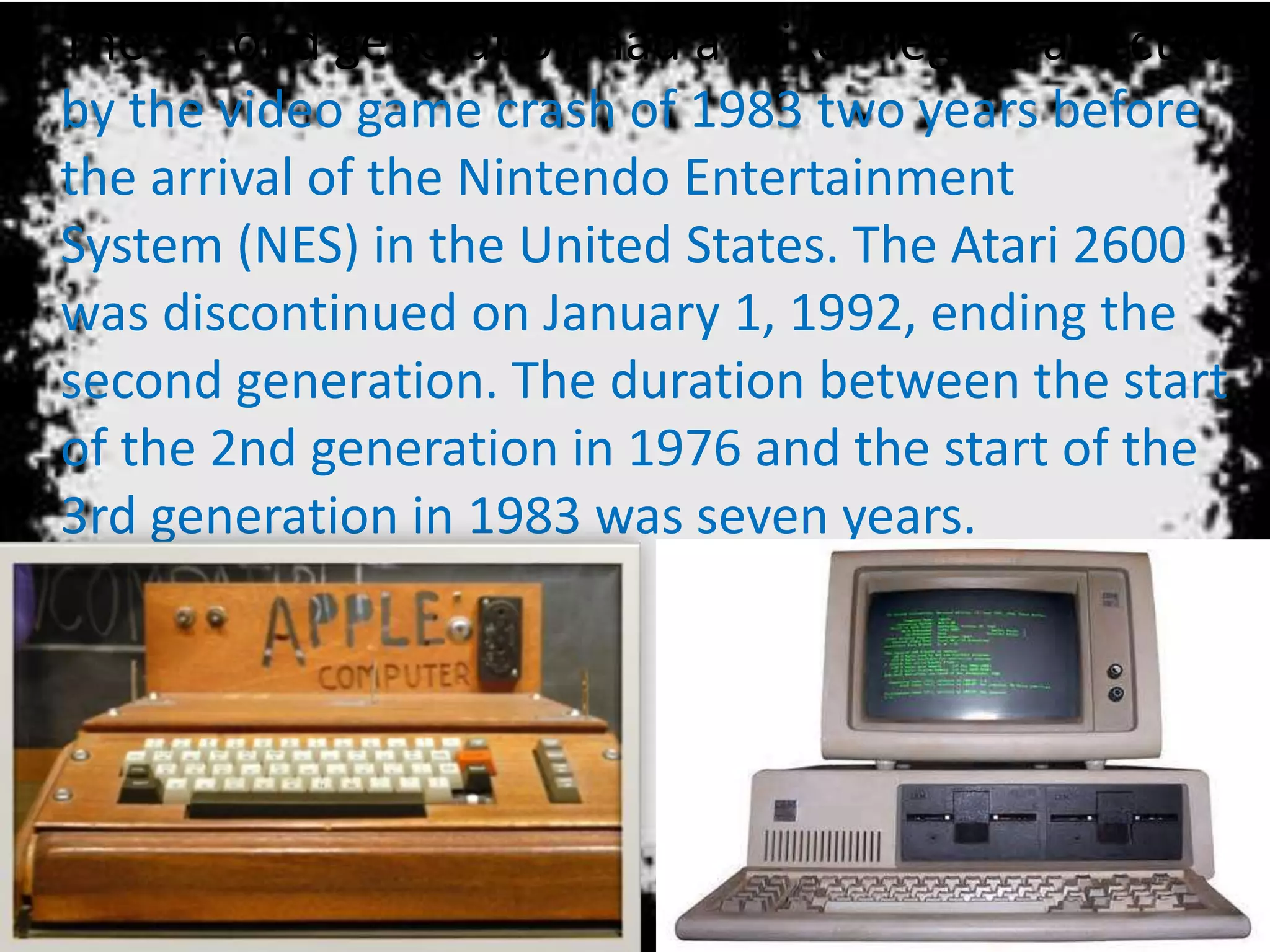
• The second generation had a mixed legacy affected
by the video game crash of 1983 two years before
the arrival of the Nintendo Entertainment
System (NES) in the United States. The Atari 2600
was discontinued on January 1, 1992, ending the
second generation. The duration between the start
of the 2nd generation in 1976 and the start of the
3rd generation in 1983 was seven years.
3rd GENERATION
• During the period of 1964 to 1971 Third generation
computers were developed. The third generation
computers emerged with the development of IC
(Integrated Circuits). The invention of the IC was the
greatest achievement done in the period of third
generation of computers. IC was invented by Robert
Noyce and Jack Kilby in 1958-59. IC is
a single component containing a number of
transistors. Transistors were miniaturized and
placed on silicon chips, called semiconductors,
which drastically increased the speed and efficiency
of computers.
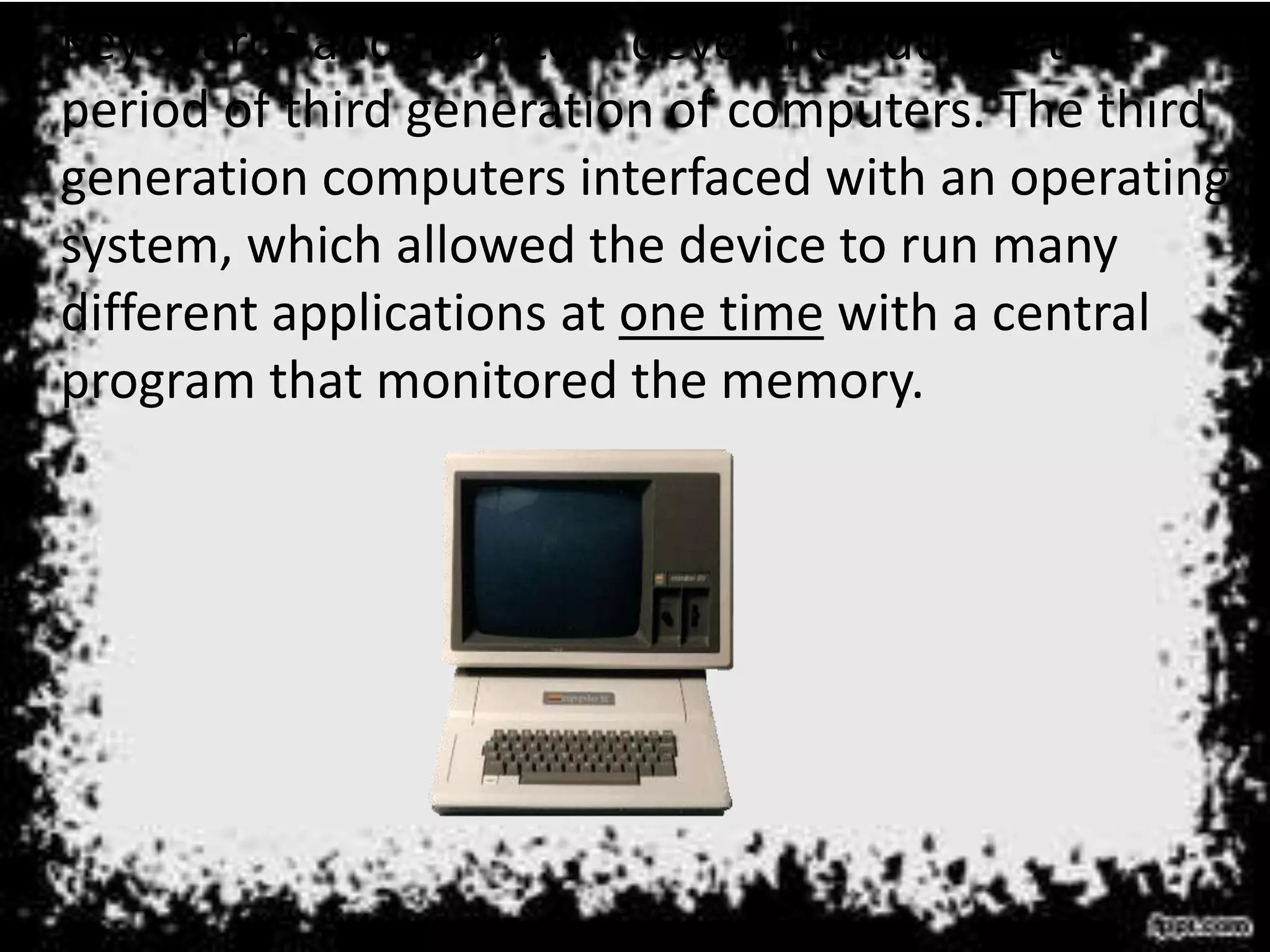
• Keyboards and monitors developed during the
period of third generation of computers. The third
generation computers interfaced with an operating
system, which allowed the device to run many
different applications at one time with a central
program that monitored the memory.
4th Generation
• In this generation, there were developments of large-
scale integration or LSI (1000 devices per chip) and very
large-scale integration or VLSI (10000 devices per chip).
These developments enabled the entire processor to fit
into a single chip and in fact, for simple systems, the
entire computer with processor; main memory and I/O
controllers could fit on a single chip.
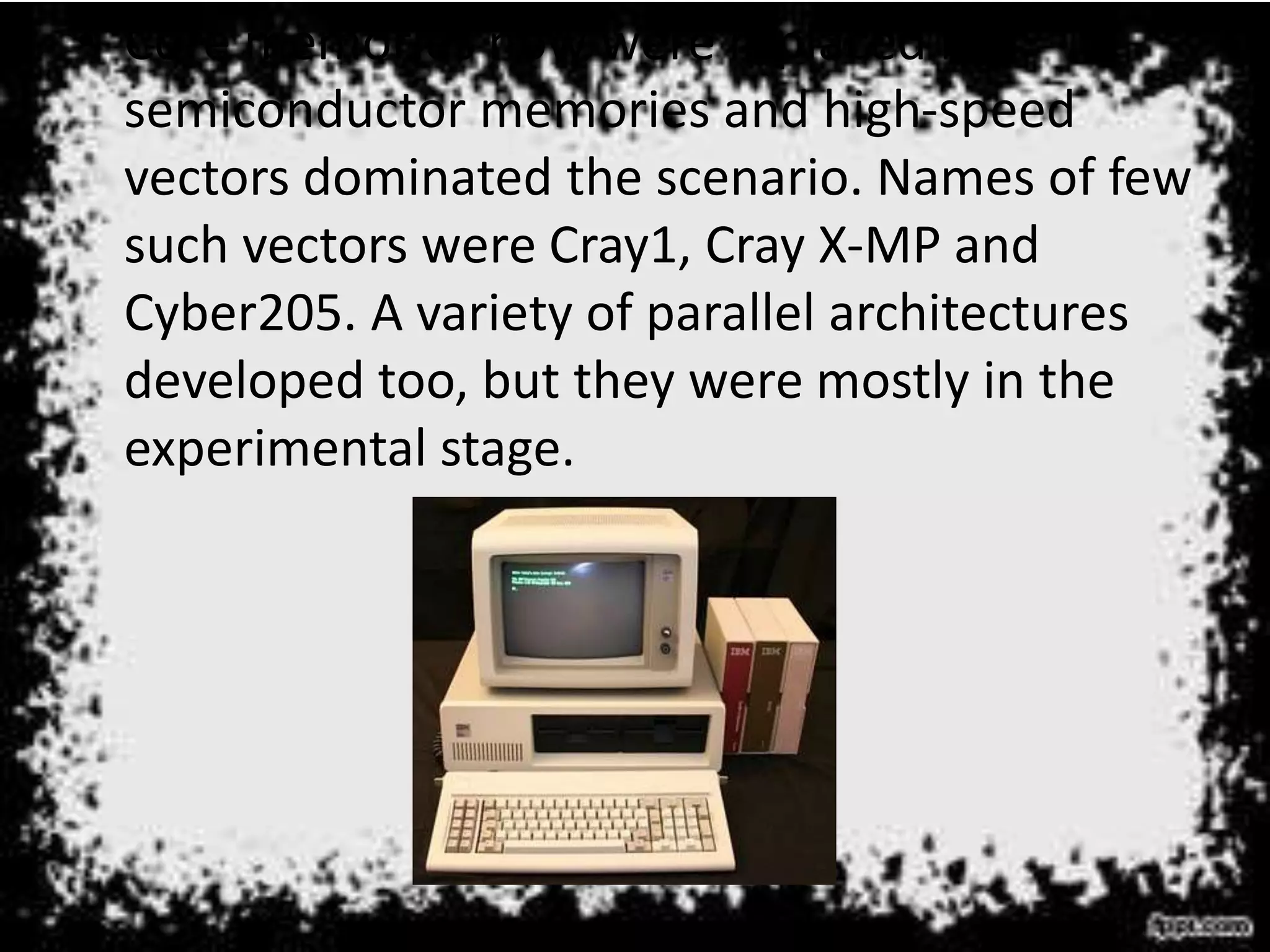
• Core memories now were replaced by semiconductor
memories and high-speed vectors dominated the
scenario. Names of few such vectors were Cray1, Cray
X-MP and Cyber205. A variety of parallel architectures
developed too, but they were mostly in the
experimental stage.
• Core memories now were replaced by
semiconductor memories and high-speed
vectors dominated the scenario. Names of few
such vectors were Cray1, Cray X-MP and
Cyber205. A variety of parallel architectures
developed too, but they were mostly in the
experimental stage.
5th generation
• The Fifth Generation Computer Systems
project (FGCS) was an initiative by Japan's Ministry
of International Trade and Industry, begun in 1982,
to create a computer using massively parallel
computing/processing. It was to be the result of a
massive government/industry research project in
Japan during the 1980s. It aimed to create an
"epoch-making computer" with-supercomputer-like
performance and to provide a platform for future
developments in artificial intelligence. There was
also an unrelated Russian project also named as
fifth-generation computer (see Kronos (computer)).
• In his "Trip report" paper, Prof. Ehud Shapiro (which
focused the FGCS project on concurrent logic
programming as the software foundation for the
project) captured the rationale and motivations driving
this huge project: "As part of Japan's effort to become a
leader in the computer industry, the Institute for New
Generation Computer Technology has launched a
revolutionary ten-year plan for the development of
large computer systems which will be applicable to
knowledge information processing systems. These Fifth
Generation computers will be built around the concepts
of logic programming. In order to refute the accusation
that Japan exploits knowledge from abroad without
contributing any of its own, this project will stimulate
original research and will make its results available to
the international research community."
THANK YOU
Name: G.SREE NAVEEN
CLASS: 10TH
SEC:B
ROLL NO. : 17

ages of computer...................

  • 1.
  • 2.
    1ST generation • Afirst-generation programming language is a machine-level programming language. • Originally, no translator was used to compile or assemble the first-generation language. The first-generation programming instructions were entered through the front panel switches of the computer system. • A first generation (programming) language (1GL) is a grouping of programming languages that are machine level languages used to program first-generation computers. The instructions were given through the front panel switches of these computers, directly to the CPU. There was originally no compiler or assembler to process the instructions in 1GL. • The instructions in 1GL are made of binary numbers, represented by 1s and 0s. This makes the language suitable for the understanding of the machine but very much more difficult to interpret and learn by the human programmer.
  • 3.
    • The mainadvantage of programming in 1GL is that the code can run very fast and very efficiently, precisely because the instructions are executed directly by the CPU. One of the main disadvantages of programming in a low level language is that when an error occurs, the code is not as easy to fix. • First generation languages are very much adapted to a specific computer and CPU, and code portability is therefore significantly reduced in comparison to higher level languages. • Modern day programmers still occasionally use machine level code, especially when programming lower level functions of the system, such as drivers, interfaces with firmware and hardware devices. Modern tools, such as native-code compilers are used to produce machine level from a higher-level language.
  • 4.
    2nd generation • Thesecond generation of computer and video games began in 1976 with the release of the Fairchild Channel F and Radofin Electronics' 1292 Advanced Programmable Video System. It coincided with and was partly fuelled by the golden age of arcade video games, a peak era of popularity and innovation for the medium. • The early period saw the launch of several consoles as various companies decided to enter the market; later releases were in direct response to the earlier consoles. The Atari 2600 was the dominant console for much of the second generation, with other consoles such as Intellivision, the Odyssey 2, and Coleco Vision also enjoying market share.
  • 5.
    • The secondgeneration had a mixed legacy affected by the video game crash of 1983 two years before the arrival of the Nintendo Entertainment System (NES) in the United States. The Atari 2600 was discontinued on January 1, 1992, ending the second generation. The duration between the start of the 2nd generation in 1976 and the start of the 3rd generation in 1983 was seven years.
  • 6.
    3rd GENERATION • Duringthe period of 1964 to 1971 Third generation computers were developed. The third generation computers emerged with the development of IC (Integrated Circuits). The invention of the IC was the greatest achievement done in the period of third generation of computers. IC was invented by Robert Noyce and Jack Kilby in 1958-59. IC is a single component containing a number of transistors. Transistors were miniaturized and placed on silicon chips, called semiconductors, which drastically increased the speed and efficiency of computers.
  • 7.
    • Keyboards andmonitors developed during the period of third generation of computers. The third generation computers interfaced with an operating system, which allowed the device to run many different applications at one time with a central program that monitored the memory.
  • 8.
    4th Generation • Inthis generation, there were developments of large- scale integration or LSI (1000 devices per chip) and very large-scale integration or VLSI (10000 devices per chip). These developments enabled the entire processor to fit into a single chip and in fact, for simple systems, the entire computer with processor; main memory and I/O controllers could fit on a single chip. • Core memories now were replaced by semiconductor memories and high-speed vectors dominated the scenario. Names of few such vectors were Cray1, Cray X-MP and Cyber205. A variety of parallel architectures developed too, but they were mostly in the experimental stage.
  • 9.
    • Core memoriesnow were replaced by semiconductor memories and high-speed vectors dominated the scenario. Names of few such vectors were Cray1, Cray X-MP and Cyber205. A variety of parallel architectures developed too, but they were mostly in the experimental stage.
  • 10.
    5th generation • TheFifth Generation Computer Systems project (FGCS) was an initiative by Japan's Ministry of International Trade and Industry, begun in 1982, to create a computer using massively parallel computing/processing. It was to be the result of a massive government/industry research project in Japan during the 1980s. It aimed to create an "epoch-making computer" with-supercomputer-like performance and to provide a platform for future developments in artificial intelligence. There was also an unrelated Russian project also named as fifth-generation computer (see Kronos (computer)).
  • 11.
    • In his"Trip report" paper, Prof. Ehud Shapiro (which focused the FGCS project on concurrent logic programming as the software foundation for the project) captured the rationale and motivations driving this huge project: "As part of Japan's effort to become a leader in the computer industry, the Institute for New Generation Computer Technology has launched a revolutionary ten-year plan for the development of large computer systems which will be applicable to knowledge information processing systems. These Fifth Generation computers will be built around the concepts of logic programming. In order to refute the accusation that Japan exploits knowledge from abroad without contributing any of its own, this project will stimulate original research and will make its results available to the international research community."
  • 13.
    THANK YOU Name: G.SREENAVEEN CLASS: 10TH SEC:B ROLL NO. : 17