ORION SOFT TECHNOLOGIES
 HISTORY OF COMPUTER: 
Initially computer was developed as accounting machine because there was a need to 
human brains for such a device to help in his work. According to the needs of human 
effective changes are made in this machine. 
AGES OF COMPUTER: 
At the early age people used pebbles, stones, sticks, scratches, symbols and finger tips to count, 
which were later replaced by numbers. The history of computing is divided into three ages during 
which man invented and improved different types of calculating machines. These ages are, 
•Dark age - 300 BC to 1890 
•Middle age - 1890 AD to 1944 
Modern Dark Age (3000 BC to 1890 AD) 
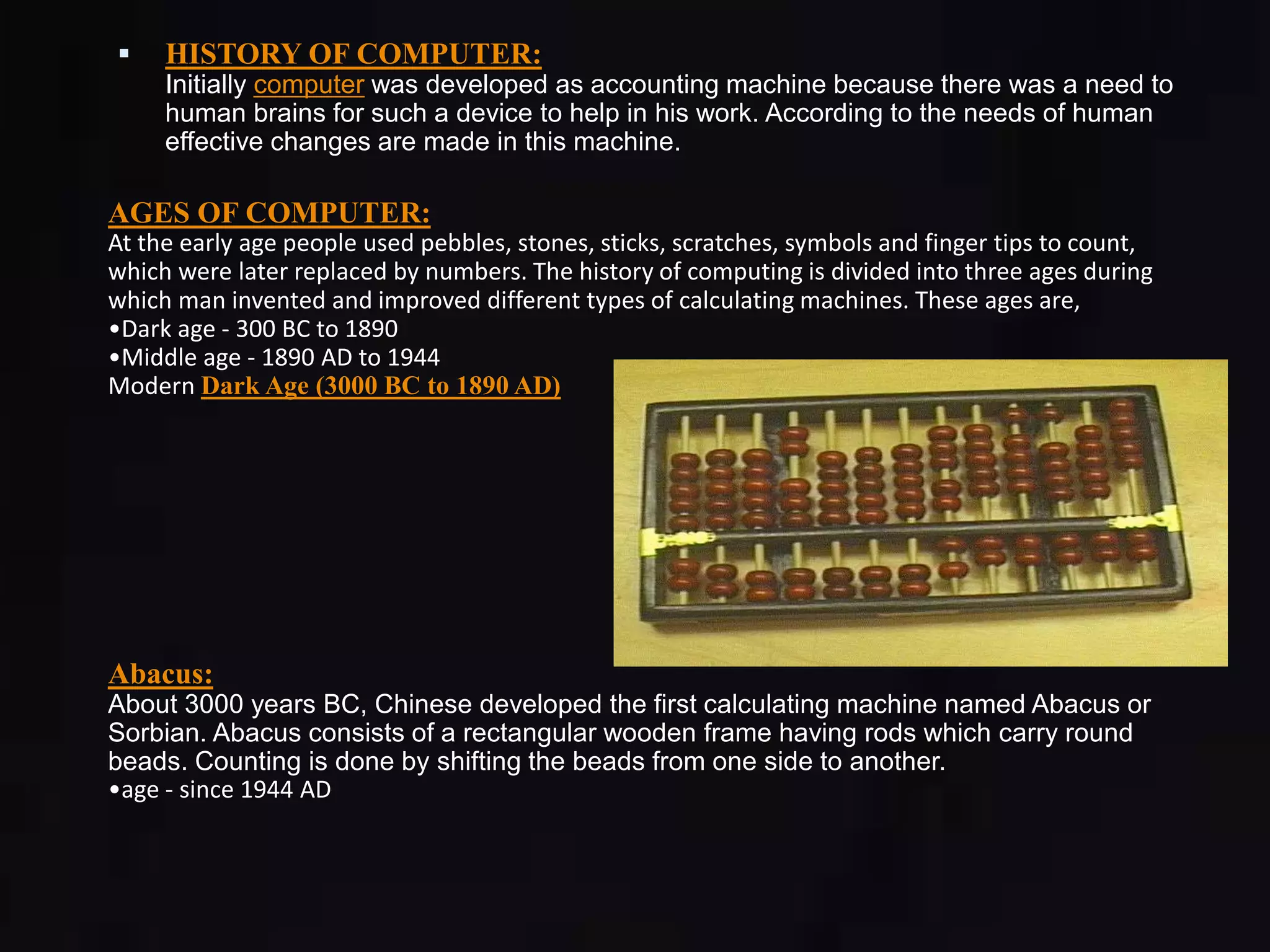
Abacus: 
About 3000 years BC, Chinese developed the first calculating machine named Abacus or 
Sorbian. Abacus consists of a rectangular wooden frame having rods which carry round 
beads. Counting is done by shifting the beads from one side to another. 
•age - since 1944 AD
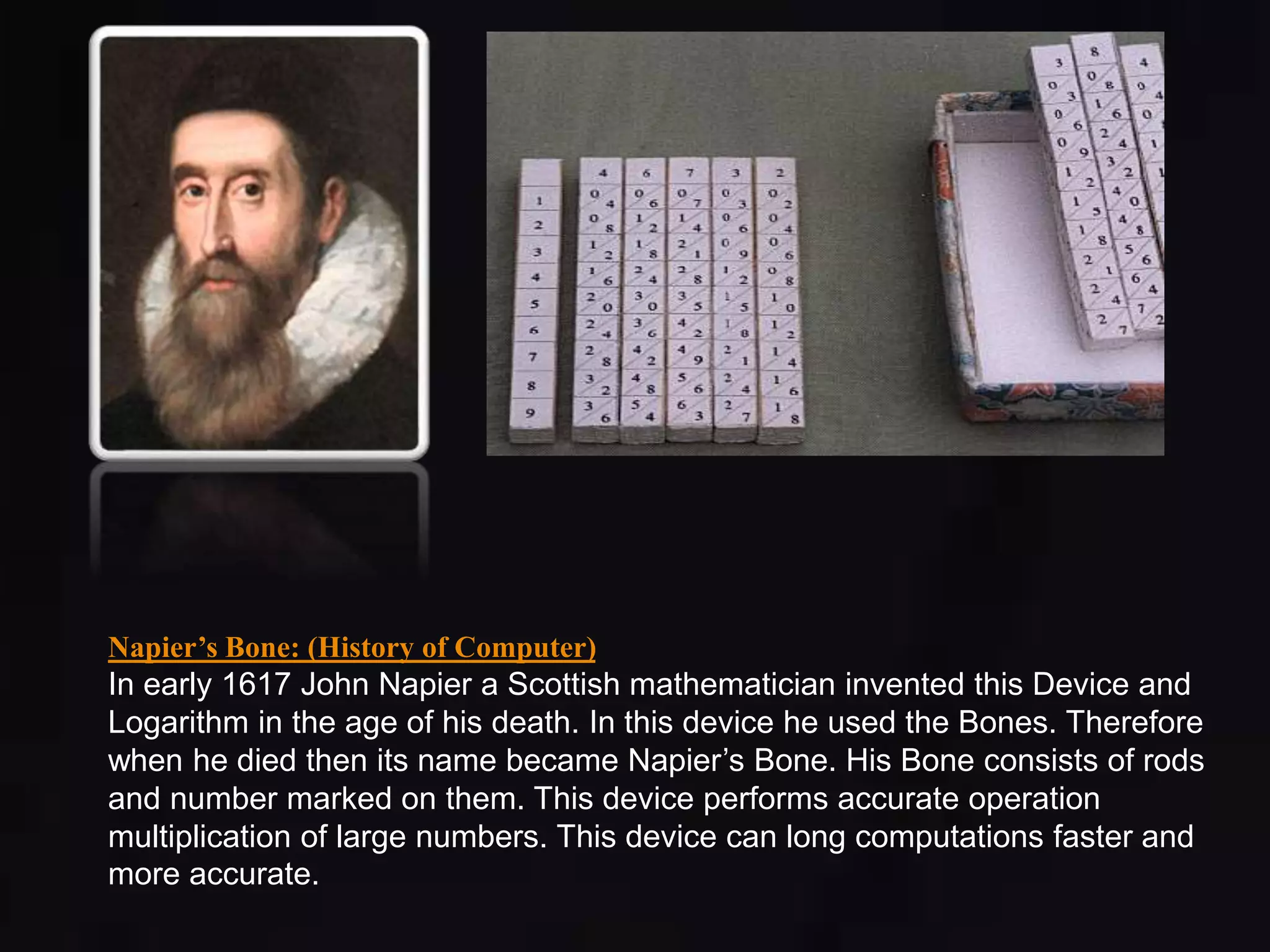
Napier’s Bone: (History of Computer) 
In early 1617 John Napier a Scottish mathematician invented this Device and 
Logarithm in the age of his death. In this device he used the Bones. Therefore 
when he died then its name became Napier’s Bone. His Bone consists of rods 
and number marked on them. This device performs accurate operation 
multiplication of large numbers. This device can long computations faster and 
more accurate.
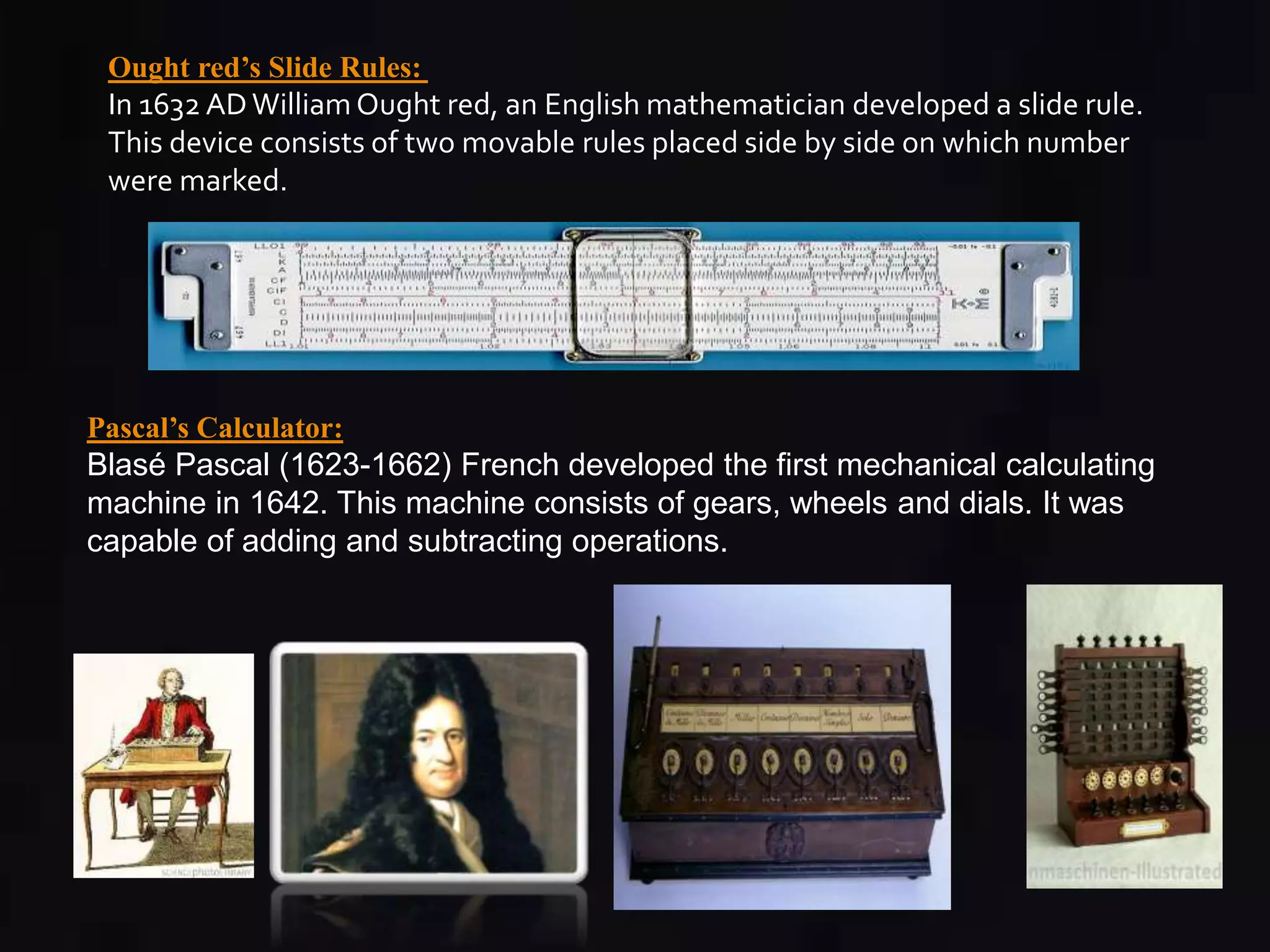
Ought red’s Slide Rules: 
In 1632 AD William Ought red, an English mathematician developed a slide rule. 
This device consists of two movable rules placed side by side on which number 
were marked. 
Pascal’s Calculator: 
Blasé Pascal (1623-1662) French developed the first mechanical calculating 
machine in 1642. This machine consists of gears, wheels and dials. It was 
capable of adding and subtracting operations.
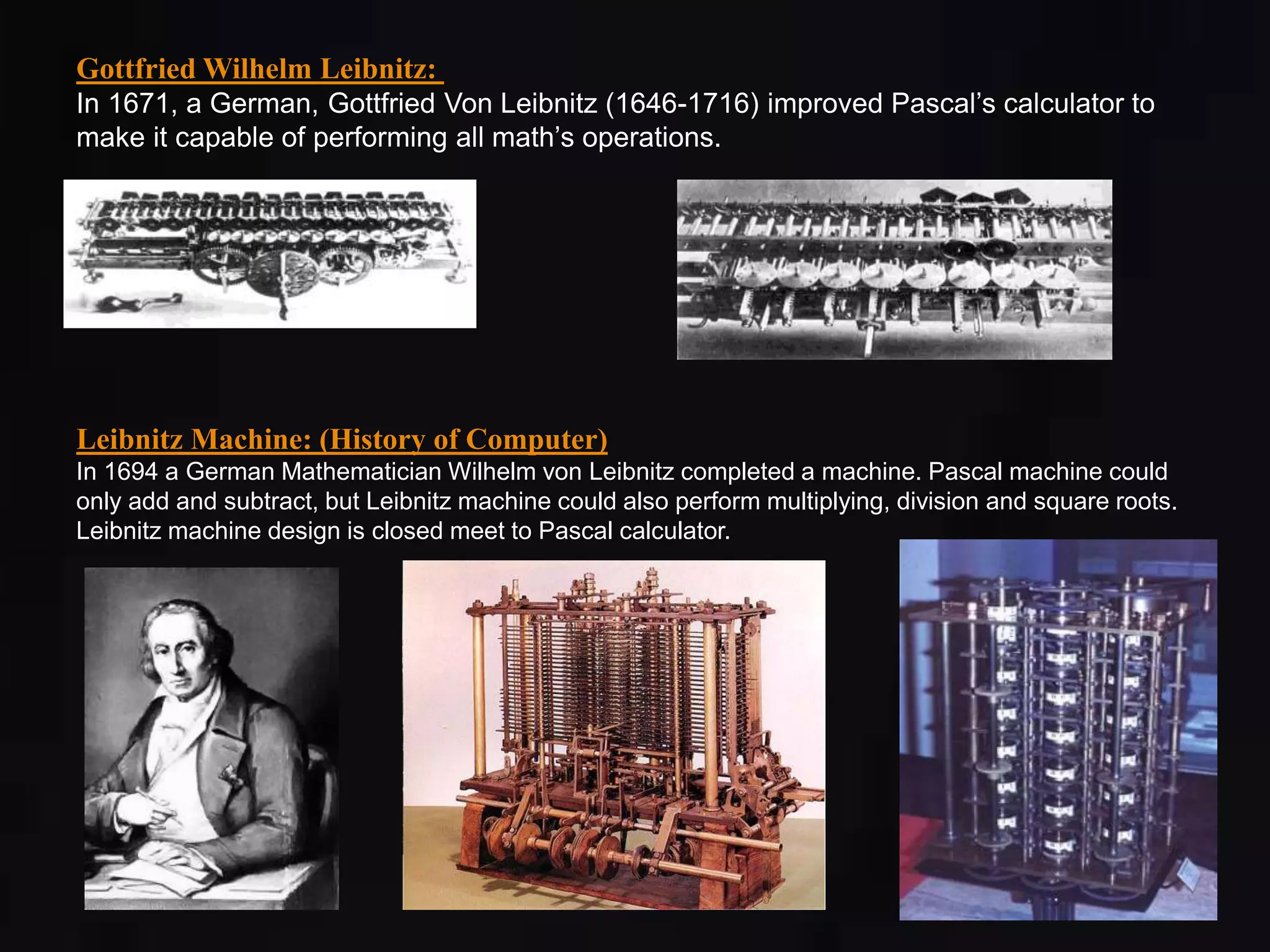
Gottfried Wilhelm Leibnitz: 
In 1671, a German, Gottfried Von Leibnitz (1646-1716) improved Pascal’s calculator to 
make it capable of performing all math’s operations. 
Leibnitz Machine: (History of Computer) 
In 1694 a German Mathematician Wilhelm von Leibnitz completed a machine. Pascal machine could 
only add and subtract, but Leibnitz machine could also perform multiplying, division and square roots. 
Leibnitz machine design is closed meet to Pascal calculator.
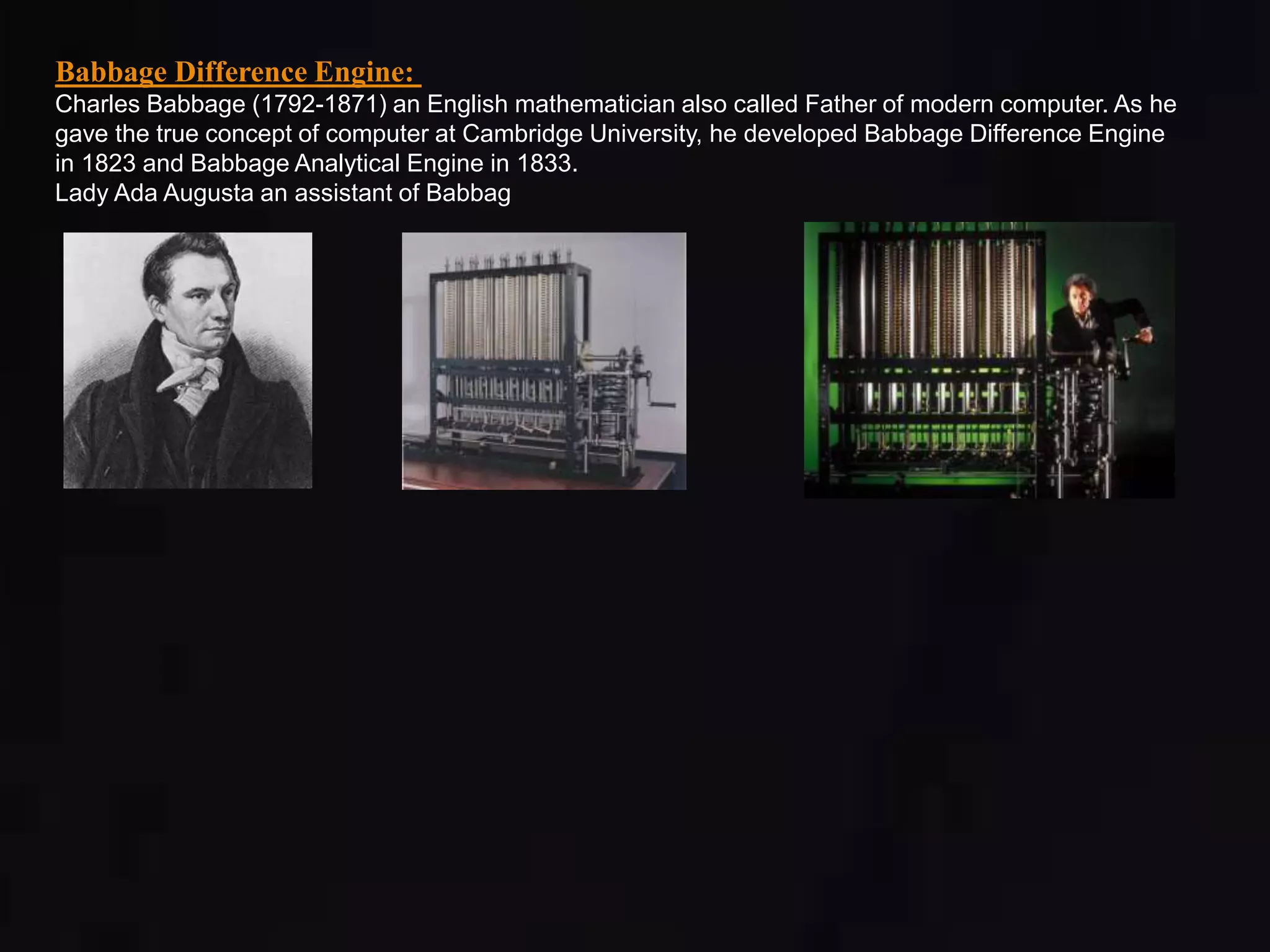
Babbage Difference Engine: 
Charles Babbage (1792-1871) an English mathematician also called Father of modern computer. As he 
gave the true concept of computer at Cambridge University, he developed Babbage Difference Engine 
in 1823 and Babbage Analytical Engine in 1833. 
Lady Ada Augusta an assistant of Babbag
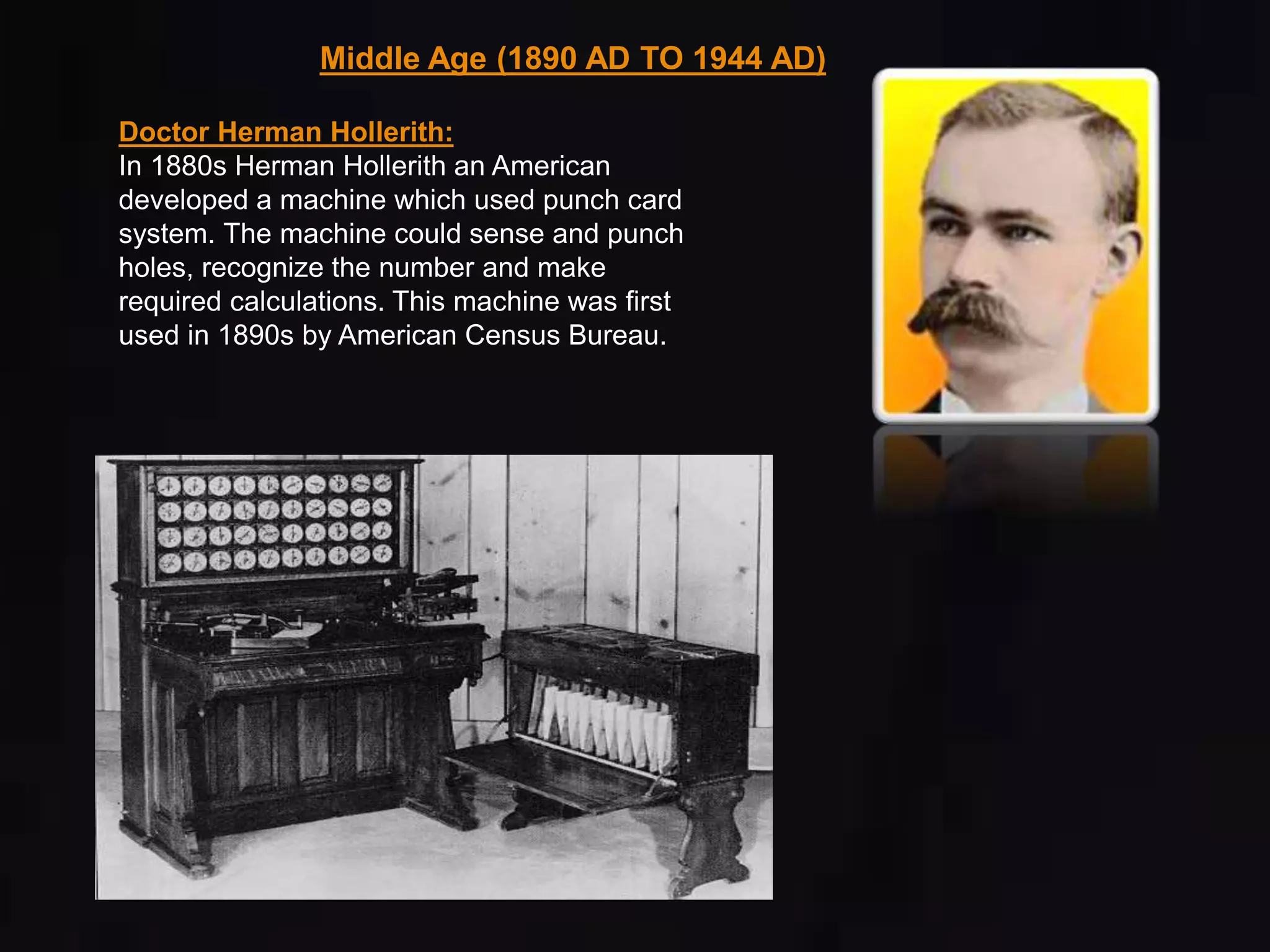
Middle Age (1890 AD TO 1944 AD) 
Doctor Herman Hollerith: 
In 1880s Herman Hollerith an American 
developed a machine which used punch card 
system. The machine could sense and punch 
holes, recognize the number and make 
required calculations. This machine was first 
used in 1890s by American Census Bureau.
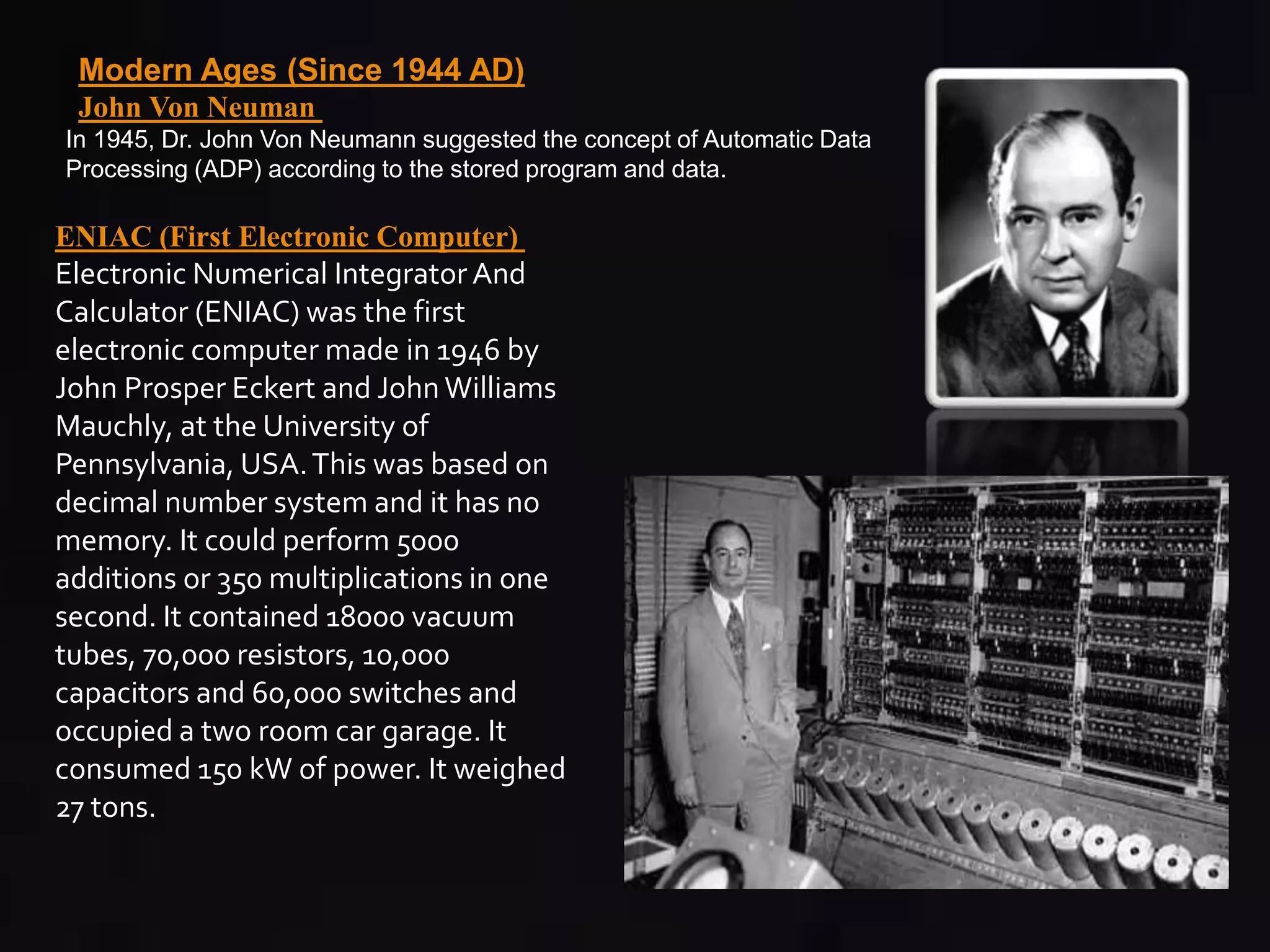
Modern Ages (Since 1944 AD) 
John Von Neuman 
In 1945, Dr. John Von Neumann suggested the concept of Automatic Data 
Processing (ADP) according to the stored program and data. 
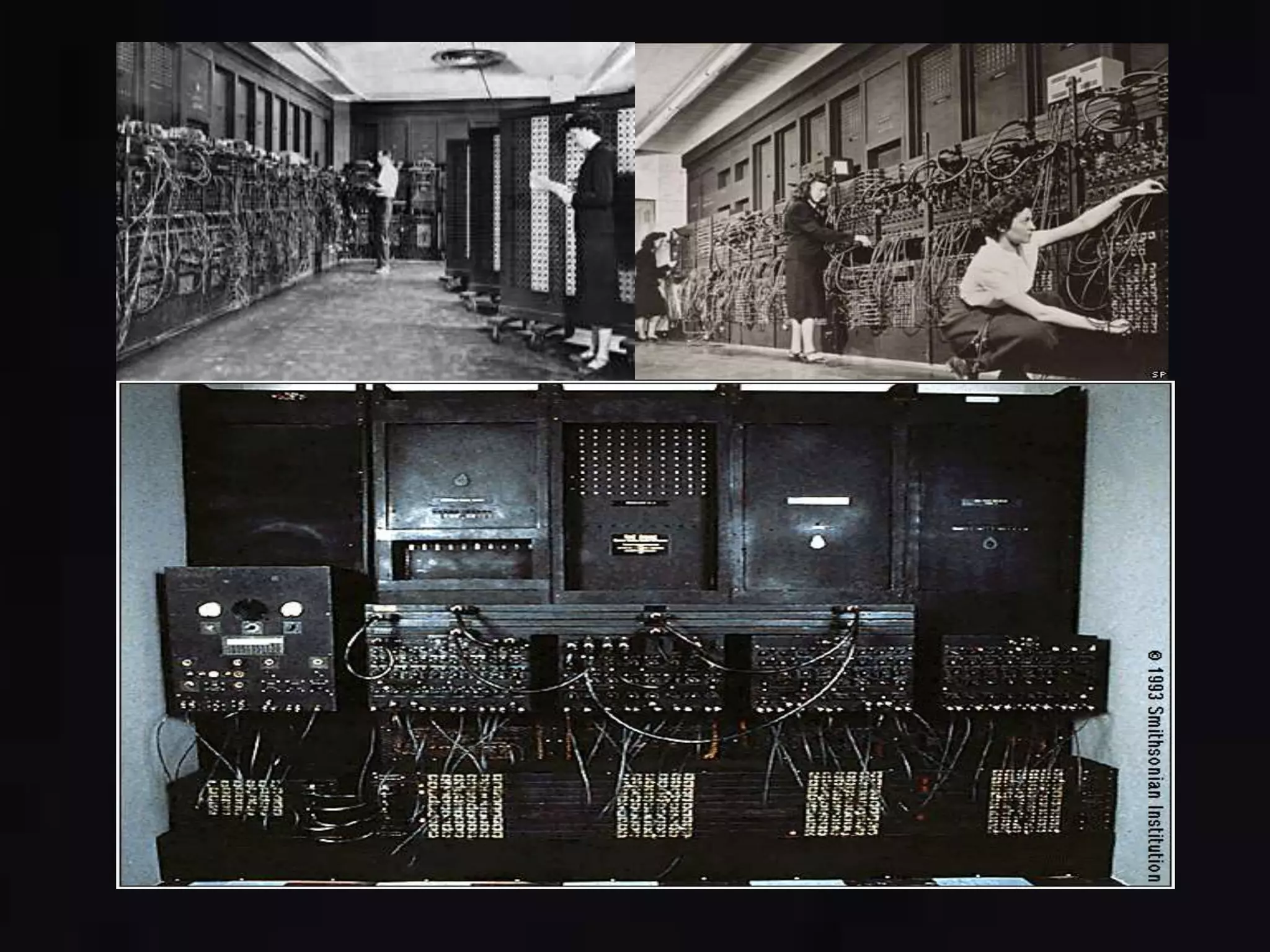
ENIAC (First Electronic Computer) 
Electronic Numerical Integrator And 
Calculator (ENIAC) was the first 
electronic computer made in 1946 by 
John Prosper Eckert and John Williams 
Mauchly, at the University of 
Pennsylvania, USA. This was based on 
decimal number system and it has no 
memory. It could perform 5000 
additions or 350 multiplications in one 
second. It contained 18000 vacuum 
tubes, 70,000 resistors, 10,000 
capacitors and 60,000 switches and 
occupied a two room car garage. It 
consumed 150 kW of power. It weighed 
27 tons.
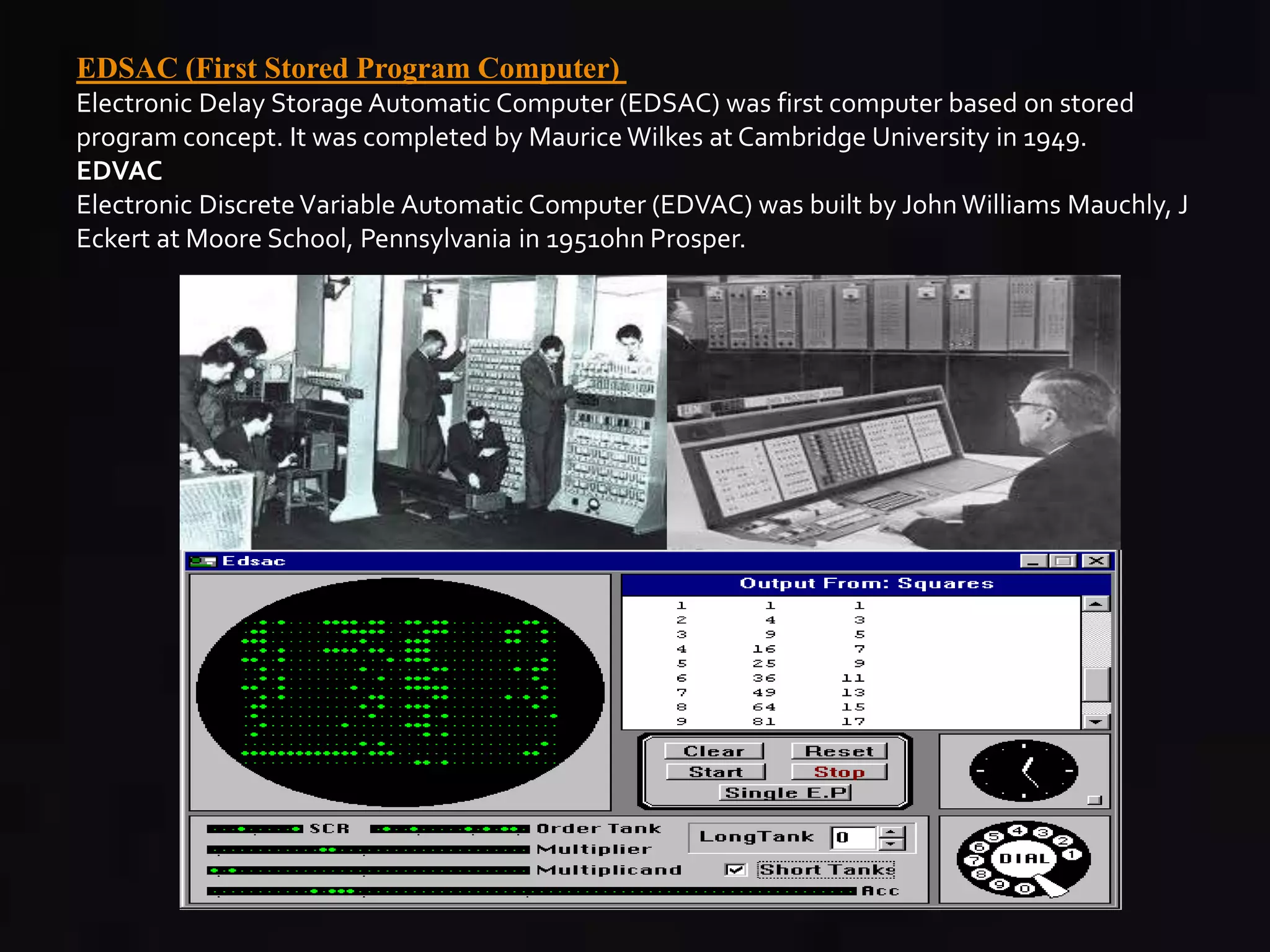
EDSAC (First Stored Program Computer) 
Electronic Delay Storage Automatic Computer (EDSAC) was first computer based on stored 
program concept. It was completed by Maurice Wilkes at Cambridge University in 1949. 
EDVAC 
Electronic Discrete Variable Automatic Computer (EDVAC) was built by John Williams Mauchly, J 
Eckert at Moore School, Pennsylvania in 1951ohn Prosper.
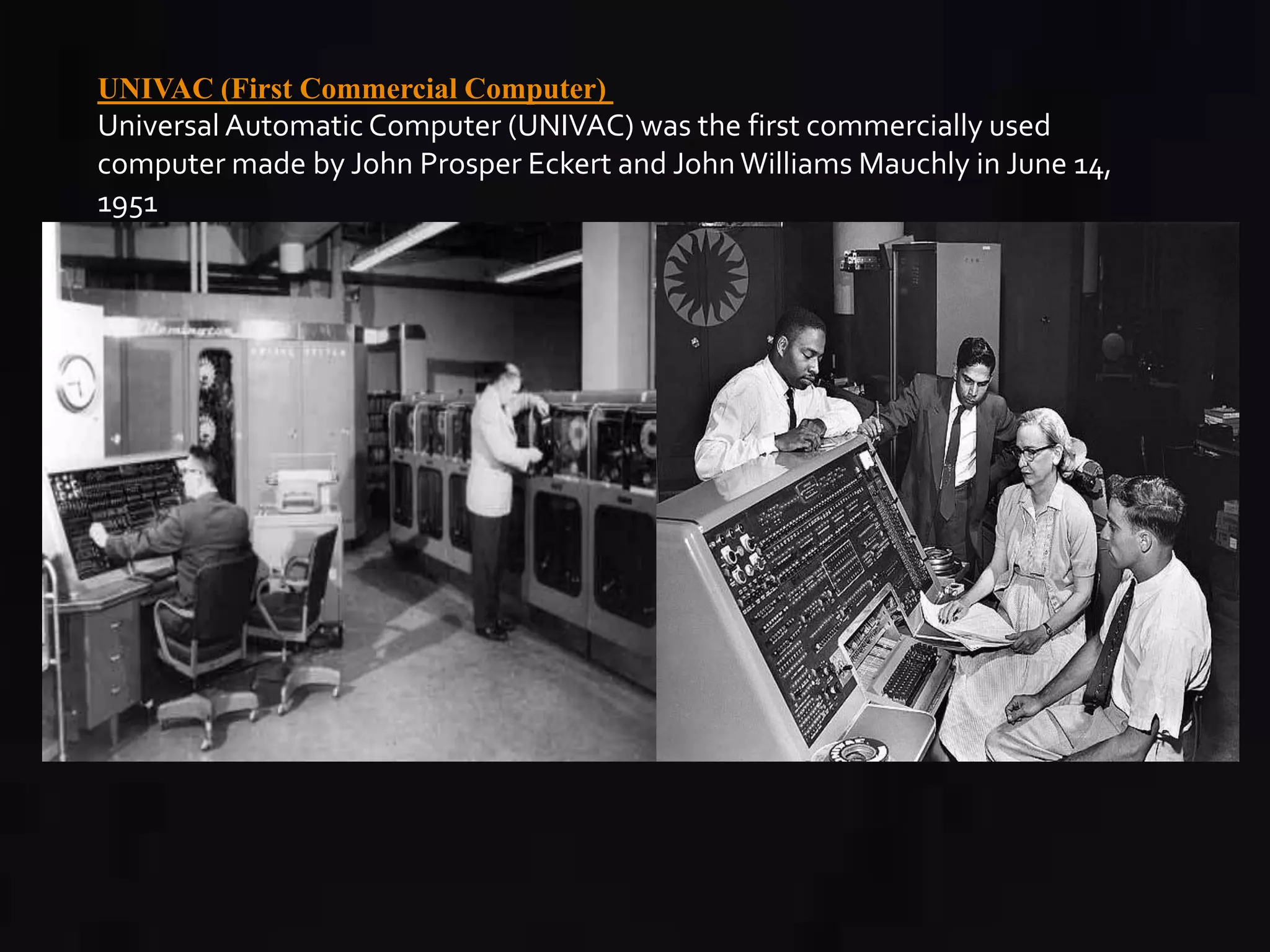
UNIVAC (First Commercial Computer) 
Universal Automatic Computer (UNIVAC) was the first commercially used 
computer made by John Prosper Eckert and John Williams Mauchly in June 14, 
1951

history & ages of computer

  • 1.
  • 2.
     HISTORY OFCOMPUTER: Initially computer was developed as accounting machine because there was a need to human brains for such a device to help in his work. According to the needs of human effective changes are made in this machine. AGES OF COMPUTER: At the early age people used pebbles, stones, sticks, scratches, symbols and finger tips to count, which were later replaced by numbers. The history of computing is divided into three ages during which man invented and improved different types of calculating machines. These ages are, •Dark age - 300 BC to 1890 •Middle age - 1890 AD to 1944 Modern Dark Age (3000 BC to 1890 AD) Abacus: About 3000 years BC, Chinese developed the first calculating machine named Abacus or Sorbian. Abacus consists of a rectangular wooden frame having rods which carry round beads. Counting is done by shifting the beads from one side to another. •age - since 1944 AD
  • 3.
    Napier’s Bone: (Historyof Computer) In early 1617 John Napier a Scottish mathematician invented this Device and Logarithm in the age of his death. In this device he used the Bones. Therefore when he died then its name became Napier’s Bone. His Bone consists of rods and number marked on them. This device performs accurate operation multiplication of large numbers. This device can long computations faster and more accurate.
  • 4.
    Ought red’s SlideRules: In 1632 AD William Ought red, an English mathematician developed a slide rule. This device consists of two movable rules placed side by side on which number were marked. Pascal’s Calculator: Blasé Pascal (1623-1662) French developed the first mechanical calculating machine in 1642. This machine consists of gears, wheels and dials. It was capable of adding and subtracting operations.
  • 5.
    Gottfried Wilhelm Leibnitz: In 1671, a German, Gottfried Von Leibnitz (1646-1716) improved Pascal’s calculator to make it capable of performing all math’s operations. Leibnitz Machine: (History of Computer) In 1694 a German Mathematician Wilhelm von Leibnitz completed a machine. Pascal machine could only add and subtract, but Leibnitz machine could also perform multiplying, division and square roots. Leibnitz machine design is closed meet to Pascal calculator.
  • 6.
    Babbage Difference Engine: Charles Babbage (1792-1871) an English mathematician also called Father of modern computer. As he gave the true concept of computer at Cambridge University, he developed Babbage Difference Engine in 1823 and Babbage Analytical Engine in 1833. Lady Ada Augusta an assistant of Babbag
  • 7.
    Middle Age (1890AD TO 1944 AD) Doctor Herman Hollerith: In 1880s Herman Hollerith an American developed a machine which used punch card system. The machine could sense and punch holes, recognize the number and make required calculations. This machine was first used in 1890s by American Census Bureau.
  • 8.
    Modern Ages (Since1944 AD) John Von Neuman In 1945, Dr. John Von Neumann suggested the concept of Automatic Data Processing (ADP) according to the stored program and data. ENIAC (First Electronic Computer) Electronic Numerical Integrator And Calculator (ENIAC) was the first electronic computer made in 1946 by John Prosper Eckert and John Williams Mauchly, at the University of Pennsylvania, USA. This was based on decimal number system and it has no memory. It could perform 5000 additions or 350 multiplications in one second. It contained 18000 vacuum tubes, 70,000 resistors, 10,000 capacitors and 60,000 switches and occupied a two room car garage. It consumed 150 kW of power. It weighed 27 tons.
  • 10.
    EDSAC (First StoredProgram Computer) Electronic Delay Storage Automatic Computer (EDSAC) was first computer based on stored program concept. It was completed by Maurice Wilkes at Cambridge University in 1949. EDVAC Electronic Discrete Variable Automatic Computer (EDVAC) was built by John Williams Mauchly, J Eckert at Moore School, Pennsylvania in 1951ohn Prosper.
  • 11.
    UNIVAC (First CommercialComputer) Universal Automatic Computer (UNIVAC) was the first commercially used computer made by John Prosper Eckert and John Williams Mauchly in June 14, 1951