GENERATIONS
OF COMPUTERS
Uttar Tamang 1
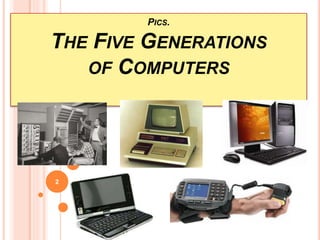
PICS.
THE FIVE GENERATIONS
OF COMPUTERS
2
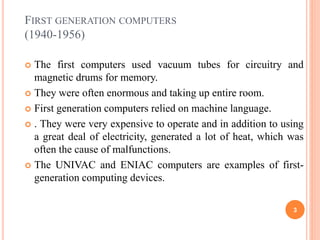
FIRST GENERATION COMPUTERS
(1940-1956)
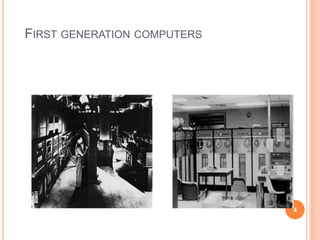
 The first computers used vacuum tubes for circuitry and
magnetic drums for memory.
 They were often enormous and taking up entire room.
 First generation computers relied on machine language.
 . They were very expensive to operate and in addition to using
a great deal of electricity, generated a lot of heat, which was
often the cause of malfunctions.
 The UNIVAC and ENIAC computers are examples of first-
generation computing devices.
3
FIRST GENERATION COMPUTERS
4
SECOND GENERATION COMPUTERS
(1956-1963)
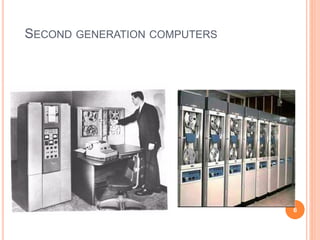
• Transistors replaced vacuum tubes and ushered in the second
generation of computers.
• Second-generation computers moved from
cryptic binary machine language to symbolic.
• High-level programming languages were also being developed
at this time, such as early versions of COBOL and FORTRAN.
• These were also the first computers that stored their
instructions in their memory.
5
SECOND GENERATION COMPUTERS
6
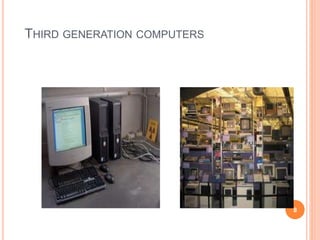
THIRD GENERATION COMPUTERS
(1964-1971)
 The development of the integrated circuit was the hallmark
of the third generation of computers.
 Transistors were miniaturized and placed on siliconchips,
called semiconductors.
 Instead of punched cards and printouts, users interacted
with third generation computers through keyboards
and monitors and interfaced with an operating system.
 Allowed the device to run many different applications at
one time.
7
THIRD GENERATION COMPUTERS
8
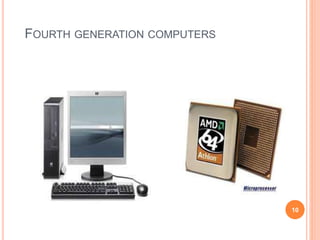
FOURTH GENERATION COMPUTERS
(1971-PRESENT)
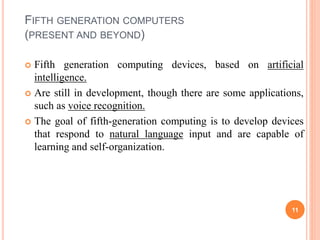
 The microprocessor brought the fourth generation of
computers, as thousands of integrated circuits were built onto a
single silicon chip.
 The Intel 4004 chip, developed in 1971, located all the
components of the computer.
 From the central processing unit and memory to input/output
controls—on a single chip.
 . Fourth generation computers also saw the development
of GUIs, the mouse and handheld devices.
9
FOURTH GENERATION COMPUTERS
10
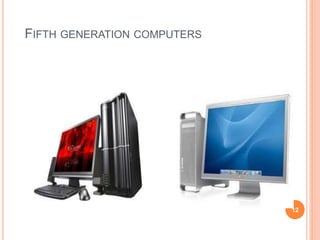
FIFTH GENERATION COMPUTERS
(PRESENT AND BEYOND)
 Fifth generation computing devices, based on artificial
intelligence.
 Are still in development, though there are some applications,
such as voice recognition.
 The goal of fifth-generation computing is to develop devices
that respond to natural language input and are capable of
learning and self-organization.
11
FIFTH GENERATION COMPUTERS
12
Generations of computer

Generations of computer

  • 1.
  • 2.
  • 3.
    FIRST GENERATION COMPUTERS (1940-1956) The first computers used vacuum tubes for circuitry and magnetic drums for memory.  They were often enormous and taking up entire room.  First generation computers relied on machine language.  . They were very expensive to operate and in addition to using a great deal of electricity, generated a lot of heat, which was often the cause of malfunctions.  The UNIVAC and ENIAC computers are examples of first- generation computing devices. 3
  • 4.
  • 5.
    SECOND GENERATION COMPUTERS (1956-1963) •Transistors replaced vacuum tubes and ushered in the second generation of computers. • Second-generation computers moved from cryptic binary machine language to symbolic. • High-level programming languages were also being developed at this time, such as early versions of COBOL and FORTRAN. • These were also the first computers that stored their instructions in their memory. 5
  • 6.
  • 7.
    THIRD GENERATION COMPUTERS (1964-1971) The development of the integrated circuit was the hallmark of the third generation of computers.  Transistors were miniaturized and placed on siliconchips, called semiconductors.  Instead of punched cards and printouts, users interacted with third generation computers through keyboards and monitors and interfaced with an operating system.  Allowed the device to run many different applications at one time. 7
  • 8.
  • 9.
    FOURTH GENERATION COMPUTERS (1971-PRESENT) The microprocessor brought the fourth generation of computers, as thousands of integrated circuits were built onto a single silicon chip.  The Intel 4004 chip, developed in 1971, located all the components of the computer.  From the central processing unit and memory to input/output controls—on a single chip.  . Fourth generation computers also saw the development of GUIs, the mouse and handheld devices. 9
  • 10.
  • 11.
    FIFTH GENERATION COMPUTERS (PRESENTAND BEYOND)  Fifth generation computing devices, based on artificial intelligence.  Are still in development, though there are some applications, such as voice recognition.  The goal of fifth-generation computing is to develop devices that respond to natural language input and are capable of learning and self-organization. 11
  • 12.