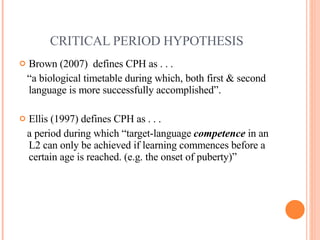
- The document discusses theories around the critical period hypothesis (CPH) which claims that second languages are more easily acquired during childhood before puberty.
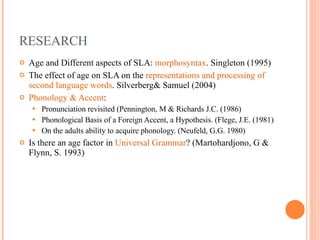
- Research on different aspects of second language acquisition like morphology, representation of words, and phonology are reviewed.
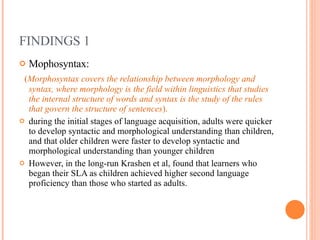
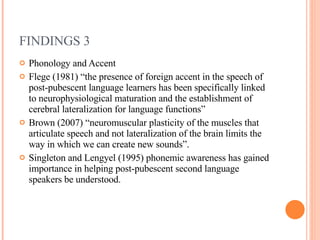
- The findings show that while adults are initially faster at syntax and morphology, children ultimately achieve higher proficiency. Representation of words is shared between languages for early bilinguals. Phonology and accent are more strongly linked to age of acquisition. Grammar may be accessible through universal principles at all ages.







![Total Physical Response Cpr1[1]](https://cdn.slidesharecdn.com/ss_thumbnails/totalphysicalresponsecpr11-091205141132-phpapp01-thumbnail.jpg?width=640&height=640&fit=bounds)


