Downloaded 488 times






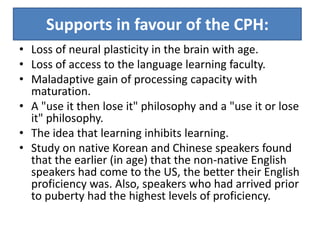
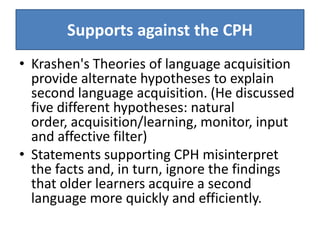
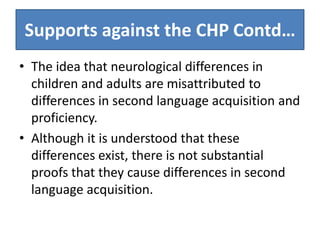
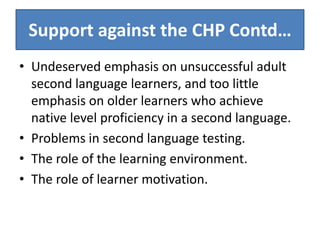



The document discusses the critical period hypothesis in second language acquisition. The critical period hypothesis proposes that there is an ideal time period in a person's life for acquiring language skills, and that after a certain age it becomes much more difficult to acquire a new language. The document outlines the historical background of the hypothesis, provides examples of studies that both support and contradict it, and discusses ongoing debates around its claims. It ultimately concludes that while early language acquisition may confer some advantages, there is not enough evidence currently to say whether there truly is a critical period for second language learning.


