Download to read offline


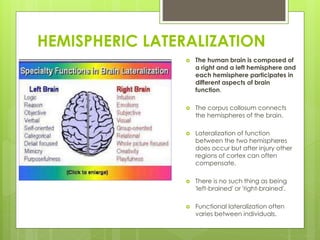




This document discusses several topics related to language acquisition and age: - The critical period hypothesis suggests that full native language competence is only possible during childhood and adolescence. Older learners rarely achieve a near-native accent. - The brain is composed of left and right hemispheres that specialize in different functions, though injury can allow compensation. There is variation between individuals and no single "type". - Language acquisition is influenced by cognitive, emotional, and linguistic factors like intellectual development, identity, empathy, and interference between first and second languages.


