Downloaded 159 times


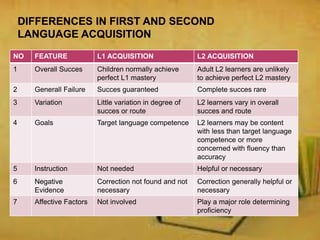


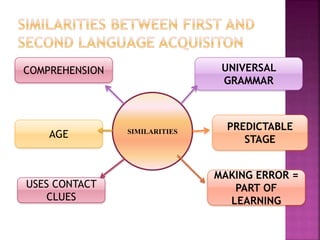


The document discusses similarities and differences between first language (L1) and second language (L2) acquisition. Some key similarities include that both involve predictable developmental stages, making errors is part of the learning process, and age affects proficiency. However, there are also differences, such as L1 acquisition nearly always leads to perfect mastery while this is unlikely for L2, and affective factors play a larger role in L2 acquisition. The document emphasizes that language acquisition is complex with many interacting factors, so teachers should consider multiple claims rather than basing instruction on a single idea.


![Theories Of Language Acquisition[1]](https://cdn.slidesharecdn.com/ss_thumbnails/theories-of-language-acquisition1-1225480010904742-8-thumbnail.jpg?width=640&height=640&fit=bounds)


