By: Gabriela Flores
ESPE UNIVERSITY
• It refers to the period of time when a person can not
acquire language or it turns more dificult than in
other moments.
• There is a biological timetable in all human being to
acquire a first or second language.
• According to some authors the most critical point for
a second language occurs around puberty.
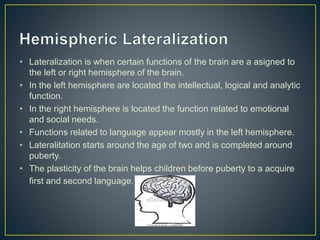
• Lateralization is when certain functions of the brain are a asigned to
the left or right hemisphere of the brain.
• In the left hemisphere are located the intellectual, logical and analytic
function.
• In the right hemisphere is located the function related to emotional
and social needs.
• Functions related to language appear mostly in the left hemisphere.
• Lateralitation starts around the age of two and is completed around
puberty.
• The plasticity of the brain helps children before puberty to a acquire
first and second language.
COGNITIVE CONSIDERATION:
• Human cognitition develops rapidly through the first sixteen years of life.
• Different from children and teenagers adults acuire second language by grammatical explanations and
deductive thinking.
• Lenguaje interacts with cognitiion to achieve equilibrium.
AFFECTIVE CONSIDERATIONS: Affective factors are related to the age of language acquisition.
• Innhibitions
• language ego
• Second identity
• Peer presure
LINGUISTIC CONSIDERATIONS
• Bilingualism: learning two languages at the same time.
• There exist the code-switch of language.
• Bilingual speakers have one meaning with two languages in operation.
• Both languges are acquired slower tha learning just one.
• Bilingual children have a greater mental flexibility.
• It is when the first language is used as an aid when
talking in the second language.
• In children the interference doesn’t appear as a marked
contrast.
• In adults, due to the difference in the acquisition of
second language (grammar, linguistic rules and
environment) the interference is notably in some cases to
bridge gaps.
• The use of the first language can be interpreted as a
facilitating factor more than an interference.
• Lenguage es linked to the human thought.
• Lenguaje helps to shape thinking and thinking helps to
shape language.
• Speaker must distinguish thoughts and concepts on the
second language which can be in some cases be similar
to the first language which can convey a new system of
conceptualization.

Age and acquisition

  • 1.
  • 2.
    • It refersto the period of time when a person can not acquire language or it turns more dificult than in other moments. • There is a biological timetable in all human being to acquire a first or second language. • According to some authors the most critical point for a second language occurs around puberty.
  • 3.
    • Lateralization iswhen certain functions of the brain are a asigned to the left or right hemisphere of the brain. • In the left hemisphere are located the intellectual, logical and analytic function. • In the right hemisphere is located the function related to emotional and social needs. • Functions related to language appear mostly in the left hemisphere. • Lateralitation starts around the age of two and is completed around puberty. • The plasticity of the brain helps children before puberty to a acquire first and second language.
  • 4.
    COGNITIVE CONSIDERATION: • Humancognitition develops rapidly through the first sixteen years of life. • Different from children and teenagers adults acuire second language by grammatical explanations and deductive thinking. • Lenguaje interacts with cognitiion to achieve equilibrium. AFFECTIVE CONSIDERATIONS: Affective factors are related to the age of language acquisition. • Innhibitions • language ego • Second identity • Peer presure LINGUISTIC CONSIDERATIONS • Bilingualism: learning two languages at the same time. • There exist the code-switch of language. • Bilingual speakers have one meaning with two languages in operation. • Both languges are acquired slower tha learning just one. • Bilingual children have a greater mental flexibility.
  • 5.
    • It iswhen the first language is used as an aid when talking in the second language. • In children the interference doesn’t appear as a marked contrast. • In adults, due to the difference in the acquisition of second language (grammar, linguistic rules and environment) the interference is notably in some cases to bridge gaps. • The use of the first language can be interpreted as a facilitating factor more than an interference.
  • 6.
    • Lenguage eslinked to the human thought. • Lenguaje helps to shape thinking and thinking helps to shape language. • Speaker must distinguish thoughts and concepts on the second language which can be in some cases be similar to the first language which can convey a new system of conceptualization.