Age and Second Language Acquisition
Presented by:
Elainy Elvira Fernández Ventura
Lideny Rodriguez
Cristian Méndez
Story
• The author, at age five, was placed in a French-
speaking school in Leopoldville, Belgian Congo.
• Initially struggled with the language but became
fluent within 18 months.
nhuiil
•Does age significantly impact the ultimate
attainment of second language acquisition
(SLA)?
Observations on Language Acquisition
Children vs. Adults
Children learn their first language (L1) easily.
Adults often face challenges and sometimes failure in learning a second
language (L2), especially in educational settings.
Research on L1 and L2
• Insights from L1
acquisition have informed
SLA theories.
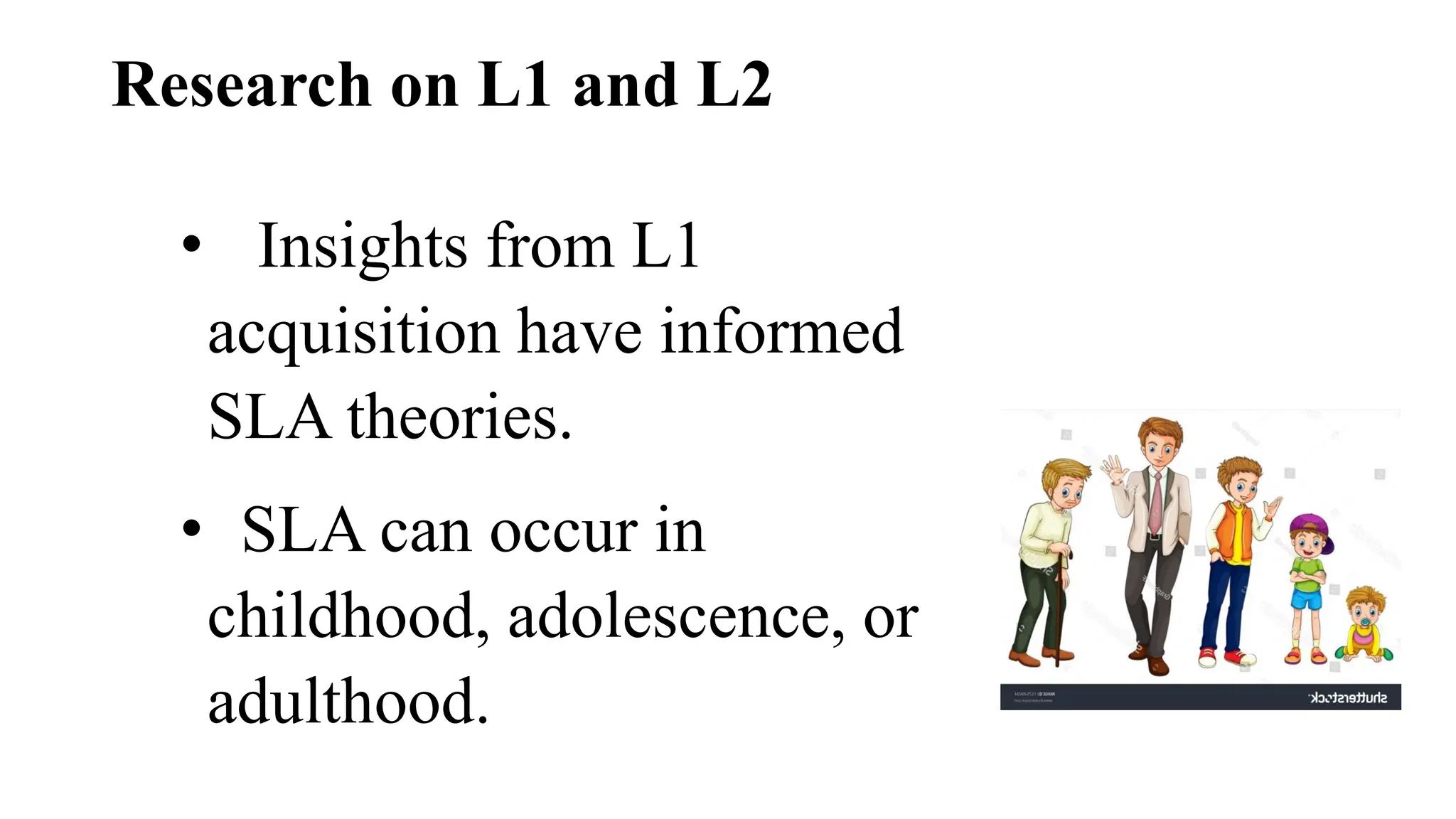
• SLA can occur in
childhood, adolescence, or
adulthood.
Dispelling Myths in SLA
• Seven Common Myths
• Misconceptions about similarities between L1 and L2
acquisition, such as:
• 1. Repetition is key to learning.
• 2. Language acquisition is primarily imitation.
• 3. The natural order of learning (sounds, words, sentences).
Dispelling Myths in SLA
• 4. Understanding always precedes speaking.
• 5. The natural order of L2 learning follows L1
learning (listening, speaking, reading, writing).
• 6. Learning without translation.
• 7. Learning without formal grammar instruction.
Critique
• These myths often misinterpret or
oversimplify L1 learning processes and
wrongly apply them to L2 learning
Types of Comparisons in SLA Research
•Logical Comparisons:
• Comparing SLA in children vs. adults.
• Comparing L1 and L2 acquisition in children.
Inappropriate Comparisons
•Comparing child L1 acquisition with
adult SLA leads to flawed conclusions.
Critical Period Hypothesis (CPH)
• Definition
• A biologically determined period during which language acquisition is easier.
• Beyond this period, acquiring language becomes more difficult.
• Applications to SLA
• CPH initially connected to L1 acquisition but now applied to L2 contexts.
• The argument that puberty marks a critical point beyond which successful SLA
is less likely
Neurological Considerations in SLA
• Hemispheric Lateralization
• Language functions are primarily located in the left
hemisphere.
• Lateralization, the process of assigning functions to different
hemispheres, may impact SLA.
• Brain plasticity before puberty allows easier language
acquisition.
Critical Period and Accent
• Some studies suggest that acquiring a native-like
accent is difficult after puberty.
• - Other higher-order language functions may not be
as affected by age.
Biological Timetables and SLA
Different Aspects of L2 Learning
• Pronunciation may be more difficult to master after
childhood.
• Semantic relations and other higher-order processes
are learned more efficiently in adulthood.
Anthropological Evidence
• Exceptional Cases
• Some adults can acquire a perfect accent in an L2 post-
puberty.
• Examples from non-Western societies where
multilingualism is common.
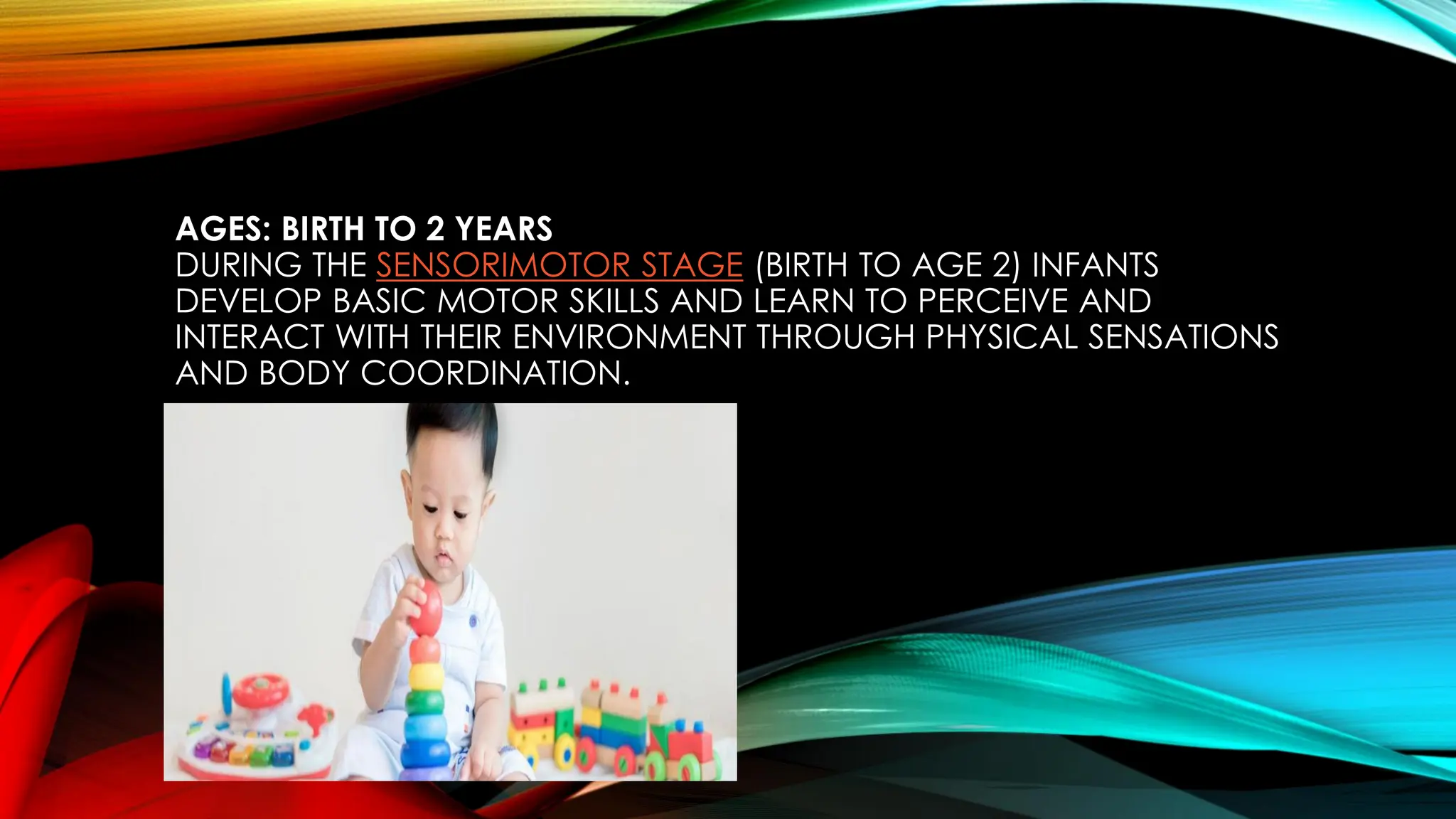
AGES: BIRTH TO 2 YEARS
DURING THE SENSORIMOTOR STAGE (BIRTH TO AGE 2) INFANTS
DEVELOP BASIC MOTOR SKILLS AND LEARN TO PERCEIVE AND
INTERACT WITH THEIR ENVIRONMENT THROUGH PHYSICAL SENSATIONS
AND BODY COORDINATION.
THE PREOPERATIONAL STAGE
AGES: 2 – 7 YEARS
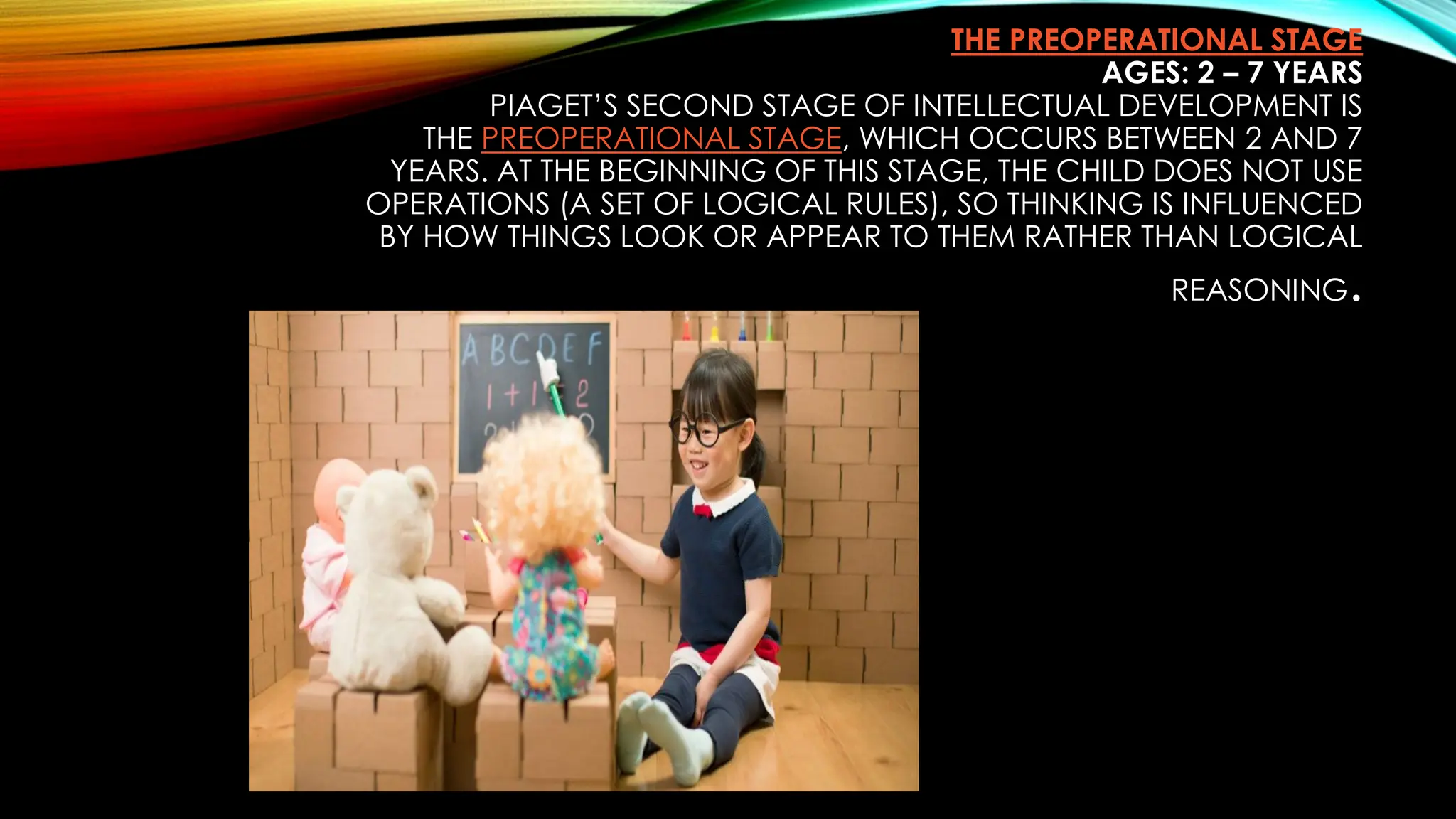
PIAGET’S SECOND STAGE OF INTELLECTUAL DEVELOPMENT IS
THE PREOPERATIONAL STAGE, WHICH OCCURS BETWEEN 2 AND 7
YEARS. AT THE BEGINNING OF THIS STAGE, THE CHILD DOES NOT USE
OPERATIONS (A SET OF LOGICAL RULES), SO THINKING IS INFLUENCED
BY HOW THINGS LOOK OR APPEAR TO THEM RATHER THAN LOGICAL
REASONING.
THE CONCRETE OPERATIONAL STAGE
AGES: 7 – 11 YEARS
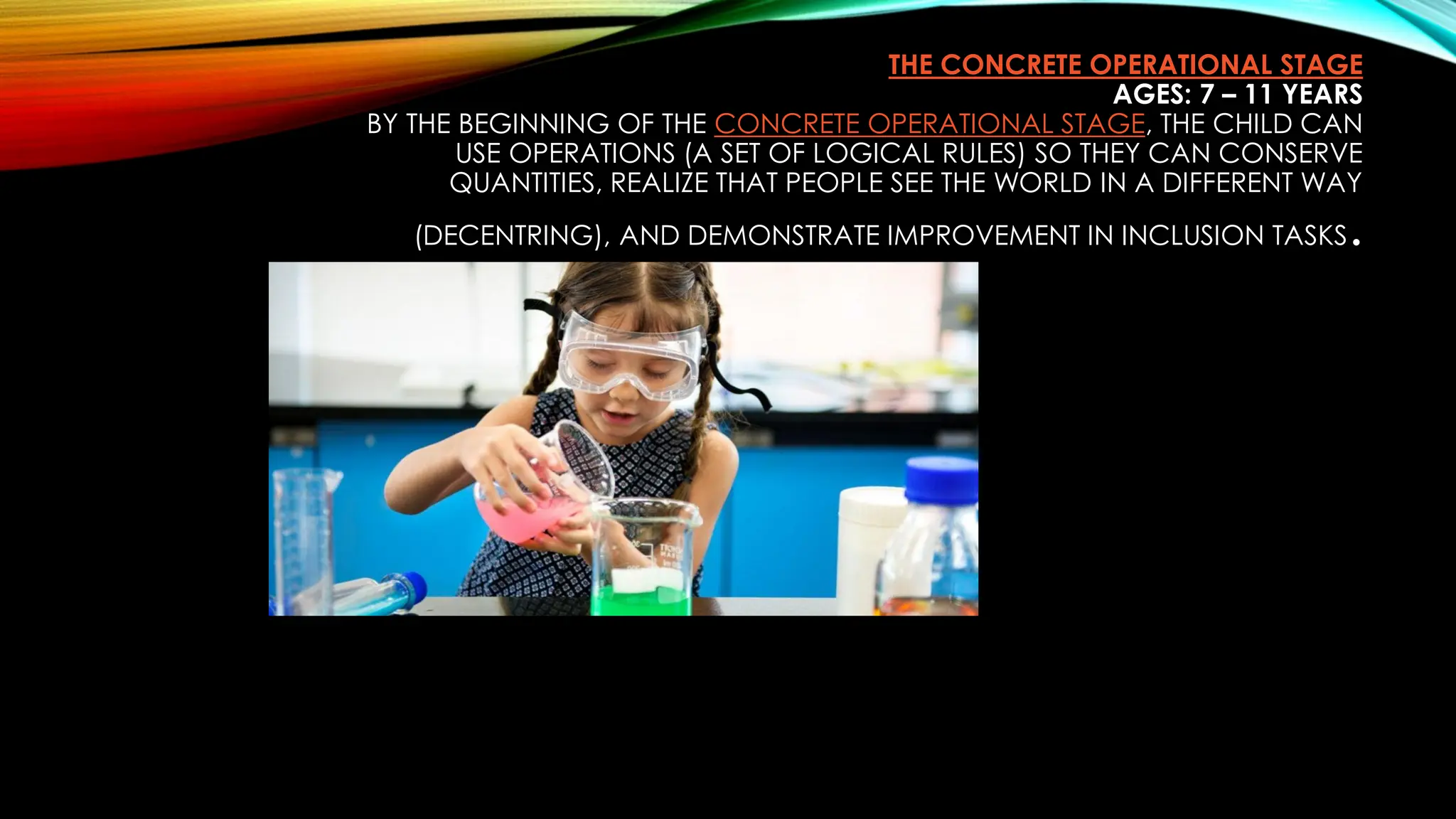
BY THE BEGINNING OF THE CONCRETE OPERATIONAL STAGE, THE CHILD CAN
USE OPERATIONS (A SET OF LOGICAL RULES) SO THEY CAN CONSERVE
QUANTITIES, REALIZE THAT PEOPLE SEE THE WORLD IN A DIFFERENT WAY
(DECENTRING), AND DEMONSTRATE IMPROVEMENT IN INCLUSION TASKS.
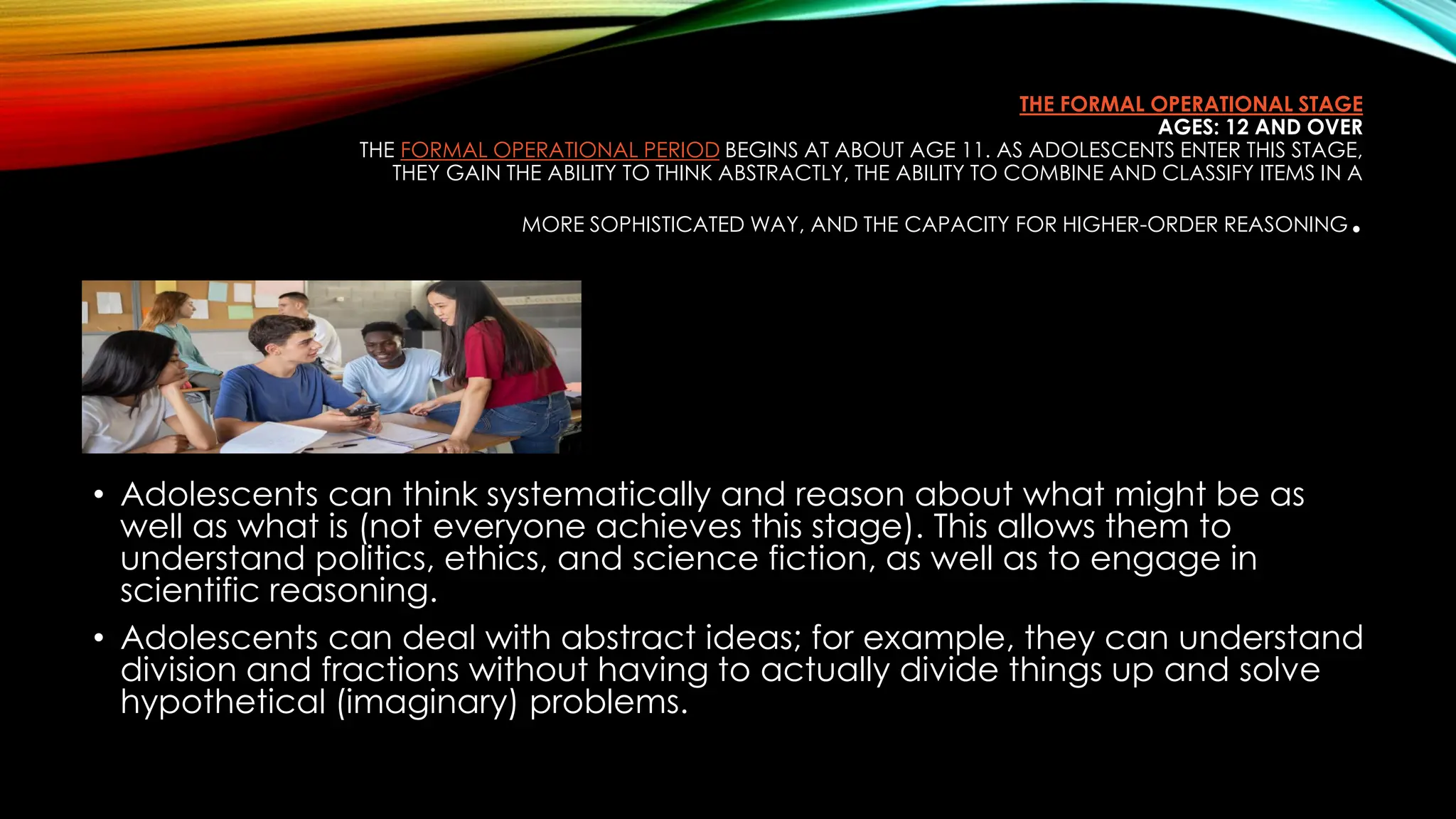
THE FORMAL OPERATIONAL STAGE
AGES: 12 AND OVER
THE FORMAL OPERATIONAL PERIOD BEGINS AT ABOUT AGE 11. AS ADOLESCENTS ENTER THIS STAGE,
THEY GAIN THE ABILITY TO THINK ABSTRACTLY, THE ABILITY TO COMBINE AND CLASSIFY ITEMS IN A
MORE SOPHISTICATED WAY, AND THE CAPACITY FOR HIGHER-ORDER REASONING.
• Adolescents can think systematically and reason about what might be as
well as what is (not everyone achieves this stage). This allows them to
understand politics, ethics, and science fiction, as well as to engage in
scientific reasoning.
• Adolescents can deal with abstract ideas; for example, they can understand
division and fractions without having to actually divide things up and solve
hypothetical (imaginary) problems.
LINGUISTIC
CONSIDERATIONS
The “Order of Acquisition” refers to the sequence in which
language learners typically acquire grammatical structures and
vocabulary in a second language (L2).
This concept is crucial in understanding how language
learning progresses.
Here are some key points:
•Is the order of grammar important in
second language adquisition?
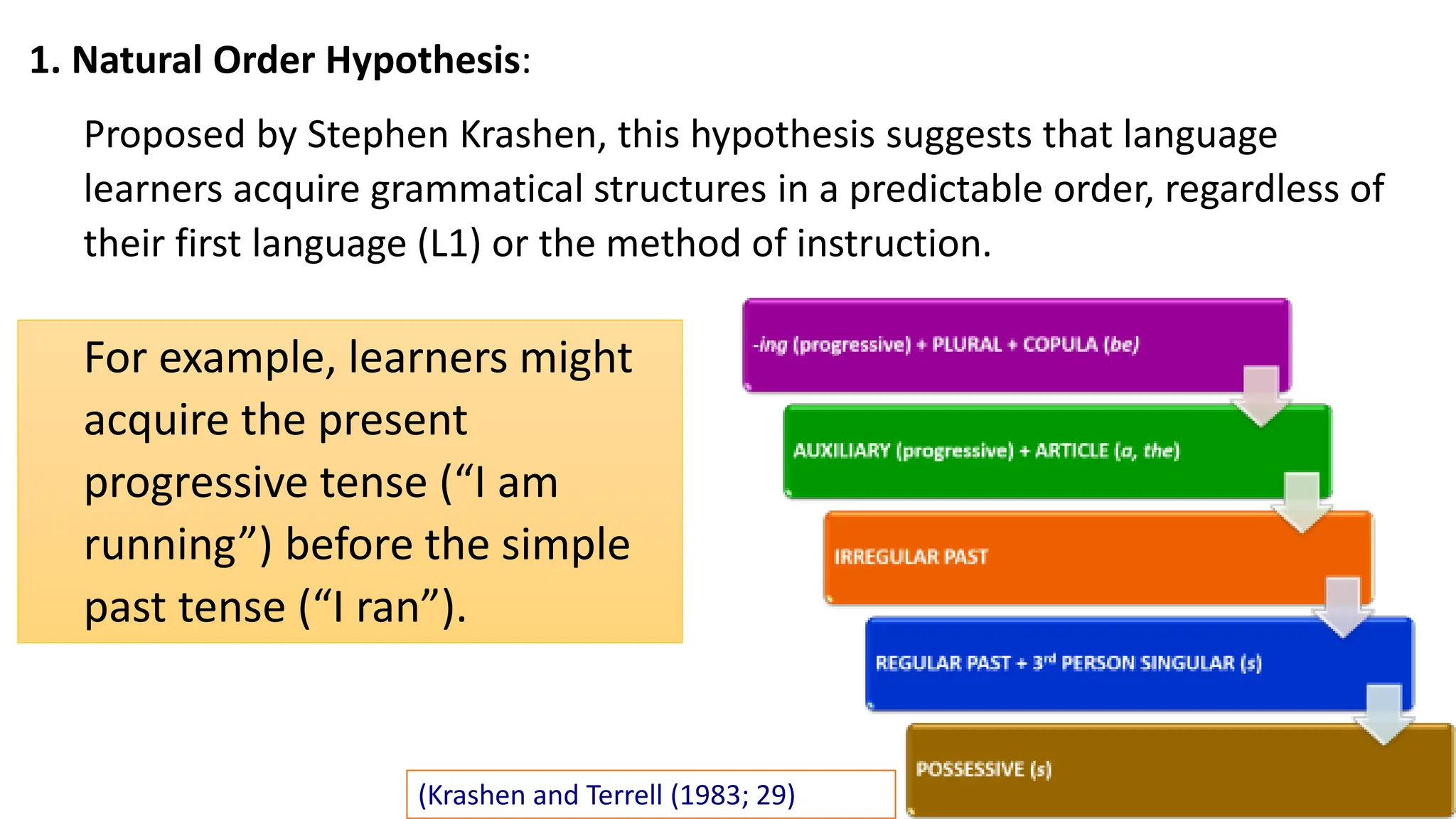
1. Natural Order Hypothesis:
Proposed by Stephen Krashen, this hypothesis suggests that language
learners acquire grammatical structures in a predictable order, regardless of
their first language (L1) or the method of instruction.
For example, learners might
acquire the present
progressive tense (“I am
running”) before the simple
past tense (“I ran”).
(Krashen and Terrell (1983; 29)
2. Factors Influencing Order of Acquisition:
❑ Linguistic Complexity: Simpler structures are
generally acquired before more complex ones.
❑ Frequency of Use: Structures that are more
frequently used in the language are typically
acquired earlier.
❑ Input and Interaction: The amount and quality of
exposure to the language, as well as opportunities
for interaction, can affect the order of acquisition.
3. Common Patterns:
❑ Morphemes: Studies have shown that certain morphemes
(smallest units of meaning) are acquired in a specific order. For
example, in English, the progressive “-ing” is often acquired
before the plural “-s”.
❑ Syntax: Sentence structures also follow a predictable pattern.
Learners might first produce simple sentences (“She eats”)
before more complex ones (“She is eating an apple”).
4. Implications for Teaching:
➢ Curriculum Design: Understanding the natural order can help in
designing curricula that align with how learners naturally
acquire language.
➢ Error Correction: Teachers can focus on correcting errors that
are developmentally appropriate, rather than expecting learners
to master complex structures prematurely.
5. Criticisms and Limitations:
o While the natural order hypothesis provides a general
framework, individual differences such as age, motivation, and
learning environment can lead to variations in the order of
acquisition.
Understanding the order of acquisition helps educators and
learners set realistic expectations and tailor their approaches to
language learning.
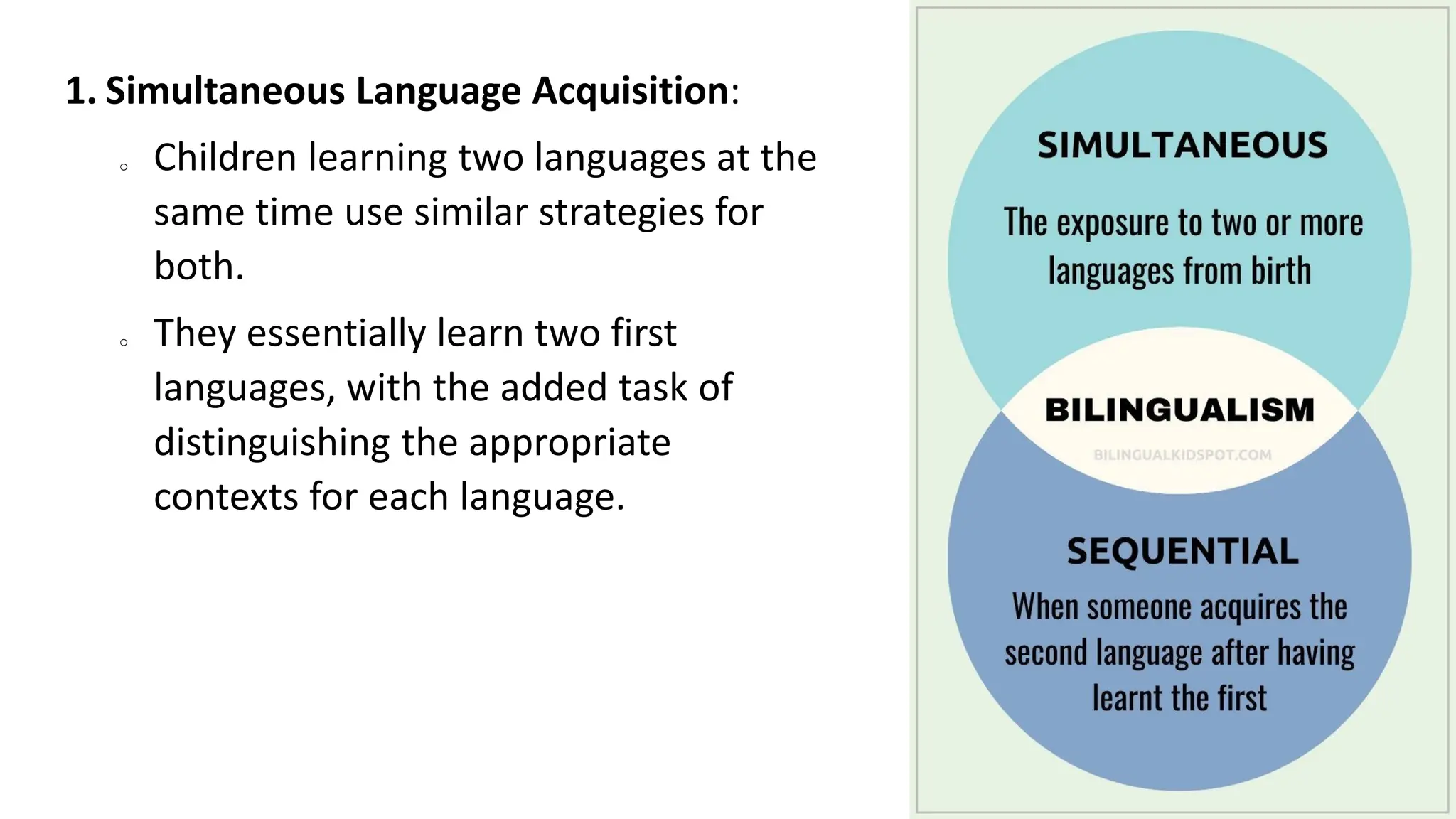
1. Simultaneous Language Acquisition:
o Children learning two languages at the
same time use similar strategies for
both.
o They essentially learn two first
languages, with the added task of
distinguishing the appropriate
contexts for each language.
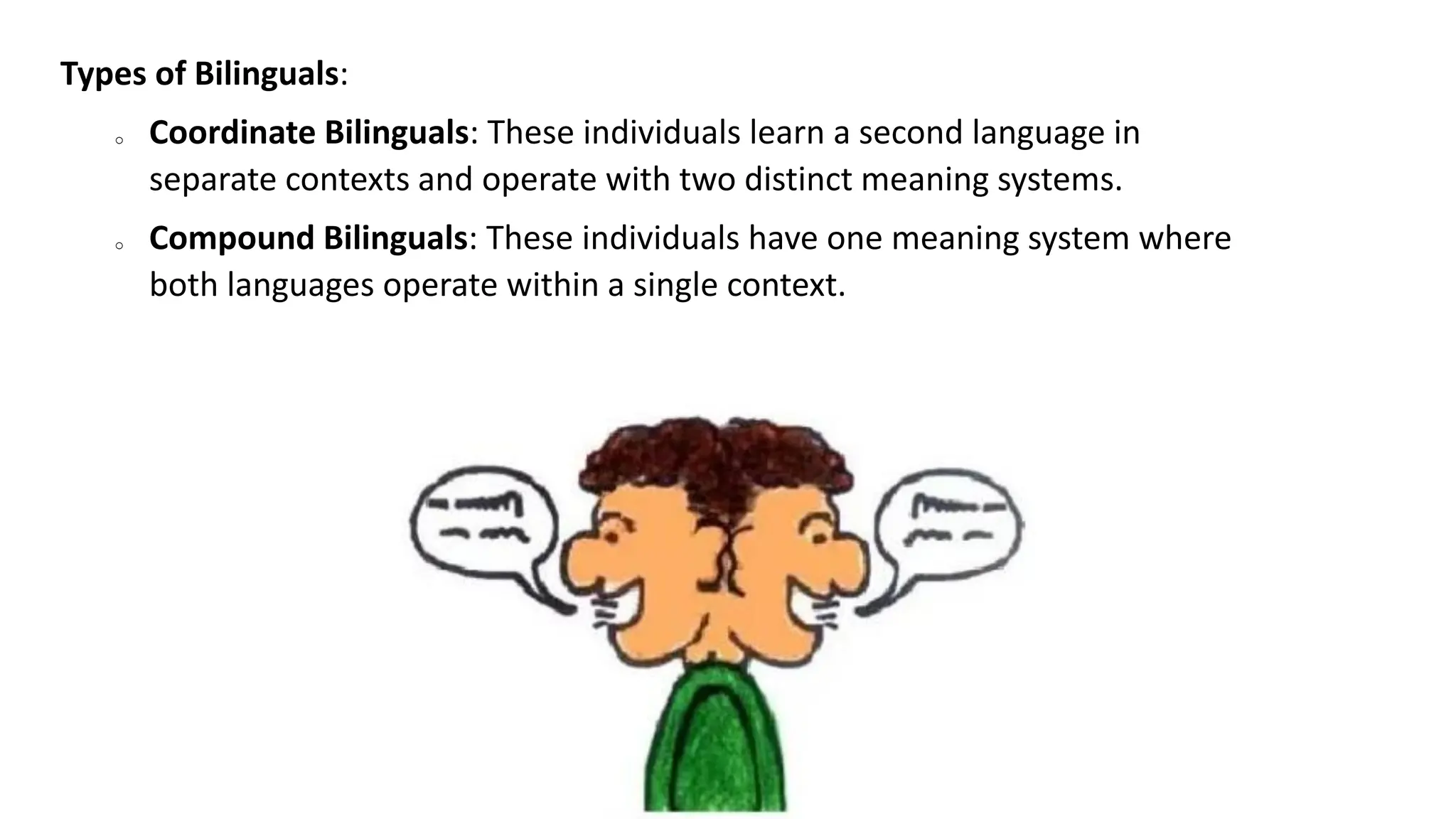
Types of Bilinguals:
o Coordinate Bilinguals: These individuals learn a second language in
separate contexts and operate with two distinct meaning systems.
o Compound Bilinguals: These individuals have one meaning system where
both languages operate within a single context.
What do you understand by Language Mixing?
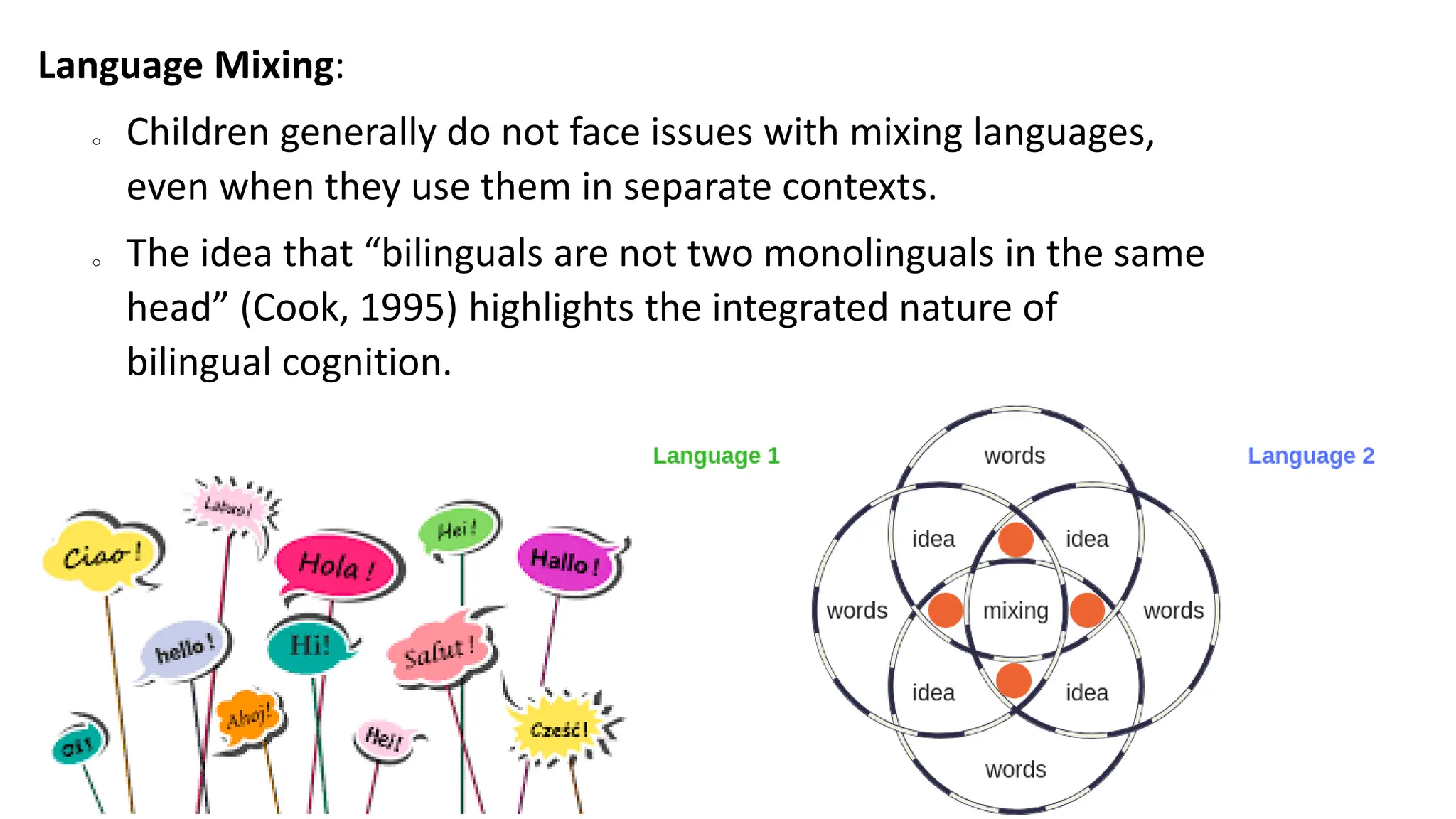
Language Mixing:
o Children generally do not face issues with mixing languages,
even when they use them in separate contexts.
o The idea that “bilinguals are not two monolinguals in the same
head” (Cook, 1995) highlights the integrated nature of
bilingual cognition.
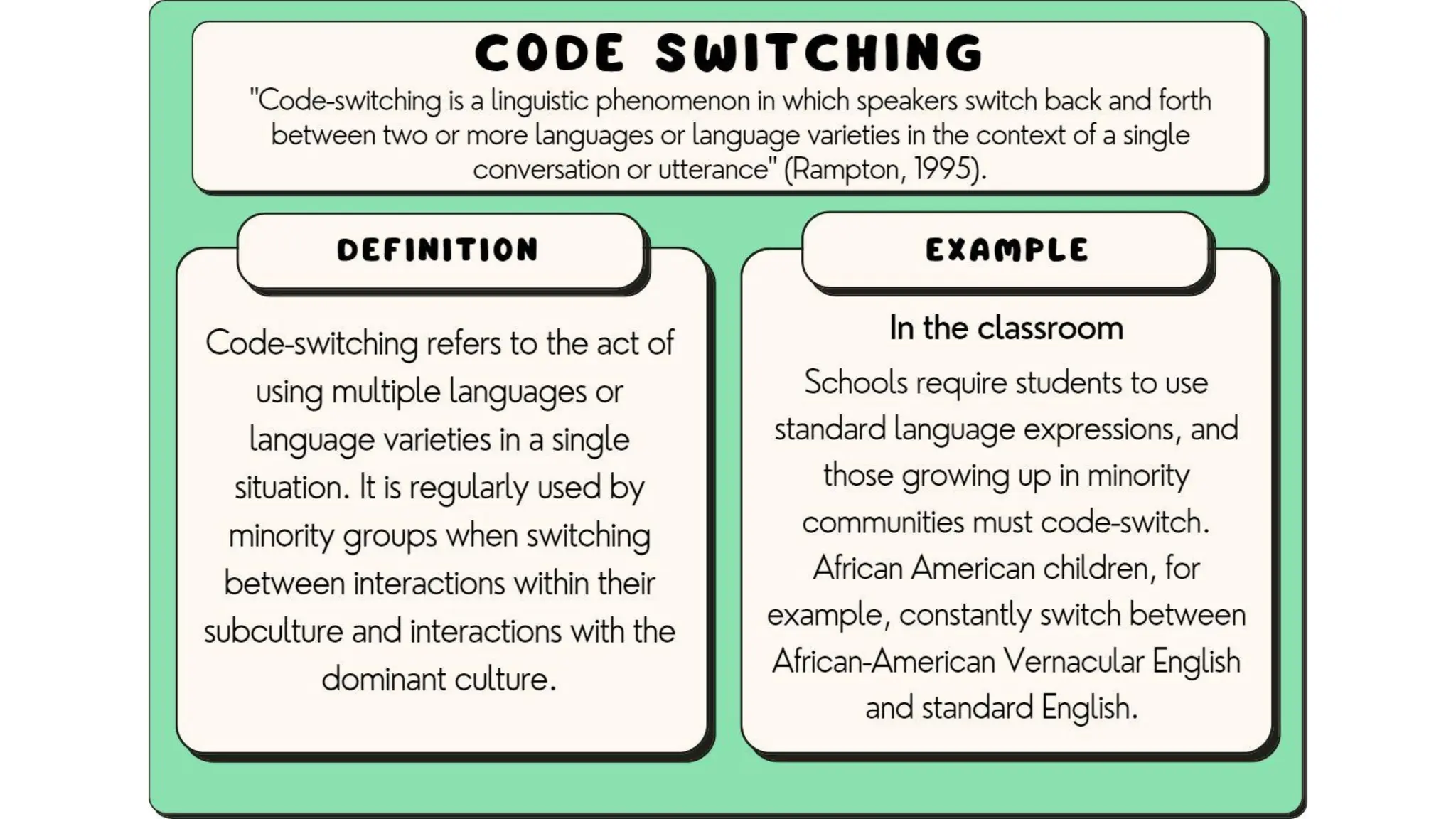
Code-Switching
The younger the better?
The idea that “the younger, the better” for
language acquisition is a common belief, but
it’s a bit more nuanced than that.
Advantages for Younger Learners:
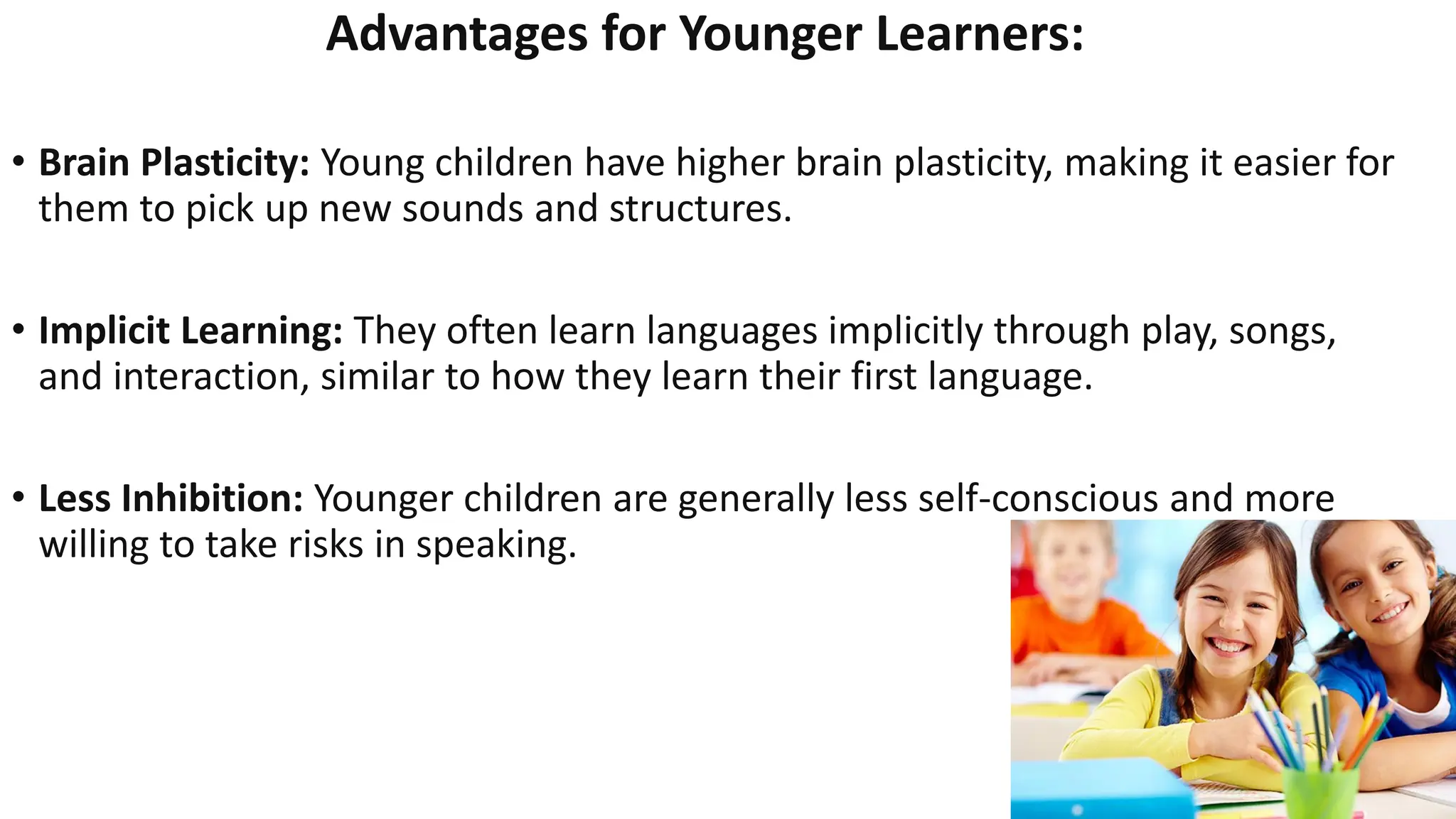
• Brain Plasticity: Young children have higher brain plasticity, making it easier for
them to pick up new sounds and structures.
• Implicit Learning: They often learn languages implicitly through play, songs,
and interaction, similar to how they learn their first language.
• Less Inhibition: Younger children are generally less self-conscious and more
willing to take risks in speaking.
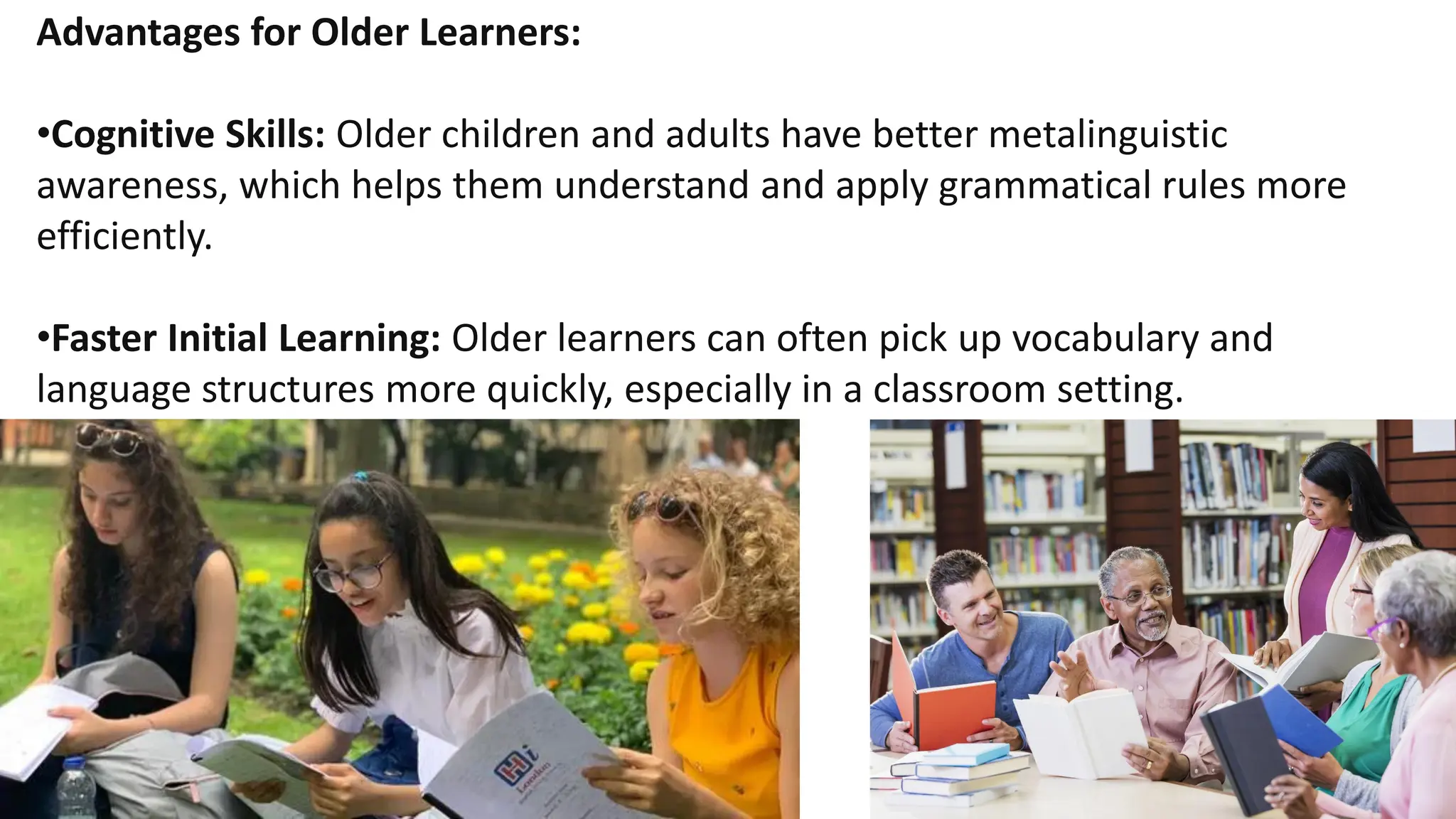
Advantages for Older Learners:
•Cognitive Skills: Older children and adults have better metalinguistic
awareness, which helps them understand and apply grammatical rules more
efficiently.
•Faster Initial Learning: Older learners can often pick up vocabulary and
language structures more quickly, especially in a classroom setting.
Research Findings:
•Studies have shown that while young children may take longer to
learn a language initially, they often achieve a higher level of
proficiency in the long run.
•In classroom settings, older children can sometimes outperform
younger ones in the early stages of learning due to their more
developed cognitive skills.
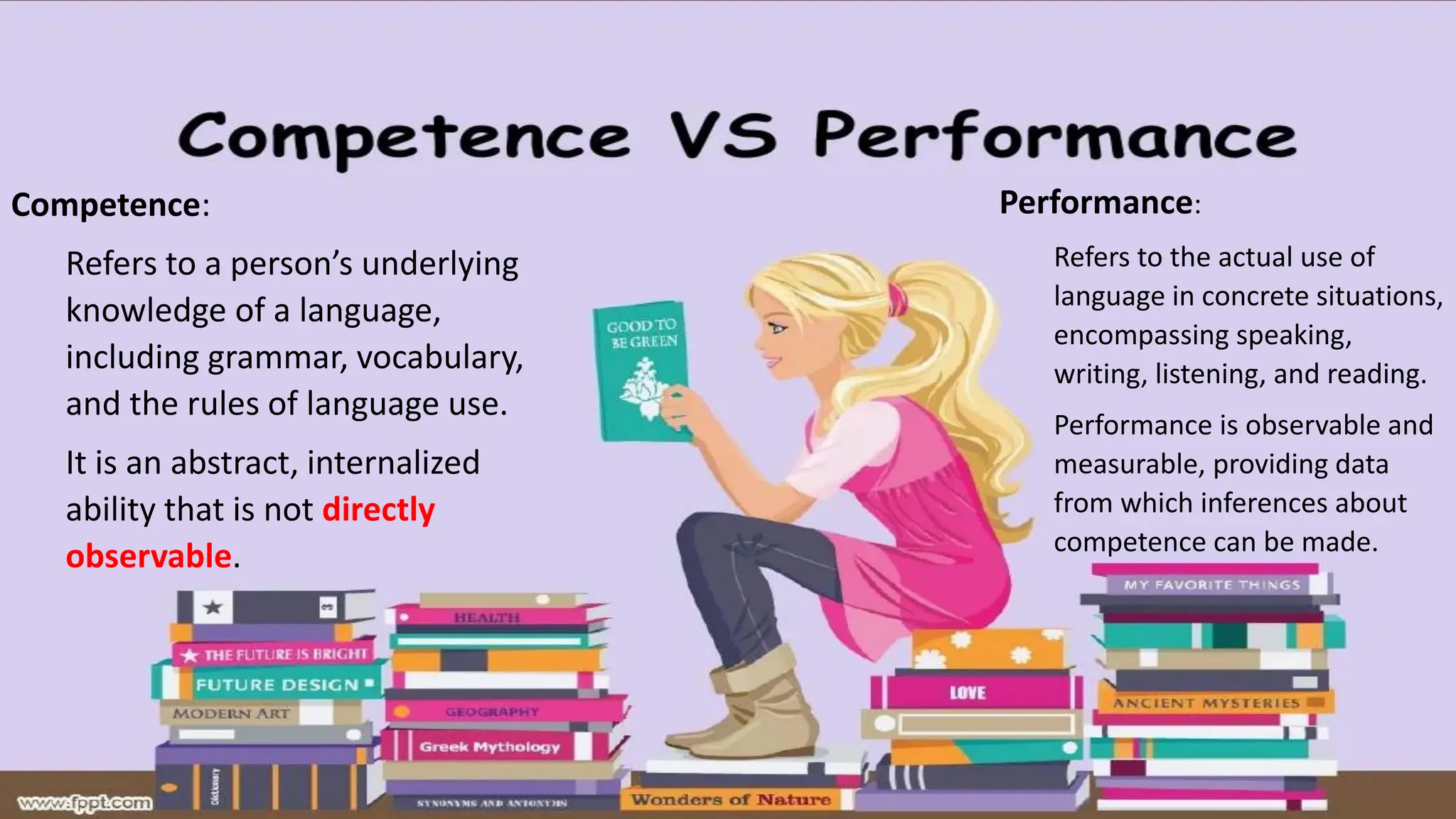
Competence:
Refers to a person’s underlying
knowledge of a language,
including grammar, vocabulary,
and the rules of language use.
It is an abstract, internalized
ability that is not directly
observable.
Performance:
Refers to the actual use of
language in concrete situations,
encompassing speaking,
writing, listening, and reading.
Performance is observable and
measurable, providing data
from which inferences about
competence can be made.
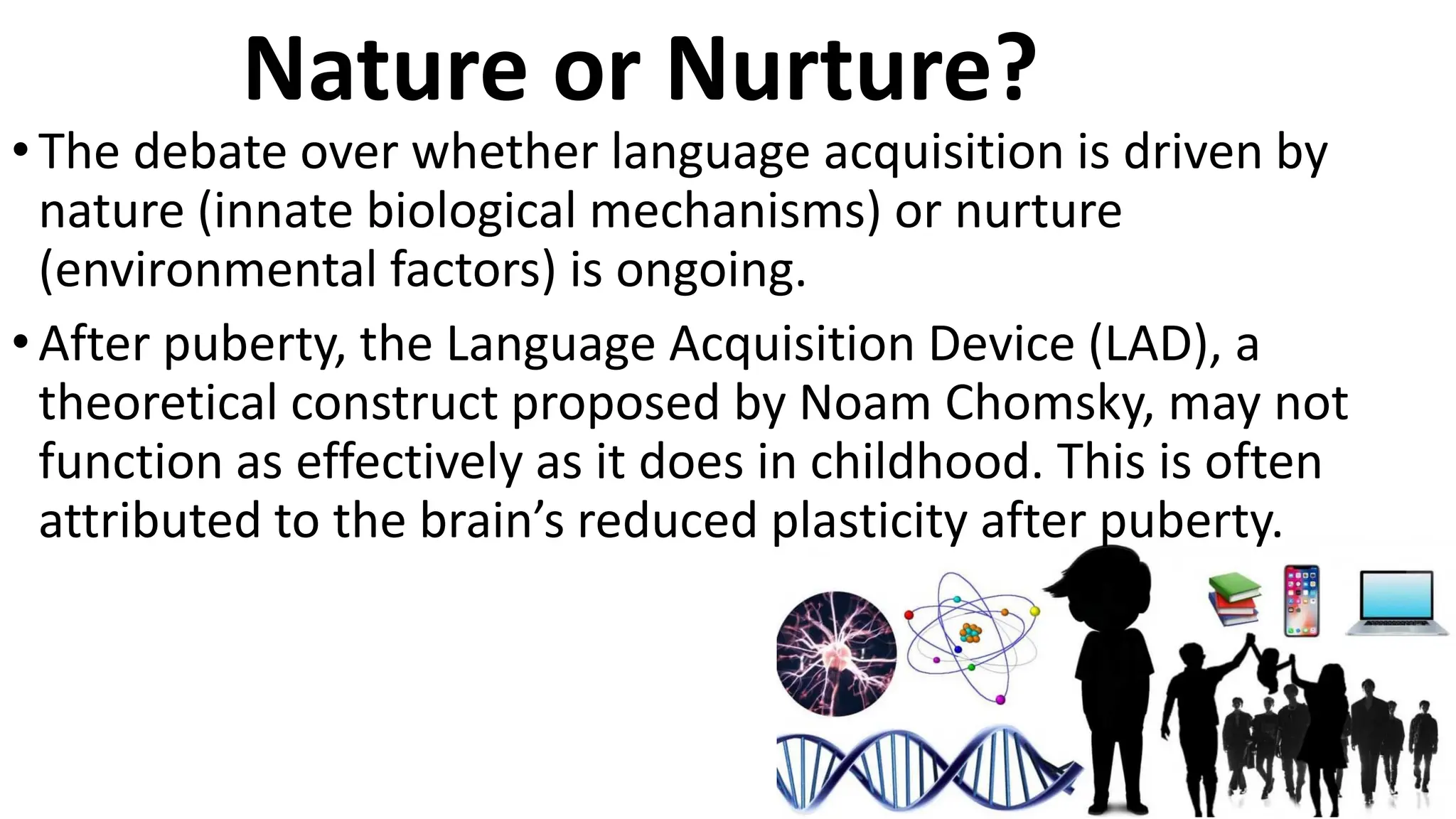
Nature or Nurture?
•The debate over whether language acquisition is driven by
nature (innate biological mechanisms) or nurture
(environmental factors) is ongoing.
•After puberty, the Language Acquisition Device (LAD), a
theoretical construct proposed by Noam Chomsky, may not
function as effectively as it does in childhood. This is often
attributed to the brain’s reduced plasticity after puberty.
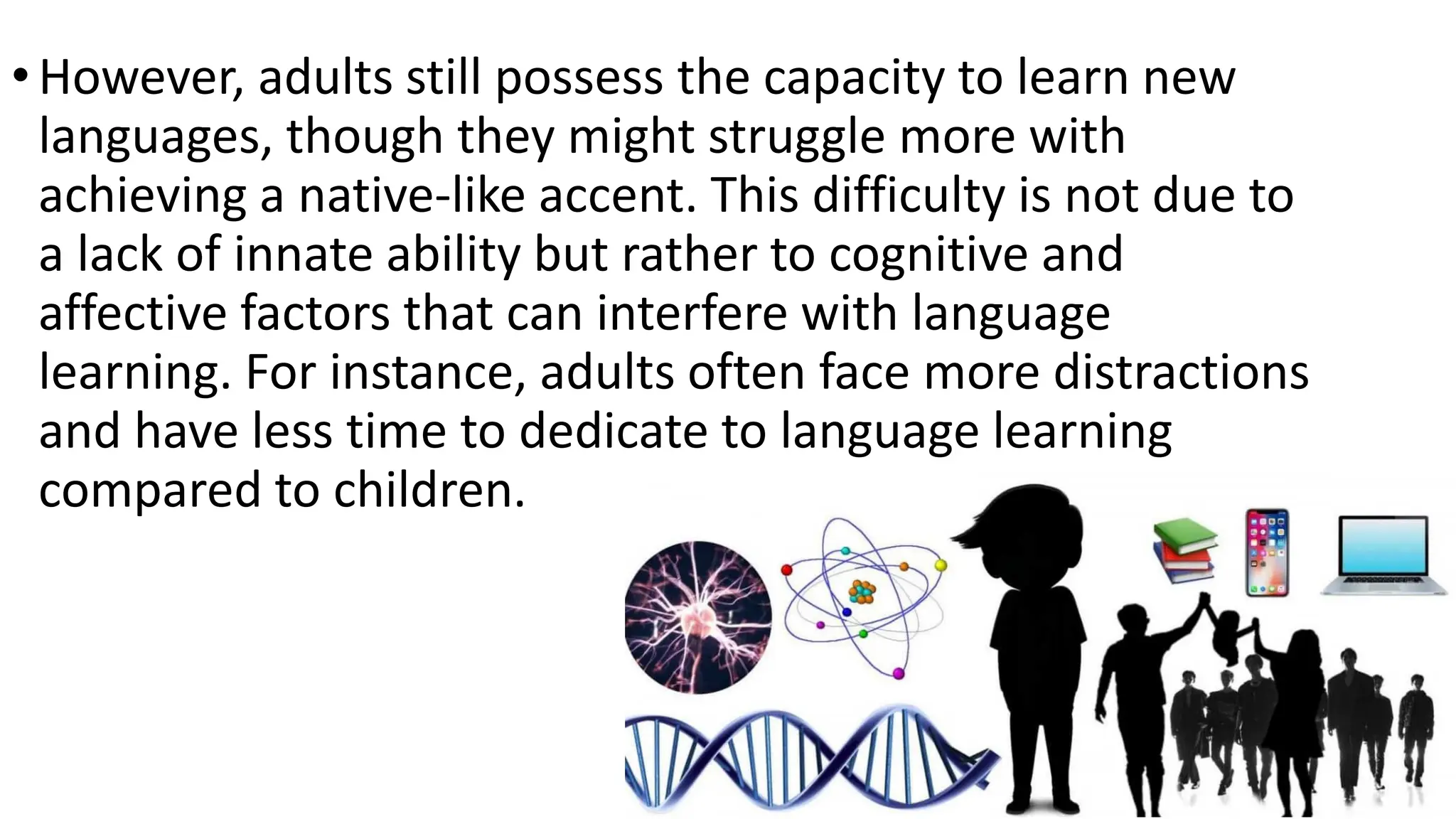
•However, adults still possess the capacity to learn new
languages, though they might struggle more with
achieving a native-like accent. This difficulty is not due to
a lack of innate ability but rather to cognitive and
affective factors that can interfere with language
learning. For instance, adults often face more distractions
and have less time to dedicate to language learning
compared to children.
However, the extent of this influence is debated:
• Direct Access vs. Mediation: It’s unclear if this knowledge comes directly from a universal
source or is mediated by the first language (L1).
• Partial Access: Some researchers, like O’Grady (1996), argue that L2 learners have only
partial access to UG.
• No Access: Bley-Vroman (1988) suggests that adults might acquire L2 without any reference
to UG.
• Critique of UG Models: Cook (1993) posits that if UG models don’t fit L2 learning, the fault
might lie in the description of UG rather than the learners themselves.
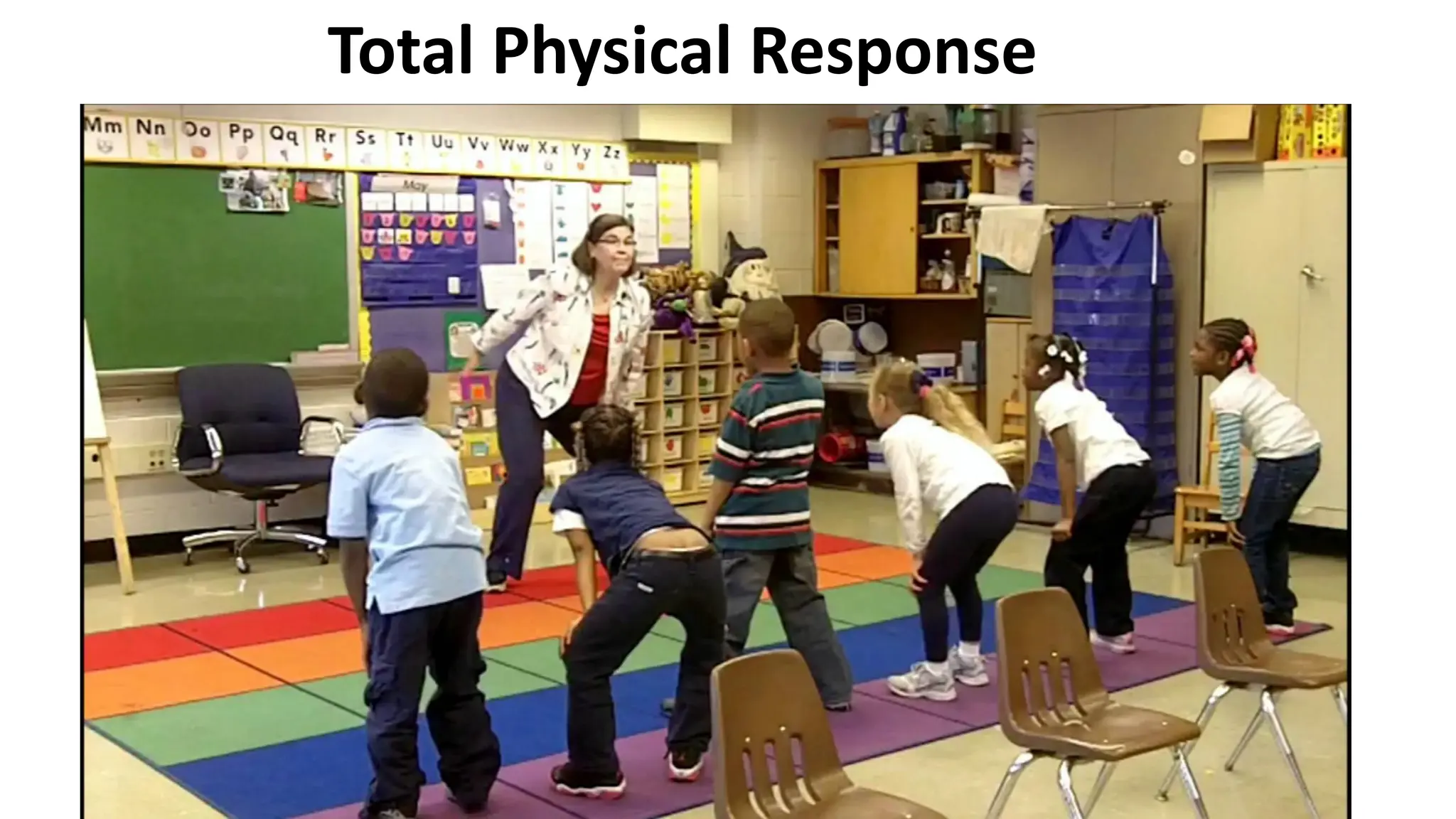
Total Physical Response
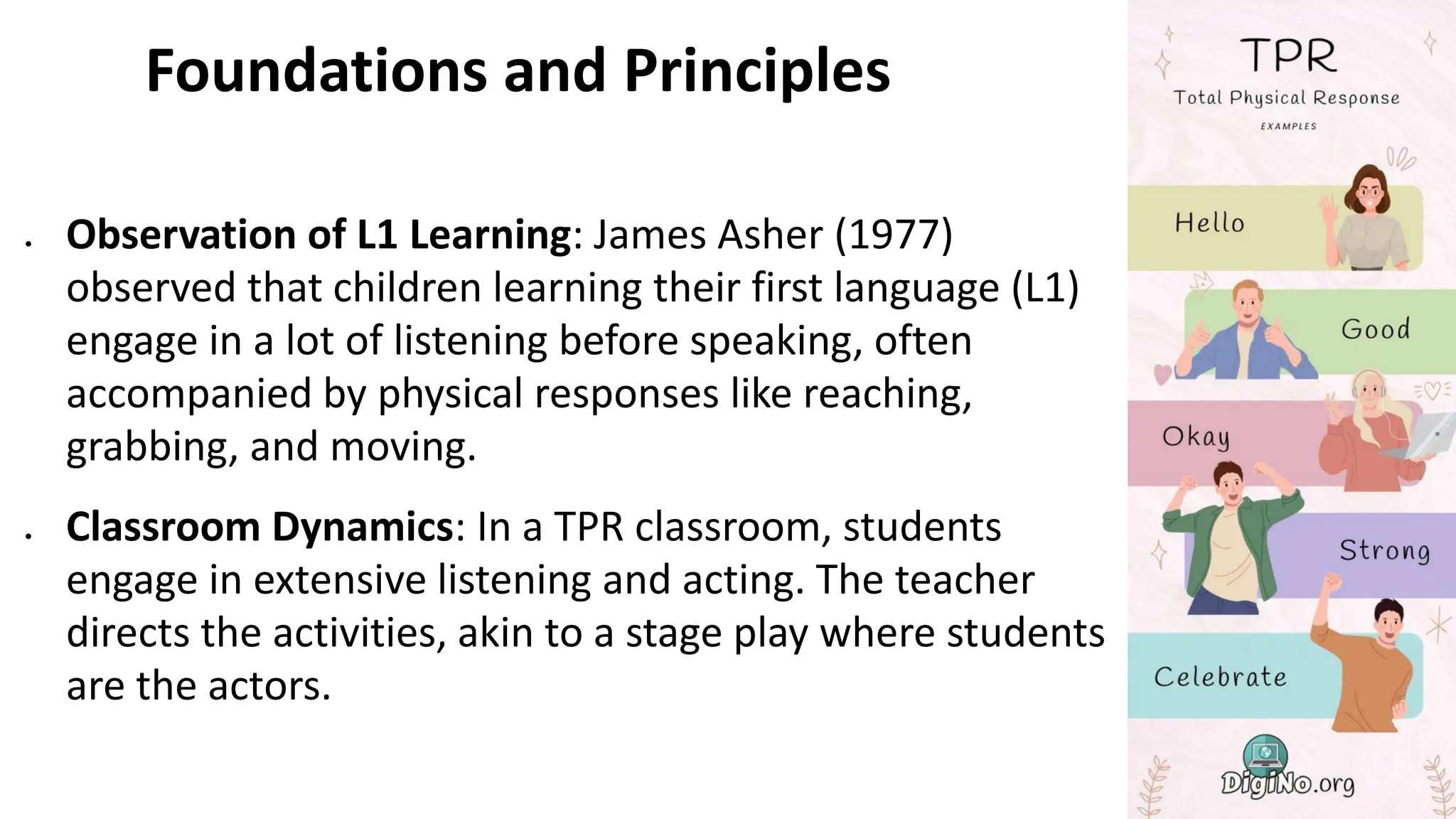
Foundations and Principles
• Observation of L1 Learning: James Asher (1977)
observed that children learning their first language (L1)
engage in a lot of listening before speaking, often
accompanied by physical responses like reaching,
grabbing, and moving.
• Classroom Dynamics: In a TPR classroom, students
engage in extensive listening and acting. The teacher
directs the activities, akin to a stage play where students
are the actors.
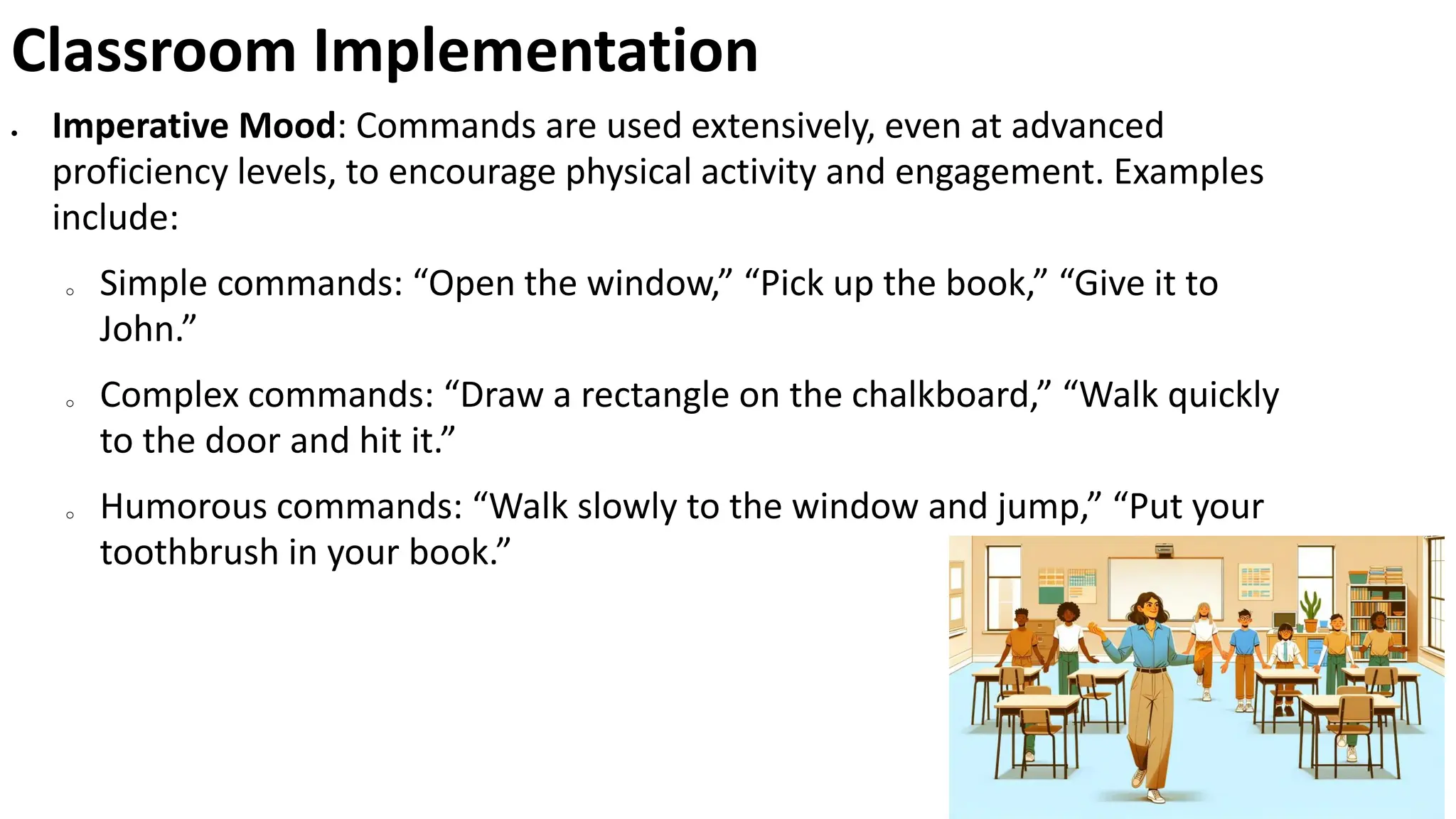
Classroom Implementation
• Imperative Mood: Commands are used extensively, even at advanced
proficiency levels, to encourage physical activity and engagement. Examples
include:
o Simple commands: “Open the window,” “Pick up the book,” “Give it to
John.”
o Complex commands: “Draw a rectangle on the chalkboard,” “Walk quickly
to the door and hit it.”
o Humorous commands: “Walk slowly to the window and jump,” “Put your
toothbrush in your book.”
Have you ever used TPR?
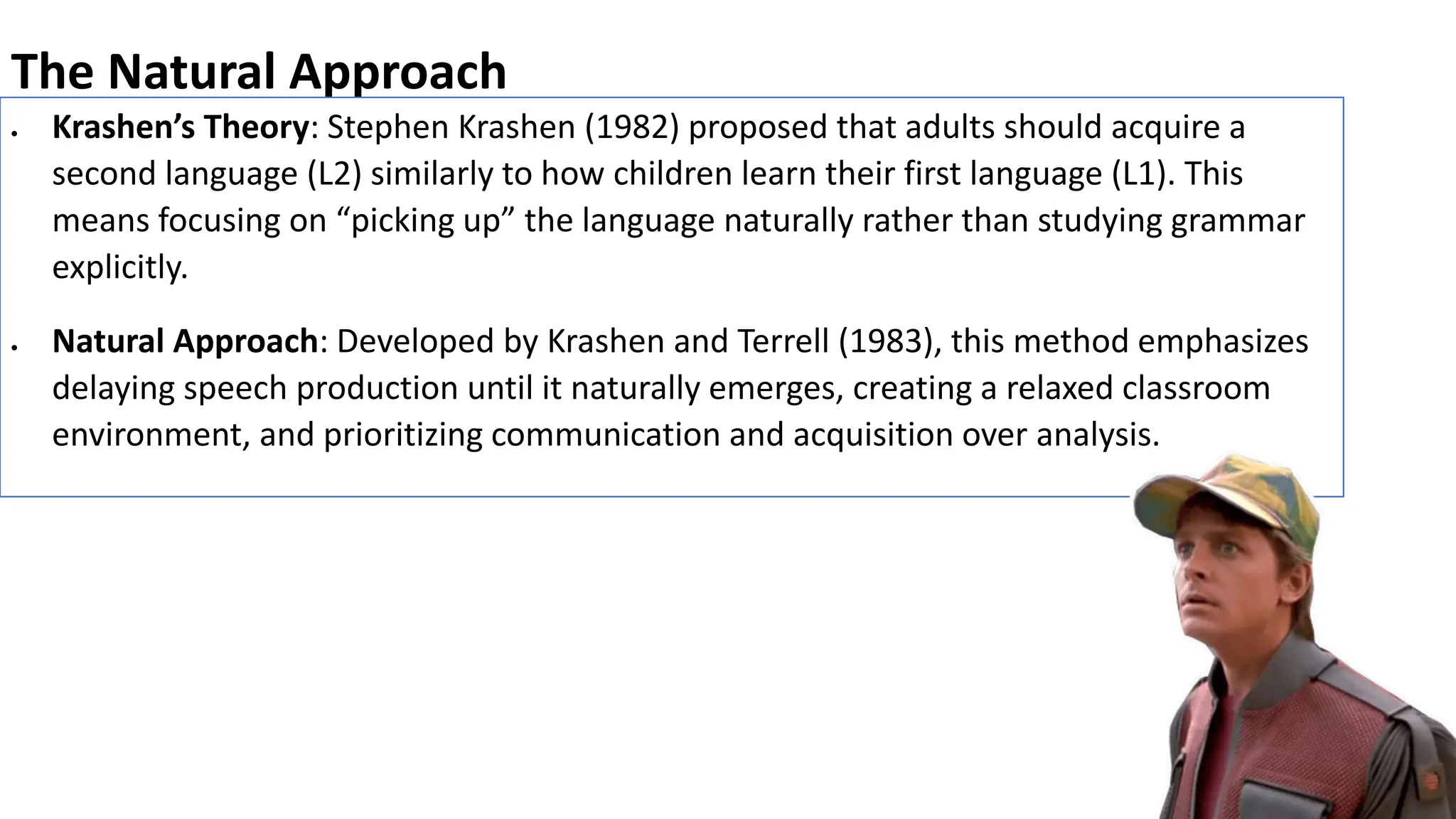
The Natural Approach
• Krashen’s Theory: Stephen Krashen (1982) proposed that adults should acquire a
second language (L2) similarly to how children learn their first language (L1). This
means focusing on “picking up” the language naturally rather than studying grammar
explicitly.
• Natural Approach: Developed by Krashen and Terrell (1983), this method emphasizes
delaying speech production until it naturally emerges, creating a relaxed classroom
environment, and prioritizing communication and acquisition over analysis.
•The Natural Approach aims to create a low-stress, immersive
environment for language learning, drawing on principles of
natural acquisition while adapting them to classroom
settings. Its focus on comprehensible input and delayed
production seeks to make language learning more intuitive
and less intimidating for learners.
Classroom Implementation
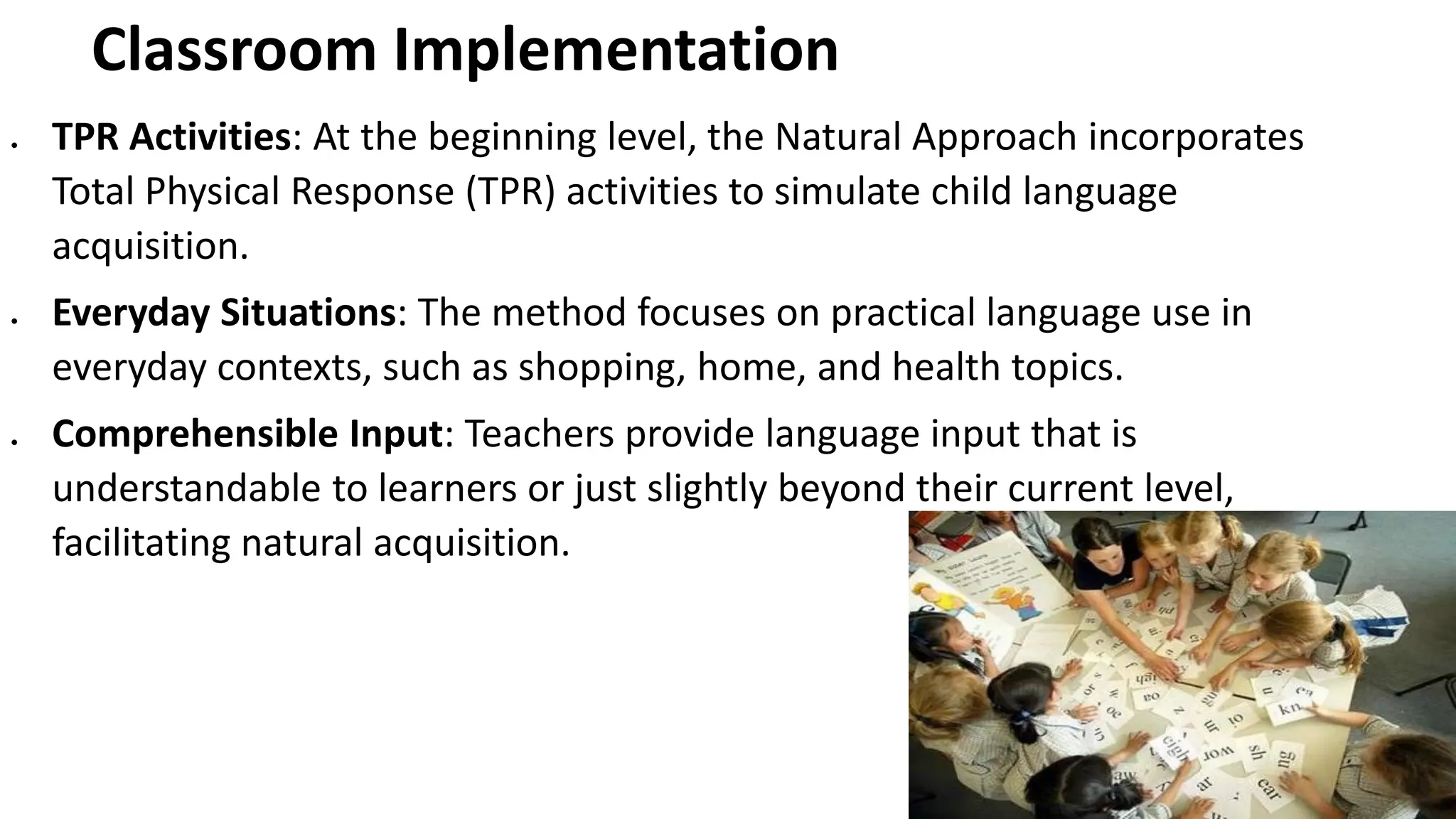
• TPR Activities: At the beginning level, the Natural Approach incorporates
Total Physical Response (TPR) activities to simulate child language
acquisition.
• Everyday Situations: The method focuses on practical language use in
everyday contexts, such as shopping, home, and health topics.
• Comprehensible Input: Teachers provide language input that is
understandable to learners or just slightly beyond their current level,
facilitating natural acquisition.
Can we incorporate the Natural Approach to our
classes nowadays?
Age and Second Language Acquisitiomn.pdf

Age and Second Language Acquisitiomn.pdf

  • 1.
    Age and SecondLanguage Acquisition Presented by: Elainy Elvira Fernández Ventura Lideny Rodriguez Cristian Méndez
  • 2.
    Story • The author,at age five, was placed in a French- speaking school in Leopoldville, Belgian Congo. • Initially struggled with the language but became fluent within 18 months.
  • 3.
    nhuiil •Does age significantlyimpact the ultimate attainment of second language acquisition (SLA)?
  • 4.
    Observations on LanguageAcquisition Children vs. Adults Children learn their first language (L1) easily. Adults often face challenges and sometimes failure in learning a second language (L2), especially in educational settings.
  • 5.
    Research on L1and L2 • Insights from L1 acquisition have informed SLA theories. • SLA can occur in childhood, adolescence, or adulthood.
  • 6.
    Dispelling Myths inSLA • Seven Common Myths • Misconceptions about similarities between L1 and L2 acquisition, such as: • 1. Repetition is key to learning. • 2. Language acquisition is primarily imitation. • 3. The natural order of learning (sounds, words, sentences).
  • 7.
    Dispelling Myths inSLA • 4. Understanding always precedes speaking. • 5. The natural order of L2 learning follows L1 learning (listening, speaking, reading, writing). • 6. Learning without translation. • 7. Learning without formal grammar instruction.
  • 8.
    Critique • These mythsoften misinterpret or oversimplify L1 learning processes and wrongly apply them to L2 learning
  • 9.
    Types of Comparisonsin SLA Research •Logical Comparisons: • Comparing SLA in children vs. adults. • Comparing L1 and L2 acquisition in children.
  • 10.
    Inappropriate Comparisons •Comparing childL1 acquisition with adult SLA leads to flawed conclusions.
  • 11.
    Critical Period Hypothesis(CPH) • Definition • A biologically determined period during which language acquisition is easier. • Beyond this period, acquiring language becomes more difficult. • Applications to SLA • CPH initially connected to L1 acquisition but now applied to L2 contexts. • The argument that puberty marks a critical point beyond which successful SLA is less likely
  • 12.
    Neurological Considerations inSLA • Hemispheric Lateralization • Language functions are primarily located in the left hemisphere. • Lateralization, the process of assigning functions to different hemispheres, may impact SLA. • Brain plasticity before puberty allows easier language acquisition.
  • 13.
    Critical Period andAccent • Some studies suggest that acquiring a native-like accent is difficult after puberty. • - Other higher-order language functions may not be as affected by age.
  • 14.
    Biological Timetables andSLA Different Aspects of L2 Learning • Pronunciation may be more difficult to master after childhood. • Semantic relations and other higher-order processes are learned more efficiently in adulthood.
  • 15.
    Anthropological Evidence • ExceptionalCases • Some adults can acquire a perfect accent in an L2 post- puberty. • Examples from non-Western societies where multilingualism is common.
  • 17.
    AGES: BIRTH TO2 YEARS DURING THE SENSORIMOTOR STAGE (BIRTH TO AGE 2) INFANTS DEVELOP BASIC MOTOR SKILLS AND LEARN TO PERCEIVE AND INTERACT WITH THEIR ENVIRONMENT THROUGH PHYSICAL SENSATIONS AND BODY COORDINATION.
  • 18.
    THE PREOPERATIONAL STAGE AGES:2 – 7 YEARS PIAGET’S SECOND STAGE OF INTELLECTUAL DEVELOPMENT IS THE PREOPERATIONAL STAGE, WHICH OCCURS BETWEEN 2 AND 7 YEARS. AT THE BEGINNING OF THIS STAGE, THE CHILD DOES NOT USE OPERATIONS (A SET OF LOGICAL RULES), SO THINKING IS INFLUENCED BY HOW THINGS LOOK OR APPEAR TO THEM RATHER THAN LOGICAL REASONING.
  • 19.
    THE CONCRETE OPERATIONALSTAGE AGES: 7 – 11 YEARS BY THE BEGINNING OF THE CONCRETE OPERATIONAL STAGE, THE CHILD CAN USE OPERATIONS (A SET OF LOGICAL RULES) SO THEY CAN CONSERVE QUANTITIES, REALIZE THAT PEOPLE SEE THE WORLD IN A DIFFERENT WAY (DECENTRING), AND DEMONSTRATE IMPROVEMENT IN INCLUSION TASKS.
  • 20.
    THE FORMAL OPERATIONALSTAGE AGES: 12 AND OVER THE FORMAL OPERATIONAL PERIOD BEGINS AT ABOUT AGE 11. AS ADOLESCENTS ENTER THIS STAGE, THEY GAIN THE ABILITY TO THINK ABSTRACTLY, THE ABILITY TO COMBINE AND CLASSIFY ITEMS IN A MORE SOPHISTICATED WAY, AND THE CAPACITY FOR HIGHER-ORDER REASONING. • Adolescents can think systematically and reason about what might be as well as what is (not everyone achieves this stage). This allows them to understand politics, ethics, and science fiction, as well as to engage in scientific reasoning. • Adolescents can deal with abstract ideas; for example, they can understand division and fractions without having to actually divide things up and solve hypothetical (imaginary) problems.
  • 21.
  • 22.
    The “Order ofAcquisition” refers to the sequence in which language learners typically acquire grammatical structures and vocabulary in a second language (L2). This concept is crucial in understanding how language learning progresses. Here are some key points:
  • 23.
    •Is the orderof grammar important in second language adquisition?
  • 24.
    1. Natural OrderHypothesis: Proposed by Stephen Krashen, this hypothesis suggests that language learners acquire grammatical structures in a predictable order, regardless of their first language (L1) or the method of instruction. For example, learners might acquire the present progressive tense (“I am running”) before the simple past tense (“I ran”). (Krashen and Terrell (1983; 29)
  • 25.
    2. Factors InfluencingOrder of Acquisition: ❑ Linguistic Complexity: Simpler structures are generally acquired before more complex ones. ❑ Frequency of Use: Structures that are more frequently used in the language are typically acquired earlier. ❑ Input and Interaction: The amount and quality of exposure to the language, as well as opportunities for interaction, can affect the order of acquisition.
  • 26.
    3. Common Patterns: ❑Morphemes: Studies have shown that certain morphemes (smallest units of meaning) are acquired in a specific order. For example, in English, the progressive “-ing” is often acquired before the plural “-s”. ❑ Syntax: Sentence structures also follow a predictable pattern. Learners might first produce simple sentences (“She eats”) before more complex ones (“She is eating an apple”).
  • 27.
    4. Implications forTeaching: ➢ Curriculum Design: Understanding the natural order can help in designing curricula that align with how learners naturally acquire language. ➢ Error Correction: Teachers can focus on correcting errors that are developmentally appropriate, rather than expecting learners to master complex structures prematurely.
  • 28.
    5. Criticisms andLimitations: o While the natural order hypothesis provides a general framework, individual differences such as age, motivation, and learning environment can lead to variations in the order of acquisition. Understanding the order of acquisition helps educators and learners set realistic expectations and tailor their approaches to language learning.
  • 29.
    1. Simultaneous LanguageAcquisition: o Children learning two languages at the same time use similar strategies for both. o They essentially learn two first languages, with the added task of distinguishing the appropriate contexts for each language.
  • 30.
    Types of Bilinguals: oCoordinate Bilinguals: These individuals learn a second language in separate contexts and operate with two distinct meaning systems. o Compound Bilinguals: These individuals have one meaning system where both languages operate within a single context.
  • 31.
    What do youunderstand by Language Mixing?
  • 32.
    Language Mixing: o Childrengenerally do not face issues with mixing languages, even when they use them in separate contexts. o The idea that “bilinguals are not two monolinguals in the same head” (Cook, 1995) highlights the integrated nature of bilingual cognition.
  • 33.
  • 34.
  • 35.
    The idea that“the younger, the better” for language acquisition is a common belief, but it’s a bit more nuanced than that.
  • 36.
    Advantages for YoungerLearners: • Brain Plasticity: Young children have higher brain plasticity, making it easier for them to pick up new sounds and structures. • Implicit Learning: They often learn languages implicitly through play, songs, and interaction, similar to how they learn their first language. • Less Inhibition: Younger children are generally less self-conscious and more willing to take risks in speaking.
  • 37.
    Advantages for OlderLearners: •Cognitive Skills: Older children and adults have better metalinguistic awareness, which helps them understand and apply grammatical rules more efficiently. •Faster Initial Learning: Older learners can often pick up vocabulary and language structures more quickly, especially in a classroom setting.
  • 38.
    Research Findings: •Studies haveshown that while young children may take longer to learn a language initially, they often achieve a higher level of proficiency in the long run. •In classroom settings, older children can sometimes outperform younger ones in the early stages of learning due to their more developed cognitive skills.
  • 39.
    Competence: Refers to aperson’s underlying knowledge of a language, including grammar, vocabulary, and the rules of language use. It is an abstract, internalized ability that is not directly observable. Performance: Refers to the actual use of language in concrete situations, encompassing speaking, writing, listening, and reading. Performance is observable and measurable, providing data from which inferences about competence can be made.
  • 41.
    Nature or Nurture? •Thedebate over whether language acquisition is driven by nature (innate biological mechanisms) or nurture (environmental factors) is ongoing. •After puberty, the Language Acquisition Device (LAD), a theoretical construct proposed by Noam Chomsky, may not function as effectively as it does in childhood. This is often attributed to the brain’s reduced plasticity after puberty.
  • 42.
    •However, adults stillpossess the capacity to learn new languages, though they might struggle more with achieving a native-like accent. This difficulty is not due to a lack of innate ability but rather to cognitive and affective factors that can interfere with language learning. For instance, adults often face more distractions and have less time to dedicate to language learning compared to children.

  • 44.
    However, the extentof this influence is debated: • Direct Access vs. Mediation: It’s unclear if this knowledge comes directly from a universal source or is mediated by the first language (L1). • Partial Access: Some researchers, like O’Grady (1996), argue that L2 learners have only partial access to UG. • No Access: Bley-Vroman (1988) suggests that adults might acquire L2 without any reference to UG. • Critique of UG Models: Cook (1993) posits that if UG models don’t fit L2 learning, the fault might lie in the description of UG rather than the learners themselves.
  • 45.
  • 46.
    Foundations and Principles •Observation of L1 Learning: James Asher (1977) observed that children learning their first language (L1) engage in a lot of listening before speaking, often accompanied by physical responses like reaching, grabbing, and moving. • Classroom Dynamics: In a TPR classroom, students engage in extensive listening and acting. The teacher directs the activities, akin to a stage play where students are the actors.
  • 47.
    Classroom Implementation • ImperativeMood: Commands are used extensively, even at advanced proficiency levels, to encourage physical activity and engagement. Examples include: o Simple commands: “Open the window,” “Pick up the book,” “Give it to John.” o Complex commands: “Draw a rectangle on the chalkboard,” “Walk quickly to the door and hit it.” o Humorous commands: “Walk slowly to the window and jump,” “Put your toothbrush in your book.”
  • 49.
    Have you everused TPR?
  • 51.
    The Natural Approach •Krashen’s Theory: Stephen Krashen (1982) proposed that adults should acquire a second language (L2) similarly to how children learn their first language (L1). This means focusing on “picking up” the language naturally rather than studying grammar explicitly. • Natural Approach: Developed by Krashen and Terrell (1983), this method emphasizes delaying speech production until it naturally emerges, creating a relaxed classroom environment, and prioritizing communication and acquisition over analysis.
  • 52.
    •The Natural Approachaims to create a low-stress, immersive environment for language learning, drawing on principles of natural acquisition while adapting them to classroom settings. Its focus on comprehensible input and delayed production seeks to make language learning more intuitive and less intimidating for learners.
  • 53.
    Classroom Implementation • TPRActivities: At the beginning level, the Natural Approach incorporates Total Physical Response (TPR) activities to simulate child language acquisition. • Everyday Situations: The method focuses on practical language use in everyday contexts, such as shopping, home, and health topics. • Comprehensible Input: Teachers provide language input that is understandable to learners or just slightly beyond their current level, facilitating natural acquisition.
  • 54.
    Can we incorporatethe Natural Approach to our classes nowadays?