Fla & sla
HAVE YOU EVER THOUGHT ABOUT THIS???Whyevery single person can acquirethefirstlanguage (L1) easily?
Whyveryfewpeoplemanagetoacquire a secondlanguage (L2) succesfully?
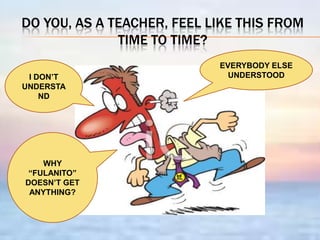
Why, eventhoughyou try yourbest as a teacher, somelearnershave a hard time acquiring L2.Do you, as a teacher, feellikethisfrom time to time?EVERYBODY ELSE UNDERSTOODI DON’T UNDERSTANDWHY “FULANITO” DOESN’T GET ANYTHING?
FIRST LANGUAGE ACQUISITION.Noam Chomsky:               “Languageisinnate.”    We are bornwith rules of language in ourheads= Universal grammarJeremyHarmer:“Unlessthereissomethingwrongwiththemmentallyorphysically, allchildrenacquire a language as theydevelop” (Harmer,1988).
FLA  stages  (l1)COOING2-4 months.Earliestspeech-likesounds.Laughterappearsaround 4 months.BABBLING6-8 MonthsBabiesstarttohave control onspeechvocalization, thishappens as aninstinct.Sensitivitytothephoneticdistinction.
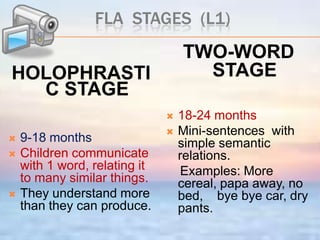
FLA  stages  (l1)TWO-WORD STAGE 18-24 monthsMini-sentenceswith simple semanticrelations.Examples: More cereal, papa away, no bed,    byebye car, dry pants.HOLOPHRASTIC STAGE9-18 monthsChildrencommunicatewith 1 word, relatingittomany similar things.Theyunderstand more thanthey can produce.
FLA  stages  (l1)TELEGRAPHIC STAGE 24-30 monthsWord combinations:             Me wantthatWhathername?Chairfalldown!Thesesentences resemble to short messages in a telegram.There are a lot of syntaxerrors.MULTIWORD STAGE30 + monthsGrammaticalorfunctionalstructures  emerge (thesintaxstage).Childrenlanguagebloomsintofluentgrammaticalconversation.
SECOND LANGUAGE ACQUISITIONStudents learning a second language go through five stages: Preproduction, Early Production, Speech Emergence, Intermediate Fluency, and Advanced Fluency                   (Krashen & Terrell, 1983). Students already have previous knowledge of language (L1).Speed of progress through the stages depends on level of education, family background, amount of exposure to the target language, among others.
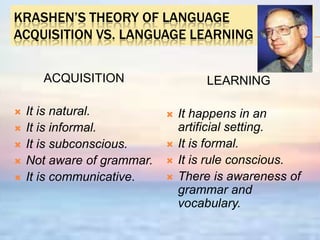
Krashen’s theory of Language acquisition VS. Language learning ACQUISITIONItis natural.Itis informal.Itissubconscious.Notaware of grammar.Itiscommunicative.LEARNINGIthappens in an artificial setting.Itis formal.Itis rule conscious.Thereisawareness of grammar and vocabulary.
Activitiesassociatedwithlearninghavetraditionallybeenused in languageschools and havegoodresults in knowledge “about” language, butnot in fluency.     ( Yule, 1955 ). "Acquisition requires meaningful interaction in the target language - natural communication - in which speakers are concerned not with the form of their utterances but with the messages they are conveying and understanding." Stephen Krashen
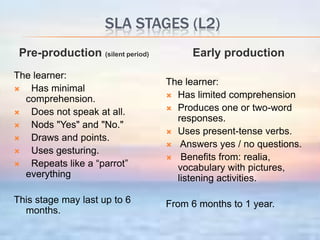
SLA STAGES (L2)Pre-production (silent period)The learner:  Has minimal comprehension.   Does not speak at all.   Nods "Yes" and "No."   Draws and points.   Uses gesturing.Repeatslike a “parrot” everythingThisstagemaylast up to 6 months. Early productionThe learner:Has limited comprehension Produces one or two-word responses. Uses present-tense verbs.  Answers yes / no questions. Benefits from: realia, vocabulary with pictures, listening activities.From 6 monthsto 1 year.
SLA STAGES (L2)IntermediatefluencyThe learner:Has excellent comprehension. Makes few grammatical errors.  Willing to express opinions and share  thoughts.Writing will have errors.From 3 to 5 yearsSpeechemergenceThe learner:Has good comprehension. Can produce simple sentences. Makes grammar and pronunciation errors. Asks simple questions, that may or may not be grammatically correct, such as: May I go to bathroom?From 1 to 3 years.
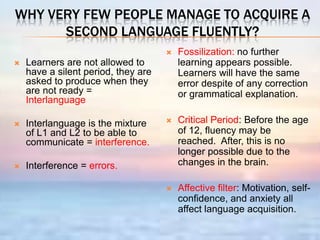
Whyveryfewpeoplemanagetoacquire a secondlanguagefluently?Learners are notallowedtohave a silentperiod, they are askedto produce whenthey are notready = InterlanguageInterlanguageisthe mixture of L1 and L2 tobeabletocommunicate =interference.Interference = errors.Fossilization: no furtherlearningappearspossible. Learnerswillhavethesame error despite of anycorrectionorgrammaticalexplanation.   CriticalPeriod: Beforetheage of 12, fluencymaybereached.  After, thisis no longerpossibleduetothechanges in thebrain.Affectivefilter: Motivation, self-confidence, and anxiety all affect language acquisition.
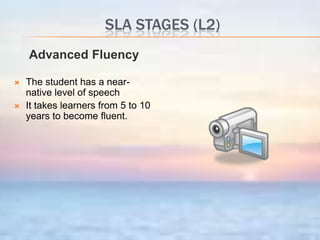
SLA STAGES (L2)AdvancedFluencyThe student has a near-native level of speechIt takes learners from 5 to 10 years to become fluent.
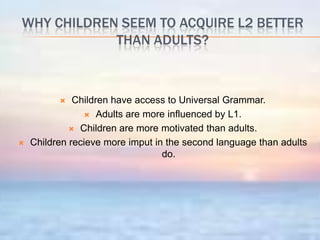
Whychildrenseemtoacquire l2 betterthanadults?Childrenhaveaccessto Universal Grammar.Adults are more influencedby L1.Children are more motivatedthanadults.Childrenrecieve more imput in thesecondlanguagethanadults do.
The use l1 in the l2 classroomADVANTAGESAccordingto Paul Seligson:Unavoidableanyway.Reduces affectivefilters.Practicetranslation.Providesfeedback.Discussidioms.
referencesYule, George. (2006).  The study of language third edition. [on line].  Fourth Worth: Harcourt Brace Janovich College Publishers .  Retrieved on October 4, 2009 from: http://books.google.com.mx/books?id=Zw5Y0o0q1bYC&dq=yule+the+study+of+language&printsec=frontcover&source=bl&ots=uo2v8ZcYYa&sig=ixeYmIWXhPglFlSwoqSIAVE_0yc&hl=es&ei=ZmvNSqKeM8XY8AauzaSFBA&sa=X&oi=book_result&ct=result&resnum=3#v=onepage&q=&f=falseEverything English as a Second Language (2000).  Everything ESL. [On line].  Retrieved October 4, 2009, from http://www.everythingesl.net/inservices/language_stages.phpLuria, H, Seymour D.M, & Smoke, T. (2006).  Language and Linguistics in Context. New Jersey: Lawrence Erlbaum associates, Inc. [on line]. Google books.  Retrieved October 5, 2009 from http://books.google.com.mx/books  

L1 and L2 acquisition

  • 1.
  • 2.
    HAVE YOU EVERTHOUGHT ABOUT THIS???Whyevery single person can acquirethefirstlanguage (L1) easily?
  • 3.
  • 4.
    Why, eventhoughyou tryyourbest as a teacher, somelearnershave a hard time acquiring L2.Do you, as a teacher, feellikethisfrom time to time?EVERYBODY ELSE UNDERSTOODI DON’T UNDERSTANDWHY “FULANITO” DOESN’T GET ANYTHING?
  • 5.
    FIRST LANGUAGE ACQUISITION.NoamChomsky: “Languageisinnate.” We are bornwith rules of language in ourheads= Universal grammarJeremyHarmer:“Unlessthereissomethingwrongwiththemmentallyorphysically, allchildrenacquire a language as theydevelop” (Harmer,1988).
  • 6.
    FLA stages (l1)COOING2-4 months.Earliestspeech-likesounds.Laughterappearsaround 4 months.BABBLING6-8 MonthsBabiesstarttohave control onspeechvocalization, thishappens as aninstinct.Sensitivitytothephoneticdistinction.
  • 7.
    FLA stages (l1)TWO-WORD STAGE 18-24 monthsMini-sentenceswith simple semanticrelations.Examples: More cereal, papa away, no bed, byebye car, dry pants.HOLOPHRASTIC STAGE9-18 monthsChildrencommunicatewith 1 word, relatingittomany similar things.Theyunderstand more thanthey can produce.
  • 8.
    FLA stages (l1)TELEGRAPHIC STAGE 24-30 monthsWord combinations: Me wantthatWhathername?Chairfalldown!Thesesentences resemble to short messages in a telegram.There are a lot of syntaxerrors.MULTIWORD STAGE30 + monthsGrammaticalorfunctionalstructures emerge (thesintaxstage).Childrenlanguagebloomsintofluentgrammaticalconversation.
  • 9.
    SECOND LANGUAGE ACQUISITIONStudentslearning a second language go through five stages: Preproduction, Early Production, Speech Emergence, Intermediate Fluency, and Advanced Fluency (Krashen & Terrell, 1983). Students already have previous knowledge of language (L1).Speed of progress through the stages depends on level of education, family background, amount of exposure to the target language, among others.
  • 10.
    Krashen’s theory ofLanguage acquisition VS. Language learning ACQUISITIONItis natural.Itis informal.Itissubconscious.Notaware of grammar.Itiscommunicative.LEARNINGIthappens in an artificial setting.Itis formal.Itis rule conscious.Thereisawareness of grammar and vocabulary.
  • 11.
    Activitiesassociatedwithlearninghavetraditionallybeenused in languageschoolsand havegoodresults in knowledge “about” language, butnot in fluency. ( Yule, 1955 ). "Acquisition requires meaningful interaction in the target language - natural communication - in which speakers are concerned not with the form of their utterances but with the messages they are conveying and understanding." Stephen Krashen
  • 12.
    SLA STAGES (L2)Pre-production(silent period)The learner: Has minimal comprehension. Does not speak at all. Nods "Yes" and "No." Draws and points. Uses gesturing.Repeatslike a “parrot” everythingThisstagemaylast up to 6 months. Early productionThe learner:Has limited comprehension Produces one or two-word responses. Uses present-tense verbs. Answers yes / no questions. Benefits from: realia, vocabulary with pictures, listening activities.From 6 monthsto 1 year.
  • 13.
    SLA STAGES (L2)IntermediatefluencyThelearner:Has excellent comprehension. Makes few grammatical errors.  Willing to express opinions and share thoughts.Writing will have errors.From 3 to 5 yearsSpeechemergenceThe learner:Has good comprehension. Can produce simple sentences. Makes grammar and pronunciation errors. Asks simple questions, that may or may not be grammatically correct, such as: May I go to bathroom?From 1 to 3 years.
  • 14.
    Whyveryfewpeoplemanagetoacquire a secondlanguagefluently?Learnersare notallowedtohave a silentperiod, they are askedto produce whenthey are notready = InterlanguageInterlanguageisthe mixture of L1 and L2 tobeabletocommunicate =interference.Interference = errors.Fossilization: no furtherlearningappearspossible. Learnerswillhavethesame error despite of anycorrectionorgrammaticalexplanation. CriticalPeriod: Beforetheage of 12, fluencymaybereached. After, thisis no longerpossibleduetothechanges in thebrain.Affectivefilter: Motivation, self-confidence, and anxiety all affect language acquisition.
  • 15.
    SLA STAGES (L2)AdvancedFluencyThestudent has a near-native level of speechIt takes learners from 5 to 10 years to become fluent.
  • 16.
    Whychildrenseemtoacquire l2 betterthanadults?ChildrenhaveaccesstoUniversal Grammar.Adults are more influencedby L1.Children are more motivatedthanadults.Childrenrecieve more imput in thesecondlanguagethanadults do.
  • 17.
    The use l1in the l2 classroomADVANTAGESAccordingto Paul Seligson:Unavoidableanyway.Reduces affectivefilters.Practicetranslation.Providesfeedback.Discussidioms.
  • 19.
    referencesYule, George. (2006). The study of language third edition. [on line]. Fourth Worth: Harcourt Brace Janovich College Publishers . Retrieved on October 4, 2009 from: http://books.google.com.mx/books?id=Zw5Y0o0q1bYC&dq=yule+the+study+of+language&printsec=frontcover&source=bl&ots=uo2v8ZcYYa&sig=ixeYmIWXhPglFlSwoqSIAVE_0yc&hl=es&ei=ZmvNSqKeM8XY8AauzaSFBA&sa=X&oi=book_result&ct=result&resnum=3#v=onepage&q=&f=falseEverything English as a Second Language (2000). Everything ESL. [On line]. Retrieved October 4, 2009, from http://www.everythingesl.net/inservices/language_stages.phpLuria, H, Seymour D.M, & Smoke, T. (2006). Language and Linguistics in Context. New Jersey: Lawrence Erlbaum associates, Inc. [on line]. Google books. Retrieved October 5, 2009 from http://books.google.com.mx/books