BY: ALBA MUÑOZ
ESPE
THE CRITICAL PERIOD HYPOTHESIS
CPH claims that there is such a biological timetable. initially the notion of a critical
period was concerned only to first language acquisition.
Pathological studies of children who failed to acquire their first language, became
fuel for arguments of biologically determined predisposition, time for release,
which would wane if the correct environmental stimuli were no present at the
crucial stage.
The critical point for second language acquisition occurs around puberty, beyond
which people seem to be relatively incapable of acquiring a second language.
By the age of twelve or thirteen you are over the hill when it comes to the
possibility of successful second language, particularly the role of accent.
-Some scholars have singled out the lateralization of the
brain as the key to answering the evidence that the
human brain matures, certain functions are
assigned or lateralized to the left hemisphere of the
brain and other functions to the right hemisphere.
-Intellectual, logical and analytical functions appear to
be largely located in the left hemisphere, while the
right hemisphere controls functions related to
emotional and social needs. Language function
appear to be controlled mainly in the left
hemisphere, although there is a good deal of
conflicting evidence.
-Lateralization is a slow process that begins around the
age of two and is completed around puberty. Shovel
suggest that puberty enables children to acquire not
only their first language but also a second language
called ¨ authentic¨ (native like) pronunciation.
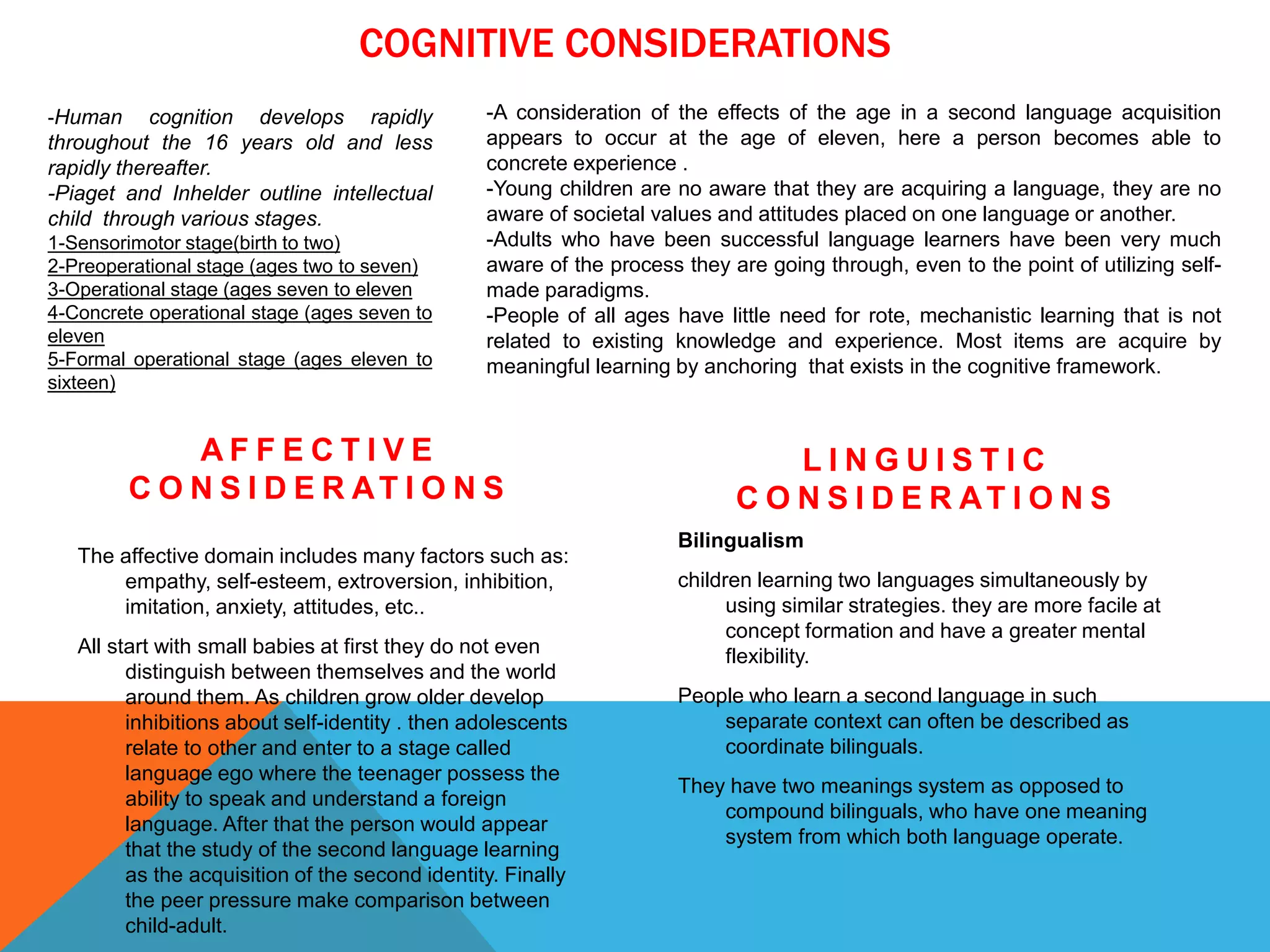
COGNITIVE CONSIDERATIONS
A F F E C T I V E
C O N S I D E R AT I O N S
The affective domain includes many factors such as:
empathy, self-esteem, extroversion, inhibition,
imitation, anxiety, attitudes, etc..
All start with small babies at first they do not even
distinguish between themselves and the world
around them. As children grow older develop
inhibitions about self-identity . then adolescents
relate to other and enter to a stage called
language ego where the teenager possess the
ability to speak and understand a foreign
language. After that the person would appear
that the study of the second language learning
as the acquisition of the second identity. Finally
the peer pressure make comparison between
child-adult.
L I N G U I S T I C
C O N S I D E R AT I O N S
Bilingualism
children learning two languages simultaneously by
using similar strategies. they are more facile at
concept formation and have a greater mental
flexibility.
People who learn a second language in such
separate context can often be described as
coordinate bilinguals.
They have two meanings system as opposed to
compound bilinguals, who have one meaning
system from which both language operate.
-A consideration of the effects of the age in a second language acquisition
appears to occur at the age of eleven, here a person becomes able to
concrete experience .
-Young children are no aware that they are acquiring a language, they are no
aware of societal values and attitudes placed on one language or another.
-Adults who have been successful language learners have been very much
aware of the process they are going through, even to the point of utilizing self-
made paradigms.
-People of all ages have little need for rote, mechanistic learning that is not
related to existing knowledge and experience. Most items are acquire by
meaningful learning by anchoring that exists in the cognitive framework.
-Human cognition develops rapidly
throughout the 16 years old and less
rapidly thereafter.
-Piaget and Inhelder outline intellectual
child through various stages.
1-Sensorimotor stage(birth to two)
2-Preoperational stage (ages two to seven)
3-Operational stage (ages seven to eleven
4-Concrete operational stage (ages seven to
eleven
5-Formal operational stage (ages eleven to
sixteen)
LANGUAGE AND THOUGHT
1. It is a complex relationship issue between first and second language.
Language helps to shape thinking and that thinking helps to shape
language.
2. The second language learner is clearly presented with a tremendous
task in sorting out new meanings from old, distinguishing thoughts
and concepts in one language that are similar but not quite parallel to
the second language, perhaps really acquiring a whole new system
of conceptualization.
3. The second language teacher needs to be acutely aware of cultural
thought patterns that may be as interfering as the linguistic patterns
themselves.

Age and acquisition learning activity 2

  • 1.
  • 2.
    THE CRITICAL PERIODHYPOTHESIS CPH claims that there is such a biological timetable. initially the notion of a critical period was concerned only to first language acquisition. Pathological studies of children who failed to acquire their first language, became fuel for arguments of biologically determined predisposition, time for release, which would wane if the correct environmental stimuli were no present at the crucial stage. The critical point for second language acquisition occurs around puberty, beyond which people seem to be relatively incapable of acquiring a second language. By the age of twelve or thirteen you are over the hill when it comes to the possibility of successful second language, particularly the role of accent.
  • 3.
    -Some scholars havesingled out the lateralization of the brain as the key to answering the evidence that the human brain matures, certain functions are assigned or lateralized to the left hemisphere of the brain and other functions to the right hemisphere. -Intellectual, logical and analytical functions appear to be largely located in the left hemisphere, while the right hemisphere controls functions related to emotional and social needs. Language function appear to be controlled mainly in the left hemisphere, although there is a good deal of conflicting evidence. -Lateralization is a slow process that begins around the age of two and is completed around puberty. Shovel suggest that puberty enables children to acquire not only their first language but also a second language called ¨ authentic¨ (native like) pronunciation.
  • 4.
    COGNITIVE CONSIDERATIONS A FF E C T I V E C O N S I D E R AT I O N S The affective domain includes many factors such as: empathy, self-esteem, extroversion, inhibition, imitation, anxiety, attitudes, etc.. All start with small babies at first they do not even distinguish between themselves and the world around them. As children grow older develop inhibitions about self-identity . then adolescents relate to other and enter to a stage called language ego where the teenager possess the ability to speak and understand a foreign language. After that the person would appear that the study of the second language learning as the acquisition of the second identity. Finally the peer pressure make comparison between child-adult. L I N G U I S T I C C O N S I D E R AT I O N S Bilingualism children learning two languages simultaneously by using similar strategies. they are more facile at concept formation and have a greater mental flexibility. People who learn a second language in such separate context can often be described as coordinate bilinguals. They have two meanings system as opposed to compound bilinguals, who have one meaning system from which both language operate. -A consideration of the effects of the age in a second language acquisition appears to occur at the age of eleven, here a person becomes able to concrete experience . -Young children are no aware that they are acquiring a language, they are no aware of societal values and attitudes placed on one language or another. -Adults who have been successful language learners have been very much aware of the process they are going through, even to the point of utilizing self- made paradigms. -People of all ages have little need for rote, mechanistic learning that is not related to existing knowledge and experience. Most items are acquire by meaningful learning by anchoring that exists in the cognitive framework. -Human cognition develops rapidly throughout the 16 years old and less rapidly thereafter. -Piaget and Inhelder outline intellectual child through various stages. 1-Sensorimotor stage(birth to two) 2-Preoperational stage (ages two to seven) 3-Operational stage (ages seven to eleven 4-Concrete operational stage (ages seven to eleven 5-Formal operational stage (ages eleven to sixteen)
  • 6.
    LANGUAGE AND THOUGHT 1.It is a complex relationship issue between first and second language. Language helps to shape thinking and that thinking helps to shape language. 2. The second language learner is clearly presented with a tremendous task in sorting out new meanings from old, distinguishing thoughts and concepts in one language that are similar but not quite parallel to the second language, perhaps really acquiring a whole new system of conceptualization. 3. The second language teacher needs to be acutely aware of cultural thought patterns that may be as interfering as the linguistic patterns themselves.