AFLP MARKER
By
KAUSHAL KUMAR SAHU
Assistant Professor (Ad Hoc)
Department of Biotechnology
Govt. Digvijay Autonomous P. G. College
Raj-Nandgaon ( C. G. )
Synopsis-
• Introduction
• Steps in AFLP
• Advantage of AFLP
• Disadvantage of AFLP
• Application
• Conclusion
• Reference
Amplified fragment length
polymorphism
• AFLP method based on PCR developed in 1995
by Vos et al.
- Involves the use of RFLP and RAPD
techniques and universally used.
- Compared with the widely used RFLP, AFLP
is faster, less labour intensive and provide more
information.
- An additional advantage over RAPD is their
reproducibility.
Amplified fragment length
polymorphism
• This is highly sensitive method for detecting
polymorphism throughout the gnome and is
becoming increasingly popular.
• The AFLP technique is based on the principle
of selectively amplifying a subset of restriction
fragments from a complex mixture of DNA
fragments obtained after digestion of genomic
DNA with restriction endonucleases.
STEPS IN AFLP
• Digestion
• Adaptor Ligation
• Amplification
• Selective amplification
• Electrophoresis
• Data collection
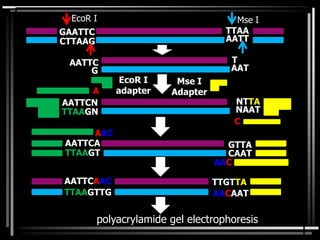
DIGESTION
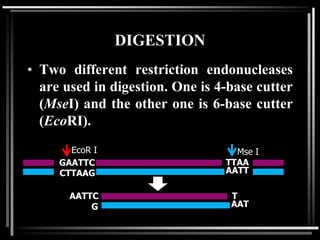
• Two different restriction endonucleases
are used in digestion. One is 4-base cutter
(MseI) and the other one is 6-base cutter
(EcoRI).
GAATTC
CTTAAG AATT
EcoR I Mse I
AATTC
G
T
AAT
TTAA
ADAPTOR LIGATION
• Two different adaptors (short double stranded
DNA sequences with sticky end) are ligated to the
digested fragments.
• One adaptor will complement to the Msel cut end,
the other will complement to the EcoRI cut end.
AATTC
G
T
AAT
EcoR I
adapter
Mse I
Adapter
AATTC
TTAAG
TTA
AAT
AMPLIFICATION
• DNA fragments with MseI-EcoRI ends with be
selected as DNA template for amplication.
• two PCR primers complementary to the two
adaptors are used in amplification.
• the PCR primers are labelled with radioactive or
fluorescence dye for detection of DNA bands on
gels.
AATTC
TTAAG
TTA
AAT
AATTC
TTAAG
TTA
AAT
SELECTIVE AMPLIFICATION
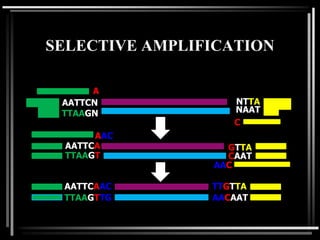
Selective Bases -
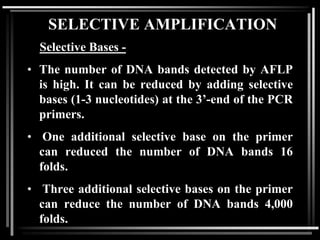
• The number of DNA bands detected by AFLP
is high. It can be reduced by adding selective
bases (1-3 nucleotides) at the 3’-end of the PCR
primers.
• One additional selective base on the primer
can reduced the number of DNA bands 16
folds.
• Three additional selective bases on the primer
can reduce the number of DNA bands 4,000
folds.
SELECTIVE AMPLIFICATION
AATTCN
TTAAGN
NTTA
NAAT
AATTCA
TTAAGT
GTTA
CAAT
AATTCAAC
TTAAGTTG
TTGTTA
AACAAT
A
C
AAC
AAC
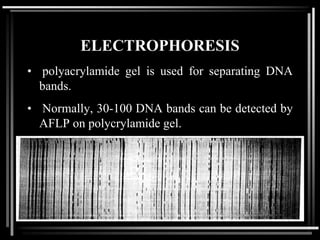
ELECTROPHORESIS
• polyacrylamide gel is used for separating DNA
bands.
• Normally, 30-100 DNA bands can be detected by
AFLP on polycrylamide gel.
GAATTC
CTTAAG
TTAA
AATT
EcoR I Mse I
AATTC
G
T
AAT
EcoR I
adapter
Mse I
Adapter
AATTCN
TTAAGN
NTTA
NAAT
AATTCA
TTAAGT
GTTA
CAAT
AATTCAAC
TTAAGTTG
TTGTTA
AACAAT
A
C
AAC
AAC
polyacrylamide gel electrophoresis
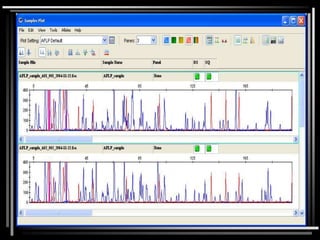
DATA COLLECTION
• Instrument for electrophoretic separation and
fluorescence detection
• During the electrophoresis, the instrument
monitors the passage the fluorescent, 5' dye-
labeled fragments through the polymer by
detecting fluctuations in emitted light when the
fragments migrate past a fixed laser beam.
• When finished, the instrument assembles the
spectral data for each sample and stores it a
sample file, or saves it to the application database.
ADVANTAGE
• This technique is extremely sensitive.
• It has high reproducibility proving extremely
proficient in revealing diversity.
• It discriminates heterozygote's from when a gel
scanner is used.
• It permits detection of restriction fragments in any
background or complexity including pooled DNA
samples and colned DNA segments.
• It not a simple fingerprinting technique but it can
be used for mapping also.
DISADVANTAGE
• It is extremely expensive and requires more
DNA than is needed is RAPD.
• It is technically more demanding than
RAPSs as it requires experience of
sequencing gels.
• AFLPs are expensive to generate as silver
staining, fluorescent dye or radioactivity
detects the bands.
APPLICATION
• To detect various polymorphisms in different
genomic regions.
• For the identification of genetic variation in
strains or closely related species of plants,
fungi, animals, and bacteria.
• The AFLP technology has been used in
criminal and paternity tests.
• In linkage studies to generate maps for
qualitative trait locus (QTL) analysis.
REFERENCE
• Plant Biotechnology- H. S. chawla
• Biotechnology- U. satyanarayana
• Biotechnology- B. D. Singh
• www.ncbi.com
• www.Wikipedia.com