PHONOLOGICAL PROCESSES DR. RICELI C. MENDOZA University of Southern Mindanao PHILIPPINES
PHONOLOGICAL PROCESSES  1. Aspiration  is  characteristic of voiceless stops consonants /p/,/t/, /k/ in English. Aspirated and unaspirated versions are positional variants. Substituting one for the other does not cause change of meaning of a word- it is merely an incorrect pronunciation.  In some languages the difference between the aspirated and unaspirated can cause a difference in meaning just like Vietnamese:  [tua] tassel [thua] lose  [tu]   repair [thu] mackerel  [tin]  smart [thin]  silent  Hence, aspirated and unaspirated sounds in Vietnamese are contrastive sounds (perceived as different sounds)
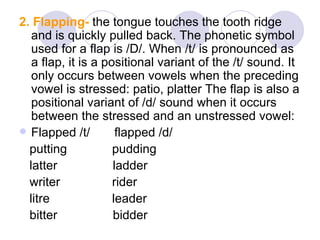
2. Flapping-  the tongue touches the tooth ridge and is quickly pulled back. The phonetic symbol used for a flap is /D/. When /t/ is pronounced as a flap, it is a positional variant of the /t/ sound. It only occurs between vowels when the preceding vowel is stressed: patio, platter The flap is also a positional variant of /d/ sound when it occurs between the stressed and an unstressed vowel:  Flapped /t/  flapped /d/  putting  pudding  latter  ladder  writer  rider  litre  leader  bitter  bidder
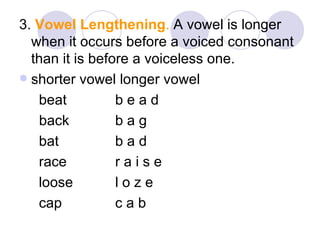
3.  Vowel Lengthening .  A vowel is longer when it occurs before a voiced consonant than it is before a voiceless one.  shorter vowel longer vowel  beat  b e a d    back  b a g  bat  b a d  race  r a i s e  loose  l o z e  cap  c a b
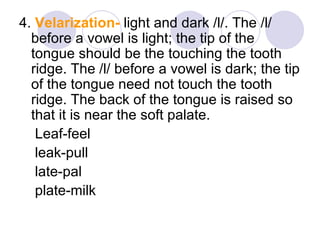
4.  Velarization-  light and dark /l/. The /l/ before a vowel is light; the tip of the tongue should be the touching the tooth ridge. The /l/ before a vowel is dark; the tip of the tongue need not touch the tooth ridge. The back of the tongue is raised so that it is near the soft palate.  Leaf-feel  leak-pull  late-pal  plate-milk
5.  Assimilation  causes a sound to become more like a neighboring sound with respect to some feature. Ex: vowel nasalization [~] , liquid and glide devoicing. LIQUIDS [l,r] and glides [w,w,y] become voiceless when they occur following a voiceless OBSTRRUENTS [ p, t, k, ?, f, s, h, c, s,].  pang + dikdik+pandikdik; pang +basa=pambansa; pang + luto +panluto
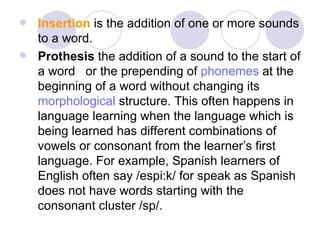
Insertion  is the addition of one or more sounds to a word.  Prothesis  the addition of a sound to the start of a word   or the prepending of  phonemes  at the beginning of a word without changing its  morphological  structure. This often happens in language learning when the language which is being learned has different combinations of vowels or consonant from the learner’s first language. For example, Spanish learners of English often say /espi:k/ for speak as Spanish does not have words starting with the consonant cluster /sp/.
Epenthesis  is  the addition of a vowel or consonant between sounds. It  is divided into two types:  excrescence  (if the sound added is a consonant) and  anaptyxis  (if the sound added is a vowel).  In English, a  stop consonant  is often added to break a nasal + fricative sequence English "hamster" often pronounced with an added "p" sound as [hæmpstəɹ]  English "warmth" often pronounced with an added "p" sound as [wɔɹrmpθ]  English "fence" often pronounced [fɛnts]
Many speakers of other languages do not use combination like the /Im/ or /Ip/ of English and add an epenthetic vowel, for example [ fil ә m] for film, and [hel ә p]  for [help]; realtor-realator  Paragoge :  the addition of a sound to the end of a word.  slack and slacken (no change in meaning) toward-towards anyway-anyways
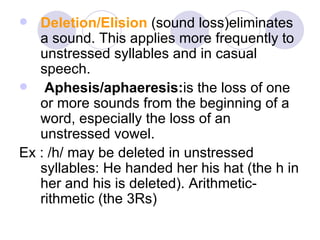
Deletion/Elision  (sound loss)eliminates a sound. This applies more frequently to unstressed syllables and in casual speech.  Aphesis/aphaeresis: is the loss of one or more sounds from the beginning of a word, especially the loss of an unstressed vowel.  Ex : /h/ may be deleted in unstressed syllables: He handed her his hat (the h in her and his is deleted). Arithmetic-rithmetic (the 3Rs)
Syncope:  is the loss of one or more sounds from the interior of a word; especially, the loss of an unstressed vowel.  go[ing t]o >  gonna   wa[nt t]o  >  wanna   did n[o]t  >  didn't do[n't k]no[w]  >  dunno I [woul]d [h]ave  >  I'd've] police [plis], believe [bliv]  dakip + in= dakipin-dakpin bukas + an = buksan-buksan
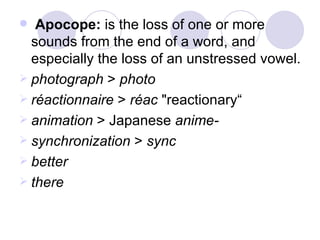
Apocope:  is the loss of one or more sounds from the end of a word, and especially the loss of an unstressed vowel.  photograph  >  photo   réactionnaire  >  réac  "reactionary“ animation  > Japanese  anime- synchronization  >  sync better there
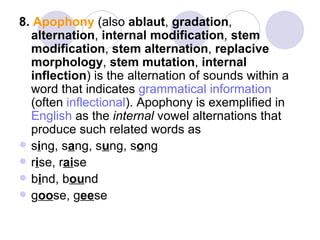
8.  Apophony  (also  ablaut ,  gradation ,  alternation ,  internal modification ,  stem modification ,  stem alternation ,  replacive morphology ,  stem mutation ,  internal inflection ) is the alternation of sounds within a word that indicates  grammatical information  (often  inflectional ). Apophony is exemplified in  English  as the  internal  vowel alternations that produce such related words as  s i ng, s a ng, s u ng, s o ng  r i se, r ai se  b i nd, b ou nd  g oo se, g ee se
The difference in these vowels marks variously a difference in  tense  or  aspect  (e.g.  sing/sang/sung ),  transitivity  ( rise/raise ),  part of speech  ( sing/song ,  bind/bound ), or  grammatical number  ( goose/geese ). Similarly, there are consonant alternations which are also used grammatically:  belie f , belie v e  hou s e (noun), hou s e (verb)   (phonetically: [haʊs] (noun), [haʊz] (verb))
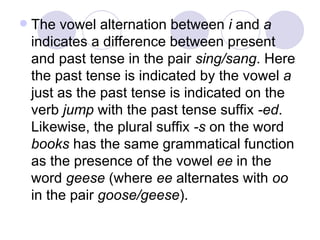
The vowel alternation between  i  and  a  indicates a difference between present and past tense in the pair  sing/sang . Here the past tense is indicated by the vowel  a  just as the past tense is indicated on the verb  jump  with the past tense suffix  -ed . Likewise, the plural suffix  -s  on the word  books  has the same grammatical function as the presence of the vowel  ee  in the word  geese  (where  ee  alternates with  oo  in the pair  goose/geese ).
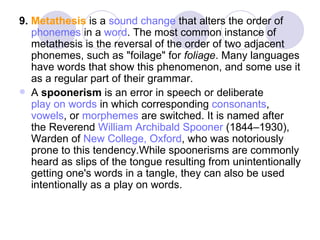
9.  Metathesis  is a  sound change  that alters the order of  phonemes  in a  word . The most common instance of metathesis is the reversal of the order of two adjacent phonemes, such as "foilage" for  foliage . Many languages have words that show this phenomenon, and some use it as a regular part of their grammar. A  spoonerism  is an error in speech or deliberate  play on words  in which corresponding  consonants ,  vowels , or  morphemes  are switched. It is named after the Reverend  William Archibald Spooner  (1844–1930), Warden of  New College, Oxford , who was notoriously prone to this tendency.While spoonerisms are commonly heard as slips of the tongue resulting from unintentionally getting one's words in a tangle, they can also be used intentionally as a play on words.
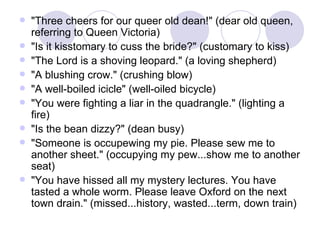
"Three cheers for our queer old dean!" (dear old queen, referring to Queen Victoria)  "Is it kisstomary to cuss the bride?" (customary to kiss)  "The Lord is a shoving leopard." (a loving shepherd)  "A blushing crow." (crushing blow)  "A well-boiled icicle" (well-oiled bicycle)  "You were fighting a liar in the quadrangle." (lighting a fire)  "Is the bean dizzy?" (dean busy)  "Someone is occupewing my pie. Please sew me to another sheet." (occupying my pew...show me to another seat)  "You have hissed all my mystery lectures. You have tasted a whole worm. Please leave Oxford on the next town drain." (missed...history, wasted...term, down train)

Phonological processes

  • 1.
    PHONOLOGICAL PROCESSES DR.RICELI C. MENDOZA University of Southern Mindanao PHILIPPINES
  • 2.
    PHONOLOGICAL PROCESSES 1. Aspiration is  characteristic of voiceless stops consonants /p/,/t/, /k/ in English. Aspirated and unaspirated versions are positional variants. Substituting one for the other does not cause change of meaning of a word- it is merely an incorrect pronunciation. In some languages the difference between the aspirated and unaspirated can cause a difference in meaning just like Vietnamese: [tua] tassel [thua] lose [tu]   repair [thu] mackerel [tin]  smart [thin]  silent Hence, aspirated and unaspirated sounds in Vietnamese are contrastive sounds (perceived as different sounds)
  • 3.
    2. Flapping- the tongue touches the tooth ridge and is quickly pulled back. The phonetic symbol used for a flap is /D/. When /t/ is pronounced as a flap, it is a positional variant of the /t/ sound. It only occurs between vowels when the preceding vowel is stressed: patio, platter The flap is also a positional variant of /d/ sound when it occurs between the stressed and an unstressed vowel: Flapped /t/ flapped /d/ putting pudding latter ladder writer rider litre leader bitter bidder
  • 4.
    3. VowelLengthening . A vowel is longer when it occurs before a voiced consonant than it is before a voiceless one. shorter vowel longer vowel beat b e a d back b a g bat b a d race r a i s e loose l o z e cap c a b
  • 5.
    4. Velarization- light and dark /l/. The /l/ before a vowel is light; the tip of the tongue should be the touching the tooth ridge. The /l/ before a vowel is dark; the tip of the tongue need not touch the tooth ridge. The back of the tongue is raised so that it is near the soft palate. Leaf-feel leak-pull late-pal plate-milk
  • 6.
    5. Assimilation causes a sound to become more like a neighboring sound with respect to some feature. Ex: vowel nasalization [~] , liquid and glide devoicing. LIQUIDS [l,r] and glides [w,w,y] become voiceless when they occur following a voiceless OBSTRRUENTS [ p, t, k, ?, f, s, h, c, s,]. pang + dikdik+pandikdik; pang +basa=pambansa; pang + luto +panluto
  • 7.
    Insertion isthe addition of one or more sounds to a word. Prothesis the addition of a sound to the start of a word   or the prepending of phonemes  at the beginning of a word without changing its morphological structure. This often happens in language learning when the language which is being learned has different combinations of vowels or consonant from the learner’s first language. For example, Spanish learners of English often say /espi:k/ for speak as Spanish does not have words starting with the consonant cluster /sp/.
  • 8.
    Epenthesis is the addition of a vowel or consonant between sounds. It is divided into two types: excrescence (if the sound added is a consonant) and anaptyxis (if the sound added is a vowel). In English, a stop consonant  is often added to break a nasal + fricative sequence English "hamster" often pronounced with an added "p" sound as [hæmpstəɹ] English "warmth" often pronounced with an added "p" sound as [wɔɹrmpθ] English "fence" often pronounced [fɛnts]
  • 9.
    Many speakers ofother languages do not use combination like the /Im/ or /Ip/ of English and add an epenthetic vowel, for example [ fil ә m] for film, and [hel ә p] for [help]; realtor-realator Paragoge : the addition of a sound to the end of a word. slack and slacken (no change in meaning) toward-towards anyway-anyways
  • 10.
    Deletion/Elision (soundloss)eliminates a sound. This applies more frequently to unstressed syllables and in casual speech. Aphesis/aphaeresis: is the loss of one or more sounds from the beginning of a word, especially the loss of an unstressed vowel. Ex : /h/ may be deleted in unstressed syllables: He handed her his hat (the h in her and his is deleted). Arithmetic-rithmetic (the 3Rs)
  • 11.
    Syncope: isthe loss of one or more sounds from the interior of a word; especially, the loss of an unstressed vowel. go[ing t]o > gonna wa[nt t]o > wanna did n[o]t > didn't do[n't k]no[w] > dunno I [woul]d [h]ave > I'd've] police [plis], believe [bliv] dakip + in= dakipin-dakpin bukas + an = buksan-buksan
  • 12.
    Apocope: isthe loss of one or more sounds from the end of a word, and especially the loss of an unstressed vowel. photograph > photo réactionnaire > réac "reactionary“ animation > Japanese anime- synchronization > sync better there
  • 13.
    8. Apophony (also ablaut , gradation , alternation , internal modification , stem modification , stem alternation , replacive morphology , stem mutation , internal inflection ) is the alternation of sounds within a word that indicates grammatical information (often inflectional ). Apophony is exemplified in English  as the internal vowel alternations that produce such related words as s i ng, s a ng, s u ng, s o ng r i se, r ai se b i nd, b ou nd g oo se, g ee se
  • 14.
    The difference inthese vowels marks variously a difference in tense or aspect (e.g. sing/sang/sung ), transitivity ( rise/raise ), part of speech ( sing/song , bind/bound ), or grammatical number ( goose/geese ). Similarly, there are consonant alternations which are also used grammatically: belie f , belie v e hou s e (noun), hou s e (verb)   (phonetically: [haʊs] (noun), [haʊz] (verb))
  • 15.
    The vowel alternationbetween i and a indicates a difference between present and past tense in the pair sing/sang . Here the past tense is indicated by the vowel a just as the past tense is indicated on the verb jump with the past tense suffix -ed . Likewise, the plural suffix -s on the word books has the same grammatical function as the presence of the vowel ee in the word geese (where ee alternates with oo in the pair goose/geese ).
  • 16.
    9. Metathesis is a sound change  that alters the order of phonemes in a word . The most common instance of metathesis is the reversal of the order of two adjacent phonemes, such as "foilage" for foliage . Many languages have words that show this phenomenon, and some use it as a regular part of their grammar. A spoonerism is an error in speech or deliberate play on words in which corresponding consonants , vowels , or morphemes are switched. It is named after the Reverend William Archibald Spooner (1844–1930), Warden of New College, Oxford , who was notoriously prone to this tendency.While spoonerisms are commonly heard as slips of the tongue resulting from unintentionally getting one's words in a tangle, they can also be used intentionally as a play on words.
  • 17.
    "Three cheers forour queer old dean!" (dear old queen, referring to Queen Victoria) "Is it kisstomary to cuss the bride?" (customary to kiss) "The Lord is a shoving leopard." (a loving shepherd) "A blushing crow." (crushing blow) "A well-boiled icicle" (well-oiled bicycle) "You were fighting a liar in the quadrangle." (lighting a fire) "Is the bean dizzy?" (dean busy) "Someone is occupewing my pie. Please sew me to another sheet." (occupying my pew...show me to another seat) "You have hissed all my mystery lectures. You have tasted a whole worm. Please leave Oxford on the next town drain." (missed...history, wasted...term, down train)