SILENCE PLEASE
PRESENTATION
IN PROGRESS
CHAPTER
(8)
SYLLABLE
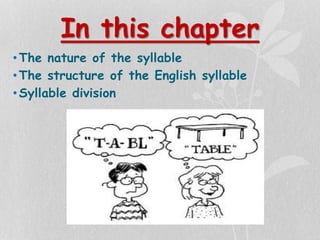
In this chapter
•The nature of the syllable
•The structure of the English syllable
•Syllable division
Many people find it easier to
count how many syllables there
are in a word/sentence more
than defining what a syllable is
Introduction
What a syllable is
THE NATURE
OF THE
SYLLABLE
Syllable
Phonetically
The relationship
between how we
produce them & how
they sound
phonologically
The possible
combination of English
phonemes
Syllable
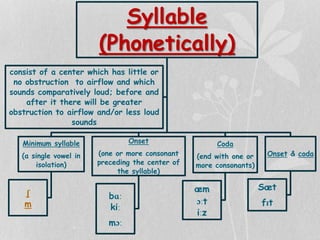
(Phonetically)
Minimum syllable
(a single vowel in
isolation)
ʃ
m
Onset
(one or more consonant
preceding the center of
the syllable)
bɑː
kiː
mɔː
Coda
(end with one or
more consonants)
æm
ɔːt
iːz
Onset & coda
Sæt
fɪt
consist of a center which has little or
no obstruction to airflow and which
sounds comparatively loud; before and
after it there will be greater
obstruction to airflow and/or less loud
sounds
ʃʃʃʃ
Mmmmm
(in agreement)
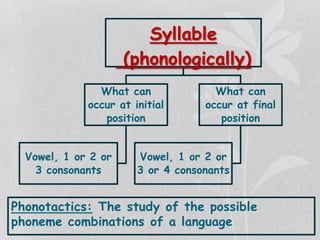
Phonotactics: The study of the possible
phoneme combinations of a language
Syllable
(phonologically)
What can
occur at initial
position
Vowel, 1 or 2 or
3 consonants
What can
occur at final
position
Vowel, 1 or 2 or
3 or 4 consonants
THE
STRUCTURE OF
THE ENGLISH
SYLLABLE
syllable
Onset
C (c)
Rhyme
Nucleus
V (v)
Coda
C (c)
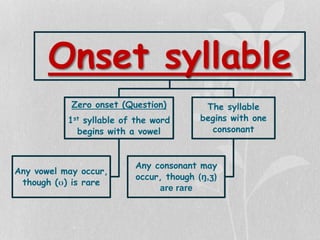
Onset syllable
Zero onset (Question)
1st syllable of the word
begins with a vowel
Any vowel may occur,
though (ʊ) is rare
The syllable
begins with one
consonant
Any consonant may
occur, though (ŋ,ʒ)
are rare
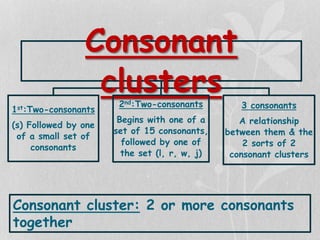
Consonant cluster: 2 or more consonants
together
Consonant
clusters
1st:Two-consonants
(s) Followed by one
of a small set of
consonants
2nd:Two-consonants
Begins with one of a
set of 15 consonants,
followed by one of
the set (l, r, w, j)
3 consonants
A relationship
between them & the
2 sorts of 2
consonant clusters
(s) pre-initial consonant
Initial
p t k b d g f θ s ʃ h v ð z ʒ m n ŋ
spɪn stɪk skɪn - - - sfəɪ - - - - - - - - smel snəʊ -
Initial or post-initial
l W J r
slɪp swɪŋ sjuː srɪndʒ
1st : Two-consonant
clusters with pre-initial
(s)
Post-
initial
v ð z ʒ m n ŋ l r w j
l - - - - - - - - - - -
r - - - - - - - - - - -
w - - - - - - - - - - -
j vjuː - - - mjuːz njuːz - ljuːd - - -
Post-
initial
p t k b d g f θ s ʃ h
l pleɪ - kleɪ blæk - gluː flaɪ - slɪp - -
r preɪ treɪ kraɪ brɪŋ drɪp grɪn fraɪ θrəʊ ?4 ʃruː -
w - twɪn kwɪn - dwel ?1 - θwɔːt swɪm ?5 -
j pjɔː tjuːn kjuː bjuːti djuː ?2 fjuː ?3 sjuː - hjuːdʒ
2nd : Two-consonant
clusters with post-initial
(l, r, w, j)
4- Some people pronounce the word ‘syringe’ as srɪndʒ; there are no
other cases of sr unless one counts foreign names (e.g. Sri Lanka)
1- Many Welsh names (including some well known outside wales) – such
as girls’ names like Gwen and places names like the country of Gwent –
have initial gw and English speakers seem to find them perfectly easy
to pronounce
5- Two cases make ʃw seem familiar: the vowel name ‘schwa’, and the
name of the soft drinks brand Schweppes. This is ,however, a very
infrequent cluster in English
2- The only possible occurrence of gj would be in the archaic word
‘gules’, which is in very few people’s vocabulary
3- θj occurs in the archaic word ‘thew’ only
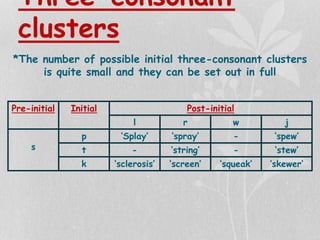
Three-consonant
clusters
*The number of possible initial three-consonant clusters
is quite small and they can be set out in full
Pre-initial Initial Post-initial
l r w j
s
p ‘Splay’ ‘spray’ - ‘spew’
t - ‘string’ - ‘stew’
k ‘sclerosis’ ‘screen’ ‘squeak’ ‘skewer’
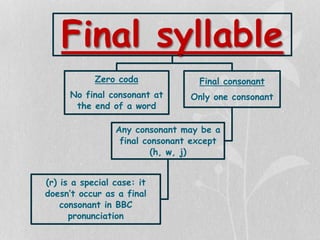
Final syllable
Zero coda
No final consonant at
the end of a word
Final consonant
Only one consonant
Any consonant may be a
final consonant except
(h, w, j)
(r) is a special case: it
doesn’t occur as a final
consonant in BBC
pronunciation
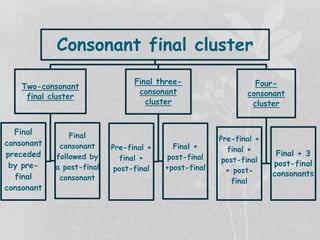
Consonant final cluster
Two-consonant
final cluster
Final
consonant
preceded
by pre-
final
consonant
Final
consonant
followed by
a post-final
consonant
Final three-
consonant
cluster
Pre-final +
final +
post-final
Final +
post-final
+post-final
Four-
consonant
cluster
Pre-final +
final +
post-final
+ post-
final
Final + 3
post-final
consonants
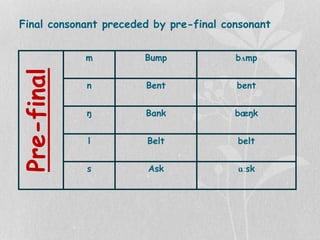
Pre-final
m Bump bʌmp
n Bent bent
ŋ Bank bæŋk
l Belt belt
s Ask ɑːsk
Final consonant preceded by pre-final consonant
Post-final
s Bets bets
z Beds bedz
t Backed bækt
d Bagged bægd
θ Eighth eɪtθ
Final consonant followed by a post-final consonant
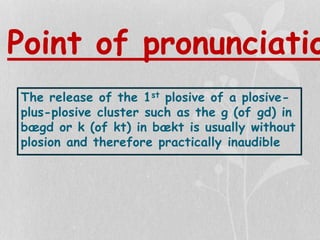
The release of the 1st plosive of a plosive-
plus-plosive cluster such as the g (of gd) in
bægd or k (of kt) in bækt is usually without
plosion and therefore practically inaudible
Point of pronunciatio
Pre-final final Post-final
Helped he l p t
Banks bæ ŋ k s
Bonds bɒ n d z
Twelfth twe l f θ
Pre-final + final + post-final
Final + post-final +post-final
final Post-final Post-final
Fifth fɪ f θ s
Next ne k s t
lapsed læ p s t
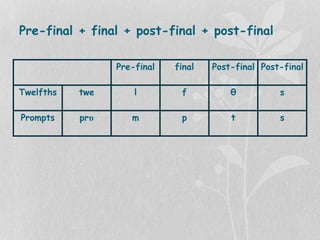
Pre-final + final + post-final + post-final
Pre-final final Post-final Post-final
Twelfths twe l f θ s
Prompts prɒ m p t s
Few cases
Final + 3 post-final consonants
Final Post-final Post-final Post-final
Sixths sɪ k s θ s
Texts te k s t s
Pre-
initial
Post-
initial
Initial
VOWEL
Pre-
final Final
Post-
Final
1
Post-
Final
2
Post-
Final
3
ONSET CODA
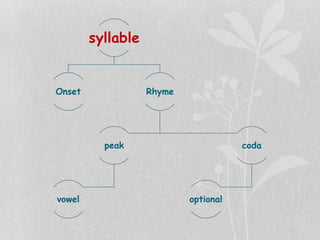
syllable
Onset Rhyme
peak
vowel
coda
optional
SYLLABLE
DIVISION
/Sɪ.lə.bl̩z/
It often happens that one or more consonants from the
end of one word combine with ne or more at the beginning
of the following word, resulting in a consonant sequence
that could not occur in a single syllable
Maximal onsets principles: Two syllables are to be divided,
any consonants between them should be attached to the
right-hand syllable
Consonants are assigned to the right-hand syllable as far
as possible within the restrictions governing syllable onsets
and codas
Ambisyllabic: When one consonant stands between vowels
and it is difficult to assign the consonant to one syllable or
to the other
Extra /ekstrə/
I. e.kstrə
II.ek.strə
III.eks.trə
IV.ekst.rə
V. ekstr.ə
Notes:
Sonority theory of syllables: Sonority corresponds to
loudness, and some sounds have greater sonority than
others
Vowels have the greatest sonority
(S) has greater sonority than (k, t)
Thank

Syllable

  • 1.
  • 2.
  • 3.
    In this chapter •Thenature of the syllable •The structure of the English syllable •Syllable division
  • 4.
    Many people findit easier to count how many syllables there are in a word/sentence more than defining what a syllable is Introduction What a syllable is
  • 5.
  • 6.
    Syllable Phonetically The relationship between howwe produce them & how they sound phonologically The possible combination of English phonemes
  • 7.
    Syllable (Phonetically) Minimum syllable (a singlevowel in isolation) ʃ m Onset (one or more consonant preceding the center of the syllable) bɑː kiː mɔː Coda (end with one or more consonants) æm ɔːt iːz Onset & coda Sæt fɪt consist of a center which has little or no obstruction to airflow and which sounds comparatively loud; before and after it there will be greater obstruction to airflow and/or less loud sounds
  • 8.
  • 9.
  • 10.
    Phonotactics: The studyof the possible phoneme combinations of a language Syllable (phonologically) What can occur at initial position Vowel, 1 or 2 or 3 consonants What can occur at final position Vowel, 1 or 2 or 3 or 4 consonants
  • 11.
  • 12.
    Onset syllable Zero onset(Question) 1st syllable of the word begins with a vowel Any vowel may occur, though (ʊ) is rare The syllable begins with one consonant Any consonant may occur, though (ŋ,ʒ) are rare
  • 13.
    Consonant cluster: 2or more consonants together Consonant clusters 1st:Two-consonants (s) Followed by one of a small set of consonants 2nd:Two-consonants Begins with one of a set of 15 consonants, followed by one of the set (l, r, w, j) 3 consonants A relationship between them & the 2 sorts of 2 consonant clusters
  • 14.
    (s) pre-initial consonant Initial pt k b d g f θ s ʃ h v ð z ʒ m n ŋ spɪn stɪk skɪn - - - sfəɪ - - - - - - - - smel snəʊ - Initial or post-initial l W J r slɪp swɪŋ sjuː srɪndʒ 1st : Two-consonant clusters with pre-initial (s)
  • 15.
    Post- initial v ð zʒ m n ŋ l r w j l - - - - - - - - - - - r - - - - - - - - - - - w - - - - - - - - - - - j vjuː - - - mjuːz njuːz - ljuːd - - - Post- initial p t k b d g f θ s ʃ h l pleɪ - kleɪ blæk - gluː flaɪ - slɪp - - r preɪ treɪ kraɪ brɪŋ drɪp grɪn fraɪ θrəʊ ?4 ʃruː - w - twɪn kwɪn - dwel ?1 - θwɔːt swɪm ?5 - j pjɔː tjuːn kjuː bjuːti djuː ?2 fjuː ?3 sjuː - hjuːdʒ 2nd : Two-consonant clusters with post-initial (l, r, w, j)
  • 16.
    4- Some peoplepronounce the word ‘syringe’ as srɪndʒ; there are no other cases of sr unless one counts foreign names (e.g. Sri Lanka) 1- Many Welsh names (including some well known outside wales) – such as girls’ names like Gwen and places names like the country of Gwent – have initial gw and English speakers seem to find them perfectly easy to pronounce 5- Two cases make ʃw seem familiar: the vowel name ‘schwa’, and the name of the soft drinks brand Schweppes. This is ,however, a very infrequent cluster in English 2- The only possible occurrence of gj would be in the archaic word ‘gules’, which is in very few people’s vocabulary 3- θj occurs in the archaic word ‘thew’ only
  • 17.
    Three-consonant clusters *The number ofpossible initial three-consonant clusters is quite small and they can be set out in full Pre-initial Initial Post-initial l r w j s p ‘Splay’ ‘spray’ - ‘spew’ t - ‘string’ - ‘stew’ k ‘sclerosis’ ‘screen’ ‘squeak’ ‘skewer’
  • 18.
    Final syllable Zero coda Nofinal consonant at the end of a word Final consonant Only one consonant Any consonant may be a final consonant except (h, w, j) (r) is a special case: it doesn’t occur as a final consonant in BBC pronunciation
  • 19.
    Consonant final cluster Two-consonant finalcluster Final consonant preceded by pre- final consonant Final consonant followed by a post-final consonant Final three- consonant cluster Pre-final + final + post-final Final + post-final +post-final Four- consonant cluster Pre-final + final + post-final + post- final Final + 3 post-final consonants
  • 20.
    Pre-final m Bump bʌmp nBent bent ŋ Bank bæŋk l Belt belt s Ask ɑːsk Final consonant preceded by pre-final consonant
  • 21.
    Post-final s Bets bets zBeds bedz t Backed bækt d Bagged bægd θ Eighth eɪtθ Final consonant followed by a post-final consonant
  • 22.
    The release ofthe 1st plosive of a plosive- plus-plosive cluster such as the g (of gd) in bægd or k (of kt) in bækt is usually without plosion and therefore practically inaudible Point of pronunciatio
  • 23.
    Pre-final final Post-final Helpedhe l p t Banks bæ ŋ k s Bonds bɒ n d z Twelfth twe l f θ Pre-final + final + post-final
  • 24.
    Final + post-final+post-final final Post-final Post-final Fifth fɪ f θ s Next ne k s t lapsed læ p s t
  • 25.
    Pre-final + final+ post-final + post-final Pre-final final Post-final Post-final Twelfths twe l f θ s Prompts prɒ m p t s
  • 26.
    Few cases Final +3 post-final consonants Final Post-final Post-final Post-final Sixths sɪ k s θ s Texts te k s t s
  • 27.
  • 28.
  • 29.
  • 30.
    It often happensthat one or more consonants from the end of one word combine with ne or more at the beginning of the following word, resulting in a consonant sequence that could not occur in a single syllable Maximal onsets principles: Two syllables are to be divided, any consonants between them should be attached to the right-hand syllable Consonants are assigned to the right-hand syllable as far as possible within the restrictions governing syllable onsets and codas Ambisyllabic: When one consonant stands between vowels and it is difficult to assign the consonant to one syllable or to the other
  • 31.
  • 32.
    Notes: Sonority theory ofsyllables: Sonority corresponds to loudness, and some sounds have greater sonority than others Vowels have the greatest sonority (S) has greater sonority than (k, t)
  • 33.