Phonemes, syllables and syllabification
WESTERN UNIVERSITY
Cengiz COBAN, LIM Uykim
Dr. Gloria Baguingan
2016-2017
Phonemes
A phoneme is a unit of sound in speech. A phoneme doesn't have
any inherent meaning by itself, but when you put phonemes
together, they can make words. Think of when adults try to get a
baby to say his or her first word. They often coax him or her to
sound out the beginning of a word by repeating that sound, or
phoneme, over and over by saying something like, 'M, m, m' for
'Mommy.' The 'm' sound, often written as /m/,(mah)sound is an
example of a phoneme.
• There are 44 phonemes in English (in the standard British
model), each one representing a different sound a person
can make. Since there are only 26 letters in the alphabet,
sometimes letter combinations need to be used to make a
phoneme. A letter can also represent different phonemes.
(From A to Z)
Phoneme Segmentation and Minimal Pair
You can segment, or break apart, any word to recognize the sounds or phonemes in
that word. For example, if you say the word 'sun,' you will hear that there are three
sound units, or phonemes, in that word: /s/ /u/ /n/
Minimal Pair
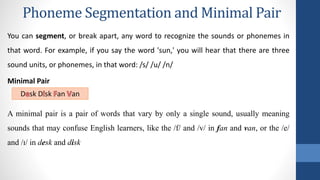
A minimal pair is a pair of words that vary by only a single sound, usually meaning
sounds that may confuse English learners, like the /f/ and /v/ in fan and van, or the /e/
and /ɪ/ in desk and disk
D sk D sk an an
Aspiration
Voiced stops are never aspirated.
Voiceless stops are sometimes aspirated and sometimes not.
These voiceless stops will be aspirated:
a. Word-initial, regardless of stress:
tap, cat, Topeka (stop precedes an unstressed vowel), command (ditto)
b. Intervocalic (between 2 vowels) but only when preceding a stressed vowel.
meticulous, repair, recalcitrant, return
These voiceless stops will be unaspirated:
a. Following /s/::: stop, skate, stick, stare, spike
b. Intervocalic, preceding an unstressed vowel :::::napping, camper, sicken, supper
(Note: Sometimes these are unaspirated, sometimes they are lightly aspirated.)
The two lips articulate together.
If the soft palate is raised, we
describe the sound as oral.
There are two oral bilabial
consonants in English: /p/ and /b/
P: pope b: barber
If the soft palate is low, we
describe the sound as nasal.
There is one bilabial nasal
consonant in English: /m/
M: mum
cengizcoban46@gmail.com
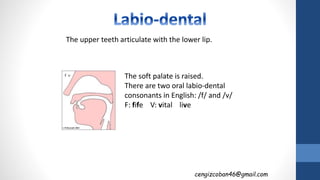
The soft palate is raised.
There are two oral labio-dental
consonants in English: /f/ and /v/
F: fife V: vital live
The upper teeth articulate with the lower lip.
cengizcoban46@gmail.com
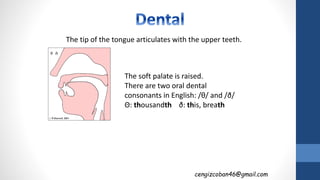
The tip of the tongue articulates with the upper teeth.
The soft palate is raised.
There are two oral dental
consonants in English: /θ/ and /ð/
Θ: thousandth ð: this, breath
cengizcoban46@gmail.com
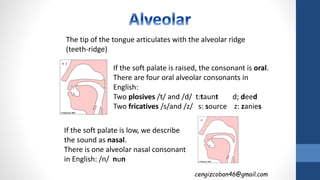
The tip of the tongue articulates with the alveolar ridge
(teeth-ridge)
If the soft palate is raised, the consonant is oral.
There are four oral alveolar consonants in
English:
Two plosives /t/ and /d/ t:taunt d; deed
Two fricatives /s/and /z/ s: source z: zanies
If the soft palate is low, we describe
the sound as nasal.
There is one alveolar nasal consonant
in English: /n/ nun
cengizcoban46@gmail.com
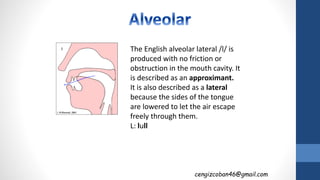
The English alveolar lateral /l/ is
produced with no friction or
obstruction in the mouth cavity. It
is described as an approximant.
It is also described as a lateral
because the sides of the tongue
are lowered to let the air escape
freely through them.
L: lull
cengizcoban46@gmail.com
The tip and blade of the tongue articulate with the back
part of the alveolar ridge (teeth-ridge)
The soft palate is raised, the consonant is oral.
There are four oral post-alveolar variants in
English:
The post-alveolar approximant: /r/
The voiced and voiceless post-alveolar fricatives:
[ɹ] and [ɹ̥]
The flap [ɾ] rare
cengizcoban46@gmail.com
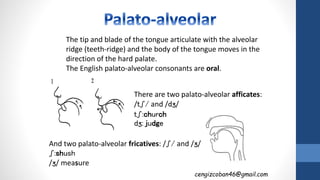
The tip and blade of the tongue articulate with the alveolar
ridge (teeth-ridge) and the body of the tongue moves in the
direction of the hard palate.
The English palato-alveolar consonants are oral.
There are two palato-alveolar afficates:
/tʃ/ and /dʒ/
tʃ:church
dʒ: judge
And two palato-alveolar fricatives: /ʃ/ and /ʒ/
ʃ:shush
/ʒ/ measure
cengizcoban46@gmail.com
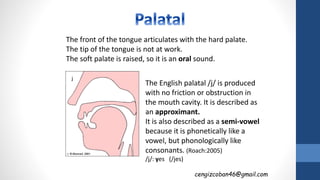
The front of the tongue articulates with the hard palate.
The tip of the tongue is not at work.
The soft palate is raised, so it is an oral sound.
The English palatal /j/ is produced
with no friction or obstruction in
the mouth cavity. It is described as
an approximant.
It is also described as a semi-vowel
because it is phonetically like a
vowel, but phonologically like
consonants. (Roach:2005)
/j/: yes (/jes)
cengizcoban46@gmail.com
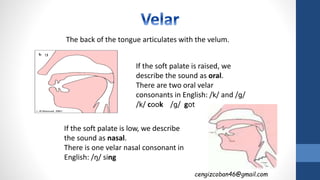
The back of the tongue articulates with the velum.
If the soft palate is raised, we
describe the sound as oral.
There are two oral velar
consonants in English: /k/ and /ɡ/
/k/ cook /ɡ/ got
If the soft palate is low, we describe
the sound as nasal.
There is one velar nasal consonant in
English: /ŋ/ sing
cengizcoban46@gmail.com
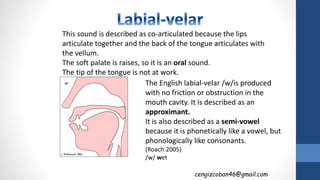
This sound is described as co-articulated because the lips
articulate together and the back of the tongue articulates with
the vellum.
The soft palate is raises, so it is an oral sound.
The tip of the tongue is not at work.
The English labial-velar /w/is produced
with no friction or obstruction in the
mouth cavity. It is described as an
approximant.
It is also described as a semi-vowel
because it is phonetically like a vowel, but
phonologically like consonants.
(Roach:2005)
/w/ wet
Syllables
Syllable is a unit of spoken language consisting of a single uninterrupted
sound.
Humans seem to need syllables as a way of segmenting the stream of
speech and giving it a rhythm of strong and weak beats.
Syllables exist only to make speech easier for the brain to process.
A word contains at least one syllable.
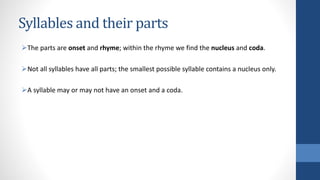
Syllables and their parts
The parts are onset and rhyme; within the rhyme we find the nucleus and coda.
Not all syllables have all parts; the smallest possible syllable contains a nucleus only.
A syllable may or may not have an onset and a coda.
Onset (O) and Rhyme (R)
• Onset: the beginning sounds of the syllable; the ones preceding the
nucleus.
• These are always consonants in English. The nucleus is a vowel in most
cases, although the consonants [ r ], [ l ], [ m ], [ n ], and the velar nasal
(the 'ng' sound) can also be the nucleus of a syllable.
• Rhyme (or rime): the rest of the syllable, after the onset (the underlined
portions of the words above). The rhyme can also be divided up:
Rhyme = nucleus + coda
Nucleus (N)
is the core or essential part of a syllable.
[ l ] and the nasals [ m n ] become syllable nuclei when they
follow an alveolar consonant in the last syllable of a word. This
happens in the relaxed or casual rather than very formal
articulation of the word. Compare casual vs. formal
pronunciations of 'button', 'bottle', 'bottom'.
Coda (C)
Coda is the ending sound of the syllable, the ones preceding
the nucleus.
 Onsets are strongly preferred over codas
Consonants in codas are weakened: think of what happens to
r in many English dialects (car [kaa] versus red). Coda
consonants are much longer.
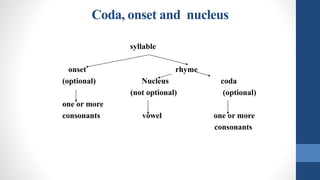
Coda, onset and nucleus
syllable
onset rhyme
(optional) Nucleus coda
(not optional) (optional)
one or more
consonants vowel one or more
consonants
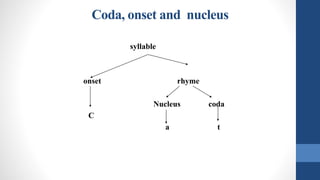
Coda, onset and nucleus
syllable
onset rhyme
Nucleus coda
C
a t
Phonological Processes
• When we combine words with affixes and other words to
form larger words and phrases.
(60)
a. Photograph [fÓutɒgrà:f]
b. Photography [fətɒɡrəfi]
c. Photographic [fÓutƏgrá:fik]
• The complex alternation between the of the word(60)
• /ou a ɒ ɑ:/ /ə/
• In Phonological Process, a Phonological rule is one sound is
changed into another sound under certain circumstances.
(61) /ou a ɒ ɑ:/ (when stress) [ə]
(62) / ə / (when stress) [ou a ɒ ɑ:]
(63)
a. Photograph [fÓutɒgrà:f]
b. Photography [fÓutɒɡrəfi]
c. Photographic [fÓutƏgrá:fik]
• Sound “o” represent /ou/ &/ɒ/, while “”ph” represent /f/.
• Underlying form(UR)
• Surface form (SR)
(64) //foutɒɡrɑ:fi// UR
Vowel reduction
ə ə
[fətɒɡrəfi] SR
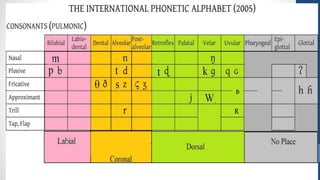
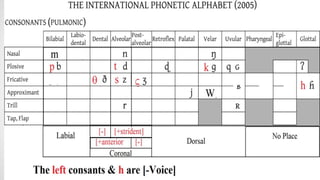
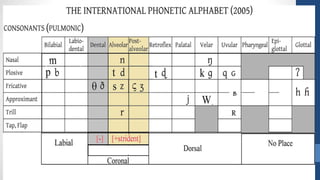
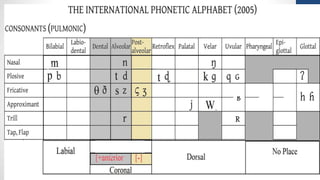
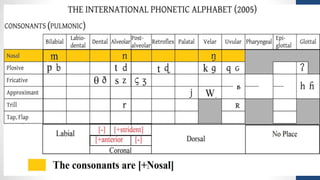
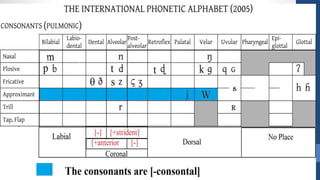
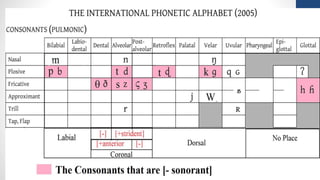
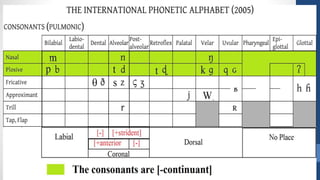
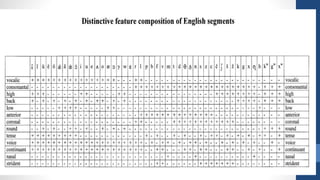
Phonological Feature
•IPA =International Phonetic Alphabet
•The voice sound /b d g v ð z ʒ ʤ/ are paired
with / p t k f ϴ s ʃ ʧ/.
•[- or +] will be indicated the feature of the Alphabet
which follow by the VERB.
•Vowels are [+syllabic]
•Consonants are [-syllabic]
•The place of consonants in the IPA(International
Phonetic Alphabet)
Labial = lips
Coronal = In front of the palate
Dorsal = On and behind the palate
Thank you
θænk jʊ

Phoneme (2)

  • 1.
    Phonemes, syllables andsyllabification WESTERN UNIVERSITY Cengiz COBAN, LIM Uykim Dr. Gloria Baguingan 2016-2017
  • 2.
    Phonemes A phoneme isa unit of sound in speech. A phoneme doesn't have any inherent meaning by itself, but when you put phonemes together, they can make words. Think of when adults try to get a baby to say his or her first word. They often coax him or her to sound out the beginning of a word by repeating that sound, or phoneme, over and over by saying something like, 'M, m, m' for 'Mommy.' The 'm' sound, often written as /m/,(mah)sound is an example of a phoneme.
  • 3.
    • There are44 phonemes in English (in the standard British model), each one representing a different sound a person can make. Since there are only 26 letters in the alphabet, sometimes letter combinations need to be used to make a phoneme. A letter can also represent different phonemes. (From A to Z)
  • 4.
    Phoneme Segmentation andMinimal Pair You can segment, or break apart, any word to recognize the sounds or phonemes in that word. For example, if you say the word 'sun,' you will hear that there are three sound units, or phonemes, in that word: /s/ /u/ /n/ Minimal Pair A minimal pair is a pair of words that vary by only a single sound, usually meaning sounds that may confuse English learners, like the /f/ and /v/ in fan and van, or the /e/ and /ɪ/ in desk and disk D sk D sk an an
  • 5.
    Aspiration Voiced stops arenever aspirated. Voiceless stops are sometimes aspirated and sometimes not. These voiceless stops will be aspirated: a. Word-initial, regardless of stress: tap, cat, Topeka (stop precedes an unstressed vowel), command (ditto) b. Intervocalic (between 2 vowels) but only when preceding a stressed vowel. meticulous, repair, recalcitrant, return These voiceless stops will be unaspirated: a. Following /s/::: stop, skate, stick, stare, spike b. Intervocalic, preceding an unstressed vowel :::::napping, camper, sicken, supper (Note: Sometimes these are unaspirated, sometimes they are lightly aspirated.)
  • 7.
    The two lipsarticulate together. If the soft palate is raised, we describe the sound as oral. There are two oral bilabial consonants in English: /p/ and /b/ P: pope b: barber If the soft palate is low, we describe the sound as nasal. There is one bilabial nasal consonant in English: /m/ M: mum cengizcoban46@gmail.com
  • 8.
    The soft palateis raised. There are two oral labio-dental consonants in English: /f/ and /v/ F: fife V: vital live The upper teeth articulate with the lower lip. cengizcoban46@gmail.com
  • 9.
    The tip ofthe tongue articulates with the upper teeth. The soft palate is raised. There are two oral dental consonants in English: /θ/ and /ð/ Θ: thousandth ð: this, breath cengizcoban46@gmail.com
  • 10.
    The tip ofthe tongue articulates with the alveolar ridge (teeth-ridge) If the soft palate is raised, the consonant is oral. There are four oral alveolar consonants in English: Two plosives /t/ and /d/ t:taunt d; deed Two fricatives /s/and /z/ s: source z: zanies If the soft palate is low, we describe the sound as nasal. There is one alveolar nasal consonant in English: /n/ nun cengizcoban46@gmail.com
  • 11.
    The English alveolarlateral /l/ is produced with no friction or obstruction in the mouth cavity. It is described as an approximant. It is also described as a lateral because the sides of the tongue are lowered to let the air escape freely through them. L: lull cengizcoban46@gmail.com
  • 12.
    cengizcoban46@gmail.com The tip andblade of the tongue articulate with the back part of the alveolar ridge (teeth-ridge) The soft palate is raised, the consonant is oral. There are four oral post-alveolar variants in English: The post-alveolar approximant: /r/ The voiced and voiceless post-alveolar fricatives: [ɹ] and [ɹ̥] The flap [ɾ] rare
  • 13.
    cengizcoban46@gmail.com The tip andblade of the tongue articulate with the alveolar ridge (teeth-ridge) and the body of the tongue moves in the direction of the hard palate. The English palato-alveolar consonants are oral. There are two palato-alveolar afficates: /tʃ/ and /dʒ/ tʃ:church dʒ: judge And two palato-alveolar fricatives: /ʃ/ and /ʒ/ ʃ:shush /ʒ/ measure
  • 14.
    cengizcoban46@gmail.com The front ofthe tongue articulates with the hard palate. The tip of the tongue is not at work. The soft palate is raised, so it is an oral sound. The English palatal /j/ is produced with no friction or obstruction in the mouth cavity. It is described as an approximant. It is also described as a semi-vowel because it is phonetically like a vowel, but phonologically like consonants. (Roach:2005) /j/: yes (/jes)
  • 15.
    cengizcoban46@gmail.com The back ofthe tongue articulates with the velum. If the soft palate is raised, we describe the sound as oral. There are two oral velar consonants in English: /k/ and /ɡ/ /k/ cook /ɡ/ got If the soft palate is low, we describe the sound as nasal. There is one velar nasal consonant in English: /ŋ/ sing
  • 16.
    cengizcoban46@gmail.com This sound isdescribed as co-articulated because the lips articulate together and the back of the tongue articulates with the vellum. The soft palate is raises, so it is an oral sound. The tip of the tongue is not at work. The English labial-velar /w/is produced with no friction or obstruction in the mouth cavity. It is described as an approximant. It is also described as a semi-vowel because it is phonetically like a vowel, but phonologically like consonants. (Roach:2005) /w/ wet
  • 17.
    Syllables Syllable is aunit of spoken language consisting of a single uninterrupted sound. Humans seem to need syllables as a way of segmenting the stream of speech and giving it a rhythm of strong and weak beats. Syllables exist only to make speech easier for the brain to process. A word contains at least one syllable.
  • 18.
    Syllables and theirparts The parts are onset and rhyme; within the rhyme we find the nucleus and coda. Not all syllables have all parts; the smallest possible syllable contains a nucleus only. A syllable may or may not have an onset and a coda.
  • 19.
    Onset (O) andRhyme (R) • Onset: the beginning sounds of the syllable; the ones preceding the nucleus. • These are always consonants in English. The nucleus is a vowel in most cases, although the consonants [ r ], [ l ], [ m ], [ n ], and the velar nasal (the 'ng' sound) can also be the nucleus of a syllable. • Rhyme (or rime): the rest of the syllable, after the onset (the underlined portions of the words above). The rhyme can also be divided up: Rhyme = nucleus + coda
  • 20.
    Nucleus (N) is thecore or essential part of a syllable. [ l ] and the nasals [ m n ] become syllable nuclei when they follow an alveolar consonant in the last syllable of a word. This happens in the relaxed or casual rather than very formal articulation of the word. Compare casual vs. formal pronunciations of 'button', 'bottle', 'bottom'.
  • 21.
    Coda (C) Coda isthe ending sound of the syllable, the ones preceding the nucleus.  Onsets are strongly preferred over codas Consonants in codas are weakened: think of what happens to r in many English dialects (car [kaa] versus red). Coda consonants are much longer.
  • 22.
    Coda, onset andnucleus syllable onset rhyme (optional) Nucleus coda (not optional) (optional) one or more consonants vowel one or more consonants
  • 23.
    Coda, onset andnucleus syllable onset rhyme Nucleus coda C a t
  • 24.
    Phonological Processes • Whenwe combine words with affixes and other words to form larger words and phrases. (60) a. Photograph [fÓutɒgrà:f] b. Photography [fətɒɡrəfi] c. Photographic [fÓutƏgrá:fik]
  • 25.
    • The complexalternation between the of the word(60) • /ou a ɒ ɑ:/ /ə/ • In Phonological Process, a Phonological rule is one sound is changed into another sound under certain circumstances. (61) /ou a ɒ ɑ:/ (when stress) [ə] (62) / ə / (when stress) [ou a ɒ ɑ:]
  • 26.
    (63) a. Photograph [fÓutɒgrà:f] b.Photography [fÓutɒɡrəfi] c. Photographic [fÓutƏgrá:fik] • Sound “o” represent /ou/ &/ɒ/, while “”ph” represent /f/. • Underlying form(UR) • Surface form (SR)
  • 27.
    (64) //foutɒɡrɑ:fi// UR Vowelreduction ə ə [fətɒɡrəfi] SR
  • 28.
    Phonological Feature •IPA =InternationalPhonetic Alphabet •The voice sound /b d g v ð z ʒ ʤ/ are paired with / p t k f ϴ s ʃ ʧ/. •[- or +] will be indicated the feature of the Alphabet which follow by the VERB.
  • 29.
    •Vowels are [+syllabic] •Consonantsare [-syllabic] •The place of consonants in the IPA(International Phonetic Alphabet) Labial = lips Coronal = In front of the palate Dorsal = On and behind the palate
  • 39.