Intro to Stress Emphasis on syllables
What is stress? Speakers learning English often stress every syllable in a word. English words can be short or long, but each word only has ONE major stress. Example: WINner, CongratuLAtions Make the stressed part Looonger and LOUDER. Make the unstressed part  shorter  and  quieter .
Unstressed Vowels Pay close attention to the vowels  a, e, I, o,  and  u  in the following: atlas, college, tulip, anchor, lettuce How are the second vowels in each word pronounced differently from the first? shorter and quieter  And… it sounds like a different vowel sound
Practice Find a partner.  Take turns reading the following words to each other. Your partner should try to guess which vowel is reduced to schwa in each word. A: distant, illness, cousin, purpose, minute B: palace, socket, promise, ribbon, circus A: advice, escape, disease, offend, suggest B: canoe, dessert, divide, contain, subtract
Think about it Look back again at the words you just practiced saying.  Can you make a rule for which vowel changes to “schwa”? The vowels in the unstressed syllables!
Say Hello! to “Schwa” In general, unstressed vowels are reduced to “schwa” / ´ / That makes “schwa” the most frequently used vowel sound in English! Being able to pronounce “schwa” correctly not only effects the way individual words sound, but also the rhythm of the entire sentence.
Exception Do  all  unstressed vowels reduce to “schwa”? Consider the following:  athlete, contact, celebrate, telephone The answer, unfortunately, is no. Some unstressed syllables receive a little bit of stress, we call this  minor  stress The vowels in these syllables their original pronunciation (but are still softer and shorter)
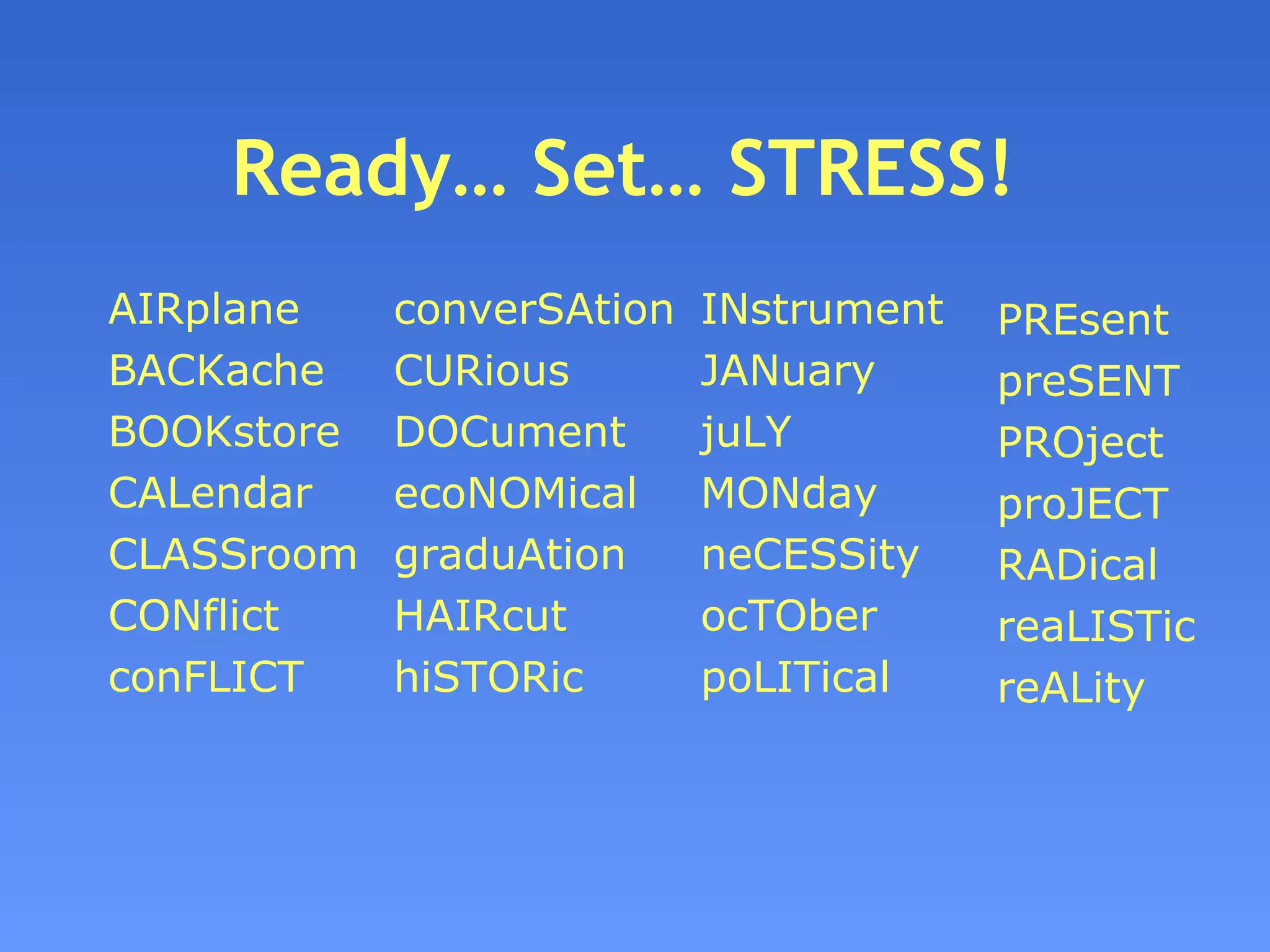
Ready… Set… STRESS!  AIRplane BACKache BOOKstore CALendar CLASSroom CONflict conFLICT converSAtion CURious DOCument ecoNOMical graduAtion HAIRcut hiSTORic INstrument JANuary juLY MONday neCESSity ocTOber poLITical PREsent preSENT PROject proJECT RADical reaLISTic reALity
Where’s the stress? How can you tell where to put the stress on unfamiliar words? There’s no rule that applies all the time… but there are some patterns we can pay attention to
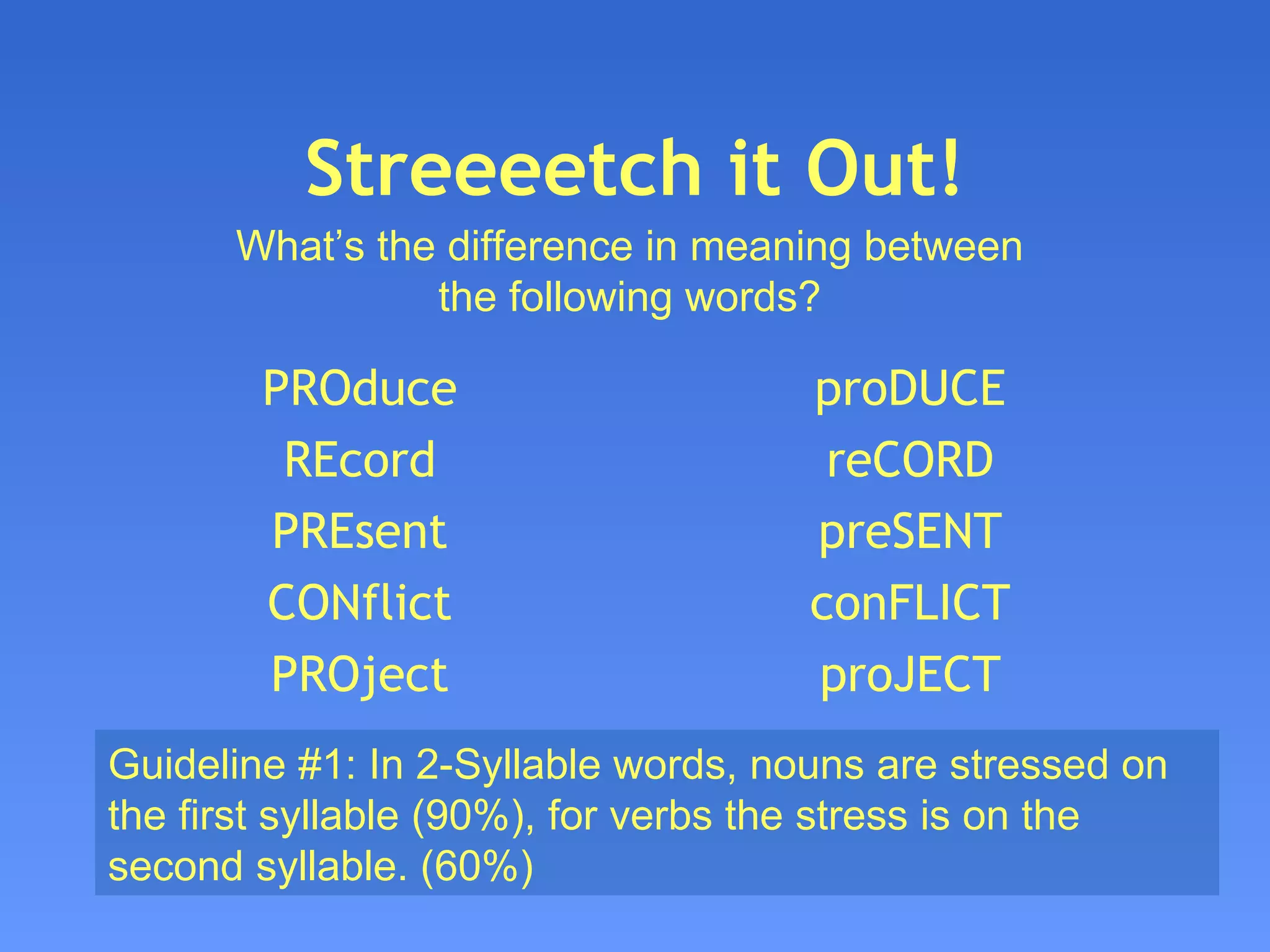
Streeeetch it Out! PROduce REcord PREsent CONflict PROject proDUCE reCORD preSENT conFLICT proJECT Guideline #1: In 2-Syllable words, nouns are stressed on the first syllable (90%), for verbs the stress is on the second syllable. (60%) What’s the difference in meaning between the following words?
Clap your Hands! instrument calendar curious sentiment document commercial vanilla develop astonish opponent Guideline #2: In 3-syllable words, major stress is often on the first or second syllable.  If the major stress in on the first syllable, then the third often gets minor stress. How many syllables does each of these words have? Which syllables are stressed? hurricane appetite crocodile congregate favorite 1st Syllable 2nd Syllable 1st + Minor 3rd
Nod your Head! airplane armchair backache bookstore classroom bedtime birthplace haircut hair-style gold mine Guideline #3: In Compound words, the first word receives major stress, and the second word receives minor stress. Where is the stress? What else do all these words have in common?
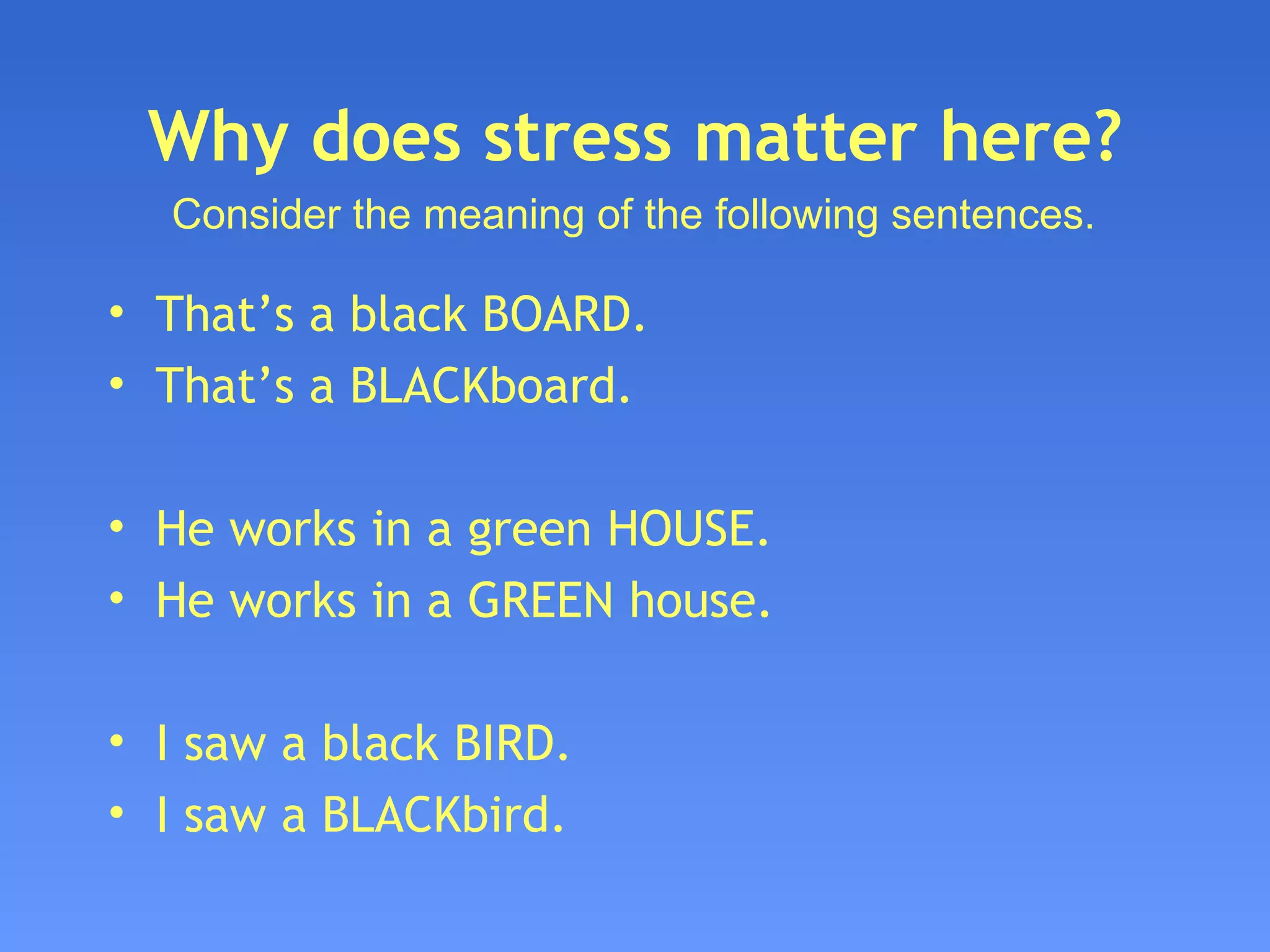
Why does stress matter here? That’s a black BOARD. That’s a BLACKboard. He works in a green HOUSE. He works in a GREEN house. I saw a black BIRD. I saw a BLACKbird. Consider the meaning of the following sentences.
Tap your Desk! Photograph photography photographic Democrat democracy democratic Aristocrat aristocracy aristocratic Diplomat diplomacy diplomatic Guideline #4: Suffixes change the placement of stress in related words.  Major stress  always  falls on the last syllable before these suffixes: -ic, -ity, -ical, -tion Where is the stress in the following words? Why does the stress move?
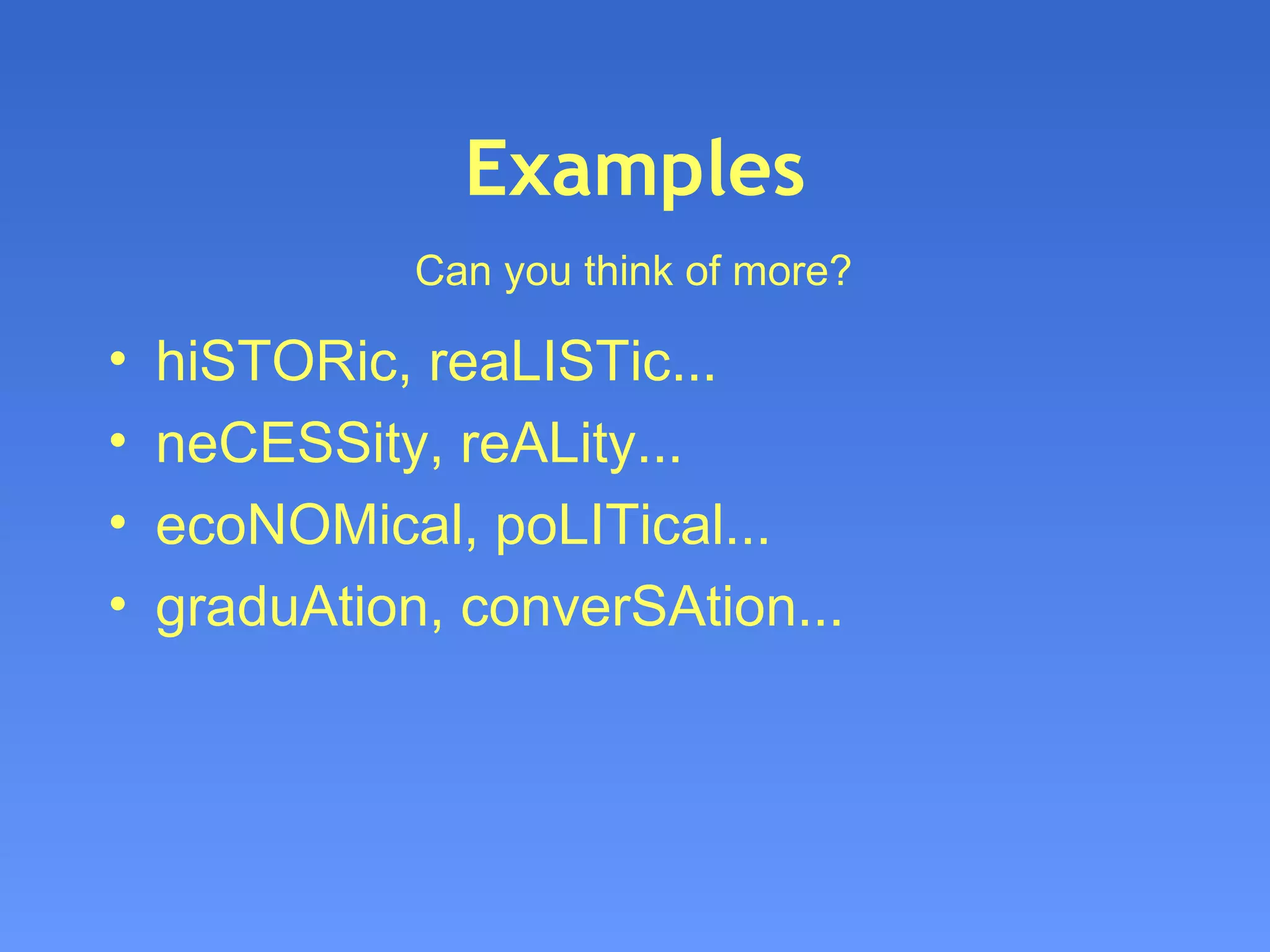
Examples hiSTORic, reaLISTic... neCESSity, reALity... ecoNOMical, poLITical... graduAtion, converSAtion... Can you think of more?

03 word stress

  • 1.
    Intro to StressEmphasis on syllables
  • 2.
    What is stress?Speakers learning English often stress every syllable in a word. English words can be short or long, but each word only has ONE major stress. Example: WINner, CongratuLAtions Make the stressed part Looonger and LOUDER. Make the unstressed part shorter and quieter .
  • 3.
    Unstressed Vowels Payclose attention to the vowels a, e, I, o, and u in the following: atlas, college, tulip, anchor, lettuce How are the second vowels in each word pronounced differently from the first? shorter and quieter And… it sounds like a different vowel sound
  • 4.
    Practice Find apartner. Take turns reading the following words to each other. Your partner should try to guess which vowel is reduced to schwa in each word. A: distant, illness, cousin, purpose, minute B: palace, socket, promise, ribbon, circus A: advice, escape, disease, offend, suggest B: canoe, dessert, divide, contain, subtract
  • 5.
    Think about itLook back again at the words you just practiced saying. Can you make a rule for which vowel changes to “schwa”? The vowels in the unstressed syllables!
  • 6.
    Say Hello! to“Schwa” In general, unstressed vowels are reduced to “schwa” / ´ / That makes “schwa” the most frequently used vowel sound in English! Being able to pronounce “schwa” correctly not only effects the way individual words sound, but also the rhythm of the entire sentence.
  • 7.
    Exception Do all unstressed vowels reduce to “schwa”? Consider the following: athlete, contact, celebrate, telephone The answer, unfortunately, is no. Some unstressed syllables receive a little bit of stress, we call this minor stress The vowels in these syllables their original pronunciation (but are still softer and shorter)
  • 8.
    Ready… Set… STRESS! AIRplane BACKache BOOKstore CALendar CLASSroom CONflict conFLICT converSAtion CURious DOCument ecoNOMical graduAtion HAIRcut hiSTORic INstrument JANuary juLY MONday neCESSity ocTOber poLITical PREsent preSENT PROject proJECT RADical reaLISTic reALity
  • 9.
    Where’s the stress?How can you tell where to put the stress on unfamiliar words? There’s no rule that applies all the time… but there are some patterns we can pay attention to
  • 10.
    Streeeetch it Out!PROduce REcord PREsent CONflict PROject proDUCE reCORD preSENT conFLICT proJECT Guideline #1: In 2-Syllable words, nouns are stressed on the first syllable (90%), for verbs the stress is on the second syllable. (60%) What’s the difference in meaning between the following words?
  • 11.
    Clap your Hands!instrument calendar curious sentiment document commercial vanilla develop astonish opponent Guideline #2: In 3-syllable words, major stress is often on the first or second syllable. If the major stress in on the first syllable, then the third often gets minor stress. How many syllables does each of these words have? Which syllables are stressed? hurricane appetite crocodile congregate favorite 1st Syllable 2nd Syllable 1st + Minor 3rd
  • 12.
    Nod your Head!airplane armchair backache bookstore classroom bedtime birthplace haircut hair-style gold mine Guideline #3: In Compound words, the first word receives major stress, and the second word receives minor stress. Where is the stress? What else do all these words have in common?
  • 13.
    Why does stressmatter here? That’s a black BOARD. That’s a BLACKboard. He works in a green HOUSE. He works in a GREEN house. I saw a black BIRD. I saw a BLACKbird. Consider the meaning of the following sentences.
  • 14.
    Tap your Desk!Photograph photography photographic Democrat democracy democratic Aristocrat aristocracy aristocratic Diplomat diplomacy diplomatic Guideline #4: Suffixes change the placement of stress in related words. Major stress always falls on the last syllable before these suffixes: -ic, -ity, -ical, -tion Where is the stress in the following words? Why does the stress move?
  • 15.
    Examples hiSTORic, reaLISTic...neCESSity, reALity... ecoNOMical, poLITical... graduAtion, converSAtion... Can you think of more?