Diphthongs
Diphthongs consist of a movement or glide from one vowel to another. A vowel
that remains constant and does not glide is called a pure vowel, and one of the
most common pronunciation mistakes that result in a learner of English having
a “foreign” accent is the production of pure vowels where a diphthong should
be pronounced.
In terms of length, diphthongs are like the long vowels described before. It is
very important to remember that in all diphthongs the first part is much longer
and stronger than the second part. For example, the diphthong /aI/ (as in the
words “eye”, “I”) consists of the /a/ vowel, and only in the last quarter of the
diphthong the glide to /I/ becomes noticeable. As the glide to /I/ happens, the
loudness of the sound decreases. As a result, the /I/ part is shorter and quieter.
In English there are eight diphthongs, that are basically vowels that begin in
one place and move towards another. So far we have only been considering
vowels that were constant; that is, vowels that were pronounced at one and
the same place. Such vowels are called monophthongs.
Compare for example the monophthong in car with the diphthong in cow, or
the monophthong in girl with the diphthong in goal. The vowels of cow and
goal both begin at a given place and glide towards another one . In goal the
vowel begins as if it was /ə/, but then it moves towards /ʊ /.
Therefore it is written /əʊ/, as in /ɡəʊl/ goal, with two symbols, one for how it
starts and one for how it ends.
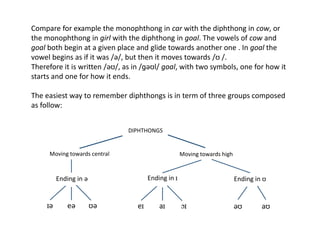
The easiest way to remember diphthongs is in term of three groups composed
as follow:
Iə eə ʊə eI aI ɔI əʊ aʊ
Ending in ə Ending in I Ending in ʊ
Moving towards central Moving towards high
DIPHTHONGS
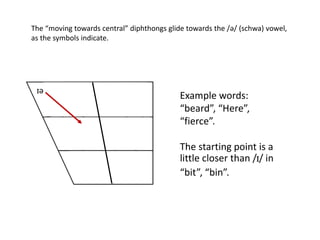
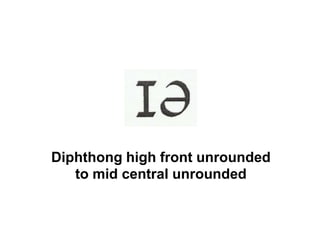
The “moving towards central” diphthongs glide towards the /ə/ (schwa) vowel,
as the symbols indicate.
Example words:
“beard”, “Here”,
“fierce”.
The starting point is a
little closer than /I/ in
“bit”, “bin”.
Iə
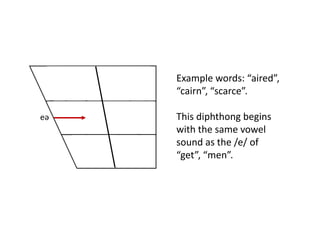
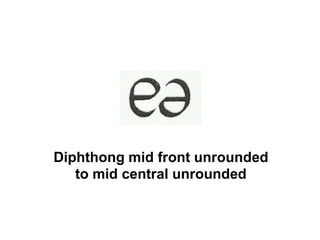
eə
Example words: “aired”,
“cairn”, “scarce”.
This diphthong begins
with the same vowel
sound as the /e/ of
“get”, “men”.
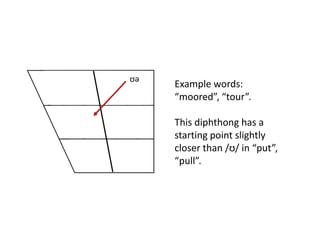
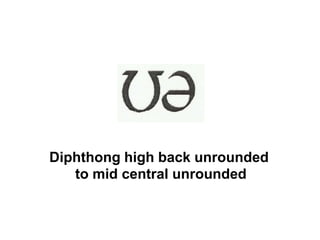
Example words:
“moored”, “tour”.
This diphthong has a
starting point slightly
closer than /ʊ/ in “put”,
“pull”.
ʊə
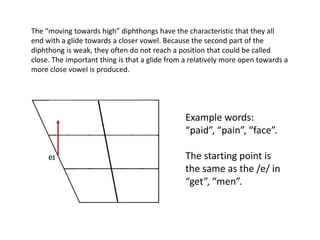
The “moving towards high” diphthongs have the characteristic that they all
end with a glide towards a closer vowel. Because the second part of the
diphthong is weak, they often do not reach a position that could be called
close. The important thing is that a glide from a relatively more open towards a
more close vowel is produced.
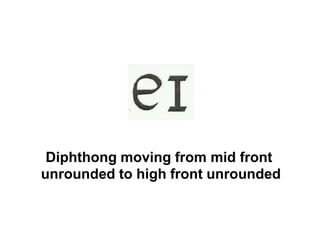
eI
Example words:
“paid”, “pain”, “face”.
The starting point is
the same as the /e/ in
“get”, “men”.
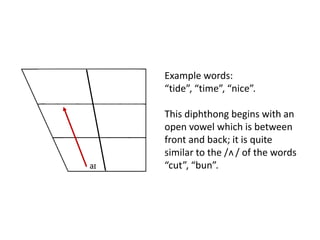
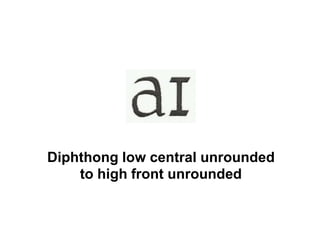
aI
Example words:
“tide”, “time”, “nice”.
This diphthong begins with an
open vowel which is between
front and back; it is quite
similar to the / / of the words
“cut”, “bun”.
v
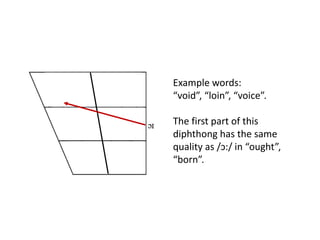
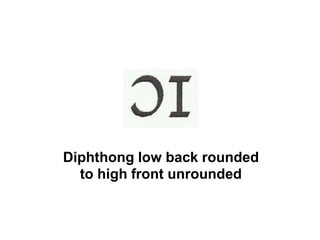
ɔI
Example words:
“void”, “loin”, “voice”.
The first part of this
diphthong has the same
quality as /ɔ:/ in “ought”,
“born”.
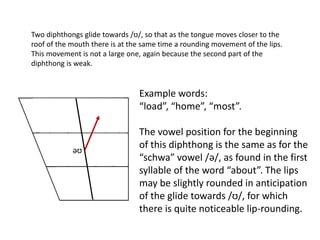
Two diphthongs glide towards /ʊ/, so that as the tongue moves closer to the
roof of the mouth there is at the same time a rounding movement of the lips.
This movement is not a large one, again because the second part of the
diphthong is weak.
Example words:
“load”, “home”, “most”.
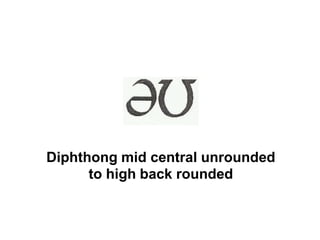
The vowel position for the beginning
of this diphthong is the same as for the
“schwa” vowel /ə/, as found in the first
syllable of the word “about”. The lips
may be slightly rounded in anticipation
of the glide towards /ʊ/, for which
there is quite noticeable lip-rounding.
əʊ
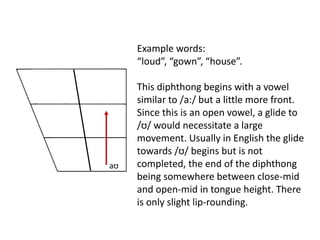
Example words:
“loud”, “gown”, “house”.
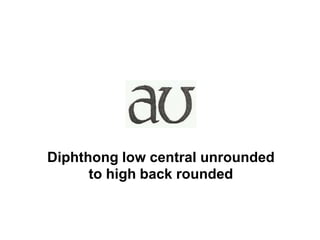
This diphthong begins with a vowel
similar to /a:/ but a little more front.
Since this is an open vowel, a glide to
/ʊ/ would necessitate a large
movement. Usually in English the glide
towards /ʊ/ begins but is not
completed, the end of the diphthong
being somewhere between close-mid
and open-mid in tongue height. There
is only slight lip-rounding.
aʊ
To finish this chapter, let’s take
a look at a summary on how
diphthongs are produced
according to tongue position.
Diphthong high front unrounded
to mid central unrounded
Diphthong mid front unrounded
to mid central unrounded
Diphthong high back unrounded
to mid central unrounded
Diphthong moving from mid front
unrounded to high front unrounded
Diphthong low central unrounded
to high front unrounded
Diphthong low back rounded
to high front unrounded
Diphthong mid central unrounded
to high back rounded
Diphthong low central unrounded
to high back rounded
*Theoretical ground taken from: Forel, A and Puskás, G (2005)
Phonetics and Phonology: Reader for First Year English
Linguistics. University of Geneva, and Roach, P (1998) English
Phonetics and Phonology: A Practical Course. Second Edition,
Cambridge University Press.
*Presentation designed by: Manuel R. Medina (2014)

Diphthongs

  • 1.
    Diphthongs Diphthongs consist ofa movement or glide from one vowel to another. A vowel that remains constant and does not glide is called a pure vowel, and one of the most common pronunciation mistakes that result in a learner of English having a “foreign” accent is the production of pure vowels where a diphthong should be pronounced. In terms of length, diphthongs are like the long vowels described before. It is very important to remember that in all diphthongs the first part is much longer and stronger than the second part. For example, the diphthong /aI/ (as in the words “eye”, “I”) consists of the /a/ vowel, and only in the last quarter of the diphthong the glide to /I/ becomes noticeable. As the glide to /I/ happens, the loudness of the sound decreases. As a result, the /I/ part is shorter and quieter. In English there are eight diphthongs, that are basically vowels that begin in one place and move towards another. So far we have only been considering vowels that were constant; that is, vowels that were pronounced at one and the same place. Such vowels are called monophthongs.
  • 2.
    Compare for examplethe monophthong in car with the diphthong in cow, or the monophthong in girl with the diphthong in goal. The vowels of cow and goal both begin at a given place and glide towards another one . In goal the vowel begins as if it was /ə/, but then it moves towards /ʊ /. Therefore it is written /əʊ/, as in /ɡəʊl/ goal, with two symbols, one for how it starts and one for how it ends. The easiest way to remember diphthongs is in term of three groups composed as follow: Iə eə ʊə eI aI ɔI əʊ aʊ Ending in ə Ending in I Ending in ʊ Moving towards central Moving towards high DIPHTHONGS
  • 3.
    The “moving towardscentral” diphthongs glide towards the /ə/ (schwa) vowel, as the symbols indicate. Example words: “beard”, “Here”, “fierce”. The starting point is a little closer than /I/ in “bit”, “bin”. Iə
  • 4.
    eə Example words: “aired”, “cairn”,“scarce”. This diphthong begins with the same vowel sound as the /e/ of “get”, “men”.
  • 5.
    Example words: “moored”, “tour”. Thisdiphthong has a starting point slightly closer than /ʊ/ in “put”, “pull”. ʊə
  • 6.
    The “moving towardshigh” diphthongs have the characteristic that they all end with a glide towards a closer vowel. Because the second part of the diphthong is weak, they often do not reach a position that could be called close. The important thing is that a glide from a relatively more open towards a more close vowel is produced. eI Example words: “paid”, “pain”, “face”. The starting point is the same as the /e/ in “get”, “men”.
  • 7.
    aI Example words: “tide”, “time”,“nice”. This diphthong begins with an open vowel which is between front and back; it is quite similar to the / / of the words “cut”, “bun”. v
  • 8.
    ɔI Example words: “void”, “loin”,“voice”. The first part of this diphthong has the same quality as /ɔ:/ in “ought”, “born”.
  • 9.
    Two diphthongs glidetowards /ʊ/, so that as the tongue moves closer to the roof of the mouth there is at the same time a rounding movement of the lips. This movement is not a large one, again because the second part of the diphthong is weak. Example words: “load”, “home”, “most”. The vowel position for the beginning of this diphthong is the same as for the “schwa” vowel /ə/, as found in the first syllable of the word “about”. The lips may be slightly rounded in anticipation of the glide towards /ʊ/, for which there is quite noticeable lip-rounding. əʊ
  • 10.
    Example words: “loud”, “gown”,“house”. This diphthong begins with a vowel similar to /a:/ but a little more front. Since this is an open vowel, a glide to /ʊ/ would necessitate a large movement. Usually in English the glide towards /ʊ/ begins but is not completed, the end of the diphthong being somewhere between close-mid and open-mid in tongue height. There is only slight lip-rounding. aʊ
  • 11.
    To finish thischapter, let’s take a look at a summary on how diphthongs are produced according to tongue position.
  • 12.
    Diphthong high frontunrounded to mid central unrounded
  • 13.
    Diphthong mid frontunrounded to mid central unrounded
  • 14.
    Diphthong high backunrounded to mid central unrounded
  • 15.
    Diphthong moving frommid front unrounded to high front unrounded
  • 16.
    Diphthong low centralunrounded to high front unrounded
  • 17.
    Diphthong low backrounded to high front unrounded
  • 18.
    Diphthong mid centralunrounded to high back rounded
  • 19.
    Diphthong low centralunrounded to high back rounded
  • 20.
    *Theoretical ground takenfrom: Forel, A and Puskás, G (2005) Phonetics and Phonology: Reader for First Year English Linguistics. University of Geneva, and Roach, P (1998) English Phonetics and Phonology: A Practical Course. Second Edition, Cambridge University Press. *Presentation designed by: Manuel R. Medina (2014)