By :
Imas Suwangsih
Mala Purnamasari
Rd. Zaenal
 phoneme:

“a basic sound unit of a language”
o allophone(s):
the phonetic variant(s) of a phoneme
 So, each phoneme comprises a set of
allophone, and each allophone is particular
realisation of phoneme in a particular
linguistics environment
 PHONEMES

are the basic sounds - the
significant , non-predictable ones.

 The

different ways the phonemes are
realised in various positions are called
ALLOPHONES - predictable, and nonsignificant.
Different language can have the same sound and
yet organise them differently in their sound
system.
For example :
1). The phoneme /p/ of English has two allophones.
 English speakers treat them as the same sound,
but they are different:
the first the second is unaspirated (plain). is
aspirated and
Plain [p] also occurs as the p in cap [kʰæp], and
the second p in paper [pʰeɪ.pɚ]


One, (ph), has a puff of air after the lips
open, and occurs at the beginnings of words
such as "pit". The other, (p), does not have a
puff of air, and occurs after second word
such as in "spit".
We can see from the other language

2). In Chinese languages treat these two phones
differently;
for example :
in Mandarin, [p] (written b in Pinyin) and [pʰ]
(written p).
English has there phonemes at the bilabial position.
 For instance, the phone [ph] and [b] occur in the
ninimal pair park [phark] versus bark [bak], And the
bilabial nasal [m] in mark [mak].
 They must, therefore, be allophone (variant) of
different phonemes. So we nkow that there are at least
there bilabial phoneme in english, and we have been
able to show that the differences between [ph b m]
contain significant information for speaker of that
language.
Usually, the different ALLOPHONES of
the same PHONEME are all similar to
each other - they form a FAMILY of
sounds.
We can see this by the fact that the
same difference can be allophonic in one
language, and phonemic in another.




We say that allophones have
complementary distribution

In English, s and sh are phonemes, and so
have contrastive distribution.
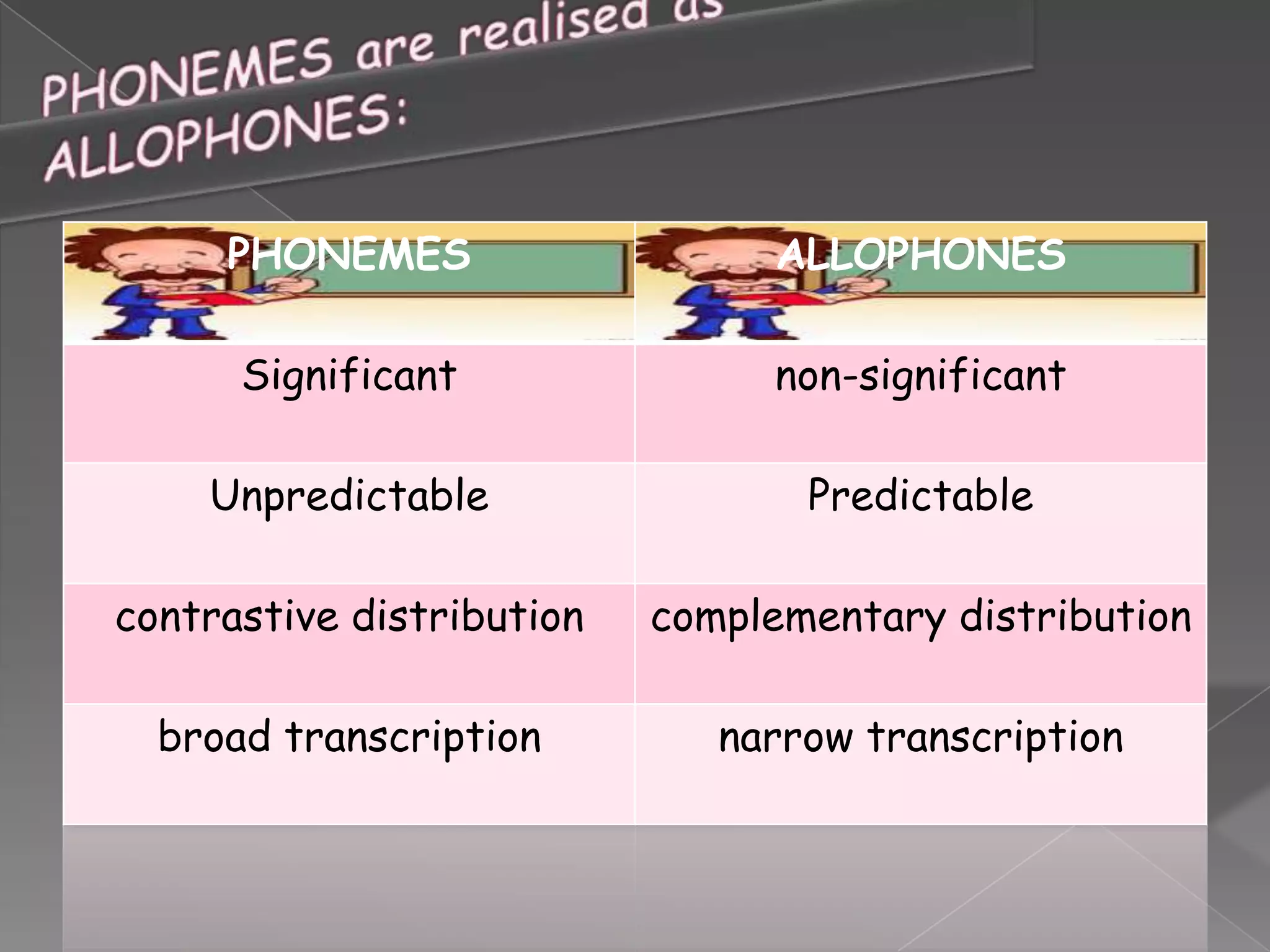
PHONEMES

ALLOPHONES

Significant

non-significant

Unpredictable

Predictable

contrastive distribution

complementary distribution

broad transcription

narrow transcription
Allophone and phoneme. persentation

Allophone and phoneme. persentation

  • 1.
    By : Imas Suwangsih MalaPurnamasari Rd. Zaenal
  • 2.
     phoneme: “a basicsound unit of a language” o allophone(s): the phonetic variant(s) of a phoneme  So, each phoneme comprises a set of allophone, and each allophone is particular realisation of phoneme in a particular linguistics environment
  • 3.
     PHONEMES are thebasic sounds - the significant , non-predictable ones.  The different ways the phonemes are realised in various positions are called ALLOPHONES - predictable, and nonsignificant.
  • 4.
    Different language canhave the same sound and yet organise them differently in their sound system. For example : 1). The phoneme /p/ of English has two allophones.  English speakers treat them as the same sound, but they are different: the first the second is unaspirated (plain). is aspirated and Plain [p] also occurs as the p in cap [kʰæp], and the second p in paper [pʰeɪ.pɚ]
  • 5.
     One, (ph), hasa puff of air after the lips open, and occurs at the beginnings of words such as "pit". The other, (p), does not have a puff of air, and occurs after second word such as in "spit".
  • 6.
    We can seefrom the other language 2). In Chinese languages treat these two phones differently; for example : in Mandarin, [p] (written b in Pinyin) and [pʰ] (written p).
  • 7.
    English has therephonemes at the bilabial position.  For instance, the phone [ph] and [b] occur in the ninimal pair park [phark] versus bark [bak], And the bilabial nasal [m] in mark [mak].  They must, therefore, be allophone (variant) of different phonemes. So we nkow that there are at least there bilabial phoneme in english, and we have been able to show that the differences between [ph b m] contain significant information for speaker of that language.
  • 8.
    Usually, the differentALLOPHONES of the same PHONEME are all similar to each other - they form a FAMILY of sounds. We can see this by the fact that the same difference can be allophonic in one language, and phonemic in another.
  • 9.
      We say thatallophones have complementary distribution In English, s and sh are phonemes, and so have contrastive distribution.
  • 10.