SYLLABLE IN PHONOLOGY

By: yahya choy
• Words can be cut up into units called syllables.


• Syllable is a unit of spoken language consisting of a
 single uninterrupted sound.

• Humans seem to need syllables as a way of segmenting
 the stream of speech and giving it a rhythm of strong and
 weak beats.

• Syllables exist only to make speech easier for the brain to
 process.

• A word contains at least one syllable.
Determine how many syllables are in the following
words:

 • Emily
 • Trevor
 • Suzy
 • Restroom
 • Recess
 • Book
 • Environment
Syllables and their parts
• The parts are onset and rhyme; within the rhyme
 we find the nucleus and coda.

• Not all syllables have all parts; the smallest
 possible syllable contains a nucleus only.

• A syllable may or may not have an onset and a
 coda.
Onset (O)
• Onset: the beginning sounds of the syllable; the
  ones preceding the nucleus.
• These are always consonants in English. The
  nucleus is a vowel in most cases, although the
  consonants [ r ], [ l ], [ m ], [ n ], and the velar
  nasal (the 'ng' sound) can also be the nucleus of
  a syllable.
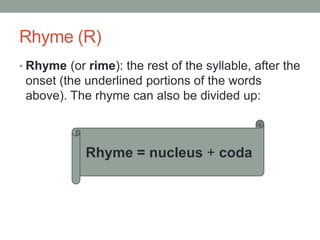
Rhyme (R)
• Rhyme (or rime): the rest of the syllable, after the
 onset (the underlined portions of the words
 above). The rhyme can also be divided up:


            Rhyme = nucleus + coda
Nucleus (N)
• is the core or essential part of a syllable. A
  nucleus must be present in order for a syllable to
  be present.
• In English and most other languages, most
  syllable nuclei are vowels.
• The English liquids [ r l ] and the nasals [ m n ]
  can be the nuclei of syllables under certain
  conditions. [ r ] can be a nucleus as easily as a
  vowel, in any position: the words 'bird', have [ r ]
  as the nucleus; in other words, there is no vowel
  in the pronunciation of these syllables, even
  though they have one in the spelling.
    [brd]
• [ l ] and the nasals [ m n ] become syllable nuclei

 when they follow an alveolar consonant in the last
 syllable of a word. This happens in the relaxed or
 casual rather than very formal articulation of the
 word. Compare casual vs. formal pronunciations
 of 'button', 'bottle', 'bottom'.
• Coda (C)
• Coda is the ending sound of the syllable, the
  ones preceding the nucleus.
• These are always consonants in English.
• Onsets are strongly preferred over codas
• Consonants in codas are weakened: think of what
  happens to r in many English dialects (car [kaa]
  versus red). Coda consonants are much longer.
  They affect stress patterns.
• Linguists often use tree diagrams to illustrate
  syllable structure. 'Flop', for example, would look
  like this (the word appears in IPA symbols, not
  English spelling). 's' = 'syllable'; 'O' = 'onset'; 'R' =
  'rhyme'; 'N' = 'nucleus'; 'C' = 'coda'.
• The syllable node at the top of the tree branches
  into Onset and Rhyme; the Onset node branches
  because it contains two consonants, [ f ] and [ l ].
  The Rhyme node branches because this syllable
  has both a nucleus and a coda.
•         σ
      /   
     O    R
     /  / 
     | | NC
     | | | |
    [f l a p]
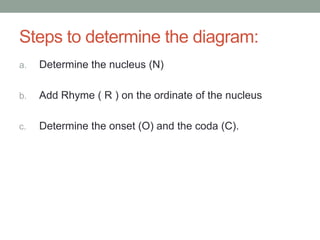
Steps to determine the diagram:
a.   Determine the nucleus (N)

b.   Add Rhyme ( R ) on the ordinate of the nucleus

c.   Determine the onset (O) and the coda (C).
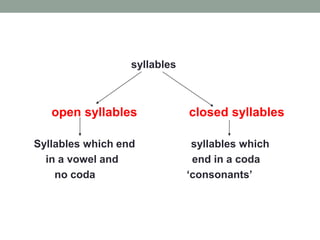
If a syllable has the coda, it is called as closed syllable
     Example : cap, sit, man

If a syllable doesn’t have the coda it is called as open
syllable.
    Example : he, she, me
Draw, the syllable structure of the
following words:
apron
basic
began
begin
depend
even
hotel
Syllables and Clusters
• A syllable must contain a vowel or a vowel-like sound.


• The most common type of syllable in a language has a
 consonant as well.

• When describing syllables:
 C = consonant
 V = vowel
Coda, onset and nucleus

                syllable

  onset                   rhyme
(optional)        Nucleus       coda
               (not optional)   (optional)
one or more
consonants      vowel         one or more
                               consonants
syllables


   open syllables             closed syllables

Syllables which end            syllables which
  in a vowel and               end in a coda
    no coda                   ‘consonants’
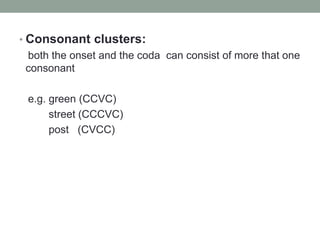
• Consonant clusters:
  both the onset and the coda can consist of more that one
  consonant

 e.g. green (CCVC)
      street (CCCVC)
      post (CVCC)
Syllabic consonants
• Sometimes when a vowel is elided a consonant
  can become a syllabic nucleus.
• Only a consonant in the coda can become a
  syllabic nucleus.
• Only the following actual consonants can become
  syllabic nuclei:
 • /l m n/
Syllables and stress
• Some syllables are more prominent than others.


• These are termed ‘stressed’ syllables.


• Stress is related to the location of a syllable in a word.
Exercise
Which is the stressed syllable in the following words?
 income
 stupid
 induce
 Phantom

Syllable in phonology

  • 1.
  • 2.
    • Words canbe cut up into units called syllables. • Syllable is a unit of spoken language consisting of a single uninterrupted sound. • Humans seem to need syllables as a way of segmenting the stream of speech and giving it a rhythm of strong and weak beats. • Syllables exist only to make speech easier for the brain to process. • A word contains at least one syllable.
  • 3.
    Determine how manysyllables are in the following words: • Emily • Trevor • Suzy • Restroom • Recess • Book • Environment
  • 4.
    Syllables and theirparts • The parts are onset and rhyme; within the rhyme we find the nucleus and coda. • Not all syllables have all parts; the smallest possible syllable contains a nucleus only. • A syllable may or may not have an onset and a coda.
  • 5.
    Onset (O) • Onset:the beginning sounds of the syllable; the ones preceding the nucleus. • These are always consonants in English. The nucleus is a vowel in most cases, although the consonants [ r ], [ l ], [ m ], [ n ], and the velar nasal (the 'ng' sound) can also be the nucleus of a syllable.
  • 6.
    Rhyme (R) • Rhyme(or rime): the rest of the syllable, after the onset (the underlined portions of the words above). The rhyme can also be divided up: Rhyme = nucleus + coda
  • 7.
    Nucleus (N) • isthe core or essential part of a syllable. A nucleus must be present in order for a syllable to be present. • In English and most other languages, most syllable nuclei are vowels. • The English liquids [ r l ] and the nasals [ m n ] can be the nuclei of syllables under certain conditions. [ r ] can be a nucleus as easily as a vowel, in any position: the words 'bird', have [ r ] as the nucleus; in other words, there is no vowel in the pronunciation of these syllables, even though they have one in the spelling. [brd]
  • 8.
    • [ l] and the nasals [ m n ] become syllable nuclei when they follow an alveolar consonant in the last syllable of a word. This happens in the relaxed or casual rather than very formal articulation of the word. Compare casual vs. formal pronunciations of 'button', 'bottle', 'bottom'.
  • 9.
    • Coda (C) •Coda is the ending sound of the syllable, the ones preceding the nucleus. • These are always consonants in English. • Onsets are strongly preferred over codas • Consonants in codas are weakened: think of what happens to r in many English dialects (car [kaa] versus red). Coda consonants are much longer. They affect stress patterns.
  • 10.
    • Linguists oftenuse tree diagrams to illustrate syllable structure. 'Flop', for example, would look like this (the word appears in IPA symbols, not English spelling). 's' = 'syllable'; 'O' = 'onset'; 'R' = 'rhyme'; 'N' = 'nucleus'; 'C' = 'coda'. • The syllable node at the top of the tree branches into Onset and Rhyme; the Onset node branches because it contains two consonants, [ f ] and [ l ]. The Rhyme node branches because this syllable has both a nucleus and a coda. • σ / O R / / | | NC | | | | [f l a p]
  • 11.
    Steps to determinethe diagram: a. Determine the nucleus (N) b. Add Rhyme ( R ) on the ordinate of the nucleus c. Determine the onset (O) and the coda (C).
  • 12.
    If a syllablehas the coda, it is called as closed syllable Example : cap, sit, man If a syllable doesn’t have the coda it is called as open syllable. Example : he, she, me
  • 13.
    Draw, the syllablestructure of the following words: apron basic began begin depend even hotel
  • 14.
    Syllables and Clusters •A syllable must contain a vowel or a vowel-like sound. • The most common type of syllable in a language has a consonant as well. • When describing syllables: C = consonant V = vowel
  • 15.
    Coda, onset andnucleus syllable onset rhyme (optional) Nucleus coda (not optional) (optional) one or more consonants vowel one or more consonants
  • 16.
    syllables open syllables closed syllables Syllables which end syllables which in a vowel and end in a coda no coda ‘consonants’
  • 17.
    • Consonant clusters: both the onset and the coda can consist of more that one consonant e.g. green (CCVC) street (CCCVC) post (CVCC)
  • 18.
    Syllabic consonants • Sometimeswhen a vowel is elided a consonant can become a syllabic nucleus. • Only a consonant in the coda can become a syllabic nucleus. • Only the following actual consonants can become syllabic nuclei: • /l m n/
  • 19.
    Syllables and stress •Some syllables are more prominent than others. • These are termed ‘stressed’ syllables. • Stress is related to the location of a syllable in a word.
  • 20.
    Exercise Which is thestressed syllable in the following words? income stupid induce Phantom