Advance Surveying
Trigonometric Leveling
Prof. Rajguru R.S.
Civil Engineering Department
(rajgururajeshcivil@sanjivani.org.in)
Sanjivani College of Engineering,
Kopargaon,MH,India
Lecture Outline
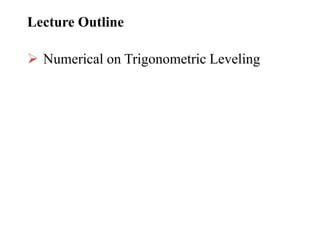
 Numerical on Trigonometric Leveling
 Numerical:
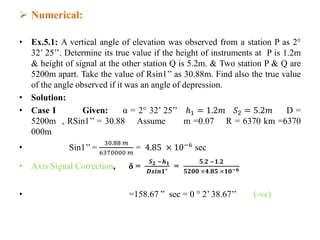
• Ex.5.1: A vertical angle of elevation was observed from a station P as 2°
32’ 25’’. Determine its true value if the height of instruments at P is 1.2m
& height of signal at the other station Q is 5.2m. & Two station P & Q are
5200m apart. Take the value of Rsin1’’ as 30.88m. Find also the true value
of the angle observed if it was an angle of depression.
• Solution:
• Case I Given: α = 2° 32’ 25’’ ℎ1 = 1.2𝑚 𝑆2 = 5.2𝑚 D =
5200m , RSin1’’ = 30.88 Assume m =0.07 R = 6370 km =6370
000m
• Sin1’’ =
30.88 𝑚
6370000 𝑚
= 4.85 × 10⁻⁶
sec
• Axis Signal Correction, δ =
𝑺 𝟐 −𝒉 𝟏
𝑫𝒔𝒊𝒏𝟏"
=
𝟓.𝟐 −𝟏.𝟐
𝟓𝟐𝟎𝟎 ×𝟒.𝟖𝟓 ×𝟏𝟎−𝟔
• =158.67 ” sec = 0 ° 2’ 38.67’’ (-ve)
 Numerical:
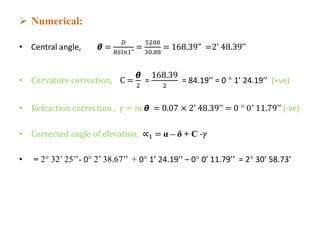
• Central angle, 𝞱 =
𝐷
𝑅𝑆𝑖𝑛1"
=
5200
30.88
= 168.39” =2’ 48.39’’
• Curvature correction, C =
𝞱
2
=
168.39
2
= 84.19’’ = 0 ° 1’ 24.19’’ (+ve)
• Refraction correction , 𝛾 = m 𝞱 = 0.07 × 2’ 48.39’’ = 0 ° 0’ 11.79’’ (-ve)
• Corrected angle of elevation, ∝1 = α – δ + C -𝛾
• = 2° 32’ 25’’- 0° 2’ 38.67’’ + 0° 1’ 24.19’’ – 0° 0’ 11.79’’ = 2° 30’ 58.73’
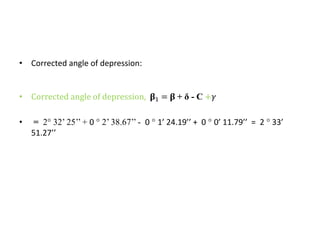
• Corrected angle of depression:
• Corrected angle of depression, 𝛃1 = 𝛃 + δ - C +𝛾
• = 2° 32’ 25’’ + 0 ° 2’ 38.67’’ - 0 ° 1’ 24.19’’ + 0 ° 0’ 11.79’’ = 2 ° 33’
51.27’’
 Numerical:
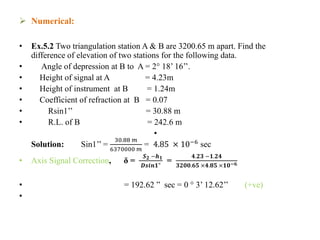
• Ex.5.2 Two triangulation station A & B are 3200.65 m apart. Find the
difference of elevation of two stations for the following data.
• Angle of depression at B to A = 2° 18’ 16’’.
• Height of signal at A = 4.23m
• Height of instrument at B = 1.24m
• Coefficient of refraction at B = 0.07
• Rsin1’’ = 30.88 m
• R.L. of B = 242.6 m
•
Solution: Sin1’’ =
30.88 𝑚
6370000 𝑚
= 4.85 × 10⁻⁶
sec
• Axis Signal Correction, δ =
𝑺 𝟐 −𝒉 𝟏
𝑫𝒔𝒊𝒏𝟏"
=
𝟒.𝟐𝟑 −𝟏.𝟐𝟒
𝟑𝟐𝟎𝟎.𝟔𝟓 ×𝟒.𝟖𝟓 ×𝟏𝟎−𝟔
• = 192.62 ” sec = 0 ° 3’ 12.62’’ (+ve)
•
 Numerical:
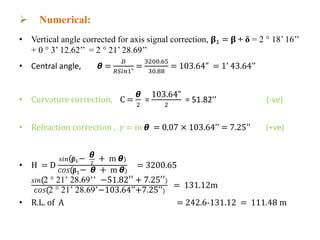
• Vertical angle corrected for axis signal correction, 𝛃1 = 𝛃 + δ = 2 ° 18’ 16’’
+ 0 ° 3’ 12.62’’ = 2 ° 21’ 28.69’’
• Central angle, 𝞱 =
𝐷
𝑅𝑆𝑖𝑛1"
=
3200.65
30.88
= 103.64” = 1’ 43.64’’
• Curvature correction, C =
𝞱
2
=
103.64”
2
= 51.82’’ (-ve)
• Refraction correction , 𝛾 = m 𝞱 = 0.07 × 103.64’’ = 7.25’’ (+ve)
• H = D
𝑠𝑖𝑛(𝛃1− 𝞱
2
+ m 𝞱)
𝐶𝑂𝑆(𝛃1− 𝞱 + m 𝞱)
= 3200.65
𝑠𝑖𝑛(2 ° 21’ 28.69’’ −51.82′′ + 7.25′′)
𝐶𝑂𝑆(2 ° 21’ 28.69’−103.64’’+7.25’’)
= 131.12m
• R.L. of A = 242.6-131.12 = 111.48 m
 Numerical:
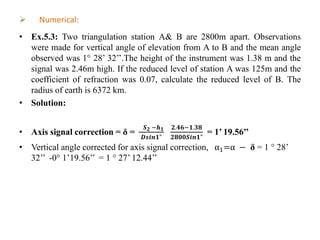
• Ex.5.3: Two triangulation station A& B are 2800m apart. Observations
were made for vertical angle of elevation from A to B and the mean angle
observed was 1° 28’ 32’’.The height of the instrument was 1.38 m and the
signal was 2.46m high. If the reduced level of station A was 125m and the
coefficient of refraction was 0.07, calculate the reduced level of B. The
radius of earth is 6372 km.
• Solution:
• Axis signal correction = δ =
𝑺 𝟐 −𝒉 𝟏
𝑫𝒔𝒊𝒏𝟏"
𝟐.𝟒𝟔−𝟏.𝟑𝟖
𝟐𝟖𝟎𝟎𝑺𝒊𝒏𝟏"
= 1’ 19.56’’
• Vertical angle corrected for axis signal correction, α1=α − δ = 1 ° 28’
32’’ -0° 1’19.56’’ = 1 ° 27’ 12.44’’
 Numerical:
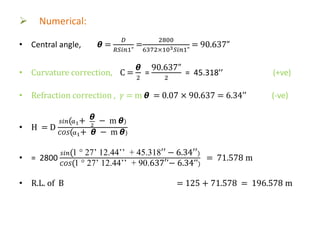
• Central angle, 𝞱 =
𝐷
𝑅𝑆𝑖𝑛1"
=
2800
6372×103 𝑆𝑖𝑛1"
= 90.637”
• Curvature correction, C =
𝞱
2
=
90.637”
2
= 45.318’’ (+ve)
• Refraction correction , 𝛾 = m 𝞱 = 0.07 × 90.637 = 6.34’’ (-ve)
• H = D
𝑠𝑖𝑛(α1+ 𝞱
2
− m 𝞱)
𝐶𝑂𝑆(α1+ 𝞱 − m 𝞱)
• = 2800
𝑠𝑖𝑛(1 ° 27’ 12.44’’ + 45.318′′ − 6.34′′)
𝐶𝑂𝑆(1 ° 27’ 12.44’’ + 90.637′’− 6.34’’)
= 71.578 m
• R.L. of B = 125 + 71.578 = 196.578 m
 Numerical:
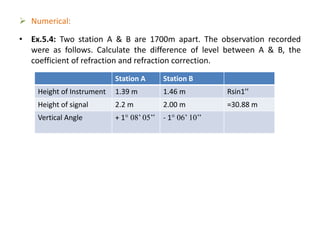
• Ex.5.4: Two station A & B are 1700m apart. The observation recorded
were as follows. Calculate the difference of level between A & B, the
coefficient of refraction and refraction correction.
Station A Station B
Height of Instrument 1.39 m 1.46 m Rsin1’’
Height of signal 2.2 m 2.00 m =30.88 m
Vertical Angle + 1° 08’ 05’’ - 1° 06’ 10’’
 Numerical:
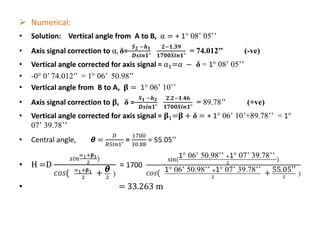
• Solution: Vertical angle from A to B, α = + 1° 08’ 05’’
• Axis signal correction to α, δ=
𝑺 𝟐 −𝒉 𝟏
𝑫𝒔𝒊𝒏𝟏"
𝟐−𝟏.𝟑𝟗
𝟏𝟕𝟎𝟎𝑺𝒊𝒏𝟏"
= 74.012’’ (-ve)
• Vertical angle corrected for axis signal = α1=α − δ = 1° 08’ 05’’
• -0° 0’ 74.012’’ = 1° 06’ 50.98’’
• Vertical angle from B to A, 𝛃 = 1° 06’ 10’’
• Axis signal correction to 𝛃, δ =
𝑺 𝟏 −𝒉 𝟐
𝑫𝒔𝒊𝒏𝟏"
𝟐.𝟐−𝟏.𝟒𝟔
𝟏𝟕𝟎𝟎𝑺𝒊𝒏𝟏"
= 89.78’’ (+ve)
• Vertical angle corrected for axis signal = 𝛃1=𝛃 + δ = + 1° 06’ 10’+89.78’’ = 1°
07’ 39.78’’
• Central angle, 𝞱 =
𝐷
𝑅𝑆𝑖𝑛1"
=
1700
30.88
= 55.05’’
• H =D
𝑠𝑖𝑛
∝1+𝛃1
2
)
𝐶𝑂𝑆( ∝1+𝛃1
2
+ 𝞱
2
)
= 1700
sin(
1° 06’ 50.98’’ +1° 07’ 39.78’’
2
)
𝐶𝑂𝑆( 1° 06’ 50.98’’ +1° 07’ 39.78’’
2
+ 55.05′′
2
)
• = 33.263 m
 Numerical:
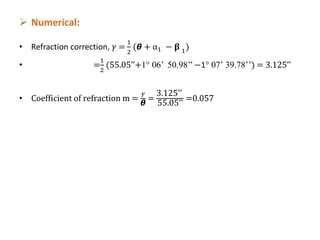
• Refraction correction, 𝛾 =
1
2
(𝞱 + α1 − ઺ 1)
• =
1
2
(55.05’’+1° 06’ 50.98’’ −1° 07’ 39.78’’) = 3.125’’
• Coefficient of refraction m =
𝛾
𝞱
=
3.125’’
55.05’’
=0.057
Thank you

Trigonometric leveling 05

  • 1.
    Advance Surveying Trigonometric Leveling Prof.Rajguru R.S. Civil Engineering Department (rajgururajeshcivil@sanjivani.org.in) Sanjivani College of Engineering, Kopargaon,MH,India
  • 2.
    Lecture Outline  Numericalon Trigonometric Leveling
  • 3.
     Numerical: • Ex.5.1:A vertical angle of elevation was observed from a station P as 2° 32’ 25’’. Determine its true value if the height of instruments at P is 1.2m & height of signal at the other station Q is 5.2m. & Two station P & Q are 5200m apart. Take the value of Rsin1’’ as 30.88m. Find also the true value of the angle observed if it was an angle of depression. • Solution: • Case I Given: α = 2° 32’ 25’’ ℎ1 = 1.2𝑚 𝑆2 = 5.2𝑚 D = 5200m , RSin1’’ = 30.88 Assume m =0.07 R = 6370 km =6370 000m • Sin1’’ = 30.88 𝑚 6370000 𝑚 = 4.85 × 10⁻⁶ sec • Axis Signal Correction, δ = 𝑺 𝟐 −𝒉 𝟏 𝑫𝒔𝒊𝒏𝟏" = 𝟓.𝟐 −𝟏.𝟐 𝟓𝟐𝟎𝟎 ×𝟒.𝟖𝟓 ×𝟏𝟎−𝟔 • =158.67 ” sec = 0 ° 2’ 38.67’’ (-ve)
  • 4.
     Numerical: • Centralangle, 𝞱 = 𝐷 𝑅𝑆𝑖𝑛1" = 5200 30.88 = 168.39” =2’ 48.39’’ • Curvature correction, C = 𝞱 2 = 168.39 2 = 84.19’’ = 0 ° 1’ 24.19’’ (+ve) • Refraction correction , 𝛾 = m 𝞱 = 0.07 × 2’ 48.39’’ = 0 ° 0’ 11.79’’ (-ve) • Corrected angle of elevation, ∝1 = α – δ + C -𝛾 • = 2° 32’ 25’’- 0° 2’ 38.67’’ + 0° 1’ 24.19’’ – 0° 0’ 11.79’’ = 2° 30’ 58.73’
  • 5.
    • Corrected angleof depression: • Corrected angle of depression, 𝛃1 = 𝛃 + δ - C +𝛾 • = 2° 32’ 25’’ + 0 ° 2’ 38.67’’ - 0 ° 1’ 24.19’’ + 0 ° 0’ 11.79’’ = 2 ° 33’ 51.27’’
  • 6.
     Numerical: • Ex.5.2Two triangulation station A & B are 3200.65 m apart. Find the difference of elevation of two stations for the following data. • Angle of depression at B to A = 2° 18’ 16’’. • Height of signal at A = 4.23m • Height of instrument at B = 1.24m • Coefficient of refraction at B = 0.07 • Rsin1’’ = 30.88 m • R.L. of B = 242.6 m • Solution: Sin1’’ = 30.88 𝑚 6370000 𝑚 = 4.85 × 10⁻⁶ sec • Axis Signal Correction, δ = 𝑺 𝟐 −𝒉 𝟏 𝑫𝒔𝒊𝒏𝟏" = 𝟒.𝟐𝟑 −𝟏.𝟐𝟒 𝟑𝟐𝟎𝟎.𝟔𝟓 ×𝟒.𝟖𝟓 ×𝟏𝟎−𝟔 • = 192.62 ” sec = 0 ° 3’ 12.62’’ (+ve) •
  • 7.
     Numerical: • Verticalangle corrected for axis signal correction, 𝛃1 = 𝛃 + δ = 2 ° 18’ 16’’ + 0 ° 3’ 12.62’’ = 2 ° 21’ 28.69’’ • Central angle, 𝞱 = 𝐷 𝑅𝑆𝑖𝑛1" = 3200.65 30.88 = 103.64” = 1’ 43.64’’ • Curvature correction, C = 𝞱 2 = 103.64” 2 = 51.82’’ (-ve) • Refraction correction , 𝛾 = m 𝞱 = 0.07 × 103.64’’ = 7.25’’ (+ve) • H = D 𝑠𝑖𝑛(𝛃1− 𝞱 2 + m 𝞱) 𝐶𝑂𝑆(𝛃1− 𝞱 + m 𝞱) = 3200.65 𝑠𝑖𝑛(2 ° 21’ 28.69’’ −51.82′′ + 7.25′′) 𝐶𝑂𝑆(2 ° 21’ 28.69’−103.64’’+7.25’’) = 131.12m • R.L. of A = 242.6-131.12 = 111.48 m
  • 8.
     Numerical: • Ex.5.3:Two triangulation station A& B are 2800m apart. Observations were made for vertical angle of elevation from A to B and the mean angle observed was 1° 28’ 32’’.The height of the instrument was 1.38 m and the signal was 2.46m high. If the reduced level of station A was 125m and the coefficient of refraction was 0.07, calculate the reduced level of B. The radius of earth is 6372 km. • Solution: • Axis signal correction = δ = 𝑺 𝟐 −𝒉 𝟏 𝑫𝒔𝒊𝒏𝟏" 𝟐.𝟒𝟔−𝟏.𝟑𝟖 𝟐𝟖𝟎𝟎𝑺𝒊𝒏𝟏" = 1’ 19.56’’ • Vertical angle corrected for axis signal correction, α1=α − δ = 1 ° 28’ 32’’ -0° 1’19.56’’ = 1 ° 27’ 12.44’’
  • 9.
     Numerical: • Centralangle, 𝞱 = 𝐷 𝑅𝑆𝑖𝑛1" = 2800 6372×103 𝑆𝑖𝑛1" = 90.637” • Curvature correction, C = 𝞱 2 = 90.637” 2 = 45.318’’ (+ve) • Refraction correction , 𝛾 = m 𝞱 = 0.07 × 90.637 = 6.34’’ (-ve) • H = D 𝑠𝑖𝑛(α1+ 𝞱 2 − m 𝞱) 𝐶𝑂𝑆(α1+ 𝞱 − m 𝞱) • = 2800 𝑠𝑖𝑛(1 ° 27’ 12.44’’ + 45.318′′ − 6.34′′) 𝐶𝑂𝑆(1 ° 27’ 12.44’’ + 90.637′’− 6.34’’) = 71.578 m • R.L. of B = 125 + 71.578 = 196.578 m
  • 10.
     Numerical: • Ex.5.4:Two station A & B are 1700m apart. The observation recorded were as follows. Calculate the difference of level between A & B, the coefficient of refraction and refraction correction. Station A Station B Height of Instrument 1.39 m 1.46 m Rsin1’’ Height of signal 2.2 m 2.00 m =30.88 m Vertical Angle + 1° 08’ 05’’ - 1° 06’ 10’’
  • 11.
     Numerical: • Solution:Vertical angle from A to B, α = + 1° 08’ 05’’ • Axis signal correction to α, δ= 𝑺 𝟐 −𝒉 𝟏 𝑫𝒔𝒊𝒏𝟏" 𝟐−𝟏.𝟑𝟗 𝟏𝟕𝟎𝟎𝑺𝒊𝒏𝟏" = 74.012’’ (-ve) • Vertical angle corrected for axis signal = α1=α − δ = 1° 08’ 05’’ • -0° 0’ 74.012’’ = 1° 06’ 50.98’’ • Vertical angle from B to A, 𝛃 = 1° 06’ 10’’ • Axis signal correction to 𝛃, δ = 𝑺 𝟏 −𝒉 𝟐 𝑫𝒔𝒊𝒏𝟏" 𝟐.𝟐−𝟏.𝟒𝟔 𝟏𝟕𝟎𝟎𝑺𝒊𝒏𝟏" = 89.78’’ (+ve) • Vertical angle corrected for axis signal = 𝛃1=𝛃 + δ = + 1° 06’ 10’+89.78’’ = 1° 07’ 39.78’’ • Central angle, 𝞱 = 𝐷 𝑅𝑆𝑖𝑛1" = 1700 30.88 = 55.05’’ • H =D 𝑠𝑖𝑛 ∝1+𝛃1 2 ) 𝐶𝑂𝑆( ∝1+𝛃1 2 + 𝞱 2 ) = 1700 sin( 1° 06’ 50.98’’ +1° 07’ 39.78’’ 2 ) 𝐶𝑂𝑆( 1° 06’ 50.98’’ +1° 07’ 39.78’’ 2 + 55.05′′ 2 ) • = 33.263 m
  • 12.
     Numerical: • Refractioncorrection, 𝛾 = 1 2 (𝞱 + α1 − ઺ 1) • = 1 2 (55.05’’+1° 06’ 50.98’’ −1° 07’ 39.78’’) = 3.125’’ • Coefficient of refraction m = 𝛾 𝞱 = 3.125’’ 55.05’’ =0.057
  • 13.