Advance Surveying
Aerial Photogrammetry
by
Prof. Rajguru R.S.
Civil Engineering Department
(rajgururajeshcivil@sanjivani.org.in)
Sanjivani College of Engineering,
Kopargaon, MH, India
 Lecture Outline
 Ground control point
 Flight planning
 Ground control point:
Definition: Ground Control Points (GCPs) are points on the ground with
known coordinates in spatial coordinate system. The coordinate of these GCPs
are determined with traditional surveying methods or other surveying methods.
GCPs determine the position of its aerial photo image in the coordinate system.
One of the major advantages of using GCPs is that they increase the global
accuracy of mapping.
CGPs
Photograph
3 to 4 GCPs should be appeared on photograph
 Ground control point:
• Pre-Pointing:
Ground Control Points (GCPs) are established on the ground before
photography. They are established in such a way that the whole area to be
photographed is covered and should appear clearly on the photograph during
photography. It is always recommended to establish GCPs in the periphery of
the photograph or the block. It is accurate but costly to establish. Tin plates or
white paper with clearly visible marks are used for this purpose.
• Post-Pointing:
In this case GCPs are established after photography. It is way cheaper than
Pre-Pointing as it is chosen in photographs. The main problem of Post-
Pointing is it is difficult to actually identify the points on the ground.
 Ground control point:
Ground control point survey split in to :
a) Basic control : Basic network of triangulation, azimuth marks, traverse
stations bench mark etc.
b) Photo control :
Greater the number of GCPs more stable and controlled the network is. The
ideal distribution of GCP is in such a way that it covers the entire project area
and both horizontal and vertical control are established.
Aerial photograph GCPs-
Role of GCPs-
1.To achieve the desired accuracy.
2.Mapping software accurately position your map in relation to the real world
around it.
 Flight planning:
Planning of aerial photogrammetry includes Overlaps, Crab, Drift, Altitude
of aircraft, Area covered by one photograph, No of photographs to cover a
given area & Interval between exposures
• Overlaps: Vertical aerial
photographic coverage of an
area is normally taken as a
series of overlapping flight
strips. Longitudinal overlap or
forward overlap is in the
direction of flight line., is kept as
about 60%. The overlap
between the adjacent flight is
called as side overlap which is
kept at about 30% .As shown in
fig. it is useful for stereoscopic
vision.
 Flight planning:
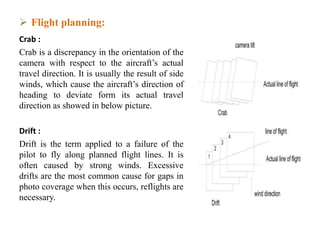
Crab :
Crab is a discrepancy in the orientation of the
camera with respect to the aircraft’s actual
travel direction. It is usually the result of side
winds, which cause the aircraft’s direction of
heading to deviate form its actual travel
direction as showed in below picture.
Drift :
Drift is the term applied to a failure of the
pilot to fly along planned flight lines. It is
often caused by strong winds. Excessive
drifts are the most common cause for gaps in
photo coverage when this occurs, reflights are
necessary.
 Flight planning:
Altitude of aircraft: Flying altitude (H) = Contour interval x C- Factor
C- Factor varies from 500 to 1500
or can be calculated from equation of scale, S =
𝐹
𝐻 −ℎ
Area covered by one photograph:
• Area covered by one photograph = [ length x scale ] [ width x scale ]
No of photograph required to cover a given area:
• Net length covered by each photographs (L) = (1-Pl ) S l
• Net width covered by each photographs (w) = (1-Pw ) S w
Pl =Longitudinal overlap, Pw = side overlap S = Scale of a photograph
l = Length of photograph in the direction of flight
w = Width of photograph normal to direction of flight
 Flight planning:
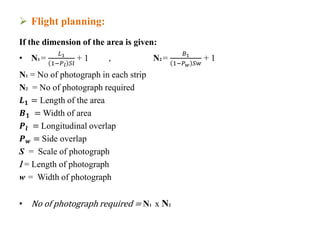
If the dimension of the area is given:
• N1 =
𝐿1
1−𝑃 𝑙 𝑆𝑙
+ 1 , N2 =
𝐵1
1−𝑃 𝑤 𝑆𝑤
+ 1
N1 = No of photograph in each strip
N2 = No of photograph required
𝑳 𝟏 = Length of the area
𝑩 𝟏 = Width of area
𝑷𝒍 = Longitudinal overlap
𝑷 𝒘 = Side overlap
S = Scale of photograph
l = Length of photograph
w = Width of photograph
• No of photograph required = N1 x N2
 Flight planning:
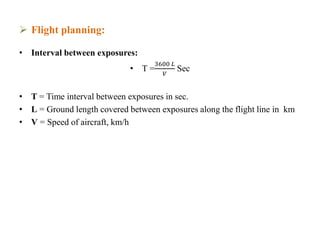
• Interval between exposures:
• T =
3600 𝐿
𝑉
Sec
• T = Time interval between exposures in sec.
• L = Ground length covered between exposures along the flight line in km
• V = Speed of aircraft, km/h
THANK YOU

Aerial photogrammetry 04

  • 1.
    Advance Surveying Aerial Photogrammetry by Prof.Rajguru R.S. Civil Engineering Department (rajgururajeshcivil@sanjivani.org.in) Sanjivani College of Engineering, Kopargaon, MH, India
  • 2.
     Lecture Outline Ground control point  Flight planning
  • 3.
     Ground controlpoint: Definition: Ground Control Points (GCPs) are points on the ground with known coordinates in spatial coordinate system. The coordinate of these GCPs are determined with traditional surveying methods or other surveying methods. GCPs determine the position of its aerial photo image in the coordinate system. One of the major advantages of using GCPs is that they increase the global accuracy of mapping. CGPs Photograph 3 to 4 GCPs should be appeared on photograph
  • 4.
     Ground controlpoint: • Pre-Pointing: Ground Control Points (GCPs) are established on the ground before photography. They are established in such a way that the whole area to be photographed is covered and should appear clearly on the photograph during photography. It is always recommended to establish GCPs in the periphery of the photograph or the block. It is accurate but costly to establish. Tin plates or white paper with clearly visible marks are used for this purpose. • Post-Pointing: In this case GCPs are established after photography. It is way cheaper than Pre-Pointing as it is chosen in photographs. The main problem of Post- Pointing is it is difficult to actually identify the points on the ground.
  • 5.
     Ground controlpoint: Ground control point survey split in to : a) Basic control : Basic network of triangulation, azimuth marks, traverse stations bench mark etc. b) Photo control : Greater the number of GCPs more stable and controlled the network is. The ideal distribution of GCP is in such a way that it covers the entire project area and both horizontal and vertical control are established. Aerial photograph GCPs- Role of GCPs- 1.To achieve the desired accuracy. 2.Mapping software accurately position your map in relation to the real world around it.
  • 6.
     Flight planning: Planningof aerial photogrammetry includes Overlaps, Crab, Drift, Altitude of aircraft, Area covered by one photograph, No of photographs to cover a given area & Interval between exposures • Overlaps: Vertical aerial photographic coverage of an area is normally taken as a series of overlapping flight strips. Longitudinal overlap or forward overlap is in the direction of flight line., is kept as about 60%. The overlap between the adjacent flight is called as side overlap which is kept at about 30% .As shown in fig. it is useful for stereoscopic vision.
  • 7.
     Flight planning: Crab: Crab is a discrepancy in the orientation of the camera with respect to the aircraft’s actual travel direction. It is usually the result of side winds, which cause the aircraft’s direction of heading to deviate form its actual travel direction as showed in below picture. Drift : Drift is the term applied to a failure of the pilot to fly along planned flight lines. It is often caused by strong winds. Excessive drifts are the most common cause for gaps in photo coverage when this occurs, reflights are necessary.
  • 8.
     Flight planning: Altitudeof aircraft: Flying altitude (H) = Contour interval x C- Factor C- Factor varies from 500 to 1500 or can be calculated from equation of scale, S = 𝐹 𝐻 −ℎ Area covered by one photograph: • Area covered by one photograph = [ length x scale ] [ width x scale ] No of photograph required to cover a given area: • Net length covered by each photographs (L) = (1-Pl ) S l • Net width covered by each photographs (w) = (1-Pw ) S w Pl =Longitudinal overlap, Pw = side overlap S = Scale of a photograph l = Length of photograph in the direction of flight w = Width of photograph normal to direction of flight
  • 9.
     Flight planning: Ifthe dimension of the area is given: • N1 = 𝐿1 1−𝑃 𝑙 𝑆𝑙 + 1 , N2 = 𝐵1 1−𝑃 𝑤 𝑆𝑤 + 1 N1 = No of photograph in each strip N2 = No of photograph required 𝑳 𝟏 = Length of the area 𝑩 𝟏 = Width of area 𝑷𝒍 = Longitudinal overlap 𝑷 𝒘 = Side overlap S = Scale of photograph l = Length of photograph w = Width of photograph • No of photograph required = N1 x N2
  • 10.
     Flight planning: •Interval between exposures: • T = 3600 𝐿 𝑉 Sec • T = Time interval between exposures in sec. • L = Ground length covered between exposures along the flight line in km • V = Speed of aircraft, km/h
  • 11.