Advance Surveying
Aerial Photogrammetry
by
Prof. Rajguru R.S.
Civil Engineering Department
(rajgururajeshcivil@sanjivani.org.in)
Sanjivani College of Engineering,
Kopargaon, MH, India
 Lecture Outline
 Relief Displacement in Vertical Photograph
 Numerical
 Relief Displacement in Vertical Photograph:
• Definition-
On an aerial photograph the
displacement of image due to
variation in relief of terrain is known
as relief displacement or height
distortion.
Let, AB is the object on ground
surface (Datum)
A=Top point of an object
B= Bottom point of an object
P= Principal point
ra = Radial distance of point a from
the principal point p
rb = Radial distance of point b from
the principal point p
Relief displacement = d = ra – rb
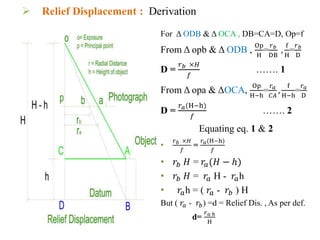
 Relief Displacement : Derivation
For Δ ODB & Δ OCA , DB=CA=D, Op=f
From Δ opb & Δ ODB ,
Op
H
=
𝑟 𝑏
DB
,
f
H
=
𝑟 𝑏
D
D =
𝑟 𝑏 ×𝐻
𝑓
……. 1
From Δ opa & ΔOCA,
Op
H−h
=
𝑟 𝑎
𝐶𝐴
,
f
H−h
=
𝑟 𝑎
D
D =
𝑟 𝑎(H−h)
𝑓
……. 2
Equating eq. 1 & 2
•
𝑟 𝑏 ×𝐻
𝑓
=
𝑟 𝑎(H−h)
𝑓
• 𝑟𝑏 𝐻 = 𝑟𝑎(𝐻 − ℎ)
• 𝑟𝑏 𝐻 = 𝑟𝑎 H - 𝑟𝑎h
• 𝑟𝑎h = ( 𝑟𝑎 - 𝑟𝑏 ) H
But ( 𝑟𝑎 - 𝑟𝑏) =d = Relief Dis. , As per def.
d=
𝑟 𝑎 ℎ
H
 Relief Displacement :
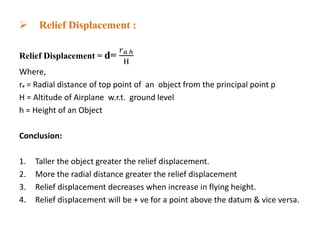
Relief Displacement = d=
𝑟 𝑎 ℎ
H
Where,
ra = Radial distance of top point of an object from the principal point p
H = Altitude of Airplane w.r.t. ground level
h = Height of an Object
Conclusion:
1. Taller the object greater the relief displacement.
2. More the radial distance greater the relief displacement
3. Relief displacement decreases when increase in flying height.
4. Relief displacement will be + ve for a point above the datum & vice versa.
 Numerical:
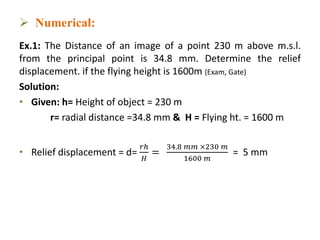
Ex.1: The Distance of an image of a point 230 m above m.s.l.
from the principal point is 34.8 mm. Determine the relief
displacement. if the flying height is 1600m (Exam, Gate)
Solution:
• Given: h= Height of object = 230 m
r= radial distance =34.8 mm & H = Flying ht. = 1600 m
• Relief displacement = d=
𝑟ℎ
𝐻
=
34.8 𝑚𝑚 ×230 𝑚
1600 𝑚
= 5 mm
 Numerical:
Ex.2: A tower lying on a flat area having an average elevation of 800 m
above m.s.l. was photograph with the a camera having focal length of
24 cm. The distance between the top and bottom of tower is measures
0.34 cm on the photograph. A line AB, 200 m long on the ground,
measures 12.2 cm on the same photograph. Determine the height of the
tower if the distance of the image of the top of the tower is 8.92 cm,
from the principal point. (Exam, Gate)
Solution:
• Given: d=relief displacement = 0.34 cm , f= Focal length = 24 cm
H = Altitude of camera = Unknown , h = Height of tower = Unknown
r= radial distance of top of tower=8.92 cm & AB line ground distance
= 200 m & AB line ground map distance = 12.2 cm
(relief displacement = d=
𝑟ℎ
𝐻
&
𝑚𝑎𝑝 𝑑𝑖𝑠𝑡𝑎𝑛𝑐𝑒
𝐺𝑟𝑜𝑢𝑛𝑑 𝑑𝑖𝑠𝑡𝑎𝑛𝑐𝑒
=
𝑓
𝐻
)
 Numerical:
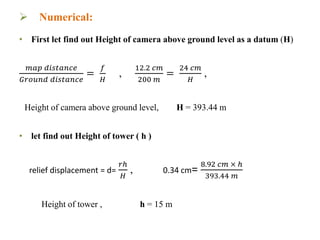
• First let find out Height of camera above ground level as a datum (H)
𝑚𝑎𝑝 𝑑𝑖𝑠𝑡𝑎𝑛𝑐𝑒
𝐺𝑟𝑜𝑢𝑛𝑑 𝑑𝑖𝑠𝑡𝑎𝑛𝑐𝑒
=
𝑓
𝐻
,
12.2 𝑐𝑚
200 𝑚
=
24 𝑐𝑚
𝐻
,
Height of camera above ground level, H = 393.44 m
• let find out Height of tower ( h )
relief displacement = d=
𝑟ℎ
𝐻
, 0.34 cm=
8.92 𝑐𝑚 × ℎ
393.44 𝑚
Height of tower , h = 15 m
 Numerical:
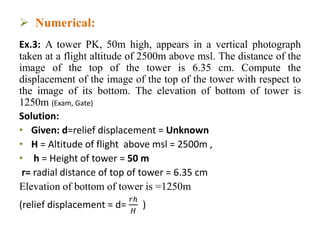
Ex.3: A tower PK, 50m high, appears in a vertical photograph
taken at a flight altitude of 2500m above msl. The distance of the
image of the top of the tower is 6.35 cm. Compute the
displacement of the image of the top of the tower with respect to
the image of its bottom. The elevation of bottom of tower is
1250m (Exam, Gate)
Solution:
• Given: d=relief displacement = Unknown
• H = Altitude of flight above msl = 2500m ,
• h = Height of tower = 50 m
r= radial distance of top of tower = 6.35 cm
Elevation of bottom of tower is =1250m
(relief displacement = d=
𝑟ℎ
𝐻
)
Numerical:
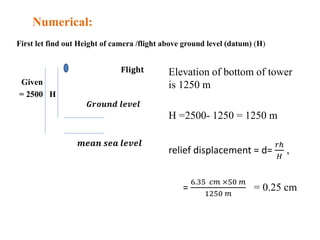
First let find out Height of camera /flight above ground level (datum) (H)
Elevation of bottom of tower
is 1250 m
H =2500- 1250 = 1250 m
relief displacement = d=
𝑟ℎ
𝐻
,
=
6.35 𝑐𝑚 ×50 𝑚
1250 𝑚
= 0.25 cm
𝐅𝐥𝐢𝐠𝐡𝐭
Given
= 2500 H
𝑮𝒓𝒐𝒖𝒏𝒅 𝒍𝒆𝒗𝒆𝒍
𝒎𝒆𝒂𝒏 𝒔𝒆𝒂 𝒍𝒆𝒗𝒆𝒍
THANK YOU

Aerial photogrammetry 03

  • 1.
    Advance Surveying Aerial Photogrammetry by Prof.Rajguru R.S. Civil Engineering Department (rajgururajeshcivil@sanjivani.org.in) Sanjivani College of Engineering, Kopargaon, MH, India
  • 2.
     Lecture Outline Relief Displacement in Vertical Photograph  Numerical
  • 3.
     Relief Displacementin Vertical Photograph: • Definition- On an aerial photograph the displacement of image due to variation in relief of terrain is known as relief displacement or height distortion. Let, AB is the object on ground surface (Datum) A=Top point of an object B= Bottom point of an object P= Principal point ra = Radial distance of point a from the principal point p rb = Radial distance of point b from the principal point p Relief displacement = d = ra – rb
  • 4.
     Relief Displacement: Derivation For Δ ODB & Δ OCA , DB=CA=D, Op=f From Δ opb & Δ ODB , Op H = 𝑟 𝑏 DB , f H = 𝑟 𝑏 D D = 𝑟 𝑏 ×𝐻 𝑓 ……. 1 From Δ opa & ΔOCA, Op H−h = 𝑟 𝑎 𝐶𝐴 , f H−h = 𝑟 𝑎 D D = 𝑟 𝑎(H−h) 𝑓 ……. 2 Equating eq. 1 & 2 • 𝑟 𝑏 ×𝐻 𝑓 = 𝑟 𝑎(H−h) 𝑓 • 𝑟𝑏 𝐻 = 𝑟𝑎(𝐻 − ℎ) • 𝑟𝑏 𝐻 = 𝑟𝑎 H - 𝑟𝑎h • 𝑟𝑎h = ( 𝑟𝑎 - 𝑟𝑏 ) H But ( 𝑟𝑎 - 𝑟𝑏) =d = Relief Dis. , As per def. d= 𝑟 𝑎 ℎ H
  • 5.
     Relief Displacement: Relief Displacement = d= 𝑟 𝑎 ℎ H Where, ra = Radial distance of top point of an object from the principal point p H = Altitude of Airplane w.r.t. ground level h = Height of an Object Conclusion: 1. Taller the object greater the relief displacement. 2. More the radial distance greater the relief displacement 3. Relief displacement decreases when increase in flying height. 4. Relief displacement will be + ve for a point above the datum & vice versa.
  • 6.
     Numerical: Ex.1: TheDistance of an image of a point 230 m above m.s.l. from the principal point is 34.8 mm. Determine the relief displacement. if the flying height is 1600m (Exam, Gate) Solution: • Given: h= Height of object = 230 m r= radial distance =34.8 mm & H = Flying ht. = 1600 m • Relief displacement = d= 𝑟ℎ 𝐻 = 34.8 𝑚𝑚 ×230 𝑚 1600 𝑚 = 5 mm
  • 7.
     Numerical: Ex.2: Atower lying on a flat area having an average elevation of 800 m above m.s.l. was photograph with the a camera having focal length of 24 cm. The distance between the top and bottom of tower is measures 0.34 cm on the photograph. A line AB, 200 m long on the ground, measures 12.2 cm on the same photograph. Determine the height of the tower if the distance of the image of the top of the tower is 8.92 cm, from the principal point. (Exam, Gate) Solution: • Given: d=relief displacement = 0.34 cm , f= Focal length = 24 cm H = Altitude of camera = Unknown , h = Height of tower = Unknown r= radial distance of top of tower=8.92 cm & AB line ground distance = 200 m & AB line ground map distance = 12.2 cm (relief displacement = d= 𝑟ℎ 𝐻 & 𝑚𝑎𝑝 𝑑𝑖𝑠𝑡𝑎𝑛𝑐𝑒 𝐺𝑟𝑜𝑢𝑛𝑑 𝑑𝑖𝑠𝑡𝑎𝑛𝑐𝑒 = 𝑓 𝐻 )
  • 8.
     Numerical: • Firstlet find out Height of camera above ground level as a datum (H) 𝑚𝑎𝑝 𝑑𝑖𝑠𝑡𝑎𝑛𝑐𝑒 𝐺𝑟𝑜𝑢𝑛𝑑 𝑑𝑖𝑠𝑡𝑎𝑛𝑐𝑒 = 𝑓 𝐻 , 12.2 𝑐𝑚 200 𝑚 = 24 𝑐𝑚 𝐻 , Height of camera above ground level, H = 393.44 m • let find out Height of tower ( h ) relief displacement = d= 𝑟ℎ 𝐻 , 0.34 cm= 8.92 𝑐𝑚 × ℎ 393.44 𝑚 Height of tower , h = 15 m
  • 9.
     Numerical: Ex.3: Atower PK, 50m high, appears in a vertical photograph taken at a flight altitude of 2500m above msl. The distance of the image of the top of the tower is 6.35 cm. Compute the displacement of the image of the top of the tower with respect to the image of its bottom. The elevation of bottom of tower is 1250m (Exam, Gate) Solution: • Given: d=relief displacement = Unknown • H = Altitude of flight above msl = 2500m , • h = Height of tower = 50 m r= radial distance of top of tower = 6.35 cm Elevation of bottom of tower is =1250m (relief displacement = d= 𝑟ℎ 𝐻 )
  • 10.
    Numerical: First let findout Height of camera /flight above ground level (datum) (H) Elevation of bottom of tower is 1250 m H =2500- 1250 = 1250 m relief displacement = d= 𝑟ℎ 𝐻 , = 6.35 𝑐𝑚 ×50 𝑚 1250 𝑚 = 0.25 cm 𝐅𝐥𝐢𝐠𝐡𝐭 Given = 2500 H 𝑮𝒓𝒐𝒖𝒏𝒅 𝒍𝒆𝒗𝒆𝒍 𝒎𝒆𝒂𝒏 𝒔𝒆𝒂 𝒍𝒆𝒗𝒆𝒍
  • 11.