Advance Surveying
Trigonometric Leveling
Prof. Rajguru R.S.
Civil Engineering Department
(rajgururajeshcivil@sanjivani.org.in)
Sanjivani College of Engineering,
Kopargaon,MH,India
Lecture Outline
Determination of Difference in elevation by
Reciprocal observation
 Introduction
 Equation to determine the difference in
Elevation
 Coefficient of refraction
 Determination of Difference in elevation by Reciprocal
observations:
• Introduction:
• In the present method the difference of elevation between two station is
find out, the observation are made simultaneously from both the station to
eliminate the effect of refraction completely. Observations are made in
between 10am to 3pm to minimize the effect of refraction. The mean of
the vertical angle is obtained and used for calculating the difference of
elevation between two station.
 Difference in elevation by Reciprocal observations:
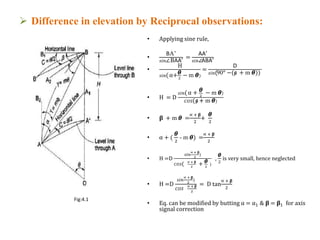
• H= Difference in elevation bet. A &B
• ∝ & 𝛃 = Angle observed simultaneously
• D = Horizontal distance = AB
• 𝛾 & C = Angle of refraction & curvature
• ∝1 & 𝛃1 = Corrected vertical angle for axis
signal
• The mean vertical angle =
∝ + 𝛃
2
• ∠B AA’ = [ α + (
ᆈ
2
- m ᆈ) ]
• ∠ ABB’ = [ 𝛃 - (
ᆈ
2
- m ᆈ) ]
• The sign of correction being +ve for angle of
elevation & -ve for angle of depression
• Since the chords AA’ & BB’ are parallel, ∠BAA’
=∠ABB’
• α + (
ᆈ
2
- m ᆈ) = 𝛃 - (
ᆈ
2
- m ᆈ) =
∝ + 𝛃
2
….. .1
Fig.3.1
 Difference in elevation by Reciprocal observations:
• Applying sine rule,
•
BA’
𝑠𝑖𝑛∠BAA’
=
AA’
𝑠𝑖𝑛∠ABA’
•
H
𝑠𝑖𝑛(α+ᆈ
2
− m ᆈ)
=
D
𝑠𝑖𝑛(90° −( 𝛃 + m ᆈ))
• H = D
𝑠𝑖𝑛(α + ᆈ
2
− m ᆈ)
𝐶𝑂𝑆( 𝛃 + m ᆈ)
• 𝛃 + m ᆈ =
∝ + 𝛃
2
+
ᆈ
2
• α + (
ᆈ
2
- m ᆈ) =
∝ + 𝛃
2
• H =D
𝑠𝑖𝑛
∝ + 𝛃
2
)
𝐶𝑂𝑆( ∝ + 𝛃
2
+ ᆈ
2
)
,
ᆈ
2
is very small, hence neglected
• H =D
𝑠𝑖𝑛
∝ + 𝛃
2
)
𝐶𝑂𝑆
∝ + 𝛃
2
= D tan
∝ + 𝛃
2
• Eq. can be modified by butting α = α1 & 𝛃 = 𝛃1 for axis
signal correction
Fig:4.1
 Coefficient of refraction:
• Coefficient of refraction (m) is the ratio of the radius of curvature of the
earth R to the radius of curvature of the line of sight 𝑅 𝑠
•
• m=
R
𝑅 𝑠
We know C=
ᆈ
2
& 𝛾 = 𝑚ᆈ
• α + (C - 𝛾) = 𝛃 – (C- 𝛾)
• 2𝛾 = α - 𝛃 +2C
• 𝛾 =
1
2
(α - 𝛃 +2C) =
1
2
(α − 𝛃 +2
ᆈ
2
) =
1
2
(ᆈ +α - 𝛃 )
• Butting 𝛾 = 𝑚ᆈ in above eq.
• 𝑚ᆈ =
1
2
(ᆈ +α - 𝛃 )
• 𝑚 =
1
2ᆈ
(ᆈ +α - 𝛃 )
Thank you

Trigonometric leveling 04

  • 1.
    Advance Surveying Trigonometric Leveling Prof.Rajguru R.S. Civil Engineering Department (rajgururajeshcivil@sanjivani.org.in) Sanjivani College of Engineering, Kopargaon,MH,India
  • 2.
    Lecture Outline Determination ofDifference in elevation by Reciprocal observation  Introduction  Equation to determine the difference in Elevation  Coefficient of refraction
  • 3.
     Determination ofDifference in elevation by Reciprocal observations: • Introduction: • In the present method the difference of elevation between two station is find out, the observation are made simultaneously from both the station to eliminate the effect of refraction completely. Observations are made in between 10am to 3pm to minimize the effect of refraction. The mean of the vertical angle is obtained and used for calculating the difference of elevation between two station.
  • 4.
     Difference inelevation by Reciprocal observations: • H= Difference in elevation bet. A &B • ∝ & 𝛃 = Angle observed simultaneously • D = Horizontal distance = AB • 𝛾 & C = Angle of refraction & curvature • ∝1 & 𝛃1 = Corrected vertical angle for axis signal • The mean vertical angle = ∝ + 𝛃 2 • ∠B AA’ = [ α + ( ᆈ 2 - m ᆈ) ] • ∠ ABB’ = [ 𝛃 - ( ᆈ 2 - m ᆈ) ] • The sign of correction being +ve for angle of elevation & -ve for angle of depression • Since the chords AA’ & BB’ are parallel, ∠BAA’ =∠ABB’ • α + ( ᆈ 2 - m ᆈ) = 𝛃 - ( ᆈ 2 - m ᆈ) = ∝ + 𝛃 2 ….. .1 Fig.3.1
  • 5.
     Difference inelevation by Reciprocal observations: • Applying sine rule, • BA’ 𝑠𝑖𝑛∠BAA’ = AA’ 𝑠𝑖𝑛∠ABA’ • H 𝑠𝑖𝑛(α+ᆈ 2 − m ᆈ) = D 𝑠𝑖𝑛(90° −( 𝛃 + m ᆈ)) • H = D 𝑠𝑖𝑛(α + ᆈ 2 − m ᆈ) 𝐶𝑂𝑆( 𝛃 + m ᆈ) • 𝛃 + m ᆈ = ∝ + 𝛃 2 + ᆈ 2 • α + ( ᆈ 2 - m ᆈ) = ∝ + 𝛃 2 • H =D 𝑠𝑖𝑛 ∝ + 𝛃 2 ) 𝐶𝑂𝑆( ∝ + 𝛃 2 + ᆈ 2 ) , ᆈ 2 is very small, hence neglected • H =D 𝑠𝑖𝑛 ∝ + 𝛃 2 ) 𝐶𝑂𝑆 ∝ + 𝛃 2 = D tan ∝ + 𝛃 2 • Eq. can be modified by butting α = α1 & 𝛃 = 𝛃1 for axis signal correction Fig:4.1
  • 6.
     Coefficient ofrefraction: • Coefficient of refraction (m) is the ratio of the radius of curvature of the earth R to the radius of curvature of the line of sight 𝑅 𝑠 • • m= R 𝑅 𝑠 We know C= ᆈ 2 & 𝛾 = 𝑚ᆈ • α + (C - 𝛾) = 𝛃 – (C- 𝛾) • 2𝛾 = α - 𝛃 +2C • 𝛾 = 1 2 (α - 𝛃 +2C) = 1 2 (α − 𝛃 +2 ᆈ 2 ) = 1 2 (ᆈ +α - 𝛃 ) • Butting 𝛾 = 𝑚ᆈ in above eq. • 𝑚ᆈ = 1 2 (ᆈ +α - 𝛃 ) • 𝑚 = 1 2ᆈ (ᆈ +α - 𝛃 )
  • 7.